check engine light TOYOTA RAV4 2006 Service Service Manual
[x] Cancel search | Manufacturer: TOYOTA, Model Year: 2006, Model line: RAV4, Model: TOYOTA RAV4 2006Pages: 2000, PDF Size: 45.84 MB
Page 1531 of 2000
BC–28BRAKE CONTROL – VEHICLE STABILITY CONTROL SYSTEM
BC
4. CLEAR ZERO POINT CALIBRATION DATA (When not
Using Intelligent Tester)
(a) Clear the zero point calibration data.
(1) Turn the ignition switch ON.
(2) The warning light and indicator light come on for
3 seconds to indicate that the initial check is
completed.
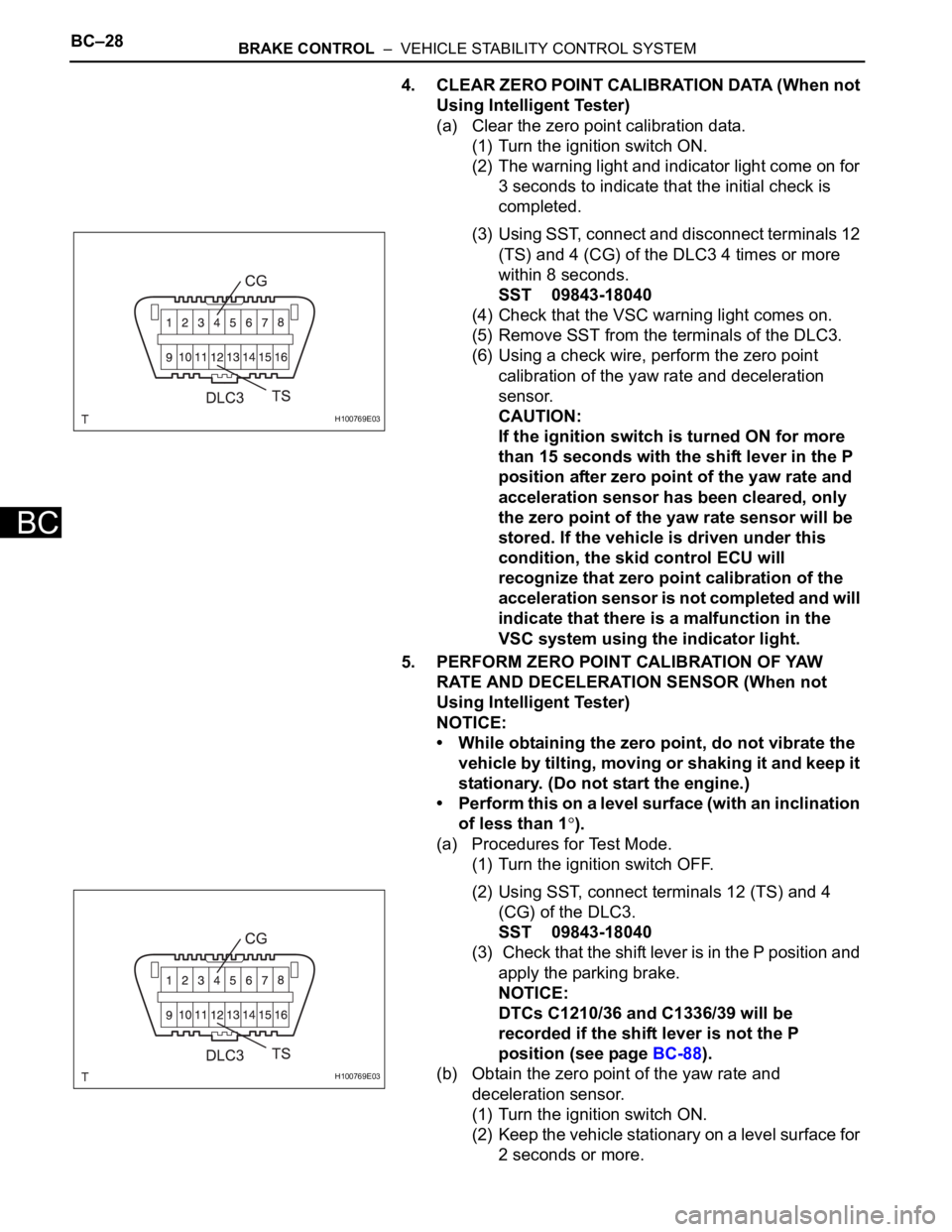
(3) Using SST, connect and disconnect terminals 12
(TS) and 4 (CG) of the DLC3 4 times or more
within 8 seconds.
SST 09843-18040
(4) Check that the VSC warning light comes on.
(5) Remove SST from the terminals of the DLC3.
(6) Using a check wire, perform the zero point
calibration of the yaw rate and deceleration
sensor.
CAUTION:
If the ignition switch is turned ON for more
than 15 seconds with the shift lever in the P
position after zero point of the yaw rate and
acceleration sensor has been cleared, only
the zero point of the yaw rate sensor will be
stored. If the vehicle is driven under this
condition, the skid control ECU will
recognize that zero point calibration of the
acceleration sensor is not completed and will
indicate that there is a malfunction in the
VSC system using the indicator light.
5. PERFORM ZERO POINT CALIBRATION OF YAW
RATE AND DECELERATION SENSOR (When not
Using Intelligent Tester)
NOTICE:
• While obtaining the zero point, do not vibrate the
vehicle by tilting, moving or shaking it and keep it
stationary. (Do not start the engine.)
• Perform this on a level surface (with an inclination
of less than 1
).
(a) Procedures for Test Mode.
(1) Turn the ignition switch OFF.
(2) Using SST, connect terminals 12 (TS) and 4
(CG) of the DLC3.
SST 09843-18040
(3) Check that the shift lever is in the P position and
apply the parking brake.
NOTICE:
DTCs C1210/36 and C1336/39 will be
recorded if the shift lever is not the P
position (see page BC-88).
(b) Obtain the zero point of the yaw rate and
deceleration sensor.
(1) Turn the ignition switch ON.
(2) Keep the vehicle stationary on a level surface for
2 seconds or more.
H100769E03
H100769E03
Page 1534 of 2000
BRAKE CONTROL – VEHICLE STABILITY CONTROL SYSTEMBC–31
BC
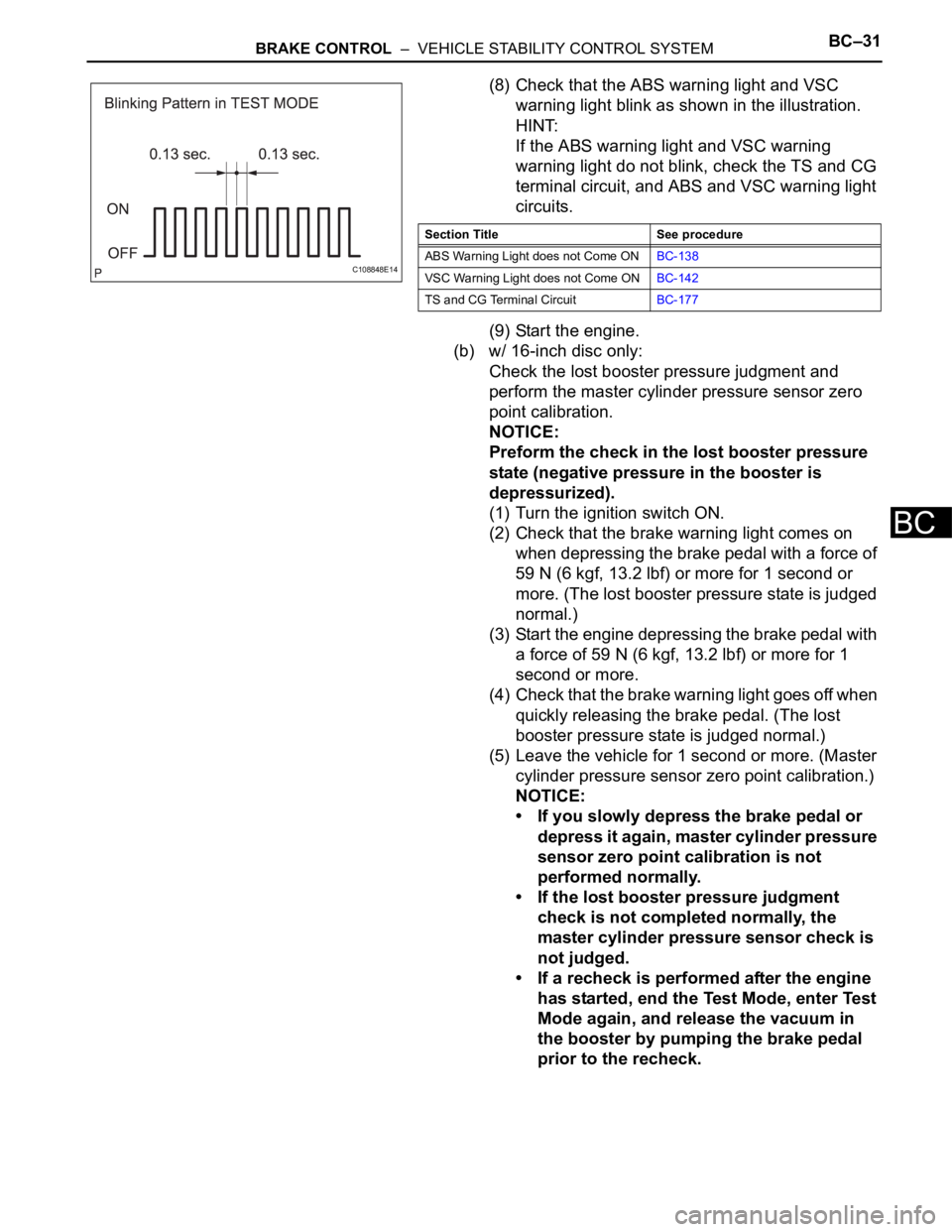
(8) Check that the ABS warning light and VSC
warning light blink as shown in the illustration.
HINT:
If the ABS warning light and VSC warning
warning light do not blink, check the TS and CG
terminal circuit, and ABS and VSC warning light
circuits.
(9) Start the engine.
(b) w/ 16-inch disc only:
Check the lost booster pressure judgment and
perform the master cylinder pressure sensor zero
point calibration.
NOTICE:
Preform the check in the lost booster pressure
state (negative pressure in the booster is
depressurized).
(1) Turn the ignition switch ON.
(2) Check that the brake warning light comes on
when depressing the brake pedal with a force of
59 N (6 kgf, 13.2 lbf) or more for 1 second or
more. (The lost booster pressure state is judged
normal.)
(3) Start the engine depressing the brake pedal with
a force of 59 N (6 kgf, 13.2 lbf) or more for 1
second or more.
(4) Check that the brake warning light goes off when
quickly releasing the brake pedal. (The lost
booster pressure state is judged normal.)
(5) Leave the vehicle for 1 second or more. (Master
cylinder pressure sensor zero point calibration.)
NOTICE:
• If you slowly depress the brake pedal or
depress it again, master cylinder pressure
sensor zero point calibration is not
performed normally.
• If the lost booster pressure judgment
check is not completed normally, the
master cylinder pressure sensor check is
not judged.
• If a recheck is performed after the engine
has started, end the Test Mode, enter Test
Mode again, and release the vacuum in
the booster by pumping the brake pedal
prior to the recheck.
C108848E14
Section Title See procedure
ABS Warning Light does not Come ONBC-138
VSC Warning Light does not Come ONBC-142
TS and CG Terminal CircuitBC-177
Page 1538 of 2000
BRAKE CONTROL – VEHICLE STABILITY CONTROL SYSTEMBC–35
BC
HINT:
See the list of the DTCs (refer to "DTC OF TEST
MODE FUNCTION (SIGNAL CHECK)" below).
2. CHECK SENSOR SIGNAL BY TEST MODE (When not
Using Intelligent Tester)
(a) Procedures for test mode:
(1) Turn the ignition switch OFF.
(2) Check that the steering wheel is in the centered
position.
(3) Check that the shift lever is in the P position and
apply the parking brake.
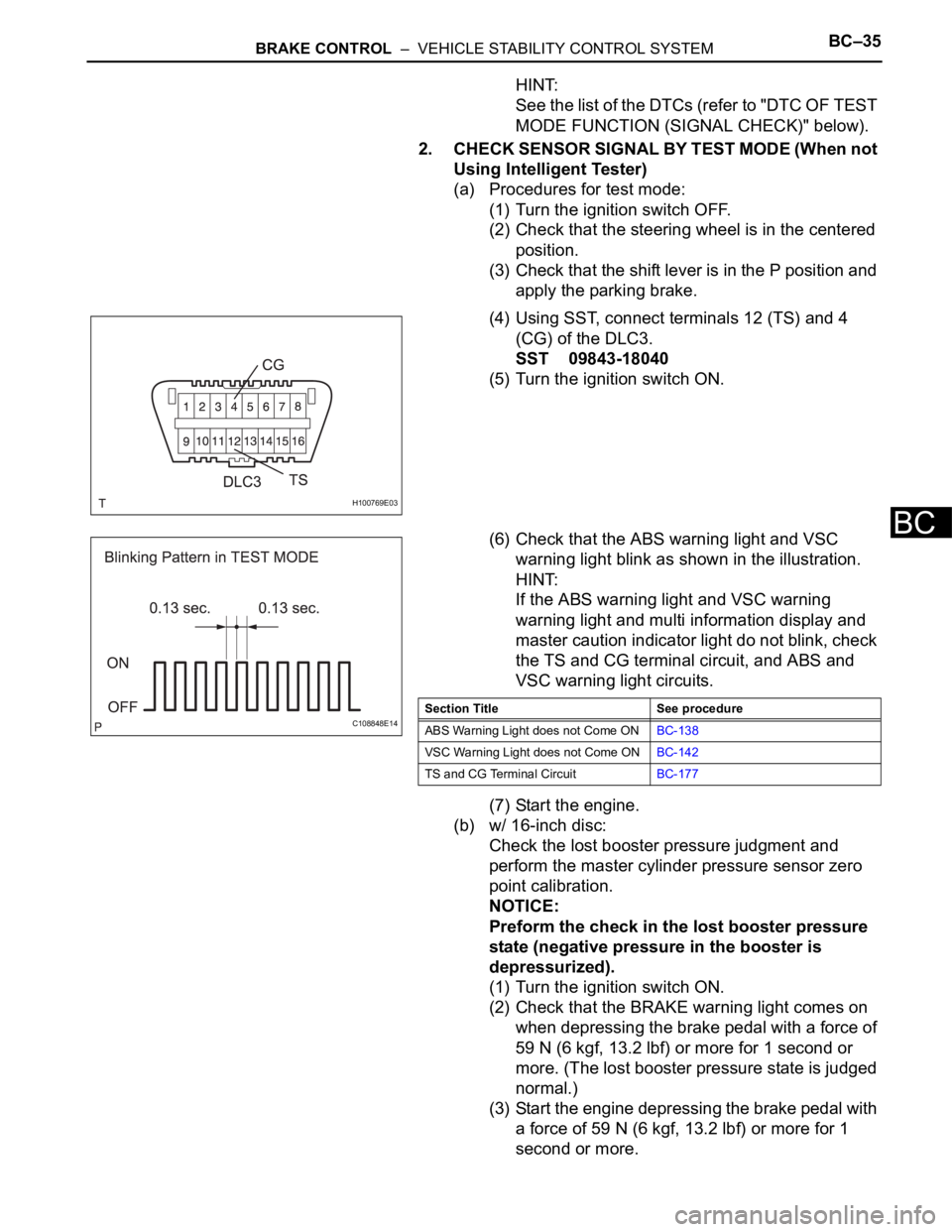
(4) Using SST, connect terminals 12 (TS) and 4
(CG) of the DLC3.
SST 09843-18040
(5) Turn the ignition switch ON.
(6) Check that the ABS warning light and VSC
warning light blink as shown in the illustration.
HINT:
If the ABS warning light and VSC warning
warning light and multi information display and
master caution indicator light do not blink, check
the TS and CG terminal circuit, and ABS and
VSC warning light circuits.
(7) Start the engine.
(b) w/ 16-inch disc:
Check the lost booster pressure judgment and
perform the master cylinder pressure sensor zero
point calibration.
NOTICE:
Preform the check in the lost booster pressure
state (negative pressure in the booster is
depressurized).
(1) Turn the ignition switch ON.
(2) Check that the BRAKE warning light comes on
when depressing the brake pedal with a force of
59 N (6 kgf, 13.2 lbf) or more for 1 second or
more. (The lost booster pressure state is judged
normal.)
(3) Start the engine depressing the brake pedal with
a force of 59 N (6 kgf, 13.2 lbf) or more for 1
second or more.
H100769E03
C108848E14Section Title See procedure
ABS Warning Light does not Come ONBC-138
VSC Warning Light does not Come ONBC-142
TS and CG Terminal CircuitBC-177
Page 1539 of 2000
BC–36BRAKE CONTROL – VEHICLE STABILITY CONTROL SYSTEM
BC
(4) Check that the brake warning light goes off when
quickly releasing the brake pedal. (The lost
booster pressure state is judged normal.)
(5) Leave the vehicle for 1 second or more. (Master
cylinder pressure sensor zero point calibration.)
NOTICE:
• If you slowly depress the brake pedal or
depress it again, master cylinder pressure
sensor zero point calibration is not
performed normally.
• If the lost booster pressure judgment
check is not completed normally, the
master cylinder pressure sensor check is
not judged.
• If a recheck is performed after the engine
has started, end the Test Mode, enter Test
Mode again, and release the vacuum in
the booster by pumping the brake pedal
prior to the recheck.
(c) Check the deceleration sensor.
(1) Keep the vehicle stationary on a level surface for
1 second or more.
HINT:
The deceleration sensor check can be
performed together with the following master
cylinder pressure sensor check.
(d) Check the master cylinder pressure sensor.
(1) Leave the vehicle in a stationary condition and
release the brake pedal for 1 second or more,
and quickly depress the brake pedal with a force
of 98 N (10 kgf, 22 lbf) or more for 1 second.
Check that the ABS warning light remains
illuminated for 3 seconds.
HINT:
• Ensure that the ABS warning light comes on.
• While the ABS warning light remains
illuminated, continue depressing the brake
pedal with a force of 98 N (10 kgf, 22 lbf) or
more.
• The ABS warning light comes on for 3
seconds every time the brake pedal operation
above is performed.
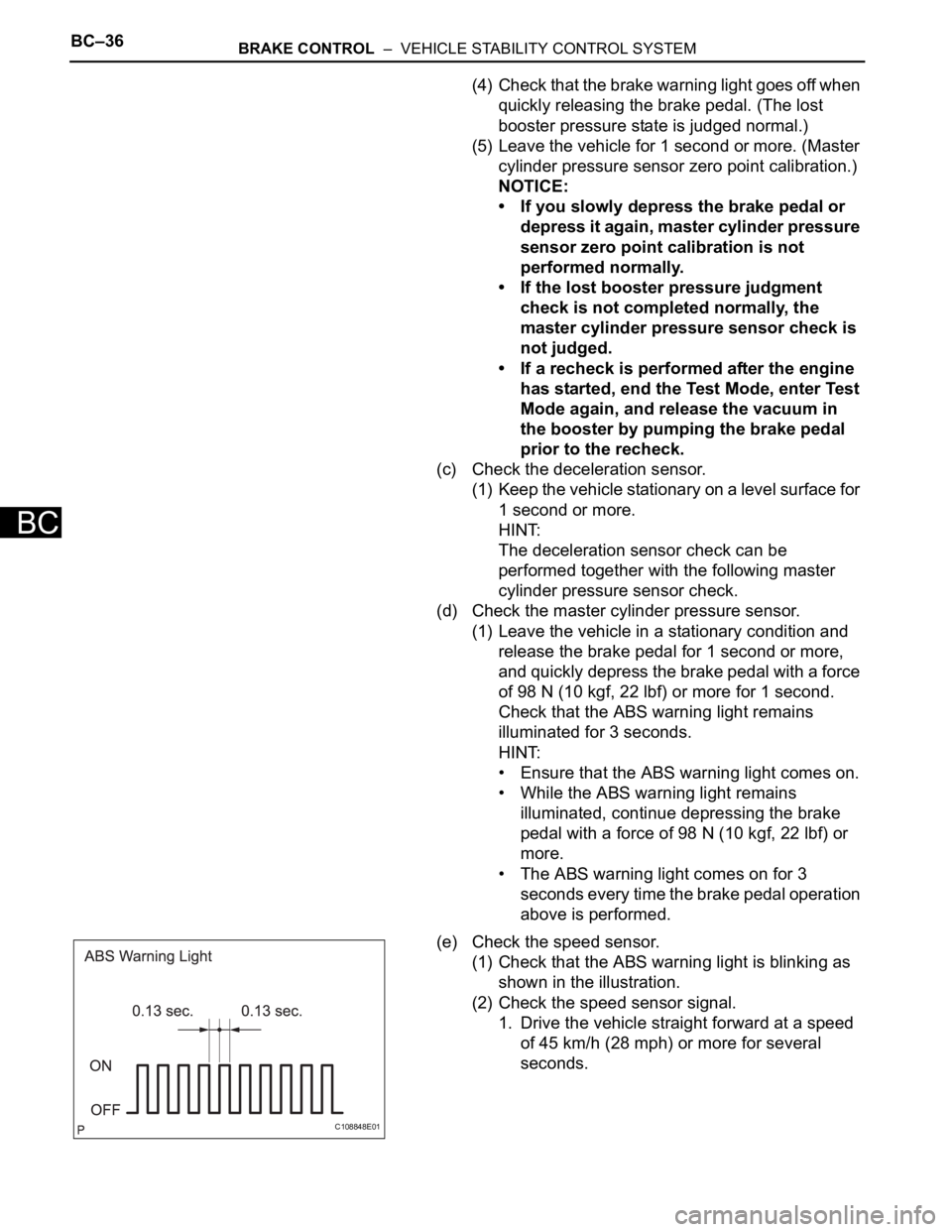
(e) Check the speed sensor.
(1) Check that the ABS warning light is blinking as
shown in the illustration.
(2) Check the speed sensor signal.
1. Drive the vehicle straight forward at a speed
of 45 km/h (28 mph) or more for several
seconds.
C108848E01
Page 1569 of 2000
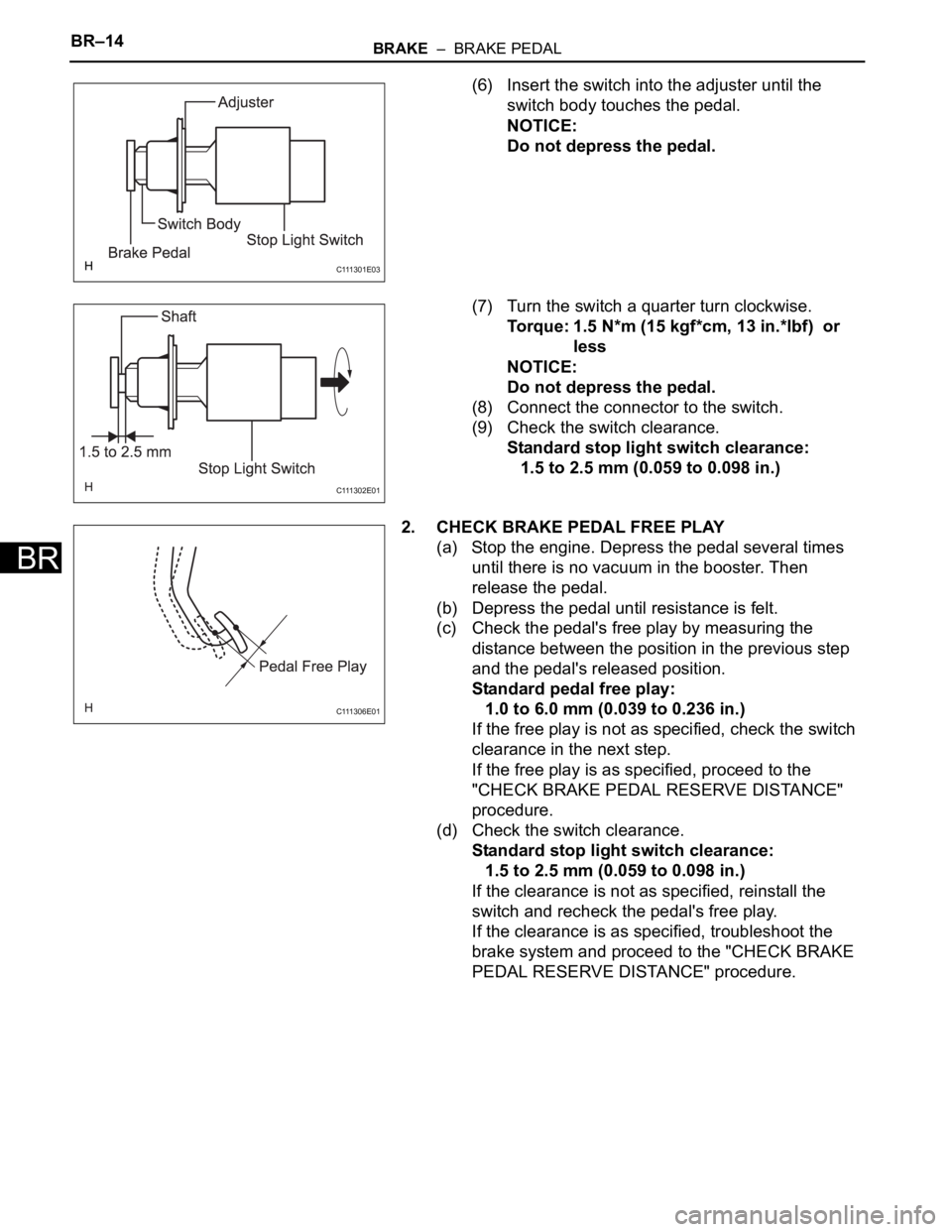
BR–14BRAKE – BRAKE PEDAL
BR
(6) Insert the switch into the adjuster until the
switch body touches the pedal.
NOTICE:
Do not depress the pedal.
(7) Turn the switch a quarter turn clockwise.
Torque: 1.5 N*m (15 kgf*cm, 13 in.*lbf) or
less
NOTICE:
Do not depress the pedal.
(8) Connect the connector to the switch.
(9) Check the switch clearance.
Standard stop light switch clearance:
1.5 to 2.5 mm (0.059 to 0.098 in.)
2. CHECK BRAKE PEDAL FREE PLAY
(a) Stop the engine. Depress the pedal several times
until there is no vacuum in the booster. Then
release the pedal.
(b) Depress the pedal until resistance is felt.
(c) Check the pedal's free play by measuring the
distance between the position in the previous step
and the pedal's released position.
Standard pedal free play:
1.0 to 6.0 mm (0.039 to 0.236 in.)
If the free play is not as specified, check the switch
clearance in the next step.
If the free play is as specified, proceed to the
"CHECK BRAKE PEDAL RESERVE DISTANCE"
procedure.
(d) Check the switch clearance.
Standard stop light switch clearance:
1.5 to 2.5 mm (0.059 to 0.098 in.)
If the clearance is not as specified, reinstall the
switch and recheck the pedal's free play.
If the clearance is as specified, troubleshoot the
brake system and proceed to the "CHECK BRAKE
PEDAL RESERVE DISTANCE" procedure.
C 111 3 0 1 E 0 3
C 111 3 0 2 E 0 1
C 111 3 0 6 E 0 1
Page 1570 of 2000
BRAKE – BRAKE PEDALBR–15
BR
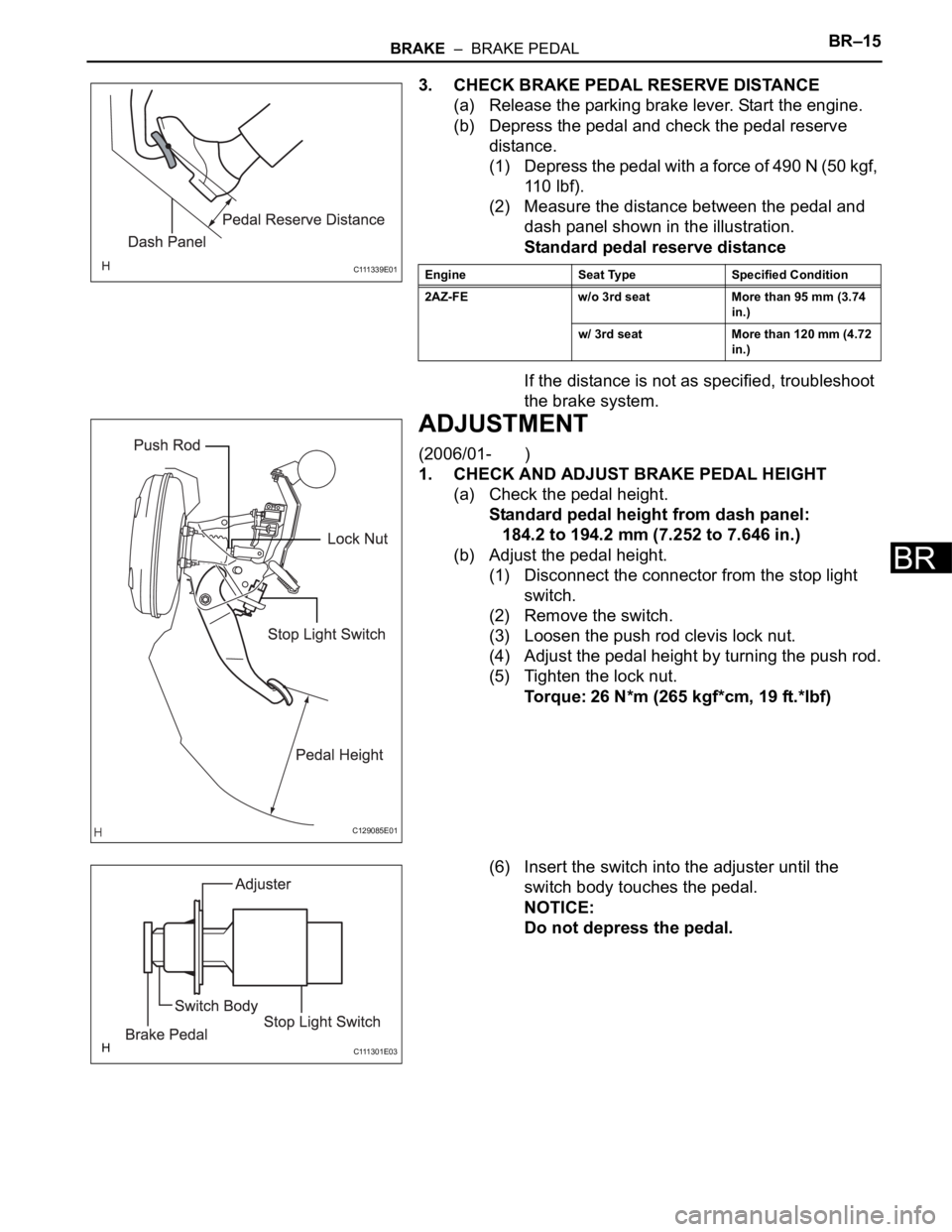
3. CHECK BRAKE PEDAL RESERVE DISTANCE
(a) Release the parking brake lever. Start the engine.
(b) Depress the pedal and check the pedal reserve
distance.
(1) Depress the pedal with a force of 490 N (50 kgf,
11 0 l b f ) .
(2) Measure the distance between the pedal and
dash panel shown in the illustration.
Standard pedal reserve distance
If the distance is not as specified, troubleshoot
the brake system.
ADJUSTMENT
(2006/01- )
1. CHECK AND ADJUST BRAKE PEDAL HEIGHT
(a) Check the pedal height.
Standard pedal height from dash panel:
184.2 to 194.2 mm (7.252 to 7.646 in.)
(b) Adjust the pedal height.
(1) Disconnect the connector from the stop light
switch.
(2) Remove the switch.
(3) Loosen the push rod clevis lock nut.
(4) Adjust the pedal height by turning the push rod.
(5) Tighten the lock nut.
Torque: 26 N*m (265 kgf*cm, 19 ft.*lbf)
(6) Insert the switch into the adjuster until the
switch body touches the pedal.
NOTICE:
Do not depress the pedal.
C 111 3 3 9 E 0 1Engine Seat Type Specified Condition
2AZ-FE w/o 3rd seat More than 95 mm (3.74
in.)
w/ 3rd seat More than 120 mm (4.72
in.)
C129085E01
C 111 3 0 1 E 0 3
Page 1571 of 2000
BR–16BRAKE – BRAKE PEDAL
BR
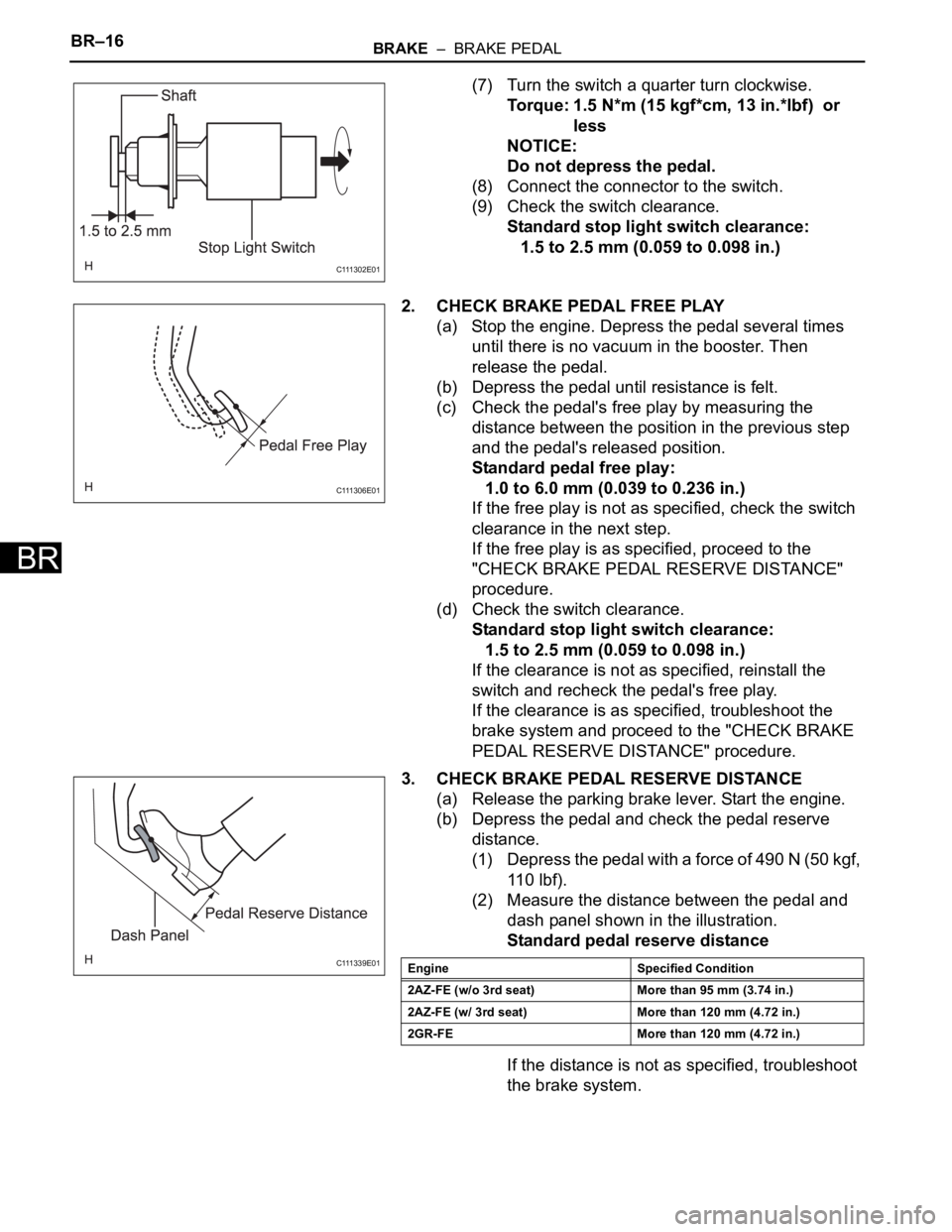
(7) Turn the switch a quarter turn clockwise.
Torque: 1.5 N*m (15 kgf*cm, 13 in.*lbf) or
less
NOTICE:
Do not depress the pedal.
(8) Connect the connector to the switch.
(9) Check the switch clearance.
Standard stop light switch clearance:
1.5 to 2.5 mm (0.059 to 0.098 in.)
2. CHECK BRAKE PEDAL FREE PLAY
(a) Stop the engine. Depress the pedal several times
until there is no vacuum in the booster. Then
release the pedal.
(b) Depress the pedal until resistance is felt.
(c) Check the pedal's free play by measuring the
distance between the position in the previous step
and the pedal's released position.
Standard pedal free play:
1.0 to 6.0 mm (0.039 to 0.236 in.)
If the free play is not as specified, check the switch
clearance in the next step.
If the free play is as specified, proceed to the
"CHECK BRAKE PEDAL RESERVE DISTANCE"
procedure.
(d) Check the switch clearance.
Standard stop light switch clearance:
1.5 to 2.5 mm (0.059 to 0.098 in.)
If the clearance is not as specified, reinstall the
switch and recheck the pedal's free play.
If the clearance is as specified, troubleshoot the
brake system and proceed to the "CHECK BRAKE
PEDAL RESERVE DISTANCE" procedure.
3. CHECK BRAKE PEDAL RESERVE DISTANCE
(a) Release the parking brake lever. Start the engine.
(b) Depress the pedal and check the pedal reserve
distance.
(1) Depress the pedal with a force of 490 N (50 kgf,
11 0 l b f ) .
(2) Measure the distance between the pedal and
dash panel shown in the illustration.
Standard pedal reserve distance
If the distance is not as specified, troubleshoot
the brake system.
C 111 3 0 2 E 0 1
C 111 3 0 6 E 0 1
C 111 3 3 9 E 0 1Engine Specified Condition
2AZ-FE (w/o 3rd seat) More than 95 mm (3.74 in.)
2AZ-FE (w/ 3rd seat) More than 120 mm (4.72 in.)
2GR-FE More than 120 mm (4.72 in.)
Page 1654 of 2000
AC–26AIR CONDITIONING – AIR CONDITIONING SYSTEM (for Automatic Air Conditioning Sys-
tem)
AC
TERMINALS OF ECU
(2005/11-2006/01)
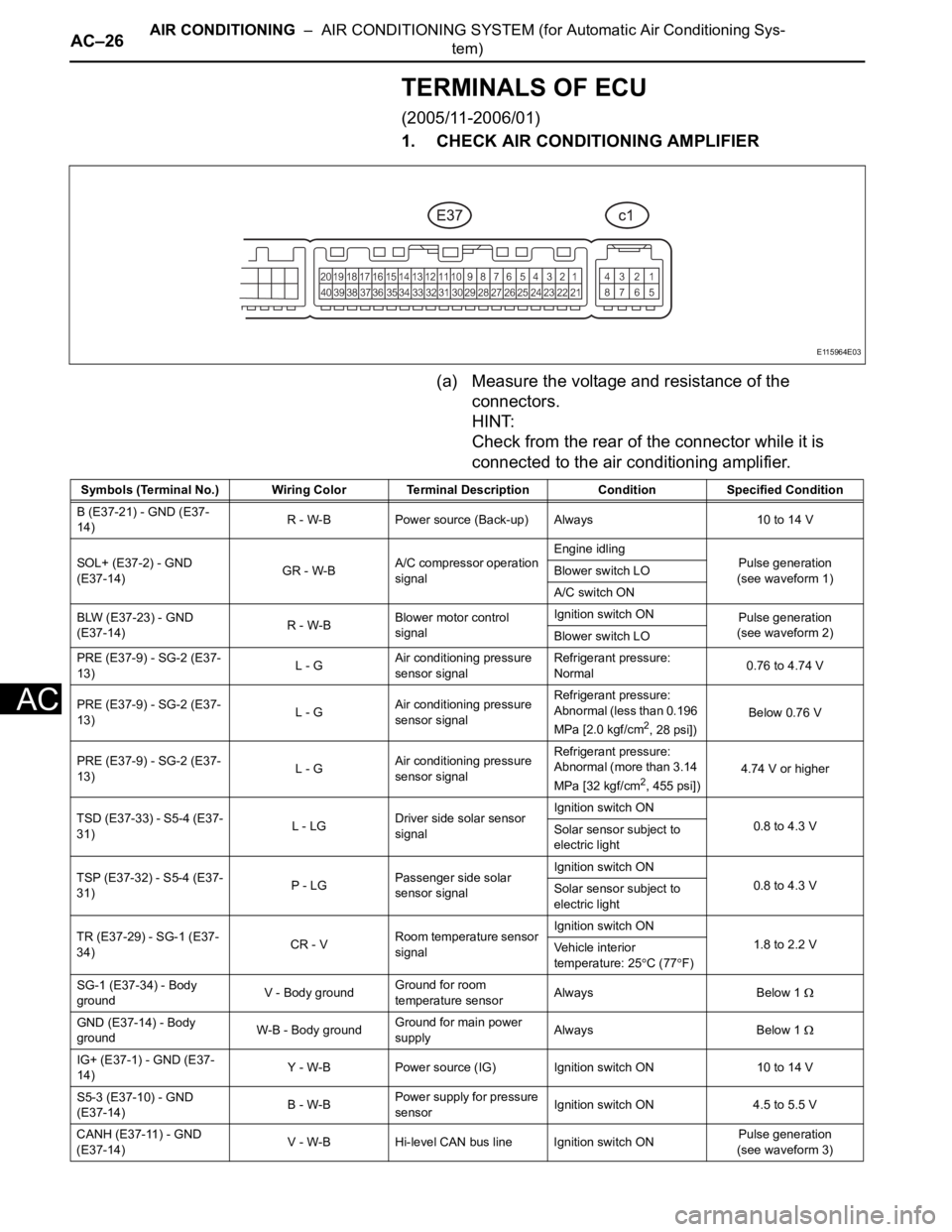
1. CHECK AIR CONDITIONING AMPLIFIER
(a) Measure the voltage and resistance of the
connectors.
HINT:
Check from the rear of the connector while it is
connected to the air conditioning amplifier.
E115964E03
Symbols (Terminal No.) Wiring Color Terminal Description ConditionSpecified Condition
B (E37-21) - GND (E37-
14)R - W-B Power source (Back-up) Always 10 to 14 V
SOL+ (E37-2) - GND
(E37-14)GR - W-BA/C compressor operation
signalEngine idling
Pulse generation
(see waveform 1) Blower switch LO
A/C switch ON
BLW (E37-23) - GND
(E37-14)R - W-BBlower motor control
signalIgnition switch ON
Pulse generation
(see waveform 2)
Blower switch LO
PRE (E37-9) - SG-2 (E37-
13)L - GAir conditioning pressure
sensor signalRefrigerant pressure:
Normal0.76 to 4.74 V
PRE (E37-9) - SG-2 (E37-
13)L - GAir conditioning pressure
sensor signalRefrigerant pressure:
Abnormal (less than 0.196
MPa [2.0 kgf/cm
2, 28 psi]) Below 0.76 V
PRE (E37-9) - SG-2 (E37-
13)L - GAir conditioning pressure
sensor signalRefrigerant pressure:
Abnormal (more than 3.14
MPa [32 kgf/cm
2, 455 psi])4.74 V or higher
TSD (E37-33) - S5-4 (E37-
31)L - LGDriver side solar sensor
signalIgnition switch ON
0.8 to 4.3 V
Solar sensor subject to
electric light
TSP (E37-32) - S5-4 (E37-
31)P - LGPassenger side solar
sensor signalIgnition switch ON
0.8 to 4.3 V
Solar sensor subject to
electric light
TR (E37-29) - SG-1 (E37-
34)CR - VRoom temperature sensor
signalIgnition switch ON
1.8 to 2.2 V
Vehicle interior
temperature: 25
C (77F)
SG-1 (E37-34) - Body
groundV - Body groundGround for room
temperature sensorAlways Below 1
GND (E37-14) - Body
groundW-B - Body groundGround for main power
supplyAlways Below 1
IG+ (E37-1) - GND (E37-
14)Y - W-B Power source (IG) Ignition switch ON 10 to 14 V
S5-3 (E37-10) - GND
(E37-14)B - W-BPower supply for pressure
sensorIgnition switch ON 4.5 to 5.5 V
CANH (E37-11) - GND
(E37-14)V - W-B Hi-level CAN bus line Ignition switch ONPulse generation
(see waveform 3)
Page 1657 of 2000
AIR CONDITIONING – AIR CONDITIONING SYSTEM (for Automatic Air Conditioning Sys-
tem)AC–29
AC
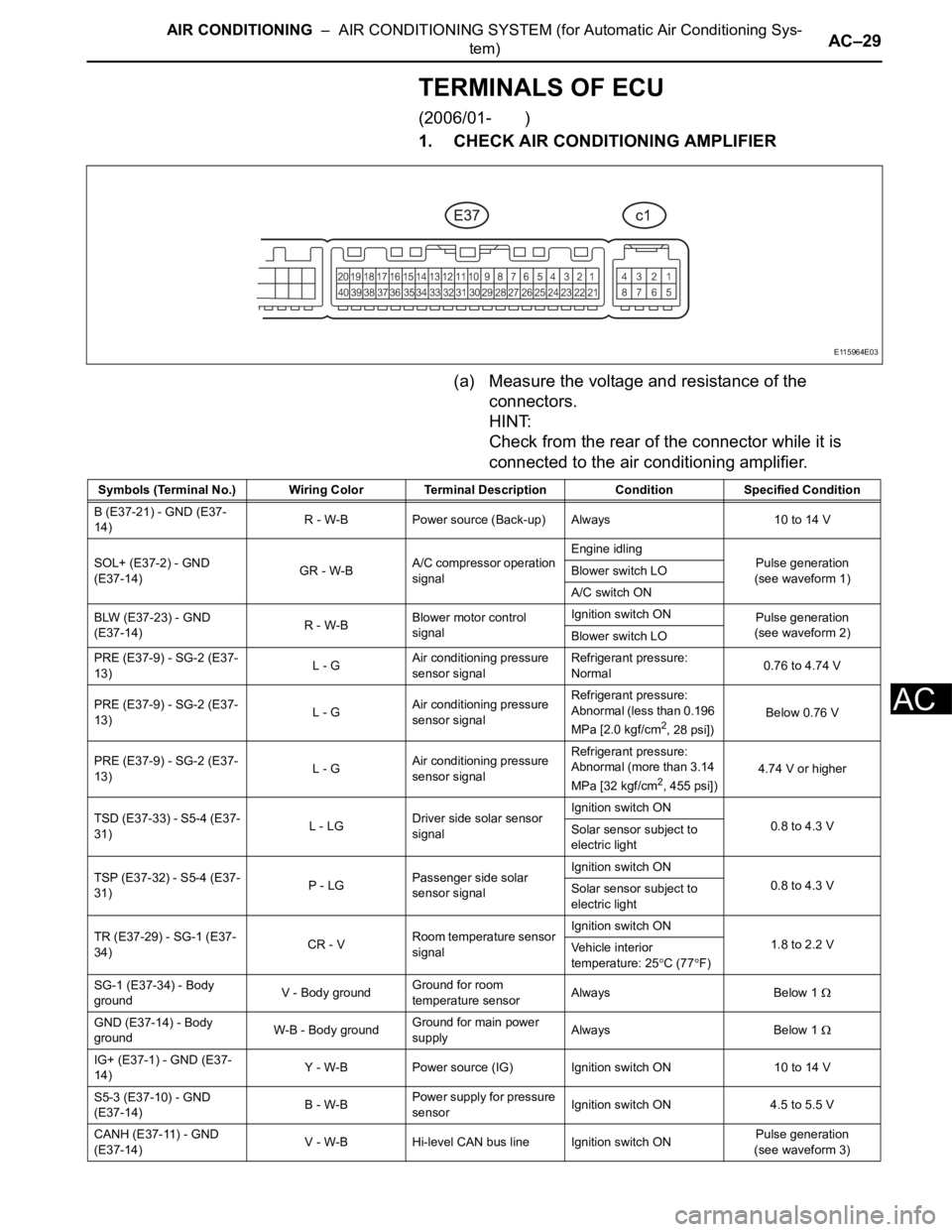
TERMINALS OF ECU
(2006/01- )
1. CHECK AIR CONDITIONING AMPLIFIER
(a) Measure the voltage and resistance of the
connectors.
HINT:
Check from the rear of the connector while it is
connected to the air conditioning amplifier.
E115964E03
Symbols (Terminal No.) Wiring Color Terminal Description ConditionSpecified Condition
B (E37-21) - GND (E37-
14)R - W-B Power source (Back-up) Always 10 to 14 V
SOL+ (E37-2) - GND
(E37-14)GR - W-BA/C compressor operation
signalEngine idling
Pulse generation
(see waveform 1) Blower switch LO
A/C switch ON
BLW (E37-23) - GND
(E37-14)R - W-BBlower motor control
signalIgnition switch ON
Pulse generation
(see waveform 2)
Blower switch LO
PRE (E37-9) - SG-2 (E37-
13)L - GAir conditioning pressure
sensor signalRefrigerant pressure:
Normal0.76 to 4.74 V
PRE (E37-9) - SG-2 (E37-
13)L - GAir conditioning pressure
sensor signalRefrigerant pressure:
Abnormal (less than 0.196
MPa [2.0 kgf/cm
2, 28 psi]) Below 0.76 V
PRE (E37-9) - SG-2 (E37-
13)L - GAir conditioning pressure
sensor signalRefrigerant pressure:
Abnormal (more than 3.14
MPa [32 kgf/cm
2, 455 psi])4.74 V or higher
TSD (E37-33) - S5-4 (E37-
31)L - LGDriver side solar sensor
signalIgnition switch ON
0.8 to 4.3 V
Solar sensor subject to
electric light
TSP (E37-32) - S5-4 (E37-
31)P - LGPassenger side solar
sensor signalIgnition switch ON
0.8 to 4.3 V
Solar sensor subject to
electric light
TR (E37-29) - SG-1 (E37-
34)CR - VRoom temperature sensor
signalIgnition switch ON
1.8 to 2.2 V
Vehicle interior
temperature: 25
C (77F)
SG-1 (E37-34) - Body
groundV - Body groundGround for room
temperature sensorAlways Below 1
GND (E37-14) - Body
groundW-B - Body groundGround for main power
supplyAlways Below 1
IG+ (E37-1) - GND (E37-
14)Y - W-B Power source (IG) Ignition switch ON 10 to 14 V
S5-3 (E37-10) - GND
(E37-14)B - W-BPower supply for pressure
sensorIgnition switch ON 4.5 to 5.5 V
CANH (E37-11) - GND
(E37-14)V - W-B Hi-level CAN bus line Ignition switch ONPulse generation
(see waveform 3)
Page 1744 of 2000

SB–6SEAT BELT – SEAT BELT WARNING SYSTEM
SB
OPERATION CHECK
1. INSPECT DRIVER SIDE SEAT BELT WARNING LIGHT
(a) Turn the ignition switch ON.
(b) When the driver seat belt is not fastened, check that
the driver seat belt warning light on the combination
meter blinks.
(c) When the driver seat belt is fastened, check that the
driver seat belt warning light on the combination
meter is off.
2. INSPECT PASSENGER SIDE SEAT BELT WARNING
LIGHT (For Automatic Air Conditioning System)
(a) Turn the ignition switch ON.
(b) When the front passenger seat belt is not fastened
with the passenger seat occupied, check that the
front passenger seat belt warning light on the heater
control panel display blinks.
(c) When the front passenger seat belt is fastened with
the passenger seat occupied, check that the front
passenger seat belt warning light on the heater
control panel display is off.
3. REMOVE PASSENGER SIDE SEAT BELT WARNING
LIGHT (For Manual Air Conditioning System)
(a) Turn the ignition switch ON.
(b) When the front passenger seat belt is not fastened
with the passenger seat occupied, check that the
front passenger seat belt warning light on the clock
panel blinks.
(c) When the front passenger seat belt is fastened with
the passenger seat occupied, check that the front
passenger seat belt warning light on the clock panel
is off.
4. INSPECT SEAT BELT WARNING BUZZER
HINT:
If the buzzer does not sound, the buzzer cancel setting
may be set to ON.
(a) Turn the ignition switch ON.
(b) When the vehicle is driven at approximately 20 km/h
(12.4 mph) or more while the driver or front
passenger seat belt is not fastened, check that the
buzzer in the combination meter sounds at 1.2
second intervals for 30 seconds.
(c) 30 seconds after the buzzer has first sounded,
check that the buzzer sounds at 0.4 second
intervals for 90 seconds.
(d) 120 seconds after the buzzer has first sounded,
check that the buzzer stops.
(e) After the buzzer has stopped, turn the ignition
switch off and then start the engine again. Drive the
vehicle at approximately 25 km/h (16 mph) or more
while the driver or front passenger seat belt is not
fastened, and then check that the buzzer sounds
again.