check engine light TOYOTA RAV4 2006 Service Owner's Manual
[x] Cancel search | Manufacturer: TOYOTA, Model Year: 2006, Model line: RAV4, Model: TOYOTA RAV4 2006Pages: 2000, PDF Size: 45.84 MB
Page 749 of 2000
EM–1122GR-FE ENGINE MECHANICAL – ENGINE UNIT
EM
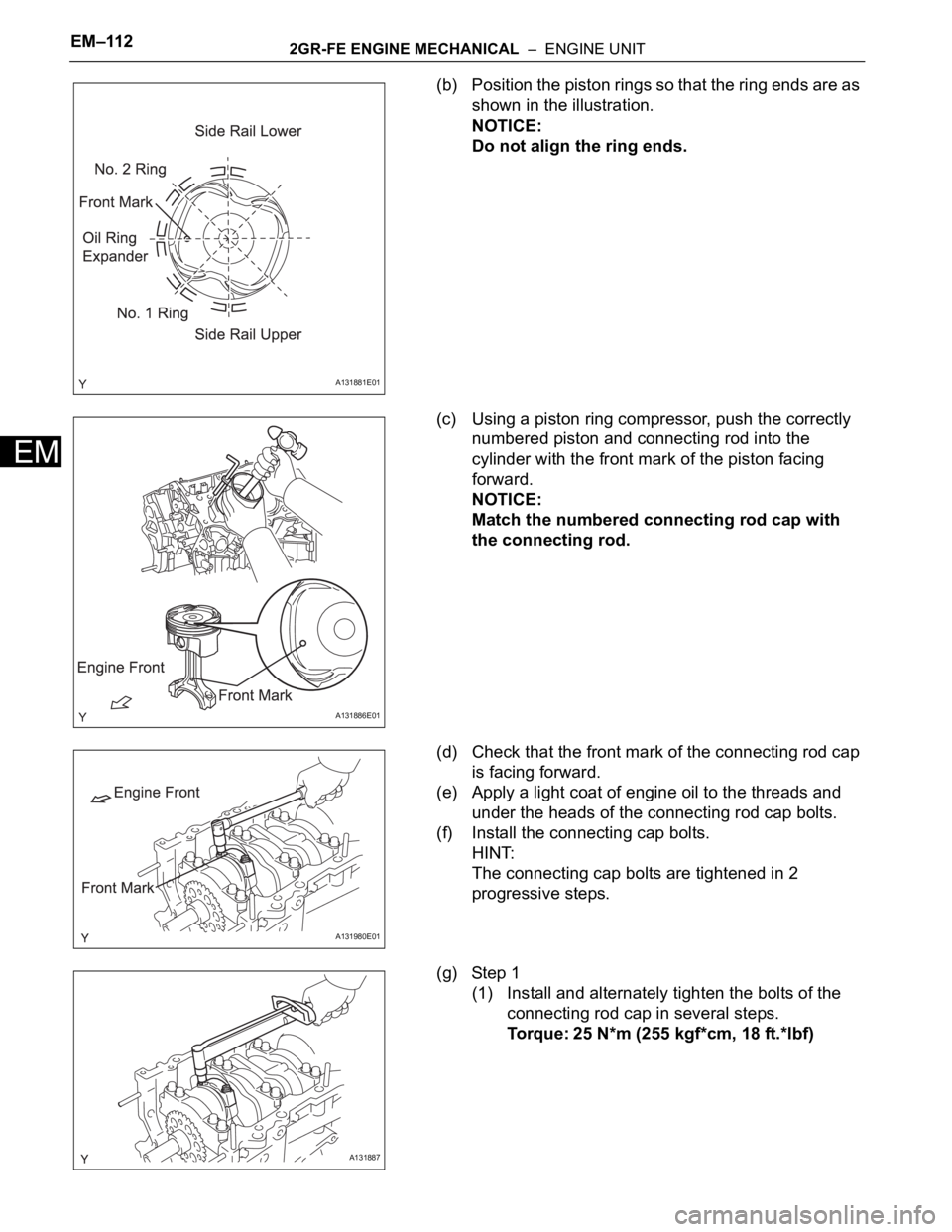
(b) Position the piston rings so that the ring ends are as
shown in the illustration.
NOTICE:
Do not align the ring ends.
(c) Using a piston ring compressor, push the correctly
numbered piston and connecting rod into the
cylinder with the front mark of the piston facing
forward.
NOTICE:
Match the numbered connecting rod cap with
the connecting rod.
(d) Check that the front mark of the connecting rod cap
is facing forward.
(e) Apply a light coat of engine oil to the threads and
under the heads of the connecting rod cap bolts.
(f) Install the connecting cap bolts.
HINT:
The connecting cap bolts are tightened in 2
progressive steps.
(g) Step 1
(1) Install and alternately tighten the bolts of the
connecting rod cap in several steps.
Torque: 25 N*m (255 kgf*cm, 18 ft.*lbf)
A131881E01
A131886E01
A131980E01
A131887
Page 753 of 2000
EM–1162GR-FE ENGINE MECHANICAL – ENGINE UNIT
EM
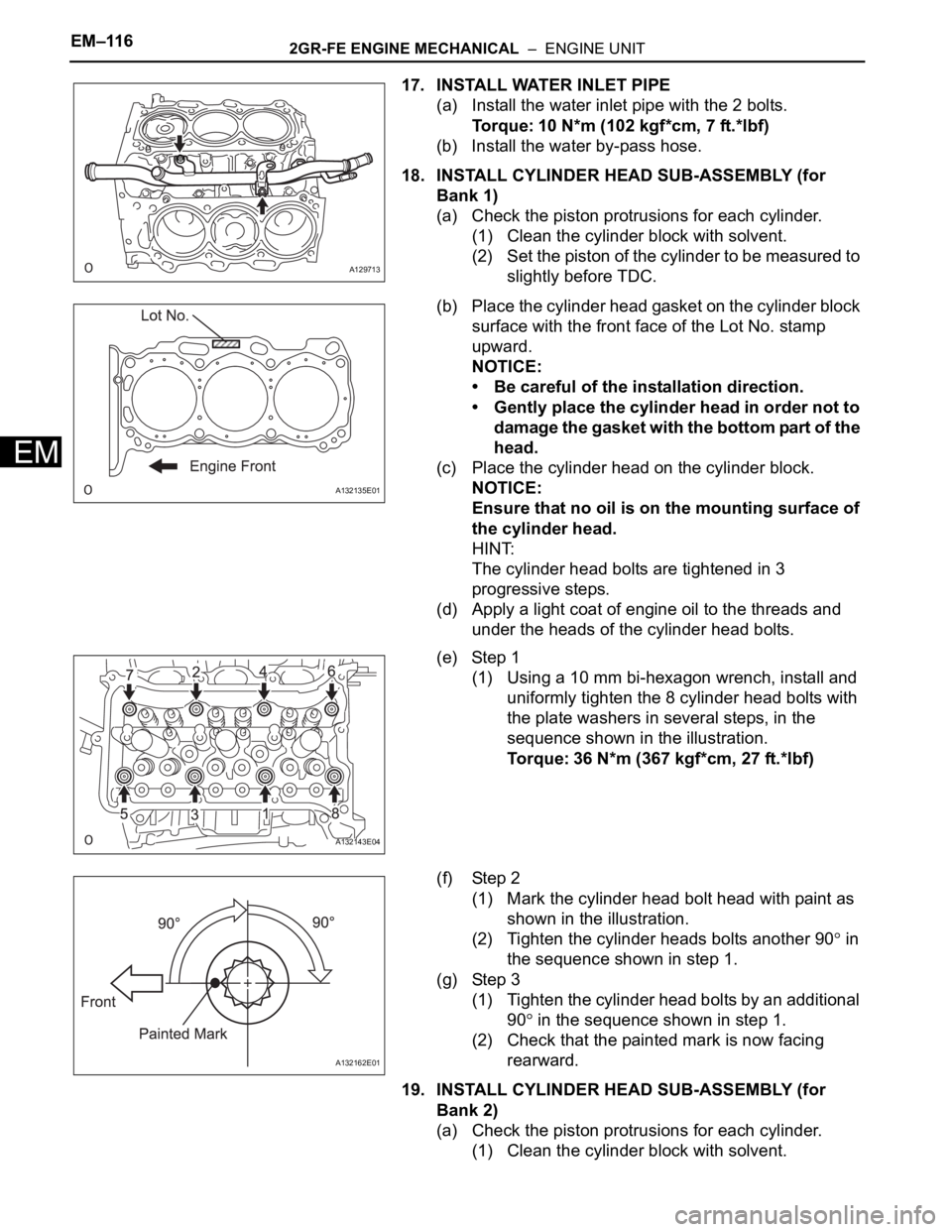
17. INSTALL WATER INLET PIPE
(a) Install the water inlet pipe with the 2 bolts.
Torque: 10 N*m (102 kgf*cm, 7 ft.*lbf)
(b) Install the water by-pass hose.
18. INSTALL CYLINDER HEAD SUB-ASSEMBLY (for
Bank 1)
(a) Check the piston protrusions for each cylinder.
(1) Clean the cylinder block with solvent.
(2) Set the piston of the cylinder to be measured to
slightly before TDC.
(b) Place the cylinder head gasket on the cylinder block
surface with the front face of the Lot No. stamp
upward.
NOTICE:
• Be careful of the installation direction.
• Gently place the cylinder head in order not to
damage the gasket with the bottom part of the
head.
(c) Place the cylinder head on the cylinder block.
NOTICE:
Ensure that no oil is on the mounting surface of
the cylinder head.
HINT:
The cylinder head bolts are tightened in 3
progressive steps.
(d) Apply a light coat of engine oil to the threads and
under the heads of the cylinder head bolts.
(e) Step 1
(1) Using a 10 mm bi-hexagon wrench, install and
uniformly tighten the 8 cylinder head bolts with
the plate washers in several steps, in the
sequence shown in the illustration.
Torque: 36 N*m (367 kgf*cm, 27 ft.*lbf)
(f) Step 2
(1) Mark the cylinder head bolt head with paint as
shown in the illustration.
(2) Tighten the cylinder heads bolts another 90
in
the sequence shown in step 1.
(g) Step 3
(1) Tighten the cylinder head bolts by an additional
90
in the sequence shown in step 1.
(2) Check that the painted mark is now facing
rearward.
19. INSTALL CYLINDER HEAD SUB-ASSEMBLY (for
Bank 2)
(a) Check the piston protrusions for each cylinder.
(1) Clean the cylinder block with solvent.
A129713
A132135E01
A132143E04
A132162E01
Page 754 of 2000
2GR-FE ENGINE MECHANICAL – ENGINE UNITEM–117
EM
(2) Set the piston of the cylinder to be measured to
slightly before TDC.
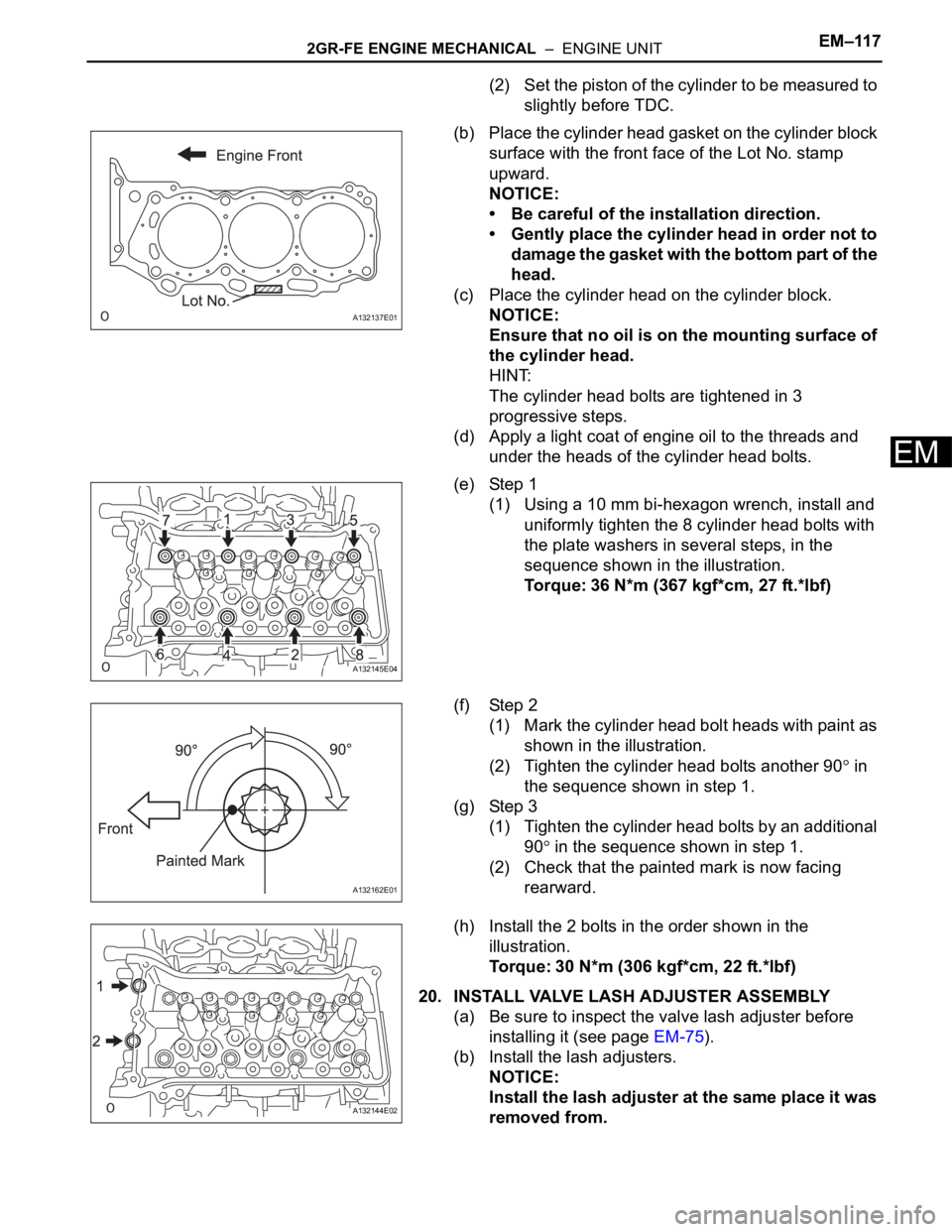
(b) Place the cylinder head gasket on the cylinder block
surface with the front face of the Lot No. stamp
upward.
NOTICE:
• Be careful of the installation direction.
• Gently place the cylinder head in order not to
dama ge the gaske t wi th t he b ottom part of t he
head.
(c) Place the cylinder head on the cylinder block.
NOTICE:
Ensure that no oil is on the mounting surface of
the cylinder head.
HINT:
The cylinder head bolts are tightened in 3
progressive steps.
(d) Apply a light coat of engine oil to the threads and
under the heads of the cylinder head bolts.
(e) Step 1
(1) Using a 10 mm bi-hexagon wrench, install and
uniformly tighten the 8 cylinder head bolts with
the plate washers in several steps, in the
sequence shown in the illustration.
Torque: 36 N*m (367 kgf*cm, 27 ft.*lbf)
(f) Step 2
(1) Mark the cylinder head bolt heads with paint as
shown in the illustration.
(2) Tighten the cylinder head bolts another 90
in
the sequence shown in step 1.
(g) Step 3
(1) Tighten the cylinder head bolts by an additional
90
in the sequence shown in step 1.
(2) Check that the painted mark is now facing
rearward.
(h) Install the 2 bolts in the order shown in the
illustration.
Torque: 30 N*m (306 kgf*cm, 22 ft.*lbf)
20. INSTALL VALVE LASH ADJUSTER ASSEMBLY
(a) Be sure to inspect the valve lash adjuster before
installing it (see page EM-75).
(b) Install the lash adjusters.
NOTICE:
Install the lash adjuster at the same place it was
removed from.
A132137E01
A132145E04
A132162E01
A132144E02
Page 783 of 2000
2AZ-FE FUEL – FUEL PRESSURE PULSATION DAMPERFU–27
FU
REMOVAL
1. DISCHARGE FUEL SYSTEM PRESSURE (See page
FU-9)
2. DISCONNECT CABLE FROM NEGATIVE BATTERY
TERMINAL
3. REMOVE NO. 1 ENGINE COVER (See page ES-410)
4. REMOVE AIR CLEANER CAP SUB-ASSEMBLY (See
page ES-411)
5. DISCONNECT FUEL MAIN TUBE (See page FU-10)
6. REMOVE FUEL PRESSURE PULSATION DAMPER
ASSEMBLY
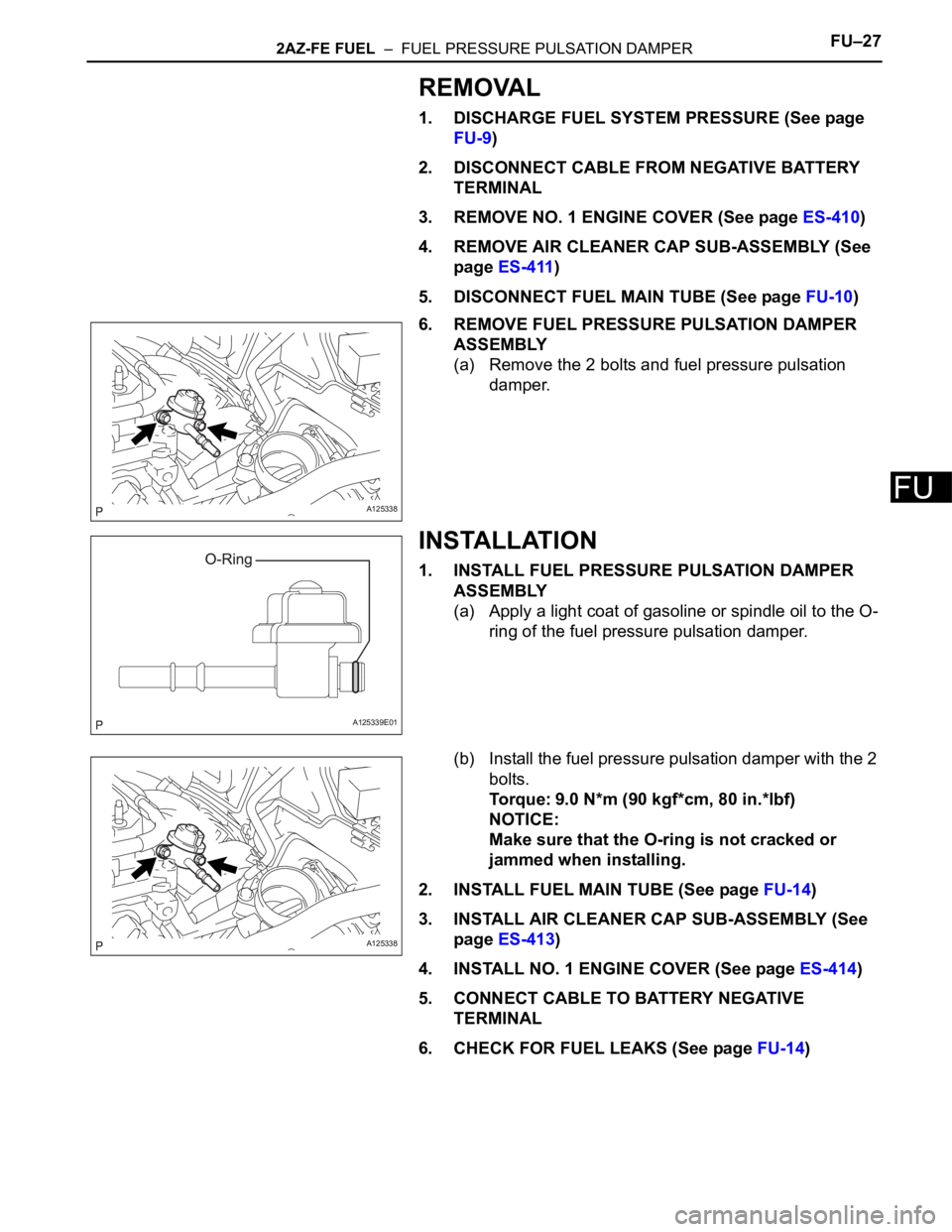
(a) Remove the 2 bolts and fuel pressure pulsation
damper.
INSTALLATION
1. INSTALL FUEL PRESSURE PULSATION DAMPER
ASSEMBLY
(a) Apply a light coat of gasoline or spindle oil to the O-
ring of the fuel pressure pulsation damper.
(b) Install the fuel pressure pulsation damper with the 2
bolts.
Torque: 9.0 N*m (90 kgf*cm, 80 in.*lbf)
NOTICE:
Make sure that the O-ring is not cracked or
jammed when installing.
2. INSTALL FUEL MAIN TUBE (See page FU-14)
3. INSTALL AIR CLEANER CAP SUB-ASSEMBLY (See
page ES-413)
4. INSTALL NO. 1 ENGINE COVER (See page ES-414)
5. CONNECT CABLE TO BATTERY NEGATIVE
TERMINAL
6. CHECK FOR FUEL LEAKS (See page FU-14)
A125338
A125339E01
A125338
Page 928 of 2000
2GR-FE CHARGING – CHARGING SYSTEMCH–5
CH
ON-VEHICLE INSPECTION
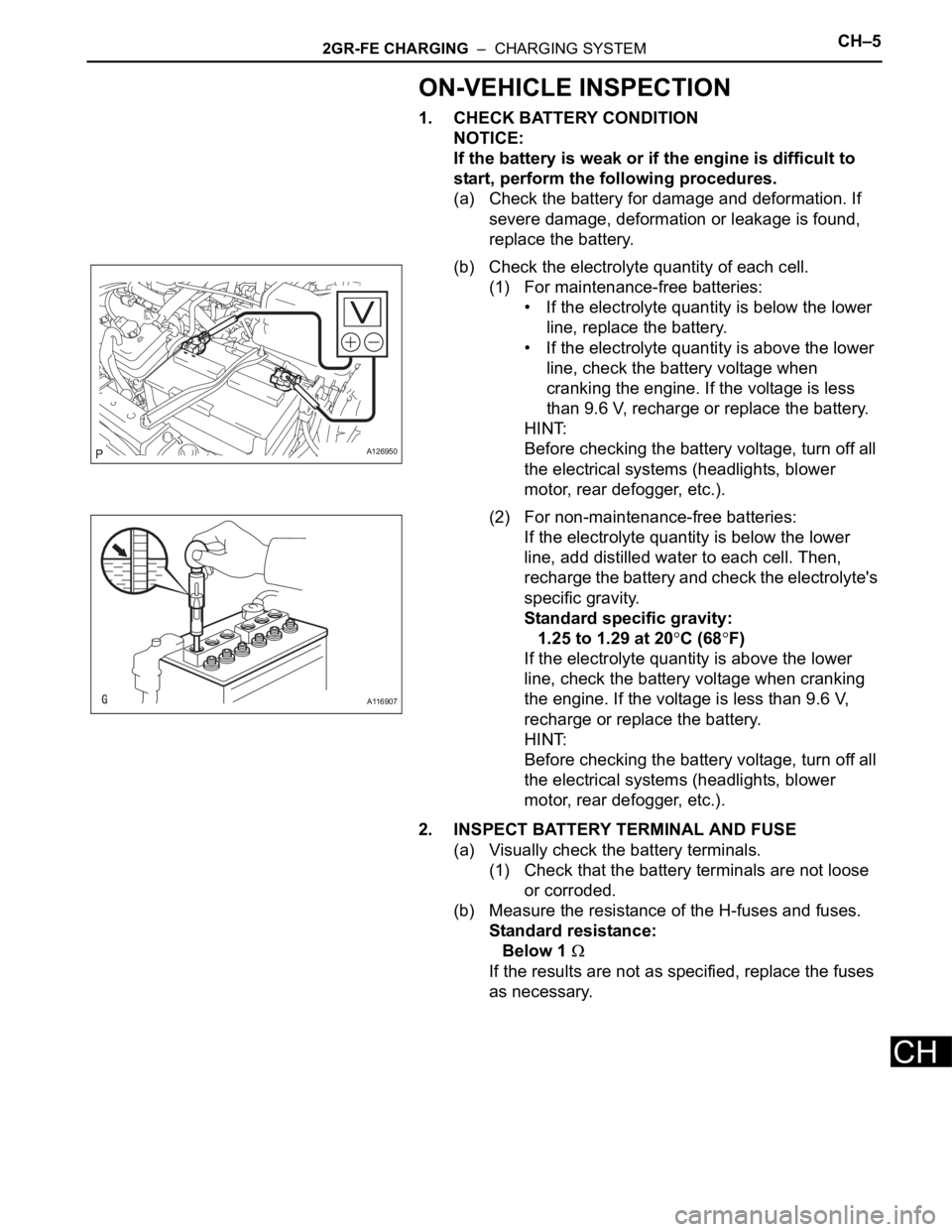
1. CHECK BATTERY CONDITION
NOTICE:
If the battery is weak or if the engine is difficult to
start, perform the following procedures.
(a) Check the battery for damage and deformation. If
severe damage, deformation or leakage is found,
replace the battery.
(b) Check the electrolyte quantity of each cell.
(1) For maintenance-free batteries:
• If the electrolyte quantity is below the lower
line, replace the battery.
• If the electrolyte quantity is above the lower
line, check the battery voltage when
cranking the engine. If the voltage is less
than 9.6 V, recharge or replace the battery.
HINT:
Before checking the battery voltage, turn off all
the electrical systems (headlights, blower
motor, rear defogger, etc.).
(2) For non-maintenance-free batteries:
If the electrolyte quantity is below the lower
line, add distilled water to each cell. Then,
recharge the battery and check the electrolyte's
specific gravity.
Standard specific gravity:
1.25 to 1.29 at 20
C (68F)
If the electrolyte quantity is above the lower
line, check the battery voltage when cranking
the engine. If the voltage is less than 9.6 V,
recharge or replace the battery.
HINT:
Before checking the battery voltage, turn off all
the electrical systems (headlights, blower
motor, rear defogger, etc.).
2. INSPECT BATTERY TERMINAL AND FUSE
(a) Visually check the battery terminals.
(1) Check that the battery terminals are not loose
or corroded.
(b) Measure the resistance of the H-fuses and fuses.
Standard resistance:
Below 1
If the results are not as specified, replace the fuses
as necessary.
A126950
A116907
Page 929 of 2000
CH–62GR-FE CHARGING – CHARGING SYSTEM
CH
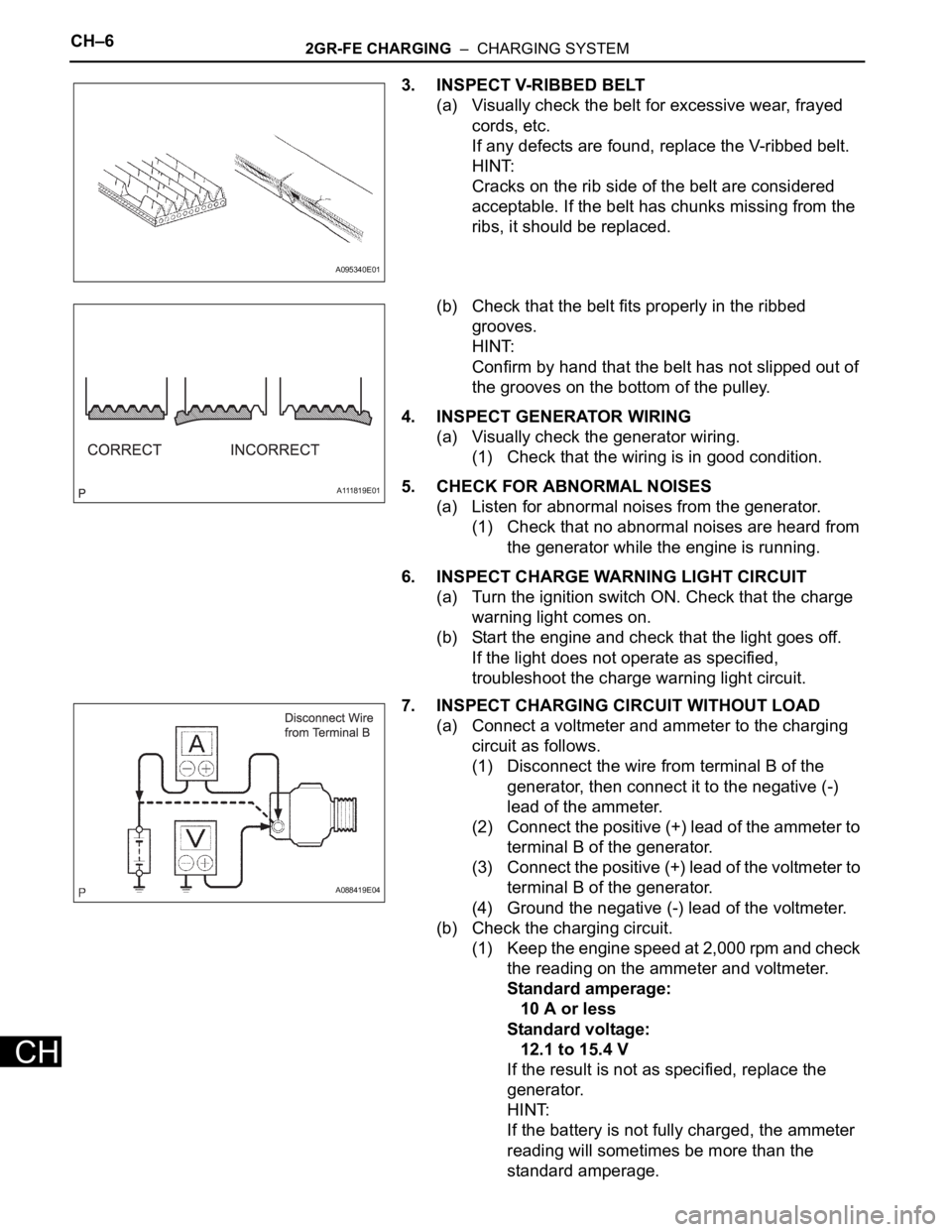
3. INSPECT V-RIBBED BELT
(a) Visually check the belt for excessive wear, frayed
cords, etc.
If any defects are found, replace the V-ribbed belt.
HINT:
Cracks on the rib side of the belt are considered
acceptable. If the belt has chunks missing from the
ribs, it should be replaced.
(b) Check that the belt fits properly in the ribbed
grooves.
HINT:
Confirm by hand that the belt has not slipped out of
the grooves on the bottom of the pulley.
4. INSPECT GENERATOR WIRING
(a) Visually check the generator wiring.
(1) Check that the wiring is in good condition.
5. CHECK FOR ABNORMAL NOISES
(a) Listen for abnormal noises from the generator.
(1) Check that no abnormal noises are heard from
the generator while the engine is running.
6. INSPECT CHARGE WARNING LIGHT CIRCUIT
(a) Turn the ignition switch ON. Check that the charge
warning light comes on.
(b) Start the engine and check that the light goes off.
If the light does not operate as specified,
troubleshoot the charge warning light circuit.
7. INSPECT CHARGING CIRCUIT WITHOUT LOAD
(a) Connect a voltmeter and ammeter to the charging
circuit as follows.
(1) Disconnect the wire from terminal B of the
generator, then connect it to the negative (-)
lead of the ammeter.
(2) Connect the positive (+) lead of the ammeter to
terminal B of the generator.
(3) Connect the positive (+) lead of the voltmeter to
terminal B of the generator.
(4) Ground the negative (-) lead of the voltmeter.
(b) Check the charging circuit.
(1) Keep the engine speed at 2,000 rpm and check
the reading on the ammeter and voltmeter.
Standard amperage:
10 A or less
Standard voltage:
12.1 to 15.4 V
If the result is not as specified, replace the
generator.
HINT:
If the battery is not fully charged, the ammeter
reading will sometimes be more than the
standard amperage.
A095340E01
A111819E01
A088419E04
Page 930 of 2000

2GR-FE CHARGING – CHARGING SYSTEMCH–7
CH
8. INSPECT CHARGING CIRCUIT WITH LOAD
(a) With the engine running at 2,000 rpm, turn the high
beam headlights ON and turn the heater blower
switch to the "HI" position.
(b) Check the reading on the ammeter.
Standard amperage:
30 A or more
If the ammeter reading is less than the standard
amperage, repair the generator.
HINT:
If the battery is fully charged, the indication will
sometimes be less than the standard amperage.
If this is the case, add more electrical load (operate
the wipers, rear window defogger, etc.) and check
the reading on the ammeter again.
Page 950 of 2000
AX–16U140F AUTOMATIC TRANSAXLE – AUTOMATIC TRANSAXLE SYSTEM
AX
(6) Check the lock-up mechanism.
• Drive the vehicl e in the O/D gear with the shift
lever on D. Maintain a steady speed (lock-up
ON).
• Lightly depress the accelerator pedal and
check that the engine speed does not change
abruptly.
HINT:
• There is no lock-up function in the 1st and
2nd gear.
• If there is a sudden increase in engine speed,
there is no lock-up.
(b) 3 position test
Move the shift lever to 3 and fully depress the
accelerator pedal. Check the following:
(1) Check up-shift operation.
Check that the 1
2 and 2 3 up-shifts take
place and that the shift point conforms to the
automatic shift schedule (see page SS-55).
(2) Check engine braking.
While driving the vehicle in the 3rd gear with the
shift lever on 3, release the accelerator pedal
and check the engine braking effect.
(3) Check for abnormal noises during acceleration
and deceleration, and for shock at up-shift and
down-shift.
(c) 2 position test
Move the shift lever to 2 and fully depress the
accelerator pedal. Check the following:
(1) Check up-shift operation.
Check that the 1
2 up-shift takes place and
that the shift point conforms to the automatic
shift schedule (see page SS-55).
HINT:
There is no O/D up-shift and lock-up when the
shift lever is on 2.
(2) Check engine braking.
While driving the vehicle in the 2nd gear with the
shift lever on 2, release the accelerator pedal
and check the engine braking effect.
(3) Check for abnormal noises during acceleration
and deceleration, and for shock at up-shift and
down-shift.
(d) L position test
Move the shift lever to L and fully depress the
accelerator pedal. Check the following:
(1) Check that there is no up-shift.
While driving the vehicle with the shift lever on L,
check that there is no up-shift to 2nd gear.
HINT:
There is no lock-up in L.
Page 951 of 2000

U140F AUTOMATIC TRANSAXLE – AUTOMATIC TRANSAXLE SYSTEMAX–17
AX
(2) Check engine braking.
While driving the vehicle with the shift lever on L,
release the accelerator pedal and check the
engine braking effect.
(3) Check for abnormal noises during acceleration
and deceleration.
(e) R position test
Move the shift lever to R and lightly depress the
accelerator pedal. Check that the vehicle moves
backward without any abnormal noise or vibration.
CAUTION:
Before conducting this test, ensure that no
people or obstacles are in the test area.
(f) P position test
Stop the vehicle on an incline (more than 5
). Then
move the shift lever to P and release the parking
brake. Check that the parking lock pawl holds the
vehicle in place.
Page 1032 of 2000
AX–16U151E AUTOMATIC TRANSAXLE – AUTOMATIC TRANSAXLE SYSTEM
AX
(4) Check kick-down operation.
While driving the vehicle in the 2nd, 3rd, 4th and
5th gears with the shift lever on D, check that the
possible kick-down vehicle speed limits for 2
1, 3
2, 4 3 and 5 4 kick-downs conform
to those indicated in the automatic shift schedule
(see page SS-43).
(5) Check for abnormal shock and slip at kick-down.
(6) Check the lock-up mechanism.
• Drive the vehicle in the 5th gear with the shift
lever on D. Maintain a steady speed (lock-up
ON).
• Lightly depress the accelerator pedal and
check that the engine speed does not change
abruptly.
HINT:
• There is no lock-up in the 1st, 2nd and 3rd
gear.
• 4th lock-up operates while uphill-downhill
control is active with the shift lever on D.
• If there is a sudden increase in engine speed,
there is no lock-up.
(b) 4 (O/D OFF) position test:
Move the shift lever to 4 and fully depress the
accelerator pedal. Check the following:
(1) Check up-shift operation.
Check that the 1
2, 2 3 and 3 4 up-shifts
take place and that the shifts point conforms to
the automatic shift schedule (see page SS-43).
HINT:
There is no 5th up-shift in the 4 position.
(2) Check engine braking.
While driving the vehicle in the 4th gear with the
shift lever on 4, release the accelerator pedal
and check the engine braking effect.
(3) Check for abnormal noise during acceleration
and deceleration, and for shock at up-shift and
down-shift.
(c) 3 position test:
Move the shift lever to 3 and fully depress the
accelerator pedal. Check the following:
(1) Check up-shift operation.
Check that the 1
2 and 2 3 up-shifts take
place and that the shifts point conforms to the
automatic shift schedule (see page SS-43).
HINT:
There is no 3rd up-shift and lock-up in the 3
position.
(2) Check engine braking.
While driving the vehicle in the 3rd gear with the
shift lever on 3, release the accelerator pedal
and check the engine braking effect.