Parts list TOYOTA RAV4 2006 Service Repair Manual
[x] Cancel search | Manufacturer: TOYOTA, Model Year: 2006, Model line: RAV4, Model: TOYOTA RAV4 2006Pages: 2000, PDF Size: 45.84 MB
Page 382 of 2000
GF1A TRANSFER – TRANSFER SYSTEMTF–3
TF
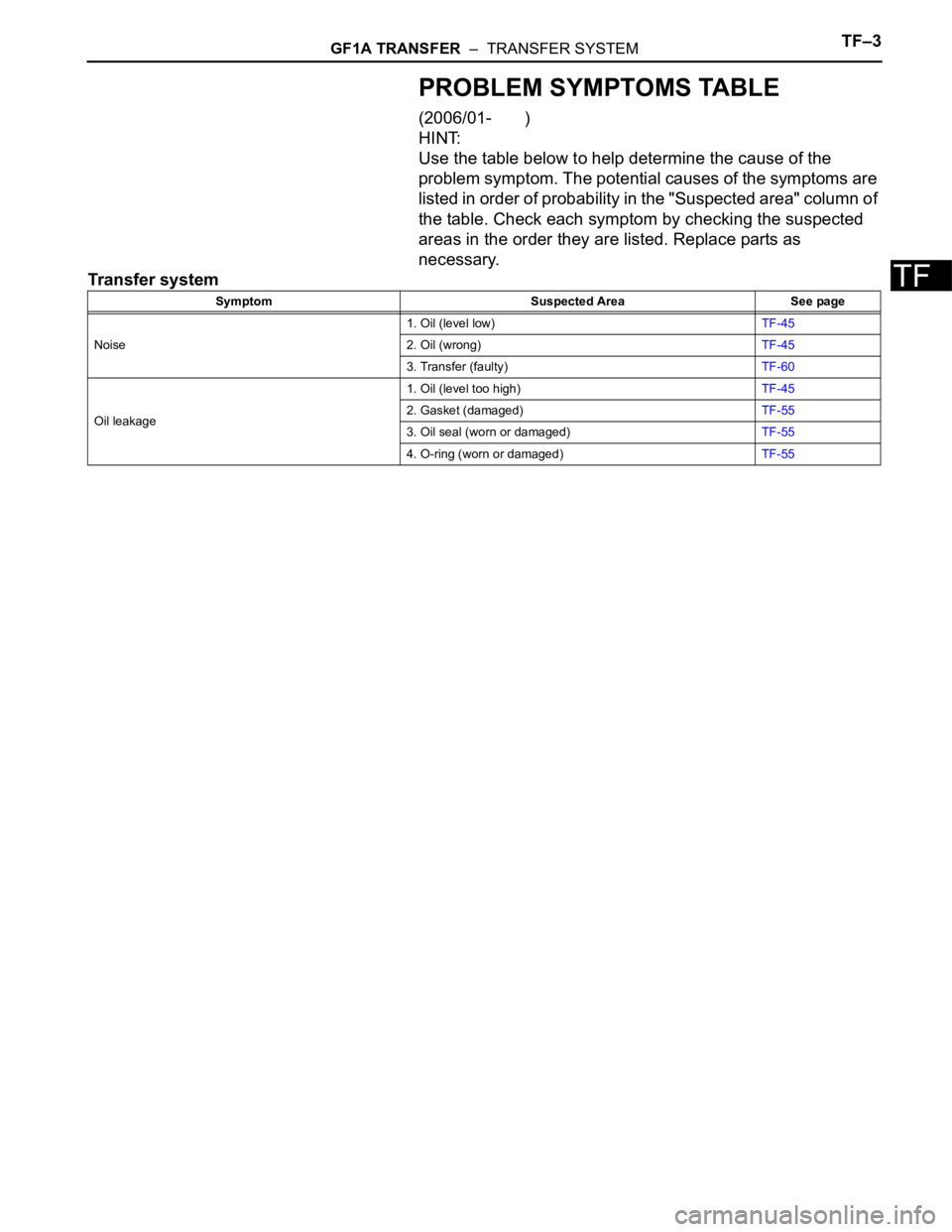
PROBLEM SYMPTOMS TABLE
(2006/01- )
HINT:
Use the table below to help determine the cause of the
problem symptom. The potential causes of the symptoms are
listed in order of probability in the "Suspected area" column of
the table. Check each symptom by checking the suspected
areas in the order they are listed. Replace parts as
necessary.
Transfer system
Symptom Suspected Area See page
Noise1. Oil (level low)TF-45
2. Oil (wrong)TF-45
3. Transfer (faulty)TF-60
Oil leakage1. Oil (level too high)TF-45
2. Gasket (damaged)TF-55
3. Oil seal (worn or damaged)TF-55
4. O-ring (worn or damaged)TF-55
Page 415 of 2000
BRAKE – BRAKE SYSTEMBR–3
BR
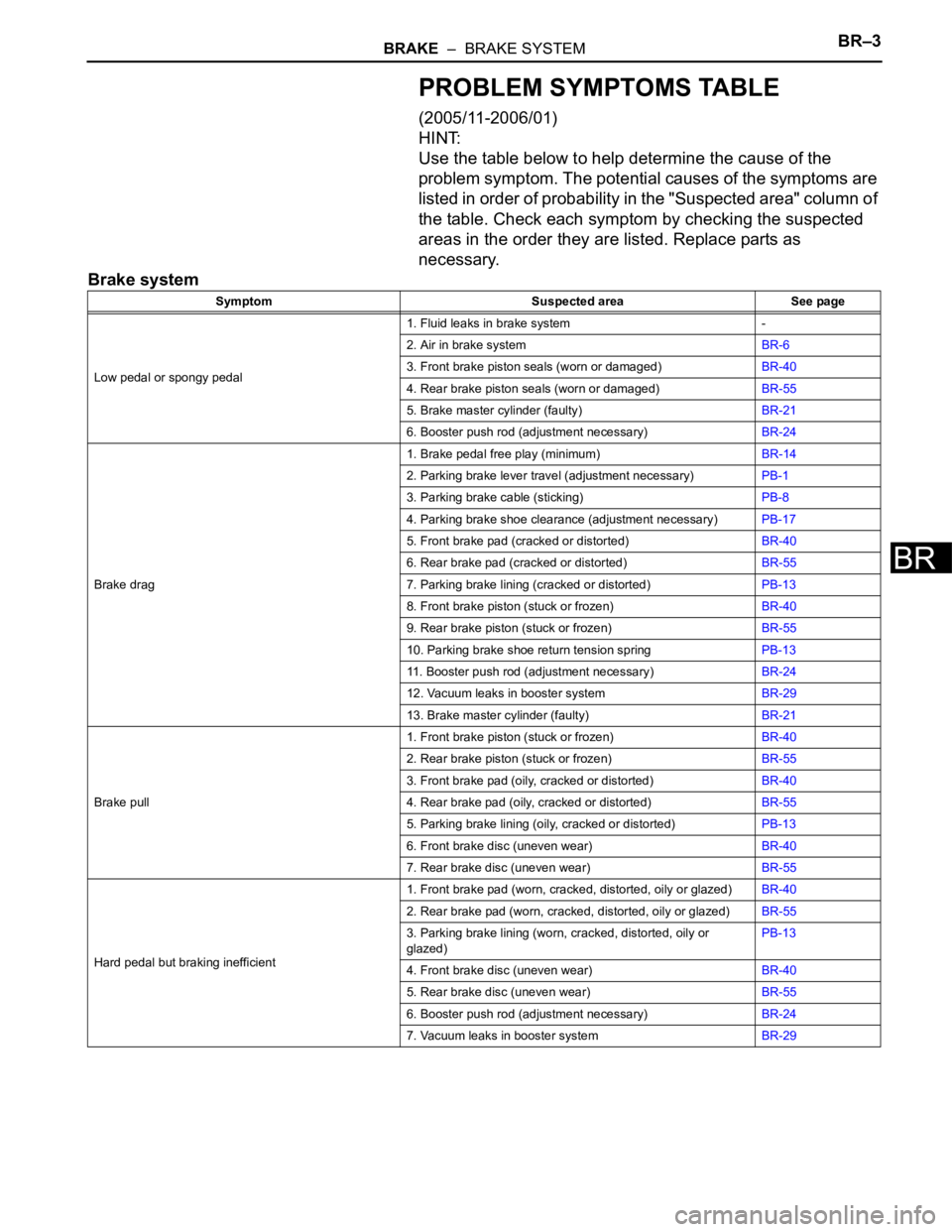
PROBLEM SYMPTOMS TABLE
(2005/11-2006/01)
HINT:
Use the table below to help determine the cause of the
problem symptom. The potential causes of the symptoms are
listed in order of probability in the "Suspected area" column of
the table. Check each symptom by checking the suspected
areas in the order they are listed. Replace parts as
necessary.
Brake system
Symptom Suspected area See page
Low pedal or spongy pedal1. Fluid leaks in brake system -
2. Air in brake systemBR-6
3. Front brake piston seals (worn or damaged)BR-40
4. Rear brake piston seals (worn or damaged)BR-55
5. Brake master cylinder (faulty)BR-21
6. Booster push rod (adjustment necessary)BR-24
Brake drag1. Brake pedal free play (minimum)BR-14
2. Parking brake lever travel (adjustment necessary)PB-1
3. Parking brake cable (sticking)PB-8
4. Parking brake shoe clearance (adjustment necessary)PB-17
5. Front brake pad (cracked or distorted)BR-40
6. Rear brake pad (cracked or distorted)BR-55
7. Parking brake lining (cracked or distorted)PB-13
8. Front brake piston (stuck or frozen)BR-40
9. Rear brake piston (stuck or frozen)BR-55
10. Parking brake shoe return tension springPB-13
11. Booster push rod (adjustment necessary)BR-24
12. Vacuum leaks in booster systemBR-29
13. Brake master cylinder (faulty)BR-21
Brake pull1. Front brake piston (stuck or frozen)BR-40
2. Rear brake piston (stuck or frozen)BR-55
3. Front brake pad (oily, cracked or distorted)BR-40
4. Rear brake pad (oily, cracked or distorted)BR-55
5. Parking brake lining (oily, cracked or distorted)PB-13
6. Front brake disc (uneven wear)BR-40
7. Rear brake disc (uneven wear)BR-55
Hard pedal but braking inefficient1. Front brake pad (worn, cracked, distorted, oily or glazed)BR-40
2. Rear brake pad (worn, cracked, distorted, oily or glazed)BR-55
3. Parking brake lining (worn, cracked, distorted, oily or
glazed)PB-13
4. Front brake disc (uneven wear)BR-40
5. Rear brake disc (uneven wear)BR-55
6. Booster push rod (adjustment necessary)BR-24
7. Vacuum leaks in booster systemBR-29
Page 421 of 2000
STEERING COLUMN – STEERING SYSTEMSR–3
SR
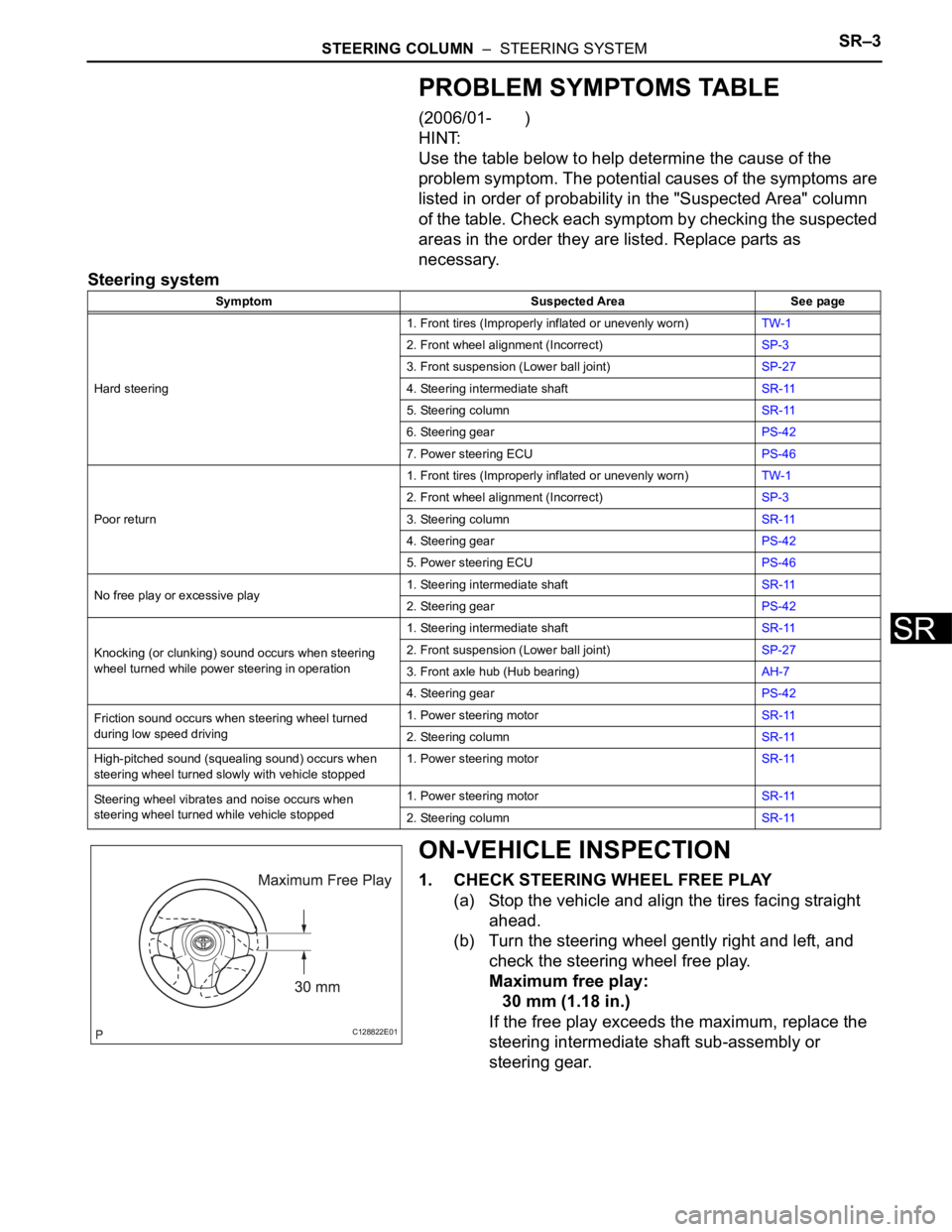
PROBLEM SYMPTOMS TABLE
(2006/01- )
HINT:
Use the table below to help determine the cause of the
problem symptom. The potential causes of the symptoms are
listed in order of probability in the "Suspected Area" column
of the table. Check each symptom by checking the suspected
areas in the order they are listed. Replace parts as
necessary.
Steering system
ON-VEHICLE INSPECTION
1. CHECK STEERING WHEEL FREE PLAY
(a) Stop the vehicle and align the tires facing straight
ahead.
(b) Turn the steering wheel gently right and left, and
check the steering wheel free play.
Maximum free play:
30 mm (1.18 in.)
If the free play exceeds the maximum, replace the
steering intermediate shaft sub-assembly or
steering gear.
Symptom Suspected Area See page
Hard steering1. Front tires (Improperly inflated or unevenly worn)TW-1
2. Front wheel alignment (Incorrect)SP-3
3. Front suspension (Lower ball joint)SP-27
4. Steering intermediate shaftSR-11
5. Steering columnSR-11
6. Steering gearPS-42
7. Power steering ECUPS-46
Poor return1. Front tires (Improperly inflated or unevenly worn)TW-1
2. Front wheel alignment (Incorrect)SP-3
3. Steering columnSR-11
4. Steering gearPS-42
5. Power steering ECUPS-46
No free play or excessive play1. Steering intermediate shaftSR-11
2. Steering gearPS-42
Knocking (or clunking) sound occurs when steering
wheel turned while power steering in operation1. Steering intermediate shaftSR-11
2. Front suspension (Lower ball joint)SP-27
3. Front axle hub (Hub bearing)AH-7
4. Steering gearPS-42
Friction sound occurs when steering wheel turned
during low speed driving1. Power steering motorSR-11
2. Steering columnSR-11
High-pitched sound (squealing sound) occurs when
steering wheel turned slowly with vehicle stopped1. Power steering motorSR-11
Steering wheel vibrates and noise occurs when
steering wheel turned while vehicle stopped1. Power steering motorSR-11
2. Steering columnSR-11
C128822E01
Page 435 of 2000
RS–384SUPPLEMENTAL RESTRAINT SYSTEM – SIDE AIRBAG SENSOR
RS
INSTALLATION
HINT:
• Use the same procedures for the RH side and LH side.
• The procedures listed below are for the LH side.
CAUTION:
Be sure to read the precautionary notices concerning the
SRS airbag system before servicing it (see page RS-1).
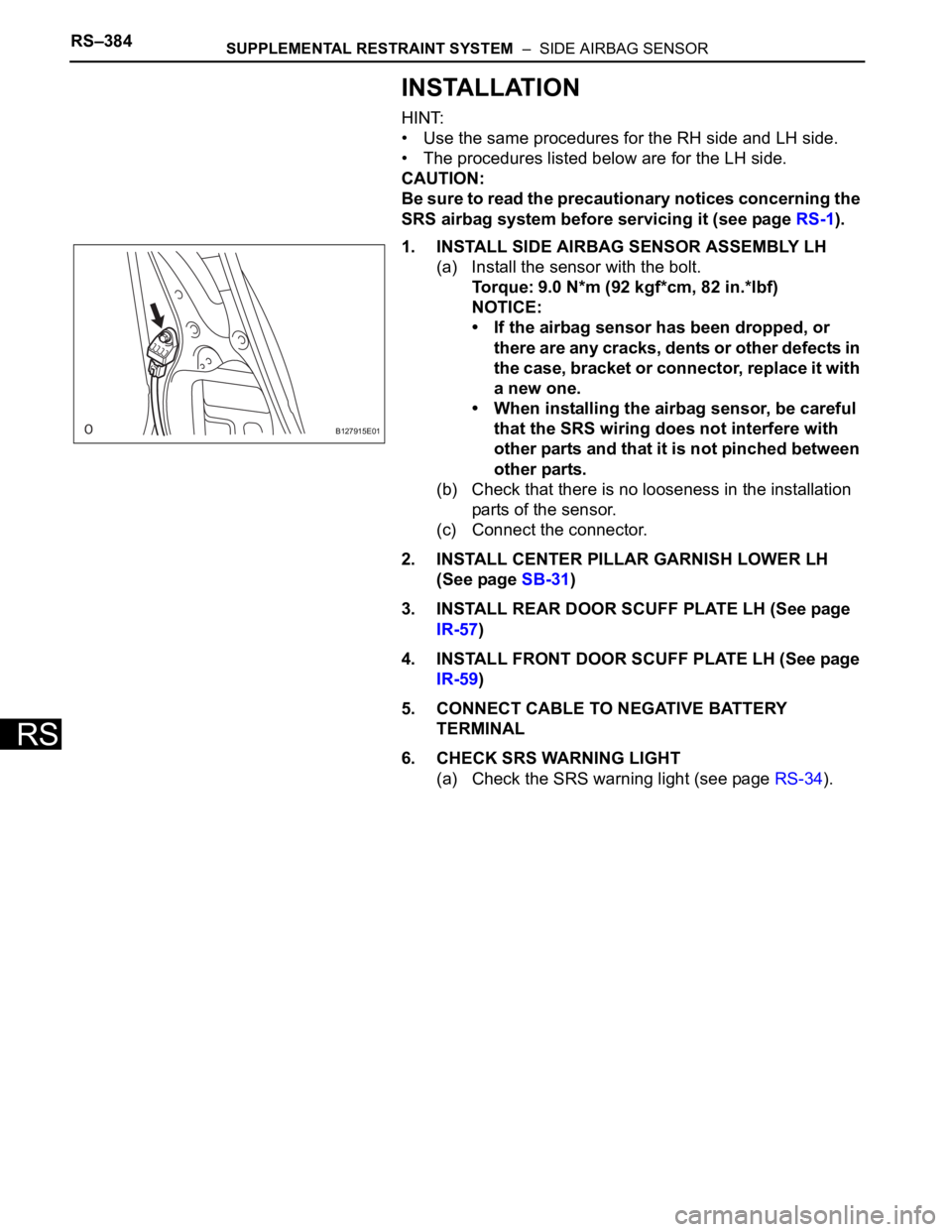
1. INSTALL SIDE AIRBAG SENSOR ASSEMBLY LH
(a) Install the sensor with the bolt.
Torque: 9.0 N*m (92 kgf*cm, 82 in.*lbf)
NOTICE:
• If the airbag sensor has been dropped, or
there are any cracks, dents or other defects in
the case, bracket or connector, replace it with
a new one.
• When installing the airbag sensor, be careful
that the SRS wiring does not interfere with
other parts and that it is not pinched between
other parts.
(b) Check that there is no looseness in the installation
parts of the sensor.
(c) Connect the connector.
2. INSTALL CENTER PILLAR GARNISH LOWER LH
(See page SB-31)
3. INSTALL REAR DOOR SCUFF PLATE LH (See page
IR-57)
4. INSTALL FRONT DOOR SCUFF PLATE LH (See page
IR-59)
5. CONNECT CABLE TO NEGATIVE BATTERY
TERMINAL
6. CHECK SRS WARNING LIGHT
(a) Check the SRS warning light (see page RS-34).
B127915E01
Page 454 of 2000
WW–4WIPER AND WASHER – WIPER AND WASHER SYSTEM
WW
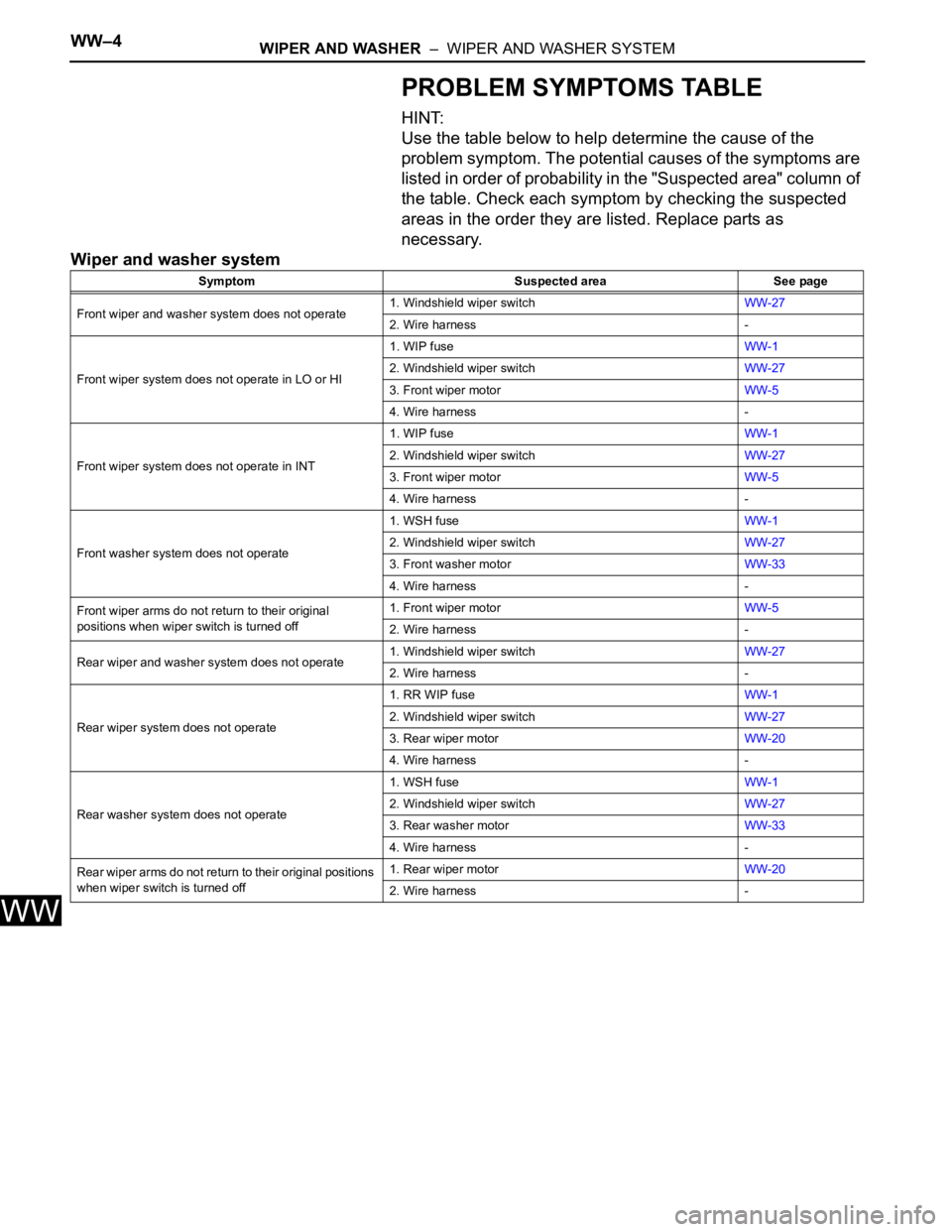
PROBLEM SYMPTOMS TABLE
HINT:
Use the table below to help determine the cause of the
problem symptom. The potential causes of the symptoms are
listed in order of probability in the "Suspected area" column of
the table. Check each symptom by checking the suspected
areas in the order they are listed. Replace parts as
necessary.
Wiper and washer system
Symptom Suspected area See page
Front wiper and washer system does not operate1. Windshield wiper switchWW-27
2. Wire harness -
Front wiper system does not operate in LO or HI1. WIP fuseWW-1
2. Windshield wiper switchWW-27
3. Front wiper motorWW-5
4. Wire harness -
Front wiper system does not operate in INT1. WIP fuseWW-1
2. Windshield wiper switchWW-27
3. Front wiper motorWW-5
4. Wire harness -
Front washer system does not operate1. WSH fuseWW-1
2. Windshield wiper switchWW-27
3. Front washer motorWW-33
4. Wire harness -
Front wiper arms do not return to their original
positions when wiper switch is turned off1. Front wiper motorWW-5
2. Wire harness -
Rear wiper and washer system does not operate1. Windshield wiper switchWW-27
2. Wire harness -
Rear wiper system does not operate1. RR WIP fuseWW-1
2. Windshield wiper switchWW-27
3. Rear wiper motorWW-20
4. Wire harness -
Rear washer system does not operate1. WSH fuseWW-1
2. Windshield wiper switchWW-27
3. Rear washer motorWW-33
4. Wire harness -
Rear wiper arms do not return to their original positions
when wiper switch is turned off1. Rear wiper motorWW-20
2. Wire harness -
Page 483 of 2000
2AZ-FE ENGINE CONTROL SYSTEM – SFI SYSTEMES–29
ES
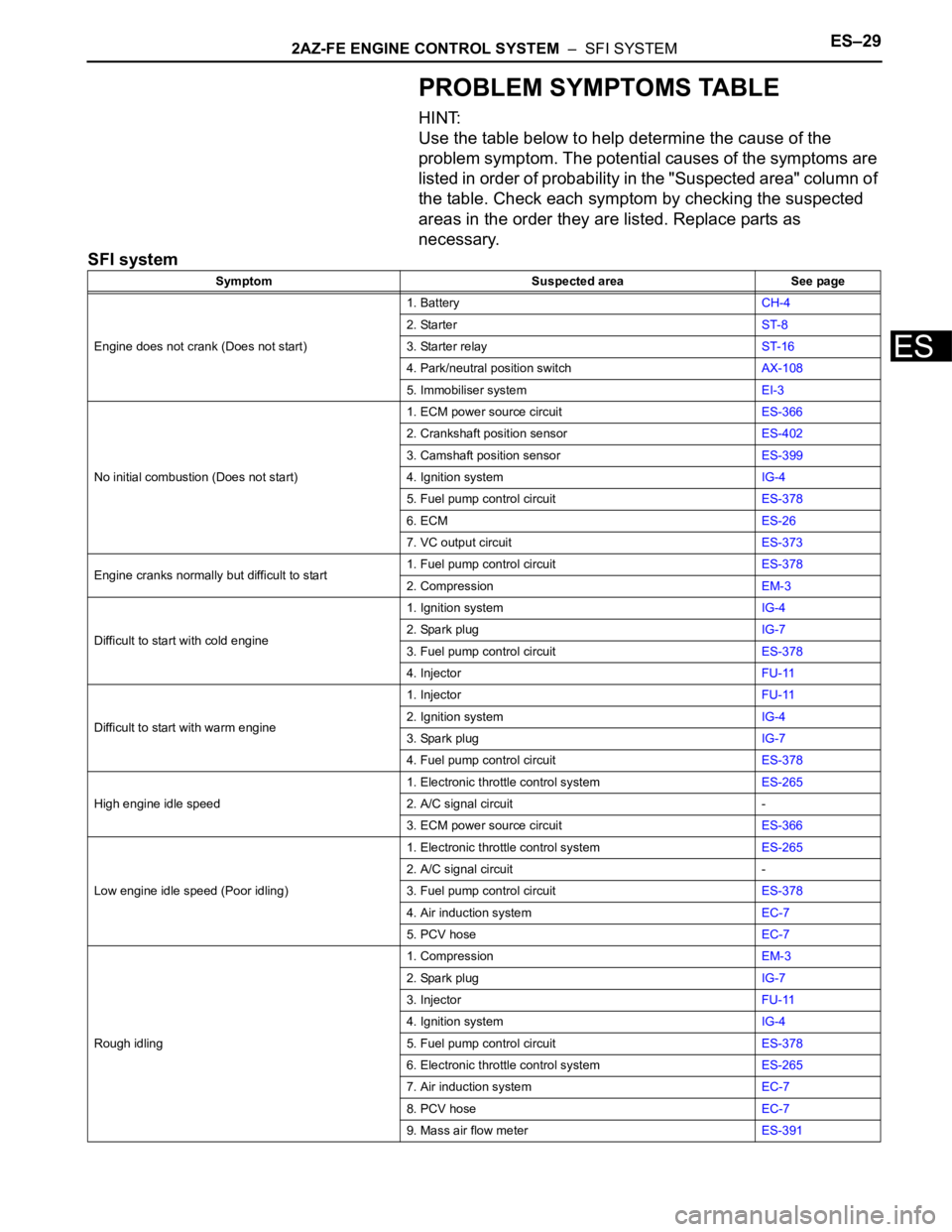
PROBLEM SYMPTOMS TABLE
HINT:
Use the table below to help determine the cause of the
problem symptom. The potential causes of the symptoms are
listed in order of probability in the "Suspected area" column of
the table. Check each symptom by checking the suspected
areas in the order they are listed. Replace parts as
necessary.
SFI system
Symptom Suspected area See page
Engine does not crank (Does not start)1. BatteryCH-4
2. StarterST-8
3. Starter relayST-16
4. Park/neutral position switchAX-108
5. Immobiliser systemEI-3
No initial combustion (Does not start)1. ECM power source circuitES-366
2. Crankshaft position sensorES-402
3. Camshaft position sensorES-399
4. Ignition systemIG-4
5. Fuel pump control circuitES-378
6. ECMES-26
7. VC output circuitES-373
Engine cranks normally but difficult to start1. Fuel pump control circuitES-378
2. CompressionEM-3
Difficult to start with cold engine1. Ignition systemIG-4
2. Spark plugIG-7
3. Fuel pump control circuitES-378
4. InjectorFU-11
Difficult to start with warm engine1. InjectorFU-11
2. Ignition systemIG-4
3. Spark plugIG-7
4. Fuel pump control circuitES-378
High engine idle speed1. Electronic throttle control systemES-265
2. A/C signal circuit -
3. ECM power source circuitES-366
Low engine idle speed (Poor idling)1. Electronic throttle control systemES-265
2. A/C signal circuit -
3. Fuel pump control circuitES-378
4. Air induction systemEC-7
5. PCV hoseEC-7
Rough idling1. CompressionEM-3
2. Spark plugIG-7
3. InjectorFU-11
4. Ignition systemIG-4
5. Fuel pump control circuitES-378
6. Electronic throttle control systemES-265
7. Air induction systemEC-7
8. PCV hoseEC-7
9. Mass air flow meterES-391
Page 501 of 2000
HO–4HORN – HORN SYSTEM
HO
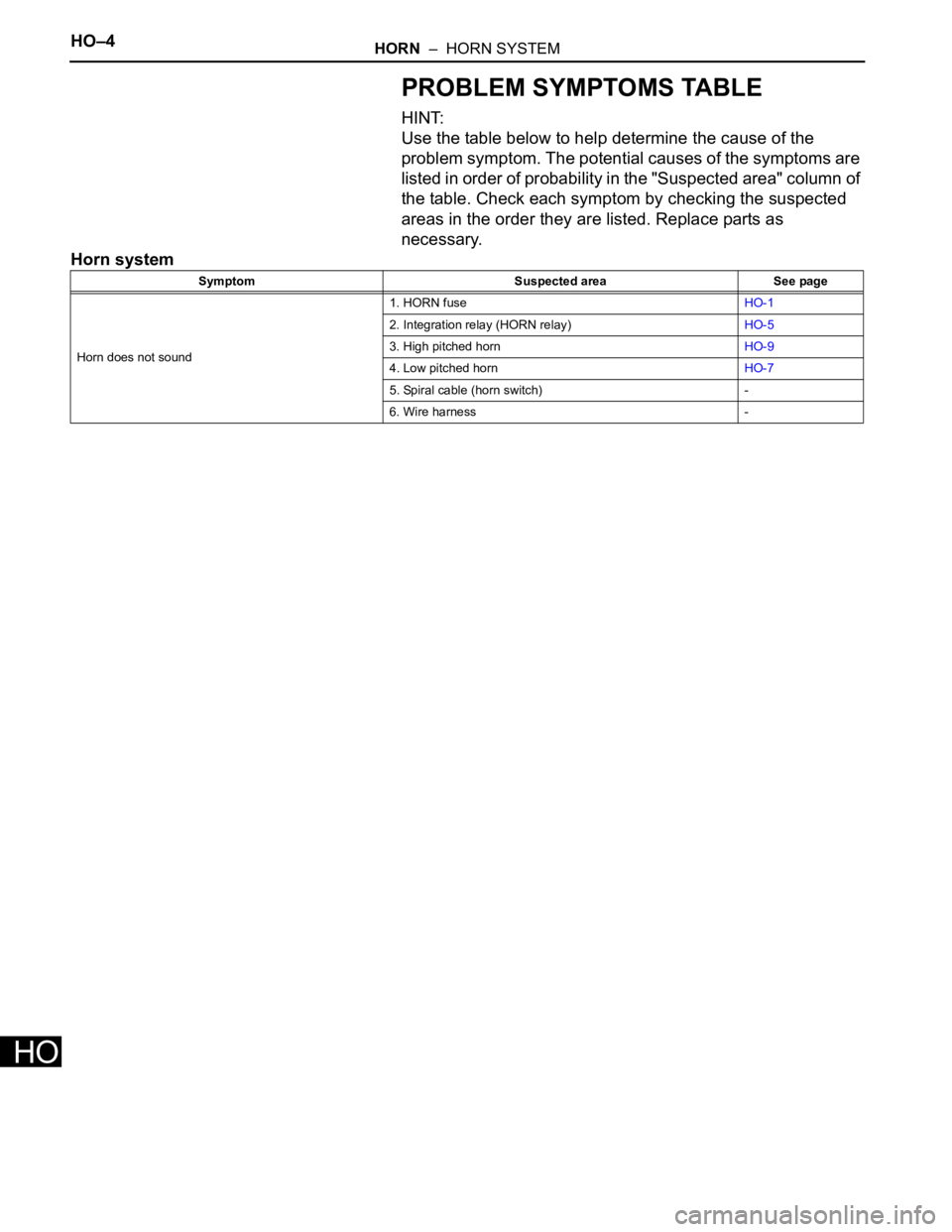
PROBLEM SYMPTOMS TABLE
HINT:
Use the table below to help determine the cause of the
problem symptom. The potential causes of the symptoms are
listed in order of probability in the "Suspected area" column of
the table. Check each symptom by checking the suspected
areas in the order they are listed. Replace parts as
necessary.
Horn system
Symptom Suspected area See page
Horn does not sound1. HORN fuseHO-1
2. Integration relay (HORN relay)HO-5
3. High pitched hornHO-9
4. Low pitched hornHO-7
5. Spiral cable (horn switch) -
6. Wire harness -
Page 504 of 2000
MI–4MIRROR – POWER MIRROR CONTROL SYSTEM
MI
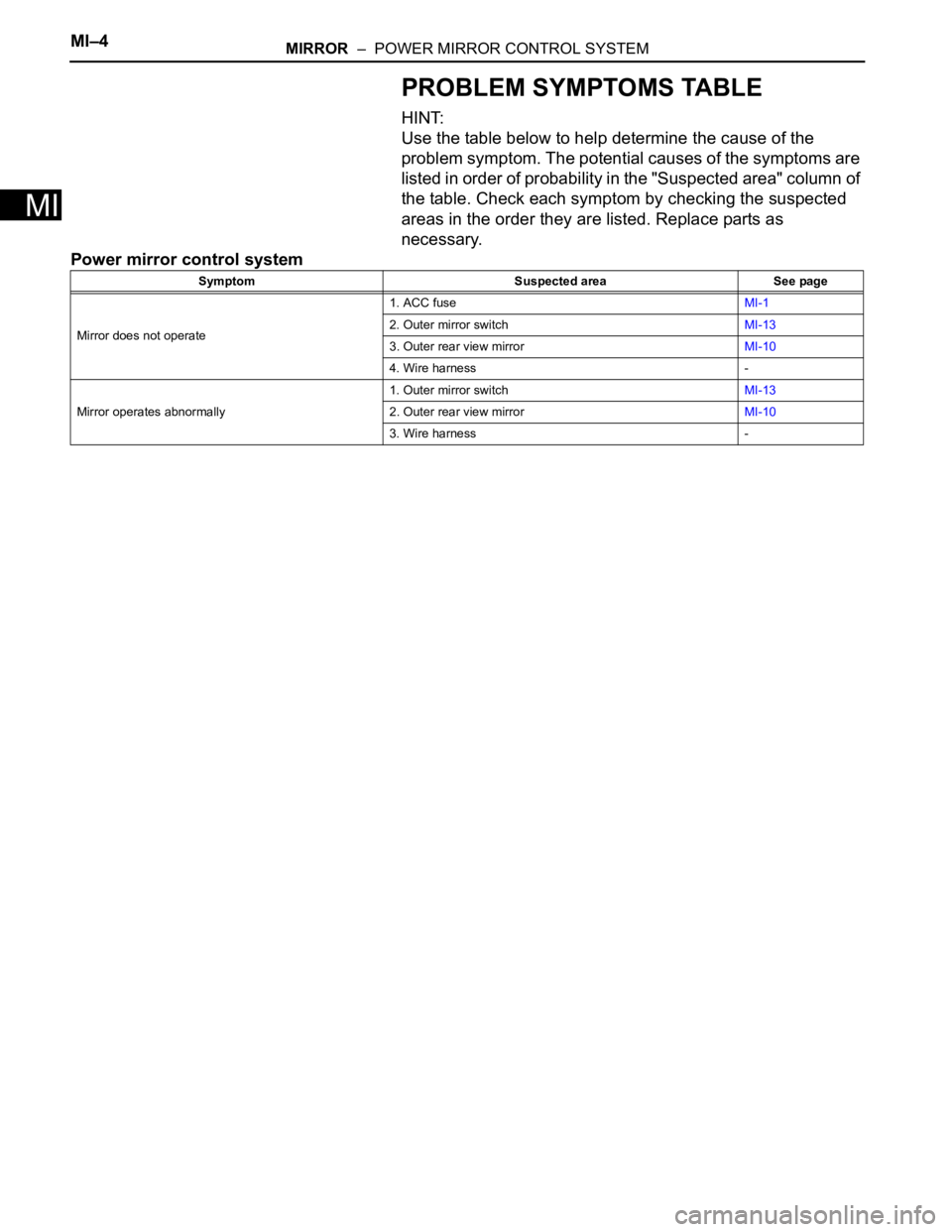
PROBLEM SYMPTOMS TABLE
HINT:
Use the table below to help determine the cause of the
problem symptom. The potential causes of the symptoms are
listed in order of probability in the "Suspected area" column of
the table. Check each symptom by checking the suspected
areas in the order they are listed. Replace parts as
necessary.
Power mirror control system
Symptom Suspected area See page
Mirror does not operate1. ACC fuseMI-1
2. Outer mirror switchMI-13
3. Outer rear view mirrorMI-10
4. Wire harness -
Mirror operates abnormally1. Outer mirror switchMI-13
2. Outer rear view mirrorMI-10
3. Wire harness -
Page 508 of 2000
SEAT – FRONT POWER SEAT CONTROL SYSTEMSE–3
SE
PROBLEM SYMPTOMS TABLE
HINT:
Use the table below to help determine the cause of the
problem symptom. The potential causes of the symptoms are
listed in order of probability in the "Suspected Area" column
of the table. Check each symptom by checking the suspected
areas in the order they are listed. Replace parts as
necessary.
Front power seat control system
ON-VEHICLE INSPECTION
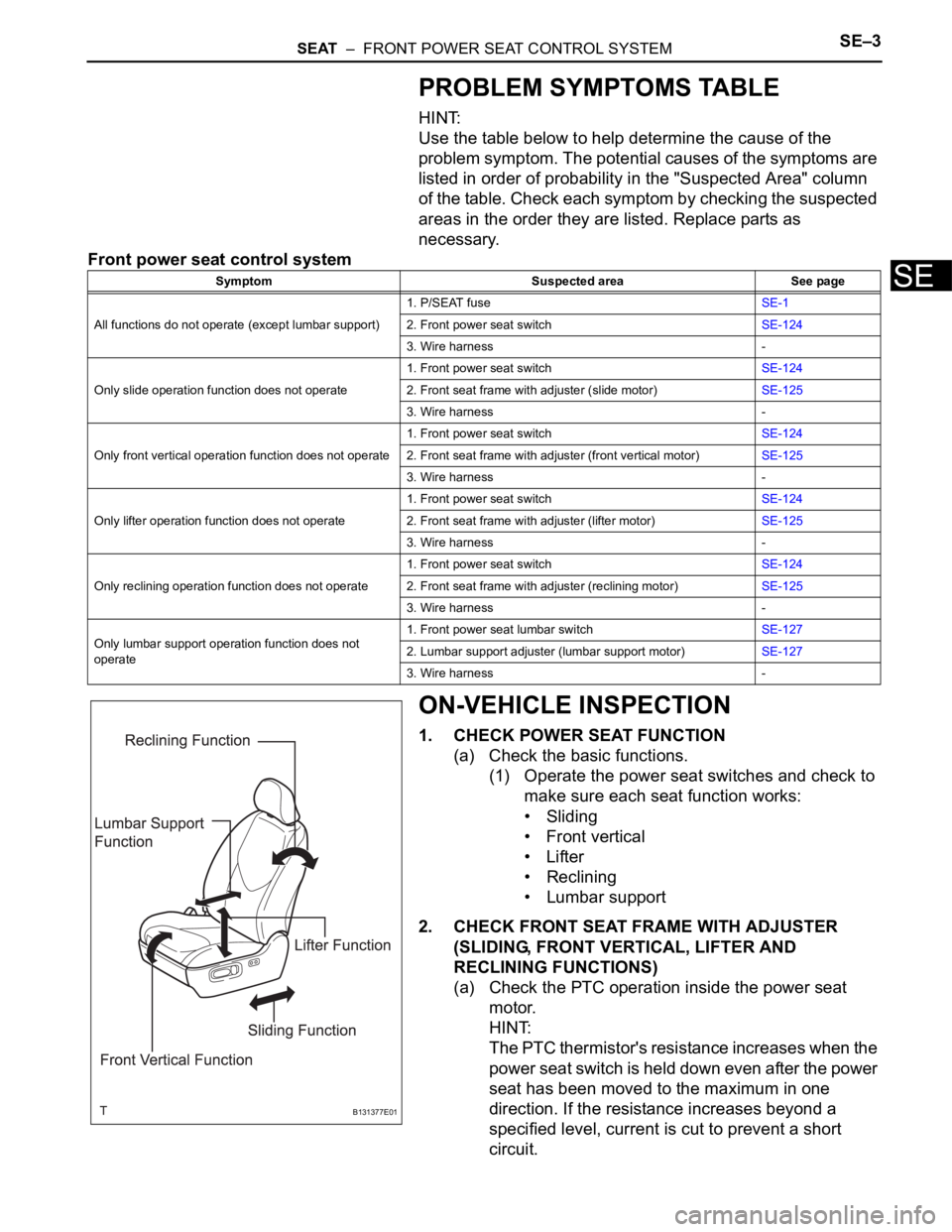
1. CHECK POWER SEAT FUNCTION
(a) Check the basic functions.
(1) Operate the power seat switches and check to
make sure each seat function works:
• Sliding
•Front vertical
•Lifter
• Reclining
• Lumbar support
2. CHECK FRONT SEAT FRAME WITH ADJUSTER
(SLIDING, FRONT VERTICAL, LIFTER AND
RECLINING FUNCTIONS)
(a) Check the PTC operation inside the power seat
motor.
HINT:
The PTC thermistor's resistance increases when the
power seat switch is held down even after the power
seat has been moved to the maximum in one
direction. If the resistance increases beyond a
specified level, current is cut to prevent a short
circuit.
Symptom Suspected area See page
All functions do not operate (except lumbar support)1. P/SEAT fuseSE-1
2. Front power seat switchSE-124
3. Wire harness -
Only slide operation function does not operate1. Front power seat switchSE-124
2. Front seat frame with adjuster (slide motor)SE-125
3. Wire harness -
Only front vertical operation function does not operate1. Front power seat switchSE-124
2. Front seat frame with adjuster (front vertical motor)SE-125
3. Wire harness -
Only lifter operation function does not operate1. Front power seat switchSE-124
2. Front seat frame with adjuster (lifter motor)SE-125
3. Wire harness -
Only reclining operation function does not operate1. Front power seat switchSE-124
2. Front seat frame with adjuster (reclining motor)SE-125
3. Wire harness -
Only lumbar support operation function does not
operate1. Front power seat lumbar switchSE-127
2. Lumbar support adjuster (lumbar support motor)SE-127
3. Wire harness -
B131377E01
Page 556 of 2000
ES–322GR-FE ENGINE CONTROL SYSTEM – SFI SYSTEM
ES
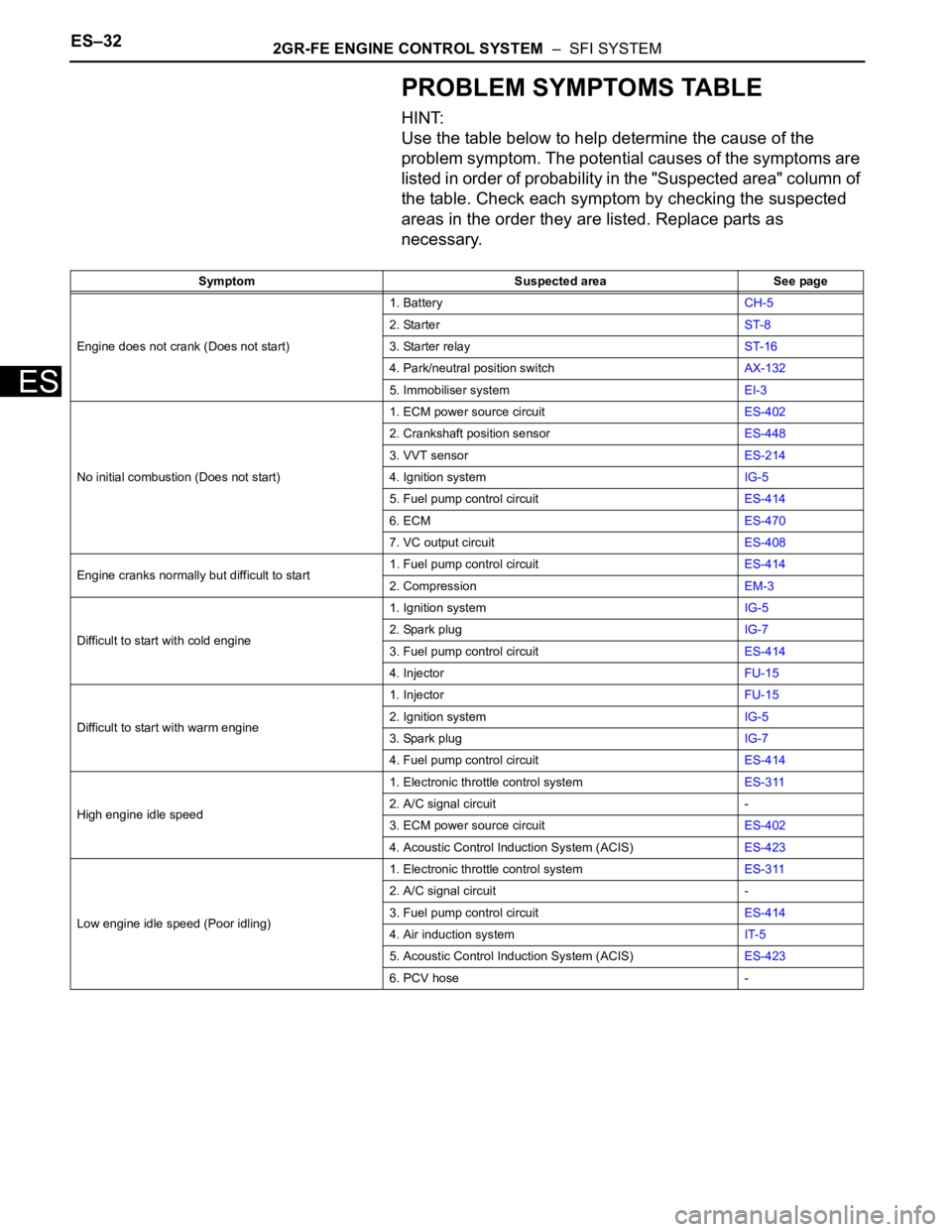
PROBLEM SYMPTOMS TABLE
HINT:
Use the table below to help determine the cause of the
problem symptom. The potential causes of the symptoms are
listed in order of probability in the "Suspected area" column of
the table. Check each symptom by checking the suspected
areas in the order they are listed. Replace parts as
necessary.
Symptom Suspected area See page
Engine does not crank (Does not start)1. BatteryCH-5
2. StarterST-8
3. Starter relayST-16
4. Park/neutral position switchAX-132
5. Immobiliser systemEI-3
No initial combustion (Does not start)1. ECM power source circuitES-402
2. Crankshaft position sensorES-448
3. VVT sensorES-214
4. Ignition systemIG-5
5. Fuel pump control circuitES-414
6. ECMES-470
7. VC output circuitES-408
Engine cranks normally but difficult to start1. Fuel pump control circuitES-414
2. CompressionEM-3
Difficult to start with cold engine1. Ignition systemIG-5
2. Spark plugIG-7
3. Fuel pump control circuitES-414
4. InjectorFU-15
Difficult to start with warm engine1. InjectorFU-15
2. Ignition systemIG-5
3. Spark plugIG-7
4. Fuel pump control circuitES-414
High engine idle speed1. Electronic throttle control systemES-311
2. A/C signal circuit -
3. ECM power source circuitES-402
4. Acoustic Control Induction System (ACIS)ES-423
Low engine idle speed (Poor idling)1. Electronic throttle control systemES-311
2. A/C signal circuit -
3. Fuel pump control circuitES-414
4. Air induction systemIT-5
5. Acoustic Control Induction System (ACIS)ES-423
6. PCV hose -