cruise control TOYOTA RAV4 2006 Service Repair Manual
[x] Cancel search | Manufacturer: TOYOTA, Model Year: 2006, Model line: RAV4, Model: TOYOTA RAV4 2006Pages: 2000, PDF Size: 45.84 MB
Page 29 of 2000

ENGINE - 2AZ-FE ENGINE
01MEG04Y
SENSORSACTUATORS
MASS AIR FLOW METER
INTAKE AIR TEMPERATURE
SENSOR
ENGIEN COOLANT
TEMPERATURE SENSOR
THROTTLE POSITION
SENSOR
CRANKSHAFT POSITION
SENSOR
CAMSHAFT POSITION
SENSOR
ACCELERATOR PEDAL
POSITION SENSOR
AIR-FUEL RATIO SENSOR
(Bank 1, Sensor 1)
HEATED OXYGEN SENSOR
(Bank 1, Sensor 2)
KNOCK SENSOR
COMBINATION METER
Vehicle Speed Signal
IGNITION SWITCH
Ignition Signal
Starter Signal
PA R K / N E U T R A L P O S I T I O N
SWITCH
TRANSMISSION CONTROL
SWITCH
CRUISE CONTROL SWITCHVG
THA
THW
VTA1
VTA2
NE
G2
VPA
VPA2
A1A
OX1B
KNK1
SPD
IGSW
STA
D, 2, L
R, P, N
3
CCSECM#10
#20
#30
#40
IGT1 IGT4
IGF1
M
OC1
FC
HA1A
HT1BSFI
No.1 INJECTOR
No.2 INJECTOR
No.3 INJECTOR
No.4 INJECTOR
ESA
IGNITION COIL
with IGNITER
SPARK PLUGS
ETCS-i
THROTTLE CONTROL
MOTOR
VVT-i
CAMSHAFT TIMING OIL
CONTROL VALVE
FUEL PUMP CONTROL
CIRCUIT OPENING
RELAY
AIR-FUEL RATIO AND
HEATED OXYGEN SENSOR
HEATER CONTROL
AIR-FUEL RATIO SENSOR
HEATER (Bank1, Sensor1)
HEATED OXYGEN SENSOR
HEATER (Bank1, Sensor2)
EG-32
2. Construction
The configuration of the engine control system in the 2AZ-FE engine is shown in the following chart.
(Continued)
Page 41 of 2000

ENGINE - 2AZ-FE ENGINE
Throttle Body
Throttle Position
Sensor Portion
Reduction
Gears
Throttle ValveMagnetic Yoke
Hall IC
Throttle Control
Motor A
View from A
Cross Section
01NEG44Y
EG-44
Construction
1) Throttle Position Sensor
The throttle position sensor is mounted on the throttle body, to detect the opening angle of the throttle
valve.
2) Throttle Control Motor
A DC motor with excellent response and minimal power consumption is used for the throttle control
motor. The ECM performs the duty ratio control of the direction and the amperage of the current that
flows to the throttle control motor in order to regulate the opening of the throttle valve.
Operation
1) General
The ECM drives the throttle control motor by determining the target throttle valve opening in accordance
with the respective operating condition.
Non-linear Control
Idle Air Control
TRAC Throttle Control
VSC Coordination Control
Cruise Control
Page 42 of 2000

ENGINE - 2AZ-FE ENGINE
005EG13Y
: With Control
: Without Control
Vehicle’s
Longitudinal G
Throttle Valve
Opening Angle
Accelerator Pedal
Depressed Angle
0
0
0
Time
EG-45
2) Normal Throttle Control (Non-linear Control)
It controls the throttle to an optimal throttle valve opening that is appropriate for the driving condition
such as the amount of the accelerator pedal effort and the engine speed in order to realize excellent throttle
control and comfort in all operating ranges.
Control Examples During Acceleration and Deceleration
3) Idle Air Control
The ECM controls the throttle valve in order to constantly maintain an ideal idle speed.
4) TRAC Throttle Control
As part of the TRAC system, the throttle valve is closed by a demand signal from the skid control ECU
if an excessive amount of slippage is created at a driving wheel, thus facilitating the vehicle in providing
excellent stability and driving force.
5) VSC Coordination Control
In order to bring the effectiveness of the VSC system control into full play, the throttle valve opening
angle is controlled by effecting a coordination control with the skid control ECU.
6) Cruise Control
An ECM with an integrated cruise control ECU directly actuates the throttle valve for operation of the
cruise control.
Page 101 of 2000

ENGINE - 2GR-FE ENGINE
01MEG08Y
DEFOGGER RELAY
TA I L L A M P R E L AY
STOP LIGHT SWITCH
CRUISE CONTROL SWITCH
AIR CONDITIONING ECU
AIRBAG SENSOR
ASSEMBLY
SKID CONTROL ECU
DLC3
MAIN RELAY
BATTERYELS
ELS2
STP
CCS
CANH,
CANL
TC
TA C H
MREL
+B
BATTECMRFC
RFC
MPMP
VPMP
PRG
WCOOLING FAN CONTROL*1
COOLING FAN ECU
FAN MOTOR NO. 1 AND
NO. 2
COOLING FAN CONTROL*
2
COOLING FAN ECU NO. 1
FAN MOTOR NO. 1
COOLING FAN ECU NO. 2
FAN MOTOR NO. 2
EVAPORATIVE EMISSION
CONTROL
LEAK DETECTION
PUMP
VENT VALVE
PURGE VSV
COMBINATION METER
MIL
: CANEG-105
*
1: Except Towing Package Models
*
2: Towing Package Models
Page 102 of 2000

ENGINE - 2GR-FE ENGINE
01MEG29Y
Ignition SwitchCombination Meter
Vehicle Speed Signal
MIL
Battery Current Sensor
(Built-in Battery
Temperature Sensor)
Park / Neutral
Position Switch
Battery
Generator
Fuel Pump Relay
Fuel Pump
Vent Valve
Circuit Opening
RelayDLC3*1*2*3
CAN
ECM
Cruise Control Switch
Accelerator Pedal
Position Sensor
Stop Light Switch
Canister
Pressure
SensorLeak
Detection
Pump
Intake Air
Temp. Sensor
VSV (For
Air Intake
Control)Mass Air
Flow Meter
AirThrottle Position
Sensor
Purge VSV
Throttle
Control
Motor
*4*5
Fan
Motor No. 1Fan
Motor
No. 2
Cooling
Fan
ECUCooling
Fan
ECU
No. 1Cooling
Fan
ECU
No. 2
Fan Motor No. 1
Fan Motor No. 2
ACIS Actuator
Intake Camshaft Timing
Oil Control Valve (Bank 2)Injector Injector
Intake Camshaft Timing
Oil Control Valve (Bank 1)
Intake VVT Sensor (Bank 1)
Ignition Coil With Igniter
Exhaust VVT Sensor (Bank 1)
Exhaust Camshaft Timing
Oil Control Valve (Bank 1)
Air-fuel Ratio Sensor
(Bank1, Sensor1)
TWC
Knock
Sensor
Intake VVT
Sensor (Bank 2)
Exhaust VVT
Sensor (Bank 2)
Air-fuel Ratio Sensor
(Bank2, Sensor1)Exhaust Camshaft
Timing Oil Control
Valve (Bank 2)
Crankshaft Position
Sensor
Engine Coolant
Temperature Sensor Heated Oxygen Sensor
(Bank1, Sensor2)Heated Oxygen Sensor
(Bank2, Sensor2)TWCTWC
EG-106
3. Engine Control System Diagram
*1: Air Conditioning ECU
*
2: Airbag Sensor Assembly
*
3: Skid Control ECU
*
4: Except Towing Package Models
*
5: Towing Package Models
Page 114 of 2000

ENGINE - 2GR-FE ENGINE
01MEG18Y
Accelerator Pedal
Position SensorThrottle ValveThrottle Position Sensor
Throttle Control
Motor
Mass Air
Flow Meter
Cruise Control
Switch
Skid Control
ECUECMIgnition Coil
Fuel Injection EG-118
8. ETCS-i (Electronic Throttle Control System-intelligent)
General
In the conventional throttle body, the throttle valve angle is determined invariably by the amount of the
accelerator pedal effort. In contrast, ETCS-i uses the ECM to calculate the optimal throttle valve angle that
is appropriate for the respective driving condition and uses a throttle control motor to control the angle.
System Diagram
Control
1) General
The ETCS-i consists of the following five functions:
Normal Throttle Control (Non-linear Control)
IAC (Idle Air Control)
TRAC (Traction Control)
VSC (Vehicle Stability Control)
Cruise Control
Page 115 of 2000

ENGINE - 2GR-FE ENGINE
005EG13Y
: With Control
: Without Control
Ve h i c l e ’ s
Longitudinal G
Throttle Valve
Opening Angle
Accelerator Pedal
Depressed Angle
0
0
0
Time
EG-119
2) Normal Throttle Control (Non-linear Control)
The ECM controls the throttle to an optimal throttle valve angle that is appropriate for the driving
condition such as the amount of the accelerator pedal effort and the engine speed in order to realize
excellent throttle control and comfort in all operating ranges.
Control Examples during Acceleration and Deceleration
3) Idle Air Control
The ECM controls the throttle valve in order to constantly maintain an ideal idle speed.
4) TRAC Throttle Control
As part of the TRAC system, the throttle valve is closed by a demand signal from the skid control ECU
if an excessive amount of slippage is created at a driving wheel, thus facilitates the vehicle in ensuring
excellent vehicle stability and driving force.
5) VSC Coordination Control
In order to bring the effectiveness of the VSC system control into full play, the throttle valve angle is
controlled by effecting a coordination control with the skid control ECU.
6) Cruise Control
An ECM with an integrated cruise control ECU directly actuates the throttle valve for operation of the
cruise control.
Fail-safe of Accelerator Pedal Position Sensor
For details, see page 46 in 2AZ-FE engine section.
Fail-safe of Throttle Position Sensor
For details, see page 47 in 2AZ-FE engine section.
Page 442 of 2000
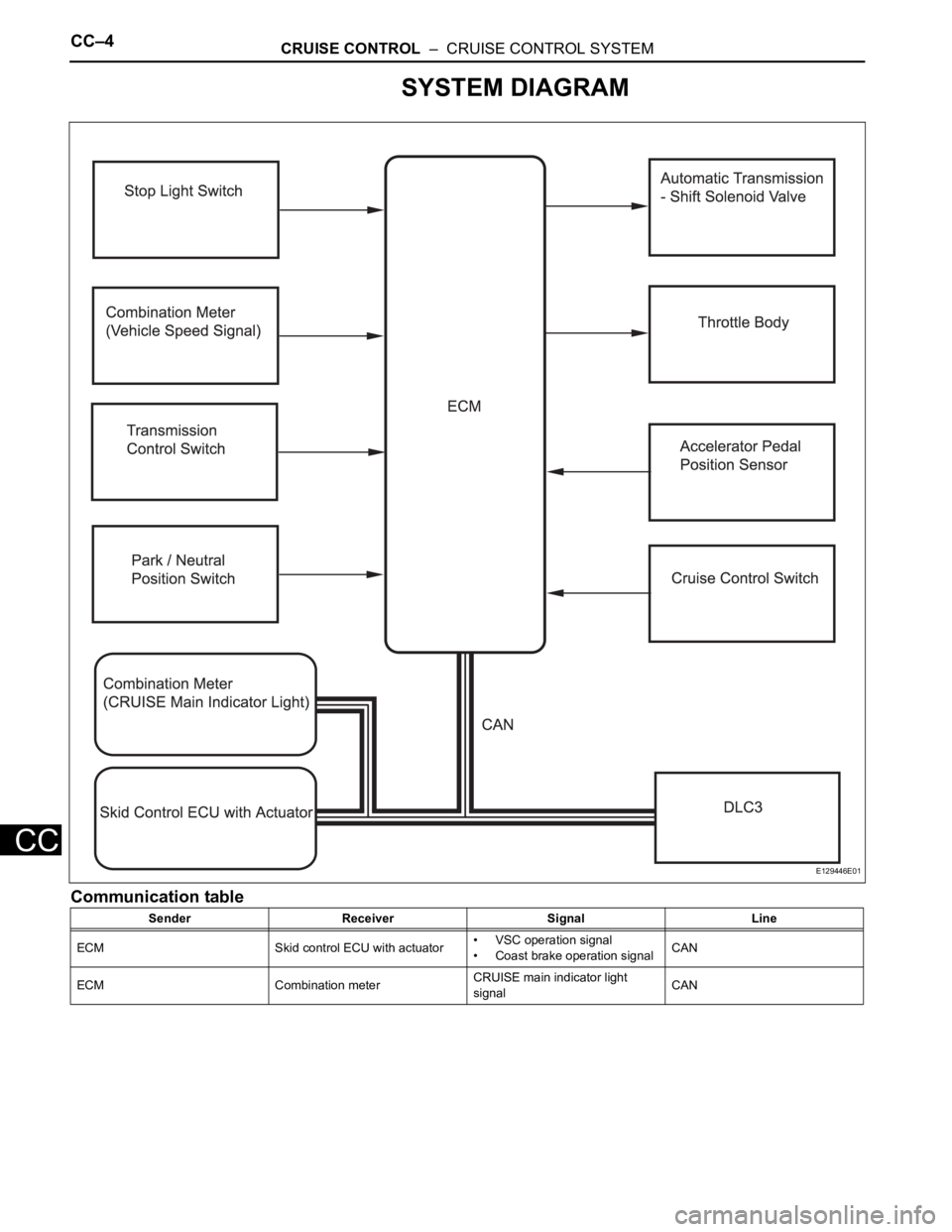
CC–4CRUISE CONTROL – CRUISE CONTROL SYSTEM
CC
SYSTEM DIAGRAM
Communication table
Sender Receiver Signal Line
ECM Skid control ECU with actuator• VSC operation signal
• Coast brake operation signalCAN
ECM Combination meterCRUISE main indicator light
signalCAN
E129446E01
Page 443 of 2000

CRUISE CONTROL – CRUISE CONTROL SYSTEMCC–5
CC
SYSTEM DESCRIPTION
1. CRUISE CONTROL SYSTEM
This system is controlled by the ECM, and is activated by
the throttle position sensor and motor. The ECM controls
the following functions: ON-OFF, SET / COAST,
RESUME / ACCEL, CANCEL, vehicle speed operation,
motor output control, and overdrive control.
• The ECM compares the driving vehicle speed from
the combination meter with the stored vehicle speed
set through the cruise control switch. The ECM
controls the throttle valve motor of the throttle body to
open the valve when the driving speed is less than the
stored speed.
• The ECM receives signals such as ON-OFF, SET /
COAST, RESUME / ACCEL, and CANCEL from the
cruise control switch.
• The ECM illuminates the combination meter CRUISE
main indicator light when it receives the cruise control
switch ON signal.
• The ECM cancels the cruise control system when the
brake pedal is depressed and the ECM receives the
stop light switch signal.
• The ECM cancels the cruise control system when the
shift lever is moved from D or 3 to a position other
than D or 3, and the ECM receives the PNP switch
signal.
2. LIMIT CONTROL
(a) Low speed limit
The lowest possible limit of the speed setting range
is set at approximately 40 km/h (25 mph). The
cruise control system cannot be set when the
driving vehicle speed is below the low speed limit.
Cruise control operation will be automatically
canceled when the vehicle speed decreases below
the low speed limit 40 km/h (25 mph) while the
cruise control is in operation.
(b) High speed limit
The highest possible limit of the speed setting range
is set at approximately 200 km/h (125 mph). The
cruise control system cannot be set when the
driving vehicle speed is over the high speed limit.
Also, +/RES cannot be used to increase speed
beyond the high speed limit.
Page 444 of 2000

CC–6CRUISE CONTROL – CRUISE CONTROL SYSTEM
CC
3. OPERATION OF CRUISE CONTROL
The cruise control switch operates 7 functions: SET,
COAST, TAP-DOWN, RESUME, ACCELERATION
(ACCEL), TAP-UP, and CANCEL. The SET, TAP-DOWN
and COAST functions, and the RESUME, TAP-UP and
ACCEL functions are operated with the same switch.
The cruise control switch is an automatic return type
switch which turns on only when pressed in each arrow
direction and turns off when released.
(a) SET CONTROL
Vehicle speed is stored and constant speed control
is maintained when pushing the switch to -/SET
while driving with the cruise control switch ON (the
CRUISE main indicator light is illuminated), and the
vehicle speed is within the set speed range
(between the low and high speed limits).
(b) COAST CONTROL
The ECM changes the cruise control demanding
throttle opening angle to 0
and decelerates the
vehicle when -/SET on the cruise control switch is
pressed and held while the cruise control system is
operating. When the cruise control switch is
released from -/SET, the vehicle speed is stored and
constant speed control is maintained.
HINT:
• The throttle valve is not fully closed due to idle
speed control, etc.
•w/ VSC:
The brake is also used to decelerate the vehicle.
(c) TAP-DOWN CONTROL
When tapping down the cruise control switch to -/
SET (for approximately 0.5 seconds) while the
cruise control system is in operation, the stored
vehicle speed decreases each time by
approximately 1.6 km/h (1.0 mph). When the cruise
control switch is released from -/SET and the
difference between the driving and stored vehicle
speed is less than 5 km/h (3 mph), the vehicle
speed is stored and constant speed control is
maintained.
(d) ACCEL CONTROL
The throttle valve motor of the throttle position
sensor and motor is instructed by the ECM to open
the throttle valve when +/RES on the cruise control
switch is pressed and held while the cruise control
system is operating. When the cruise control switch
is released from +/RES, the vehicle speed is stored
and constant speed is maintained.