maintenance TOYOTA RAV4 2006 Service Repair Manual
[x] Cancel search | Manufacturer: TOYOTA, Model Year: 2006, Model line: RAV4, Model: TOYOTA RAV4 2006Pages: 2000, PDF Size: 45.84 MB
Page 14 of 2000

ENGINE - 2AZ-FE ENGINEEG-17
Engine Coolant Specifications
Engine
Coolant
Ty p e
TOYOTA genuine Super Long Life Coolant
(SLLC) or similar high quality ethylene
glycol based non-silicate, non-amine,
non-nitrite and non-borate coolant with
long-life hybrid organic acid technology
(coolant with long-life hybrid organic acid
technology is a combination of low
phosphates and organic acids.) Do not use
plain water alone.
ColorPink
CapacityM/T6.6 (7.0, 5.8)Capacity
Liters (US qts, Imp. qts)A/T6.7 (7.1, 5.9)
MaintenanceFirst Time100,000 mile (160,000 km)Maintenance
IntervalsSubsequentEvery 50,000 mile (80,000 km)
ThermostatOpening TemperatureC (F)80 - 84 (176 - 183)
SLLC is pre-mixed (the U.S.A. models: 50 % coolant and 50 % deionized water, the Canada. models:
55 % coolant and 45 % deionized water). Therefore, no dilution is needed when SLLC in the vehicle is
added or replaced.
If LLC is mixed with SLLC, the interval for LLC (every 25,000 miles / 40,000 km or 24 months
whichever comes first) should be used.
You can also apply the new maintenance interval (every 50,000 miles / 80,000 km) to vehicles initially
filled with LLC (red-colored), if you use SLLC (pink-colored) for the engine coolant change.
Page 16 of 2000
ENGINE - 2AZ-FE ENGINE
01MEG10Y
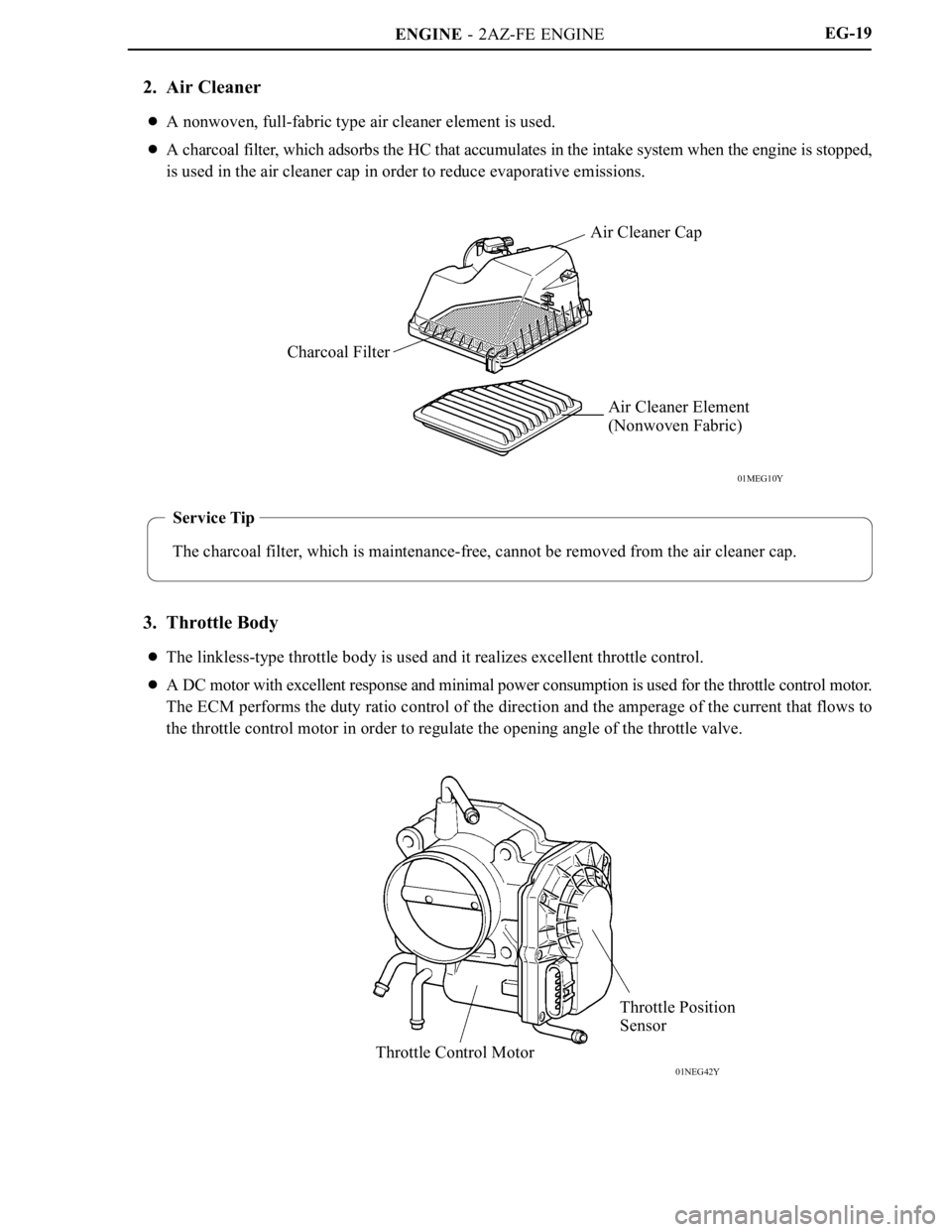
Charcoal FilterAir Cleaner Cap
Air Cleaner Element
(Nonwoven Fabric)
Service Tip
The charcoal filter, which is maintenance-free, cannot be removed from the air cleaner cap.
01NEG42Y
Throttle Position
Sensor
Throttle Control MotorEG-19
2. Air Cleaner
A nonwoven, full-fabric type air cleaner element is used.
A charcoal filter, which adsorbs the HC that accumulates in the intake system when the engine is stopped,
is used in the air cleaner cap in order to reduce evaporative emissions.
3. Throttle Body
The linkless-type throttle body is used and it realizes excellent throttle control.
A DC motor with excellent response and minimal power consumption is used for the throttle control motor.
The ECM performs the duty ratio control of the direction and the amperage of the current that flows to
the throttle control motor in order to regulate the opening angle of the throttle valve.
Page 51 of 2000
ENGINE - 2AZ-FE ENGINE
Service Tip
The canister pump module performs the EVAP leak check. This check is done approximately five
hours after the engine is turned off. So you may hear sound coming from underneath the luggage
compartment for several minutes. It does not indicate a malfunction.
The pinpoint pressure test procedure is carried out by pressurizing the fresh air line that runs from
the pump module to the air filler neck. For details, refer to the 2006 RAV4 Repair Manual (Pub.
No. RM01M1U).
EG-54
10. EVAP (evaporative Emission) Control System
General
The EVAP (evaporative emission) control system prevents the vapor gas that is created in the fuel tank from
being released directly into the atmosphere.
The canister stores the vapor gas that has been created in the fuel tank.
The ECM controls the purge VSV in accordance with the driving conditions in order to direct the vapor
gas into the engine, where it is burned.
In this system, the ECM checks the evaporative emission leak and outputs DTC (Diagnostic Trouble
Code) in the event of a malfunction. An EVAP (evaporative emission) leak check consists of an
application of a vacuum pressure to the system and monitoring the changes in the system pressure in order
to detect a leakage.
This system consists of the purge VSV, canister, refueling valve, canister pump module, and ECM.
The ORVR (Onboard Refueling Vapor Recovery) function is provided in the refueling valve.
The canister pressure sensor has been included to the canister pump module.
The canister filter has been provided on the fresh air line. This canister filter is maintenance-free.
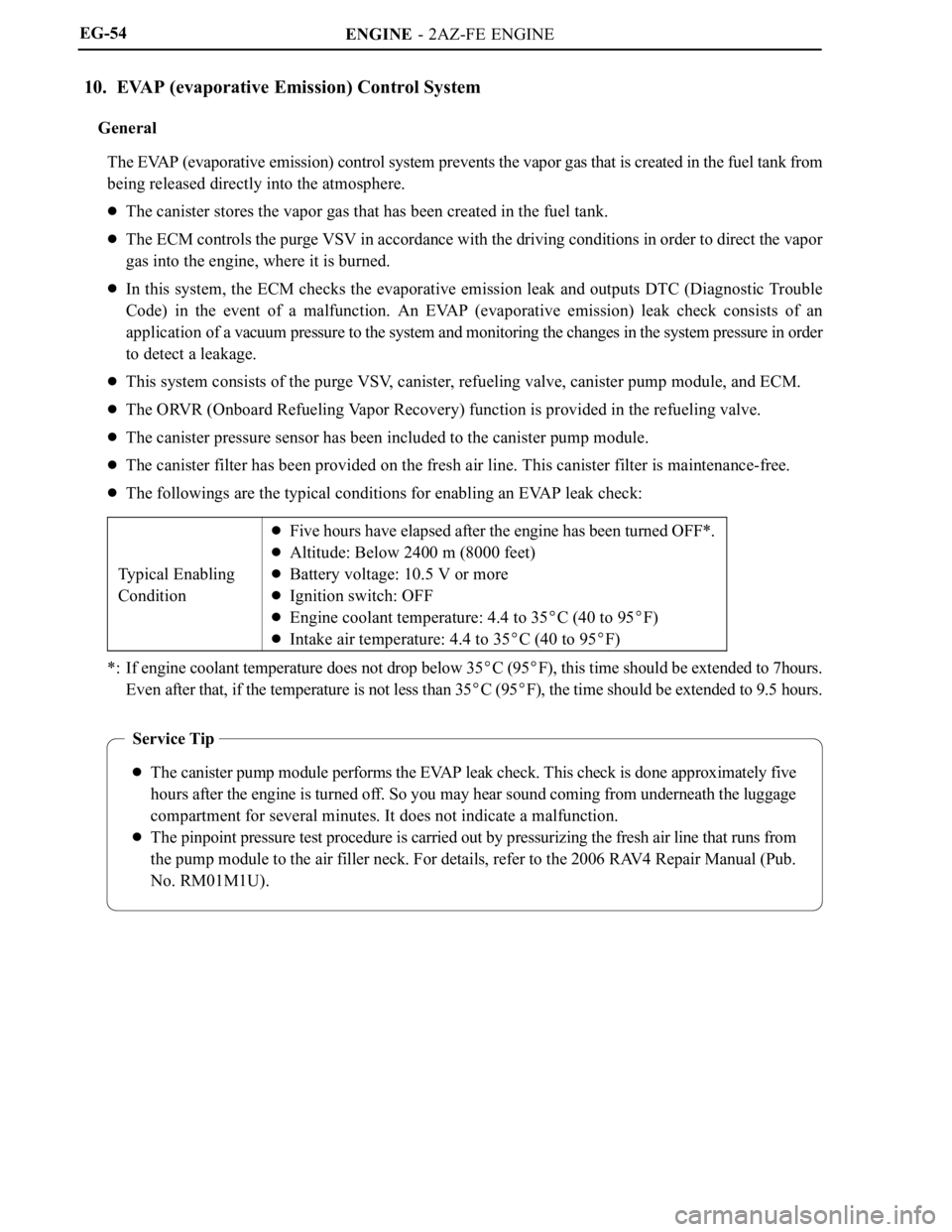
The followings are the typical conditions for enabling an EVAP leak check:
Typical Enabling
Condition
Five hours have elapsed after the engine has been turned OFF*.
Altitude: Below 2400 m (8000 feet)
Battery voltage: 10.5 V or more
Ignition switch: OFF
Engine coolant temperature: 4.4 to 35C (40 to 95F)
Intake air temperature: 4.4 to 35C (40 to 95F)
*: If engine coolant temperature does not drop below 35C (95F), this time should be extended to 7hours.
Even after that, if the temperature is not less than 35
C (95F), the time should be extended to 9.5 hours.
Page 83 of 2000
ENGINE - 2GR-FE ENGINE
01MEG12Y
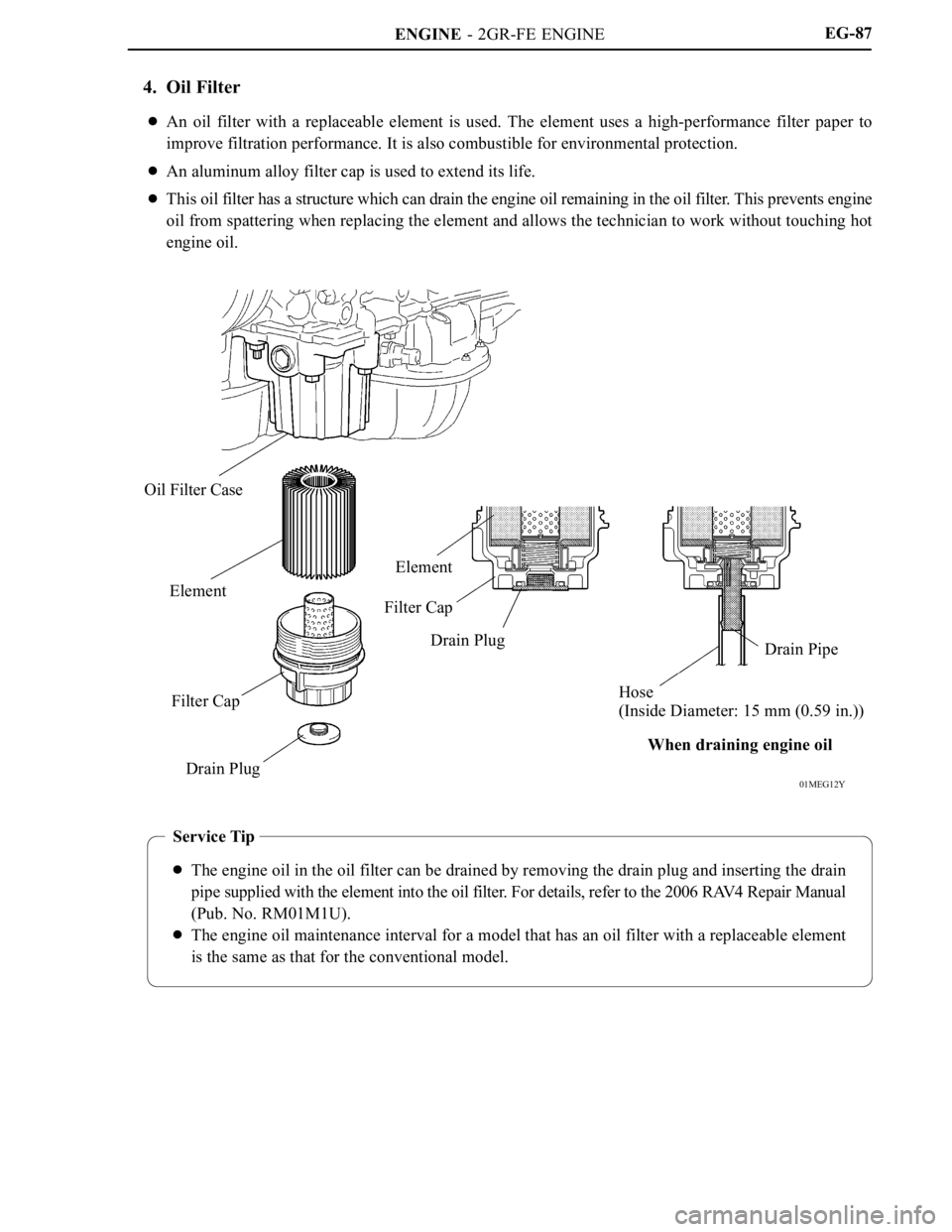
Oil Filter Case
Element
Filter Cap
Drain PlugElement
Filter Cap
Drain Plug
Drain Pipe
Hose
(Inside Diameter: 15 mm (0.59 in.))
When draining engine oil
Service Tip
The engine oil in the oil filter can be drained by removing the drain plug and inserting the drain
pipe supplied with the element into the oil filter. For details, refer to the 2006 RAV4 Repair Manual
(Pub. No. RM01M1U).
The engine oil maintenance interval for a model that has an oil filter with a replaceable element
is the same as that for the conventional model.
EG-87
4. Oil Filter
An oil filter with a replaceable element is used. The element uses a high-performance filter paper to
improve filtration performance. It is also combustible for environmental protection.
An aluminum alloy filter cap is used to extend its life.
This oil filter has a structure which can drain the engine oil remaining in the oil filter. This prevents engine
oil from spattering when replacing the element and allows the technician to work without touching hot
engine oil.
Page 85 of 2000

ENGINE - 2GR-FE ENGINE
285EG29
Timing Chain Cover
Wa t e r P u m p G a s k e t
Wa t e r P u m pVolute ChambersFrom Water Inlet Housing
Rotor
View from Back Side
Cross SectionEG-89
Engine Coolant Specifications
Engine
Ty p e
TOYOTA genuine Super Long Life Coolant
(SLLC) or similar high quality ethylene glycol
based non-silicate, non-amine, non-nitrite and
non-borate coolant with long-life hybrid
organic acid technology (coolant with
long-life hybrid organic acid technology is a
combination of low phosphates and organic
acids.) Do not use plain water alone.
Engine
CoolantColorPink
Capacity
Except Towing
Package Models8.9 Liters (9.4 US qts, 7.8 Imp. qts)
CapacityTowing Package
Models9.2 Liters (9.7 US qts, 8.1 Imp. qts)
Maintenance IntervalsFirst Time100,000 miles (160,000 km)Maintenance IntervalsSubsequentEvery 50,000 miles (80,000 km)
SLLC is pre-mixed (the U.S.A. models: 50 % coolant and 50 % deionized water, the Canada. models: 55
% coolant and 45 % deionized water), so no dilution is needed when SLLC in the vehicle is added or
replaced.
If LLC is mixed with SLLC, the interval for LLC (every 25,000 miles (USA), 32,000 km (CANADA) or
24 months whichever comes first) should be used.
2. Water Pump
The water pump has two volute chambers, and circulates coolant uniformly to the left and right banks of the
cylinder block.
Page 87 of 2000

ENGINE - 2GR-FE ENGINE
01MEG13Y
Air Cleaner Hose with
Resonator
Air Cleaner Cap
Charcoal Filter
Air Cleaner Element
(Nonwoven Fabric)
Air Cleaner Case
Actuator
(For Air Intake Control)
Air Cleaner Inlet
Resonator
285EG32
Throttle Position Sensor
Throttle Control MotorEG-91
2. Air Cleaner
A nonwoven, full-fabric type air cleaner
element is used.
A charcoal filter, which adsorbs the HC that
accumulates in the intake system when the
engine is stopped, is used in the air cleaner case
in order to reduce evaporative emissions. This
filter is maintenance-free.
Along with the use of the air intake control
system, an air intake control valve is provided
on the air cleaner case. For details, see page
EG-128.
Resonators have been provided to reduce the
amount of intake air sound.
3. Throttle Body
A linkless-type throttle body in which the throttle position sensor and the throttle control motor are integrated
is used. It realizes excellent throttle valve control. For details, see page EG-118.
In the throttle control motor, a DC motor with excellent response and minimal power consumption is used.
The ECM performs the duty ratio control of the direction and the amperage of the current that flows to
the throttle control motor in order to regulate the throttle valve angle.
Page 93 of 2000

ENGINE - 2GR-FE ENGINE
285EG40
Iridium Tip
Platinum Tip
Wa t e r J a c k e t Long-reach
Ty p eConventional
Ty p eEG-97
3. Spark Plug
Long-reach type spark plugs are used. This type of spark plugs allow the area of the cylinder head to
receive the spark plugs to be made thick. Thus, the water jacket can be extended near the combustion
chamber, which contributes to cooling performance.
Iridium-tipped spark plugs are used to achieve a 120,000 miles (193,000 km) maintenance interval. By
making the center electrode of iridium, the superior ignition performance as platinum-tipped spark plugs
is achieved and durability has been increased.
Page 182 of 2000

MAINTENANCE – UNDER HOODMA–7
MA
GENERAL MAINTENANCE
(2006/01- )
1. GENERAL NOTES
• Maintenance requirements vary depending on the
country.
• Check the maintenance schedule in the owner's
manual supplement.
• Following the maintenance schedule is mandatory.
• Determine the appropriate time to service the vehicle
using either miles driven or time elapsed, whichever
reaches the specification first.
• Maintain similar intervals between periodic
maintenance, unless otherwise noted.
• Failing to check each vehicle part could lead to poor
engine performance and increase exhaust emissions.
2. WINDSHIELD WASHER FLUID
(a) Check that there is sufficient fluid in the tank.
3. ENGINE COOLANT LEVEL
(a) Check that the coolant level is between the "FULL"
and "LOW" lines on the see-through reservoir.
4. RADIATOR AND HOSES
(a) Check that the front of the radiator is clean and not
blocked by leaves, dirt or bugs.
(b) Check the hoses for cracks, kinks, rot or loose
connections.
5. BATTERY ELECTROLYTE LEVEL
(a) Check that the electrolyte level of all the battery
cells is between the upper and lower level lines on
the case.
HINT:
If the electrolyte level is difficult to see, lightly shake
the vehicle.
6. BRAKE FLUID LEVEL
(a) Check that the brake fluid levels are near the upper
level lines on the see-through reservoirs.
7. ENGINE DRIVE BELT
(a) Check the drive belt for fraying, cracks, wear or
oiliness.
8. ENGINE OIL LEVEL
(a) Check the level on the dipstick with the engine
stopped.
9. AUTOMATIC TRANSAXLE FLUID LEVEL
10. EXHAUST SYSTEM
(a) Check for unusual exhaust sounds or abnormal
exhaust fumes. Inspect the cause and repair it.
Type See procedures
U151E See page AX-126
U151F See page AX-126
Page 339 of 2000
CH–42AZ-FE CHARGING – CHARGING SYSTEM
CH
ON-VEHICLE INSPECTION
1. CHECK BATTERY CONDITION
NOTICE:
If the battery is weak or if the engine is difficult to
start, perform the following procedures.
(a) Check the battery for damage and deformation. If
severe damage, deformation or leakage is found,
replace the battery.
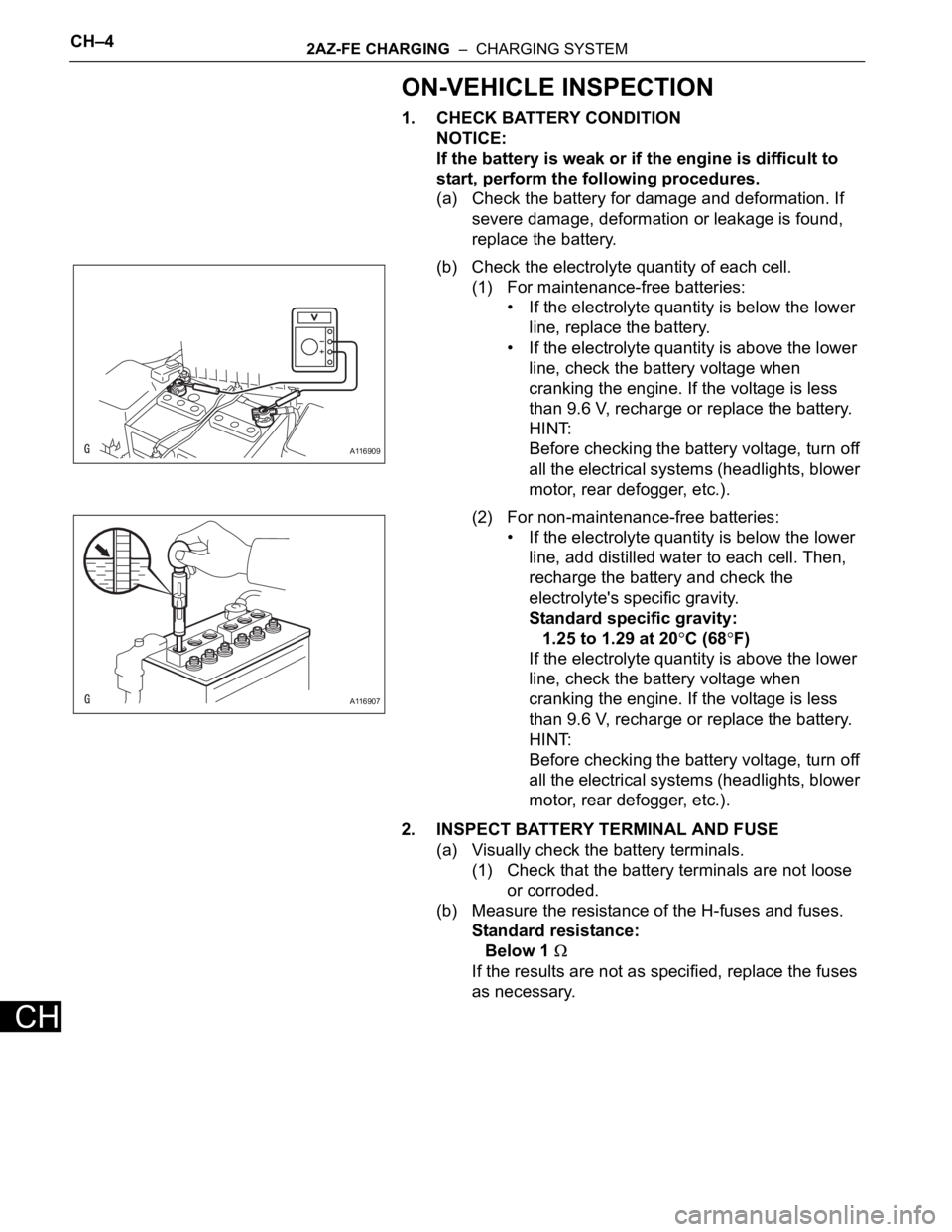
(b) Check the electrolyte quantity of each cell.
(1) For maintenance-free batteries:
• If the electrolyte quantity is below the lower
line, replace the battery.
• If the electrolyte quantity is above the lower
line, check the battery voltage when
cranking the engine. If the voltage is less
than 9.6 V, recharge or replace the battery.
HINT:
Before checking the battery voltage, turn off
all the electrical systems (headlights, blower
motor, rear defogger, etc.).
(2) For non-maintenance-free batteries:
• If the electrolyte quantity is below the lower
line, add distilled water to each cell. Then,
recharge the battery and check the
electrolyte's specific gravity.
Standard specific gravity:
1.25 to 1.29 at 20
C (68F)
If the electrolyte quantity is above the lower
line, check the battery voltage when
cranking the engine. If the voltage is less
than 9.6 V, recharge or replace the battery.
HINT:
Before checking the battery voltage, turn off
all the electrical systems (headlights, blower
motor, rear defogger, etc.).
2. INSPECT BATTERY TERMINAL AND FUSE
(a) Visually check the battery terminals.
(1) Check that the battery terminals are not loose
or corroded.
(b) Measure the resistance of the H-fuses and fuses.
Standard resistance:
Below 1
If the results are not as specified, replace the fuses
as necessary.
A116909
A116907
Page 419 of 2000
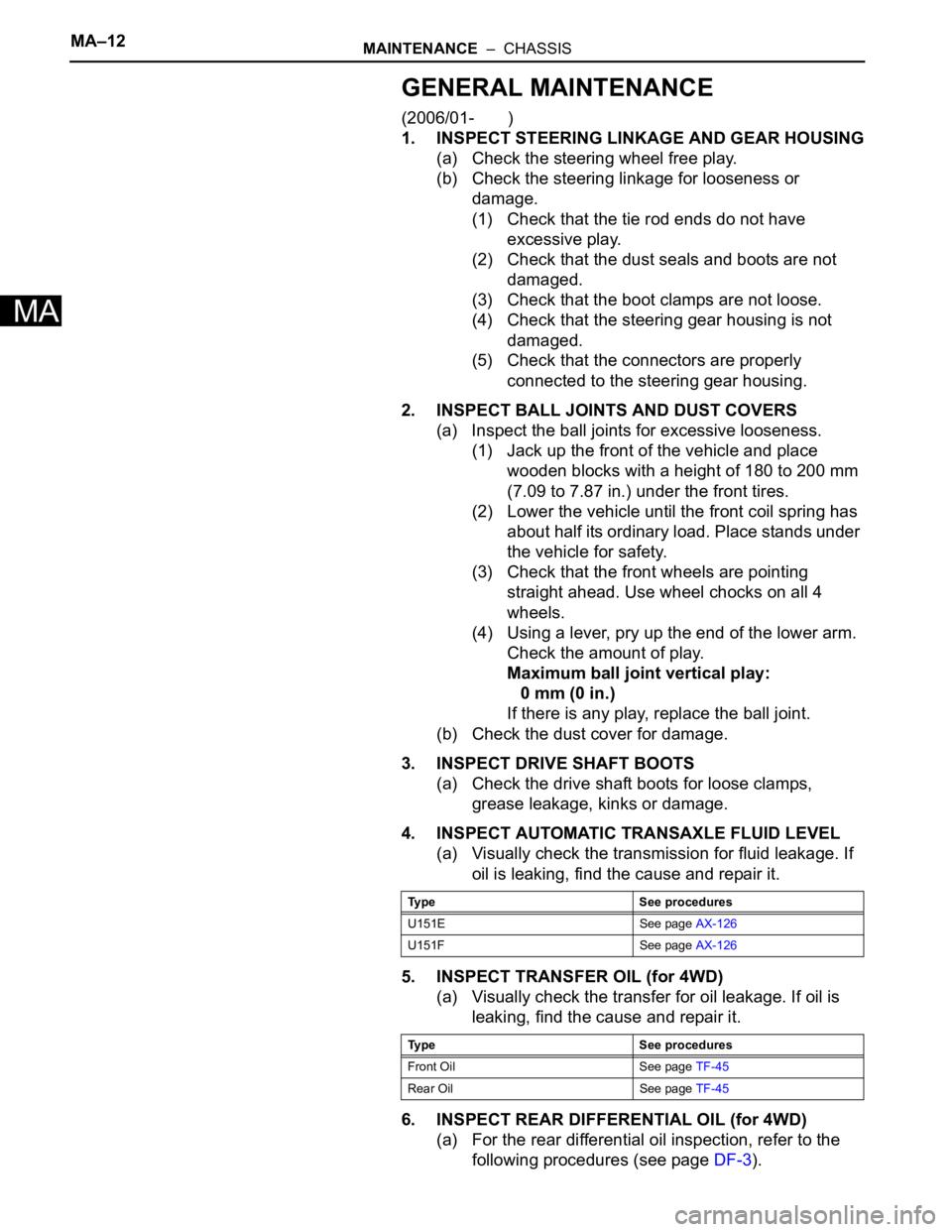
MA–12MAINTENANCE – CHASSIS
MA
GENERAL MAINTENANCE
(2006/01- )
1. INSPECT STEERING LINKAGE AND GEAR HOUSING
(a) Check the steering wheel free play.
(b) Check the steering linkage for looseness or
damage.
(1) Check that the tie rod ends do not have
excessive play.
(2) Check that the dust seals and boots are not
damaged.
(3) Check that the boot clamps are not loose.
(4) Check that the steering gear housing is not
damaged.
(5) Check that the connectors are properly
connected to the steering gear housing.
2. INSPECT BALL JOINTS AND DUST COVERS
(a) Inspect the ball joints for excessive looseness.
(1) Jack up the front of the vehicle and place
wooden blocks with a height of 180 to 200 mm
(7.09 to 7.87 in.) under the front tires.
(2) Lower the vehicle until the front coil spring has
about half its ordinary load. Place stands under
the vehicle for safety.
(3) Check that the front wheels are pointing
straight ahead. Use wheel chocks on all 4
wheels.
(4) Using a lever, pry up the end of the lower arm.
Check the amount of play.
Maximum ball joint vertical play:
0 mm (0 in.)
If there is any play, replace the ball joint.
(b) Check the dust cover for damage.
3. INSPECT DRIVE SHAFT BOOTS
(a) Check the drive shaft boots for loose clamps,
grease leakage, kinks or damage.
4. INSPECT AUTOMATIC TRANSAXLE FLUID LEVEL
(a) Visually check the transmission for fluid leakage. If
oil is leaking, find the cause and repair it.
5. INSPECT TRANSFER OIL (for 4WD)
(a) Visually check the transfer for oil leakage. If oil is
leaking, find the cause and repair it.
6. INSPECT REAR DIFFERENTIAL OIL (for 4WD)
(a) For the rear differential oil inspection, refer to the
following procedures (see page DF-3).
Type See procedures
U151E See page AX-126
U151F See page AX-126
Type See procedures
Front Oil See page TF-45
Rear Oil See page TF-45