fuel cap TOYOTA RAV4 2018 Owners Manual (in English)
[x] Cancel search | Manufacturer: TOYOTA, Model Year: 2018, Model line: RAV4, Model: TOYOTA RAV4 2018Pages: 744, PDF Size: 13.78 MB
Page 3 of 744

3
RAV4_OM_OM0R012U_(U)
1
9 8
7
6 4 3
2
10
5
4-1. Before drivingDriving the vehicle ............. 166
Cargo and luggage............ 176
Vehicle load limits ............. 180
Trailer towing..................... 181
Dinghy towing.................... 197
4-2. Driving procedures Engine (ignition) switch (vehicles without
smart key system) ........... 198
Engine (ignition) switch (vehicles with
smart key system) ........... 200
Automatic transmission ..... 205
Turn signal lever................ 213
Parking brake .................... 214
4-3. Operating the lights and wipers
Headlight switch ................ 215
Automatic High Beam ....... 220
Fog light switch ................. 224
Windshield wipers and washer ..................... 225
Rear window wiper and washer ..................... 229 4-4. Refueling
Opening the fuel tank cap................................... 232
4-5. Using the driving support systems
Toyota Safety Sense P ...... 235
PCS (Pre-Collision System)..... 242
LDA (Lane Departure Alert with steering
control) ............................ 256
Dynamic radar cruise control.............................. 264
Cruise control .................... 276
Intuitive parking assist ....... 280
Rear view monitor system ............................. 289
All-wheel drive lock switch (AWD models) ...... 299
BSM (Blind Spot Monitor)......... 300
• The Blind Spot Monitor function.......................... 304
• The Rear Cross Traffic Alert function ................. 307
Driving assist systems ....... 310
4-6. Driving tips Winter driving tips .............. 317
Utility vehicle precautions ...................... 321
4Driving
Page 15 of 744
15Pictorial index
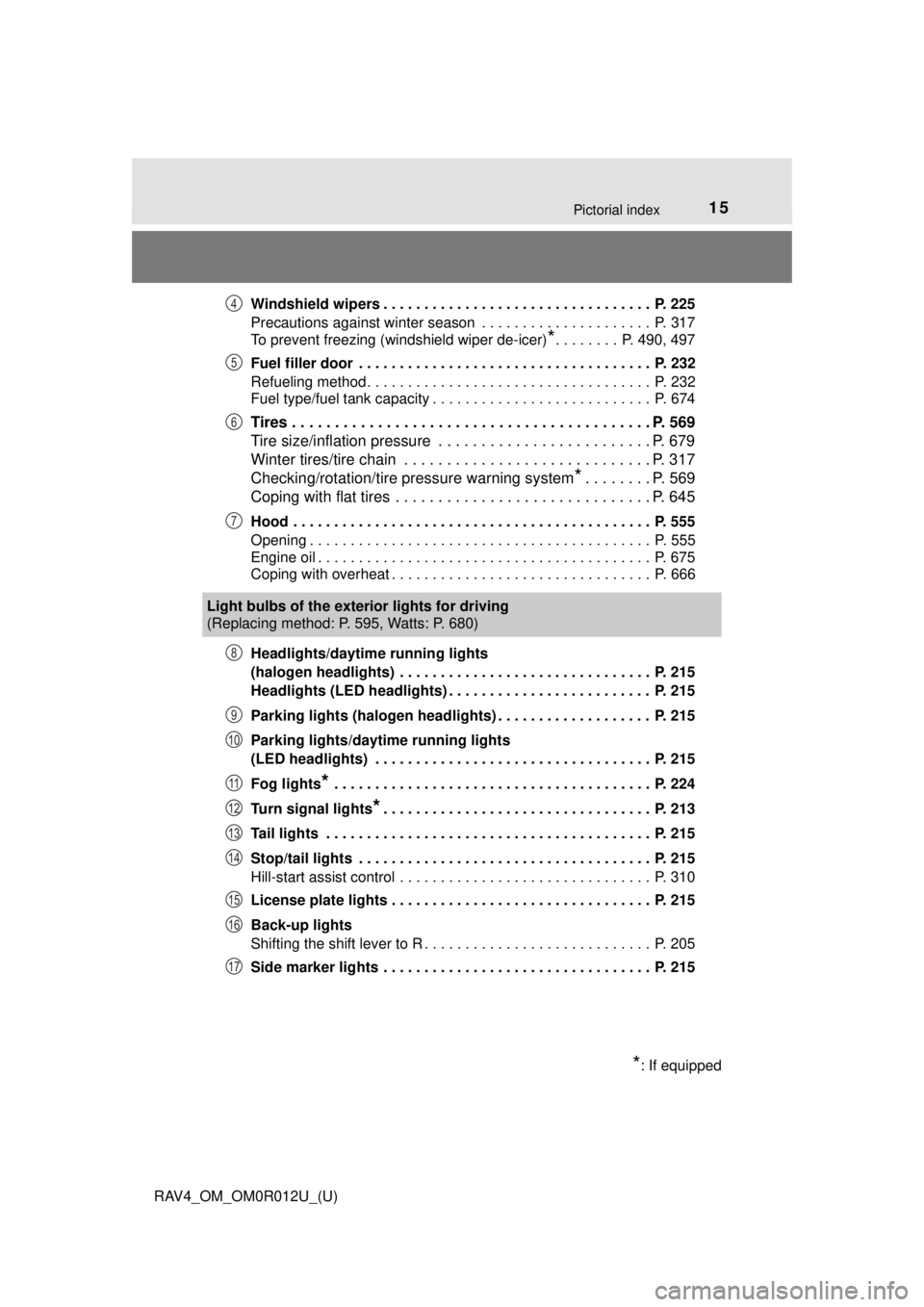
RAV4_OM_OM0R012U_(U)Windshield wipers . . . . . . . . . . . . . . . . . . . . . . . . . . . . . . . . . P. 225
Precautions against winter season . . . . . . . . . . . . . . . . . . . . . P. 317
To prevent freezing (windshield wiper de-icer)
*. . . . . . . . P. 490, 497
Fuel filler door . . . . . . . . . . . . . . . . . . . . . . . . . . . . . . . . . . . . P. 232
Refueling method . . . . . . . . . . . . . . . . . . . . . . . . . . . . . . . . . . . P. 232
Fuel type/fuel tank capacity . . . . . . . . . . . . . . . . . . . . . . . . . . . P. 674
Tires . . . . . . . . . . . . . . . . . . . . . . . . . . . . . . . . . . . . . . . . . . P. 569
Tire size/inflation pressure . . . . . . . . . . . . . . . . . . . . . . . . . P. 679
Winter tires/tire chain . . . . . . . . . . . . . . . . . . . . . . . . . . . . . P. 317
Checking/rotation/tire pressure warning system
*. . . . . . . . P. 569
Coping with flat tires . . . . . . . . . . . . . . . . . . . . . . . . . . . . . . P. 645
Hood . . . . . . . . . . . . . . . . . . . . . . . . . . . . . . . . . . . . . . . . . . . . P. 555
Opening . . . . . . . . . . . . . . . . . . . . . . . . . . . . . . . . . . . . . . . . . . P. 555
Engine oil . . . . . . . . . . . . . . . . . . . . . . . . . . . . . . . . . . . . . . . . . P. 675
Coping with overheat . . . . . . . . . . . . . . . . . . . . . . . . . . . . . . . . P. 666
Headlights/daytime running lights
(halogen headlights) . . . . . . . . . . . . . . . . . . . . . . . . . . . . . . . P. 215
Headlights (LED headlights) . . . . . . . . . . . . . . . . . . . . . . . . . P. 215
Parking lights (halogen headlights) . . . . . . . . . . . . . . . . . . . P. 215
Parking lights/daytime running lights
(LED headlights) . . . . . . . . . . . . . . . . . . . . . . . . . . . . . . . . . . P. 215
Fog lights
* . . . . . . . . . . . . . . . . . . . . . . . . . . . . . . . . . . . . . . . P. 224
Turn signal lights
*. . . . . . . . . . . . . . . . . . . . . . . . . . . . . . . . . P. 213
Tail lights . . . . . . . . . . . . . . . . . . . . . . . . . . . . . . . . . . . . . . . . P. 215
Stop/tail lights . . . . . . . . . . . . . . . . . . . . . . . . . . . . . . . . . . . . P. 215
Hill-start assist control . . . . . . . . . . . . . . . . . . . . . . . . . . . . . . . P. 310
License plate lights . . . . . . . . . . . . . . . . . . . . . . . . . . . . . . . . P. 215
Back-up lights
Shifting the shift lever to R . . . . . . . . . . . . . . . . . . . . . . . . . . . . P. 205
Side marker lights . . . . . . . . . . . . . . . . . . . . . . . . . . . . . . . . . P. 215
4
5
6
7
Light bulbs of the exter ior lights for driving
(Replacing method: P. 595, Watts: P. 680)
*: If equipped
8
9
10
11
12
13
14
15
16
17
Page 165 of 744
165
RAV4_OM_OM0R012U_(U)
4Driving
4-1. Before drivingDriving the vehicle ............. 166
Cargo and luggage ........... 176
Vehicle load limits ............. 180
Trailer towing..................... 181
Dinghy towing ................... 197
4-2. Driving procedures Engine (ignition) switch (vehicles without
smart key system) ........... 198
Engine (ignition) switch (vehicles with
smart key system) ........... 200
Automatic transmission ..... 205
Turn signal lever................ 213
Parking brake .................... 214
4-3. Operating the lights and wipers
Headlight switch ................ 215
Automatic High Beam ....... 220
Fog light switch ................. 224
Windshield wipers and washer ..................... 225
Rear window wiper and washer ..................... 229 4-4. Refueling
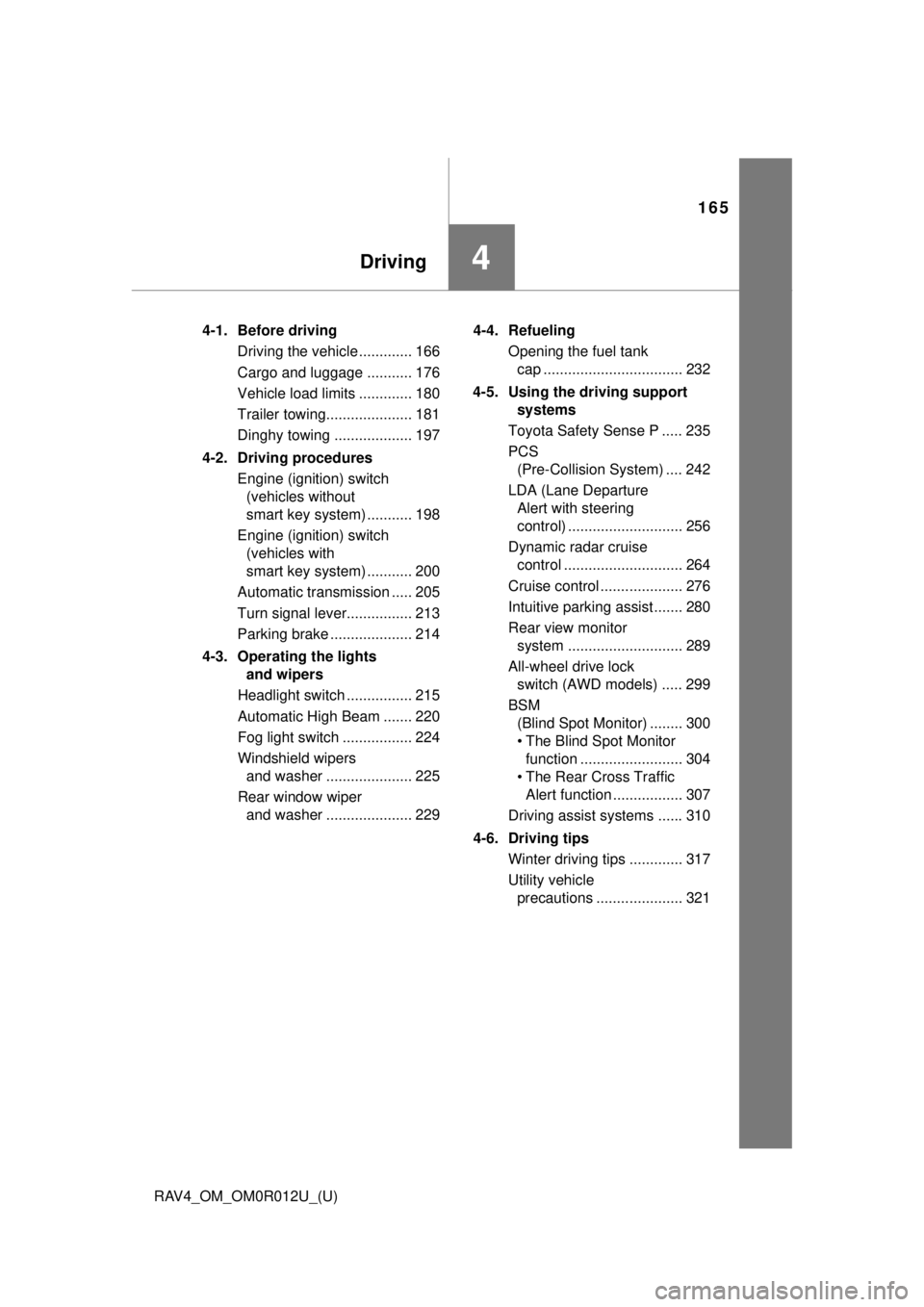
Opening the fuel tank cap .................................. 232
4-5. Using the driving support systems
Toyota Safety Sense P ..... 235
PCS (Pre-Collision System) .... 242
LDA (Lane Departure Alert with steering
control) ............................ 256
Dynamic radar cruise control ............................. 264
Cruise control .................... 276
Intuitive parking assist....... 280
Rear view monitor system ............................ 289
All-wheel drive lock switch (AWD models) ..... 299
BSM (Blind Spot Monitor) ........ 300
• T he Blind Spot Monitor
function ......................... 304
• T he Rear Cross Traffic
Alert function ................. 307
Driving assist systems ...... 310
4-6. Driving tips Winter driving tips ............. 317
Utility vehicle precautions ..................... 321
Page 232 of 744
232
RAV4_OM_OM0R012U_(U)
4-4. Refueling
Opening the fuel tank cap
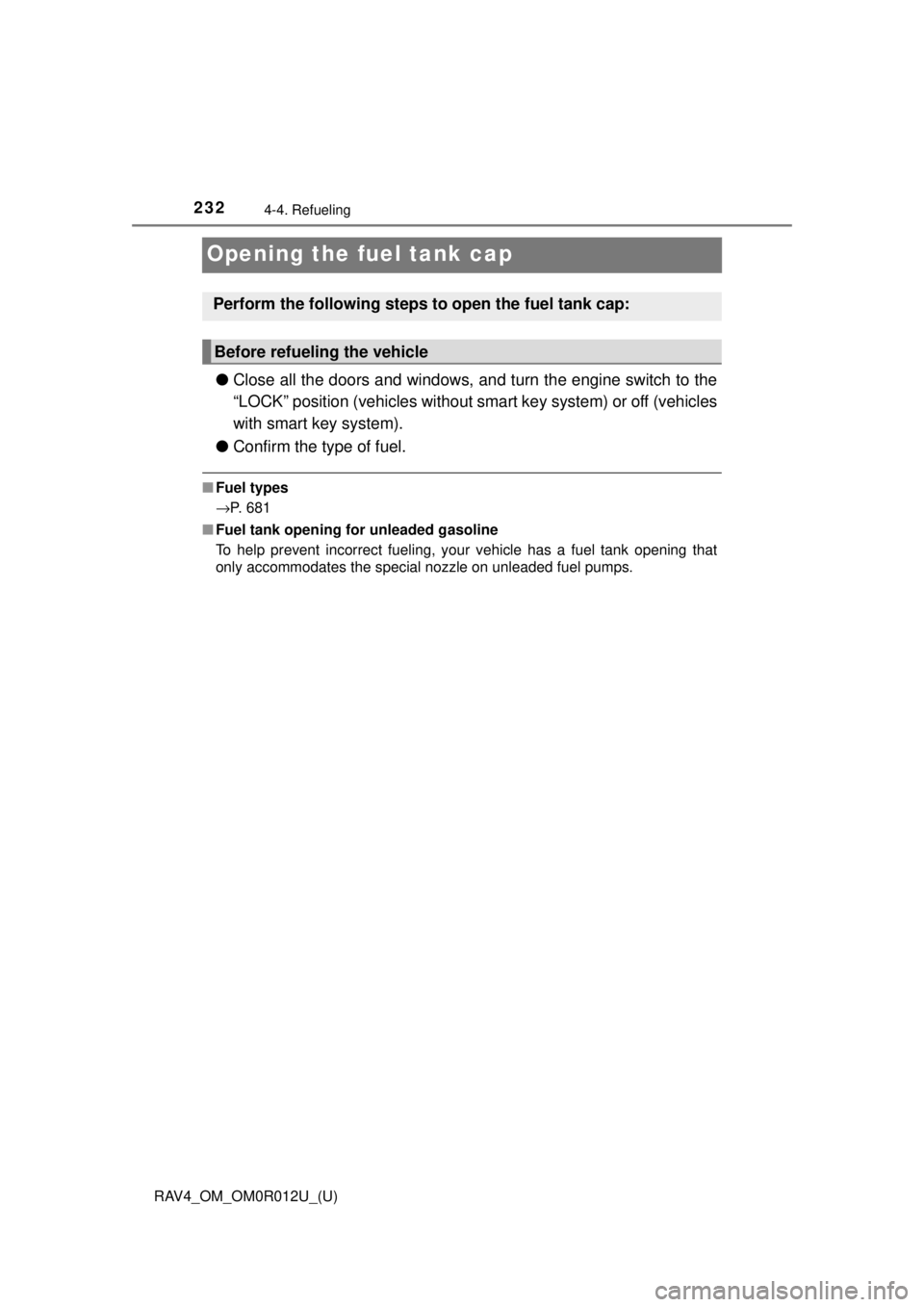
●Close all the doors and windows, and turn the engine switch to the
“LOCK” position (vehicles without smart key system) or off (vehicles
with smart key system).
● Confirm the type of fuel.
■Fuel types
→P. 681
■ Fuel tank opening for unleaded gasoline
To help prevent incorrect fueling, your vehicle has a fuel tank opening that
only accommodates the special nozzle on unleaded fuel pumps.
Perform the following steps to open the fuel tank cap:
Before refueling the vehicle
Page 233 of 744
RAV4_OM_OM0R012U_(U)
2334-4. Refueling
4
Driving
WARNING
■When refueling the vehicle
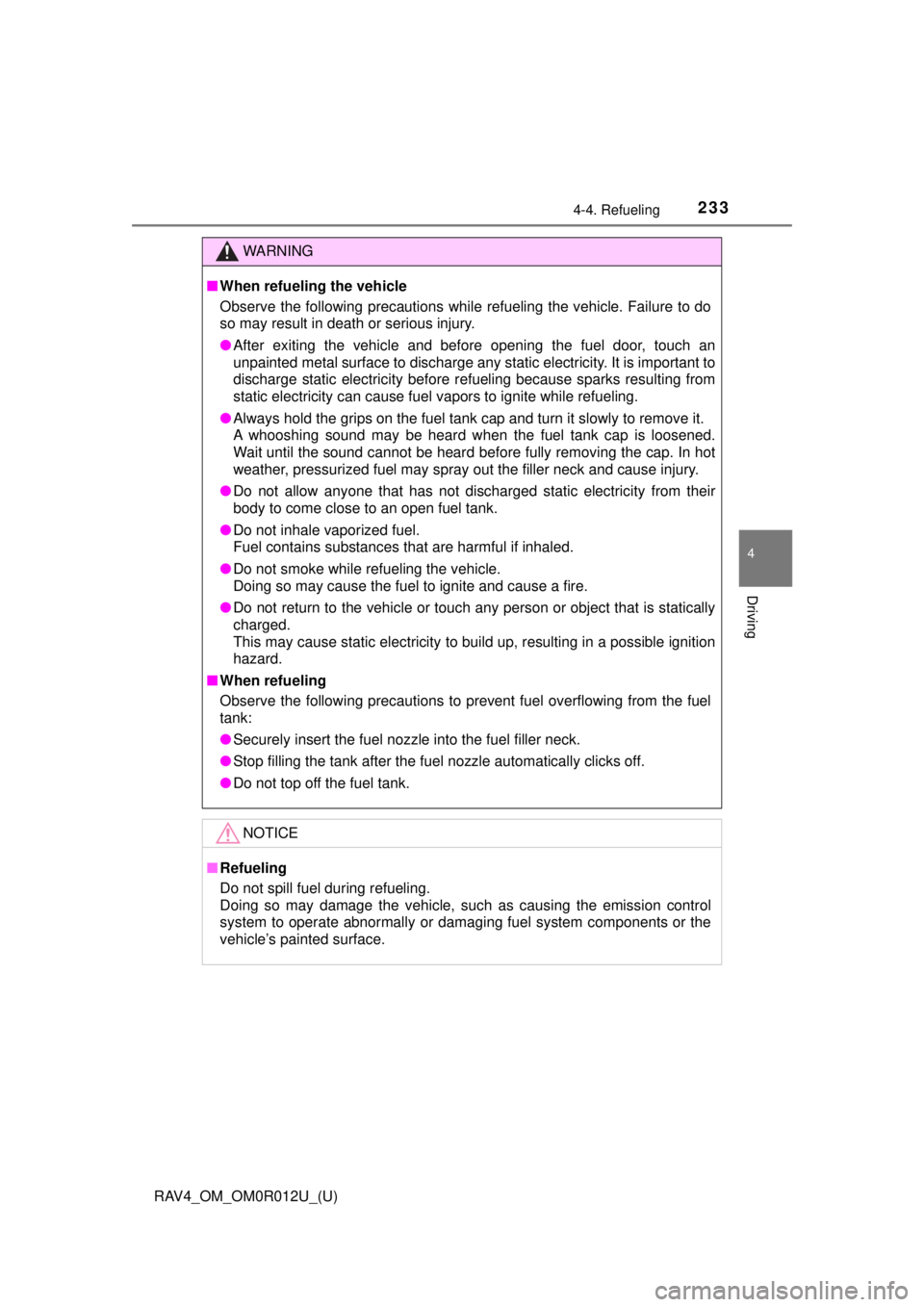
Observe the following precautions while refueling the vehicle. Failure to do
so may result in death or serious injury.
● After exiting the vehicle and before opening the fuel door, touch an
unpainted metal surface to discharge any static electricity. It is important to
discharge static electricity before refueling because sparks resulting from
static electricity can cause fuel vapors to ignite while refueling.
● Always hold the grips on the fuel tank cap and turn it slowly to remove it.
A whooshing sound may be heard when the fuel tank cap is loosened.
Wait until the sound cannot be heard before fully removing the cap. In hot
weather, pressurized fuel may spray out the filler neck and cause injury.
● Do not allow anyone that has not discharged static electricity from their
body to come close to an open fuel tank.
● Do not inhale vaporized fuel.
Fuel contains substances that are harmful if inhaled.
● Do not smoke while refueling the vehicle.
Doing so may cause the fuel to ignite and cause a fire.
● Do not return to the vehicle or touch any person or object that is statically
charged.
This may cause static electricity to build up, resulting in a possible ignition
hazard.
■ When refueling
Observe the following precautions to prevent fuel overflowing from the fuel
tank:
● Securely insert the fuel nozzle into the fuel filler neck.
● Stop filling the tank after the fuel nozzle automatically clicks off.
● Do not top off the fuel tank.
NOTICE
■Refueling
Do not spill fuel during refueling.
Doing so may damage the vehicle, such as causing the emission control
system to operate abnormally or damaging fuel system components or the
vehicle’s painted surface.
Page 234 of 744
234
RAV4_OM_OM0R012U_(U)
4-4. Refueling
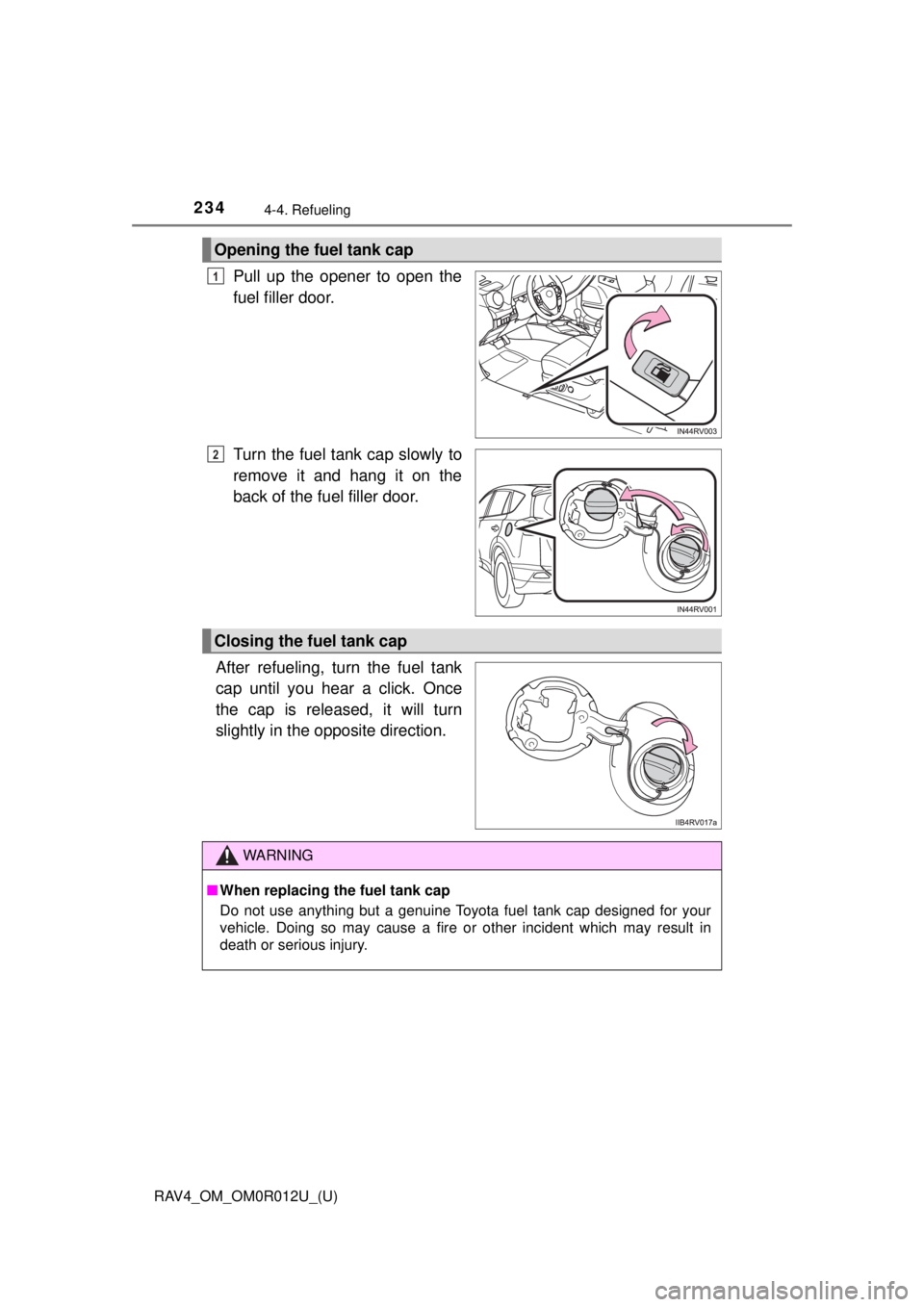
Pull up the opener to open the
fuel filler door.
Turn the fuel tank cap slowly to
remove it and hang it on the
back of the fuel filler door.
After refueling, turn the fuel tank
cap until you hear a click. Once
the cap is released, it will turn
slightly in the opposite direction.
Opening the fuel tank cap
1
2
Closing the fuel tank cap
WARNING
■ When replacing the fuel tank cap
Do not use anything but a genuine Toyota fuel tank cap designed for your
vehicle. Doing so may cause a fire or other incident which may result in
death or serious injury.
Page 492 of 744
492
RAV4_OM_OM0R012U_(U)
6-1. Using the air conditioning system and defogger
■Operation of the air conditio ning system in Eco drive mode
In Eco drive mode, the air conditioning system is controlled to prioritize fuel
efficiency by regulating the engine speed and compressor operation to
restrict the heating/cooling capacity.
To improve air conditioning performance, perform the following operations:
● Adjust the fan speed
● Adjust the temperature setting
● Turn off Eco drive mode ( →P. 207)
■ Fogging up of the windows
●The windows will easily fog up when the humidity in the vehicle is high.
Turning on will dehumidify the air from the outlets and defog the wind-
shield effectively.
● If you turn off, the windows may fog up more easily.
● The windows may fog up if the recirculated air mode is used.
■ Outside/recirculated air mode
When driving on dusty roads such as tunnels or in heavy traffic, set the out-
side/recirculated air mode button to the recirculated air mode. This is effective
in preventing outside air from entering the vehicle interior. During cooling
operation, setting the recirculated air mode will also cool the vehicle interior
effectively.
■ When the outside temperature is low (vehicles with the “A/C” button)
The dehumidification function may not operate even when the “A/C” button is
pressed.
■ Ventilation and air conditioning odors
●To let fresh air in, set the air conditioning system to the outside air m\
ode.
● During use, various odors from inside and outside the vehicle may enter into
and accumulate in the air conditioning system. This may then cause odor to
be emitted from the vents.
● To reduce potential odors from occurring:
It is recommended that the air conditioning system be set to outside air
mode prior to turning the vehicle off.
■ Air conditioning filter
→P. 587
Page 499 of 744
RAV4_OM_OM0R012U_(U)
4996-1. Using the air conditioning system and defogger
6
Interior features
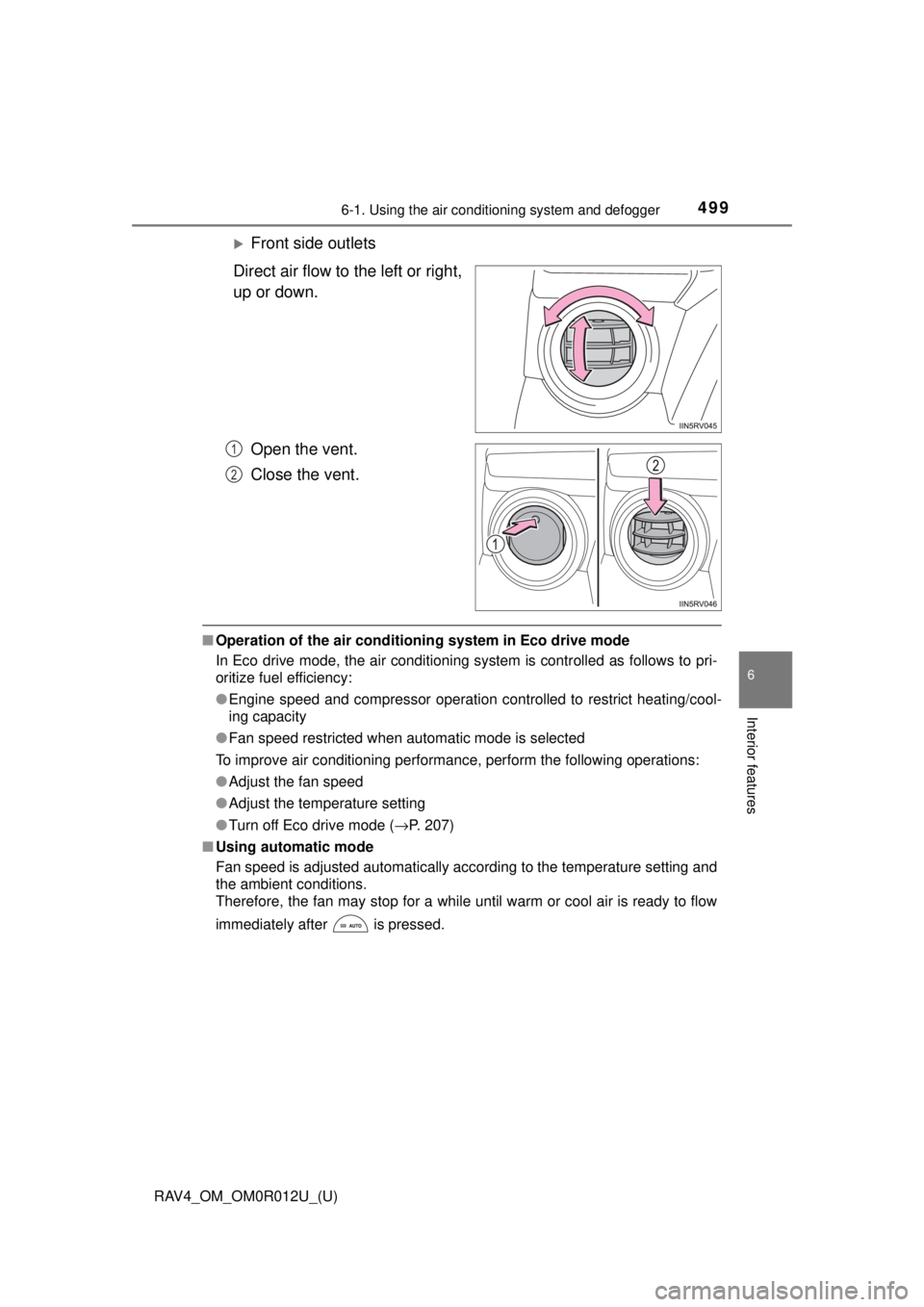
Front side outlets
Direct air flow to the left or right,
up or down.
Open the vent.
Close the vent.
■Operation of the air conditio ning system in Eco drive mode
In Eco drive mode, the air conditioning system is controlled as follows to pri-
oritize fuel efficiency:
● Engine speed and compressor operation controlled to restrict heating/cool-
ing capacity
● Fan speed restricted when automatic mode is selected
To improve air conditioning performance, perform the following operations:
● Adjust the fan speed
● Adjust the temperature setting
● Turn off Eco drive mode ( →P. 207)
■ Using automatic mode
Fan speed is adjusted automatically according to the temperature setting and
the ambient conditions.
Therefore, the fan may stop for a while until warm or cool air is ready to flow
immediately after is pressed.
1
2
Page 552 of 744
552
RAV4_OM_OM0R012U_(U)
7-2. Maintenance
Emission inspection and maintenance (I/M)
programs
The OBD system determin es that a problem exists somewhere in the
emission control system. Your vehi cle may not pass the I/M test and
may need to be repaired. Contact your Toyota dealer to service the
vehicle.
● When the battery is disconnected or discharged
Readiness codes that are set duri ng ordinary driving are erased.
Also, depending on your driving habits, the readiness codes may
not be completely set.
● When the fuel tank cap is loose
The malfunction indicator lamp comes on indicating a temporary
malfunction and your vehicle may not pass the I/M test.
The error code in the OBD system will not be cleared unless the vehi-
cle is driven 40 or more times.
Contact your Toyota dealer to prepare the vehicle for re-testing.
Some states have vehicle emission inspection programs which
include OBD (On Board Diagnos tics) checks. The OBD system
monitors the operation of the emission control system.
If the malfunction indicator lamp comes on
Your vehicle may not pass the I/M test in the following situations:
When the malfunction indicator la mp still remains on after sev-
eral driving trips
If your vehicle does not pass the I/M test
Page 582 of 744
582
RAV4_OM_OM0R012U_(U)
7-3. Do-it-yourself maintenance
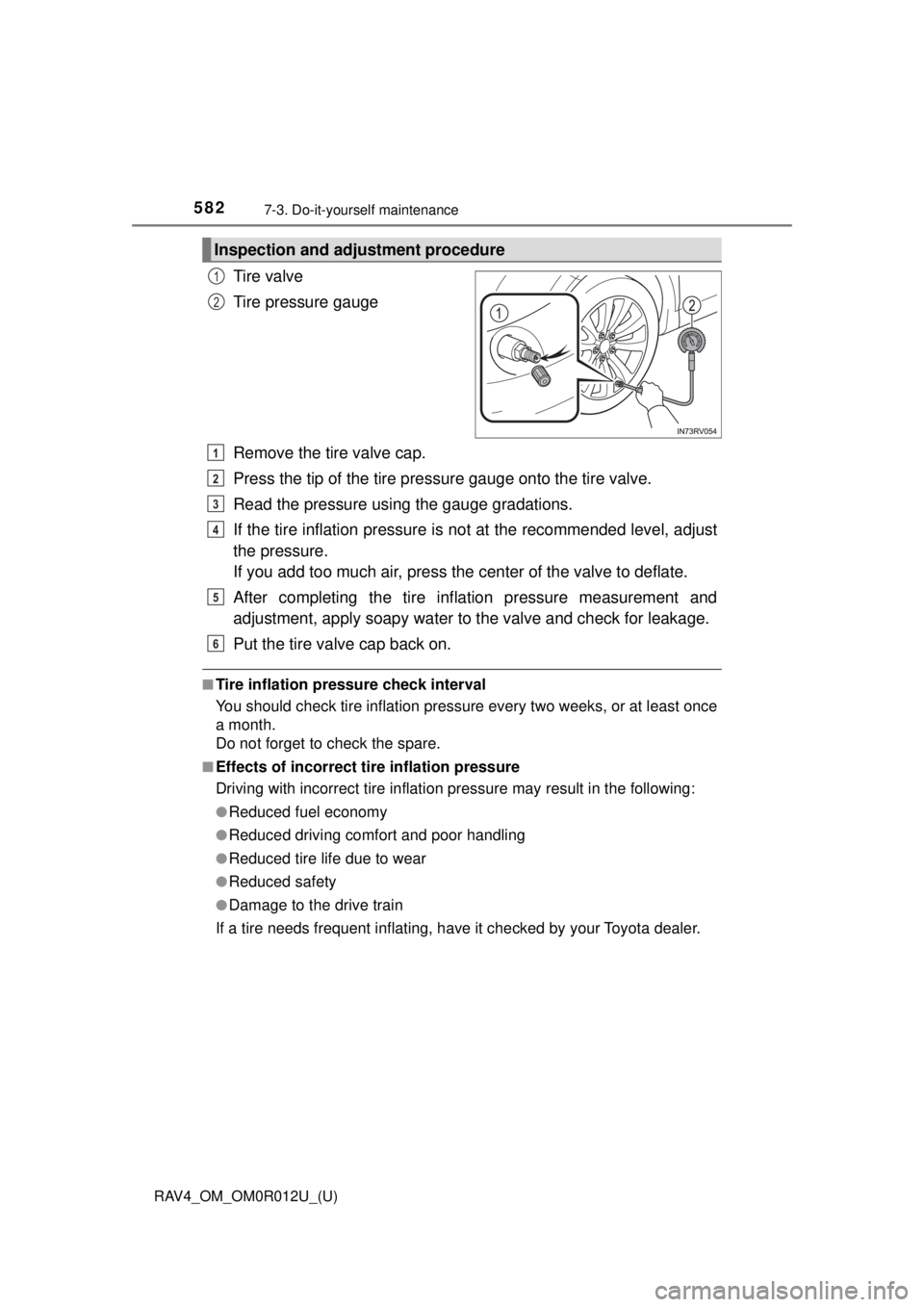
Tire valve
Tire pressure gauge
Remove the tire valve cap.
Press the tip of the tire pressure gauge onto the tire valve.
Read the pressure usi ng the gauge gradations.
If the tire inflation pressure is not at the recommended level, adjust
the pressure.
If you add too much air, press the center of the valve to deflate.
After completing the tire inflation pressure measurement and
adjustment, apply soapy water to the valve and check for leakage.
Put the tire valve cap back on.
■Tire inflation pressure check interval
You should check tire inflation pressure every two weeks, or at least once
a month.
Do not forget to check the spare.
■Effects of incorrect tire inflation pressure
Driving with incorrect tire inflation pressure may result in the following:
●Reduced fuel economy
●Reduced driving comfort and poor handling
●Reduced tire life due to wear
●Reduced safety
●Damage to the drive train
If a tire needs frequent inflating, have it checked by your Toyota dealer.
Inspection and adjustment procedure
1
2
1
2
3
4
5
6