high beam TOYOTA RAV4 2018 Owners Manual (in English)
[x] Cancel search | Manufacturer: TOYOTA, Model Year: 2018, Model line: RAV4, Model: TOYOTA RAV4 2018Pages: 744, PDF Size: 13.78 MB
Page 3 of 744
3
RAV4_OM_OM0R012U_(U)
1
9 8
7
6 4 3
2
10
5
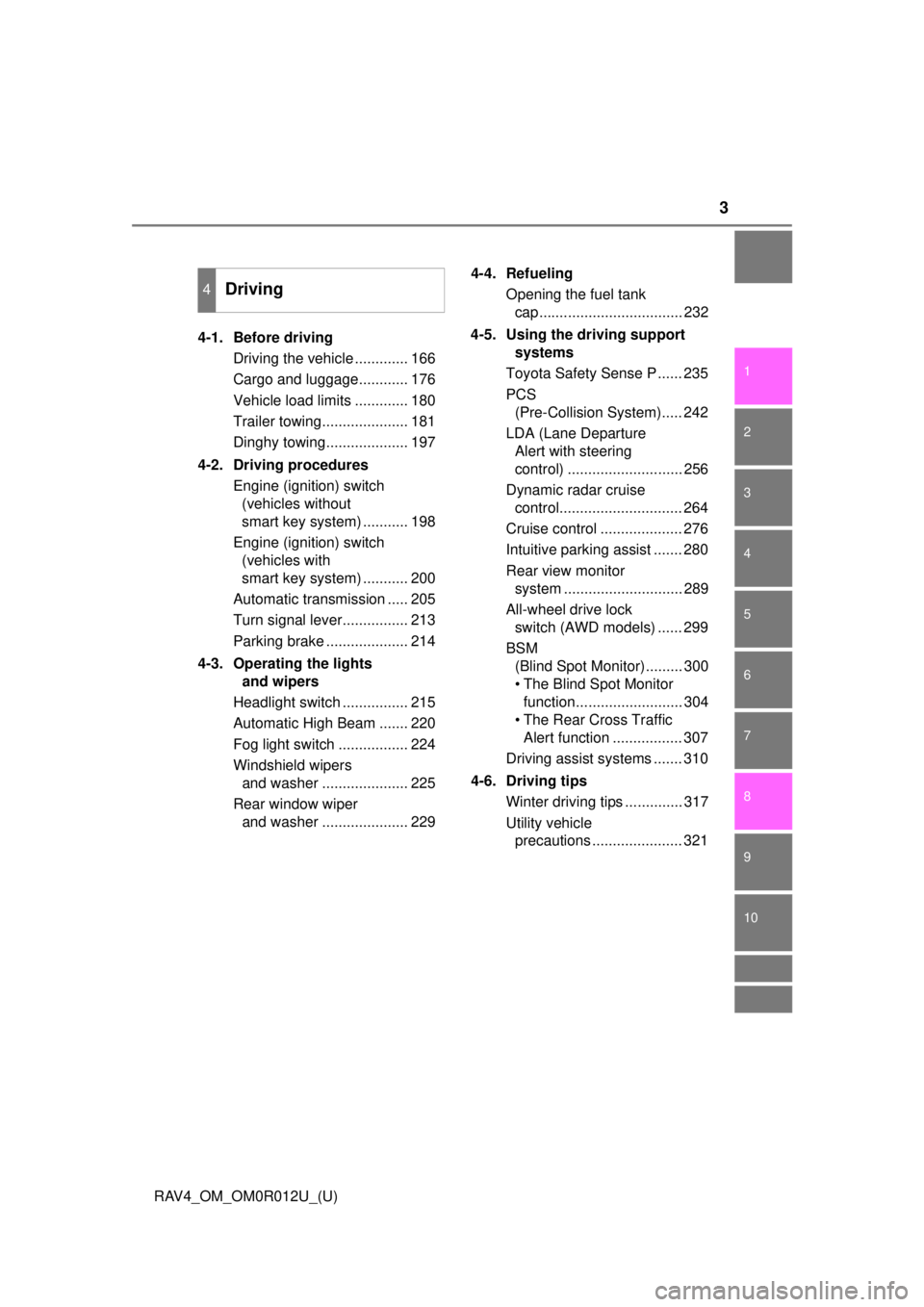
4-1. Before drivingDriving the vehicle ............. 166
Cargo and luggage............ 176
Vehicle load limits ............. 180
Trailer towing..................... 181
Dinghy towing.................... 197
4-2. Driving procedures Engine (ignition) switch (vehicles without
smart key system) ........... 198
Engine (ignition) switch (vehicles with
smart key system) ........... 200
Automatic transmission ..... 205
Turn signal lever................ 213
Parking brake .................... 214
4-3. Operating the lights and wipers
Headlight switch ................ 215
Automatic High Beam ....... 220
Fog light switch ................. 224
Windshield wipers and washer ..................... 225
Rear window wiper and washer ..................... 229 4-4. Refueling
Opening the fuel tank cap................................... 232
4-5. Using the driving support systems
Toyota Safety Sense P ...... 235
PCS (Pre-Collision System)..... 242
LDA (Lane Departure Alert with steering
control) ............................ 256
Dynamic radar cruise control.............................. 264
Cruise control .................... 276
Intuitive parking assist ....... 280
Rear view monitor system ............................. 289
All-wheel drive lock switch (AWD models) ...... 299
BSM (Blind Spot Monitor)......... 300
• The Blind Spot Monitor function.......................... 304
• The Rear Cross Traffic Alert function ................. 307
Driving assist systems ....... 310
4-6. Driving tips Winter driving tips .............. 317
Utility vehicle precautions ...................... 321
4Driving
Page 81 of 744
RAV4_OM_OM0R012U_(U)
812. Instrument cluster
2
Instrument cluster
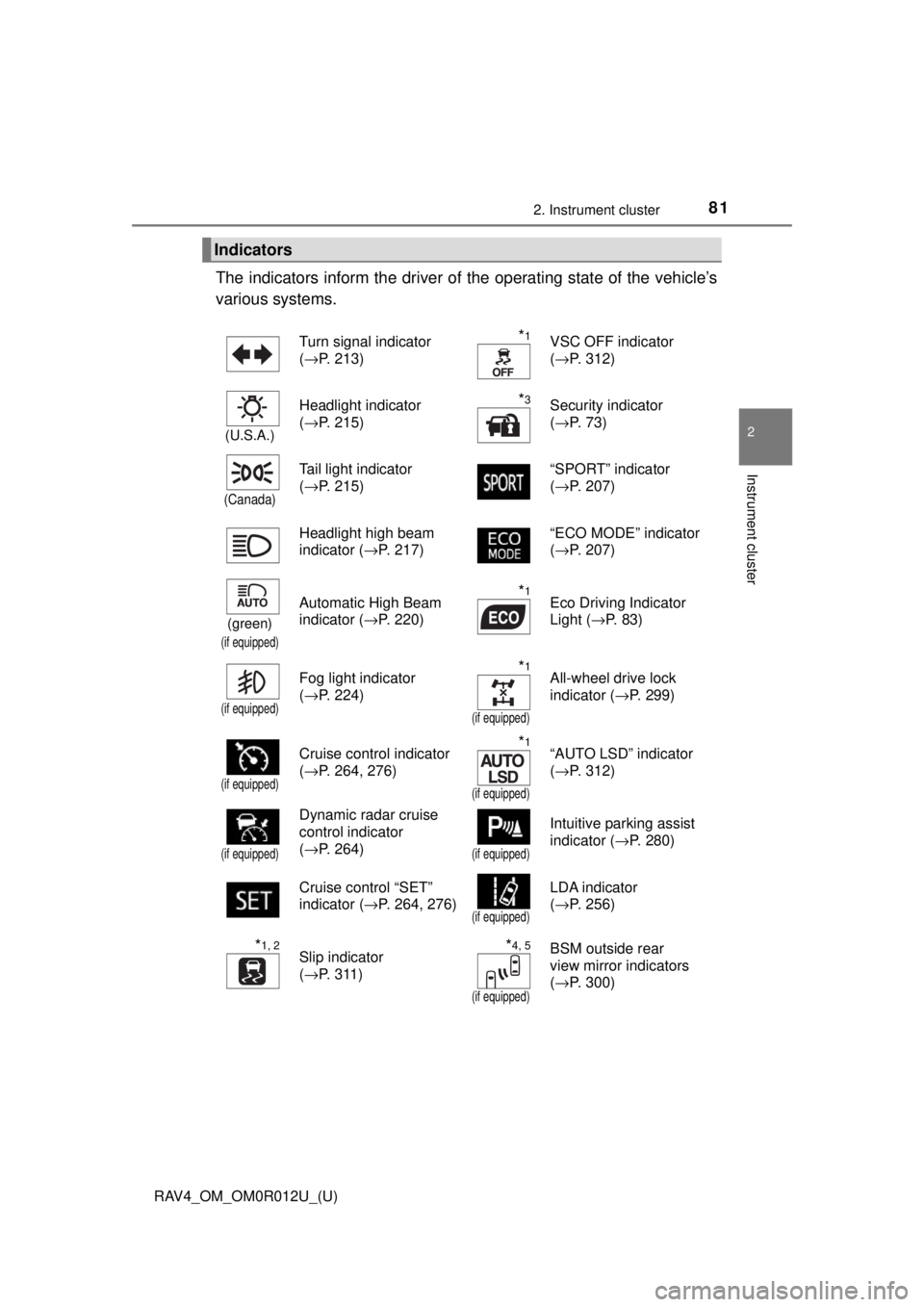
The indicators inform the driver of the operating state of the vehicle’s
various systems.
Indicators
Turn signal indicator
( →P. 213)*1VSC OFF indicator
(→P. 312)
(U.S.A.)
Headlight indicator
(→P. 215)*3Security indicator
(→P. 73)
(Canada)
Tail light indicator
(→P. 215) “SPORT” indicator
(
→P. 207)
Headlight high beam
indicator ( →P. 217) “ECO MODE” indicator
(
→P. 207)
(green)
(if equipped)
Automatic High Beam
indicator ( →P. 220)*1Eco Driving Indicator
Light (→P. 83)
(if equipped)
Fog light indicator
(→P. 224)*1
(if equipped)
All-wheel drive lock
indicator ( →P. 299)
(if equipped)
Cruise control indicator
(→P. 264, 276)*1
(if equipped)
“AUTO LSD” indicator
(→P. 312)
(if equipped)
Dynamic radar cruise
control indicator
(→P. 264)
(if equipped)
Intuitive parking assist
indicator ( →P. 280)
Cruise control “SET”
indicator ( →P. 264, 276)
(if equipped)
LDA indicator
(→P. 256)
*1, 2Slip indicator
(→P. 311)*4, 5
(if equipped)
BSM outside rear
view mirror indicators
(→P. 300)
Page 165 of 744
165
RAV4_OM_OM0R012U_(U)
4Driving
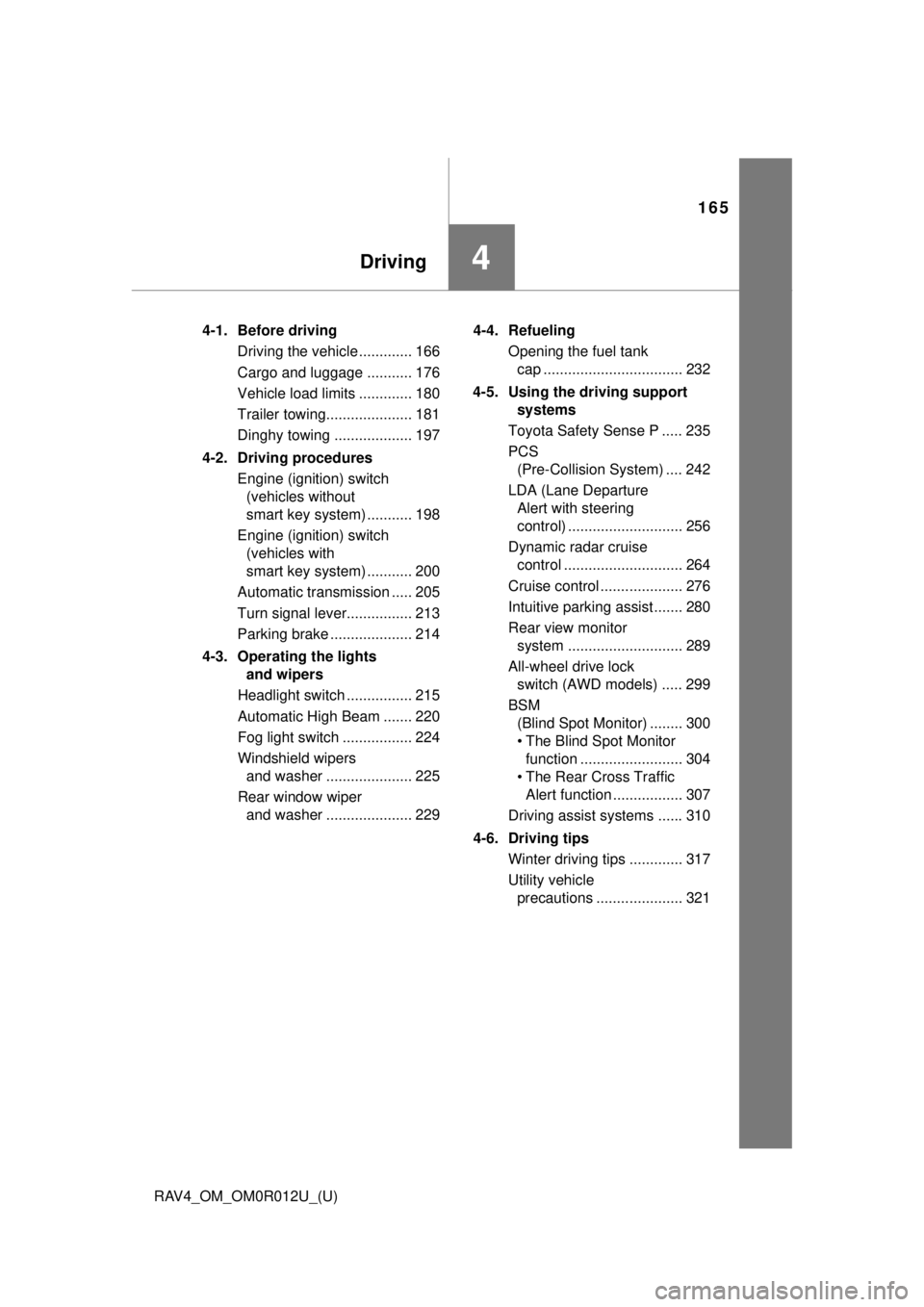
4-1. Before drivingDriving the vehicle ............. 166
Cargo and luggage ........... 176
Vehicle load limits ............. 180
Trailer towing..................... 181
Dinghy towing ................... 197
4-2. Driving procedures Engine (ignition) switch (vehicles without
smart key system) ........... 198
Engine (ignition) switch (vehicles with
smart key system) ........... 200
Automatic transmission ..... 205
Turn signal lever................ 213
Parking brake .................... 214
4-3. Operating the lights and wipers
Headlight switch ................ 215
Automatic High Beam ....... 220
Fog light switch ................. 224
Windshield wipers and washer ..................... 225
Rear window wiper and washer ..................... 229 4-4. Refueling
Opening the fuel tank cap .................................. 232
4-5. Using the driving support systems
Toyota Safety Sense P ..... 235
PCS (Pre-Collision System) .... 242
LDA (Lane Departure Alert with steering
control) ............................ 256
Dynamic radar cruise control ............................. 264
Cruise control .................... 276
Intuitive parking assist....... 280
Rear view monitor system ............................ 289
All-wheel drive lock switch (AWD models) ..... 299
BSM (Blind Spot Monitor) ........ 300
• T he Blind Spot Monitor
function ......................... 304
• T he Rear Cross Traffic
Alert function ................. 307
Driving assist systems ...... 310
4-6. Driving tips Winter driving tips ............. 317
Utility vehicle precautions ..................... 321
Page 217 of 744
RAV4_OM_OM0R012U_(U)
2174-3. Operating the lights and wipers
4
Driving
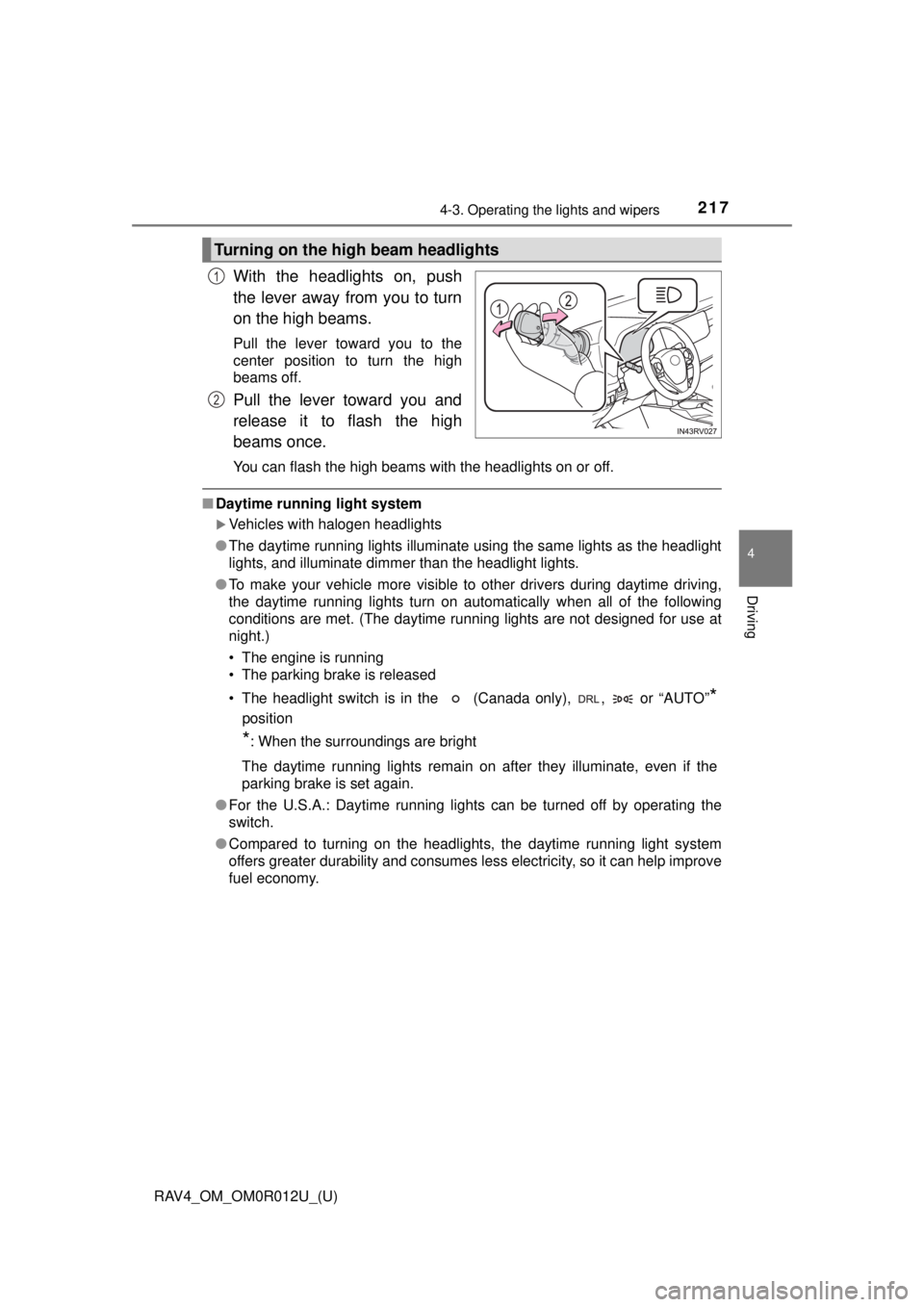
With the headlights on, push
the lever away from you to turn
on the high beams.
Pull the lever toward you to the
center position to turn the high
beams off.
Pull the lever toward you and
release it to flash the high
beams once.
You can flash the high beams with the headlights on or off.
■Daytime running light system
Vehicles with halogen headlights
● The daytime running lights illuminate using the same lights as the headlight
lights, and illuminate dimmer than the headlight lights.
● To make your vehicle more visible to other drivers during daytime driving,
the daytime running lights turn on automatically when all of the following
conditions are met. (The daytime running lights are not designed for use at
night.)
• The engine is running
• The parking brake is released
• The headlight switch is in the (Canada only), , or “AUTO”
*
position
*: When the surroundings are bright
The daytime running lights remain on after they illuminate, even if the
parking brake is set again.
● For the U.S.A.: Daytime running lights can be turned off by operating the
switch.
● Compared to turning on the headlights, the daytime running light system
offers greater durability and consumes less electricity, so it can help improve
fuel economy.
Turning on the high beam headlights
1
2
Page 220 of 744
220
RAV4_OM_OM0R012U_(U)
4-3. Operating the lights and wipers
Automatic High Beam∗
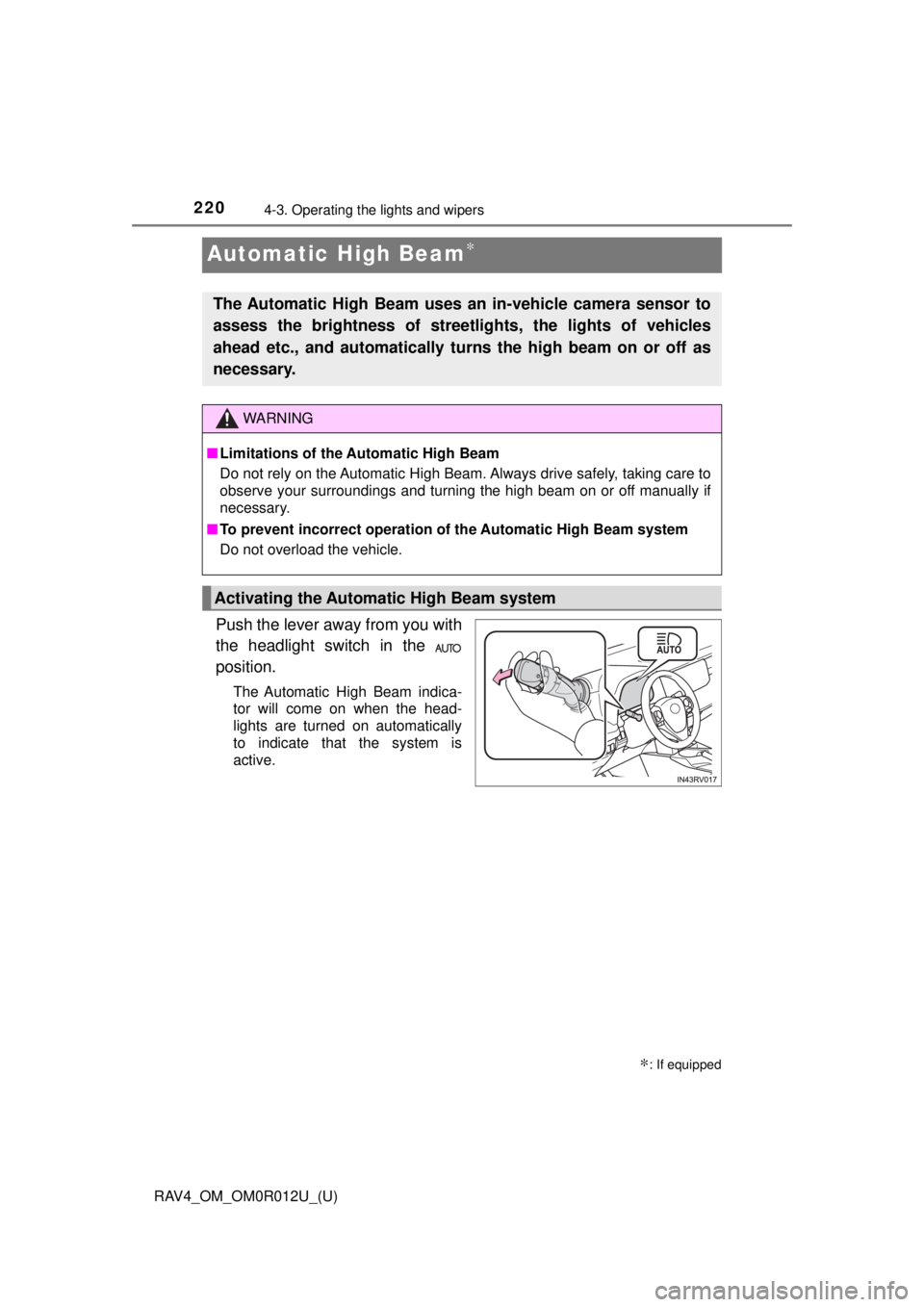
Push the lever away from you with
the headlight switch in the
position.
The Automatic High Beam indica-
tor will come on when the head-
lights are turned on automatically
to indicate that the system is
active.
∗: If equipped
The Automatic High Beam uses an in-vehicle camera sensor to
assess the brightness of streetlights, the lights of vehicles
ahead etc., and automatically turns the high beam on or off as
necessary.
WARNING
■Limitations of the Automatic High Beam
Do not rely on the Automatic High Beam. Always drive safely, taking care to
observe your surroundings and turning the high beam on or off manually if
necessary.
■ To prevent incorrect operation of the Automatic High Beam system
Do not overload the vehicle.
Activating the Automatic High Beam system
Page 221 of 744
RAV4_OM_OM0R012U_(U)
2214-3. Operating the lights and wipers
4
Driving
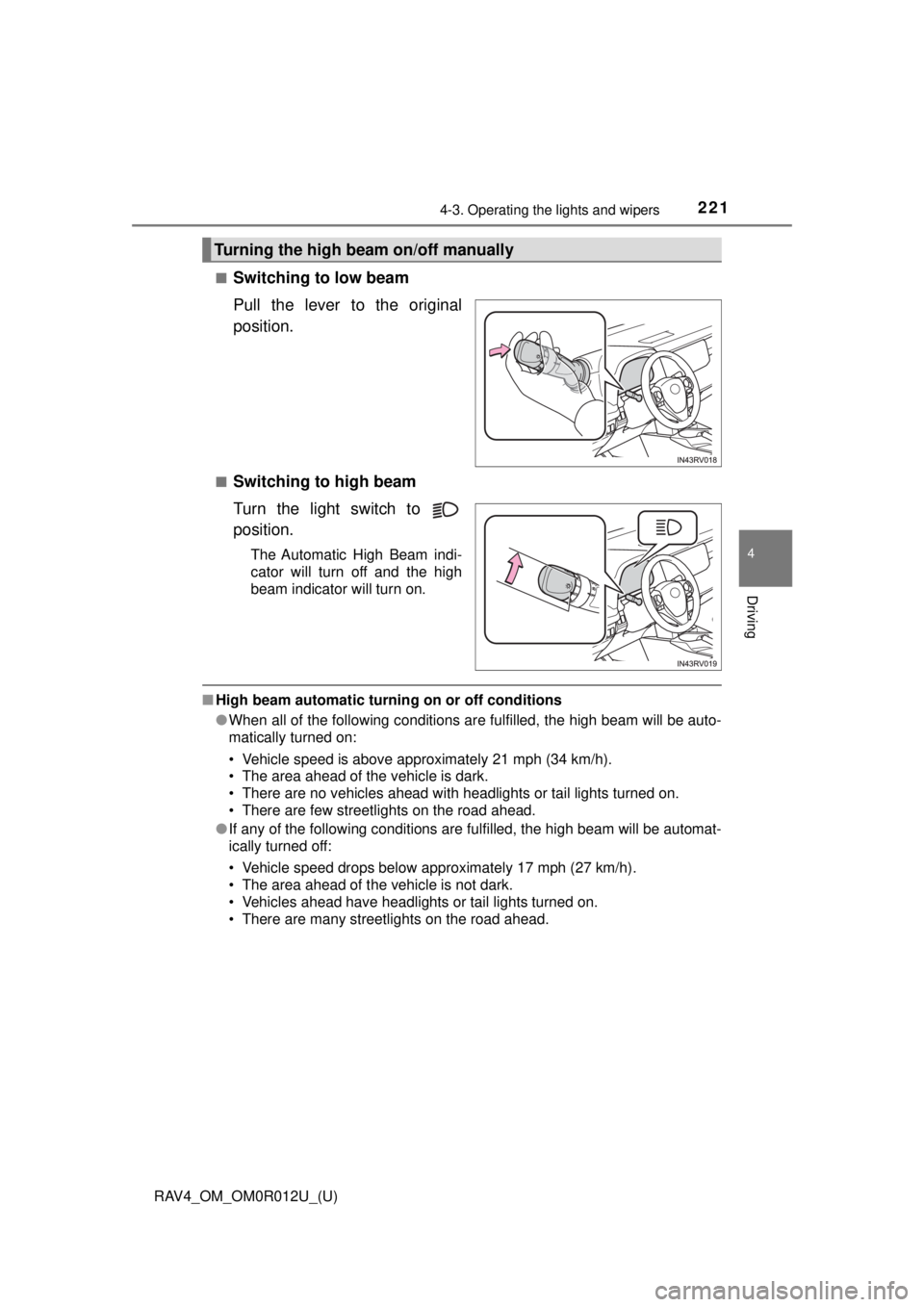
■Switching to low beam
Pull the lever to the original
position.
■Switching to high beam
Turn the light switch to
position.
The Automatic High Beam indi-
cator will turn off and the high
beam indicator will turn on.
■High beam automatic turning on or off conditions
●When all of the following conditions are fulfilled, the high beam will be auto-
matically turned on:
• Vehicle speed is above approximately 21 mph (34 km/h).
• The area ahead of the vehicle is dark.
• There are no vehicles ahead with headlights or tail lights turned on.
• There are few streetlights on the road ahead.
● If any of the following conditions are fulfilled, the high beam will be automat-
ically turned off:
• Vehicle speed drops below approximately 17 mph (27 km/h).
• The area ahead of the vehicle is not dark.
• Vehicles ahead have headlights or tail lights turned on.
• There are many streetlights on the road ahead.
Turning the high beam on/off manually
Page 222 of 744
222
RAV4_OM_OM0R012U_(U)
4-3. Operating the lights and wipers
■Camera sensor detection information
●The high beam may not be automatically turned off in the following situa-
tions:
• When oncoming vehicles suddenly appear from a curve
• When the vehicle is cut in front of by another vehicle
• When vehicles ahead are hidden from sight due to repeated curves, road
dividers or roadside trees
• When vehicles ahead appear from the faraway lane on wide road
• When vehicles ahead have no lights
● The high beam may be turned off if a vehicle ahead that is using fog lights
without using the headlights is detected.
● House lights, street lights, traffic signals, and illuminated billboards or signs
may cause the high beam to switch to the low beams, or the low beams to
remain on.
● The following factors may affect the amount of time taken to turn the high
beam on or off:
• The brightness of headlights, fog lights, and tail lights of vehicles ahe\
ad
• The movement and direction of vehicles ahead
• When a vehicle ahead only has operational lights on one side
• When a vehicle ahead is a two-wheeled vehicle
• The condition of the road (gradient, curve, condition of the road surface
etc.)
• The number of passengers and amount of luggage
● The high beam may be turned on or off when the driver does not expect it.
● Bicycles or similar objects may not be detected.
● In the situations shown below, the system may not be able to accurately
detect surrounding brightness levels. This may cause the low beams to
remain on or the high beams to cause problems for pedestrians, vehicles
ahead or other parties. In these cases, manually switch between the high
and low beams.
• In bad weather (rain, snow, fog, sandstorms etc.)
• The windshield is obscured by fog, mist, ice, dirt etc.
• The windshield is cracked or damaged.
• The camera sensor is deformed or dirty.
• The camera sensor temperature is extremely high.
• Surrounding brightness levels are equal to those of headlights, tail lights
or fog lights.
• Vehicles ahead have headlights that are either switched off, dirty, are changing color, or are not aimed properly.
• When driving through an area of in termittently changing brightness and
darkness.
• When frequently and repeatedly driving ascending/descending roads, or roads with rough, bumpy or uneven surfaces (such as stone-paved
roads, gravel tracks etc.).
• When frequently and repeatedly taking curves or driving on a winding road.
Page 223 of 744
RAV4_OM_OM0R012U_(U)
2234-3. Operating the lights and wipers
4
Driving
• There is a highly reflective object ahead of the vehicle, such as a sign ora mirror.
• The back of a vehicle ahead is highly reflective, such as a container on a truck.
• The vehicle’s headlights are damaged or dirty.
• The vehicle is listing or tilting, due to a flat tire, a trailer being towed etc.
• The high beam and low beam are repeatedly being switched between in an abnormal manner.
• The driver believes that the high beam may be causing problems or dis- tress to other drivers or pedestrians nearby.
■ Temporarily lowering sensor sensitivity
The sensitivity of the sensor can be temporarily lowered.
Turn the engine switch off while the following conditions are met.
• The headlight switch is in .
• The headlight switch lever is in high beam position. Turn the engine switch to IGNITION ON mode.
Within 5 seconds after , repeat pulling the headlight switch lever to the
original position then pushing it to the high beam position quickly 9 times,
then leave the lever in high beam position.
Automatic High Beam (headlights) may turn on even the vehicle is stopped.
■ If a warning message of the Auto matic High Beam is displayed
It may indicate a malfunction in the system. Contact your Toyota dealer.
■ Customization
The Automatic High Beam can be turned off.
(Customizable features: →P. 704)
1
2
32
Page 235 of 744
235
RAV4_OM_OM0R012U_(U)
4-5. Using the driving support systems
4
Driving
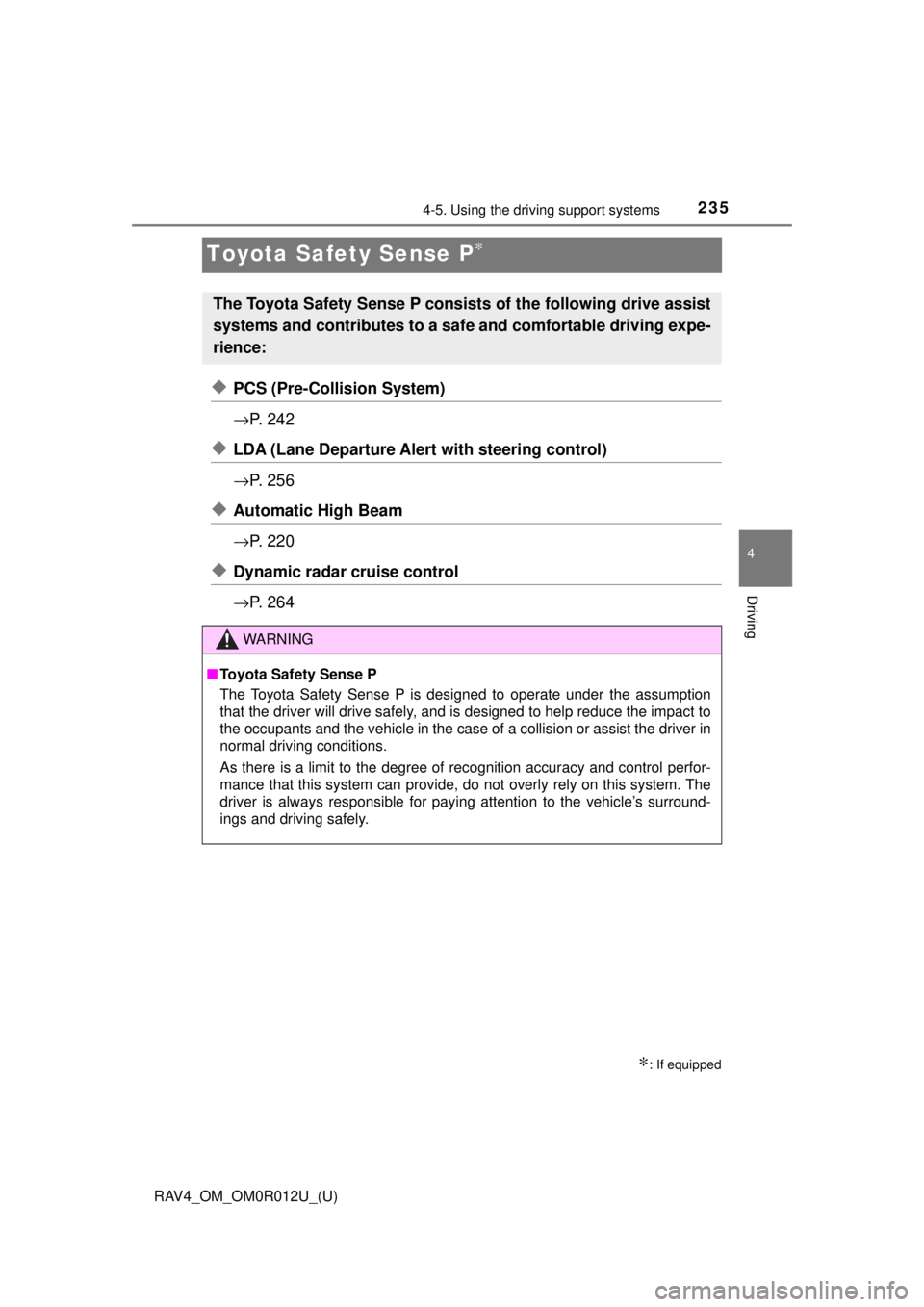
Toyota Safety Sense P∗
◆PCS (Pre-Collision System)
→P. 2 4 2
◆LDA (Lane Departure Alert with steering control)
→P. 2 5 6
◆Automatic High Beam
→P. 2 2 0
◆Dynamic radar cruise control
→P. 2 6 4
∗: If equipped
The Toyota Safety Sense P consists of the following drive assist
systems and contributes to a safe and comfortable driving expe-
rience:
WARNING
■Toyota Safety Sense P
The Toyota Safety Sense P is designed to operate under the assumption
that the driver will drive safely, and is designed to help reduce the impact to
the occupants and the vehicle in the case of a collision or assist the driver in
normal driving conditions.
As there is a limit to the degree of recognition accuracy and control perfor-
mance that this system can provide, do not overly rely on this system. The
driver is always responsible for paying attention to the vehicle’s surround-
ings and driving safely.
Page 635 of 744
6358-2. Steps to take in an emergency
RAV4_OM_OM0R012U_(U)
8
When trouble arises
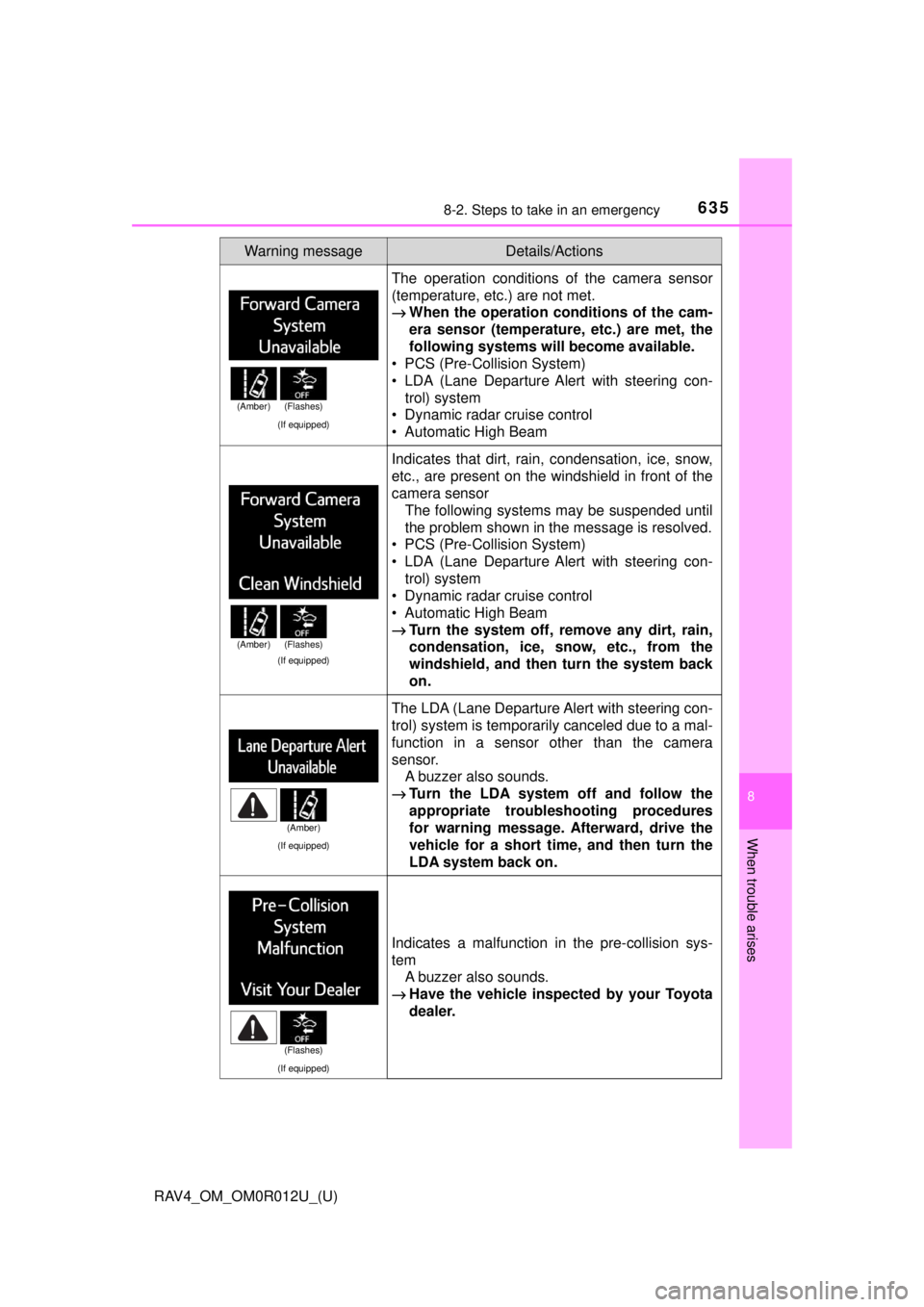
(If equipped)
The operation conditions of the camera sensor
(temperature, etc.) are not met.
→When the operation c onditions of the cam-
era sensor (temperature, etc.) are met, the
following systems will become available.
• PCS (Pre-Collision System)
• LDA (Lane Departure Alert with steering con- trol) system
• Dynamic radar cruise control
• Automatic High Beam
(If equipped)
Indicates that dirt, rain, condensation, ice, snow,
etc., are present on the windshield in front of the
camera sensor The following systems may be suspended until
the problem shown in the message is resolved.
• PCS (Pre-Collision System)
• LDA (Lane Departure Alert with steering con-
trol) system
• Dynamic radar cruise control
• Automatic High Beam
→ Turn the system off, remove any dirt, rain,
condensation, ice, snow, etc., from the
windshield, and then turn the system back
on.
(If equipped)
The LDA (Lane Departure Alert with steering con-
trol) system is temporarily canceled due to a mal-
function in a sensor other than the camera
sensor.
A buzzer also sounds.
→ Turn the LDA system off and follow the
appropriate troubleshooting procedures
for warning message. Afterward, drive the
vehicle for a short time, and then turn the
LDA system back on.
(If equipped)
Indicates a malfunction in the pre-collision sys-
tem
A buzzer also sounds.
→ Have the vehicle inspect ed by your Toyota
dealer.
Warning messageDetails/Actions
(Amber) (Flashes)
(Amber) (Flashes)
(Amber)
(Flashes)