lock TOYOTA RAV4 EV 2012 1.G Owners Manual
[x] Cancel search | Manufacturer: TOYOTA, Model Year: 2012, Model line: RAV4 EV, Model: TOYOTA RAV4 EV 2012 1.GPages: 520, PDF Size: 8.29 MB
Page 407 of 520
407
4-3. Do-it-yourself maintenance
4
Maintenance and care
■
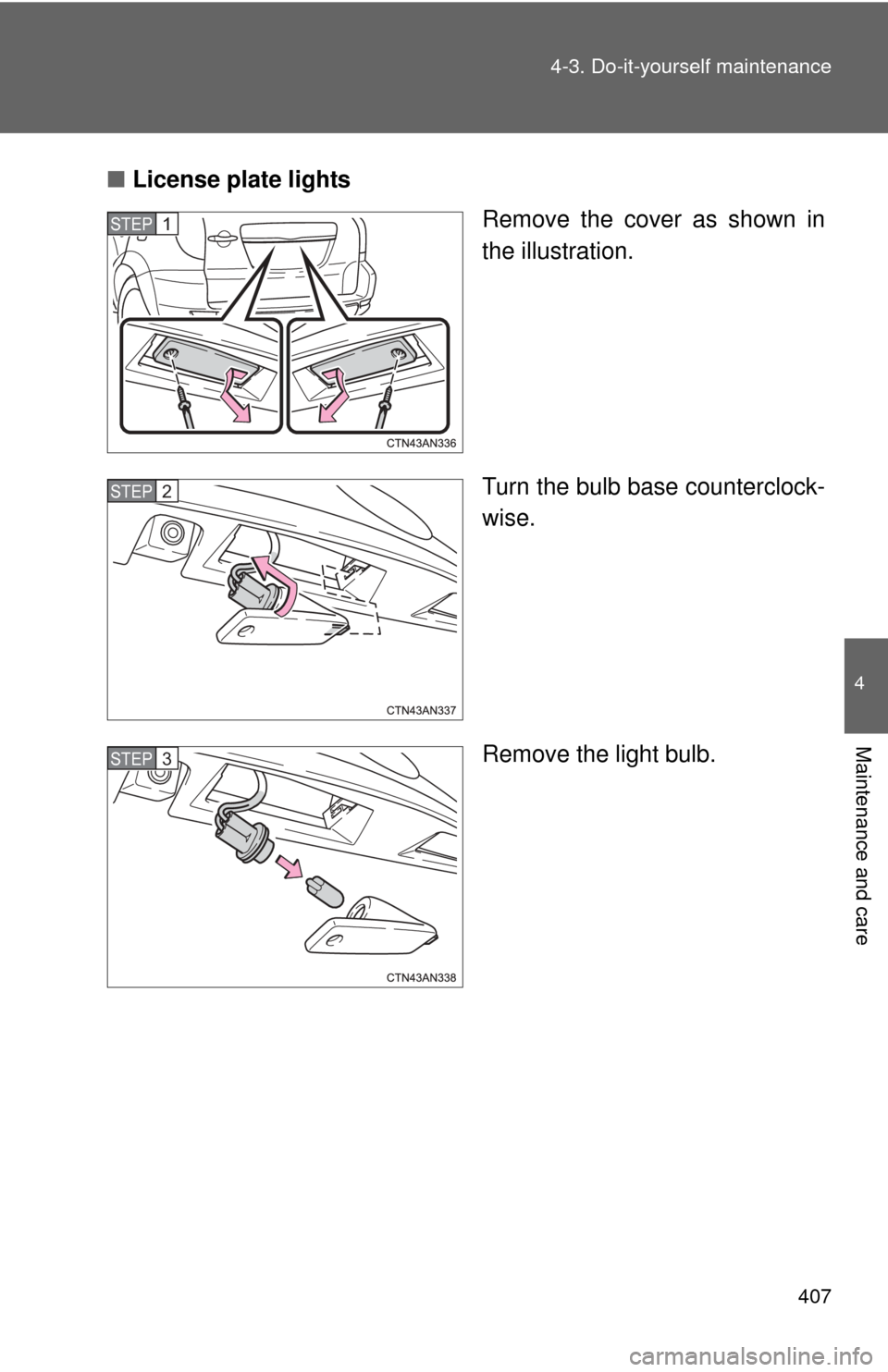
License plate lights
Remove the cover as shown in
the illustration.
Turn the bulb base counterclock-
wise.
Remove the light bulb.
STEP 1
STEP 2
STEP 3
Page 409 of 520

409
4-3. Do-it-yourself maintenance
4
Maintenance and care
CAUTION
■
Replacing light bulbs
●Turn off the lights. Do not attempt to replace the bulb immediately after
turning off the lights.
The bulbs become very hot and may cause burns.
● Do not touch the glass portion of the light bulb with bare hands. Hold the
bulb by the plastic or metal portion.
If the bulb is scratched or dropped, it may blow out or crack.
● Fully install light bulbs and any parts used to secure them. Failure to do so
may result in heat damage, fire, or water entering the headlight unit. This
may damage the headlights or cause condensation to build up on the lens.
■ To prevent damage or fire
Make sure bulbs are fully seated and locked.
Page 413 of 520
5
When trouble arises
413
5-1. Essential information
If your vehicle needs to be towed
Before towingThe following may indicate a problem with your transmission. Contact
your Toyota dealer before towing.
● The EV system is operating bu t the vehicle will not move.
● The vehicle makes an abnormal sound.
If there is a malfunction in the P position control system, or if the 12-
volt battery is discharged, the vehicle cannot be moved with the front
wheels on the ground, as the front wheels may be locked.
In this case, move the vehicle with both front wheels or all four
wheels lifted.
Jump start procedure ( P. 470)
If towing is necessary, we recommend having your vehicle towed by
your Toyota dealer or a commerci al towing service, using a lift-type
truck or flatbed truck.
Use a safety chain system for all to wing, and abide by all state/pro-
vincial and local laws.
Page 431 of 520
5
When trouble arises
431
5-2. Steps to take in an emergency
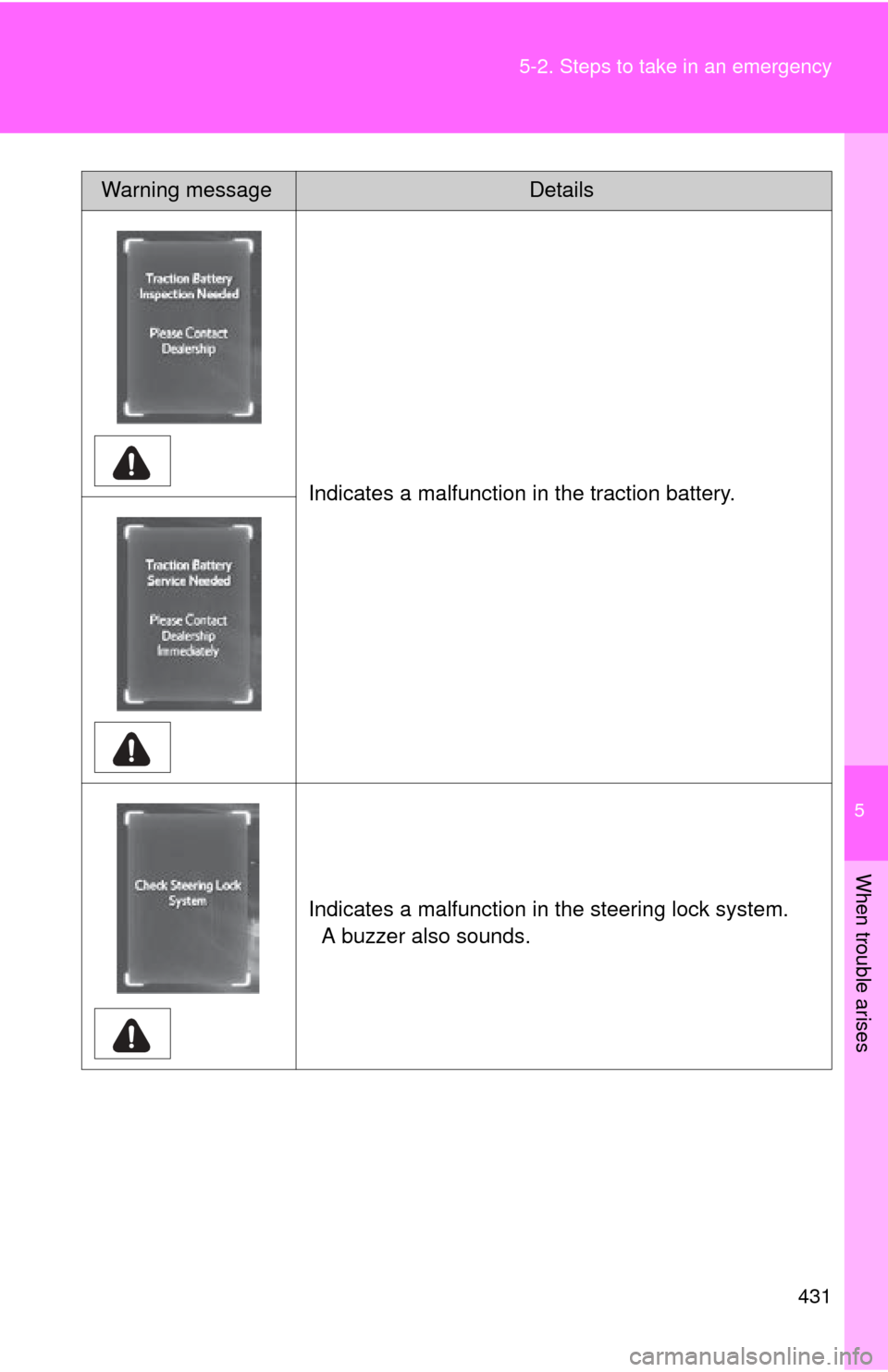
Indicates a malfunction in the traction battery.
Indicates a malfunction in the steering lock system.
A buzzer also sounds.
Warning messageDetails
Page 432 of 520
432 5-2. Steps to take in an emergency
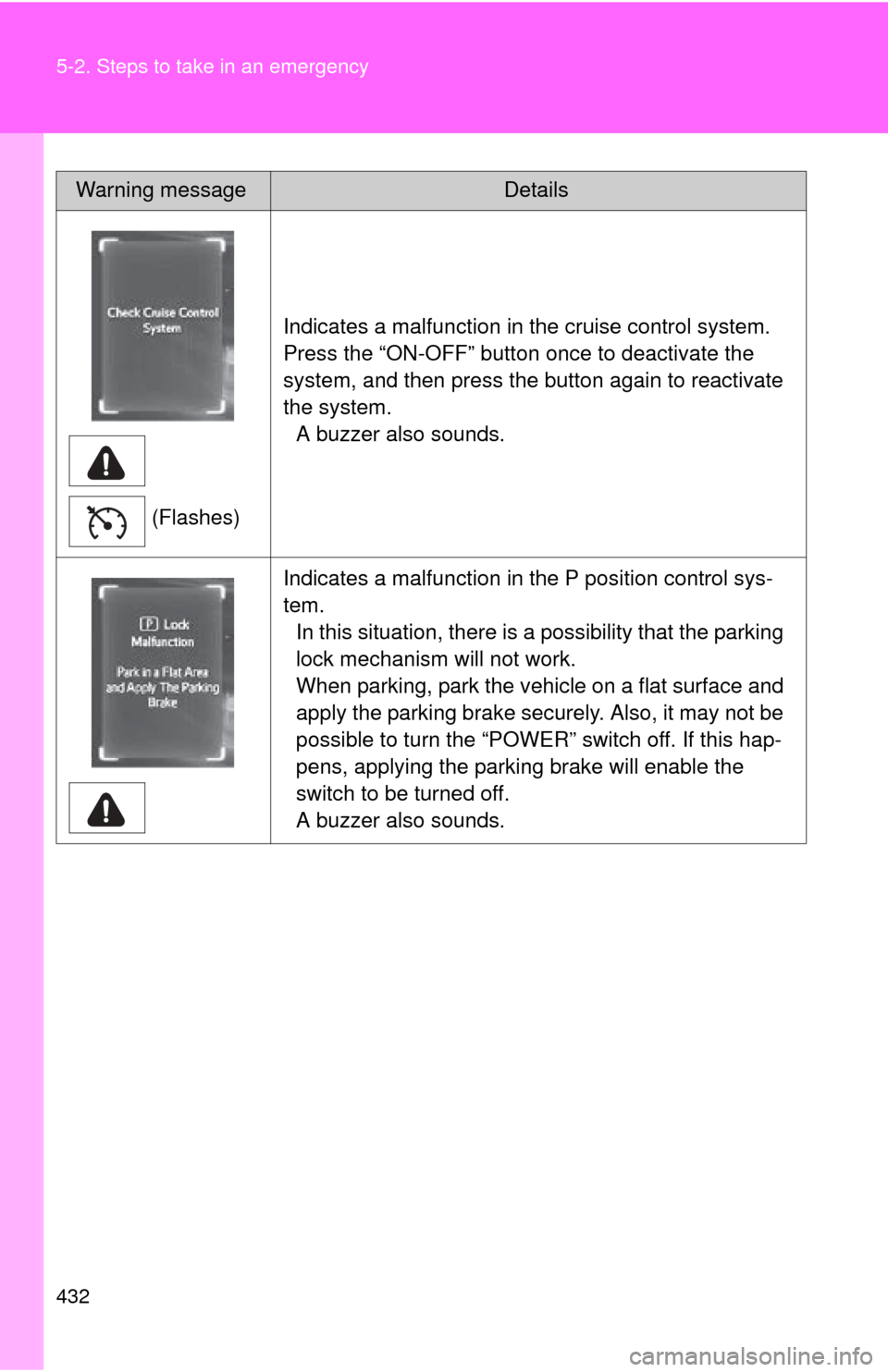
(Flashes)Indicates a malfunction in the cruise control system.
Press the “ON-OFF” button once to deactivate the
system, and then press the button again to reactivate
the system.
A buzzer also sounds.
Indicates a malfunction in the P position control sys-
tem. In this situation, there is a possibility that the parking
lock mechanism will not work.
When parking, park the vehicle on a flat surface and
apply the parking brake securely. Also, it may not be
possible to turn the “POWER” switch off. If this hap-
pens, applying the parking brake will enable the
switch to be turned off.
A buzzer also sounds.
Warning messageDetails
Page 442 of 520
442 5-2. Steps to take in an emergency
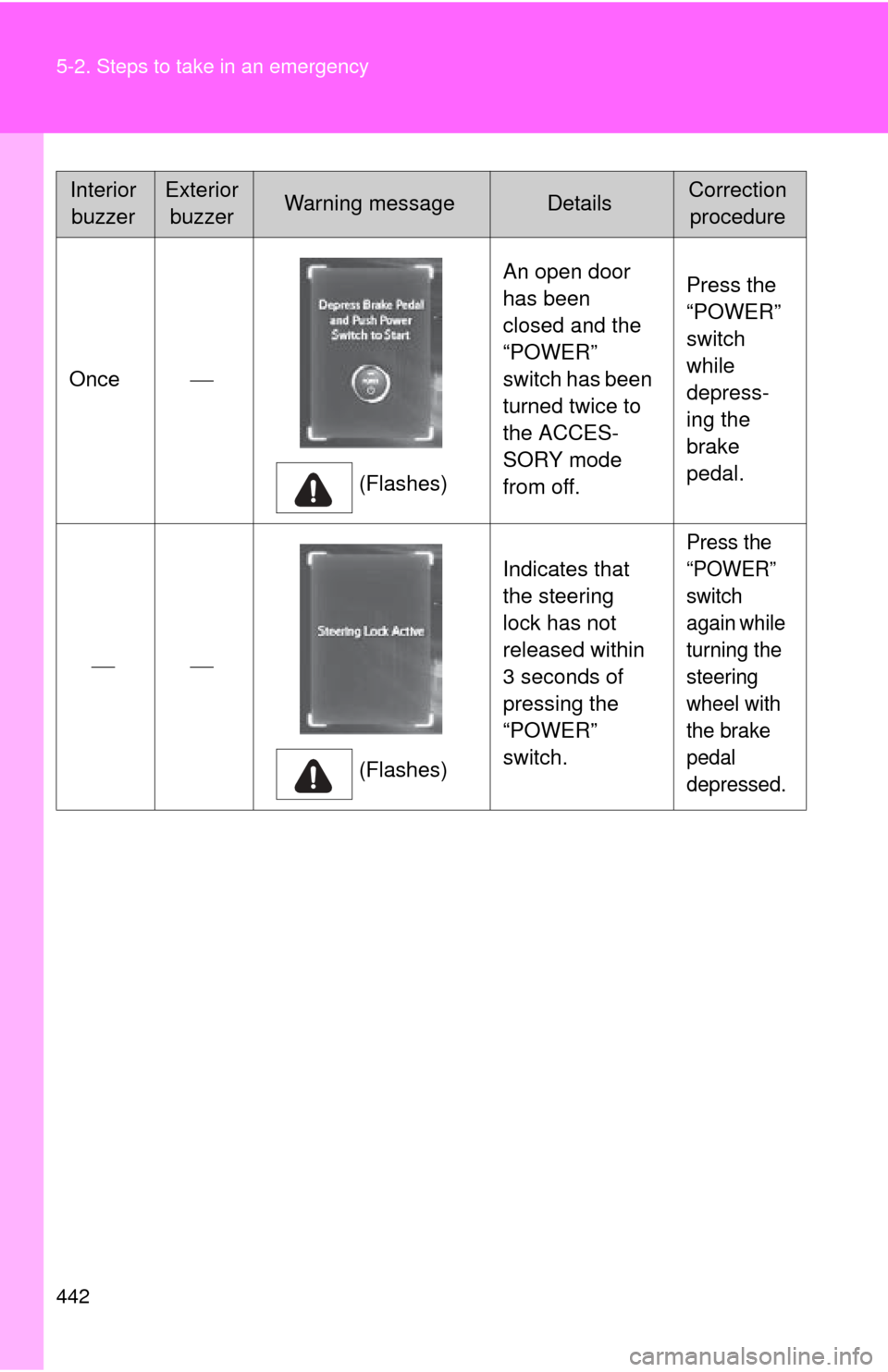
Once
(Flashes)An open door
has been
closed and the
“POWER”
switch has been
turned twice to
the ACCES-
SORY mode
from off.
Press the
“POWER”
switch
while
depress-
ing the
brake
pedal.
(Flashes)Indicates that
the steering
lock has not
released within
3 seconds of
pressing the
“POWER”
switch.
Press the
“POWER”
switch
again while
turning the
steering
wheel with
the brake
pedal
depressed.
Interior
buzzerExterior buzzerWarning messageDetailsCorrection procedure
Page 452 of 520
452 5-2. Steps to take in an emergency
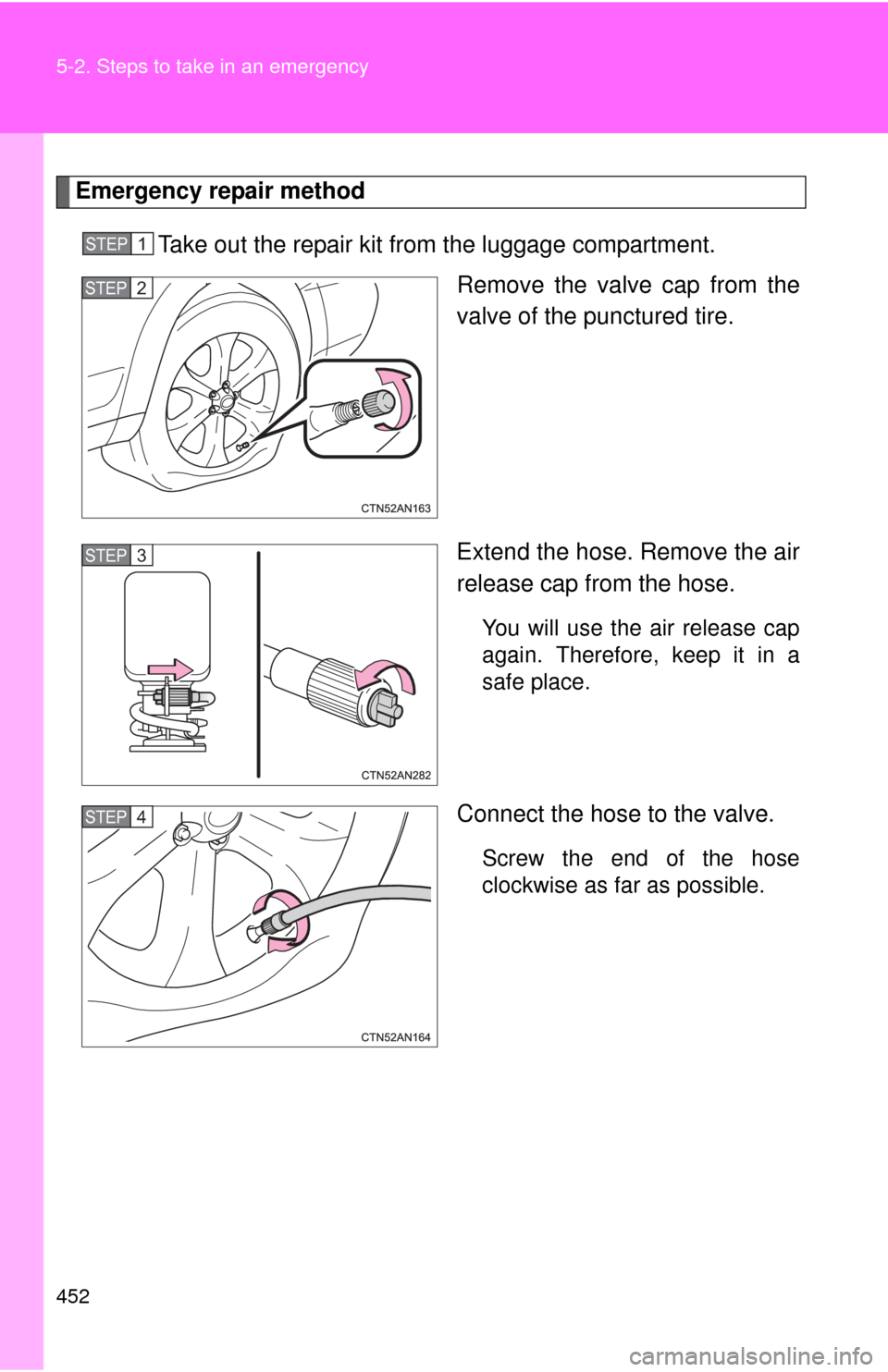
Emergency repair methodTake out the repair kit from the luggage compartment. Remove the valve cap from the
valve of the punctured tire.
Extend the hose. Remove the air
release cap from the hose.
You will use the air release cap
again. Therefore, keep it in a
safe place.
Connect the hose to the valve.
Screw the end of the hose
clockwise as far as possible.
STEP 1
STEP 2
STEP 3
STEP 4
Page 465 of 520
5
When trouble arises
465
5-2. Steps to take in an emergency
If the EV (Electric Vehicle) system will not start
Reasons for the EV system not star ting vary depending on the situa-
tion. Check the following and pe rform the appropriate procedure:
■The EV system will not start even though the correct start-
ing procedure is being followed. ( P. 200)
One of the following may be the cause of the problem:
● The charging cable may be connected to the vehicle.
● The electronic key may not be functioning properly. ( P. 468)
● There may be a malfunction in the immobilizer system.
( P. 149)
● There may be a malfunction in the steering lock system.
● The EV system may be malfunct ioning due to an electrical
problem such as an open circuit or a blown fuse. However,
depending on the type of malf unction, an interim measure is
available to start the EV system. ( P. 385)
● There may be a malfunction in th e P position control system.*
( P. 203)
*: It may not be possible to shift the shift position from P to other posi-
tions.
■The interior lights and headlights are dim, or the horn does
not sound or sounds at a low volume.
One of the following may be the cause of the problem:
●The 12-volt battery may be discharged. ( P. 470)
● The 12-volt battery terminal c onnections may be loose or cor-
roded.
Page 468 of 520
468
5-2. Steps to take in an emergency
If the electronic key does not operate properly
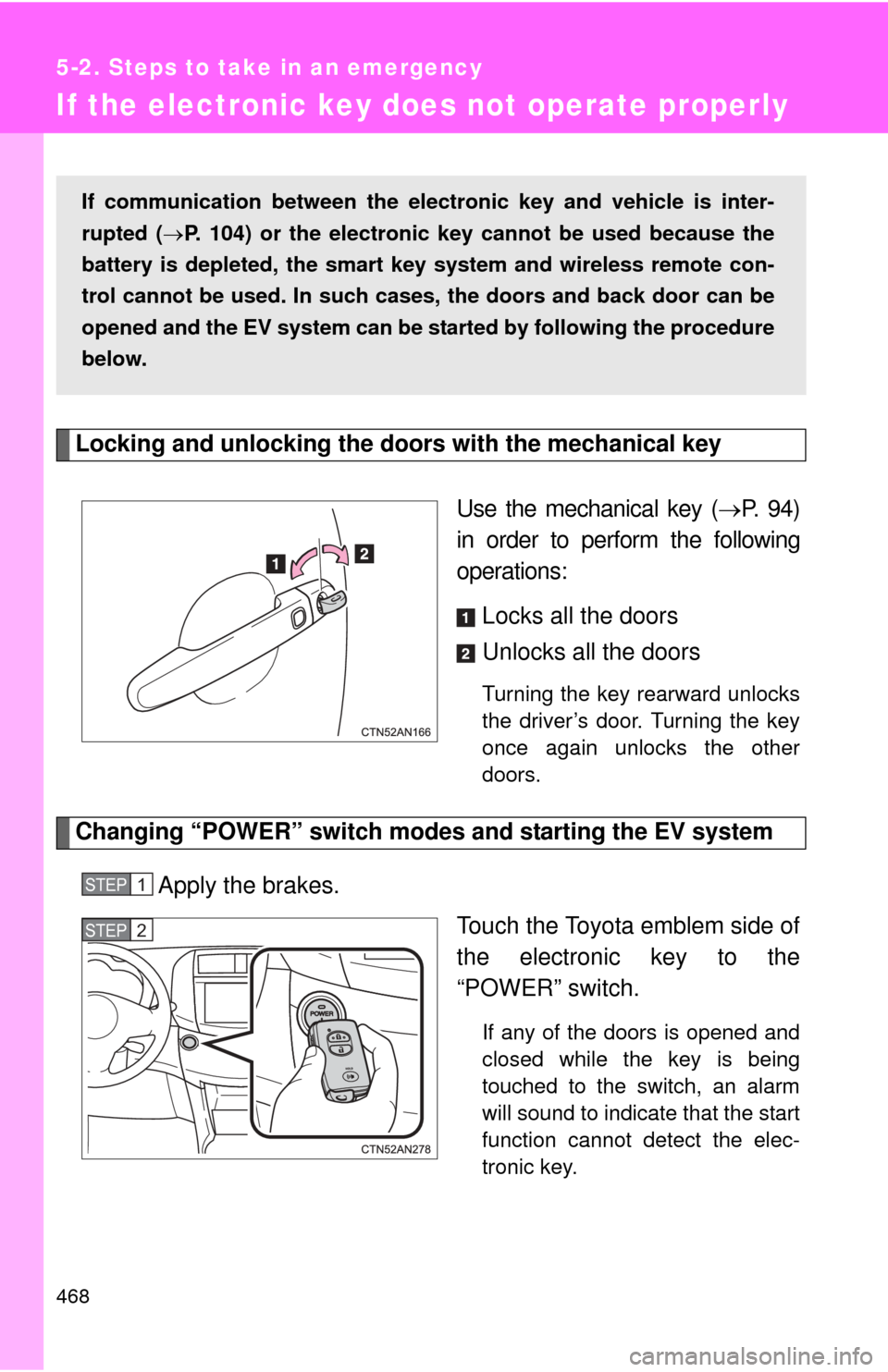
Locking and unlocking the doors with the mechanical key
Use the mechanical key ( P. 94)
in order to perform the following
operations:
Locks all the doors
Unlocks all the doors
Turning the key rearward unlocks
the driver’s door. Turning the key
once again unlocks the other
doors.
Changing “POWER” switch modes and starting the EV system
Apply the brakes. Touch the Toyota emblem side of
the electronic key to the
“POWER” switch.
If any of the doors is opened and
closed while the key is being
touched to the switch, an alarm
will sound to indicate that the start
function cannot detect the elec-
tronic key.
If communication between the electronic key and vehicle is inter-
rupted (P. 104) or the electronic key cannot be used because the
battery is depleted, the smart key system and wireless remote con-
trol cannot be used. In such cases, the doors and back door can be
opened and the EV system can be started by following the procedure
below.
STEP 1
STEP 2
Page 472 of 520

472 5-2. Steps to take in an emergency
■Starting the EV system when the 12-volt battery is discharged
The EV system cannot be started by push-starting.
■ To prevent 12-volt battery discharge
●Turn off the headlights and the navigation system while the EV system is
off.
● Turn off any unnecessary electrical components when the vehicle is run-
ning at a low speed for an extended period, such as in heavy traffic.
■ When the 12-volt battery is removed or discharged
●The EV system may not start. (P. 363)
● If the 12-volt battery discharges while the shift position is in P, it may not
be possible to shift the shift position to other positions.
In this case, the vehicle cannot be moved without lifting both front wheels
because the front wheels will be locked. ( P. 413)
● The power windows must be initialized. ( P. 147)
■ Charging the 12-volt battery
The electricity stored in the 12-volt battery will discharge gradually even
when the vehicle is not in use, due to natural discharge and the draining
effects of certain electrical appliances. If the vehicle is left for a long time, the
12-volt battery may discharge, and the EV system may be unable to start.
(The 12-volt battery recharges automatically while the EV system is operat-
ing.)