steering TOYOTA RAV4 EV 2014 1.G Repair Manual
[x] Cancel search | Manufacturer: TOYOTA, Model Year: 2014, Model line: RAV4 EV, Model: TOYOTA RAV4 EV 2014 1.GPages: 521, PDF Size: 7.44 MB
Page 431 of 521
430 5-2. Steps to take in an emergency
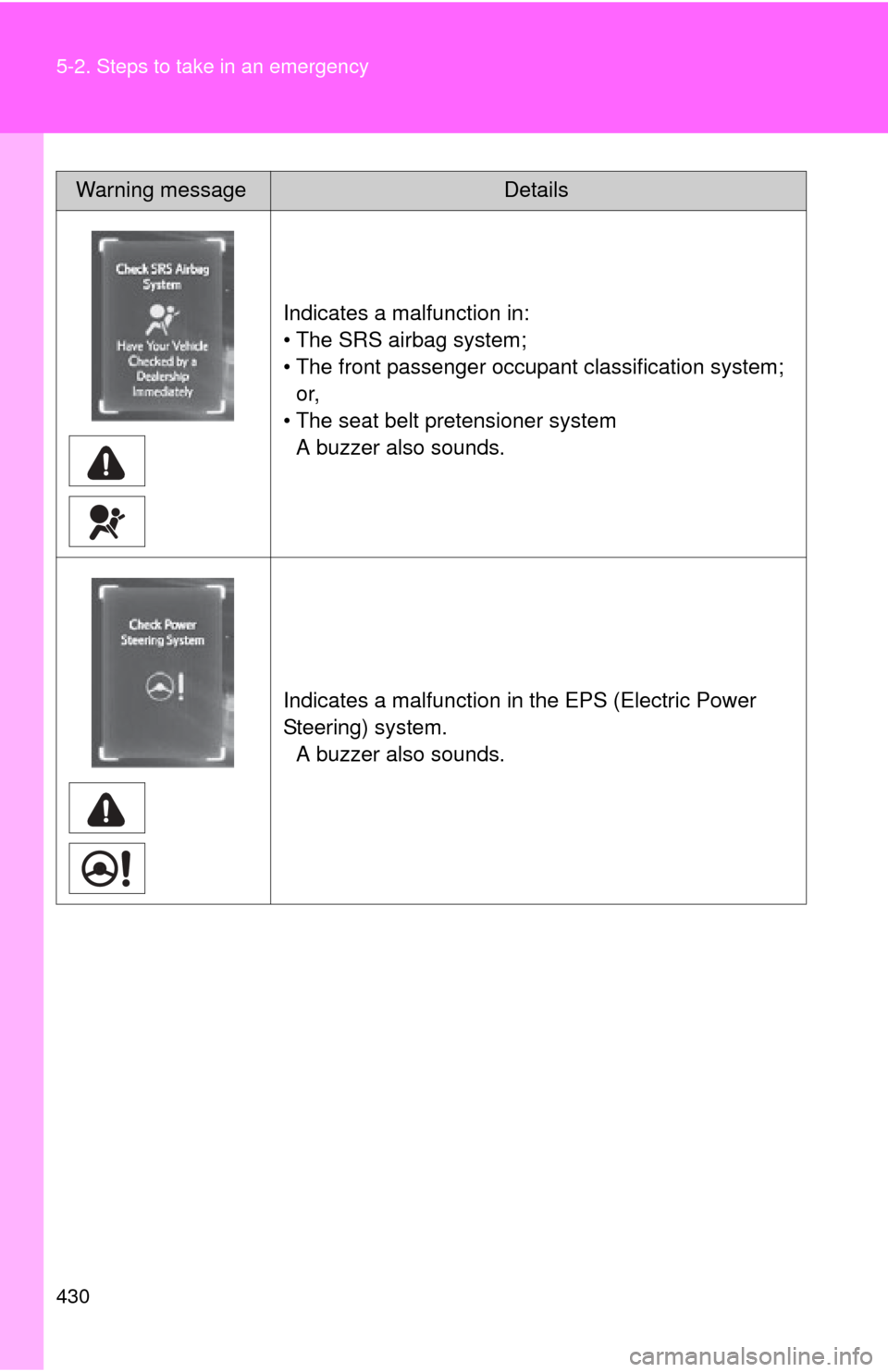
Indicates a malfunction in:
• The SRS airbag system;
• The front passenger occupant classification system; or,
• The seat belt pretensioner system A buzzer also sounds.
Indicates a malfunction in the EPS (Electric Power
Steering) system. A buzzer also sounds.
Warning messageDetails
Page 432 of 521
5
When trouble arises
431
5-2. Steps to take in an emergency
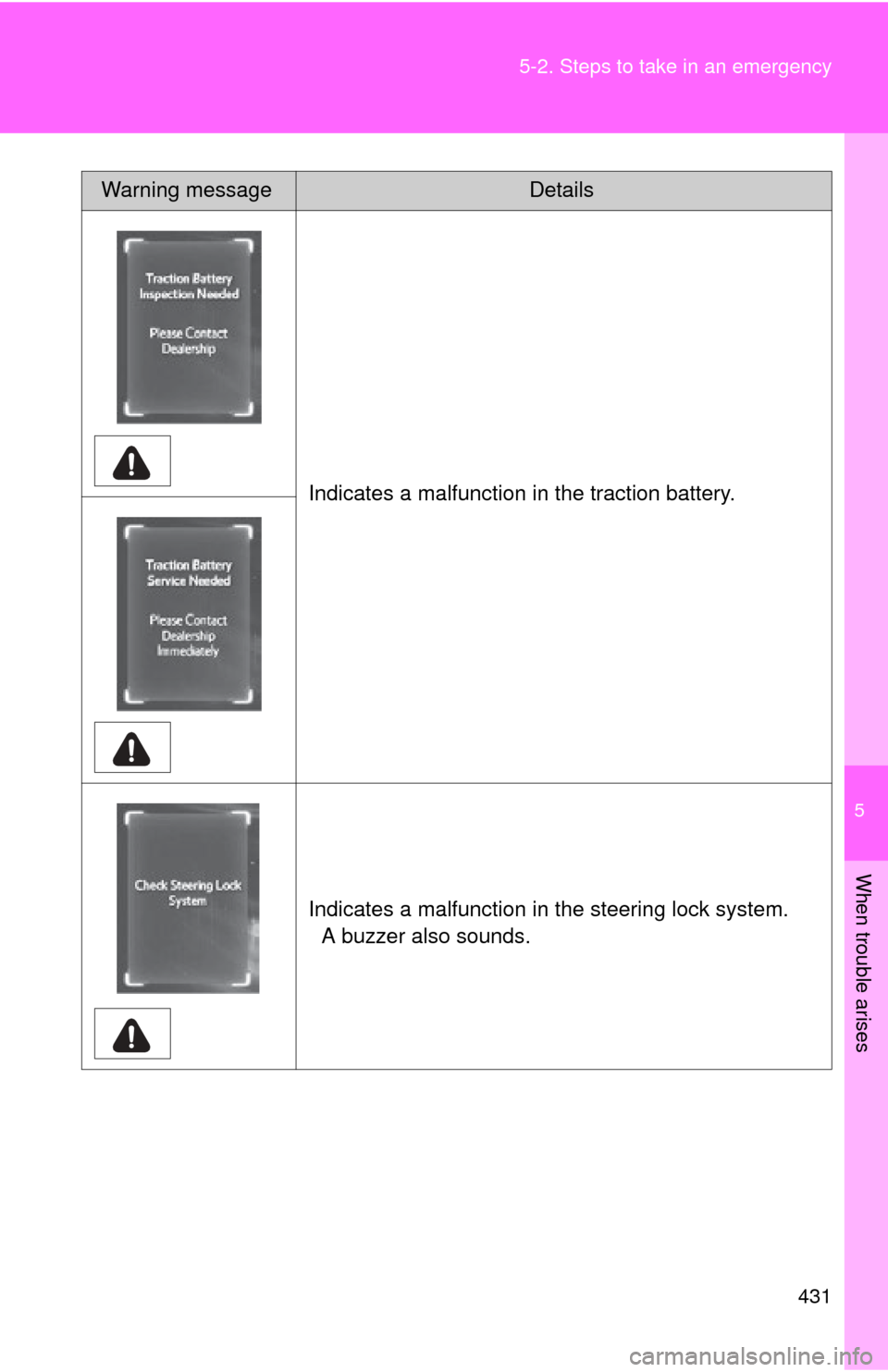
Indicates a malfunction in the traction battery.
Indicates a malfunction in the steering lock system.
A buzzer also sounds.
Warning messageDetails
Page 443 of 521
442 5-2. Steps to take in an emergency
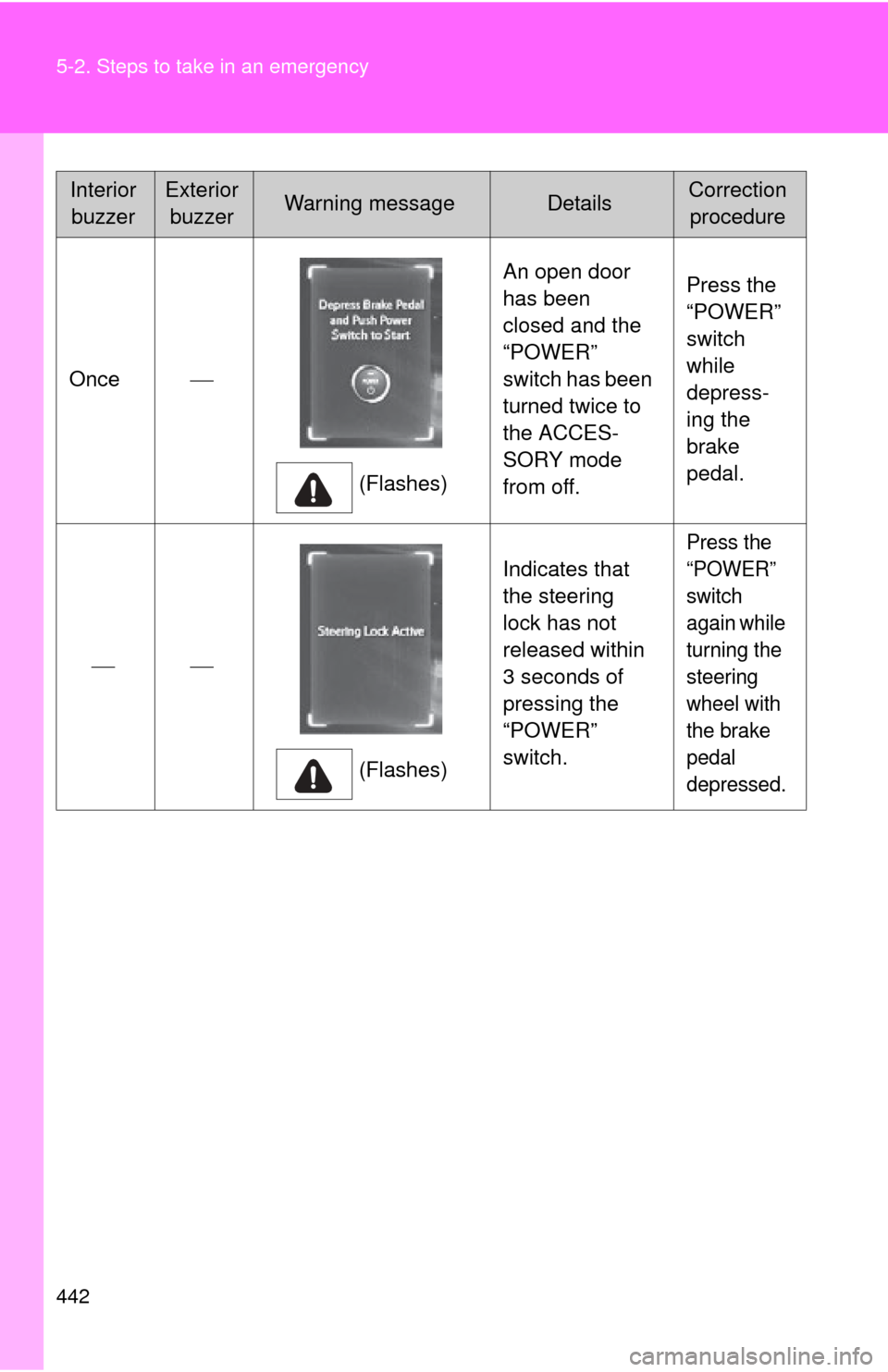
Once
(Flashes)An open door
has been
closed and the
“POWER”
switch has been
turned twice to
the ACCES-
SORY mode
from off.
Press the
“POWER”
switch
while
depress-
ing the
brake
pedal.
(Flashes)Indicates that
the steering
lock has not
released within
3 seconds of
pressing the
“POWER”
switch.
Press the
“POWER”
switch
again while
turning the
steering
wheel with
the brake
pedal
depressed.
Interior
buzzerExterior buzzerWarning messageDetailsCorrection procedure
Page 464 of 521

5
When trouble arises
463
5-2. Steps to take in an emergency
CAUTION
●After inflation of the tire has comp
leted, the sealant may splatter when
the hose is disconnected or so me air is let out of the tire.
●Follow the operation procedure to repair the tire. If the procedures not
followed, the sealant may spray out.
●Keep back from the tire while it is being repaired, as there is a chance
of it bursting while the repair ope ration is being performed. If you
notice any cracks or deformation of the tire, turn off the compressor
switch and stop the repair operation immediately.
●The repair kit may overheat if operated for a long period of time. Do not
operate the repair kit continuously for more than 35 minutes.
●Parts of the repair kit become hot during operation. Be careful when
handling the repair kit during and after operation. Do not touch the
metal part around the connecting area between the bottle and com-
pressor. It will be extremely hot.
●Do not attach the vehicle speed warning sticker to an area other than
the one indicated. If the sticker is attached to an area where an SRS
airbag is located, such as the pad of the steering wheel, it may prevent
the SRS airbag from operating properly.
■Driving to spread the liquid sealant evenly
Observe the following precautions to reduce the risk of accidents.
Failing to do so may result in a loss of vehicle control and cause death or
serious injury.
●Drive the vehicle carefully at a lo w speed. Be especially careful when
turning and cornering.
●If the vehicle does not drive straight or you feel a pull through the
steering wheel, stop the vehicle and check the following.
• Tire condition. The tire may have separated from the wheel.
• Tire inflation pressure. If the tire inflation pressure is 19 psi (130
kPa, 1.3 kgf/cm
2 or bar) or less, the tire may be severely dam-
aged.
Page 466 of 521
5
When trouble arises
465
5-2. Steps to take in an emergency
If the EV (Electric Vehicle) system will not start
Reasons for the EV system not star ting vary depending on the situa-
tion. Check the following and pe rform the appropriate procedure:
■The EV system will not start even though the correct start-
ing procedure is being followed. ( P. 200)
One of the following may be the cause of the problem:
● The charging cable may be connected to the vehicle.
● The electronic key may not be functioning properly. ( P. 468)
● There may be a malfunction in the immobilizer system.
( P. 149)
● There may be a malfunction in the steering lock system.
● The EV system may be malfunct ioning due to an electrical
problem such as an open circuit or a blown fuse. However,
depending on the type of malf unction, an interim measure is
available to start the EV system. ( P. 385)
● There may be a malfunction in th e P position control system.*
( P. 203)
*: It may not be possible to shift the shift position from P to other posi-
tions.
■The interior lights and headlights are dim, or the horn does
not sound or sounds at a low volume.
One of the following may be the cause of the problem:
●The 12-volt battery may be discharged. ( P. 470)
● The 12-volt battery terminal c onnections may be loose or cor-
roded.
Page 480 of 521
5
When trouble arises
479
5-2. Steps to take in an emergency
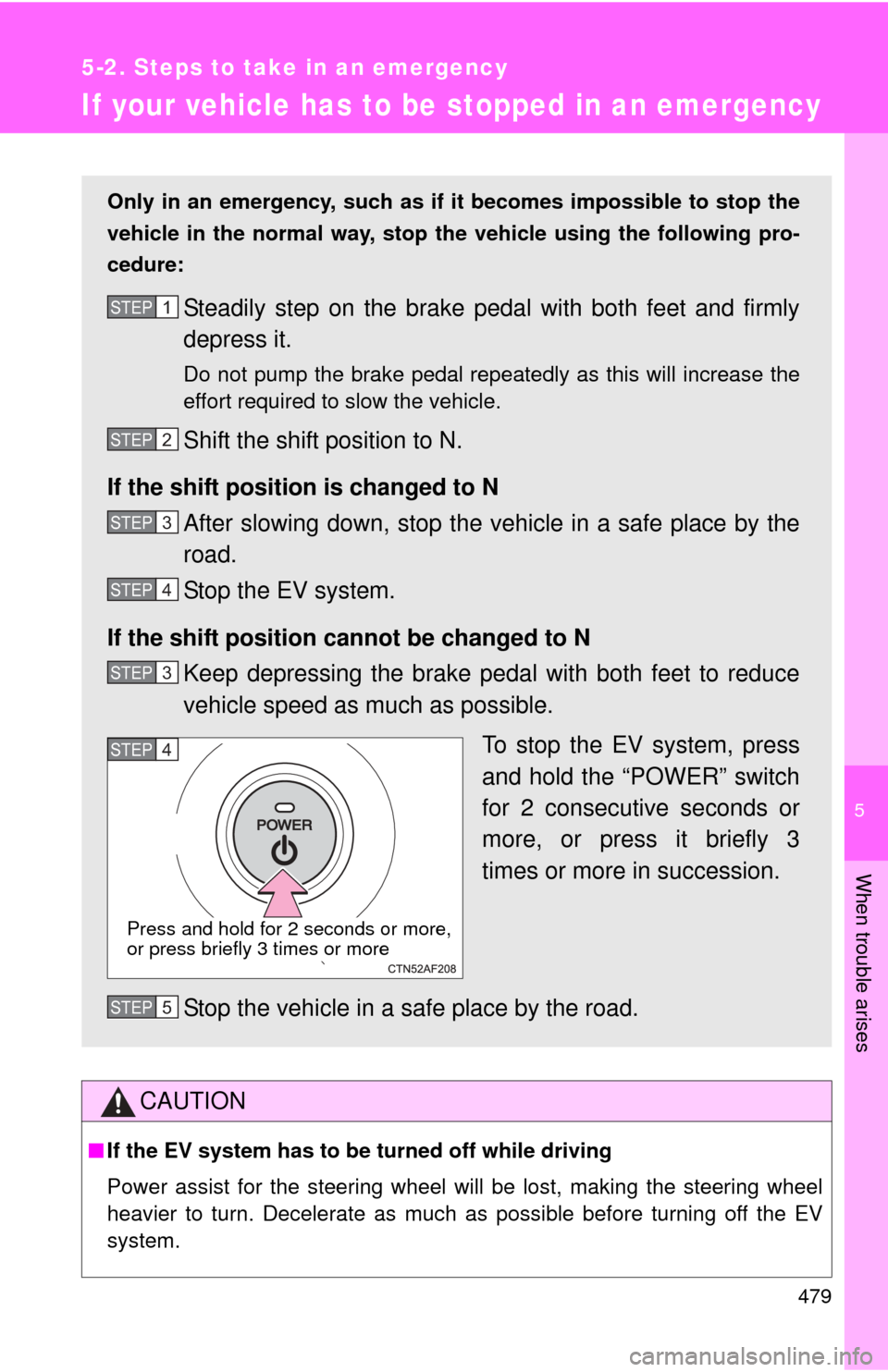
If your vehicle has to be stopped in an emergency
CAUTION
■If the EV system has to be turned off while driving
Power assist for the steering wheel will be lost, making the steering wheel
heavier to turn. Decelerate as much as possible before turning off the EV
system.
Only in an emergency, such as if it becomes impossible to stop the
vehicle in the normal way, stop the vehicle using the following pro-
cedure:
Steadily step on the brake pedal with both feet and firmly
depress it.
Do not pump the brake pedal repeatedly as this will increase the
effort required to slow the vehicle.
Shift the shift position to N.
If the shift position is changed to N After slowing down, stop the vehi cle in a safe place by the
road.
Stop the EV system.
If the shift position cannot be changed to N Keep depressing the brake pedal with both feet to reduce
vehicle speed as much as possible.
To stop the EV system, press
and hold the “POWER” switch
for 2 consecutive seconds or
more, or press it briefly 3
times or more in succession.
Stop the vehicle in a safe place by the road.
STEP 1
STEP 2
STEP 3
STEP 4
STEP 3
STEP 4
Press and hold for 2 seconds or more,
or press briefly 3 times or more
STEP 5
Page 488 of 521
487
6-1. Specifications
6
Vehicle specifications
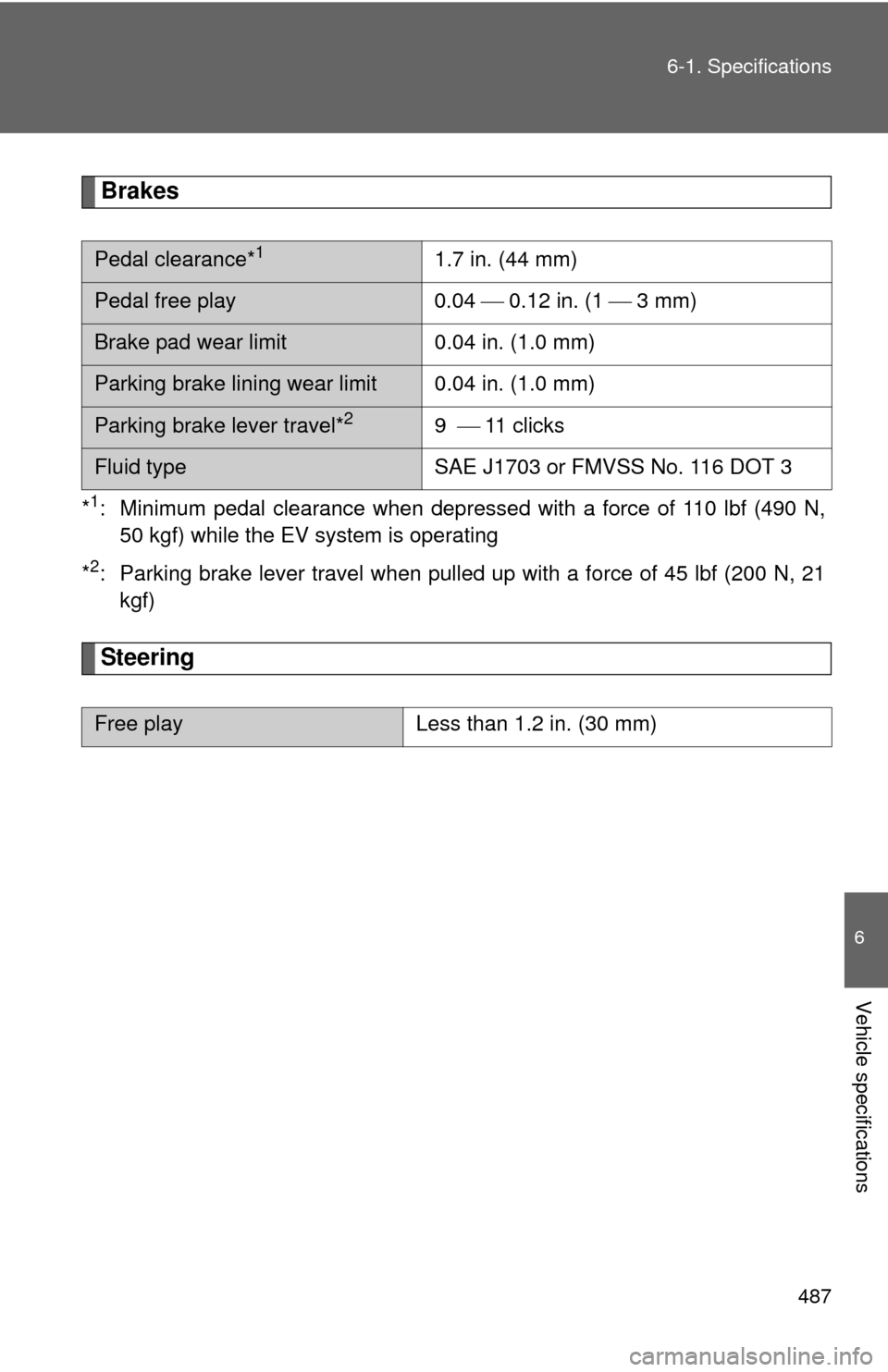
Brakes
*1: Minimum pedal clearance when depressed with a force of 110 lbf (490 N,
50 kgf) while the EV system is operating
*
2: Parking brake lever travel when pulled up with a force of 45 lbf (200 N, 21 kgf)
Steering
Pedal clearance*11.7 in. (44 mm)
Pedal free play 0.04 0.12 in. (1 3 mm)
Brake pad wear limit 0.04 in. (1.0 mm)
Parking brake lining wear limit 0.04 in. (1.0 mm)
Parking brake lever travel*29 11 clicks
Fluid type SAE J1703 or FMVSS No. 116 DOT 3
Free playLess than 1.2 in. (30 mm)
Page 495 of 521

494 6-1. Specifications
Warning: The temperature grades for this tire are established for a
tire that is properly inflated and not overloaded.
Excessive speed, underinflation, or excessive loading, either sepa-
rately or in combination, can cause heat buildup and possible tire fail-
ure.
Glossary of tire terminology
Tire related termMeaning
Cold tire inflation pres-
sure Tire pressure when the vehicle has been
parked for three hours or more, or has not
been driven more than 1 mile or 1.5 km under
that condition
Maximum inflation
pressure The maximum cold inflated
pressure to which a
tire may be inflated, s hown on the sidewall of
the tire
Recommended infla-
tion pressure Cold tire inflation pressure recommended by a
manufacturer
Accessory weight The combined weight (in excess of those stan-
dard items which may be replaced) of auto-
matic transmission, power steering, power
brakes, power windows, power seats, radio
and heater, to the extent that these items are
available as factory-installed equipment
(whether installed or not)
Curb weight The weight of a motor vehicle with standard
equipment, including the maximum capacity of
fuel, oil (for electric vehicle, traction battery)
and coolant, and if so equipped, air condition-
ing and additional weight optional engine (for
electric vehicle, traction motor)
Maximum loaded vehi-
cle weight The sum of:
(a) Curb weight
(b) Accessory weight
(c) Vehicle capacity weight
(d) Production options weight
Page 509 of 521
508
Abbreviation list
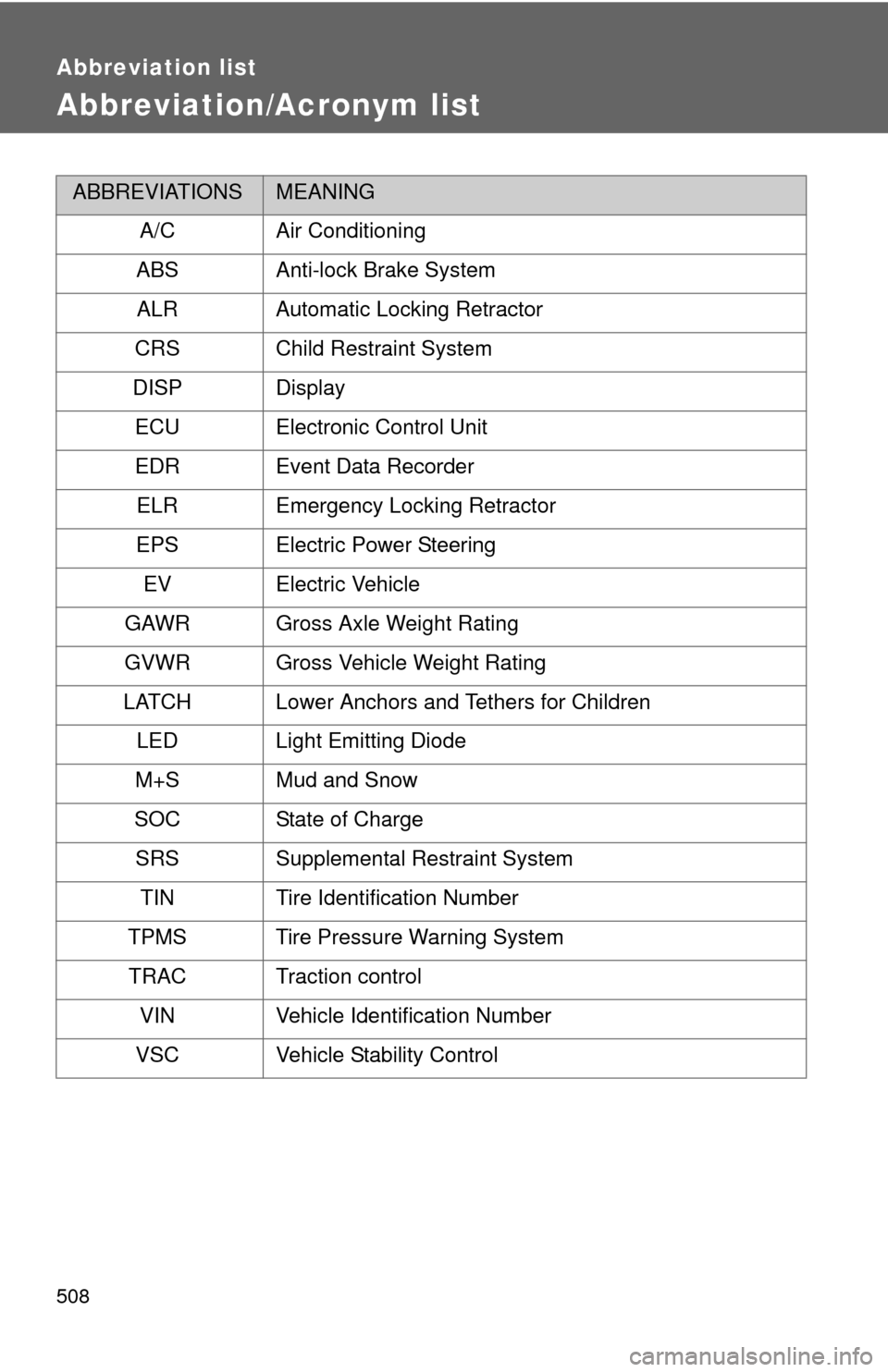
Abbreviation/Acronym list
ABBREVIATIONSMEANING
A/C Air Conditioning
ABS Anti-lock Brake System ALR Automatic Locking Retractor
CRS Child Restraint System
DISP Display ECU Electronic Control Unit
EDR Event Data Recorder
ELR Emergency Locking Retractor
EPS Electric Power Steering
EV Electric Vehicle
GAWR Gross Axle Weight Rating
GVWR Gross Vehicle Weight Rating
LATCH Lower Anchors and Tethers for Children
LED Light Emitting Diode
M+S Mud and Snow
SOC State of Charge
SRS Supplemental Restraint System TIN Tire Identification Number
TPMS Tire Pressure Warning System
TRAC Traction control VIN Vehicle Identification Number
VSC Vehicle Stability Control
Page 512 of 521

511
Alphabetical index
Doors
Back door ............................. 113
Door lock ........................ 96, 108
Door window......................... 146
Rear door child protector ...... 111
Side doors ............................ 110
Side mirrors .......................... 143
Driver's seat belt reminder
light ........................................ 419
Driving Break-in tips ......................... 191
Correct posture..................... 152
Procedures ........................... 190
Winter driving tips ................. 268
Electric power steering........... 251
Electric vehicle .......................... 26
Electronic key If your electronic key
battery is discharged .......... 468
Emergency flasher Switch ................................... 412
Emergency tire puncture repair kit................................. 447
Emergency, in case of
If a warning buzzer sounds... ........................... 417
If a warning light turns
on ....................................... 417
If a warning message is displayed ............................ 427
If the electronic key does not operate properly ........... 468
If the EV (Electric Vehicle)
system will not start............ 465
If the vehicle 12-volt battery is discharged .......... 470
If you have a flat tire ............ 447
If you lose your keys............. 467
If you think something is wrong ................................. 416
If your vehicle becomes stuck................................... 477 If your vehicle has to be
stopped in an
emergency ..........................479
If your vehicle needs to be towed ..................................413
If your vehicle overheats .......475
Energy monitor Past record screen ..................40
Trip information screen ...........38
EPS ............................................251
EV (Electric Vehicle) system Charging..................................53
Driving tips ..............................41
Emergency shut off system .....33
Energy monitor/consumption screen..............38
EV System Indicator..............221
EV (Electric Vehicle) system
precautions ...........................32
High voltage components........32
How to start the EV system ...200
If the EV (Electric Vehicle) system will not start ............465
“POWER” switch ...................200
Vehicle Proximity Notification System ...............31
Event data recorder ...................19
Extended charge mode .............58
Floor mat...................................316
Fluid Brake .....................................361
Washer ..................................365
Front passenger occupant
classification system ............166
Front passenger's seat belt reminder light.........................419
Front seats Adjustment ............................118
Front side marker lights
Switch....................................234
E
F