tires TOYOTA RAV4 PLUG-IN HYBRID 2021 User Guide
[x] Cancel search | Manufacturer: TOYOTA, Model Year: 2021, Model line: RAV4 PLUG-IN HYBRID, Model: TOYOTA RAV4 PLUG-IN HYBRID 2021Pages: 666, PDF Size: 161.28 MB
Page 332 of 666
3305-2. Driving procedures
enabled, the system will turn off and the
brake hold standby indicator light will go off. In addition, if any of the conditions
are detected while th e system is holding
the brake, a warning buzzer will sound and a message wi ll be shown on the
multi-information display. The parking
brake will then be set automatically.
■Brake hold function
●If the brake pedal is left released for a
period of about 3 minutes after the system has started ho lding the brake,
the parking brake will be set automati -
cally. In this case, a warning buzzer sounds and a message is shown on
the multi-information display.
●To turn the system o ff while the sys-
tem is holding the brake, firmly
depress the brak e pedal and press the button again.
●The brake hold func tion may not hold the vehicle when the vehicle is on a
steep incline. In this situation, it may
be necessary for the driver to apply the brakes. A warning buzzer will
sound and the multi -information dis-
play will inform the dr iver of this situa- tion. If a warning message is shown
on the multi-informa tion display, read
the message and follow the instruc - tions.
■When the parking brake is set auto -
matically while the system is hold -
ing the brakes
Perform any of the following operations
to release the parking brake:
●Depress the accelerator pedal. (The
parking brake will not be released
automatically if the seat belt is not fas - tened.)
●Operate the parking brake switch with
the brake pedal depressed.
Make sure that the parking brake indica -
tor light goes off. ( →P.326)
■When an inspection at any autho-
rized Toyota retailer or Toyota authorized repairer, or any reliable
repairer is necessary
When the brake hold standby indicator (green) does not illuminate even when
the brake hold switch is pressed with the
brake hold system ope rating conditions met, the system may b e malfunctioning.
Have the vehicle i nspected at any
authorized Toyota r etailer or Toyota authorized repairer, or any reliable
repairer.
■If “Brake Hold Malfunction Press
Brake to Deactivate Visit Your Dealer” or “Brake Hold Malfunction
Visit Your Dealer” is displayed on
the multi-information display
The system may be malfunctioning.
Have the vehicle inspected by any
authorized Toyota r etailer or Toyota authorized repairer, or any reliable
repairer.
■Warning messages and buzzers
Warning messages and buzzers are used to indicate a system malfunction or
to inform the driver of the need for cau -
tion. If a warning message is shown on the multi-information display, read the
message and follow the instructions.
■If the brake hold operated indicator
flashes
→ P.574
WARNING
■When the vehicle is on a steep
incline
When using the brake hold system on a steep incline, exercise caution. The
brake hold function may not hold the
vehicle in such a situation.
■When stopped on a slippery road
The system cannot stop the vehicle when the gripping ab ility of the tires
has been exceeded. Do not use the
system when stopped on a slippery road.
Page 358 of 666
3565-5. Using the driving support systems
WARNING
■Limitations of the pre-collision
system
●The driver is solely responsible for safe driving. Always drive safely,
taking care to observe your sur -
roundings. Do not use the pre- collision system
instead of normal braking opera -
tions under any circumstances.
This system will not prevent colli - sions or lessen collision damage or
injury in every situation. Do not
overly rely on thi s system. Failure to do so may lead to an accident,
resulting in death or serious injury.
●Although this system is designed to
help avoid a collision or help reduce
the impact of the collision, its effec - tiveness may change according to
various conditions, therefore the
system may not alw ays be able to achieve the same level of perfor -
mance.
Read the following conditions care - fully. Do not over ly rely on this sys-
tem and always drive carefully.
• Conditions under which the system may operate even if there is no pos -
sibility of a collision: →P.359
• Conditions under which the system may not operate properly: →P.360
●Do not attempt to test the operation of the pre-collision system yourself.
Depending on the objects used for
testing (dummies, cardboard objects imitating detectable objects,
etc.), the system m ay not operate
properly, possibly leading to an accident.
■Pre-collision braking
●When the pre-collision braking
function is operating, a large
amount of braking force will be applied.
●If the vehicle is stopped by the operation of the pre-collision brak -
ing function, the p re-collision brak-
ing function operation will be canceled after approximately 2 sec -
onds. Depress the brake pedal as
necessary.
●The pre-collision braking function
may not operate if certain opera - tions are performed by the driver. If
the accelerator pedal is being
depressed strongly or the steering wheel is being turned, the system
may determine that the driver is tak -
ing evasive action and possibly pre - vent the pre-col lision braking
function from operating.
●In some situations, while the pre-
collision braking function is operat -
ing, operation of the function may be canceled if the accelerator pedal
is depressed strongly or the steer -
ing wheel is tur ned and the system determines that the driver is taking
evasive action.
●If the brake pedal is being
depressed, the system may deter -
mine that the driv er is taking eva- sive action and possibly delay the
operation timing of the pre-collision
braking function.
■When to disable the pre-colli -
sion system
In the following situations, disable the
system, as it may not operate prop-
erly, possibly leading to an accident resulting in death or serious injury:
●When the vehicle is being towed
●When your vehicle is towing
another vehicle
●When transporting the vehicle via truck, boat, train or similar means of
transportation
●When the vehicle is raised on a lift
with the hybrid system on and the
tires are allowed to rotate freely
Page 359 of 666
357
5
5-5. Using the driving support systems
Driving
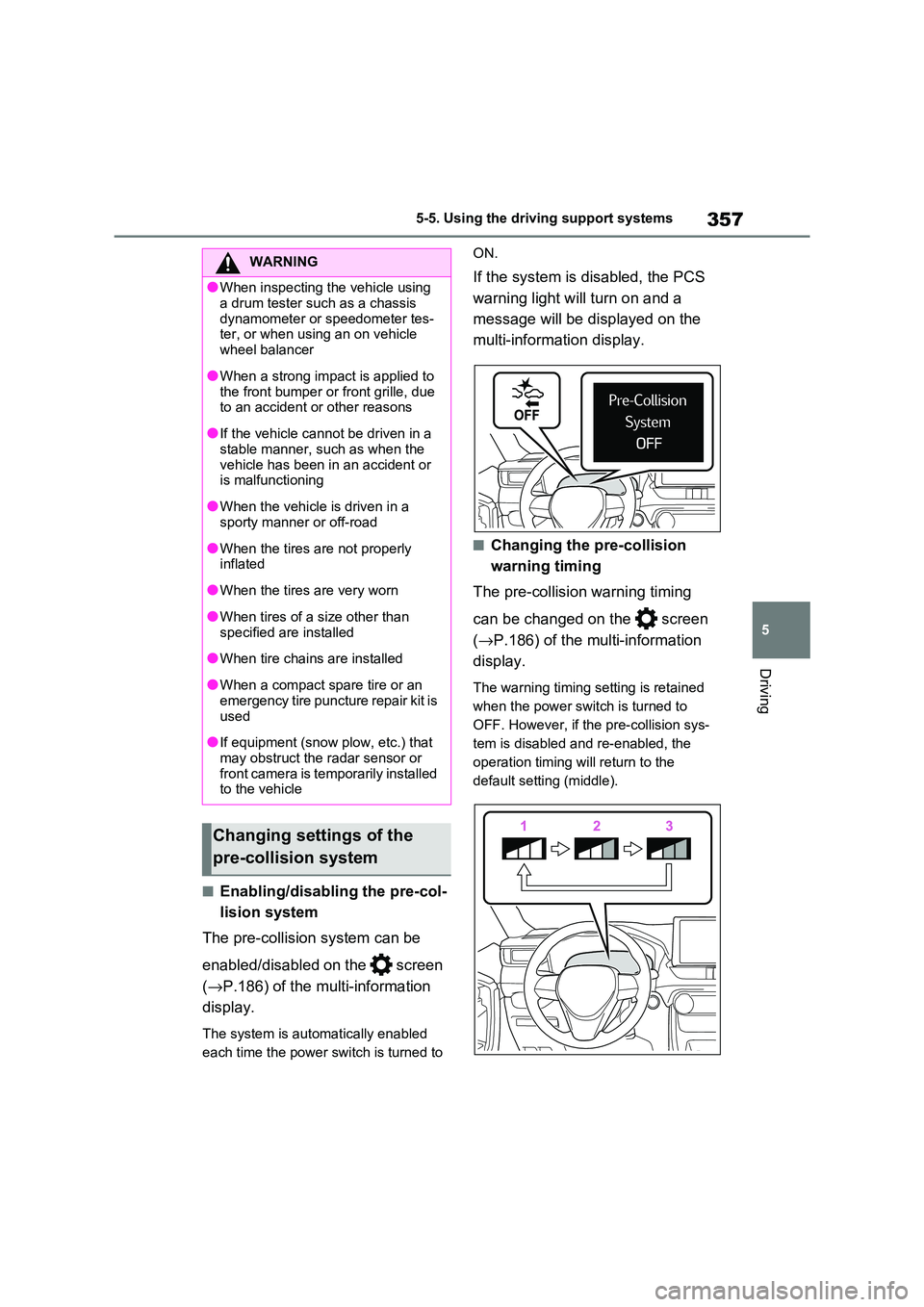
■Enabling/disabling the pre-col -
lision system
The pre-collisio n system can be
enabled/disabled on the screen
( →P.186) of the multi-information
display.
The system is automa tically enabled
each time the power switch is turned to
ON.
If the system is disabled, the PCS
warning light will turn on and a
message will be di splayed on the
multi-information display.
■Changing the pre-collision
warning timing
The pre-collision warning timing
can be changed on the screen
( →P.186) of the multi-information
display.
The warning timing setting is retained
when the power switch is turned to
OFF. However, if the pre-collision sys-
tem is disabled and re-enabled, the
operation timing will return to the
default setting (middle).
WARNING
●When inspecting the vehicle using
a drum tester su ch as a chassis
dynamometer or speedometer tes- ter, or when using an on vehicle
wheel balancer
●When a strong impact is applied to
the front bumper or front grille, due
to an accident or other reasons
●If the vehicle cannot be driven in a
stable manner, such as when the
vehicle has been in an accident or is malfunctioning
●When the vehicle is driven in a sporty manner or off-road
●When the tires are not properly inflated
●When the tires are very worn
●When tires of a size other than
specified are installed
●When tire chains are installed
●When a compact spare tire or an
emergency tire puncture repair kit is
used
●If equipment (snow p low, etc.) that
may obstruct the radar sensor or front camera is tem porarily installed
to the vehicle
Changing settings of the
pre-collision system
Page 365 of 666
363
5
5-5. Using the driving support systems
Driving
WARNING
■Before using LTA system
●Do not rely sole ly upon the LTA
system. The LTA system does not automatically drive the vehicle or
reduce the amount of attention that
must be paid to the area in front of the vehicle. The driver must always
assume full responsibility for driving
safely by paying careful attention to
the surrounding conditions and operating the stee ring wheel to cor-
rect the path of t he vehicle. Also,
the driver must take adequate breaks when fatigued, such as from
driving for a long period of time.
●Failure to perform appropriate driv -
ing operations and pay careful
attention may lead to an accident, resulting in death or serious injury.
●When not u sing the LTA system, use the LTA switch to turn the sys -
tem off.
■Situations unsuitable for LTA
system
In the following situations, use the LTA switch to tu rn the system off.
Failure to do so may lead to an acci -
dent, resulting in death or serious injury.
●Vehicle is driven on a road surface which is slippery due to rainy
weather, fallen snow, freezing, etc.
●Vehicle is driven on a snow-cov -
ered road.
●White (yellow) lines are difficult to
see due to rain, snow, fog, dust,
etc.
●Vehicle is driven in a temporary
lane or restricted lane due to con - struction work.
●Vehicle is driven in a construction zone.
●A spare tire, tire chains, etc. are equipped.
●When the tires have been exces - sively worn, or when the tire infla -
tion pressure is low.
●When tires of a size other than
specified are installed.
●Vehicle is driven in traffic lanes
other than that highways and free -
ways.
●When your vehicle is towing a
trailer or during emergency towing
■Preventing LTA system malfunc -
tions and operations performed by mistake
●Do not modify the headlights or
place stickers, etc. on the surface of the lights.
●Do not modify the suspension etc. If the suspension etc. needs to be
replaced, contact any authorized
Toyota retailer or Toyota authorized repairer, or any reliable repairer.
●Do not install or place anything on the hood or grille. Also, do not
install a grille guar d (bull bars, kan-
garoo bar, etc.).
●If your windshield needs repairs,
contact any autho rized Toyota retailer or Toyota authorized
repairer, or any reliable repairer.
■Conditions in which functions
may not operate properly
In the following situ ations, the func- tions may not operate properly and
the vehicle may depart from its lane.
Drive safely by always paying careful
attention to your surroundings and operate the steering wheel to correct
the path of the vehicle without relying
solely on the functions.
Page 367 of 666
365
5
5-5. Using the driving support systems
Driving
■Lane departure alert function
When the system determines that
the vehicle might depart from its
lane or course*, a warning is dis -
played on the multi-information dis -
play, and either a warning buzzer
will sound or the steering wheel will
vibrate to alert the driver.
When the warning buzzer sounds or
the steering wheel vibrates, check the
area around your vehicle and carefully
WARNING
●The vehicle is driven in an area
without white (yellow) lines, such as
in front of a tollg ate or checkpoint, or at an intersection, etc.
●The white (yellow) lines are cracked, “Raised pavement
marker” or stones are present.
●The white (yellow) lines cannot be seen or are difficu lt to see due to
sand, etc.
●The vehicle is driven on a road sur -
face that is wet due to rain, pud -
dles, etc.
●The traffic lines are yellow (which
may be more difficult to recognize than lines that are white).
●The white (yellow) lines cross over a curb, etc.
●The vehicle is driven on a bright surface, such as concrete.
●If the edge of the road is not clear or straight.
●The vehicle is driven on a surface that is bright due t o reflected light,
etc.
●The vehicle is driven in an area
where the brightness changes sud -
denly, such as at the entrances and exits of tunnels, etc.
●Light from the hea dlights of an oncoming vehicle, the sun, etc.
enters the camera.
●The vehicle is driven on a slope.
●The vehicle is driven on a road which tilts left or right, or a winding
road.
●The vehicle is driven on an
unpaved or rough road.
●The traffic lane is excessively nar -
row or wide.
●The vehicle is ext remely tilted due to carrying heavy luggage or having
improper tire pressure.
●The distance to the preceding vehi -
cle is extremely short.
●The vehicle is moving up and down
a large amount due to road condi-
tions during drivi ng (poor roads or road seams).
●When driving in a t unnel or at night with the headlights off or when a
headlight is dim due to its lens
being dirty or it being misaligned.
●The vehicle is s truck by a cross-
wind.
●The vehicle is affected by wind from
a vehicle driven in a nearby lane.
●The vehicle has just changed lanes
or crossed an intersection.
●Tires which differ by structure, man -
ufacturer, brand or tread pattern are used.
●Snow tires, etc. are equipped.
●The vehicle is b eing driven at
extremely high speeds.
Functions included in LTA
system
Page 413 of 666
411
5
5-5. Using the driving support systems
Driving
●Instances of the BSM function unnec -
essarily detecting a vehicle and/or object may increase in the following
situations:
• When the sensor is misaligned due to a strong impact to the sensor or its
surrounding area
• When the distance between your vehi - cle and a guardrail, wall, etc. that
enters the detect ion area is short
• When driving up and down consecu - tive steep inclines, such as hills, dips
in the road, etc.
• When vehicle lanes are narrow, or when driving on the edge of a lane,
and a vehicle travel ing in a lane other
than the adjacent lanes enters the detection area
• When driving on roads with sharp
bends, consecutive curves, or uneven surfaces
• When the tires are slipping or spinning
• When the distance between your vehi - cle and a following vehicle is short
• When an accessory (such as a bicycle
carrier) is installed to the rear of the vehicle
• When the vehicle th rows up water or
snow behind.
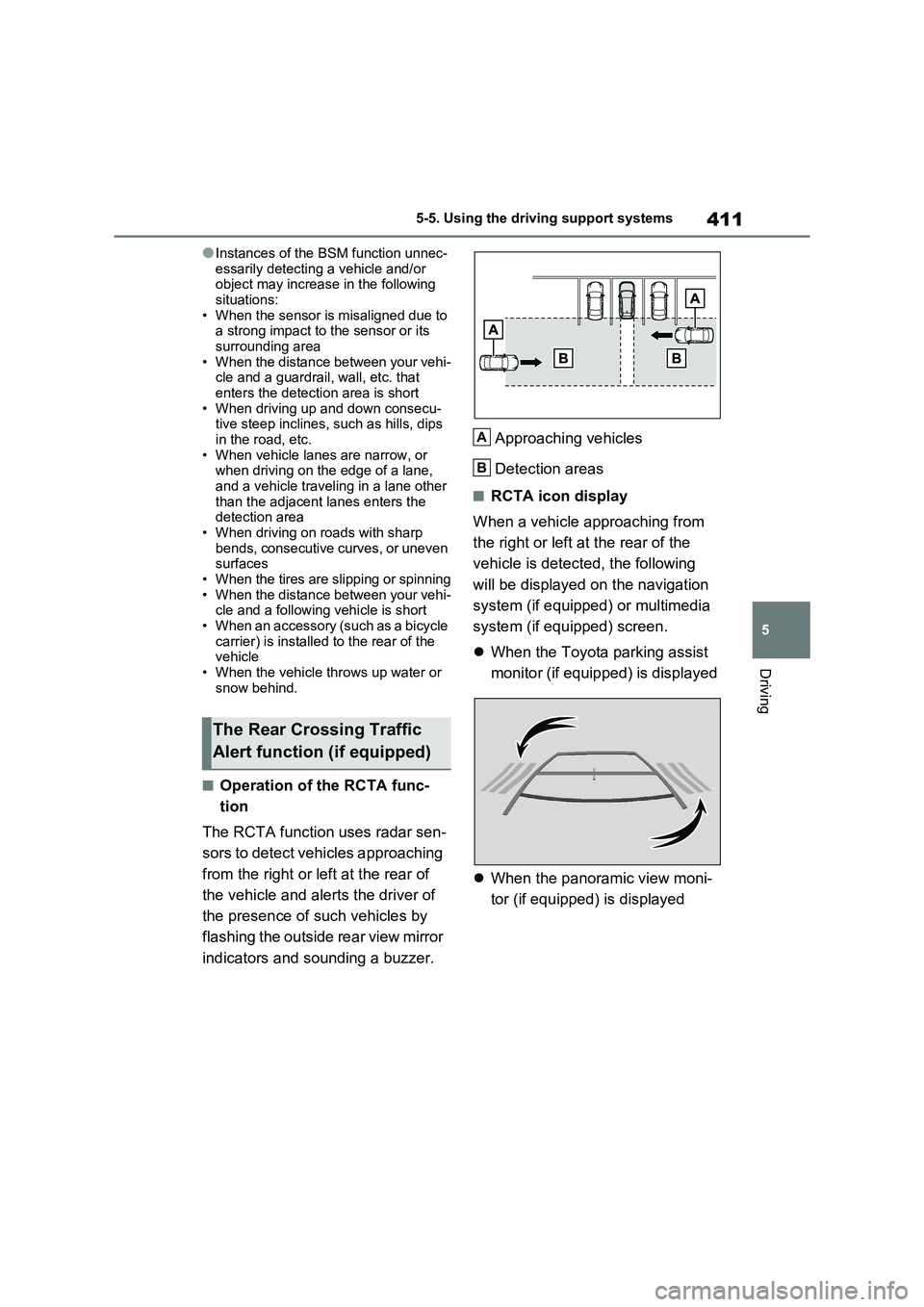
■Operation of the RCTA func -
tion
The RCTA function uses radar sen -
sors to detect vehicles approaching
from the right or left at the rear of
the vehicle and aler ts the driver of
the presence of s uch vehicles by
flashing the outside rear view mirror
indicators and sounding a buzzer.
Approaching vehicles
Detection areas
■RCTA icon display
When a vehicle approaching from
the right or left at the rear of the
vehicle is detected, the following
will be displayed on the navigation
system (if equipped) or multimedia
system (if equipped) screen.
When the Toyota parking assist
monitor (if equipped) is displayed
When the panoramic view moni-
tor (if equipped) is displayed
The Rear Crossing Traffic
Alert function (if equipped)
A
B
Page 428 of 666
4265-5. Using the driving support systems
■The Parking Support Brake func- tion (static object) will operate
when
The function will operate when the
PKSB OFF indicator is not illuminated ( →P.170, 171) and all of the following
conditions are met:
●Hybrid system outpu t restriction con-
trol
• The Parking Support Brake is enabled.
• The vehicle speed is approximately 15
km/h (9 mph) or less. • There is a static object in the traveling
direction of the v ehicle and approxi-
mately 2 to 4 m (6 to 13 ft.) away. • The Parking Support Brake deter -
mines that a stronger-than-normal
brake operation is n ecessary to avoid a collision.
●Brake control• Hybrid system outpu t restriction con-
WARNING
●If the area around a radar sensor is
subjected to an im pact, the system
may not operate properly due to a sensor malfunction. Have the vehi -
cle inspected by any authorized
Toyota retailer or Toyota authorized repairer, or any reliable repairer.
■Handling the suspension
Do not modify the suspension, as changes to the height or inclination of
the vehicle may pr event the sensors
from detecting objects correctly or cause the system to not operate or
operate unnecessarily.
■If the Parking Support Brake
function (static objects) operates
unnecessarily, such as at a rail - road crossing
In the event that the Parking Support
Brake function (sta tic objects) oper- ates unnecessarily, such as at a rail-
road crossing, brake control will be
canceled after appr oximately 2 sec- onds, allowing you to proceed forward
and leave the area, brake control can
also be canceled by depressing the brake pedal. Depressing the acceler -
ator pedal after brake control is can -
celed will allow you to proceed forward and leav e the area.
■Notes when washing the vehicle
Do not apply intensive bursts of water
or steam to the sensor area.
Doing so may resul t in the sensor malfunctioning.
●When using a high pressure washer to wash the vehicle, do not
spray the sensors directly, as doing
so may cause a sensor to malfunc - tion.
●When using steam to clean the vehicle, do not direct steam too
close to the sensors as doing so
may cause a sensor to malfunction.
■When to disable the Parking Sup - port Brake
In the following situations, disable the
Parking Support Brake as the system may operate even t hough there is no
possibility of a collision.
●When inspecting t he vehicle using
a chassis roller, chassis dynamo or
free roller
●When loading the vehicle onto a
boat, truck or other transport vessel
●If the suspension has been modi -
fied or tires of a size other than specified are installed
●If the front of the vehicle is raised or lowered due to the carried load
●When equipment that may obstruct a sensor is instal led, such as a tow-
ing eyelet, bumper protector (an
additional trim st rip, etc.), bicycle carrier, or snow plow
●When using an autom atic car wash
Page 431 of 666
429
5
5-5. Using the driving support systems
Driving
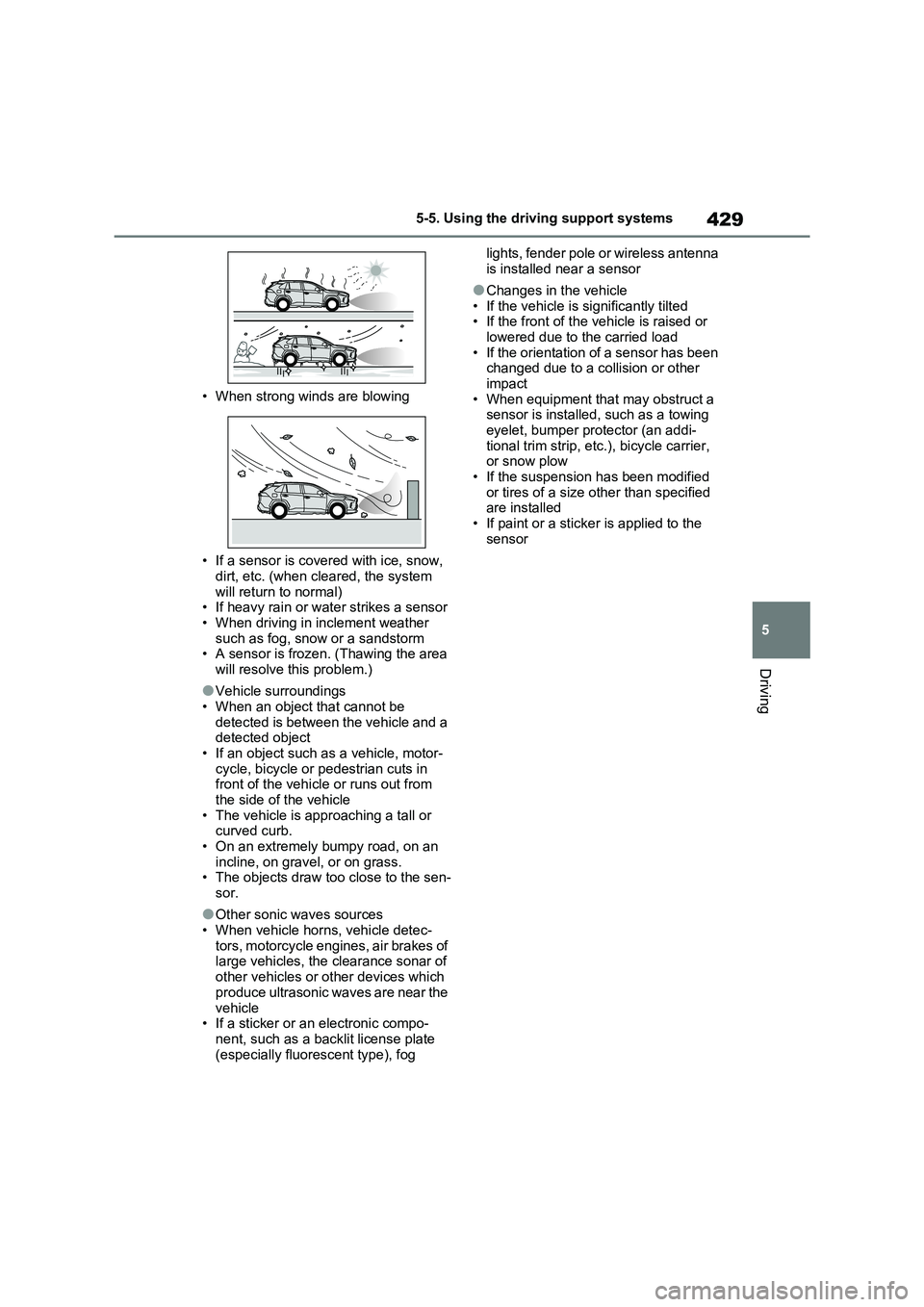
• When strong winds are blowing
• If a sensor is cove red with ice, snow,
dirt, etc. (when cleared, the system
will return t o normal) • If heavy rain or wa ter strikes a sensor
• When driving in inclement weather
such as fog, snow or a sandstorm • A sensor is frozen. (Thawing the area
will resolve this problem.)
●Vehicle surroundings
• When an object that cannot be
detected is between the vehicle and a detected object
• If an object such as a vehicle, motor-
cycle, bicycle or pedestrian cuts in front of the vehicl e or runs out from
the side of the vehicle
• The vehicle is approaching a tall or curved curb.
• On an extremely bumpy road, on an
incline, on gravel, or on grass. • The objects draw too close to the sen -
sor.
●Other sonic waves sources
• When vehicle horns , vehicle detec-
tors, motorcycle engines, air brakes of large vehicles, the clearance sonar of
other vehicles or other devices which
produce ultrasonic waves are near the
vehicle • If a sticker or an electronic compo -
nent, such as a backl it license plate
(especially fluorescent type), fog
lights, fender pole or wireless antenna
is installed near a sensor
●Changes in the vehicle
• If the vehicle is significantly tilted • If the front of the v ehicle is raised or
lowered due to the carried load
• If the orientation of a sensor has been changed due to a collision or other
impact
• When equipment that may obstruct a sensor is installed , such as a towing
eyelet, bumper protector (an addi -
tional trim str ip, etc.), bicycle carrier, or snow plow
• If the suspension has been modified
or tires of a size o ther than specified are installed
• If paint or a sticker is applied to the
sensor
Page 434 of 666
4325-5. Using the driving support systems
approximately 24 km/h (15 mph)*: Depending on the conditions, detec-
tion of a vehicle and/or object may
occur.
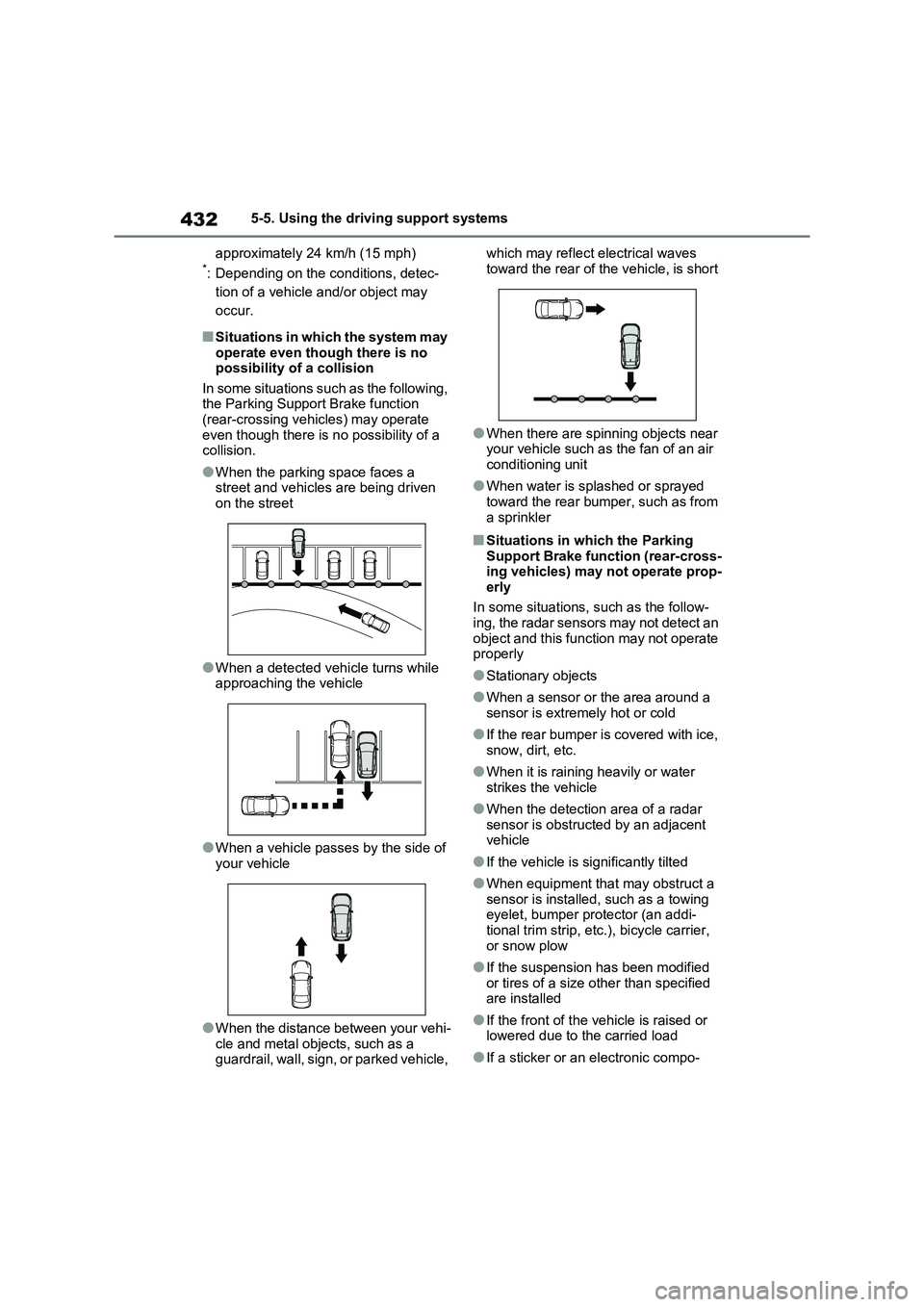
■Situations in which the system may
operate even though there is no possibility of a collision
In some situations such as the following,
the Parking Support Brake function (rear-crossing vehicles) may operate
even though there is n o possibility of a
collision.
●When the parking space faces a
street and vehicles are being driven on the street
●When a detected vehicle turns while approaching the vehicle
●When a vehicle passe s by the side of your vehicle
●When the distance between your vehi -
cle and metal objects, such as a guardrail, wall, sign, or parked vehicle,
which may reflect electrical waves
toward the rear of the vehicle, is short
●When there are spinning objects near
your vehicle such as the fan of an air conditioning unit
●When water is spla shed or sprayed toward the rear bumper, such as from
a sprinkler
■Situations in which the Parking
Support Brake function (rear-cross - ing vehicles) may not operate prop -
erly
In some situations, s uch as the follow- ing, the radar sensors may not detect an
object and this function may not operate
properly
●Stationary objects
●When a sensor or the area around a
sensor is extremely hot or cold
●If the rear bumper is covered with ice,
snow, dirt, etc.
●When it is raining heavily or water
strikes the vehicle
●When the detection area of a radar
sensor is obstruct ed by an adjacent
vehicle
●If the vehicle is significantly tilted
●When equipment that may obstruct a
sensor is installed , such as a towing
eyelet, bumper protector (an addi - tional trim str ip, etc.), bicycle carrier,
or snow plow
●If the suspension has been modified or tires of a size o ther than specified
are installed
●If the front of the v ehicle is raised or
lowered due to the carried load
●If a sticker or an electronic compo -
Page 444 of 666
4425-5. Using the driving support systems
MessageDetails/Actions
“AWD System Over-
heated Switching to 2WD
Mode”
AWD system is overheating.
→ Drive the vehicle at low speeds and stop the
vehicle in a safe place with the hybrid system
operating until the message is cleared.
Once the display message on the multi-information dis -
play turns off, there is no p roblem continuing to drive.
If the message does not dis appear, have your vehicle
checked by any authorized Toyota retailer or Toyota
authorized repairer, or any reliable repairer immedi-
ately.
“AWD System Over -
heated 2WD Mode
Engaged”
The vehicle switch ed from all-wheel drive (AWD) to
front wheel drive du e to overheating.
→ Drive the vehicle at low speeds and stop the
vehicle in a safe place with the hybrid system
operating until the message is cleared.
Once the display message on the multi-information dis -
play turns off, the AWD s ystem returns to normal.
If the message does not dis appear, have your vehicle
checked by any authorized Toyota retailer or Toyota
authorized repairer, or any reliable repairer immedi-
ately.
“AWD System Malfunc -
tion 2WD Mode Engaged
Visit Your Dealer”
A malfunction occurr ed in the AWD system.
→ Have your vehicle checked by any authorized
Toyota retailer or Toyota authorized repairer, or
any reliable repairer immediately.
WARNING
■The ABS does not operate effec -
tively when
●The limits of tire gripping perfor -
mance have been exceeded (such
as excessively worn tires on a snow covered road).
●The vehicle hydroplanes while driv - ing at high speed on wet or slick
roads.
■Stopping distance when the ABS
is operating may exceed that of normal conditions
The ABS is not desi gned to shorten
the vehicle’s stopping distance. Always maintain a safe distance from
the vehicle in fron t of you, especially
in the following situations:
●When driving on dirt, gravel or snow-covered roads
●When driving wit h tire chains
●When driving over bumps in the
road