brake TOYOTA RAV4 PLUG-IN HYBRID 2021 Owners Manual
[x] Cancel search | Manufacturer: TOYOTA, Model Year: 2021, Model line: RAV4 PLUG-IN HYBRID, Model: TOYOTA RAV4 PLUG-IN HYBRID 2021Pages: 666, PDF Size: 161.28 MB
Page 5 of 666
3TABLE OF CONTENTS
1
6
5
4
3
2
8
7
9
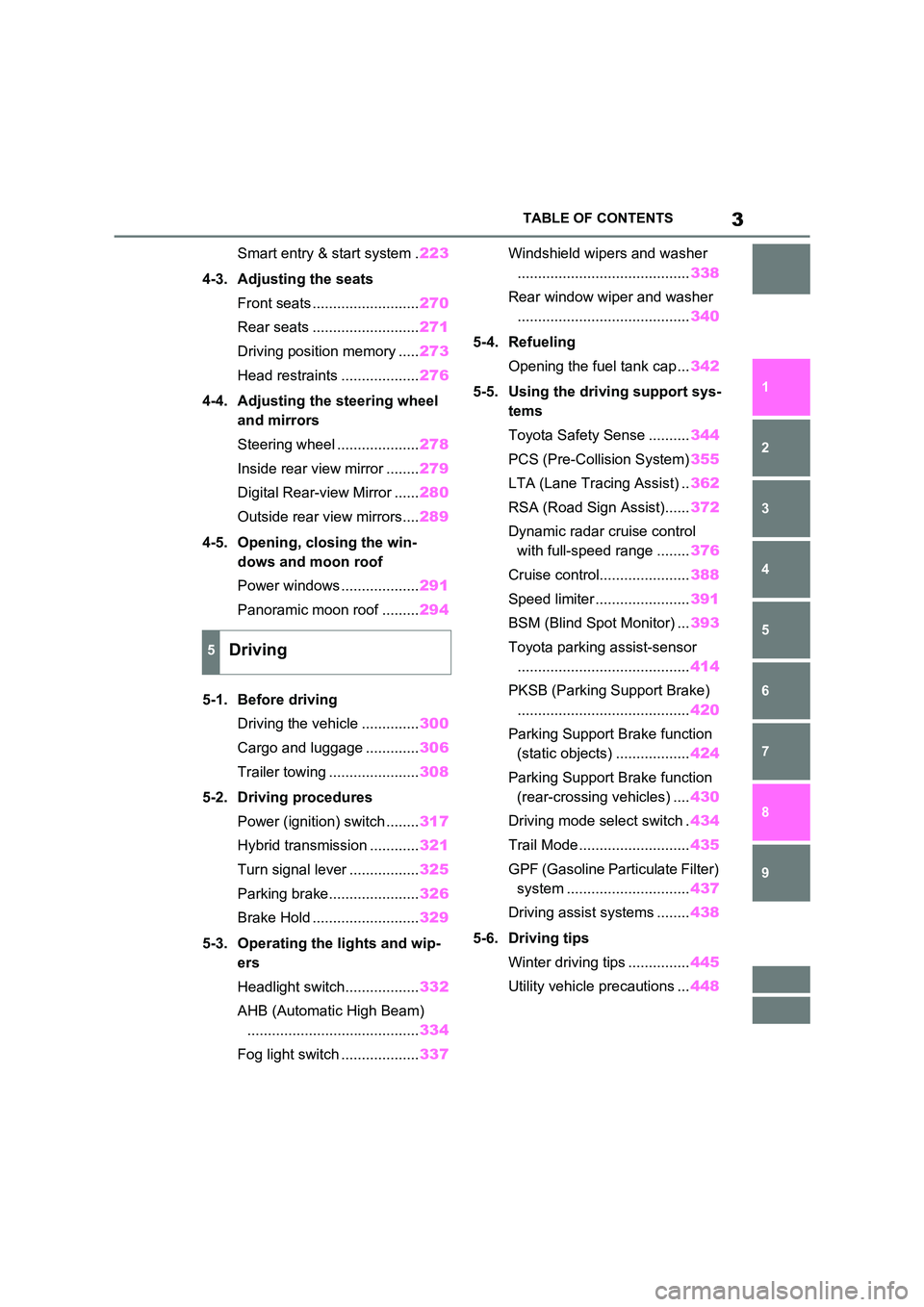
Smart entry & start system . 223
4-3. Adjusting the seats
Front seats .......................... 270
Rear seats .......................... 271
Driving position memory ..... 273
Head restraints ................... 276
4-4. Adjusting the steering wheel
and mirrors
Steering wheel .................... 278
Inside rear view mirror ........ 279
Digital Rear-view Mirror ...... 280
Outside rear view mirrors.... 289
4-5. Opening, closing the win -
dows and moon roof
Power windows ................... 291
Panoramic moon roof ......... 294
5-1. Before driving
Driving the vehicle .............. 300
Cargo and luggage ............. 306
Trailer towing ...................... 308
5-2. Driving procedures
Power (ignition) switch ........ 317
Hybrid transmission ............ 321
Turn signal lever ................. 325
Parking brake...................... 326
Brake Hold .......................... 329
5-3. Operating the lights and wip -
ers
Headlight switch.................. 332
AHB (Automatic High Beam)
.......................................... 334
Fog light switch ................... 337
Windshield wipers and washer
.......................................... 338
Rear window wiper and washer
.......................................... 340
5-4. Refueling
Opening the fuel tank cap ... 342
5-5. Using the driving support sys -
tems
Toyota Safety Sense .......... 344
PCS (Pre-Collision System) 355
LTA (Lane Tracing Assist) .. 362
RSA (Road Sign Assist)...... 372
Dynamic radar cruise control
with full-speed range ........ 376
Cruise control...................... 388
Speed limiter ....................... 391
BSM (Blind Spot Monitor) ... 393
Toyota parking assist-sensor
.......................................... 414
PKSB (Parking Support Brake)
.......................................... 420
Parking Support Brake function
(static objects) .................. 424
Parking Support Brake function
(rear-crossing vehicles) .... 430
Driving mode select switch . 434
Trail Mode ........................... 435
GPF (Gasoline Particulate Filter)
system .............................. 437
Driving assist systems ........ 438
5-6. Driving tips
Winter driving tips ............... 445
Utility vehicle precautions ... 448
5Driving
Page 8 of 666
6
Please note that this manual
applies to all models and explains
all equipment, including options.
Therefore, you may find some
explanations for equipment not
installed on your vehicle.
All specifications provided in this
manual are current at the time of
printing. However, because of the
Toyota policy of c ontinual product
improvement, we reserve the right
to make changes at any time with -
out notice.
Depending on specifications, the
vehicle shown in the illustrations
may differ from your vehicle in
terms of equipment.
Both genuine Toy ota and a wide
variety of other spare parts and
accessories for Toyota vehicles are
currently available in the market.
Should it be determined that any of
the genuine Toyot a parts or acces-
sories supplied with the vehicle
need to be replaced, Toyota recom -
mends that genuine Toyota parts or
accessories, be used to replace
them. Other parts or accessories of
matching quality can also be used.
Toyota cannot accept any liability
or guarantee sp are parts and
accessories which are not genuine
Toyota products, nor for replace -
ment or installati on involving such
parts. In addition, damage or per -
formance problems resulting from
the use of non-genuine Toyota
spare parts or accessories may not
be covered under warranty.
The installation of an RF-transmit -
ter system in your vehicle could
affect electronic systems such as:
Hybrid system
Multiport fuel injection sys-
tem/sequential multiport fuel
injection system
Toyota Safety Sense
Cruise control system
Anti-lock brake system
SRS airbag system
Seat belt pretensioner system
Be sure to check with any autho -
rized Toyota retailer or Toyota
authorized repairer, or any reliable
repairer for precautionary mea -
sures or special instructions regard -
ing installation of an RF-transmitter
system.
Further information regarding fre -
quency bands, power levels,
antenna positions and installation
provisions for the installation of RF-
transmitters, is available on request
For your information
Main Owner’s Manual
Accessories, spare parts
and modification of your
Toyota
Installation of an RF-trans -
mitter system
Page 9 of 666
7
at any authorized Toyota retailer or
Toyota authorized repairer, or any
reliable repairer.
High voltage parts and cables on
the hybrid vehicles emit approxi -
mately the same amount of electro -
magnetic waves as the
conventional gasoline powered
vehicles or home electronic appli -
ances despite of their electromag -
netic shielding.
Unwanted noise may occur in the
reception of the radio frequency
transmitter (RF-transmitter).
The vehicle is equipped with
sophisticated computers that will
record certain data, such as:
• Engine speed/Electric motor
speed (traction motor speed)
• Accelerator status
• Brake status
• Vehicle speed
• Operation statu s of the driving
assist systems
• Hybrid battery (traction battery)
status
The recorded data varies according
to the vehicle grade level, options
and destinations w ith which it is
equipped.
These computers do not record
conversations or sounds, and only
record images outs ide of the vehi-
cle in certain situations.
Data usage
Toyota may use the data recorded in
this computer to diagnose malfunc -
tions, conduct research and develop -
ment, and improve quality.
Toyota will not disclose the recorded
data to a thir d party except:
• With the consent of the vehicle owner
or with the consent of the lessee if
the vehicle is leased
• In response to an official request by
the police, a court o f law or a govern-
ment agency
• For use by Toyota in a lawsuit
• For research purposes where the
data is not tied to a specific vehicle or
vehicle owner
The SRS airbag and seat belt pre-
tensioner devices in your Toyota
contain explosive chemicals. If the
vehicle is scrapped with the airbags
and seat belt pretensioners left as
they are, this may cause an acci -
dent such as fire. Be sure to have
the systems of the SRS airbag and
seat belt pretensioner removed and
disposed of by a qualified service
shop or any authorized Toyota
retailer or Toyota authorized
repairer, or any reliable repairer,
before you scrap your vehicle.
Vehicle data recordingScrapping of your Toyota
Page 21 of 666
19Pictorial index
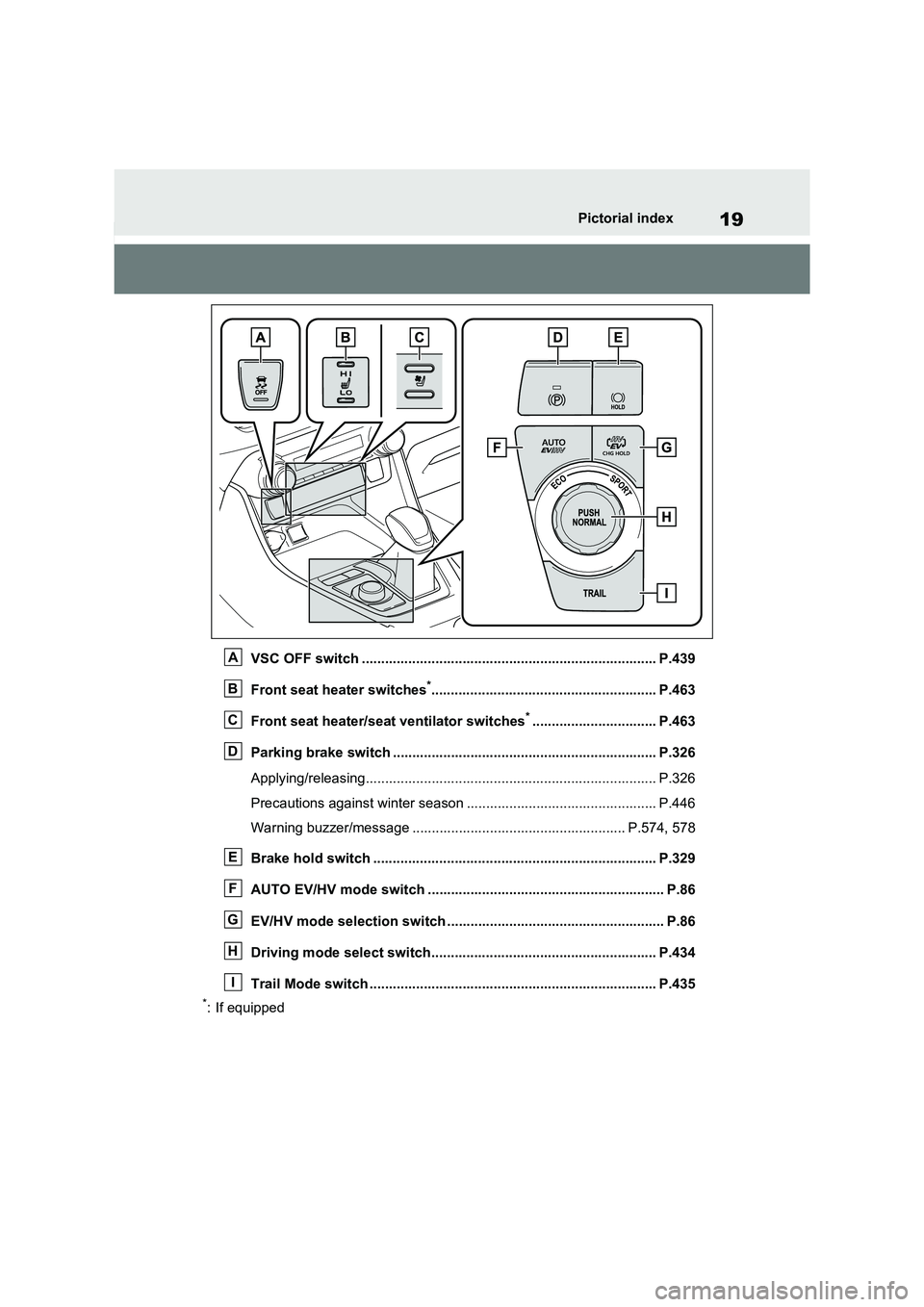
VSC OFF switch ............................................................................ P.439
Front seat heater switches*.......................................................... P.463
Front seat heater/seat ventilator switches*................................ P.463
Parking brake switch ........................................... ......................... P.326
Applying/releasing............................................. .............................. P.326
Precautions against winter season .............................. ................... P.446
Warning buzzer/message ......................................... .............. P.574, 578
Brake hold switch .. ....................................................................... P.329
AUTO EV/HV mode switch ......................................... .................... P.86
EV/HV mode selection switch .................................... .................... P.86
Driving mode select switch..................................... ..................... P.434
Trail Mode switch .............................................. ............................ P.435
*: If equipped
A
B
C
D
E
F
G
H
I
Page 29 of 666
27Pictorial index
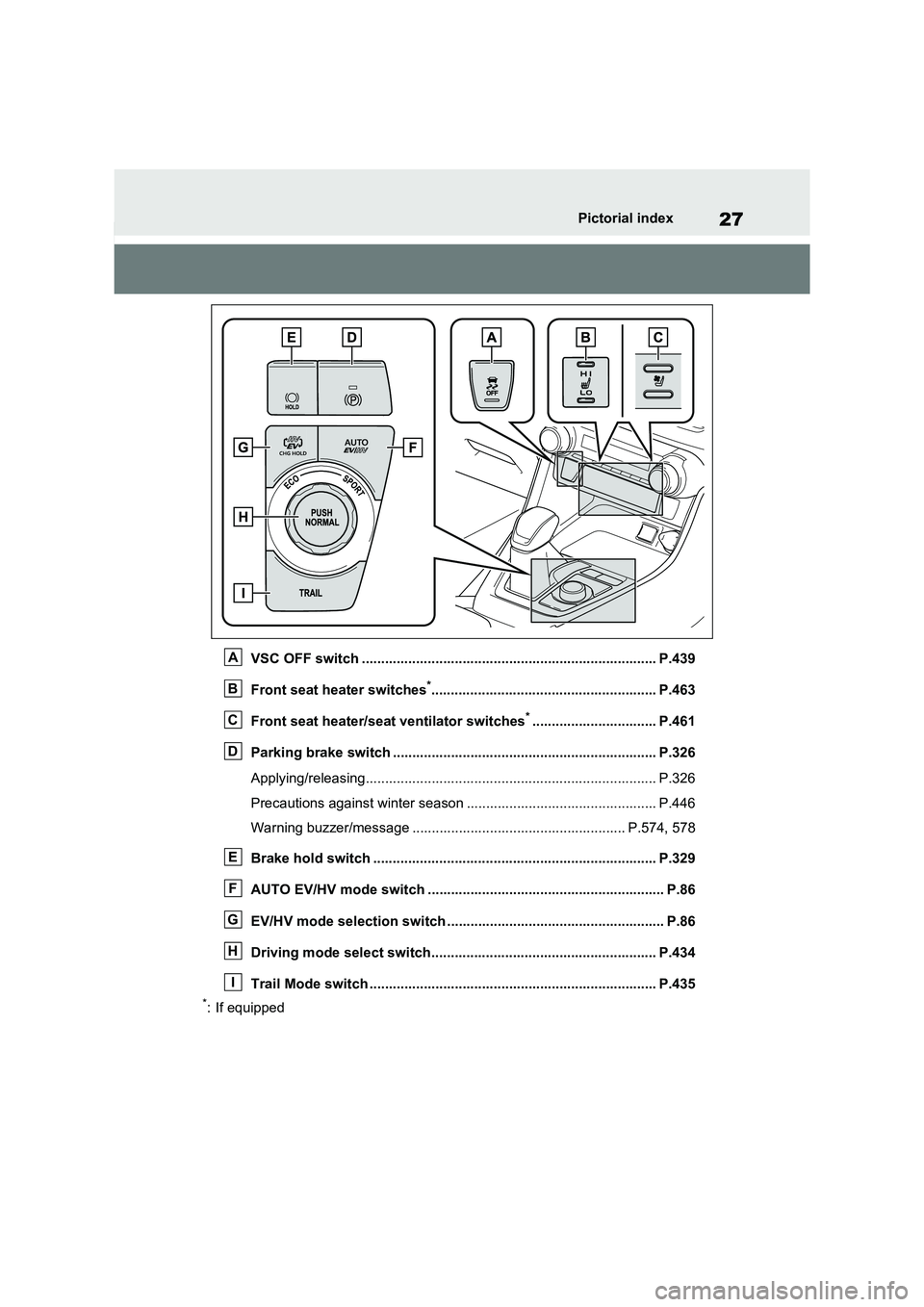
VSC OFF switch ............................................................................ P.439
Front seat heater switches*.......................................................... P.463
Front seat heater/seat ventilator switches*................................ P.461
Parking brake switch ........................................... ......................... P.326
Applying/releasing............................................. .............................. P.326
Precautions against winter season .............................. ................... P.446
Warning buzzer/message ......................................... .............. P.574, 578
Brake hold switch .. ....................................................................... P.329
AUTO EV/HV mode switch ......................................... .................... P.86
EV/HV mode selection switch .................................... .................... P.86
Driving mode select switch..................................... ..................... P.434
Trail Mode switch .............................................. ............................ P.435
*: If equipped
A
B
C
D
E
F
G
H
I
Page 43 of 666
41
1
1-1. For safe use
For safety and security
“PASSENGER AIR BAG” indicator
The main SRS airbag system comp onents are shown above. The SRS air-
bag system is controlled by the airbag sensor assembly. As the airbags
deploy, a chemical reaction in t he inflators quickly fills the airbags with non-
toxic gas to help restrain t he motion of the occupants.
■If the SRS airbags deploy (inflate)
●Slight abrasions, burns, bruising etc.,
may be sustained from SRS airbags, due to the extrem ely high speed
deployment (inflation) by hot gases.
●A loud noise and white powder will be
emitted.
●Parts of the airbag module (steering
wheel hub, airbag cover and inflator)
as well as the fron t seats, parts of the front and rear pillars, and roof side
rails, may be hot for several minutes.
The airbag itself m ay also be hot.
●The windshield may crack.
●The hybrid system will be stopped and
fuel supply to t he engine will be
stopped. ( →P.98)
●All of the doors will be unlocked.
( →P.206)
●Vehicles with Secondary Collision
Brake: The brakes and stop lights will be controlled au tomatically. (→P.439)
●The interior lights will turn on automat- ically. ( →P.466)
●The emergency flashers will turn on automatically. ( →P.560)
■SRS airbag deployment conditions
(SRS front airbags)
●The SRS front airb ags will deploy in
the event of an impact that exceeds
the set threshold level (the level of force corresponding to an approxi -
mately 20-30 km/h [12-18 mph] frontal
collision with a fixed wall that does not move or deform).
However, this threshold velocity will be
considerably higher in the following situ -
ations:
• If the vehicle strikes an object, such as a parked vehicle or sign pole,
which can move or deform on impact
• If the vehicle is involved in an under -
ride collision, such as a collision in which the front of the vehicle under -
rides, or goes under , the bed of a
truck
●Depending on the type of collision, it is
possible that only the seat belt preten - sioners will activate.
■SRS airbag deployment conditions
(SRS side and cu rtain shield air-
bags)
●The SRS side and curtain shield air -
bags will deploy in the event of an impact that exceeds the set threshold
level (the level of force corresponding
to the impact forc e produced by an approximately 1500 kg [3300 lb.] vehi -
cle colliding with the vehicle cabin
from a direction perpendicular to the vehicle orientation at an approximate
speed of 20 -30 km/h [12 -18 mph]).
●Both SRS curtain shield airbags may
also deploy in the event of a severe
frontal collision.
■Conditions under which the SRS airbags may deploy (inflate), other
than a collision
The SRS front airbags and SRS curtain shield airbags may a lso deploy if a seri-
ous impact occurs to the underside of
your vehicle. Some e xamples are shown in the illustration.
●Hitting a curb, edge of pavement or hard surface
●Falling into or jumping over a deep hole
●Landing hard or falling
O
Page 92 of 666
902-1. Plug-in hybrid system
Moreover, as fuel consumption is
also reduced when in HV mode, the
regenerative braking system can be
used effectively.
■Regenerative braking
In the following situations, kinetic energy is converted to electric energy and
deceleration force can be obtained in
conjunction with the recharging of the hybrid battery (traction battery).
●The accelerator pedal is released while driving with the shift lever in D or
S.
●The brake pedal is depressed while
driving with the shift lever in D or S.
■EV driving range
●The EV driving range is displayed on
the multi-information display.
( →P.181)
●The EV driving range changes in
accordance with the charge status of the hybrid battery ( traction battery),
the speed of the vehicle, etc.
●Even if there is enough charge
remaining in t he hybrid battery (trac-
tion battery), EV driving may be can- celed and both gasoline engine and
electric motor are used depending on
the situation. ( →P.90)
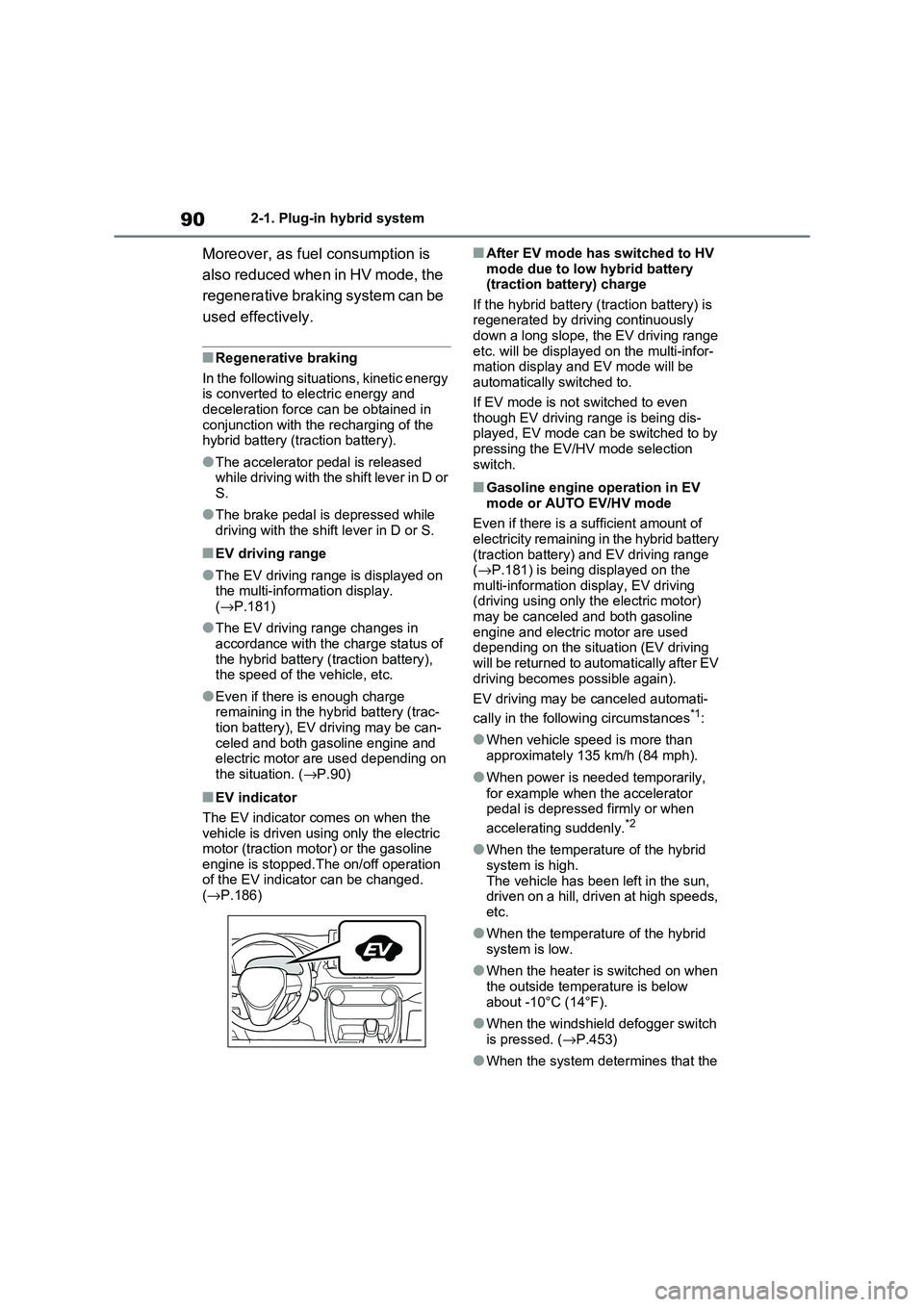
■EV indicator
The EV indicator comes on when the vehicle is driven usin g only the electric
motor (traction moto r) or the gasoline
engine is stopped.The on/off operation of the EV indicator can be changed.
( →P.186)
■After EV mode has switched to HV
mode due to low hybrid battery (traction battery) charge
If the hybrid battery ( traction battery) is
regenerated by driving continuously down a long slope, the EV driving range
etc. will be displaye d on the multi-infor-
mation display and EV mode will be automatically switched to.
If EV mode is not switched to even
though EV driving range is being dis - played, EV mode can be switched to by
pressing the EV/HV mode selection
switch.
■Gasoline engine operation in EV mode or AUTO EV/HV mode
Even if there is a su fficient amount of
electricity remaining in the hybrid battery (traction battery) and EV driving range
( →P.181) is being displayed on the
multi-information display, EV driving (driving using only the electric motor)
may be canceled and both gasoline
engine and electric motor are used depending on the situation (EV driving
will be returned to automatically after EV
driving becomes possible again).
EV driving may be canceled automati -
cally in the follo wing circumstances*1:
●When vehicle speed is more than
approximately 135 km/h (84 mph).
●When power is needed temporarily,
for example when the accelerator
pedal is depressed firmly or when
accelerating suddenly.*2
●When the temperatu re of the hybrid
system is high. The vehicle has been left in the sun,
driven on a hill, driven at high speeds,
etc.
●When the temperatu re of the hybrid
system is low.
●When the heater is switched on when
the outside temperature is below
about -10°C (14°F).
●When the windshield defogger switch
is pressed. ( →P.453)
●When the system determines that the
Page 93 of 666
91
2
2-1. Plug-in hybrid system
Plug-in hybrid system
gasoline engine needs to be started.*1: The gasoline engine may also oper -
ate in circumstances other than those
listed above, depending on condi -
tions.
*2: When driving in AUTO EV/HV mode.
Even in EV mode, the gasoline
engine may start, depending on the
condition of the hybrid battery (trac -
tion battery).
■If “Engine Started to Protect Sys -
tem EV driving unavailable” is dis - played on the mu lti-information
display
EV driving may be canceled in order to protect the hybr id system, etc.
In this case, perform driving with the
gasoline engine until EV driving will be returned to automatically.
■Conditions in which the gasoline
engine may not stop
The gasoline engine starts and stops automatically. Howev er, it may not stop
automatically in the following condi -
tions*:
●During gasoline engine warm-up
●During hybrid battery (traction battery)
charging
●When the temperature of the hybrid
battery (traction batt ery) is high or low
●When the windshield defogger switch
is pressed. ( →P.453)*: Depending on the circumstances, the
gasoline engine may also not stop
automatically in sit uations other than
those above.
■Sounds and vibrations specific to a
hybrid vehicle
There may be no engine sound or vibra - tion even though the vehicle is able to
move with the “READY” indicator is illu-
minated. For safety, apply the parking brake and make sure to shift the shift
lever to P when parked.
The following sounds o r vibrations may
occur when the hyb rid system is operat- ing and are not a malfunction.
●Motor sounds may be heard from the engine compartment.
●Sounds may be heard from the hybrid battery (traction battery) when the
hybrid system starts or stops.
●Relay operating sounds such as a
snap or soft clank will be emitted from
the hybrid battery ( traction battery), behind the rear seats, when the hybrid
system is started or stopped.
●Sounds from the hy brid system may
be heard when the back door is open.
●Sounds may be heard from the trans -
mission when the gasoline engine
starts or stops, when driving at low speeds, or during idling.
●Engine sounds may be heard when accelerating sharply.
●Sounds may be heard due to regener - ative braking when t he brake pedal is
depressed or as the accelerator pedal
is released.
●Vibration may be f elt when the gaso-
line engine starts or stops.
●Cooling fan sounds may be heard
from the air intake vent under the rear seat. ( →P.98)
●Sounds may be heard from near the hybrid battery (traction battery) in
accordance with th e operation of the
air conditioning syst em or “Battery Cooler” ( →P.129).
■Maintenance, repair, recycling, and
disposal
Contact any authoriz ed Toyota retailer
or Toyota authorized repairer, or any reliable repairer regarding mainte -
nance, repair, recycling and disposal.
Do not dispose of the vehicle yourself.
I n o r d e r t o m a k e E V m o d e o r A U T O
EV/HV mode available, charge the
Charging ( →P.105)
Page 98 of 666
962-1. Plug-in hybrid system
WARNING
●Never touch, disassemble, remove
or replace the high voltage parts,
cables or their connectors.
●The hybrid system will become hot
after starting a s the system uses high voltage. Be careful of both the
high voltage and the high tempera -
ture, and always obe y the caution
labels attached to the vehicle.
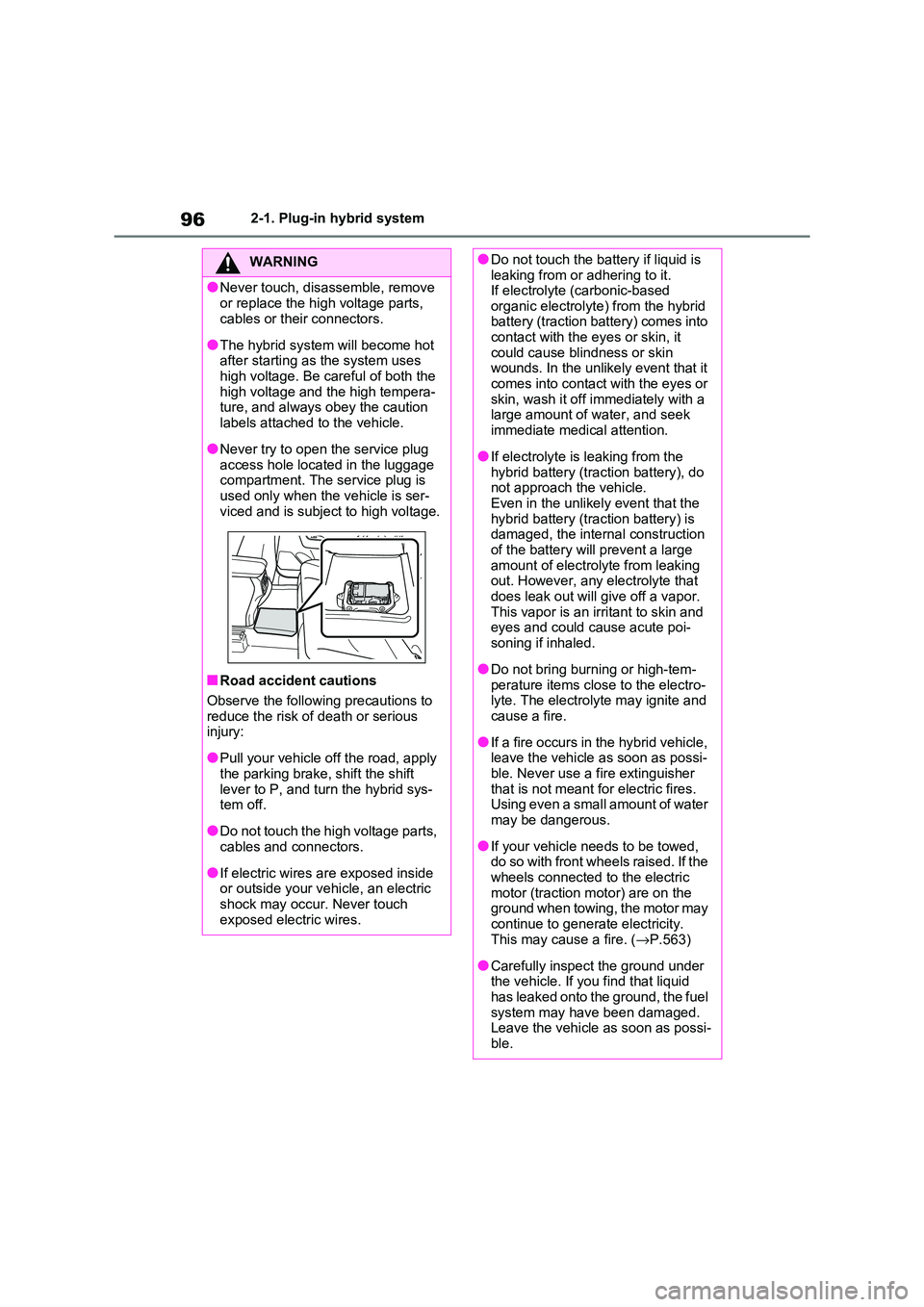
●Never try to open the service plug
access hole located in the luggage compartment. The service plug is
used only when the vehicle is ser-
viced and is subject to high voltage.
■Road accident cautions
Observe the following precautions to reduce the risk of d eath or serious
injury:
●Pull your vehicle off the road, apply
the parking brake, shift the shift
lever to P, and tu rn the hybrid sys- tem off.
●Do not touch the high voltage parts, cables and connectors.
●If electric wires are exposed inside or outside your vehi cle, an electric
shock may occur. Never touch
exposed electric wires.
●Do not touch the battery if liquid is leaking from or adhering to it.
If electrolyte ( carbonic-based
organic electrolyte) from the hybrid battery (traction battery) comes into
contact with the eyes or skin, it
could cause blindness or skin wounds. In the unlik ely event that it
comes into contact with the eyes or
skin, wash it off immediately with a large amount of w ater, and seek
immediate medical attention.
●If electrolyte is leaking from the
hybrid battery (traction battery), do
not approach the vehicle. Even in the unlikely event that the
hybrid battery (traction battery) is
damaged, the internal construction of the battery wil l prevent a large
amount of electrolyte from leaking
out. However, any electrolyte that does leak out will g ive off a vapor.
This vapor is an irritant to skin and
eyes and could c ause acute poi- soning if inhaled.
●Do not bring burning or high-tem - perature items close to the electro -
lyte. The electrolyte may ignite and
cause a fire.
●If a fire occurs in the hybrid vehicle,
leave the vehicle as soon as possi - ble. Never use a f ire extinguisher
that is not meant fo r electric fires.
Using even a small amount of water may be dangerous.
●If your vehicle nee ds to be towed, do so with front wheels raised. If the
wheels connected to the electric
motor (traction motor) are on the ground when towing, the motor may
continue to generate electricity.
This may cause a fire. ( →P.563)
●Carefully inspect the ground under
the vehicle. If you find that liquid
has leaked onto the ground, the fuel system may have been damaged.
Leave the vehicle as soon as possi -
ble.
Page 102 of 666
1002-1. Plug-in hybrid system
Shift the shift lever to D when
stopped at a traffic light, or driving
in heavy traffic etc. Shift the shift
lever to P when parking. When
using the N, there is no positive
effect on fuel consumption. In the
N, the gasoline engine operates but
electricity canno t be generated.
Also, when using the air condition -
ing system, etc., the hybrid battery
(traction battery) power is con -
sumed.
Drive your vehicle smoothly.
Avoid abrupt acceleration and
deceleration. Gradual accelera -
tion and deceler ation will make
more effective use of the electric
motor (traction motor) without
having to use gasoline engine
power.
Avoid repeated acceleration.
Repeated acceleration con -
sumes hybrid battery (traction
battery) power, resulting in poor
fuel consumption. Battery power
can be restored by driving with
the accelerator pedal slightly
released.
Make sure to operate the brakes
gently and a ti mely manner. A
greater amount of electrical energy
can be regenerated when slowing
down.
Repeated acceler ation and decel-
eration, as well as long waits at traf -
fic lights, will lead to high fuel and
electricity consumption. Check traf -
fic reports before leaving and avoid
delays as much as possible. When
driving in a traffic jam, gently
release the brake pedal to allow the
vehicle to move forward slightly
while avoiding overuse of the accel -
erator pedal. Doing so can help
control excessive electricity and
fuel consumption.
Control and maintain the vehicle
at a constant speed. Before stop -
ping at a toll booth or similar,
allow plenty of time to release
the accelerator and gently apply
the brakes. A greater amount of
electrical energy can be regener -
ated when slowing down.
Electricity consumption will
increase significantly when driv -
ing at high speeds in EV mode or
AUTO EV/HV mode. If there will
be a long distance to the next
external charging point after
leaving a freewa y, it is recom-
mended to drive in HV mode
while on the freeway and change
Shift lever operation
Accelerator pedal/brake
pedal operation
When braking
Delays
Highway driving