fuel pressure TOYOTA RAV4 PLUG-IN HYBRID 2021 Owners Manual
[x] Cancel search | Manufacturer: TOYOTA, Model Year: 2021, Model line: RAV4 PLUG-IN HYBRID, Model: TOYOTA RAV4 PLUG-IN HYBRID 2021Pages: 666, PDF Size: 161.28 MB
Page 3 of 666
RAV4 Plug-in Hybrid_OM_OM42E06E_(EE)
1
6
5
4
3
2
8
7
9
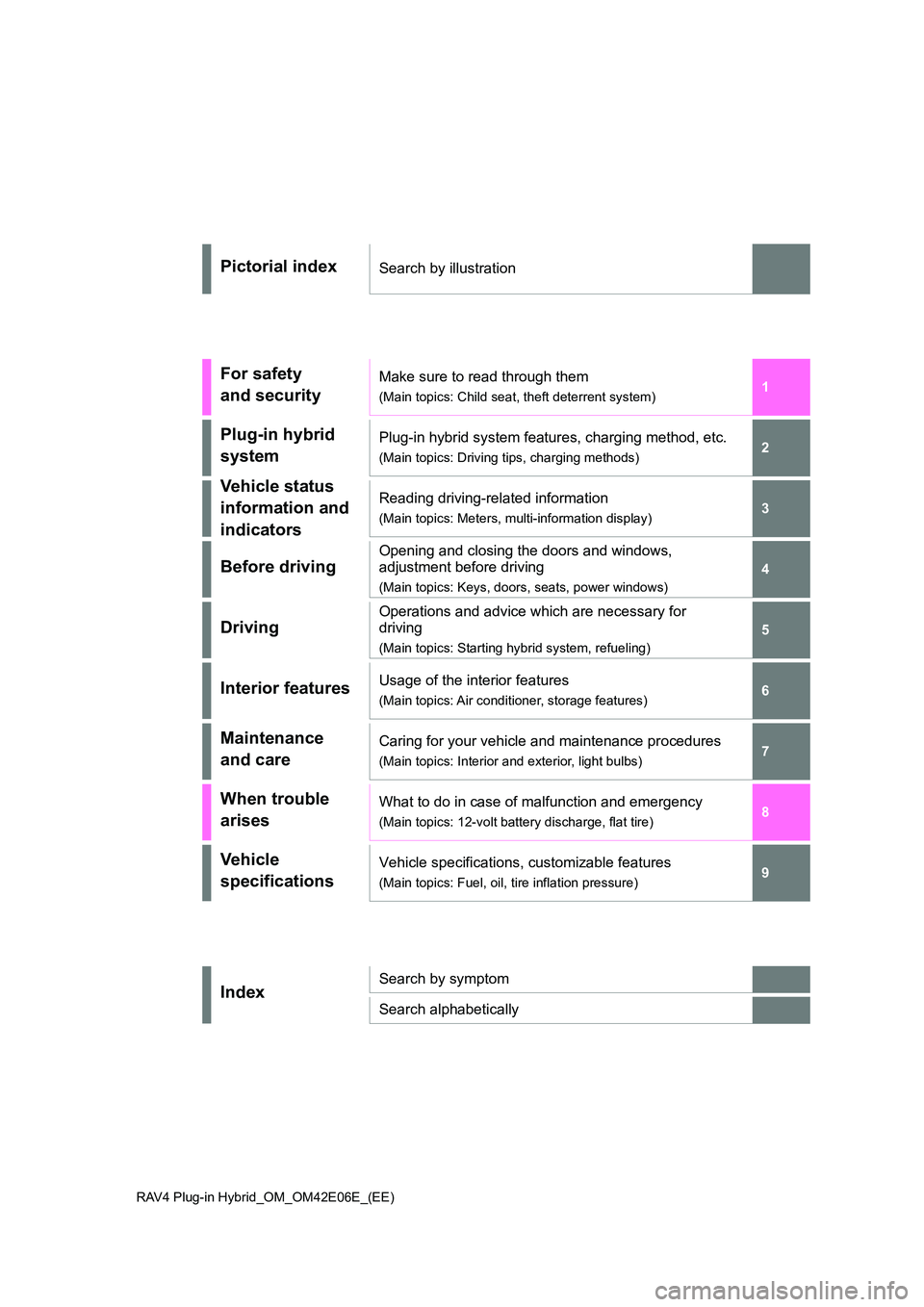
Pictorial indexSearch by illustration
For safety
and security
Make sure to read through them
(Main topics: Child seat, theft deterrent system)
Plug-in hybrid
system
Plug-in hybrid system features, charging method, etc.
(Main topics: Driving tips, charging methods)
Vehicle status
information and
indicators
Reading driving-related information
(Main topics: Meters, multi-information display)
Before driving
Opening and closing the doors and windows,
adjustment before driving
(Main topics: Keys, doors, seats, power windows)
Driving
Operations and advice which are necessary for
driving
(Main topics: Starting hybrid system, refueling)
Interior featuresUsage of the interior features
(Main topics: Air conditioner, storage features)
Maintenance
and care
Caring for your vehicle and maintenance procedures
(Main topics: Interior and exterior, light bulbs)
When trouble
arises
What to do in case of malfunction and emergency
(Main topics: 12-volt battery discharge, flat tire)
Vehicle
specifications
Vehicle specifications, customizable features
(Main topics: Fuel, oil, tire inflation pressure)
IndexSearch by symptom
Search alphabetically
Page 15 of 666
13Pictorial index
Precautions against winter season ................................................. P.445
To prevent freezing (windshield wiper de-icer)*1............................. P.457
Precautions against car wash ................................... ...................... P.489
Replacing the wiper insert..................................... .......................... P.539
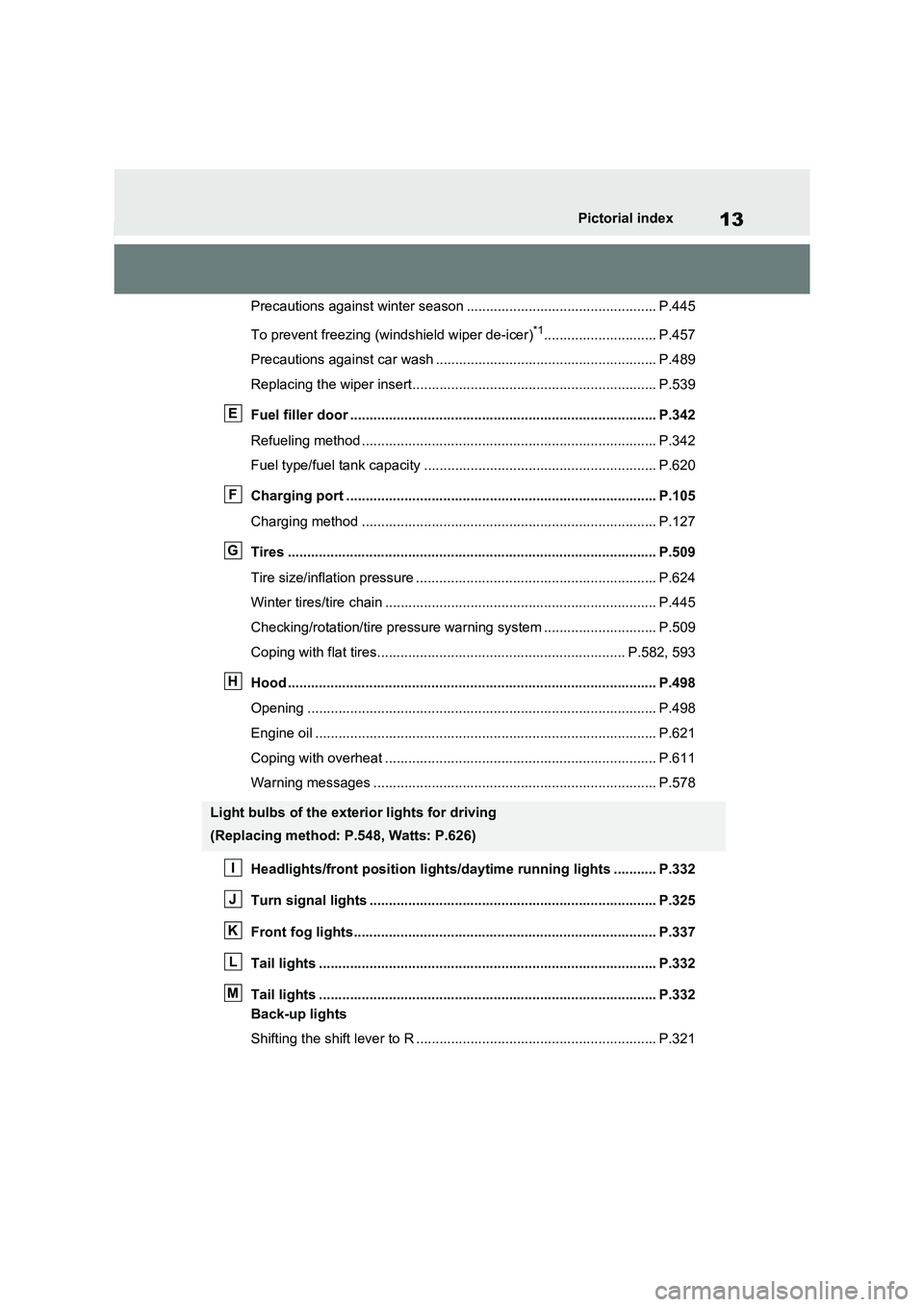
Fuel filler door ............................................... ................................ P.342
Refueling method ............................................... ............................. P.342
Fuel type/fuel tank capacity ................................... ......................... P.620
Charging port .................................................. .............................. P.105
Charging method ................................................ ............................ P.127
Tires .......................................................... ..................................... P.509
Tire size/inflation pressure .............................................................. P.624
Winter tires/tire chain ........................................ .............................. P.445
Checking/rotation/tire pressu re warning system ............................. P.509
Coping with flat tires......................................... ....................... P.582, 593
Hood ........................................................... .................................... P.498
Opening ........................................................ .................................. P.498
Engine oil ..................................................... ................................... P.621
Coping with overheat ........................................... ........................... P.611
Warning messages ............................................... .......................... P.578
Headlights/front position lights/daytime running lights ........ ... P.332
Turn signal lights ............................................. ............................. P.325
Front fog lights............................................... ............................... P.337
Tail lights .................................................... ................................... P.332
Tail lights .................................................... ................................... P.332
Back-up lights
Shifting the shift lever to R .................................. ............................ P.321
Light bulbs of the exterior lights for driving
(Replacing method: P.548, Watts: P.626)
E
F
G
H
I
J
K
L
M
Page 103 of 666
101
2
2-1. Plug-in hybrid system
Plug-in hybrid system
to EV mode or AUTO EV/HV
mode after leaving the freeway.
( →P.86)
Turn the “A/C” switch off when it
is not needed. Doing so can help
reduce excessive e lectricity and
fuel consumption.
In summer: When the ambient tem -
perature is high, use the recirculated air
mode. Doing so will help to reduce the
burden on the air co nditioning system
and reduce electricity and fuel con -
sumption as well.
In winter: Avoid excessive and unnec-
essary use of the heater. Usage of the
heated steering w heel (if equipped)
( →P.462) and seat heaters (→P.463)
are effective.
Using the Remote Air Condition-
ing System ( →P.460) while the
AC charging cable is connected
to the vehicle can reduce elec -
tricity consumption immediately
after starting off by operating air
conditioning mainly using elec -
tricity from an external power
source.
When setting the charging
schedule, setting the charging
mode to “Departure” and “Cli -
mate Prep” to on can reduce
electricity consumption immedi -
ately after starting off by operat -
ing air conditioning before
charging is completed. ( →P.144)
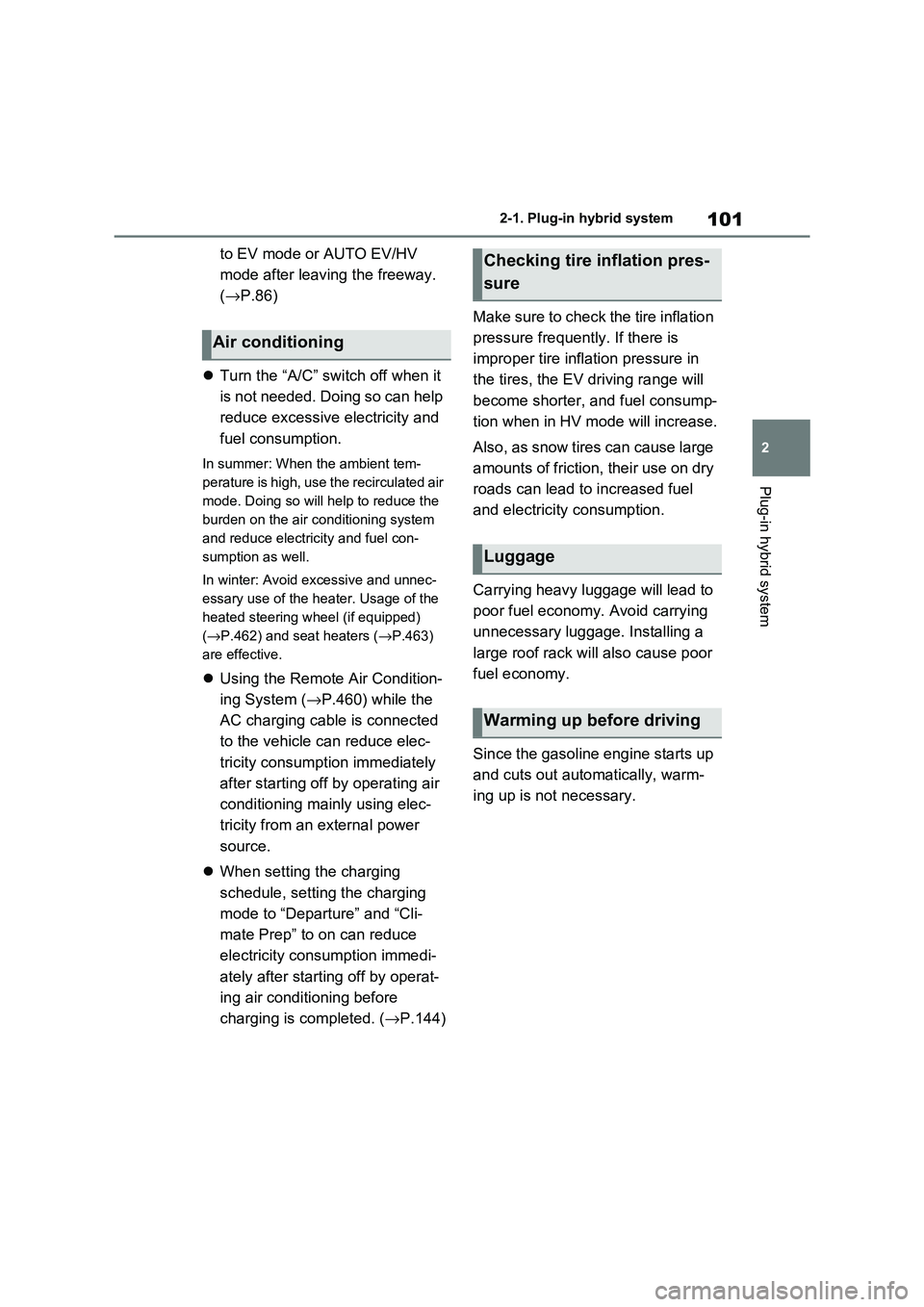
Make sure to check the tire inflation
pressure frequen tly. If there is
improper tire inflation pressure in
the tires, the EV driving range will
become shorter, and fuel consump-
tion when in HV mode will increase.
Also, as snow tires can cause large
amounts of friction, their use on dry
roads can lead to increased fuel
and electricity consumption.
Carrying heavy luggage will lead to
poor fuel economy. Avoid carrying
unnecessary lugga ge. Installing a
large roof rack will also cause poor
fuel economy.
Since the gasoline engine starts up
and cuts out automatically, warm -
ing up is not necessary.
Air conditioning
Checking tire inflation pres -
sure
Luggage
Warming up before driving
Page 105 of 666

103
2
2-1. Plug-in hybrid system
Plug-in hybrid system
■When starting off, depress the
accelerator pedal smoothly to
accelerate
As a guide, acce lerate up to
approximately 20 km/h (12mph) in
the first 5 seconds.
Electrical and fuel efficiency can be
improved just by using the ECO
Accelerator Guidance displayed on
the multi-informat ion display and
taking care to start off gently.
( →P.182)
When the driving mode is set to Eco
drive mode, depressing the accelerator
pedal generates smooth torque that
makes it easier to operate the accelera -
tor gently.
■Maintain sufficient vehicle-to-
vehicle distance and do not
accelerate or decelerate
unnecessarily
Try to maintain a fixed speed while
driving. Driving at a short vehicle-
to-vehicle distance will result in
repeating wasteful acceleration and
deceleration, which will worsen the
electrical and fuel efficiency.
■Release the accelerator pedal
early before stopping the vehi -
cle, such as at a traffic light
The regenerative brake will operate
to convert the kinetic energy of the
vehicle into electrical energy, which
will charge the hyb rid battery (trac-
tion battery).
The regeneration status can be
checked from the Hybrid System
Indicator. ( →P.177)
When the brake pedal is depressed
lightly during deceleration, the
regeneration amount increases,
enabling more electrical energy to
be recovered.
If the brake pedal is depressed too
strongly, the recovered amount indica -
tor will reach the maximum level and
the upper limit of the recoverable
energy will be exceeded. Therefore, be
sure to operate the brake pedal early.
■Use the air co nditioning sys-
tem appropriately, and also
utilize the heated steering
wheel (if equipped) and seat
heaters
In EV mode, the vehicle is cooled
and heated by electrical energy.
(Except in extremely cold tempera -
tures of approximately -10°C (14°F)
or less.)
Preventing excessive cooling or
heating of the vehicle will reduce
power consumption and improve
electrical efficiency.
The heated steering wheel (if
equipped) and seat heaters are effi -
cient heating device that directly
warm the body using less electric
power.
When used together with the air condi -
tioning system, a low temperature set-
ting can be used to improve electrical
and fuel efficiency.
■Check the tire pressure
If the tire pressure is lower than the
specified value, i t will worsen the
electrical and fuel efficiency.
Page 106 of 666
1042-1. Plug-in hybrid system
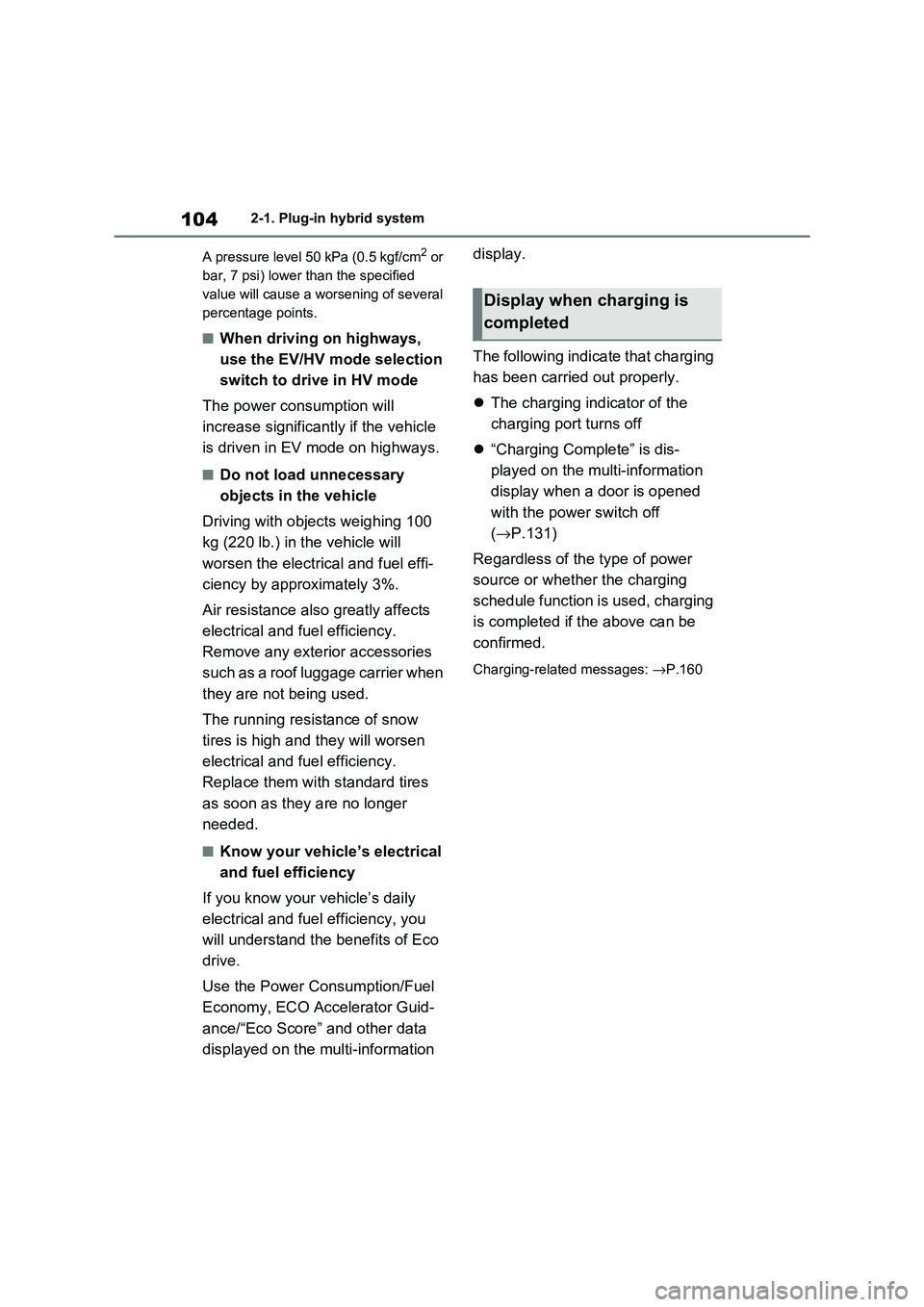
A pressure level 50 kPa (0.5 kgf/cm2 or
bar, 7 psi) lower than the specified
value will cause a worsening of several
percentage points.
■When driving on highways,
use the EV/HV mode selection
switch to drive in HV mode
The power consumption will
increase significantly if the vehicle
is driven in EV mode on highways.
■Do not load unnecessary
objects in the vehicle
Driving with objects weighing 100
kg (220 lb.) in the vehicle will
worsen the electrical and fuel effi -
ciency by approximately 3%.
Air resistance also greatly affects
electrical and fuel efficiency.
Remove any exterior accessories
such as a roof luggage carrier when
they are not being used.
The running resistance of snow
tires is high and they will worsen
electrical and fuel efficiency.
Replace them with standard tires
as soon as they are no longer
needed.
■Know your vehicle’s electrical
and fuel efficiency
If you know your vehicle’s daily
electrical and fuel efficiency, you
will understa nd the benefits of Eco
drive.
Use the Power Consumption/Fuel
Economy, ECO Accelerator Guid -
ance/“Eco Score” and other data
displayed on the multi-information
display.
The following indicate that charging
has been carried out properly.
The charging indicator of the
charging port turns off
“Charging Complete” is dis-
played on the multi-information
display when a door is opened
with the power switch off
( →P.131)
Regardless of the type of power
source or whether the charging
schedule function is used, charging
is completed if the above can be
confirmed.
Charging-related messages: →P.160
Display when charging is
completed
Page 172 of 666
1703-1. Instrument cluster
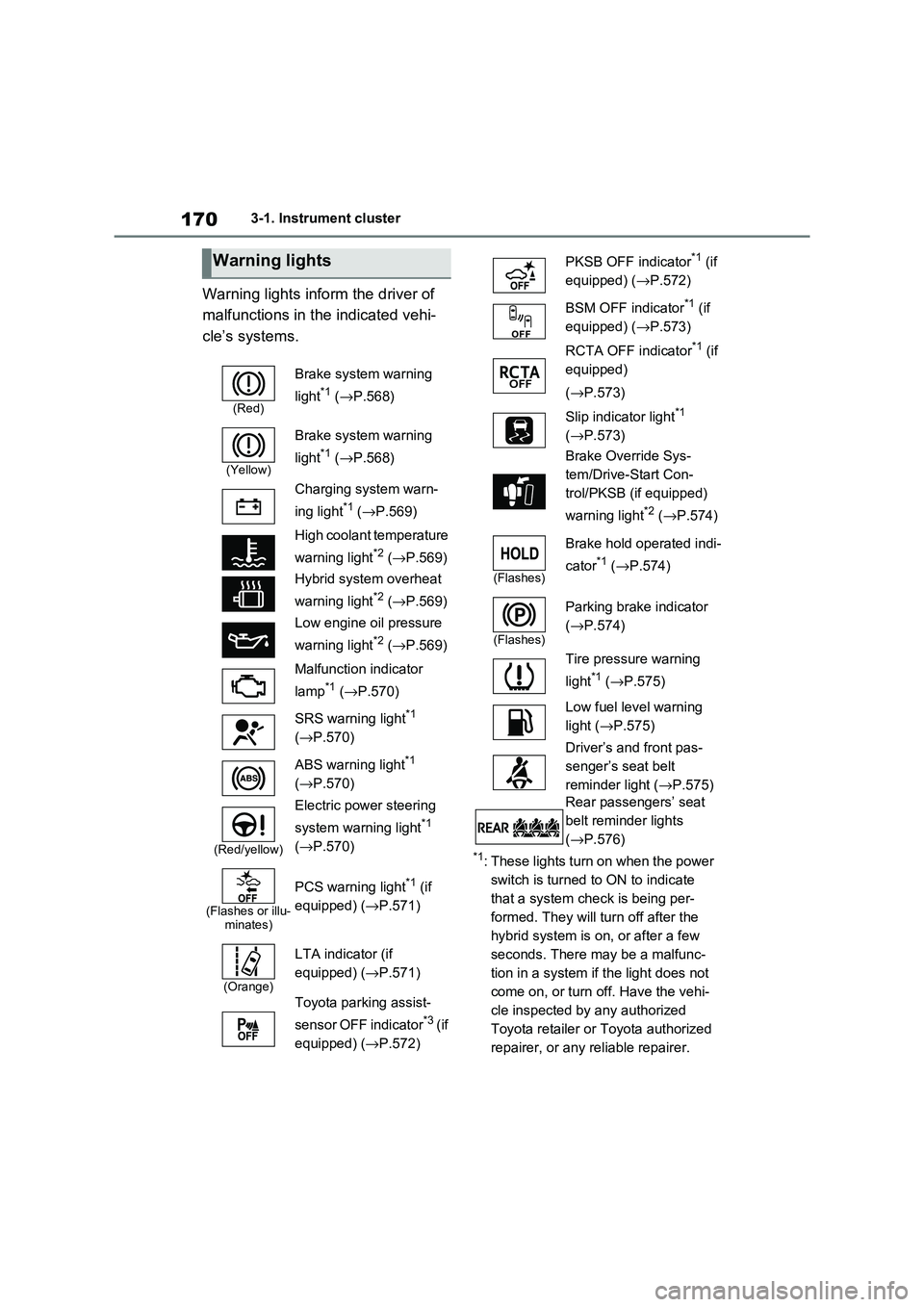
Warning lights inform the driver of
malfunctions in the indicated vehi -
cle’s systems.
*1: These lights turn on when the power
switch is turned to ON to indicate
that a system check is being per -
formed. They will turn off after the
hybrid system is on , or after a few
seconds. There may be a malfunc-
tion in a system if the light does not
come on, or turn off. Have the vehi -
cle inspected by any authorized
Toyota retailer or Toyota authorized
repairer, or any reliable repairer.
Warning lights
(Red)
Brake system warning
light*1 ( →P.568)
(Yellow)
Brake system warning
light*1 ( →P.568)
Charging system warn -
ing light*1 ( →P.569)
High coolant temperature
warning light*2 ( →P.569)
Hybrid system overheat
warning light*2 ( →P.569)
Low engine oil pressure
warning light*2 ( →P.569)
Malfunction indicator
lamp*1 ( →P.570)
SRS warning light*1
( →P.570)
ABS warning light*1
( →P.570)
(Red/yellow)
Electric power steering
system warning light*1
( →P.570)
(Flashes or illu- minates)
PCS warning light*1 (if
equipped) ( →P.571)
(Orange)
LTA indicator (if
equipped) ( →P.571)
Toyota parking assist-
sensor OFF indicator*3 ( i f
equipped) ( →P.572)
PKSB OFF indicator*1 (if
equipped) ( →P.572)
BSM OFF indicator*1 (if
equipped) ( →P.573)
RCTA OFF indicator*1 (if
equipped)
( →P.573)
Slip indicator light*1
( →P.573)
Brake Override Sys -
tem/Drive-Start Con -
trol/PKSB (if equipped)
warning light*2 ( →P.574)
(Flashes)
Brake hold operated indi-
cator*1 ( →P.574)
(Flashes)
Parking brake indicator
( →P.574)
Tire pressure warning
light*1 ( →P.575)
Low fuel level warning
light ( →P.575)
Driver’s and front pas -
senger’s seat belt
reminder light ( →P.575)
Rear passengers’ seat
belt reminder lights
( →P.576)
Page 190 of 666
1883-1. Instrument cluster
Select to enable/disable the battery
cooler. ( →P.129)
PBD (Power Back Door) (if
equipped) ( →P.213)
Select to set up the following items.
• System settings
Select to enable/disable the power
back door system.
•“Hands Free”*
Select to enable/disable the Hands
Free Power Back Door.
• “Opening Adjustment”
Select the open posi tion when power
back door is fully open.
•“Volume”
Select to set the vo lume of the buzzer
which sounds when the power back
door system operates.
*: Vehicles with Hands Free Power
Back Door
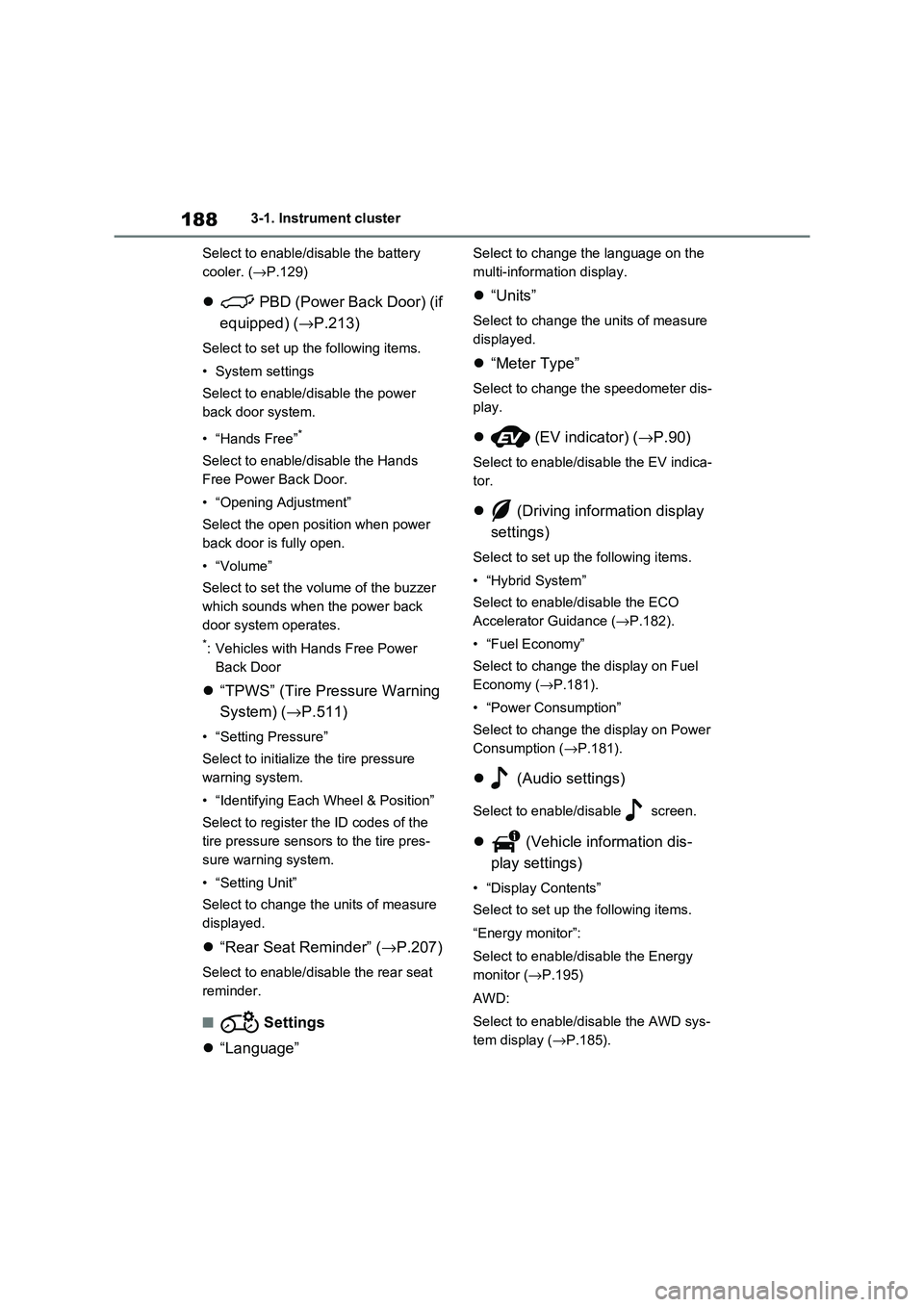
“TPWS” (Tire Pressure Warning
System) ( →P.511)
• “Setting Pressure”
Select to initialize the tire pressure
warning system.
• “Identifying Each Wheel & Position”
Select to register t he ID codes of the
tire pressure sensors to the tire pres -
sure warning system.
• “Setting Unit”
Select to change t he units of measure
displayed.
“Rear Seat Reminder” (→P.207)
Select to enable/disable the rear seat
reminder.
■ Settings
“Language”
Select to change the language on the
multi-information display.
“Units”
Select to change the units of measure
displayed.
“Meter Type”
Select to change the speedometer dis-
play.
(EV indicator) (→P.90)
Select to enable/disable the EV indica-
tor.
(Driving information display
settings)
Select to set up th e following items.
• “Hybrid System”
Select to enable/disable the ECO
Accelerator Guidance ( →P.182).
• “Fuel Economy”
Select to change th e display on Fuel
Economy ( →P.181).
• “Power Consumption”
Select to change the display on Power
Consumption ( →P.181).
(Audio settings)
Select to enable/disable screen.
(Vehicle information dis-
play settings)
• “Display Contents”
Select to set up th e following items.
“Energy monitor”:
Select to enable/disable the Energy
monitor ( →P.195)
AWD:
Select to enable/disable the AWD sys -
tem display ( →P.185).
Page 310 of 666
3085-1. Before driving
■Tire information
●Increase the tire inflation pressure to
20.0 kPa (0.2 kgf/cm2 or bar, 3 psi) greater than the recommended value
when towing. ( →P.624)
●Increase the air pressure of the trailer
tires in accordance with the total
trailer weight and according to the val - ues recommended by the manufac -
turer of your trailer.
■Safety checks before towing
●Check that the maximum load limit for
the towing hitch/bracket and hitch ball
is not exceeded. Bear in mind that the coupling weight of the trailer will add
to the load exerted on the vehicle.
Also make sure tha t the total load exerted on the vehi cle is within the
range of the weight limits. ( →P.309)
●Ensure that the trailer load is secure.
●Supplementary outside rear view mir- rors should be added to the vehicle if
the traffic behind c annot be clearly
seen with standard mirrors. Adjust the extending arms of these mirrors on
both sides of the vehicle so that they
always provide maxi mum visibility of the road behind.
Trailer towing
Your vehicle is designed pri -
marily as a passenger carry -
ing vehicle. Towing a trailer
will have an adverse effect on
handling, performance, brak -
ing, durability, and fuel con -
sumption. Your safety and
satisfaction depend on the
proper use of correct equip -
ment and cautious driving hab -
its. For your safety and the
safety of others, do not over -
load the vehicle or trailer.
To tow a trailer safely, use
extreme care and drive the
vehicle in accordance with the
trailer’s characteristics and
operating conditions.
Toyota warranties do not apply
to damage or malfunction
caused by towing a trailer for
commercial purposes.
Ask your local authorized
Toyota retailer or Toyota
authorized repairer, or any reli -
able repairer for further details
before towing, as there are
additional legal requirements
in some countries.
WARNING
Follow all the instructions described in
this section.
Failure to do so could cause an acci - dent resulting in death or serious
injury.
■Trailer towing precautions
When towing, make sure that none of
the weight limits are exceeded.
( →P.309)
■To avoid accident or injury
●Vehicles with compact spare tire: Do not tow a trailer when the com -
pact spare tire is installed on your
vehicle.
●Vehicles with emergency tire punc -
ture repair kit: Do not tow a traile r when the tire
installed is repa ired with the emer-
gency tire puncture repair kit.
Page 449 of 666
447
5
5-6. Driving tips
Driving
Vehicles with 225/60R18 tires
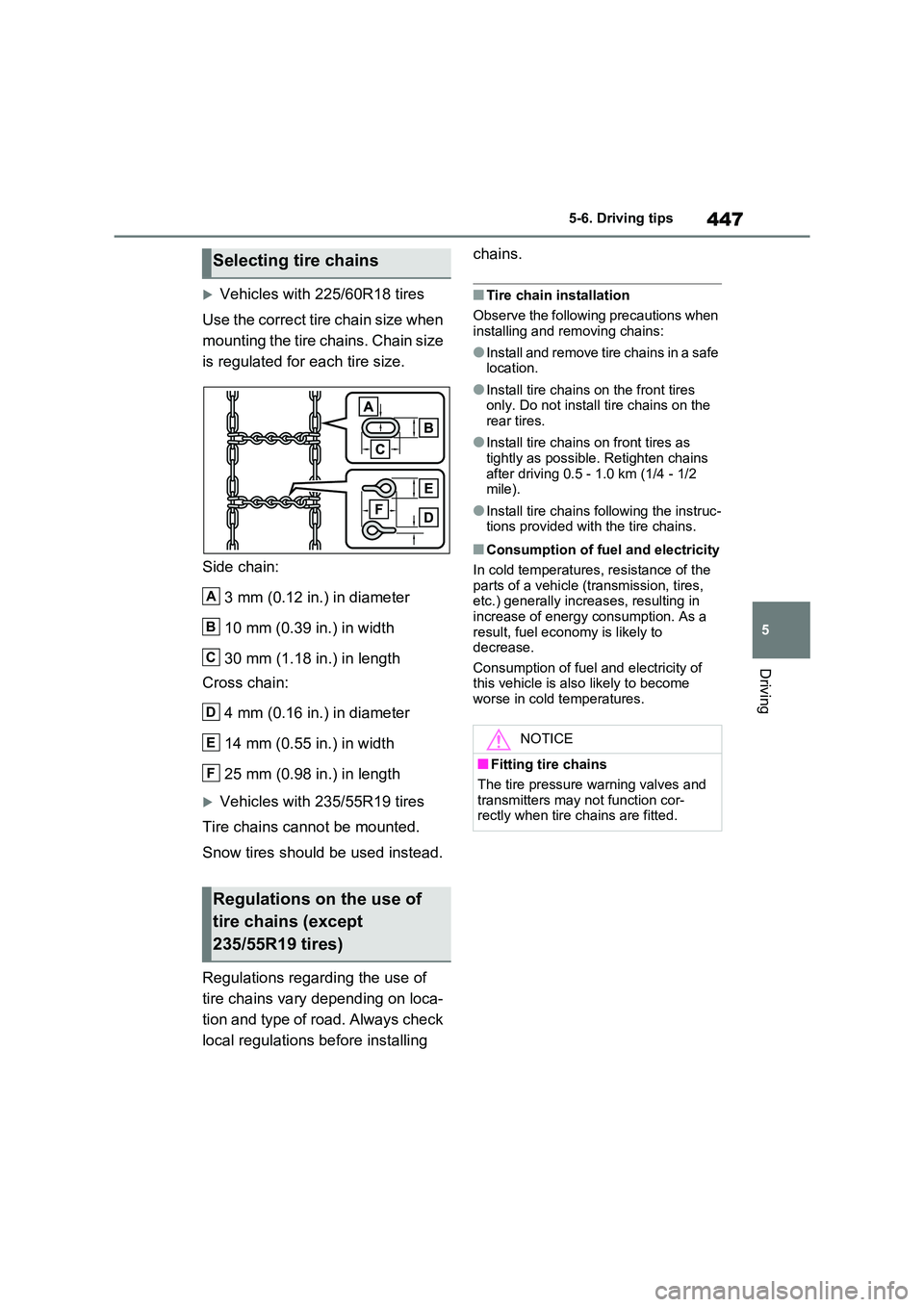
Use the correct tire chain size when
mounting the tire chains. Chain size
is regulated for each tire size.
Side chain:
3 mm (0.12 in.) in diameter
10 mm (0.39 in.) in width
30 mm (1.18 in.) in length
Cross chain:
4 mm (0.16 in.) in diameter
14 mm (0.55 in.) in width
25 mm (0.98 in.) in length
Vehicles with 235/55R19 tires
Tire chains cannot be mounted.
Snow tires should be used instead.
Regulations regarding the use of
tire chains vary depending on loca -
tion and type of road. Always check
local regulations before installing
chains.
■Tire chain installation
Observe the following precautions when installing and removing chains:
●Install and remove tire chains in a safe location.
●Install tire chains on the front tires only. Do not install t ire chains on the
rear tires.
●Install tire chains on front tires as
tightly as possible. Retighten chains
after driving 0.5 - 1.0 km (1/4 - 1/2 mile).
●Install tire chains following the instruc - tions provided with the tire chains.
■Consumption of fuel and electricity
In cold temperatures, resistance of the
parts of a vehicle (tr ansmission, tires, etc.) generally incr eases, resulting in
increase of energy consumption. As a
result, fuel economy is likely to decrease.
Consumption of fuel and electricity of
this vehicle is als o likely to become worse in cold temperatures.
Selecting tire chains
Regulations on the use of
tire chains (except
235/55R19 tires)
A
B
C
D
E
F
NOTICE
■Fitting tire chains
The tire pressure w arning valves and
transmitters may not function cor - rectly when tire chains are fitted.
Page 490 of 666
4887-1. Maintenance and care
7-1.Maintenance and care
Working from top to bottom, lib-
erally apply water to the vehicle
body, wheel wells and underside
of the vehicle to remove any dirt
and dust.
Wash the vehicle body using a
sponge or soft cloth, such as a
chamois.
For hard-to-remove marks, use
car wash soap and rinse thor -
oughly with water.
Wipe away any water.
Wax the vehicle when the water-
proof coating deteriorates.
If water does not bead on a clean sur -
face, apply wax when the vehicle body
is cool.
■Before car washes
Check that the fuel filler door and charging port lid on your vehicle are
closed properly.
■Automatic car washes
●Before washing the vehicle:
• Fold the mirrors
• Turn off the power back door (if equipped)
Start washing from t he front of the vehi-
cle. Make sure to extend the mirrors
before driving.
●Brushes used in automatic car
washes may scratch the vehicle sur - face, parts (wheel, etc.) and harm
your vehicle’s paint.
●Rear spoiler may not be washable in
some automatic c ar washes. There
may also be an increased risk of dam - age to vehicle.
■High pressure car washes
As water may enter the cabin, do not
bring the nozzle tip near the gaps around the doors or perimeter of the
windows, or spray th ese areas continu-
ously.
■Note for a smart e ntry & start sys- tem
If the door handle becomes wet while
the electronic key is within the effective range, the door may lock and unlock
repeatedly. In that c ase, follow the fol-
lowing correction procedures to wash the vehicle:
●Place the key in a position 2 m (6 ft.) or more separate from the vehicle
while the vehicle is being washed.
(Take care to ensur e that the key is not stolen.)
●Set the electronic key to battery-sav - ing mode to disable the smart entry &
start system. ( →P.224)
■Wheels and wheel ornaments
●Remove any dirt immediately by using
a neutral detergent.
●Wash detergent of f with water imme-
diately after use.
●To protect the paint from damage,
make sure to observe the following
precautions. • Do not use acidic, alkaline or abrasive
detergent.
• Do not use hard brushes.
• Do not use deterg ent on the wheels when they are hot, such as after driv -
ing or parking in hot weather.
Cleaning and protecting
the vehicle exterior
Perform the following to pro -
tect the vehicle and maintain it
in prime condition:
Cleaning instructions