heater TOYOTA RAV4 PRIME 2021 Owners Manual
[x] Cancel search | Manufacturer: TOYOTA, Model Year: 2021, Model line: RAV4 PRIME, Model: TOYOTA RAV4 PRIME 2021Pages: 618, PDF Size: 24.18 MB
Page 4 of 618
4TABLE OF CONTENTS
Utility vehicle precautions.................................... 390
6-1. Using the air conditioning
system and defogger
Automatic air conditioning system ......................... 396
Remote Air Conditioning Sys- tem .............................. 405
Heated steering wheel/Front seat heaters/Front seat
heaters and ventilators/Rear
seat heaters ................ 407
6-2. Using the interior lights Interior lights list ............ 410
6-3. Using the storage features List of storage features . 413
Luggage compartment fea- tures ............................ 417
6-4. Using the other interior fea- tures
Other interior features ... 420
Garage door opener...... 435
7-1. Maintenance and care Cleaning and protecting the vehicle exterior ............ 444
Cleaning and protecting the vehicle interior ............. 447
7-2. Maintenance Maintenance requirements.................................... 450
General maintenance.... 451Emission inspection and
maintenance (I/M) programs.................................... 454
7-3. Do-it-yourself maintenance Do-it-yourself service precau-tions ............................. 455
Hood .............................. 457
Positioning a floor jack .. 458
Engine compartment ..... 460
12-volt battery................ 466
Tires .............................. 468
Tire inflation pressure .... 480
Wheels .......................... 482
Air conditioning filter ...... 483
Cleaning the DC/DC Con- verter air intake vent and fil-
ter ............................... 486
Wiper insert replacement .................................... 489
Electronic key battery .... 493
Checking and replacing fuses .................................... 495
Light bulbs ..................... 497
8-1. Essential information Emergency flashers....... 504
If your vehicle has to be stopped in an emergency.................................... 505
If the vehicle is trapped in ris- ing water ...................... 506
8-2. Steps to take in an emer- gency
If your vehicle needs to be towed ........................... 507
6Interior features
7Maintenance and care
8When trouble arises
Page 21 of 618
21Pictorial index
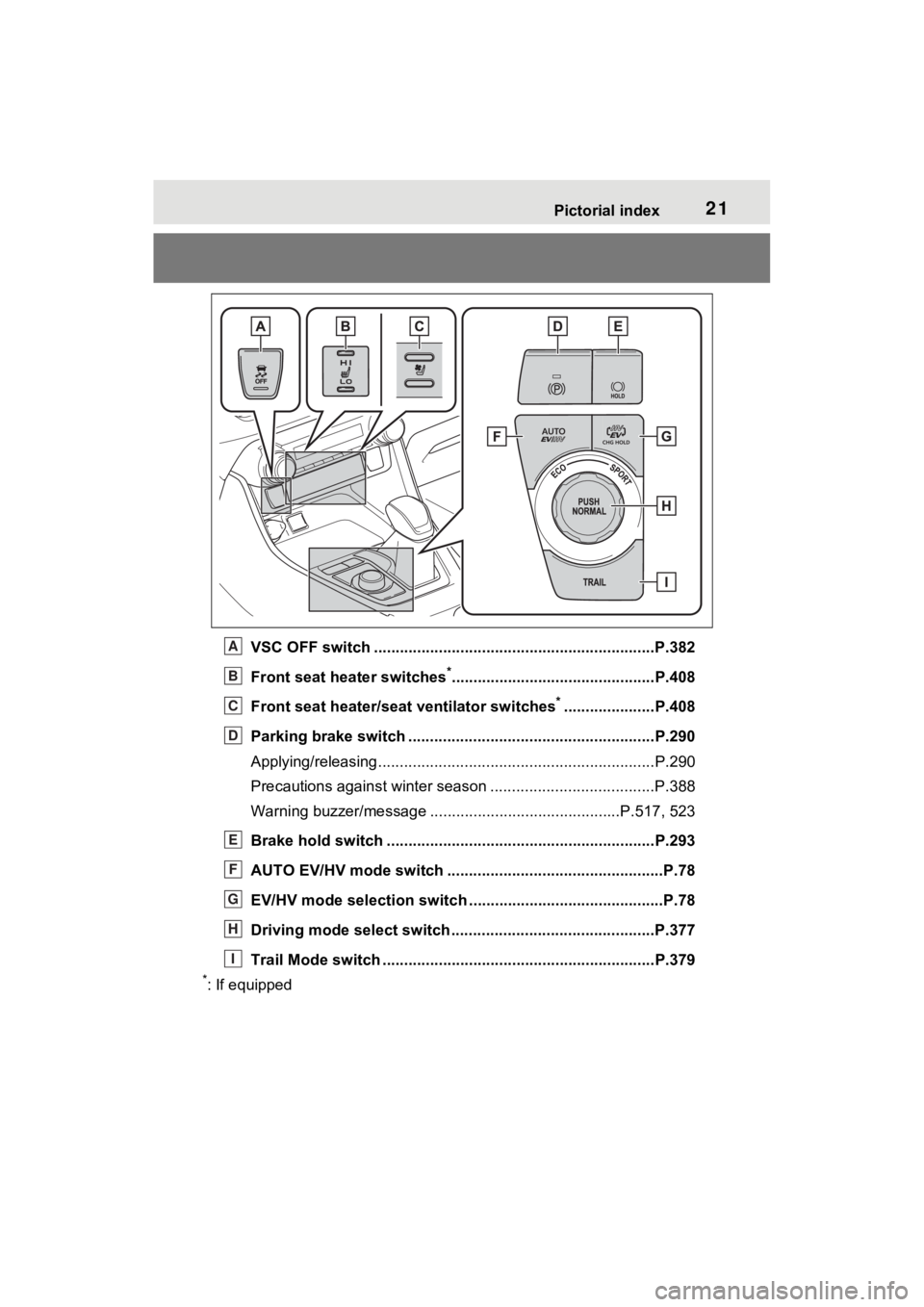
VSC OFF switch .................................................................P.382
Front seat heater switches
*...............................................P.408
Front seat heater/seat ventilator switches
*.....................P.408
Parking brake switch ........................................... ..............P.290
Applying/releasing............................................. ...................P.290
Precautions against winter season .............................. ........P.388
Warning buzzer/message ... .........................................P.517, 523
Brake hold switch .............................................. ................P.293
AUTO EV/HV mode switch ......................................... .........P.78
EV/HV mode selection switc h .............................................P.78
Driving mode select switch ..................................... ..........P.377
Trail Mode switch ...............................................................P.379
*: If equipped
A
B
C
D
E
F
G
H
I
Page 22 of 618
22Pictorial index
■Interior
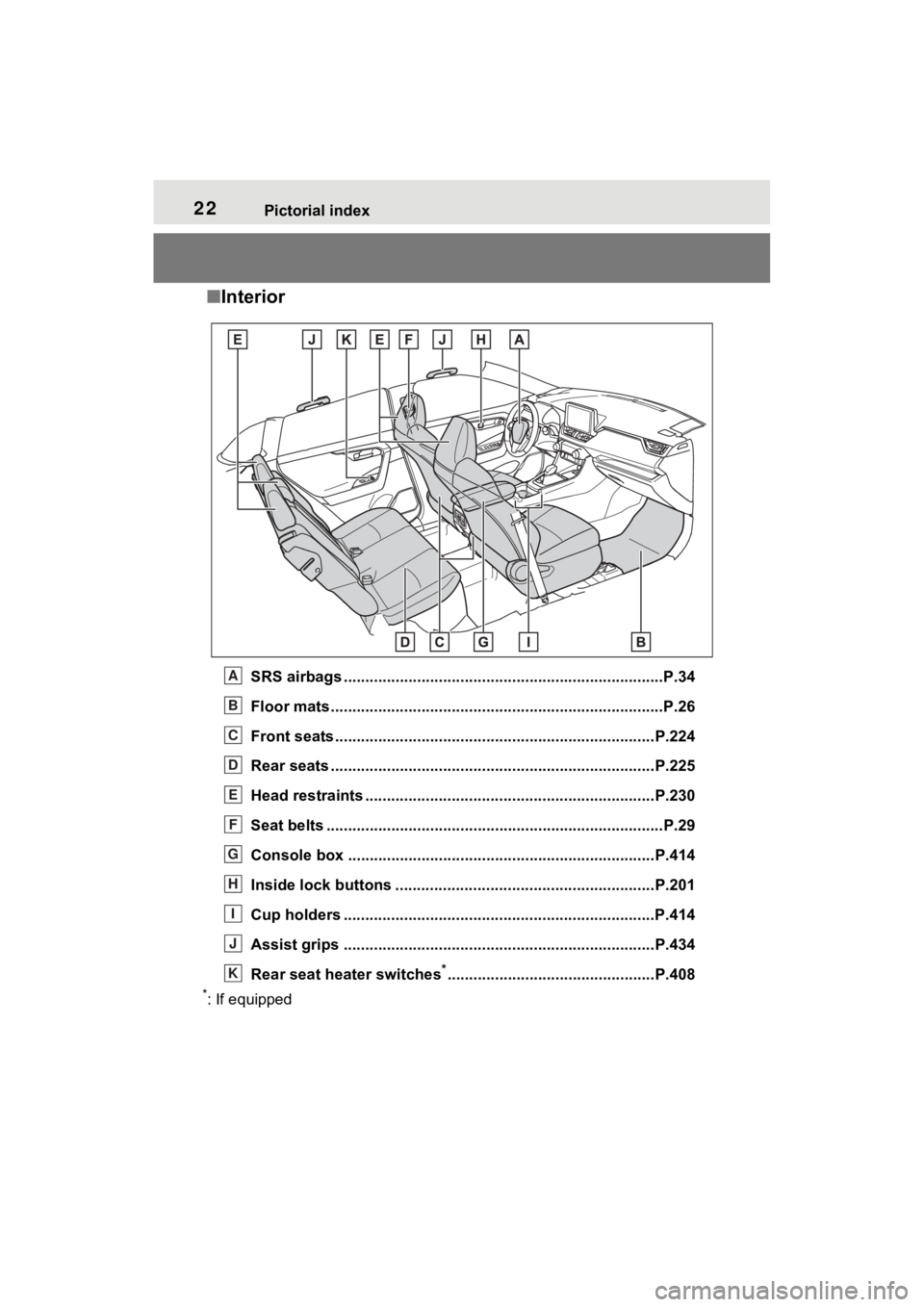
SRS airbags .................................................... ......................P.34
Floor mats..................................................... ........................P.26
Front seats .................................................... ......................P.224
Rear seats ..................................................... ......................P.225
Head restraints ...................................................................P.230
Seat belts ..................................................... .........................P.29
Console box .................................................... ...................P.414
Inside lock buttons ............................................ ................P.201
Cup holders ........................................................................P.414
Assist grips ................................................... .....................P.434
Rear seat heater switches
*................................................P.408
*: If equipped
A
B
C
D
E
F
G
H
I
J
K
Page 83 of 618

832-1. Plug-in hybrid system
2
Plug-in hybrid system
driving range (P.172) is being dis-
played on the multi-information dis-
play, EV driving (driving using only
the electric motor) may be canceled
and both gasoline engine and elec-
tric motor are used depending on
the situation (EV driving will be
returned to automatically after EV
driving becomes possible again).
EV driving may be canceled auto-
matically in the following circum-
stances
*1:
●When vehicle speed is more than
approximately 84 mph (135 km/h).
●When power is needed temporar-
ily, for example when the acceler-
ator pedal is depressed firmly or
when accelerating suddenly.
*2
●When the temperature of the
hybrid system is high.
The vehicle has been left in the
sun, driven on a hill, driven at high
speeds, etc.
●When the temperature of the
hybrid system is low.
●When the heater is switched on
when the outside temperature is
below about 14°F (-10°C).
●When the windshield defogger
switch is pressed. ( P.398)
●When the system determines that
the gasoline engine needs to be
started.
*1: The gasoline engine may also
operate in circumstances other
than those listed above, depend-
ing on conditions.
*2: When driving in AUTO EV/HV mode. Even in EV mode, the gas-
oline engine may start, depend-
ing on the condition of the hybrid
battery (traction battery).
■If “Engine Started to Protect
System EV driving unavailable”
is displayed on the multi-infor-
mation display
EV driving may be canceled in order to protect the hybrid system, etc.
In this case, perform driving with the
gasoline engine until EV driving will
be returned to automatically.
■Conditions in which the gaso-
line engine may not stop
The gasoline engine starts and
stops automatically. However, it
may not stop automatically in the
following conditions
*:
●During gasoline engine warm-up
●During hybrid battery (traction bat-
tery) charging
●When the temperature of the
hybrid battery (traction battery) is
high or low
●When the windshield defogger
switch is pressed. ( P.398)
*: Depending on the circumstances,
the gasoline engine may also not
stop automatically in situations
other than those above.
■Sounds and vibrations specific
to a hybrid vehicle
There may be no e ngine sound or
vibration even thoug h the vehicle is
able to move with the “READY” indi-
cator is illuminated. For safety,
apply the parking brake and make
sure to shift the shift lever to P when
parked.
The following sounds or vibrations
may occur when the hybrid system
is operating and are not a malfunc-
tion.
●Motor sounds may be heard from
the engine compartment.
●Sounds may be heard from the
hybrid battery (traction battery)
when the hybrid sy stem starts or
stops.
●Relay operating sounds such as a
snap or soft clank will be emitted
from the hybrid ba ttery (traction
battery), behind the rear seats,
when the hybrid system is started
or stopped.
Page 94 of 618
942-1. Plug-in hybrid system
HV mode while on the free-
way and change to EV mode
or AUTO EV/HV mode after
leaving the freeway. (P.78)
Turn the “A/C” switch off
when it is not needed. Doing
so can help reduce excessive
electricity and fuel consump-
tion.
In summer: When the ambient tem-
perature is high, use the recircu-
lated air mode. Doing so will help to
reduce the burden on the air condi-
tioning system and reduce electric-
ity and fuel consumption as well.
In winter: Avoid excessive and
unnecessary use o f the heater.
Usage of the heated steering wheel
(if equipped) ( P.407) and seat
heaters ( P.408) are effective.
Using the Remote Air Condi-
tioning System ( P.405)
while the AC charging cable is
connected to the vehicle can
reduce electricity consump-
tion immediately after starting
off by operating air condition-
ing mainly using electricity
from an external power
source.
When setting the charging
schedule, setting the charging
mode to “Departure” and “Cli-
mate Prep” to on can reduce
electricity consumption imme-
diately after starting off by
operating air conditioning before charging is completed.
(
P.130)
Make sure to check the tire infla-
tion pressure frequently. If there
is improper tire inflation pres-
sure in the tires, the EV driving
range will become shorter, and
fuel consumption when in HV
mode will increase.
Also, as snow tires can cause
large amounts of friction, their
use on dry roads can lead to
increased fuel and electricity
consumption.
Carrying heavy luggage will lead
to poor fuel economy. Avoid car-
rying unnecessary luggage.
Installing a large roof rack will
also cause poor fuel economy.
Since the gasoline engine starts
up and cuts out automatically,
warming up is not necessary.
Air conditioning
Checking tire inflation
pressure
Luggage
Warming up before driv-
ing
Page 96 of 618

962-1. Plug-in hybrid system
of occupants.
The distance that EV driving is
possible can be extended if the
following is performed:
■When starting off, depress
the accelerator pedal
smoothly to accelerate
As a guide, accelerate up to
approximately 12mph (20 km/h)
in the first 5 seconds.
Electrical and fuel efficiency can
be improved just by using the
ECO Accelerator Guidance dis-
played on the multi-information
display and taking care to start
off gently. ( P.173)
When the driving mode is set to
Eco drive mode, depressing the
accelerator pedal generates
smooth torque that makes it easier
to operate the accelerator gently.
At the same time, the air condition-
ing control is switched to eco air
conditioning mode ( P.397) to
reduce the strength of the air condi-
tioning operation.
■Maintain sufficient vehicle-
to-vehicle distance and do
not accelerate or decelerate
unnecessarily
Try to maintain a fixed speed
while driving. Driving at a short
vehicle-to-vehicle distance will
result in repeating wasteful
acceleration and deceleration,
which will worsen the electrical
and fuel efficiency.
■Release the accelerator
pedal early before stopping
the vehicle, such as at a
traffic light
The regenerative brake will
operate to convert the kinetic
energy of the vehicle into electri-
cal energy, which will charge the
hybrid battery (traction battery).
The regeneration status can be
checked from the Hybrid Sys-
tem Indicator. ( P.167)
When the brake pedal is
depressed lightly during decel-
eration, the regeneration
amount increases, enabling
more electrical energy to be
recovered.
If the brake pedal is depressed too
strongly, the recovered amount
indicator will reac h the maximum
level and the upper limit of the
recoverable energy will be
exceeded. Theref ore, be sure to
operate the brak e pedal early.
■Use the air conditioning
system appropriately, and
also utilize the heated steer-
ing wheel (if equipped) and
seat heaters
In EV mode, the vehicle is
cooled and heated by electrical
energy. (Except in extremely
cold temperatures of approxi-
mately 14°F (-10°C) or less.)
Preventing excessive cooling or
heating of the vehicle will reduce
power consumption and
improve electrical efficiency.
Page 97 of 618

972-1. Plug-in hybrid system
2
Plug-in hybrid system
When eco air conditioning mode
is used, the air conditioning con-
trol is switched automatically to
a lower setting. (P.397)
The heated steering wheel (if
equipped) and seat heaters are
efficient heating device that
directly warm the body using
less electric power.
When used togethe r with the air
conditioning system, a low tem-
perature setting can be used to
improve electrical and fuel effi-
ciency.
■Check the tire pressure
If the tire pressure is lower than
the specified value, it will
worsen the electrical and fuel
efficiency.
A pressure level 7 psi (50 kPa, 0.5
kgf/cm
2 or bar) lower than the spec-
ified value will cause a worsening of
several percentage points.
■When driving on highways,
use the EV/HV mode selec-
tion switch to drive in HV
mode
The power consumption will
increase significantly if the vehi-
cle is driven in EV mode on
highways.
■Do not load unnecessary
objects in the vehicle
Driving with objects weighing
220 lb. (100 kg) in the vehicle
will worsen the electrical and
fuel efficiency by approximately
3%. Air resistance also greatly
affects electrical and fuel effi-
ciency. Remove any exterior
accessories such as a roof lug-
gage carrier when they are not
being used.
The running resistance of snow
tires is high and they will worsen
electrical and fuel efficiency.
Replace them with standard
tires as soon as they are no lon-
ger needed.
■Know your vehicle’s electri-
cal and fuel efficiency
If you know your vehicle’s daily
electrical and fuel efficiency, you
will understand the benefits of
Eco drive.
Use the Power Consump-
tion/Fuel Economy, ECO Accel-
erator Guidance/“Eco Score”
and other data displayed on the
multi-information display.
The following indicate that
charging has been carried out
properly.
The charging indicator of the
charging port turns off
“Charging Complete” is dis-
played on the multi-informa-
tion display when a door is
opened with the power switch
off ( P.119)
Regardless of the type of power
Display when c harging is
completed
Page 101 of 618
1012-2. Charging
2
Plug-in hybrid system
*: Flashes for a certain period of time, and then turns off.
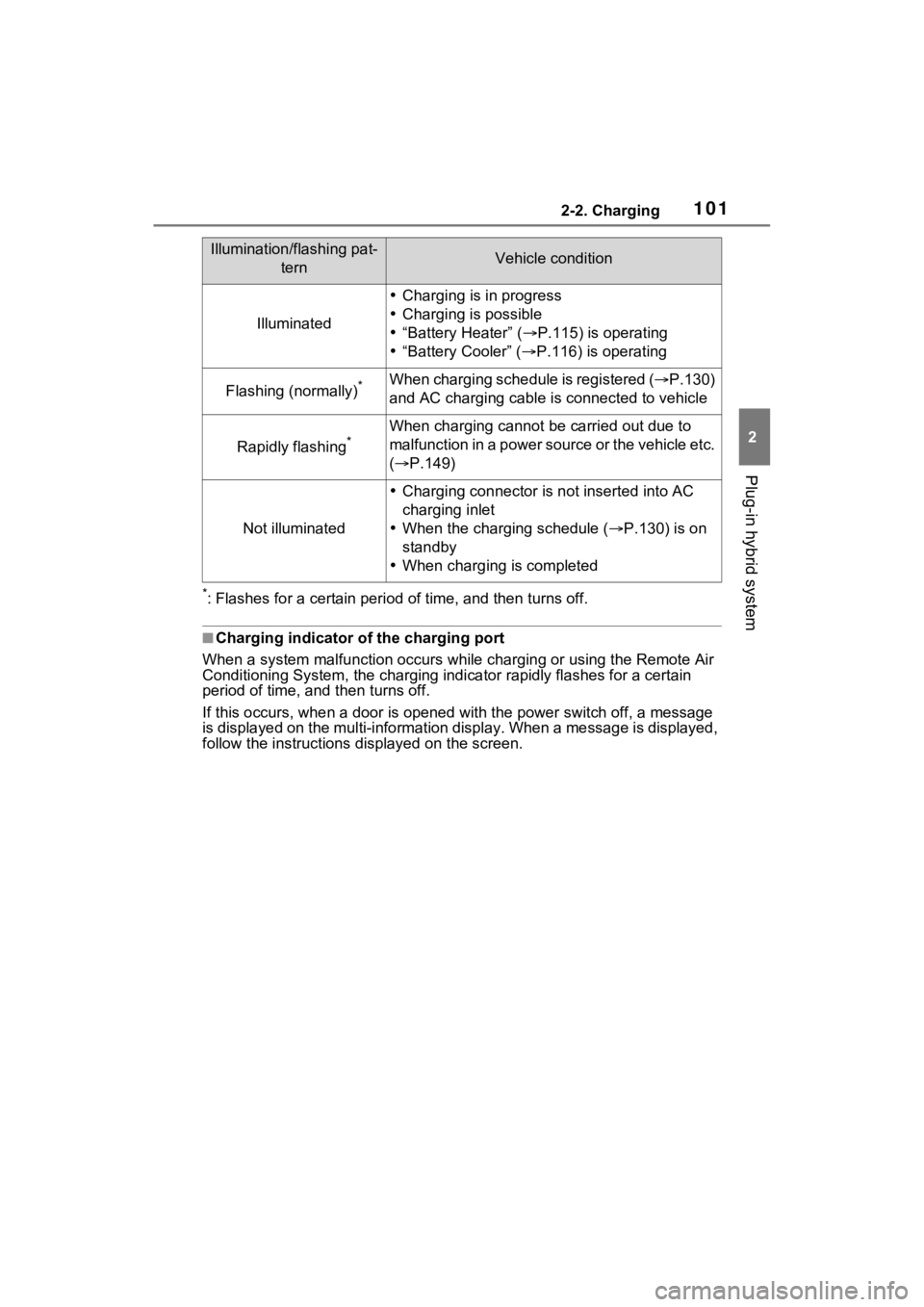
■Charging indicator of the charging port
When a system malfunction occurs while charging or using the Remote Air
Conditioning System, the charging indicator rapidly flashes for a certain
period of time, and t hen turns off.
If this occurs, when a door is o pened with the power switch off , a message
is displayed on the multi-informa tion display. When a message is displayed,
follow the instructions d isplayed on the screen.
Illumination/flashing pat-
ternVehicle condition
Illuminated
Charging is in progress
Charging is possible
“Battery Heater” ( P.115) is operating
“Battery Cooler” ( P.116) is operating
Flashing (normally)*When charging schedule is registered ( P.130)
and AC charging cable is connected to vehicle
Rapidly flashing*When charging cannot be carried out due to
m a lfu nct ion in a p ow er so ur ce or th e v eh icle et c.
( P.149)
Not illuminated
Charging connector is not inserted into AC
charging inlet
When the charging schedule ( P.130) is on
standby
When charging is completed
Page 113 of 618
1132-2. Charging
2
Plug-in hybrid system
WARNING
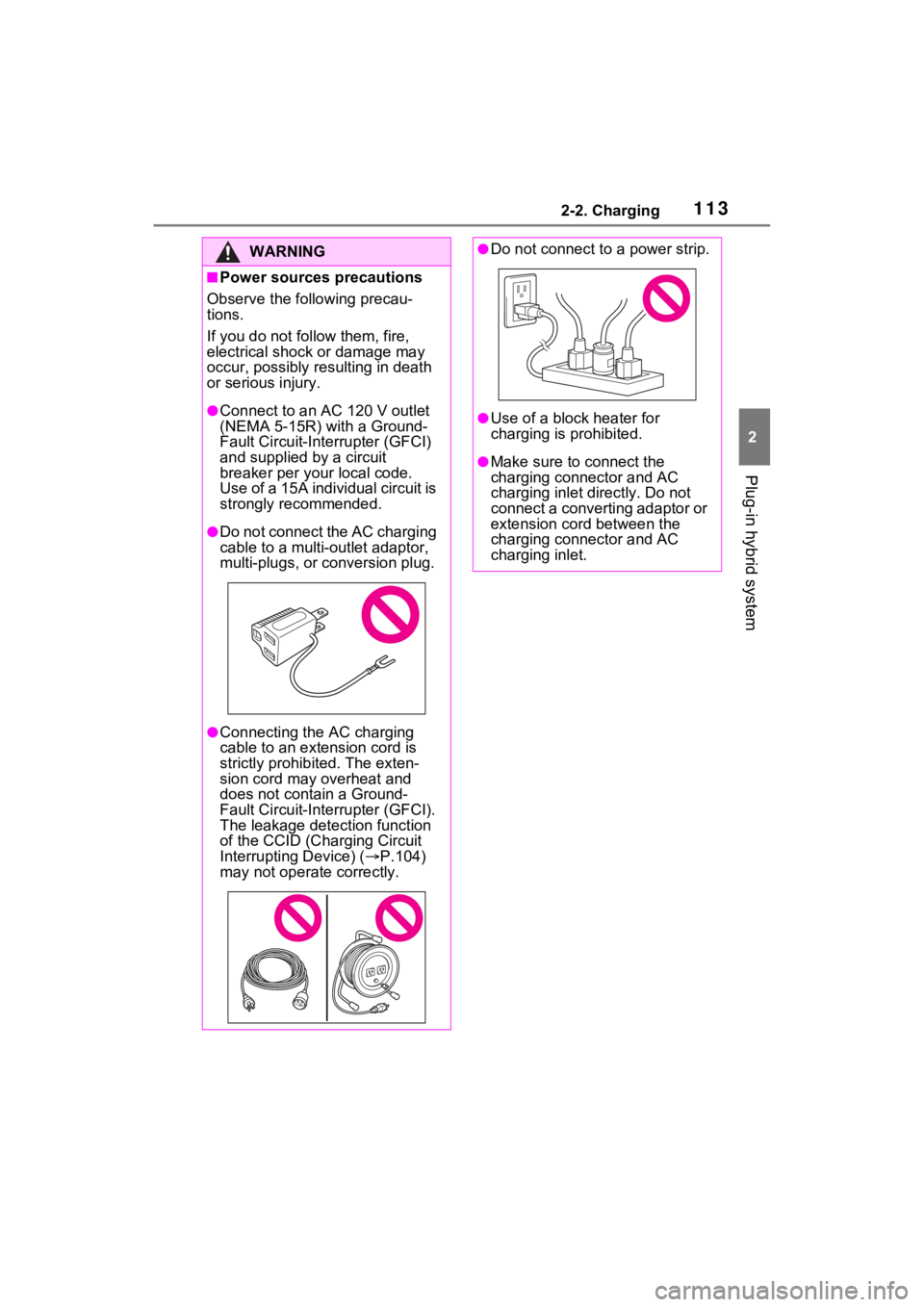
■Power sources precautions
Observe the following precau-
tions.
If you do not follow them, fire,
electrical shock or damage may
occur, possibly resulting in death
or serious injury.
●Connect to an AC 120 V outlet
(NEMA 5-15R) with a Ground-
Fault Circuit-Interrupter (GFCI)
and supplied by a circuit
breaker per your local code.
Use of a 15A individual circuit is
strongly recommended.
●Do not connect the AC charging
cable to a multi-outlet adaptor,
multi-plugs, or conversion plug.
●Connecting the AC charging
cable to an extension cord is
strictly prohibited. The exten-
sion cord may overheat and
does not contain a Ground-
Fault Circuit-Interrupter (GFCI).
The leakage detection function
of the CCID (Cha rging Circuit
Interrupting Device) ( P.104)
may not operate correctly.
●Do not connect to a power strip.
●Use of a block heater for
charging is prohibited.
●Make sure to connect the
charging connector and AC
charging inlet directly. Do not
connect a converting adaptor or
extension cord between the
charging connector and AC
charging inlet.
Page 115 of 618

1152-2. Charging
2
Plug-in hybrid system
( P.144), the time required for
charging to complete may be
longer or the charging may not
be completed.
*4: If equipped
■Charging time may increase
In the following si tuations, charging
time may become longer than nor-
mal:
●In very hot or very cold tempera-
tures.
●When the hybrid battery (traction
battery) becomes hot, such as
immediately after high-load driv-
ing.
●The vehicle is consuming a lot of
electricity, for example, when the
headlights are on etc.
●When using “My Room Mode”.
( P.144)
●There is a power outage during
charging.
●There is an interruption in the
electrical supply.
●There is a drop in the voltage of
external power source.
●The charge in the 12-volt battery
is low, for examp le due to the
vehicle being left unused for a
long period of time.
●The maximum charging current is
set to 8A or 16A* through “Vehicle
Settings”. ( P.112)
●When the “Battery Heater” oper-
ates. ( P.115)
●When the “Battery Cooler” is oper-
ated before charging. ( P.116)
●When the plug generates heat
due to a loose outlet connection
etc.
*: Vehicles with 6.6 kW onboard
traction battery charger only
■Using a DC Charger
DC Chargers cannot be used with this vehicle.
■Charging electricity
This vehicle can be charged up to
approximately 3. 3 kW or 6.6 kW
*.
However, depending on the used
charger or AC charging cable,
charging electrici ty may be limited.
*: Vehicles with 6.6 kW onboard
traction battery charger only
This vehicle is equipped with
several functions that are linked
with charging.
■“My Room Mode” ( P.144)
When the AC charging cable is
connected to the vehicle, electri-
cal components such as the air
conditioning system or audio
system can be used using the
external power source
*.
*: The power of the hybrid battery
(traction battery) may be used
depending on the situation.
■“Battery Heater”
When the outside temperature
is low and the AC charging
cable is connected to the vehi-
cle, this function automatically
warms the hybrid battery (trac-
tion battery) until it reaches or
exceeds a certain temperature.
“Battery Heater” will operate
when the “Battery Heater” of the
“Charging Settings” on the multi-
information display is on.
( P.178)
Charging-linked functions