towing TOYOTA RAV4 PRIME 2023 Owners Manual
[x] Cancel search | Manufacturer: TOYOTA, Model Year: 2023, Model line: RAV4 PRIME, Model: TOYOTA RAV4 PRIME 2023Pages: 662, PDF Size: 25.4 MB
Page 3 of 662
3TABLE OF CONTENTS
1
2
3
4
5
6
7
8
9
10
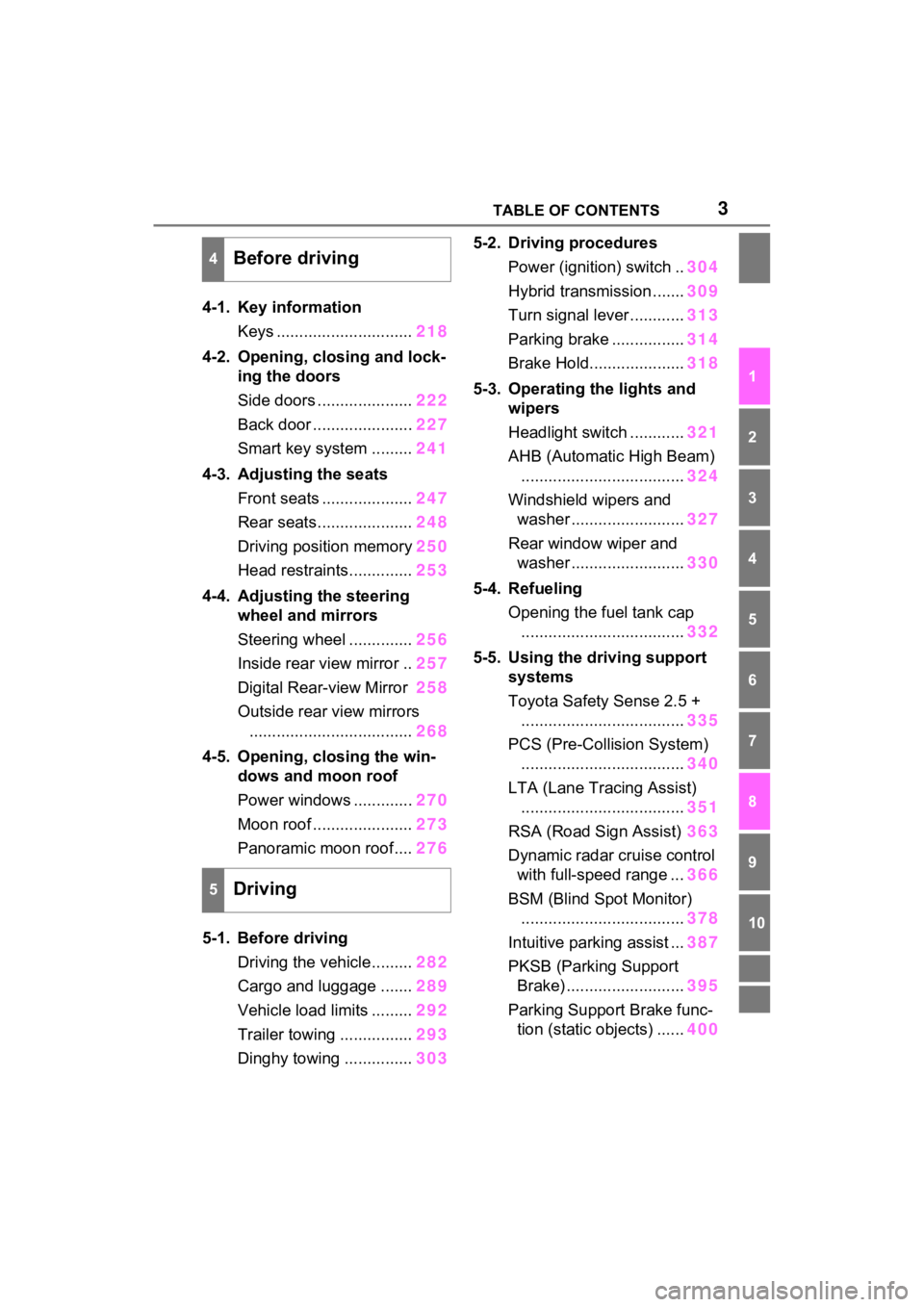
4-1. Key informationKeys .............................. 218
4-2. Opening, closing and lock- ing the doors
Side doors ..................... 222
Back door ...................... 227
Smart key system ......... 241
4-3. Adjusting the seats Front seats .................... 247
Rear seats..................... 248
Driving position memory 250
Head restraints.............. 253
4-4. Adjusting the steering wheel and mirrors
Steering wheel .............. 256
Inside rear view mirror .. 257
Digital Rear-view Mirror 258
Outside rear view mirrors .................................... 268
4-5. Opening, closing the win- dows and moon roof
Power windows ............. 270
Moon roof ...................... 273
Panoramic moon roof.... 276
5-1. Before driving Driving the vehicle......... 282
Cargo and luggage ....... 289
Vehicle load limits ......... 292
Trailer towing ................ 293
Dinghy towing ............... 3035-2. Driving procedures
Power (ignition) switch .. 304
Hybrid transmission ....... 309
Turn signal lever ............ 313
Parking brake ................ 314
Brake Hold..................... 318
5-3. Operating the lights and wipers
Headlight switch ............ 321
AHB (Automatic High Beam) .................................... 324
Windshield wipers and washer ......................... 327
Rear window wiper and washer ......................... 330
5-4. Refueling Opening the fuel tank cap.................................... 332
5-5. Using the driving support systems
Toyota Safety Sense 2.5 +
.................................... 335
PCS (Pre-Collision System) .................................... 340
LTA (Lane Tracing Assist) .................................... 351
RSA (Road Sign Assist) 363
Dynamic radar cruise control with full-speed range ... 366
BSM (Blind Spot Monitor) .................................... 378
Intuitive parking assist ... 387
PKSB (Parking Support Brake) .......................... 395
Parking Suppo rt Bra
ke func-
tion (static objects) ...... 400
4Before driving
5Driving
Page 17 of 662
17Pictorial index
■Instrument panel
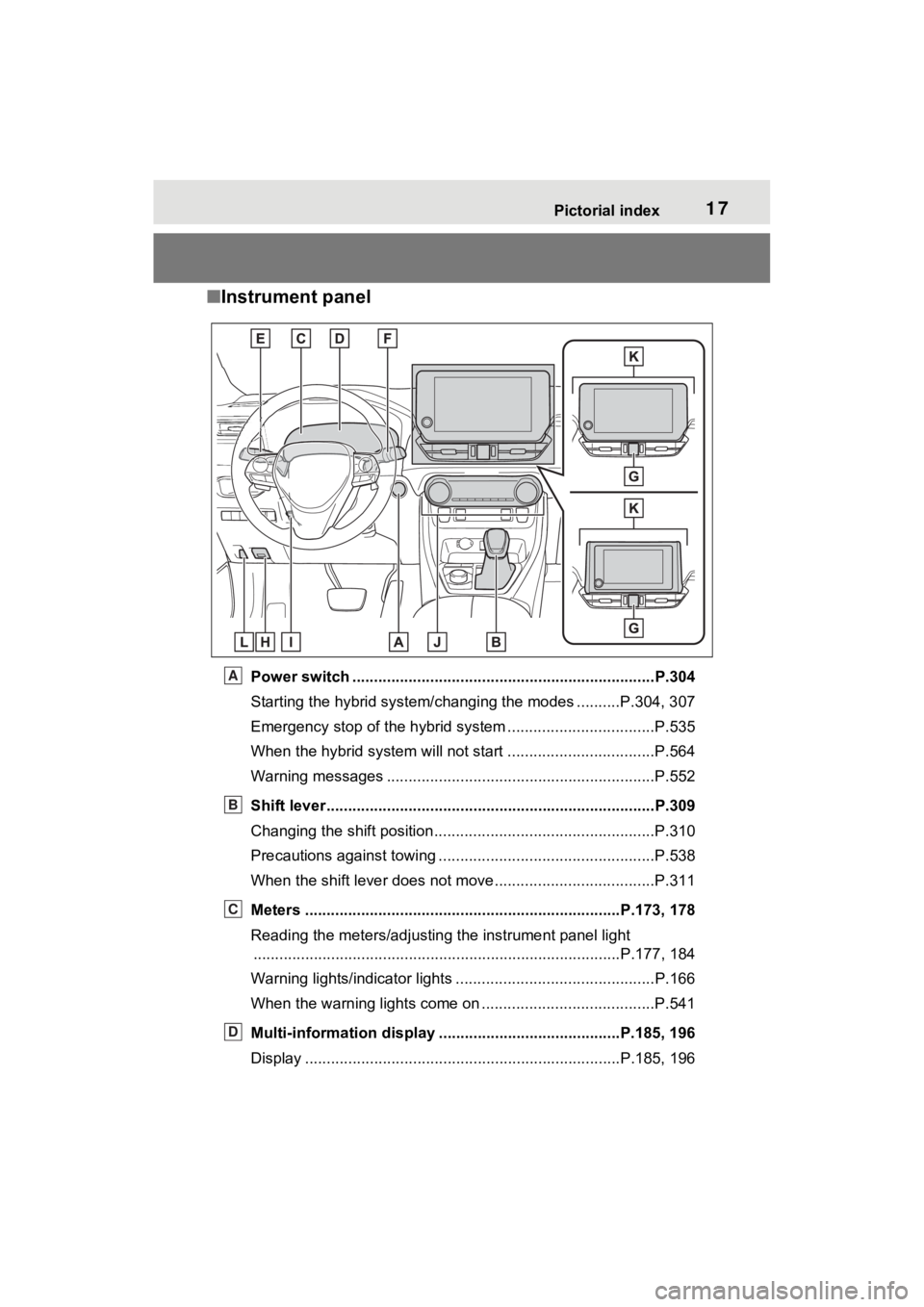
Power switch ................................................... ...................P.304
Starting the hybrid system/chan ging the modes ..........P.304, 307
Emergency stop of the hybrid system ............................ ......P.535
When the hybrid system will not start .......................... ........P.564
Warning messages ..............................................................P.552
Shift lever.................................................... ........................P.309
Changing the shift position.................................... ...............P.310
Precautions against towing ..................................................P.538
When the shift lever does not move............................. ........P.311
Meters ......................................................... ................P.173, 178
Reading the meters/adjusting the instrument panel light ............................................................... ......................P.177, 184
Warning lights/indicator lights ................................ ..............P.166
When the warning lights come on ................................ ........P.541
Multi-information display . .........................................P.185, 196
Display ........................................................ .................P.185, 196A
B
C
D
Page 58 of 662
581-2. Child safety
buckle. Make sure that the
belt is not twisted.
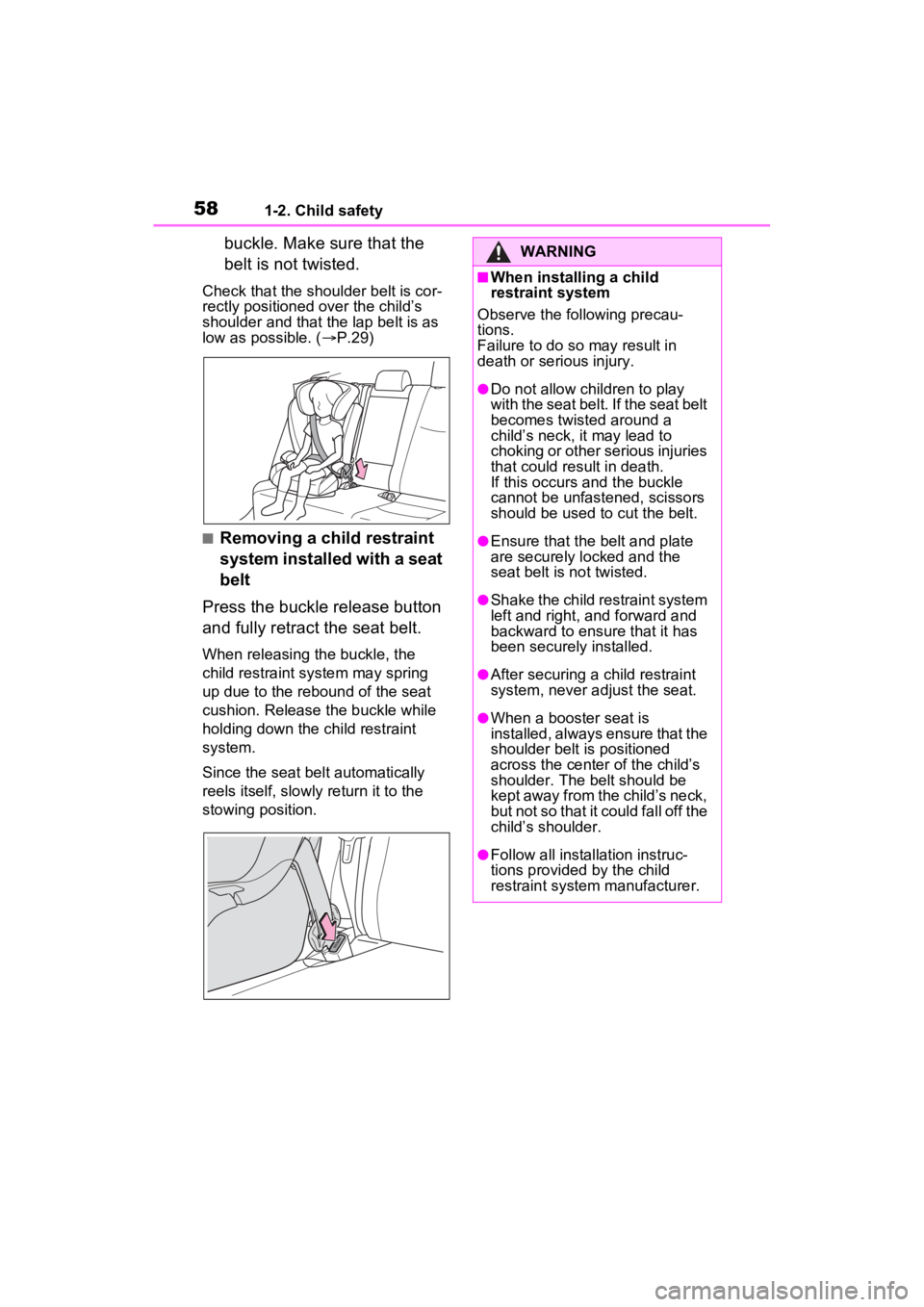
Check that the shoulder belt is cor-
rectly positioned over the child’s
shoulder and that the lap belt is as
low as possible. (P.29)
■Removing a child restraint
system installed with a seat
belt
Press the buckle release button
and fully retract the seat belt.
When releasing the buckle, the
child restraint system may spring
up due to the rebound of the seat
cushion. Release the buckle while
holding down the child restraint
system.
Since the seat belt automatically
reels itself, slowly return it to the
stowing position.
WARNING
■When installing a child
restraint system
Observe the following precau-
tions.
Failure to do so may result in
death or serious injury.
●Do not allow children to play
with the seat belt. If the seat belt
becomes twisted around a
child’s neck, it may lead to
choking or other serious injuries
that could result in death.
If this occurs and the buckle
cannot be unfastened, scissors
should be used to cut the belt.
●Ensure that the belt and plate
are securely locked and the
seat belt is not twisted.
●Shake the child restraint system
left and right, and forward and
backward to ensure that it has
been securely installed.
●After securing a child restraint
system, never adjust the seat.
●When a booster seat is
installed, always ensure that the
shoulder belt is positioned
across the center of the child’s
shoulder. The belt should be
kept away from the child’s neck,
but not so that it could fall off the
child’s shoulder.
●Follow all installation instruc-
tions provided by the child
restraint system manufacturer.
Page 68 of 662

681-3. Emergency assistance
Rico and Toyota.ca in Canada.
■Emergency Assistance But-
ton (“SOS”)
In the event of an emergency on
the road, push the “SOS” button
to reach the Safety Connect
response center. The answering
agent will determine your vehi-
cle’s location, assess the emer-
gency, and dispatch the
necessary assistance required.
If you accidentally press the “SOS”
button, tell the response-center
agent that you are not experiencing
an emergency.
■Enhanced Roadside Assis-
tance
Enhanced Roadside Assistance
adds GPS data to the already
included warranty-based Toyota
roadside service.
Subscribers can press the
“SOS” button to reach a Safety
Connect response-center agent,
who can help with a wide range
of needs, such as: towing, flat
tire, fuel delivery, etc. For a
description of the Enhanced
Roadside Assistance services
and their limitations, please see
the Safety Connect Terms and
Conditions, which are available
at Toyota.com in the United
States, Toyotapr.com in Puerto
Rico and Toyota.ca in Canada. Important! Read this informa-
tion before using Safety Con-
nect.
■Exposure to radio fre-
quency signals
The Safety Connect system
installed in your vehicle is a low-
power radio transmitter and
receiver. It receives and also
sends out radio frequency (RF)
signals.
In August 1996, the Federal
Communications Commission
(FCC) adopted RF exposure
guidelines with safety levels for
mobile wireless phones. Those
guidelines are consistent with
the safety standards previously
set by the following U.S. and
international standards bodies.
ANSI (American National
Standards Institute) C95.1
[1992]
NCRP (National Council on
Radiation Protection and
Measurement) Report 86
[1986]
ICNIRP (International Com-
mission on Non-Ionizing Radi-
ation Protection) [1996]
Those standards were based on
comprehensive and periodic
evaluations of the relevant sci-
entific literature. Over 120 scien-
tists, engineers, and physicians
Safety information for
Safety Connect
Page 87 of 662
872-1. Plug-in hybrid system
2
Plug-in hybrid system
WARNING
●Never touch, disassemble,
remove or replace the high volt-
age parts, cables or their con-
nectors.
●The hybrid system will become
hot after starting as the system
uses high voltage. Be careful of
both the high voltage and the
high temperature, and always
obey the caution labels
attached to the vehicle.
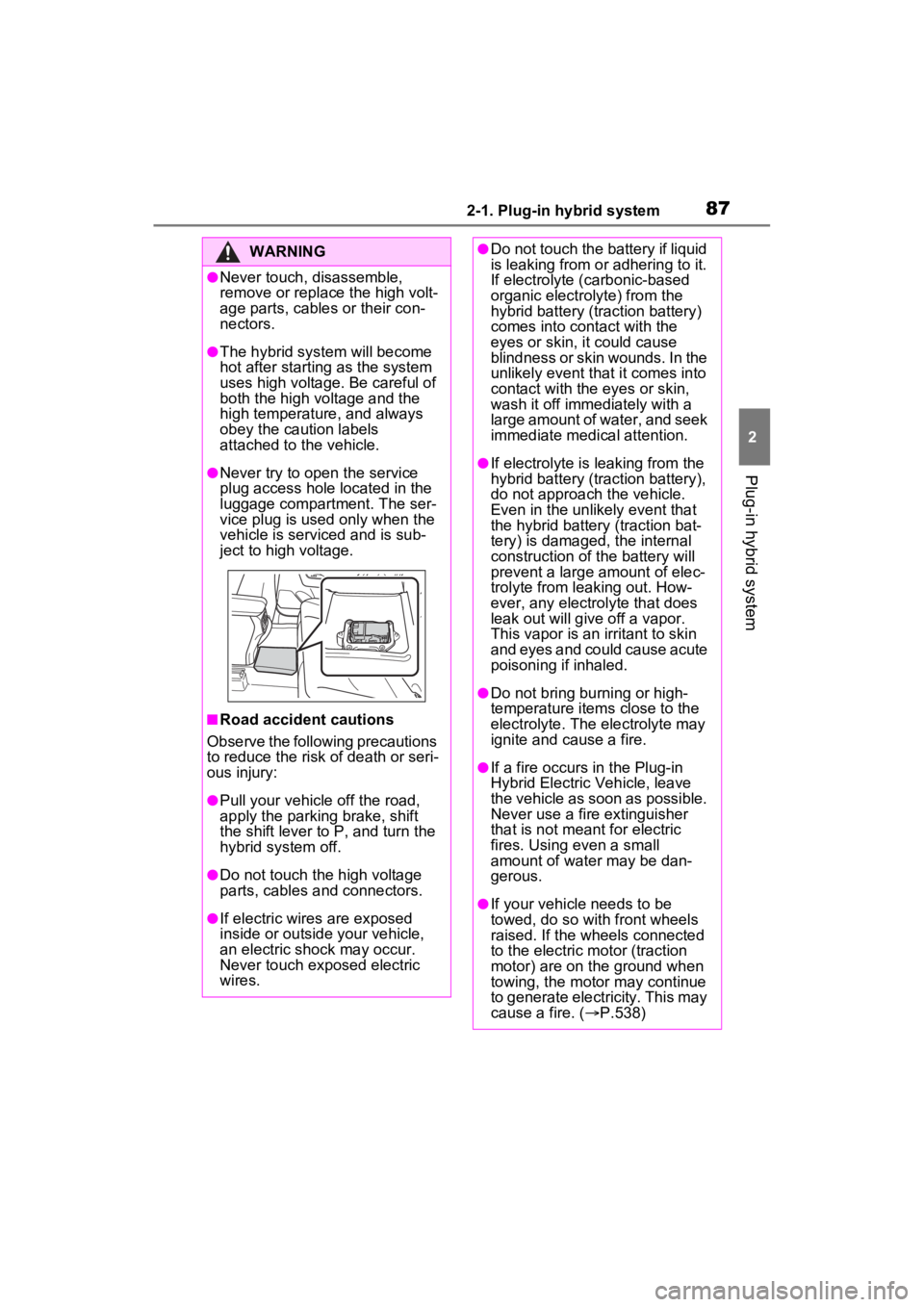
●Never try to open the service
plug access hole located in the
luggage compartment. The ser-
vice plug is used only when the
vehicle is serviced and is sub-
ject to high voltage.
■Road accident cautions
Observe the following precautions
to reduce the risk of death or seri-
ous injury:
●Pull your vehicle off the road,
apply the parking brake, shift
the shift lever to P, and turn the
hybrid system off.
●Do not touch the high voltage
parts, cables and connectors.
●If electric wires are exposed
inside or outside your vehicle,
an electric shock may occur.
Never touch exposed electric
wires.
●Do not touch the battery if liquid
is leaking from or adhering to it.
If electrolyte (carbonic-based
organic electrolyte) from the
hybrid battery (traction battery)
comes into contact with the
eyes or skin, it could cause
blindness or skin wounds. In the
unlikely event that it comes into
contact with the eyes or skin,
wash it off immediately with a
large amount of water, and seek
immediate medical attention.
●If electrolyte is leaking from the
hybrid battery (traction battery),
do not approach the vehicle.
Even in the unlikely event that
the hybrid battery (traction bat-
tery) is damaged, the internal
construction of the battery will
prevent a large amount of elec-
trolyte from leaking out. How-
ever, any electrolyte that does
leak out will give off a vapor.
This vapor is an irritant to skin
and eyes and could cause acute
poisoning if inhaled.
●Do not bring burning or high-
temperature items close to the
electrolyte. The electrolyte may
ignite and cause a fire.
●If a fire occurs in the Plug-in
Hybrid Electric Vehicle, leave
the vehicle as soon as possible.
Never use a fire extinguisher
that is not meant for electric
fires. Using even a small
amount of water may be dan-
gerous.
●If your vehicle needs to be
towed, do so with front wheels
raised. If the wheels connected
to the electric motor (traction
motor) are on the ground when
towing, the motor may continue
to generate electricity. This may
cause a fire. ( P.538)
Page 279 of 662
281
5
5
Driving
Driving
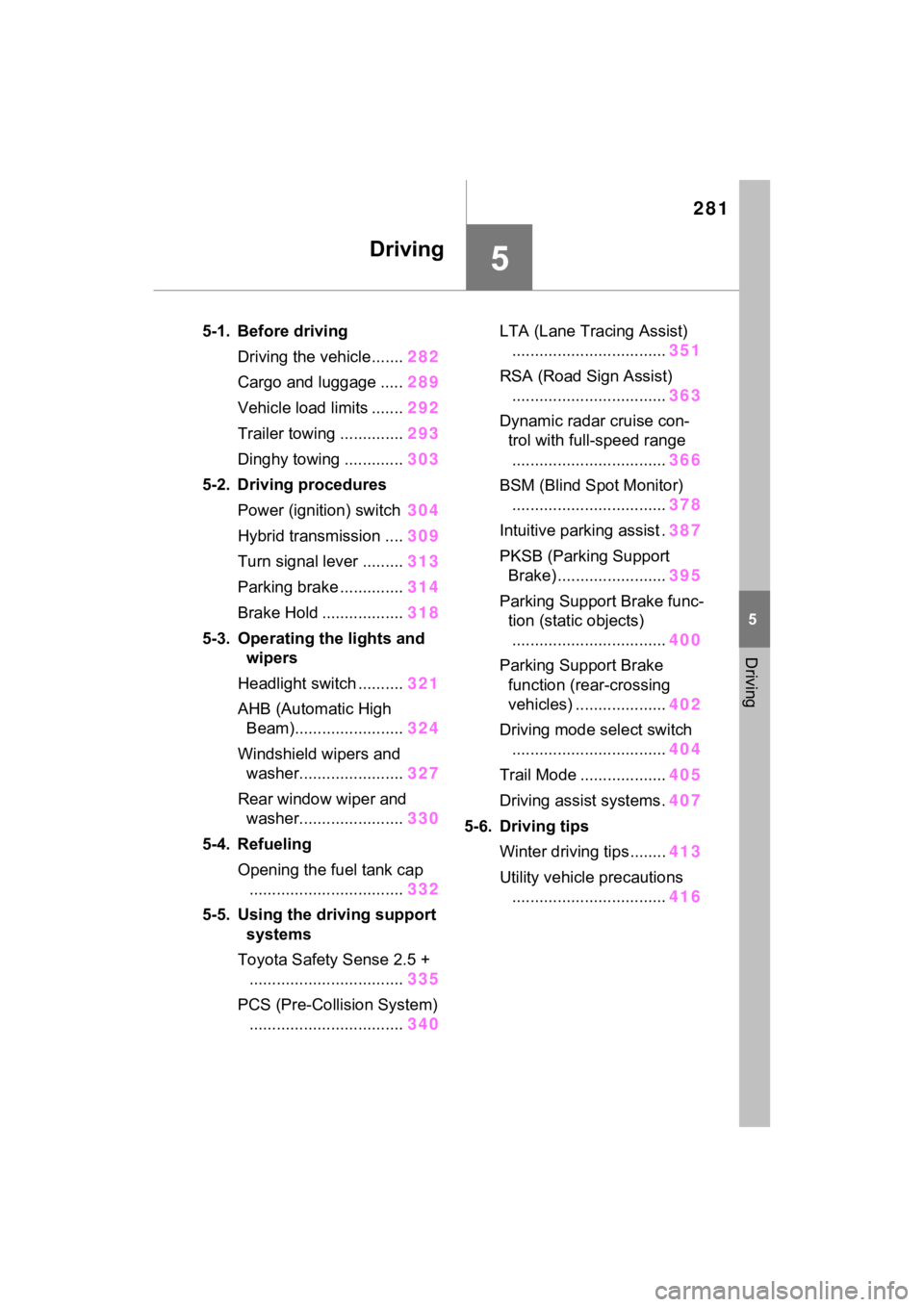
5-1. Before drivingDriving the vehicle....... 282
Cargo and luggage ..... 289
Vehicle load limits ....... 292
Trailer towing .............. 293
Dinghy towing ............. 303
5-2. Driving procedures Power (ignition) switch 304
Hybrid transmission .... 309
Turn signal lever ......... 313
Parking brake .............. 314
Brake Hold .................. 318
5-3. Operating the lights and wipers
Headlight switch .......... 321
AHB (Automatic High Beam)........................ 324
Windshield wipers and washer....................... 327
Rear window wiper and washer....................... 330
5-4. Refueling Opening the fuel tank cap.................................. 332
5-5. Using the driving support
systems
Toyota Safety Sense 2.5 + .................................. 335
PCS (Pre-Collision System) .................................. 340LTA (Lane Tracing Assist)
.................................. 351
RSA (Road Sign Assist) .................................. 363
Dynamic radar cruise con- trol with full-speed range
.................................. 366
BSM (Blind Spot Monitor) .................................. 378
Intuitive parking assist . 387
PKSB (Parking Support Brake) ........................ 395
Parking Support Brake func- tion (static objects).................................. 400
Parking Support Brake function (rear-crossing
vehicles) .................... 402
Driving mode select switch .................................. 404
Trail Mode ................... 405
Driving assist systems. 407
5-6. Driving tips Winter driving tips........ 413
Utility vehicle precautions .................................. 416
Page 288 of 662
2905-1. Before driving
Cargo capacity depends on the
total weight of the occupants.
(Cargo capacity) = (Total load
capacity) - (Total weight of occu-
pants)
Steps for Determining Correct
Load Limit
(1) Locate the statement “The
combined weight of occupants
and cargo should never exceed
XXX kg or XXX lbs.” on your
vehicle’s placard.
(2) Determine the combined
weight of the driver and passen-
gers that will be riding in your
vehicle.
(3) Subtract the combined
weight of the driver and passen-
gers from XXX kg or XXX lbs.
(4) The resulting figure equals the available amount of cargo
and luggage load capacity.
For example, if the “XXX”
amount equals 1400 lbs. and
there will be five 150 lb passen-
gers in your vehicle, the amount
of available cargo and luggage
load capacity is 650 lbs. (1400 -
750 (5
150) = 650 lbs.)
(5) Determine the combined
weight of luggage and cargo
being loaded on the vehicle.
That weight may not safely
exceed the available cargo and
luggage load capacity calcu-
lated in Step 4.
(6) If your vehicle will be towing
a trailer, load from your trailer
will be transferred to your vehi-
cle. Consult this manual to
determine how this reduces the
available cargo and luggage
load capacity of your vehicle.
( P.292)
WARNING
●Secure all items in the occupant
compartment.
●When you fold down the rear
seats, long items should not be
placed directly behind the front
seats.
●Never allow anyone to ride in
the luggage compartment. It is
not designed for passengers.
They should ride in their seats
with their seat belts properly
fastened. Otherwise, they are
much more likely to suffer death
or serious bodily injury, in the
event of sudden braking, sud-
den swerving or an accident.
Capacity and distribution
WARNING
■Capacity and distribution
●Do not exceed the maximum
axle weight rating or the total
vehicle weight rating.
●Even if the total load of occu-
pant’ weight and the cargo load
is less than the total load capac-
ity, do not apply the load
unevenly. Improper loading may
cause deterioration of steering
or braking control which may
cause death or serious injury.
Page 291 of 662
2935-1. Before driving
5
Driving
WARNING
■Overloading the vehicle
Do not overload the vehicle. It
may not only cause damage to
the tires, but also degrade steer-
ing and braking ability, resulting in
an accident.
Trailer towing
Your vehicle is designed
primarily as a passenger-
and-load-carrying vehicle.
Towing a trailer can have an
adverse impact on handling,
performance, braking, dura-
bility, and fuel consump-
tion. For your safety and the
safety of others, you must
not overload your vehicle or
trailer. You must also
ensure that you are using
appropriate towing equip-
ment, that the towing equip-
ment has been installed
correctly and used properly,
and that you employ the
requisite driving habits.
Vehicle-trailer stability and
braking performance are
affected by trailer stability,
brake performance and set-
ting, trailer brakes, the hitch
and hitch systems (if
equipped).
To tow a trailer safely, use
extreme care and drive the
vehicle in accordance with
your trailer’s characteris-
tics and operating condi-
tions.
Page 292 of 662
2945-1. Before driving
■Before towing
Check that the following conditions
are met:
●Ensure that your vehicle’s tires
are properly inflated. ( P.585)
●Trailer tires are inflated according
to the trailer manufacturer’s rec-
ommendation.
●All trailer lights work as required
by law.
●All lights work each time you con-
nect them.
●The trailer ball is set at the proper
height for the coupler on the
trailer.
●The trailer is level when it is
hitched.
Do not drive if the trailer is not
level, and check for improper
tongue weight, overloading, worn
suspension, or other possible
causes.
●The trailer cargo is securely
loaded.
●The rear view mirrors conform to
all applicable federal, state/provin-
cial or local regu lations. If they do
not, install rear view mirrors
appropriate for towing purposes.
■When towing a trailer
Disable the following systems, as
the systems may not operate prop-
erly.
●LTA (Lane Tracing Assist)
( P.351)
●Dynamic radar cruise control with
full-speed range ( P.366)
●PKSB (Parking Suppor t Brake) (if
equipped) ( P.395)
●BSM (Blind Spot Monitor)
( P.378)
●Intuitive parking assist (if
equipped) ( P.387)
●RCTA (Rear Cross Traffic Alert)
function ( P.378)
Toyota warranties do not
apply to damage or mal-
function caused by towing a
trailer for commercial pur-
poses.
Contact your Toyota dealer for
further information about addi-
tional requirements such as a
towing kit, etc.
WARNING
■Trailer towing precautions
To tow a trailer safely, use
extreme care and drive the vehi-
cle in accordance with the trailer’s
characteristics and operating con-
ditions. Failure to do so could
cause an accident resulting in
death or serious injury. Vehicle
stability and brak ing performance
are affected by trailer stability,
brake setting and performance,
and the hitch. Yo ur vehicle will
handle differently when towing a
trailer.
■To avoid accident or injury
●Do not exceed the TWR,
unbraked TWR, GCWR, GVWR
or GAWR.
●Adjust the tongue weight within
the appropriate range. Place
heavier loads as close to the
trailer axle as possible.
Page 293 of 662
2955-1. Before driving
5
Driving
■GCWR (Gross Combination
Weight Rating)
The maximum allowable gross
combination weight. The gross
WARNING
●Do not exceed 65 mph (104
km/h), the posted towing speed
limit or the speed limit for your
trailer as set fort h in your trailer
owner’s manual, whichever is
lowest. Slow down sufficiently
before making a turn, in cross
winds, on wet or slippery sur-
face, etc. to help avoid an acci-
dent. If you experience a
vehicle-trailer instability from
reducing a certain speed, slow
down and make sure you keep
your vehicle speed under the
speed of which you experience
the instability.
●Do not make jerky, abrupt or
sharp turns.
●Do not apply the brakes sud-
denly as you may skid, resulting
in jackknifing and loss of vehicle
control. This is especially true
on wet or slippery surfaces.
●Do not exceed th e trailer hitch
assembly weight, gross vehicle
weight, gross axle weight and
trailer tongue weight capacities.
●Do not use dynamic radar
cruise control with full-speed
range when towing.
●Slow down and downshift
before descending steep or long
downhill grades. Do not make
sudden downshifts while
descending steep or long down-
hill grades.
●Vehicle-trailer in stability is more
likely on steep long downhills.
Before descending steep or
long downhill grades, slow
down and downshift. Do not
make sudden downshifts when
descending steep or long down-
hill grades. Avoid holding the
brake pedal down too long or
applying the brakes too fre-
quently. This could cause the
brakes to overheat and result in
reduced braking efficiency.
●Do not tow a trailer when the
compact spare tire is installed
on your vehicle.
■When towing a trailer
Toyota recommends trailers with
brakes that conform to any appli-
cable federal and s tate/provincial
regulations.
●If the gross tr ailer weight
exceeds unbraked TWR, trailer
brakes are required. Toyota rec-
ommends trailers with brakes
that conform to all applicable
federal and state/provincial reg-
ulations.
●Never tap into your vehicle’s
hydraulic system, as this will
lower the vehicle’s braking
effectiveness.
●Never tow a traile r without using
a safety chain securely attached
to both the trailer and the vehi-
cle. If damage occurs to the
coupling unit or hitch ball, there
is danger of the trailer wander-
ing into another lane.
Towing related terms