air condition TOYOTA SEQUOIA 2009 2.G Owners Manual
[x] Cancel search | Manufacturer: TOYOTA, Model Year: 2009, Model line: SEQUOIA, Model: TOYOTA SEQUOIA 2009 2.GPages: 612
Page 1 of 612
TABLE OF CONTENTS
1
1Before drivingAdjusting and operating features such as door locks,
mirrors, and steering column.
2When drivingDriving, stopping, and safe-driving information.
3Interior
featuresAir conditioning and audio systems, as well as other in-
terior features for a comfortable driving experience.
4Maintenance
and careCleaning and protecting your vehicle, performing do-it-
yourself maintenance, and maintenance information.
5When trouble
arisesWhat to do if the vehicle needs to be towed, gets a flat
tire, or is involved in an accident.
6Vehicle
specificationsDetailed vehicle information.
7For ownersReporting safety defects for U.S. owners and seat belt
instructions for Canadian owners.
IndexAlphabetical listing of information contained in this
manual.
Page 3 of 612
1
2
3
4
5
6
7
3
2-3. Operating the lights and wipers .............................. 180
Headlight switch .................. 180
Fog light switch ................... 183
Windshield wipers and washer .............................. 184
Rear window wiper and washer .............................. 186
Headlight cleaner switch ..... 187
2-4. Using other driving systems ........................... 188
Cruise control ...................... 188
Dynamic laser cruise control ............................... 191
Intuitive parking assist......... 202
Electronically modulated air suspension................... 208
AVS (Adaptive Variable Suspension System) ......... 213
Four-wheel drive system ..... 214
AUTO LSD system.............. 219
Driving assist systems ........ 221
2-5. Driving information ........... 227 Off-road precautions ........... 227
Cargo and luggage ............. 232
Vehicle load limits ............... 236
Winter driving tips ............... 237
Trailer towing ...................... 241
Dinghy towing ..................... 257 3-1. Using the air conditioning
system and defogger ..... 260
Front air conditioning system .............................. 260
Rear air conditioning system .............................. 268
Rear window and outside rear view mirror
defoggers ......................... 272
Windshield wiper de-icer .... 273
Using the steering wheel climate remote control
switches ........................... 274
3-2. Using the audio system ... 276 Audio system (without navigation system) ........... 276
Using the radio ................... 279
Using the CD player ........... 285
Playing back MP3 and WMA discs ....................... 292
Optimal use of the audio system .............................. 301
Using the AUX adapter....... 303
Using the steering wheel audio switches.................. 305
3-3. Using the rear audio/ video system .................. 307
Rear seat entertainment system .............................. 307
Using the DVD player (DVD video)...................... 314
Using the DVD player (video CD) ........................ 323
3Interior features
Page 5 of 612
1
2
3
4
5
6
7
5
4-2. Maintenance ...................... 439Maintenance requirements ..................... 439
General maintenance.......... 441
Emission inspection and maintenance (I/M)
programs........................... 444
4-3. Do-it-yourself maintenance .................... 445
Do-it-yourself service precautions ....................... 445
Hood ................................... 449
Engine compartment ........... 450
Tires .................................... 466
Tire inflation pressure ......... 473
Wheels ................................ 477
Air conditioning filter............ 479
Wireless remote control battery ............................... 482
Checking and replacing fuses ................................. 484
Light bulbs........................... 495
5-1. Essential information ....... 508 Emergency flashers ............ 508
If your vehicle needs to be towed ................................ 509
If you think something is wrong ................................ 514
Fuel pump shut off system .............................. 515
Event data recorder ............ 516 5-2. Steps to take in an
emergency ...................... 518
If a warning light turns on or a warning buzzer
sounds... .......................... 518
If a warning message is displayed (vehicles with
multi-information
display) ............................. 527
If you have a flat tire ........... 532
If the engine will not start.... 542
If the shift lever cannot be shifted from P ................... 544
If you lose your keys........... 545
If the vehicle battery is discharged........................ 546
If your vehicle overheats .... 550
If the vehicle becomes stuck ................................. 553
6-1. Specifications ................... 556 Maintenance data (fuel, oil level, etc.) ........... 556
Fuel information.................. 569
Tire information .................. 573
6-2. Customization................... 584 Customizable features........ 584
Items to initialize ................. 588
5When trouble arises
6Vehicle specifications
Page 15 of 612
15
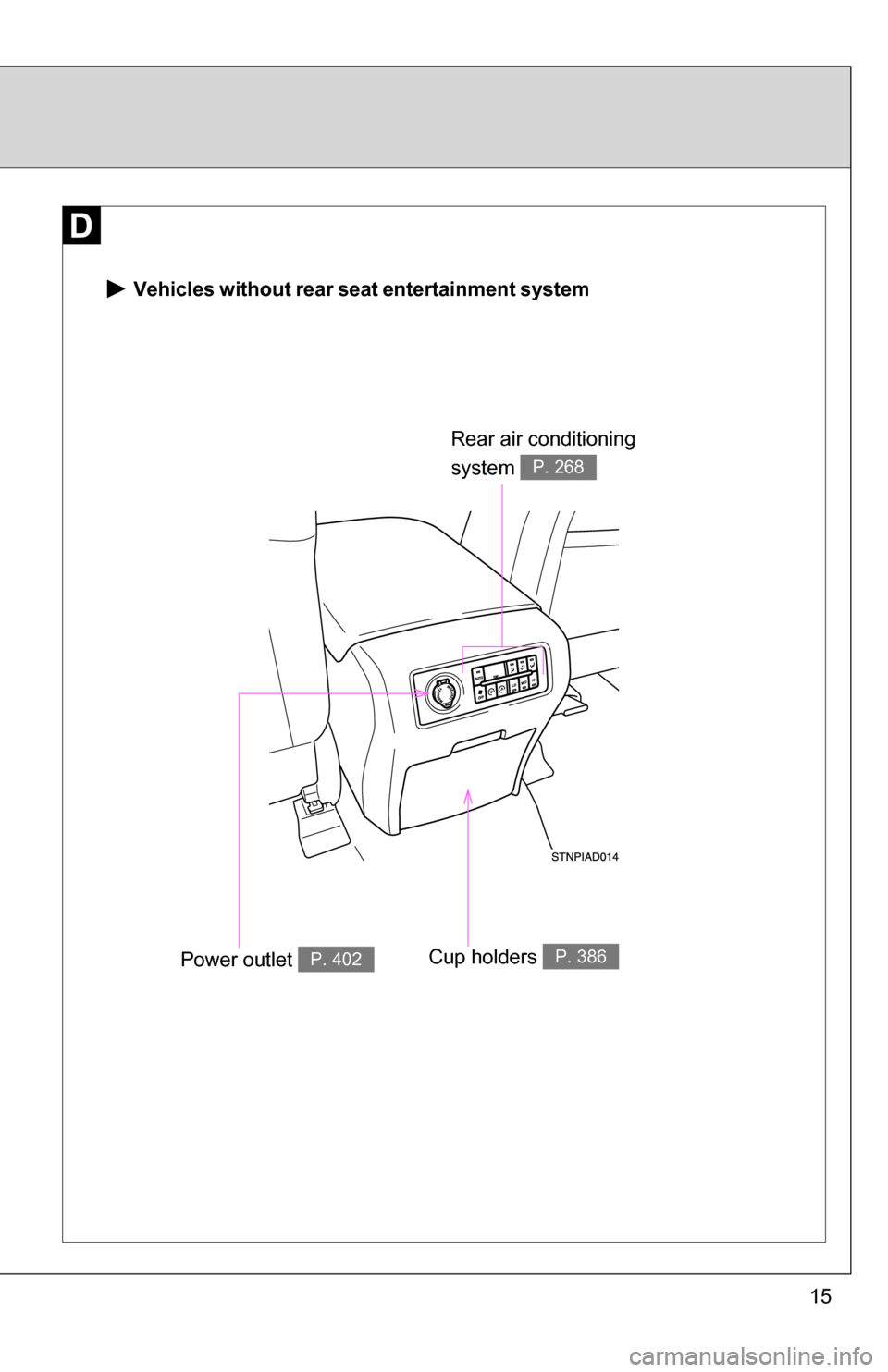
Vehicles without rear seat entertainment system
Rear air conditioning
system
P. 268
Power outlet P. 402Cup holders P. 386
Page 16 of 612
16
Pictorial indexInterior
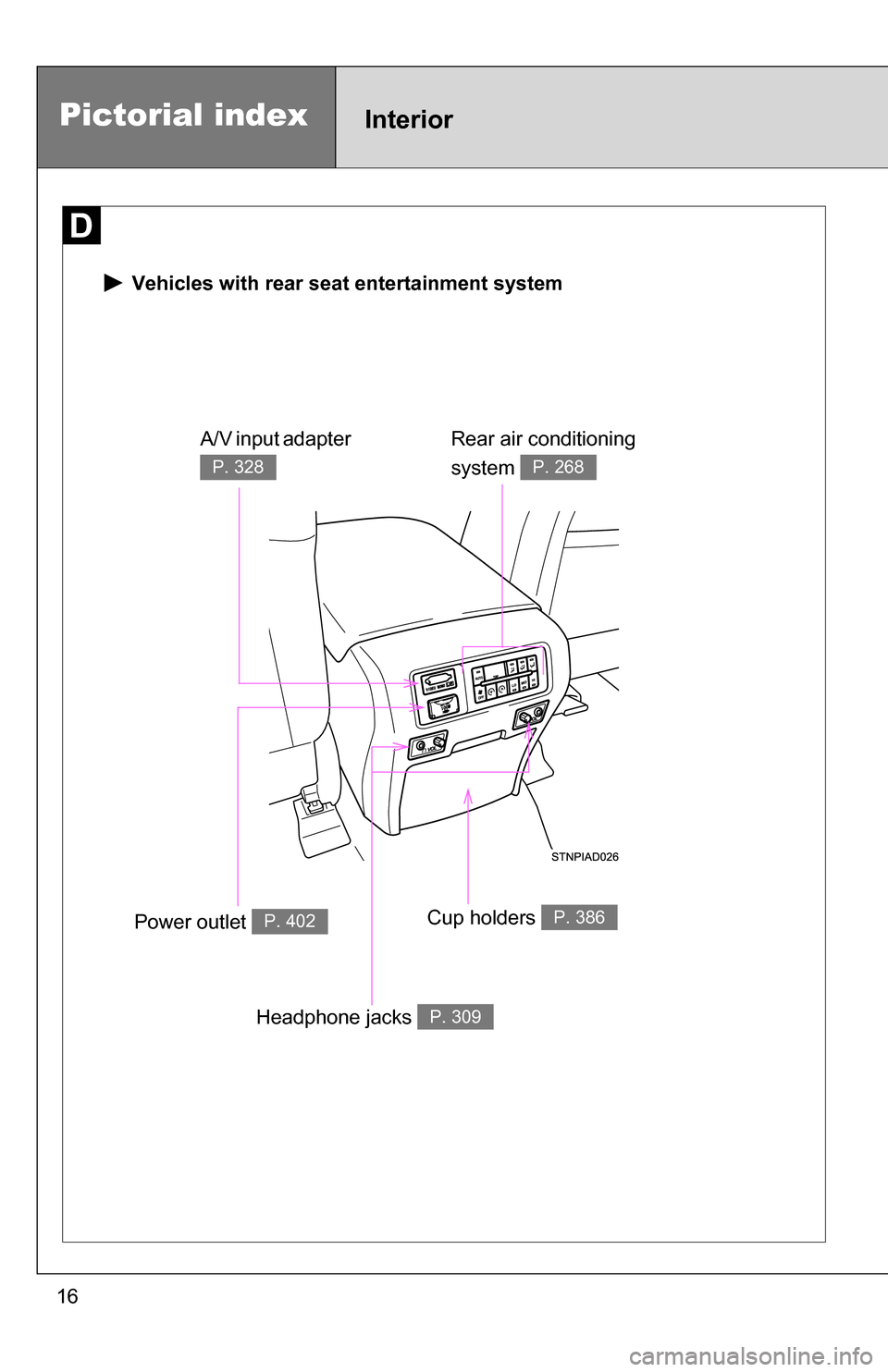
Vehicles with rear seat entertainment system
Rear air conditioning
system
P. 268
Power outlet P. 402Cup holders P. 386
A/V input adapter
P. 328
Headphone jacks P. 309
Page 19 of 612
19
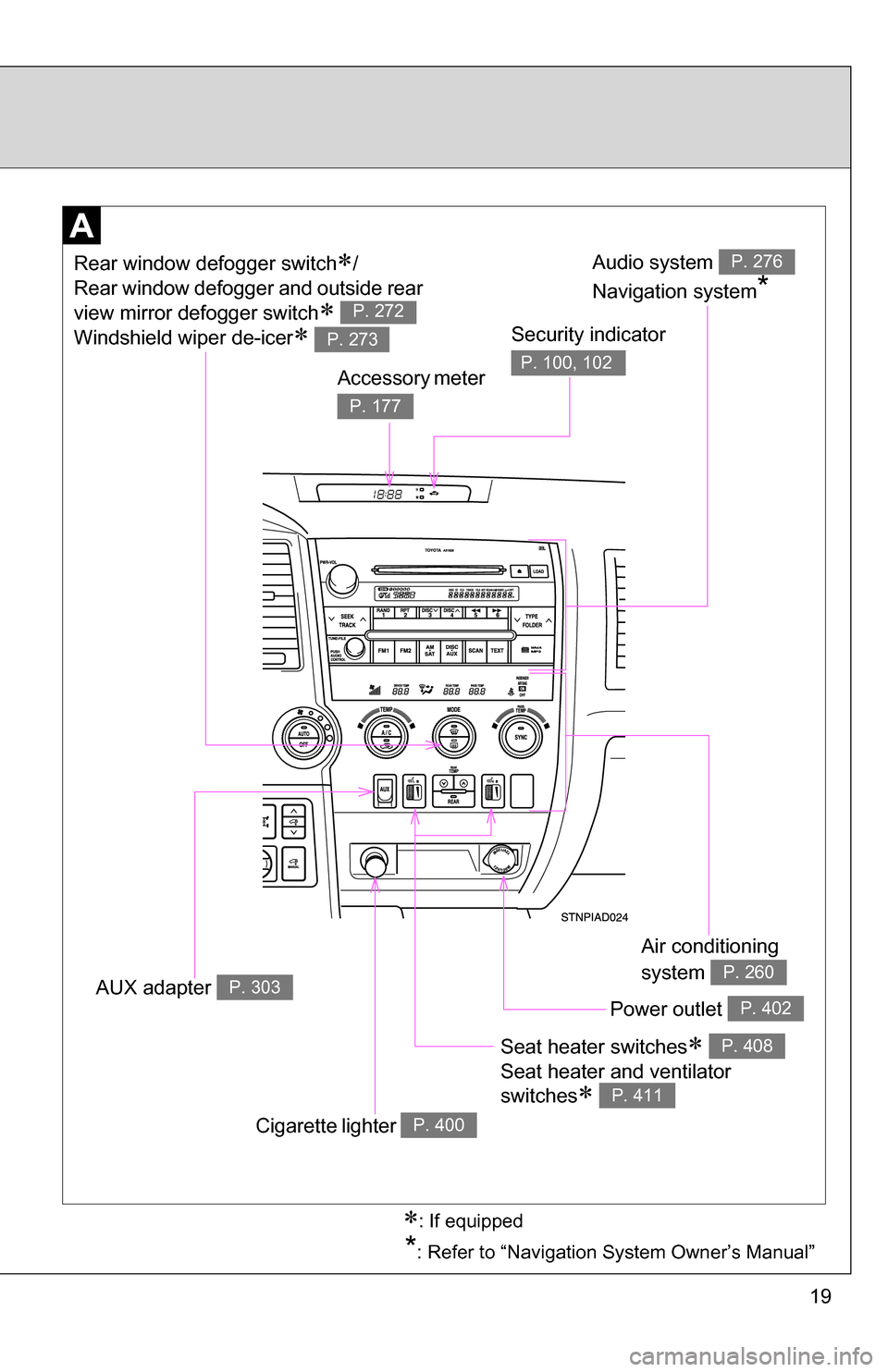
*: Refer to “Navigation System Owner’s Manual”
Seat heater switches
Seat heater and ventilator
switches
P. 408
P. 411
Air conditioning
system
P. 260
Power outlet P. 402
Audio system
Navigation system
*
P. 276Rear window defogger switch/
Rear window defogger and outside rear
view mirror defogger switch
Windshield wiper de-icer
P. 272
P. 273Security indicator
P. 100, 102Accessory meter
P. 177
Cigarette lighter P. 400
AUX adapter P. 303
: If equipped
Page 35 of 612
35
1-2. Opening, closing and locking the doors
1
Before driving
■
Conditions affecting operation
The wireless remote control function may not operate normally in the follow-
ing situations.
●Near a TV tower, radio station, electr ic power plant, airport or other facil-
ity that generates strong radio waves
● When carrying a portable radio, cell ular phone or other wireless commu-
nication device
● When multiple wireless keys are in the vicinity
● When the wireless key has come into contact with, or is covered by a
metallic object
● When a wireless key (that emits radio waves) is being used nearby
● When the wireless key has been left near an electrical appliance such as
a personal computer
■ Customization
●That can be configured at Toyota dealer (vehicles without multi-informa-
tion display)
Settings (e.g. wireless remote control) can be changed.
(Customizable features P. 584)
● It is possible to change the settings (vehicles with multi-information dis-
play) (Feature customization P. 173)
Page 110 of 612
110 1-7. Safety information
■Operating conditions (front airbags)
● The SRS front airbags will deploy if the severity of the frontal impact is
above the designed threshold level, comparable to an approximate 15
mph (25 km/h) collision when the vehicle impacts straight into a fixed bar-
rier that does not move or deform.
However, this threshold velocity will be considerably higher if the vehicle
strikes an object, such as a parked vehicle or sign pole, which can move or
deform on impact, or if the vehicle is involved in an underride collision (e.g.
a collision in which the front of the vehicle “underrides”, or goes under, the
bed of a truck, etc.).
● It is possible that in some collisions where the forward deceleration of the
vehicle is very close to the designed threshold level, the SRS front air-
bags and the seat belt pretensioners may not activate together.
● The SRS front passenger airbag will not activate if there is no passenger
sitting in the front passenger seat. However, the front passenger airbag
may deploy if luggage is put in the seat, or the seat belt is fastened, even
if the seat is unoccupied. ( P. 120)
■ Operating conditions (side airbags)
●The SRS side airbags are designed to inflate when the passenger com-
partment is subjected to a severe impact from the side.
● The SRS side airbag on the passenger seat will activate even if there is
no passenger sitting in the front passenger seat. ( P. 120)
■ Operating conditions (c urtain shield airbags)
The SRS curtain shield airbags are designed to inflate when the passenger
compartment is subjected to a severe impact from the side or vehicle roll-
over. Depending on the conditions and type of accident, there are times
when the curtain shield airbags may deploy (inflate) in a front impact.
Page 111 of 612
111
1-7. Safety information
1
Before driving
■
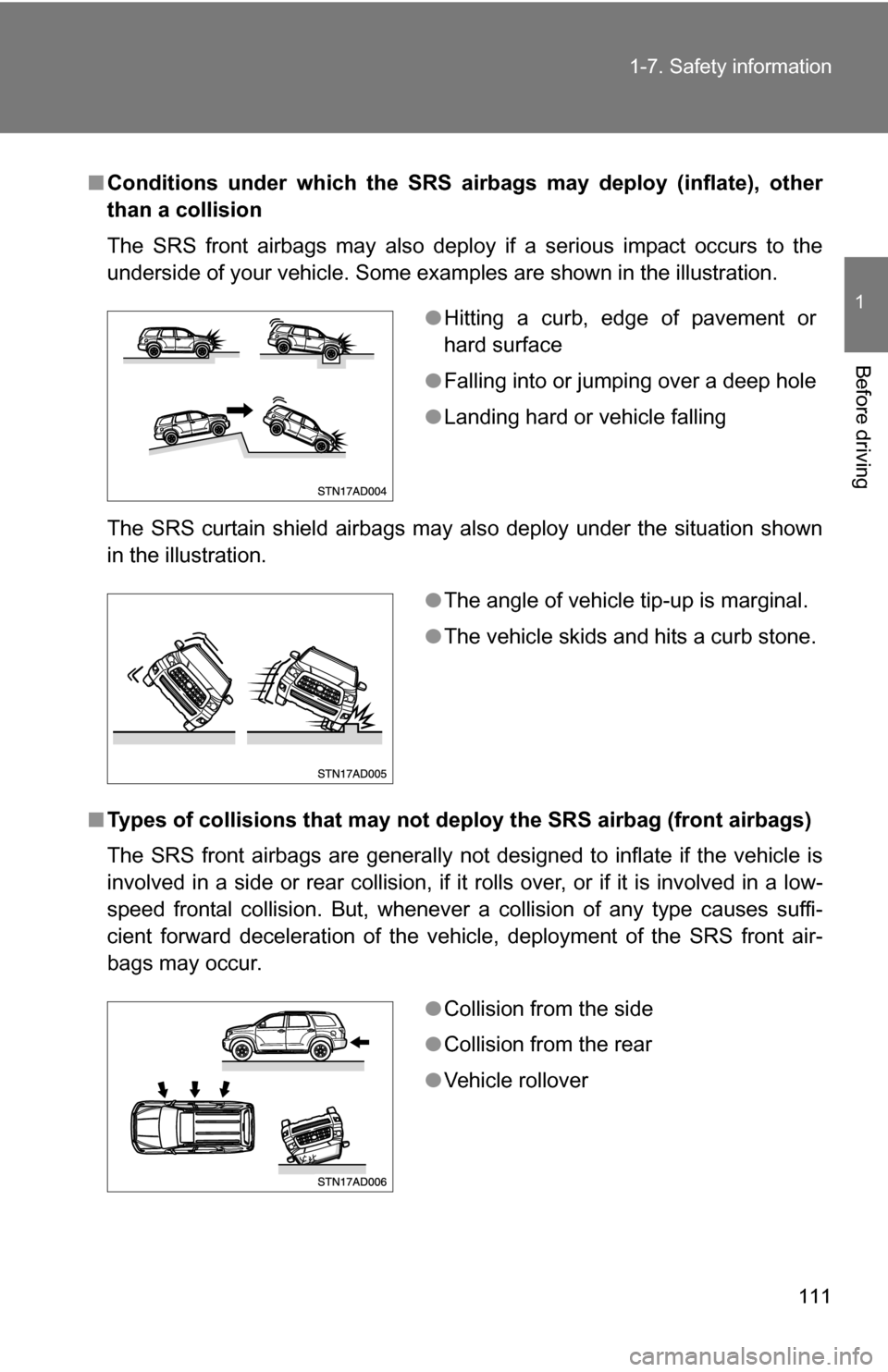
Conditions under which the SRS airbags may deploy (inflate), other
than a collision
The SRS front airbags may also deploy if a serious impact occurs to the
underside of your vehicle. Some examples are shown in the illustration.
The SRS curtain shield airbags may also deploy under the situation shown
in the illustration.
■ Types of collisions that may not depl oy the SRS airbag (front airbags)
The SRS front airbags are generally not designed to inflate if the vehicle is
involved in a side or rear collision, if it rolls over, or if it is involved in a low-
speed frontal collision. But, whenever a collision of any type causes suffi-
cient forward deceleration of the vehicle, deployment of the SRS front air-
bags may occur.
● Hitting a curb, edge of pavement or
hard surface
● Falling into or jumping over a deep hole
● Landing hard or vehicle falling
●The angle of vehicle tip-up is marginal.
● The vehicle skids and hits a curb stone.
●Collision from the side
● Collision from the rear
● Vehicle rollover
Page 119 of 612
119
1-7. Safety information
1
Before driving
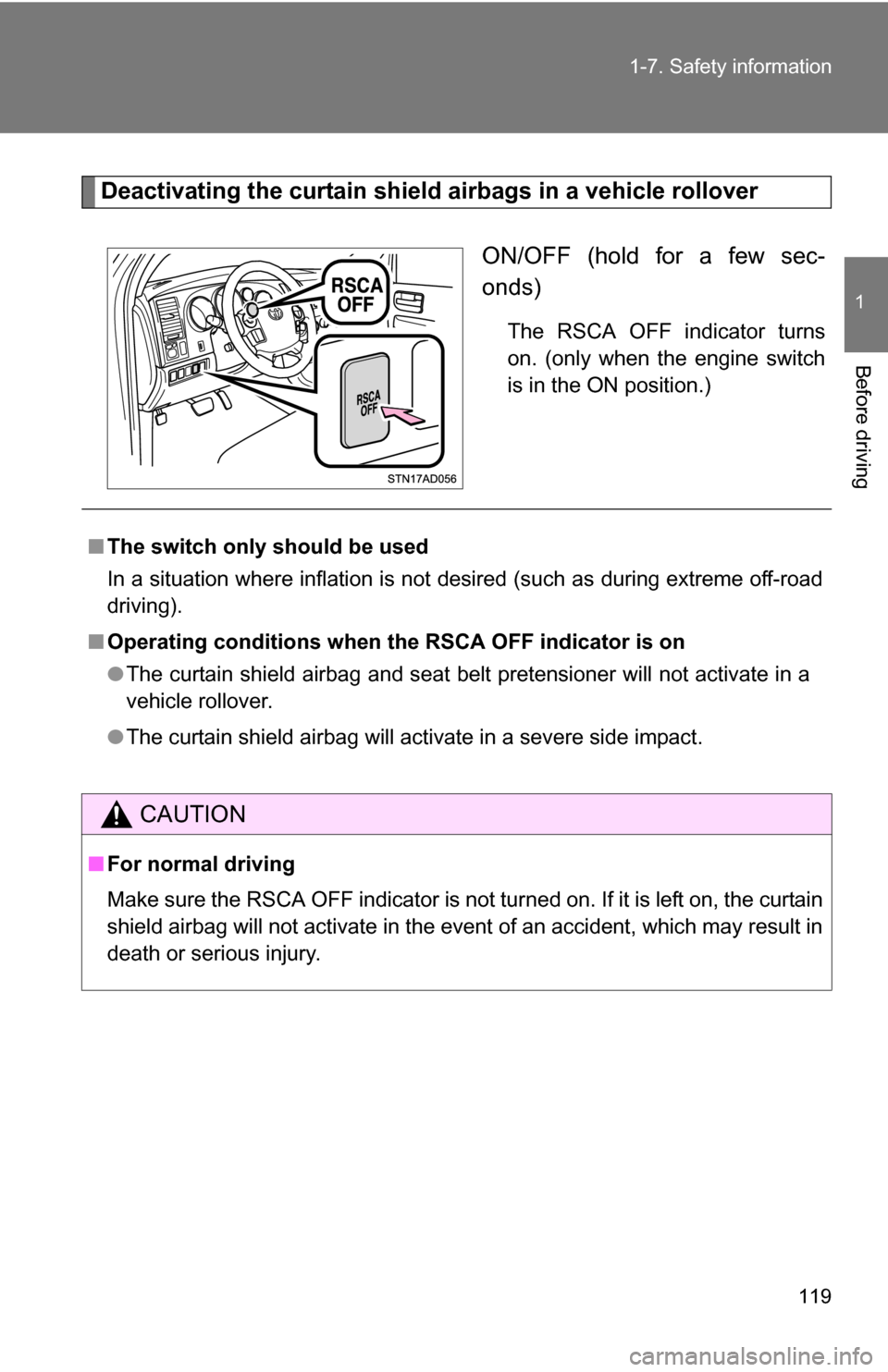
Deactivating the curtain shield airbags in a vehicle rollover
ON/OFF (hold for a few sec-
onds)
The RSCA OFF indicator turns
on. (only when the engine switch
is in the ON position.)
■The switch only should be used
In a situation where inflation is not desired (such as during extreme off-road
driving).
■ Operating conditions when th e RSCA OFF indicator is on
● The curtain shield airbag and seat belt pretensioner will not activate in a
vehicle rollover.
● The curtain shield airbag will activate in a severe side impact.
CAUTION
■For normal driving
Make sure the RSCA OFF indicator is not turned on. If it is left on, the curtain
shield airbag will not activate in the event of an accident, which may result in
death or serious injury.