air suspension TOYOTA SEQUOIA 2009 2.G Owners Manual
[x] Cancel search | Manufacturer: TOYOTA, Model Year: 2009, Model line: SEQUOIA, Model: TOYOTA SEQUOIA 2009 2.GPages: 612
Page 3 of 612
1
2
3
4
5
6
7
3
2-3. Operating the lights and wipers .............................. 180
Headlight switch .................. 180
Fog light switch ................... 183
Windshield wipers and washer .............................. 184
Rear window wiper and washer .............................. 186
Headlight cleaner switch ..... 187
2-4. Using other driving systems ........................... 188
Cruise control ...................... 188
Dynamic laser cruise control ............................... 191
Intuitive parking assist......... 202
Electronically modulated air suspension................... 208
AVS (Adaptive Variable Suspension System) ......... 213
Four-wheel drive system ..... 214
AUTO LSD system.............. 219
Driving assist systems ........ 221
2-5. Driving information ........... 227 Off-road precautions ........... 227
Cargo and luggage ............. 232
Vehicle load limits ............... 236
Winter driving tips ............... 237
Trailer towing ...................... 241
Dinghy towing ..................... 257 3-1. Using the air conditioning
system and defogger ..... 260
Front air conditioning system .............................. 260
Rear air conditioning system .............................. 268
Rear window and outside rear view mirror
defoggers ......................... 272
Windshield wiper de-icer .... 273
Using the steering wheel climate remote control
switches ........................... 274
3-2. Using the audio system ... 276 Audio system (without navigation system) ........... 276
Using the radio ................... 279
Using the CD player ........... 285
Playing back MP3 and WMA discs ....................... 292
Optimal use of the audio system .............................. 301
Using the AUX adapter....... 303
Using the steering wheel audio switches.................. 305
3-3. Using the rear audio/ video system .................. 307
Rear seat entertainment system .............................. 307
Using the DVD player (DVD video)...................... 314
Using the DVD player (video CD) ........................ 323
3Interior features
Page 118 of 612
118 1-7. Safety information
CAUTION
■Modification and disposal of SRS airbag system components
Do not dispose of your vehicle or perform any of the following modifications
without consulting your Toyota dealer.
The SRS airbags may malfunction or deploy (inflate) accidentally, causing
death or serious injury.
● Installation, removal, disassembly and repair of the SRS airbags.
● Repairs, modifications, removal or replacement of the steering wheel,
instrument panel, dashboard, seats or seat upholstery, front, side and rear
pillars or roof side rails.
● Repairs or modifications of the front fender, front bumper, or side of the
occupant compartment.
● Installation of snow plows, winches, etc. to the front grille (bull bars, kan-
garoo bar etc.).
● Modifications to the vehicle’s suspension system.
● Installation of electronic devices such as mobile two-way radios or CD
players.
● Modifications to your vehicle for a person with a physical disability.
Page 141 of 612
When driving2
141
2-1. Driving procedures ........ 142Driving the vehicle............ 142
Engine (ignition) switch .... 151
Automatic
transmission..... 154
Turn signal lever .............. 158
Parking brake ................... 159
Horn ................................. 160
2-2. Instrument cluster.......... 161 Gauges and meters ......... 161
Indicators and warning lights .............................. 166
Multi-information display............................ 171
Accessory meter .............. 177
2-3. Operating the lights and wipers ........................... 180
Headlight switch ............... 180
Fog light switch ................ 183
Windshield wipers and washer ........................... 184
Rear window wiper and washer ........................... 186
Headlight cleaner switch ............................. 187 2-4. Using other driving
systems ........................ 188
Cruise control ................... 188
Dynamic laser cruise control ............................ 191
Intuitive parking assist...... 202
Electronically modulated air suspension ................ 208
AVS (Adaptive Variable Suspension System) ...... 213
Four-wheel drive system ........................... 214
AUTO LSD system........... 219
Driving assist systems ..... 221
2-5. Driving information ........ 227 Off-road precautions ........ 227
Cargo and luggage .......... 232
Vehicle load limits ............ 236
Winter driving tips ............ 237
Trailer towing ................... 241
Dinghy towing .................. 257
Page 206 of 612
206 2-4. Using other driving systems
■Sensor detection information
●Certain vehicle conditions and the surrounding environment may affect
the ability of a sensor to correctly detect an obstacle. Particular instances
where this may occur are listed below.
• There is dirt, snow or ice on a sensor.
• A sensor is frozen.
• A sensor is covered in any way.
• The vehicle is leaning considerably to one side.
• On an extremely bumpy road, on an incline, on gravel, or on grass.
• The vicinity of the vehicle is noisy due to vehicle horns, motorcycle
engines, air brakes of large vehicles, or other loud noises producing
ultrasonic waves.
• There is another vehicle equipped with parking assist sensors in the vicinity.
• A sensor is coated with a sheet of spray or heavy rain.
• The vehicle is equipped with a fender pole or radio antenna.
• A bumper or sensor receives a strong impact.
• The vehicle is approaching a tall or right-angled curb.
• In harsh sunlight or intense cold weather.
• The area directly under the bumpers is not detected. Objects lower than the sensors or thin stakes etc. may be detected ini-
tially, but as they draw closer, they may cease to be detected.
• A towing hitch is mounted to the vehicle.
• A non-genuine Toyota suspension (lowered suspension etc.) is installed.
• When attaching a two-way radio antenna.
• When a towing eyelet is mounted on your vehicle.
• When the bumper is damaged.
In addition to the examples above, there are instances in which, because of
their shapes, signs and other objects may be judged by a sensor to be closer
than they are.
● The shape of the obstacle may prevent a sensor from detecting it. Pay
particular attention to the following obstacles:
• Wires, fences, ropes, etc.
• Cotton, snow and other materials that absorb radio waves
• Sharply-angled objects
Page 208 of 612
208
2-4. Using other driving systems
Electronically modulated air suspension (if equipped)
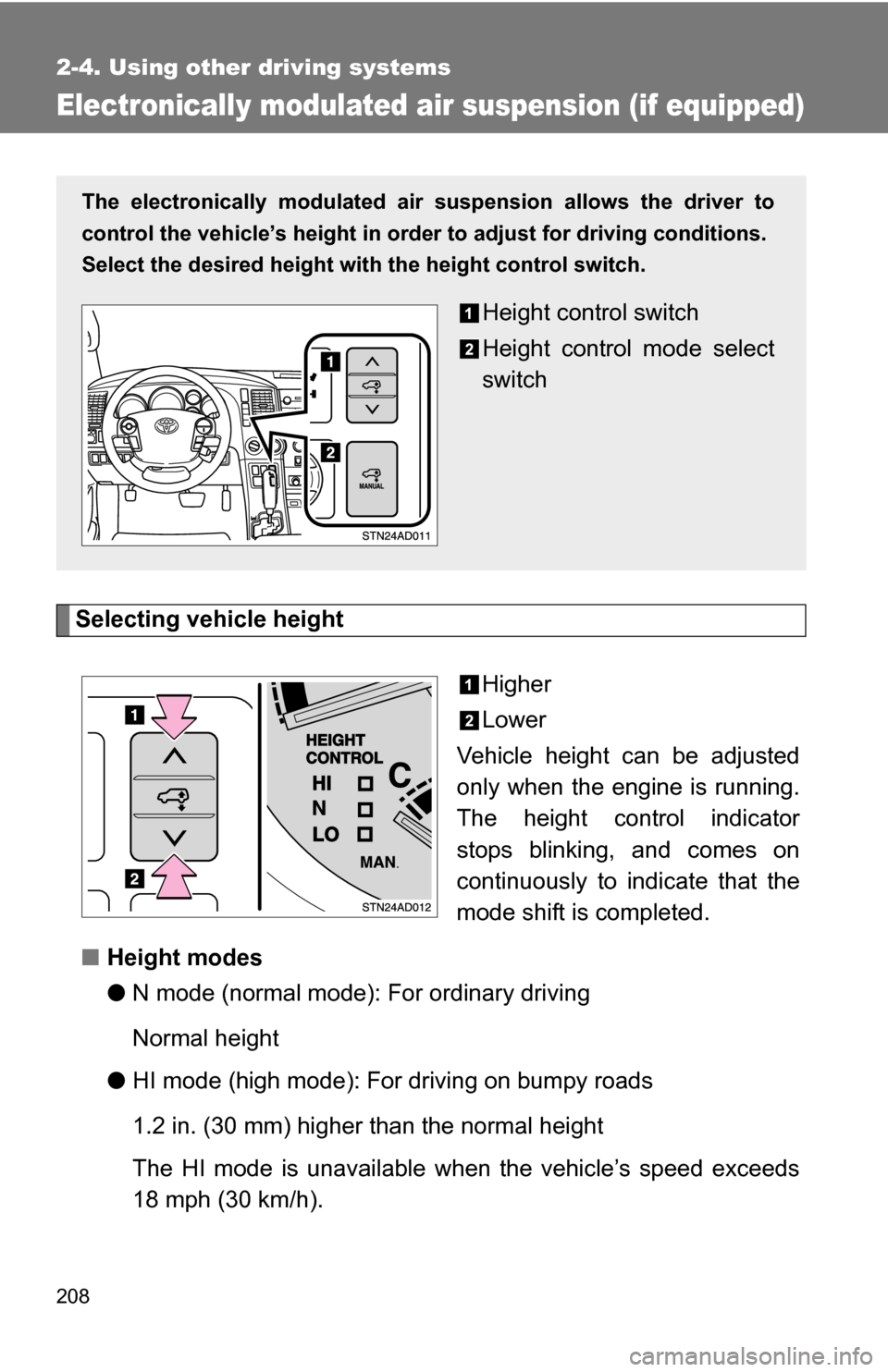
Selecting vehicle heightHigher
Lower
Vehicle height can be adjusted
only when the engine is running.
The height control indicator
stops blinking, and comes on
continuously to indicate that the
mode shift is completed.
■ Height modes
●N mode (normal mode): For ordinary driving
Normal height
● HI mode (high mode): For driving on bumpy roads
1.2 in. (30 mm) higher than the normal height
The HI mode is unavailable w hen the vehicle’s speed exceeds
18 mph (30 km/h).
The electronically modulated air suspension allows the driver to
control the vehicle’s height in orde r to adjust for driving conditions.
Select the desired height with the height control switch.
Height control switch
Height control mode select
switch
Page 210 of 612
210 2-4. Using other driving systems
■Automatic leveling function
Regardless of the number of occupants or the luggage load, vehicle height
in any mode is always adjusted to a fixed height by the automatic leveling
function.
■ When HI mode is selected
The vehicle height will change to N mode when driving at the speeds of 1\
8
mph (30 km/h).
■ When LO mode is selected
●The vehicle height will change to N mode when vehicle speed exceeds 7
mph (12 km/h).
● This mode allows for easy access to the vehicle (getting in and out) and
easy loading and unloading.
■ The electronically modulated air susp ension will not operate in the fol-
lowing cases:
● The underbody of the vehicle is touching the surface of the road.
● The area around the suspension is covered with ice.
The height control indicators will blink, turn off and then turn on continuously
to indicate that the electronically modulated air suspension is not opera-
tional.
To re-enable operation, turn off the engine and then restart it.
■ Even if you hear an operating noise
This does not indicate a problem in the electronically modulated air suspen-
sion.
■ If there is a problem somewhere in the electronically modulated air
suspension
The height control MAN. indicator will behave as follows:
●The indicator will not come on when the engine switch is turned on.
● The indicator will blink.
Although the vehicle may be driven, have the vehicle inspected by your Toy-
ota dealer.
Page 211 of 612
211
2-4. Using other
driving systems
2
When driving
CAUTION
■The electronically modulated air susp ension must be turned off in the
following circumstances:
Otherwise, the automatic leveling function may cause the vehicle’s height to
change, resulting in an unexpected accident.
● When driving through water such as shallow streams (Put the vehicle
height in HI mode and turn off the electronically modulated air suspension.
Drive at 18 mph [30 km/h] or slower.)
● When jacking up the vehicle, installing tire chains or tying the vehicle with
chains/wires for transportation via flat bed truck (Turn the system to the
manual mode and stop the engine.)
● When the vehicle must be towed (Put the vehicle height in N mode and
turn the system to the manual mode.)
● When the vehicle gets stuck (Turn the system to the manual mode.)
● When disconnecting a trailer (Put the vehicle height in LO mode and turn
the system to the manual mode.)
■ Selecting the correct height mode
Observe the following precautions to prevent accidents.
Failure to do so may cause damage to parts of the vehicle, as well as dan-
gerous handling characteristics, which may lead to fatal or injury accidents.
●Before you lower the vehicle’s height, check under the vehicle to make
sure that no one is there.
● The HI mode should be used for off-road driving conditions.
As the vehicle’s center of gravity is higher in this setting, the vehicle may
become unstable when turning abruptly.
● Do not select HI mode when you load cargo on the roof luggage carrier.
This may result in a loss of control or vehicle rollover.
Page 252 of 612
252 2-5. Driving information
■Before towing
Check that the following conditions are met:
●Ensure that your vehicle’s tires are properly inflated. ( P. 567)
● Trailer tires should be inflated according to the trailer manufacturer’s rec-
ommendation.
● All trailer lights work to be legal.
● All lights work each time you connect them.
● The trailer ball is set up at the proper height for the coupler on the t\
railer.
● The vehicle remains level when a loaded or unloaded trailer is hitched.
Do not drive if the vehicle is not level, and check for improper tongue
load, overloading, worn suspension, or other possible causes.
● The trailer cargo is securely loaded.
● The rear view mirrors conform to all applicable federal, state/provincial or
local regulations. If they do not, install rear view mirrors appropriate for
towing purposes.
● Depress TOW/HAUL button (if equipped)
■ When connecting and disconnecting a trailer
Set the electronically modulated air suspension system to MAN., or turn off
the engine, when the system is in N mode. (if equipped)
■ AVS (adaptive variable suspension system) (if equipped)
The suspension can be switched for improvement in driveability. ( P. 213)
■ Break-in schedule
If your vehicle is new or equipped with any new power train components
(such as an engine, transmission, differential and wheel bearing), Toyota
recommends that you do not tow a trailer until it has been driven for over 500
miles (800 km).
However, avoid full throttle acceleration.
■ Maintenance
●If you tow a trailer, your vehicle will require more frequent maintenance
due to the additional load. (See “Scheduled Maintenance Guide” or
“Owner’s Manual Supplement”.)
● Retighten the fixing bolts of the towing ball and bracket after approxi-
mately 600 miles (1000 km).
Page 513 of 612
5
When trouble arises
513
5-1. Essential information
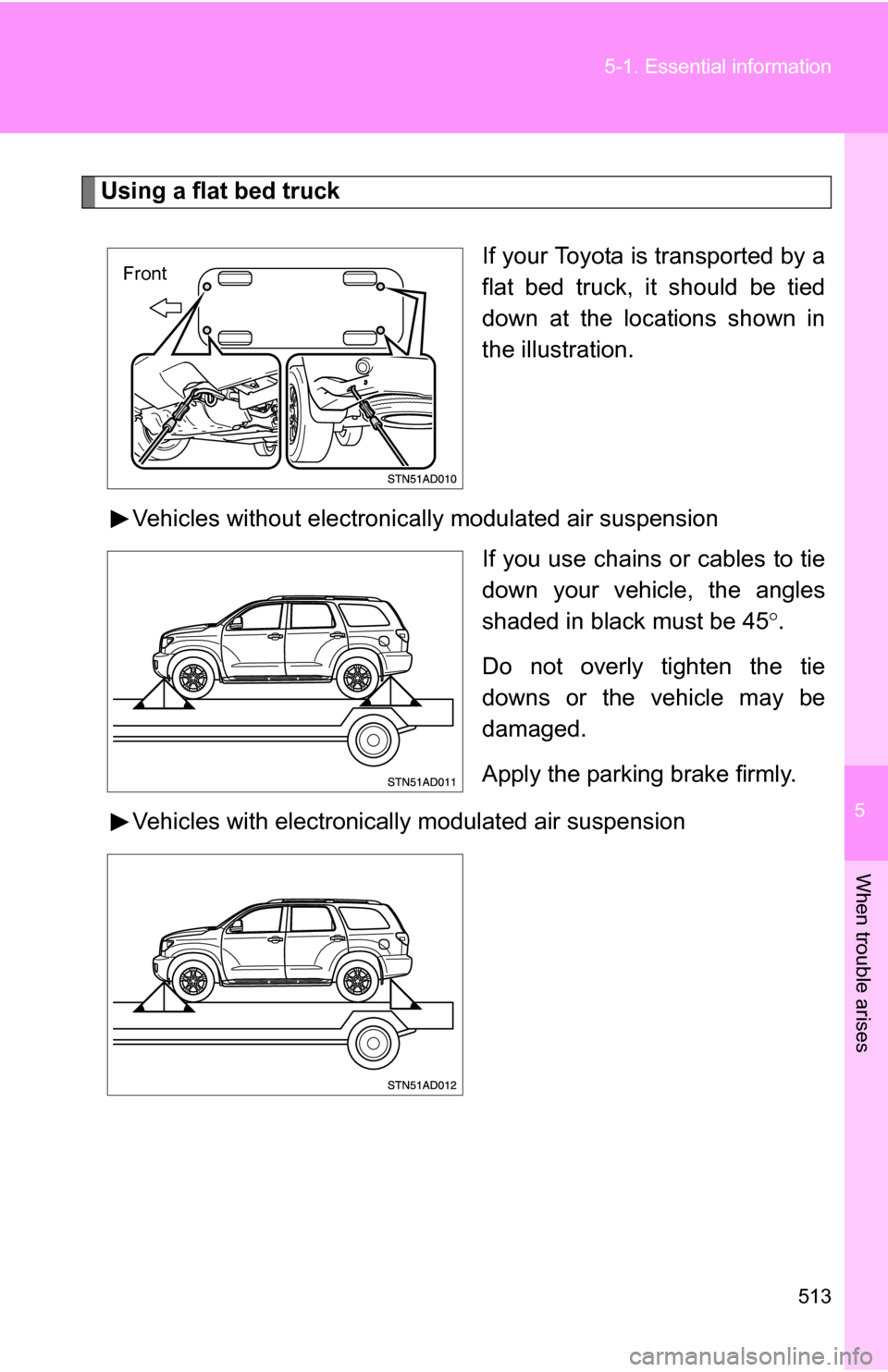
Using a flat bed truck
If your Toyota is transported by a
flat bed truck, it should be tied
down at the locations shown in
the illustration.
Vehicles without electronica lly modulated air suspension
If you use chains or cables to tie
down your vehicle, the angles
shaded in black must be 45 .
Do not overly tighten the tie
downs or the vehicle may be
damaged.
Apply the parking brake firmly.
Vehicles with electronically modulated air suspension
Front
Page 514 of 612
514
5-1. Essential information
If you think something is wrong
If you notice any of the following symptoms, your vehicle probably
needs adjustment or repair. Contact your Toyota dealer as soon as
possible.
■ Visible symptoms
●Fluid leaks under the vehicle
(Water dripping from the air cond itioning after use is normal.)
● Flat-looking tires or uneven tire wear
● Engine coolant temperature g auge needle continually points
higher or lower than normal
● Voltmeter continually points higher or lower than normal
● Engine oil pressure gauge continually points higher or lower
than normal
● Automatic transmission fluid temperature gauge needle con-
tinually points higher or lower than normal (if equipped)
■ Audible symptoms
●Changes in exhaust sound
● Excessive tire squeal when cornering
● Strange noises related to the suspension system
● Pinging or other noises related to the engine
■ Operational symptoms
●Engine missing, stumbling or running rough
● Appreciable loss of power
● Vehicle pulls heavily to one side when braking
● Vehicle pulls heavily to one side when driving on a level road
● Loss of brake effectiveness, s pongy feeling, pedal almost
touches the floor