brakes TOYOTA SEQUOIA 2020 (in English) Owner's Manual
[x] Cancel search | Manufacturer: TOYOTA, Model Year: 2020, Model line: SEQUOIA, Model: TOYOTA SEQUOIA 2020Pages: 588, PDF Size: 12.33 MB
Page 332 of 588

3324-6. Driving tips
SEQUOIA_OM_USA_OM0C021U_20MY
WARNING
■Off-road driving precautions
Always observe the following precautions to minimize the risk o f death, seri-
ous injury or damage to your vehicle:
● Drive carefully when off the road. Do not take unnecessary risk s by driving
in dangerous places.
● Do not grip the steering wheel spokes when driving off-road. A bad bump
could jerk the wheel and injure your hands. Keep both hands and espe-
cially your thumbs on the outside of the rim.
● Always check your brakes for effectiveness immediately after driving in
sand, mud, water or snow.
● After driving through tall grass, mud, rock, sand, rivers, etc. , check that
there is no grass, bush, paper, rags, stone, sand, etc. adherin g or trapped
on the underbody. Clear off any such matter from the underbody. If the
vehicle is used with these materials trapped or adhering to the underbody,
a breakdown or fire could occur.
● In a rollover crash, an unbelted person is significantly more l ikely to die
than a person wearing a seat belt. Therefore, the driver and al l passengers
should fasten their seat belts whenever the vehicle is moving.
● When driving off-road or in rugged terrain, do not drive at excessive
speeds, jump, make sharp turns, strike objects, etc. This may c ause loss
of control or vehicle rollover causing death or serious injury. You are also
risking expensive damage to your vehicle’s suspension and chass is.
Page 335 of 588
3354-6. Driving tips
4
Driving
SEQUOIA_OM_USA_OM0C021U_20MY
Perform the following according to the driving conditions:
● Do not try to forcibly open a window or move a wiper that is fr ozen.
Pour warm water over the frozen area to melt the ice. Wipe away
the water immediately to prevent it from freezing.
● To ensure proper operation of the climate control system fan,
remove any snow that has accumulated on the air inlet vents in
front of the windshield.
● Check for and remove any excess ic e or snow that may have accu-
mulated on the exterior lights, vehicle’s roof, chassis, around the
tires or on the brakes.
● Remove any snow or mud from the bottom of your shoes before
getting in the vehicle.
Accelerate the vehicle slowly, keep a safe distance between you and
the vehicle ahead, and drive at a reduced speed suitable to roa d con-
ditions.
● Park the vehicle and move the shift lever to P without setting the
parking brake. The parking brake may freeze up, preventing it from
being released. If the vehicle is parked without setting the pa rking
brake, make sure t o block the wheels.
Failure to do so may be dangerou s because it may cause the vehi-
cle to move unexpectedly, pos sibly leading to an accident.
● If the vehicle is parked without setting the parking brake, confirm
that the shift lever c annot be moved out of P
*.
*: The shift lever will be locked if it is attempted to be shifte d from P to any
other position without depressing the brake pedal. If the shift lever can be
shifted from P, there may be a problem with the shift lock syst em. Have the
vehicle inspected by your Toyota dealer immediately.
Before driving the vehicle
When driving the vehicle
When parking the vehicle
Page 407 of 588
4076-2. Maintenance
6
Maintenance and care
SEQUOIA_OM_USA_OM0C021U_20MY
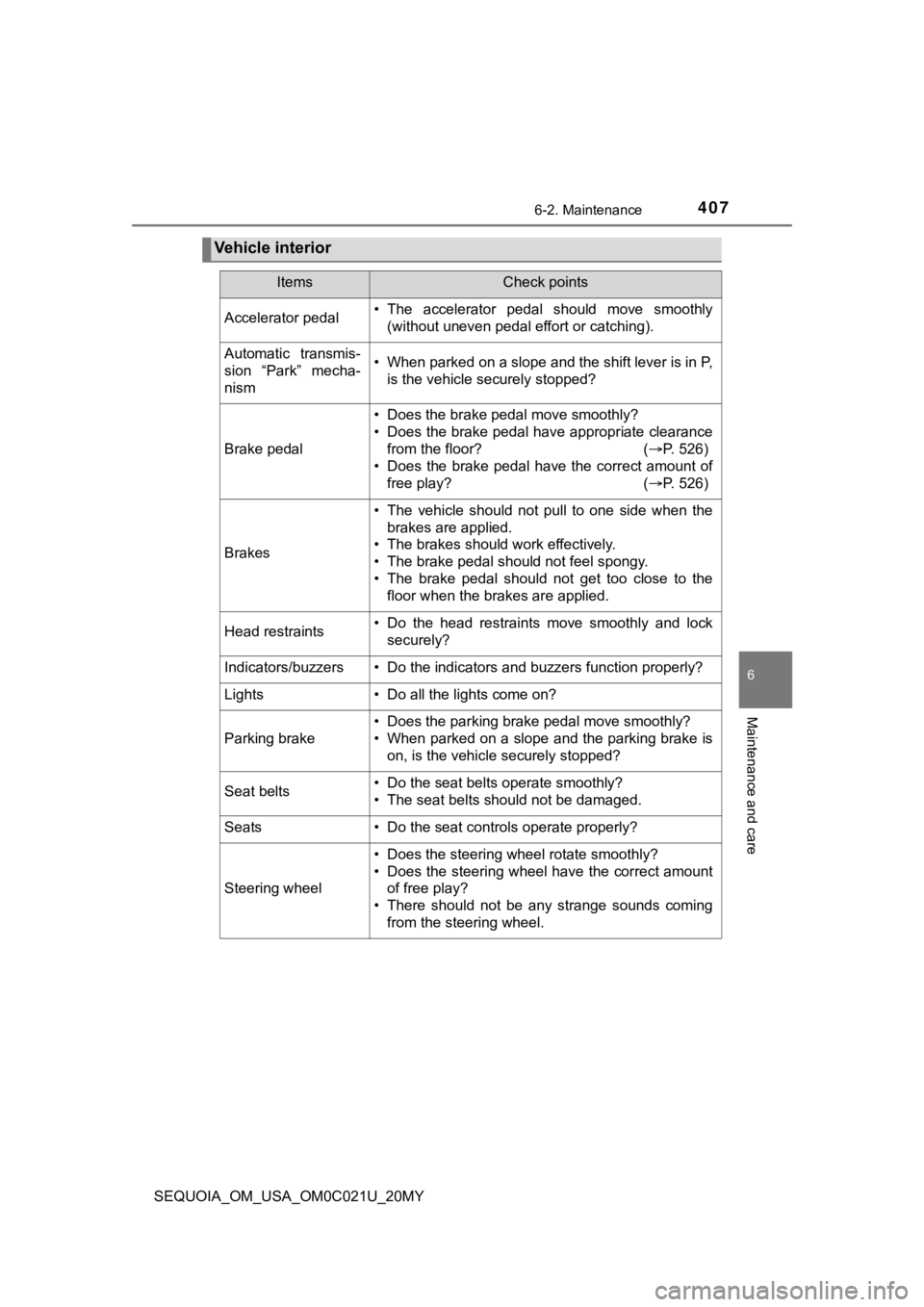
Vehicle interior
ItemsCheck points
Accelerator pedal• The accelerator pedal should move smoothly(without uneven pedal effort or catching).
Automatic transmis-
sion “Park” mecha-
nism• When parked on a slope and the shift lever is in P,is the vehicle securely stopped?
Brake pedal
• Does the brake pedal move smoothly?
• Does the brake pedal have appropriate clearancefrom the floor? ( P. 526)
• Does the brake pedal have the correct amount of
free play? ( P. 526)
Brakes
• The vehicle should not pull to one side when the
brakes are applied.
• The brakes should work effectively.
• The brake pedal should not feel spongy.
• The brake pedal should not get too close to the floor when the brakes are applied.
Head restraints• Do the head restraints move smoothly and locksecurely?
Indicators/buzzers• Do the indicators and buzzers function properly?
Lights • Do all the lights come on?
Parking brake
• Does the parking brake pedal move smoothly?
• When parked on a slope and the parking brake is
on, is the vehicle securely stopped?
Seat belts• Do the seat belts operate smoothly?
• The seat belts should not be damaged.
Seats• Do the seat controls operate properly?
Steering wheel
• Does the steering wheel rotate smoothly?
• Does the steering wheel have the correct amountof free play?
• There should not be any strange sounds coming
from the steering wheel.
Page 460 of 588
4607-1. Essential information
SEQUOIA_OM_USA_OM0C021U_20MY
WARNING
■If the engine has to be tu rned off while driving
Power assist for the brakes and steering wheel will be lost, making the
brake pedal harder to depress and the steering wheel heavier to turn.
Decelerate as much as possible before turning off the engine.
Page 464 of 588
4647-2. Steps to take in an emergency
SEQUOIA_OM_USA_OM0C021U_20MY
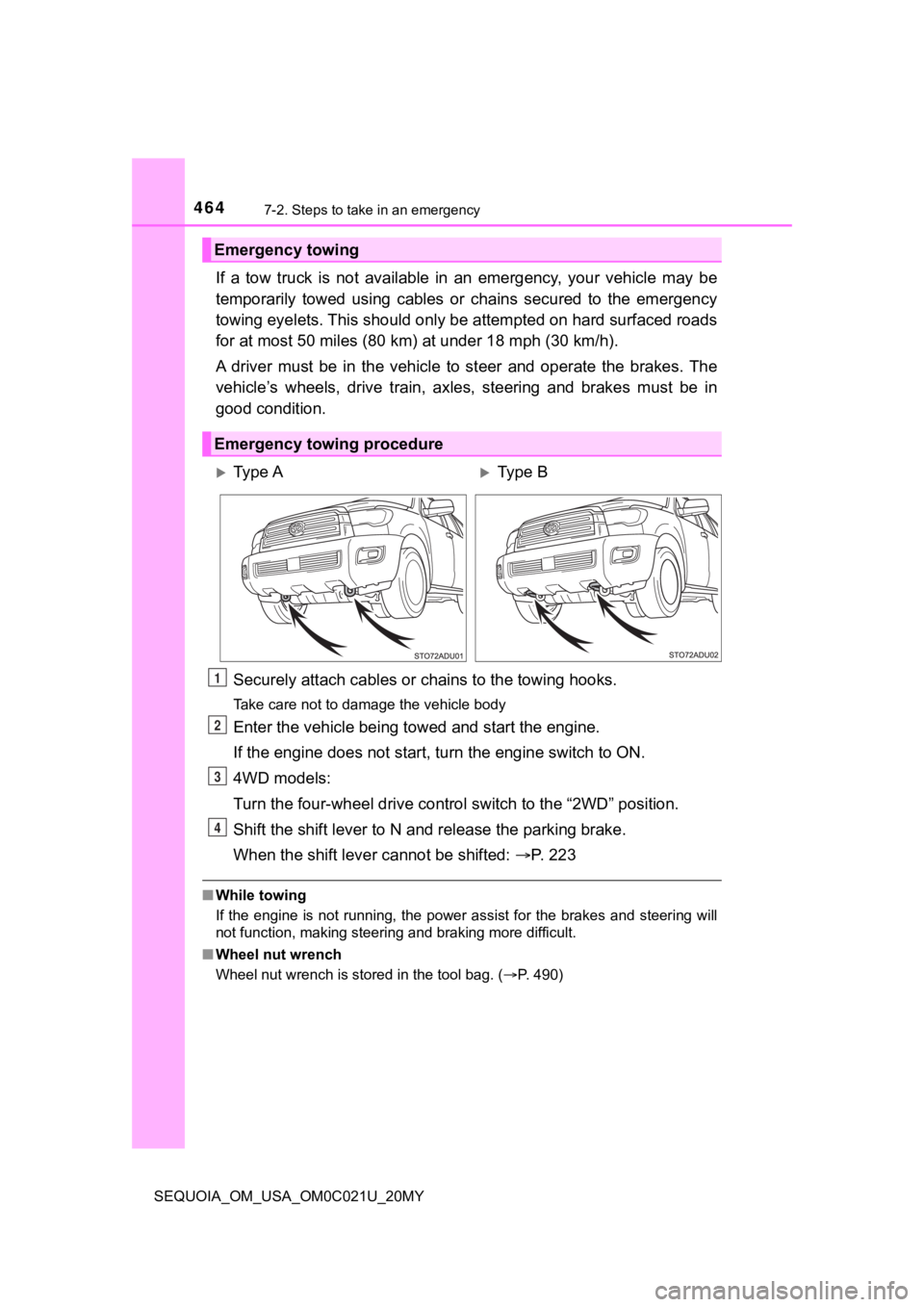
If a tow truck is not available in an emergency, your vehicle may be
temporarily towed using cables or chains secured to the emergen cy
towing eyelets. This should only be attempted on hard surfaced roads
for at most 50 miles (80 km) at under 18 mph (30 km/h).
A driver must be in the vehicle to steer and operate the brakes . The
vehicle’s wheels, drive train, a xles, steering and brakes must be in
good condition.
Securely attach cables or chains to the towing hooks.
Take care not to damage the vehicle body
Enter the vehicle being towed and start the engine.
If the engine does not start, turn the engine switch to ON.
4WD models:
Turn the four-wheel drive control switch to the “2WD” position.
Shift the shift lever to N and release the parking brake.
When the shift lever cannot be shifted: P. 2 2 3
■While towing
If the engine is not running, the power assist for the brakes a nd steering will
not function, making steering and braking more difficult.
■ Wheel nut wrench
Wheel nut wrench is stored in the tool bag. ( P. 490)
Emergency towing
Emergency towing procedure
Ty p e AType B
1
2
3
4
Page 474 of 588
4747-2. Steps to take in an emergency
SEQUOIA_OM_USA_OM0C021U_20MY
WARNING
■If both the ABS and the brake system warning lights remain on
Stop your vehicle in a safe place immediately and contact your To y o t a
dealer. The vehicle will become extremely unstable during braki ng, and
the ABS system may fail, which could cause an accident resultin g in
death or serious injury.
■When the power steering system warning light comes on
The steering wheel may become extremely heavy.
If the steering wheel becomes heavier than usual when operating , hold
firmly and operate using more force than usual.
■If the tire pressure warning light comes on
Be sure to observe the following precautions. Failure to do so could
cause a loss of vehicle control and result in death or serious injury.
●Stop your vehicle in a safe place as soon as possible. Adjust t he tire
inflation pressure immediately.
●If the tire pressure warning light comes on even after tire inf lation pres-
sure adjustment, it is probable that you have a flat tire. Chec k the tires.
If a tire is flat, change it with the spare tire and have the f lat tire
repaired by the nearest Toyota dealer.
●Avoid abrupt maneuvering and braking. If the vehicle tires dete riorate,
you could lose control of the steering wheel or the brakes.
■If a blowout or sudden air leakage should occur
The tire pressure warning system may not activate immediately.
Page 477 of 588
4777-2. Steps to take in an emergency
SEQUOIA_OM_USA_OM0C021U_20MY
7
When trouble arises
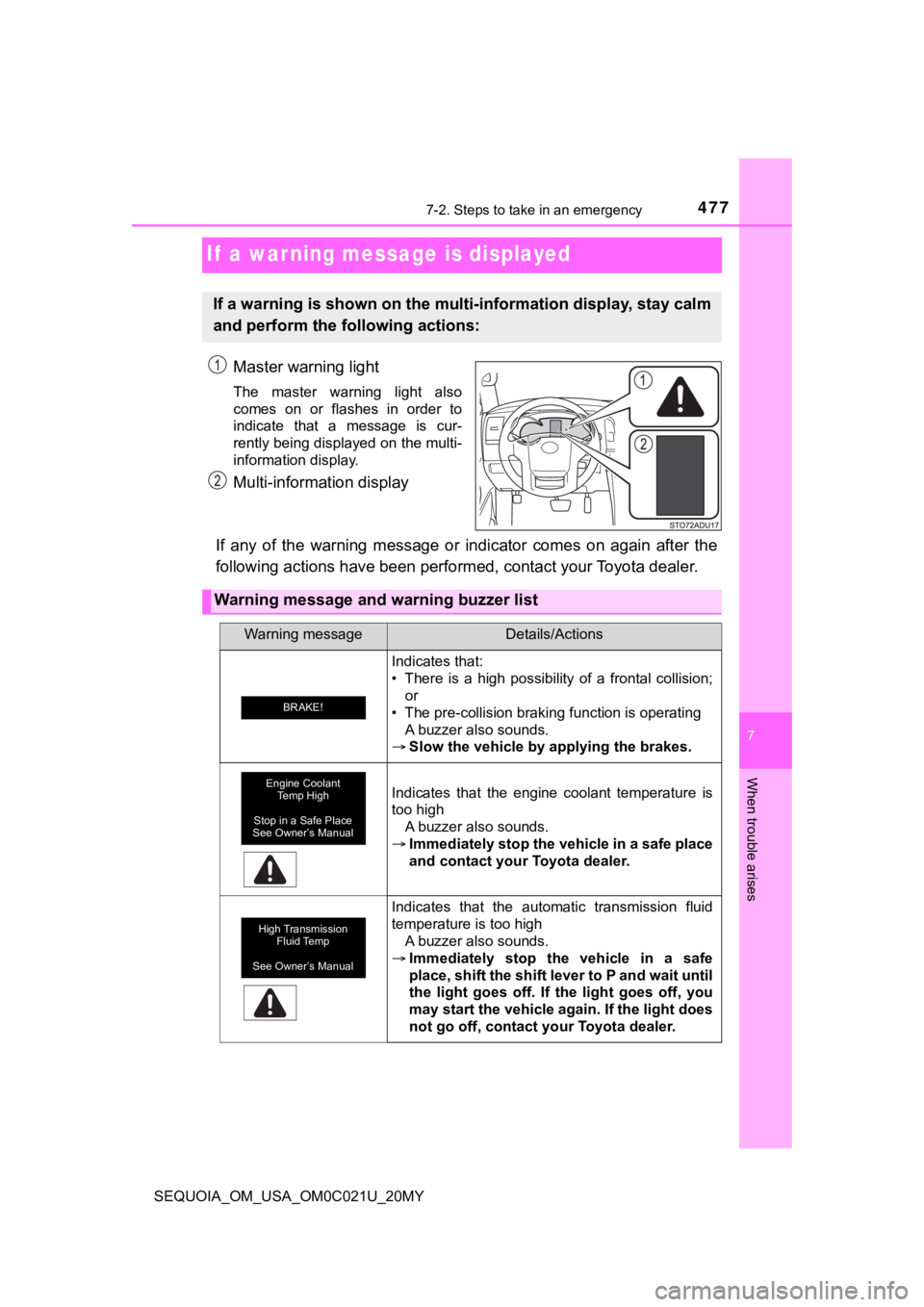
If a warning message is displayed
Master warning light
The master warning light also
comes on or flashes in order to
indicate that a message is cur-
rently being displayed on the multi-
information display.
Multi-information display
If any of the warning message or indicator comes on again after the
following actions have been per formed, contact your Toyota deal er.
If a warning is shown on the multi-information display, stay ca lm
and perform the following actions:
Warning message and warning buzzer list
Warning messageDetails/Actions
Indicates that:
• There is a high possibility of a frontal collision; or
• The pre-collision braking function is operating
A buzzer also sounds.
Slow the vehicle by applying the brakes.
Indicates that the engine coolant temperature is
too high
A buzzer also sounds.
Immediately stop the vehicle in a safe place
and contact your Toyota dealer.
Indicates that the automatic transmission fluid
temperature is too high
A buzzer also sounds.
Immediately stop the vehicle in a safe
place, shift the shift lever to P and wait until
the light goes off. If the light goes off, you
may start the vehicle again. If the light does
not go off, contact your Toyota dealer.
BRAKE!
Engine Coolant
Temp High
Stop in a Safe Place
See Owner’s Manual
High Transmission Fluid Temp
See Owner’s Manual
Page 496 of 588
4967-2. Steps to take in an emergency
SEQUOIA_OM_USA_OM0C021U_20MY
WARNING
■Replacing a flat tire
●Observe the following precautions.
Failure to do so may result in serious injury:
• Lower the spare tire completely to the ground before removing it
from under the vehicle.
• Do not try to remove the wheel ornament by hand. Take due care in
handling the ornament to avoi d unexpected personal injury.
• Do not attach a heavily damaged wheel ornament, as it may fly off
the wheel while the vehicle is moving.
• Do not touch the disc wheels or the area around the brakes imm edi-
ately after the vehi cle has been driven.
After the vehicle has been driven the disc wheels and the area
around the brakes will be extreme ly hot. Touching these areas with
hands, feet or other body parts while changing a tire, etc. may result
in burns.
●Failure to follow these precautions could cause the wheel nuts to
loosen and the t ire to fall off, resulting in death or serious injury.
• Have the wheel nuts tightened with a torque wrench as soon as pos-
sible after changing wheels.
Steel wheel: 154 ft·lbf (209 N·m, 21.3 kgf·m)
Aluminum wheel: 97 ft·lbf (131 N·m, 13.4 kgf·m)
• When installing a tire, only use wheel nuts that have been spe cifi-
cally designed for that wheel.
• If there are any cracks or deformations in the bolt screws, nu t
threads or bolt holes of the wheel, have the vehicle inspected by
your Toyota dealer.
• When installing the wheel nuts, b e sure to install them with the
tapered ends facing inward. ( P. 440)
Page 526 of 588
5268-1. Specifications
SEQUOIA_OM_USA_OM0C021U_20MY
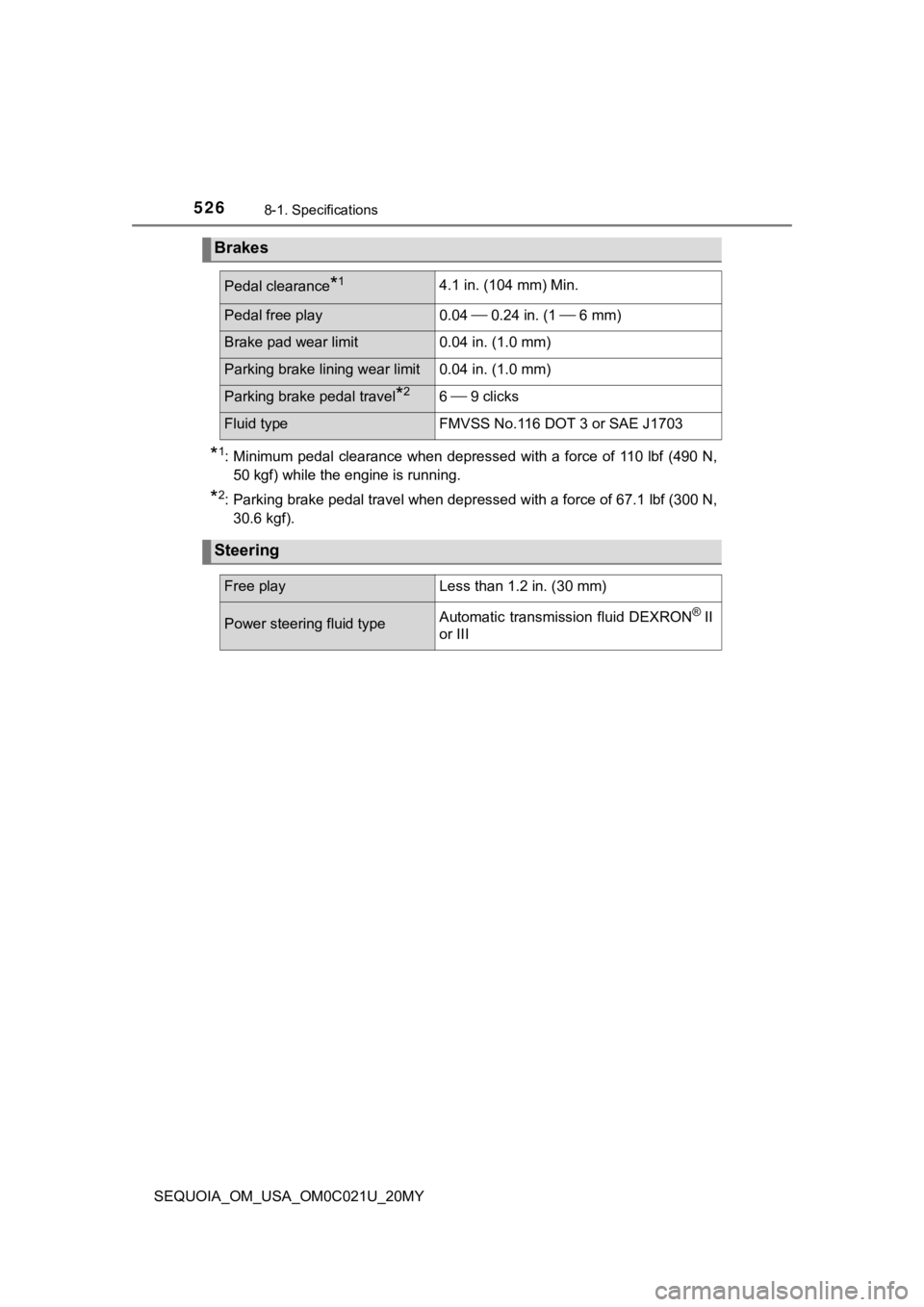
*1: Minimum pedal clearance when depressed with a force of 110 lbf (490 N,
50 kgf) while the engine is running.
*2: Parking brake pedal travel when depressed with a force of 67.1 lbf (300 N,
30.6 kgf).
Brakes
Pedal clearance*14.1 in. (104 mm) Min.
Pedal free play0.04 0.24 in. (1 6 mm)
Brake pad wear limit0.04 in. (1.0 mm)
Parking brake lining wear limit0.04 in. (1.0 mm)
Parking brake pedal travel*26 9 clicks
Fluid typeFMVSS No.116 DOT 3 or SAE J1703
Steering
Free playLess than 1.2 in. (30 mm)
Power steering fluid typeAutomatic transmission fluid DEXRON® II
or III
Page 538 of 588
5388-1. Specifications
SEQUOIA_OM_USA_OM0C021U_20MY
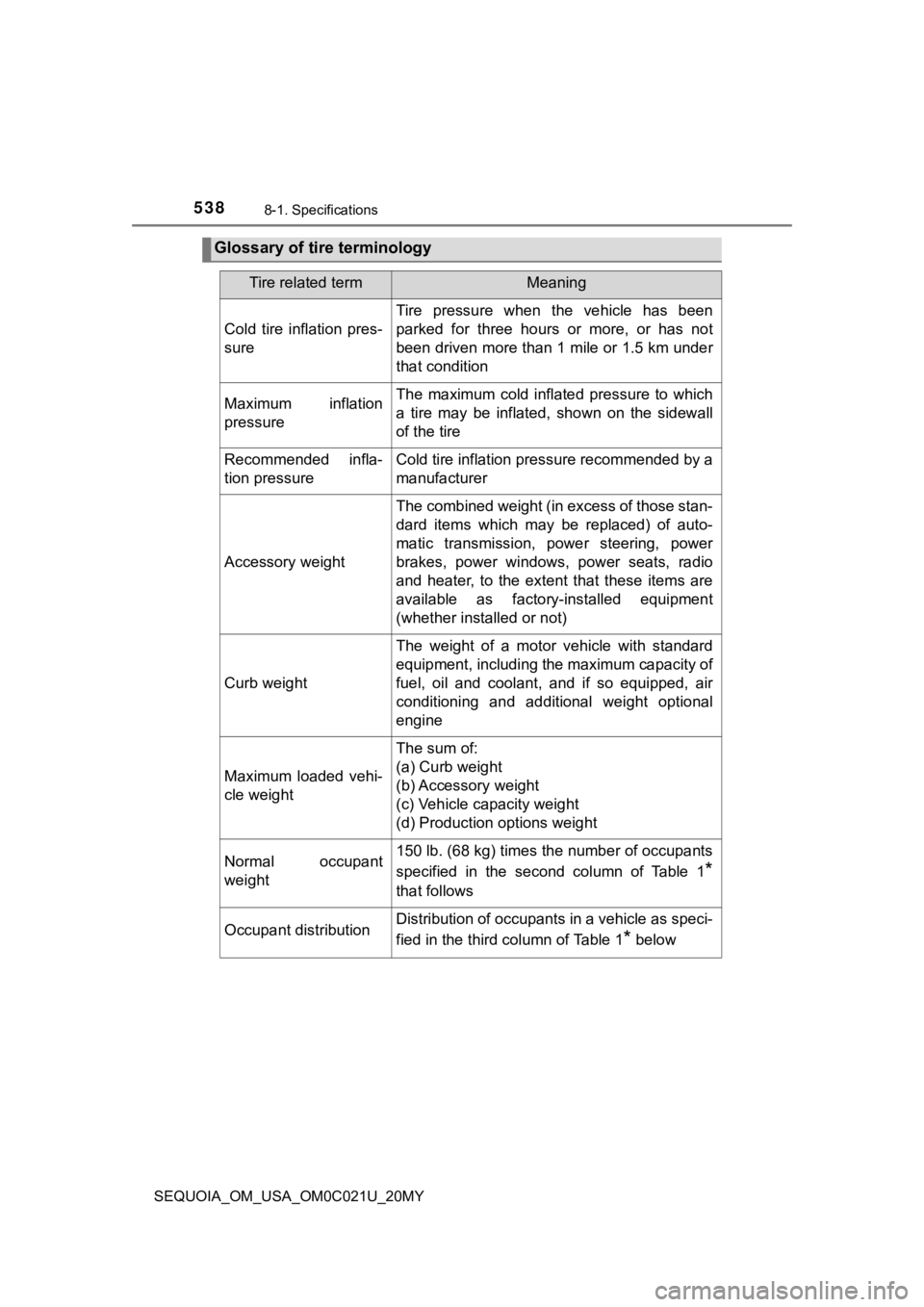
Glossary of tire terminology
Tire related termMeaning
Cold tire inflation pres-
sure
Tire pressure when the vehicle has been
parked for three hours or more, or has not
been driven more than 1 mile or 1.5 km under
that condition
Maximum inflation
pressureThe maximum cold inflated pressure to which
a tire may be inflated, shown on the sidewall
of the tire
Recommended infla-
tion pressureCold tire inflation pressure recommended by a
manufacturer
Accessory weight
The combined weight (in excess of those stan-
dard items which may be replaced) of auto-
matic transmission, power steering, power
brakes, power windows, power seats, radio
and heater, to the extent that these items are
available as factory-installed equipment
(whether installed or not)
Curb weight
The weight of a motor vehicle with standard
equipment, including the maximum capacity of
fuel, oil and coolant, and if so equipped, air
conditioning and additional weight optional
engine
Maximum loaded vehi-
cle weight
The sum of:
(a) Curb weight
(b) Accessory weight
(c) Vehicle capacity weight
(d) Production options weight
Normal occupant
weight150 lb. (68 kg) times the number of occupants
specified in the second column of Table 1
*
that follows
Occupant distributionDistribution of occupants in a vehicle as speci-
fied in the third column of Table 1
* below