weight TOYOTA SEQUOIA HYBRID 2023 Owner's Manual
[x] Cancel search | Manufacturer: TOYOTA, Model Year: 2023, Model line: SEQUOIA HYBRID, Model: TOYOTA SEQUOIA HYBRID 2023Pages: 628, PDF Size: 14.27 MB
Page 362 of 628
3624-5. Using the driving support systems
Owners Manual_USA_M0C043_enDisplays the vehicle’s estimate
d degree of incline or indicates a tire slip-
page. ( P.357, 358)
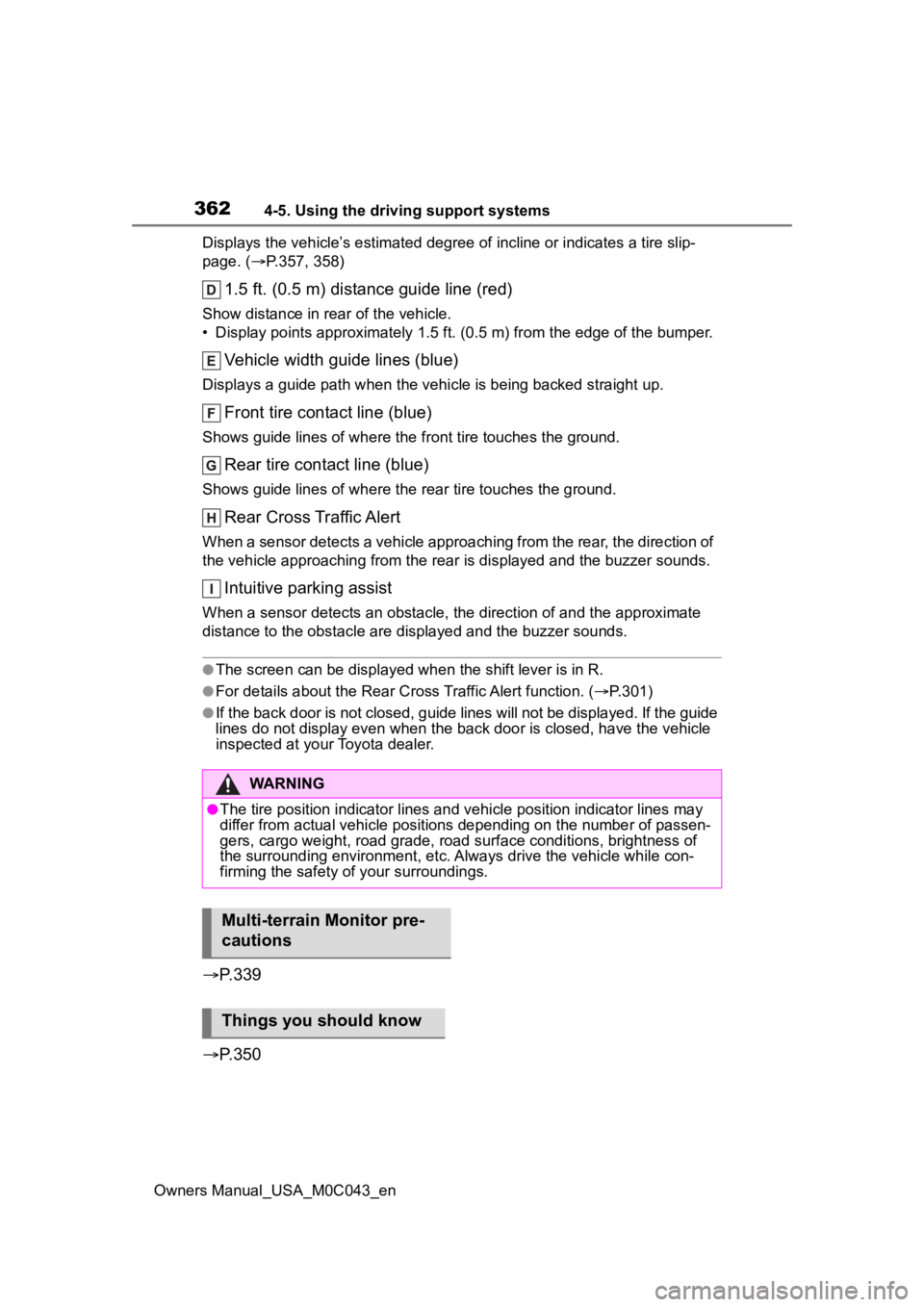
1.5 ft. (0.5 m) distance guide line (red)
Show distance in rear of the vehicle.
• Display points approximately 1.5 ft. (0.5 m) fr om the edge of the bumper.
Vehicle width guide lines (blue)
Displays a guide path w hen the vehicle is being backed straight up.
Front tire contact line (blue)
Shows guide lines of where the front tire touches the ground.
Rear tire contact line (blue)
Shows guide lines of where the rear tire touches the ground.
Rear Cross Traffic Alert
When a sensor detects a vehicle approaching from the rear, the direction of
the vehicle approaching from the r ear is displayed and the buzzer sounds.
Intuitive parking assist
When a sensor detects an obstacle, the direction of and the app roximate
distance to the obsta cle are displayed and the buzzer sounds.
●The screen can be displayed when the shift lever is in R.
●For details about the Rear C ross Traffic Alert function. (P.301)
●If the back door is not closed, guide lines will not be display ed. If the guide
lines do not display e ven when the back door is closed, have th e vehicle
inspected at you r Toyota dealer.
P.339
P.350
WARNING
●The tire position indicator lines and vehicle pos ition indicator lines may
differ from actual vehicle positions depending on the number of passen-
gers, cargo weight, road grade, r oad surface conditions, brightness of
the surrounding environment, etc. Always drive the vehicle whil e con-
firming the safety of your surroundings.
Multi-terrain Monitor pre-
cautions
Things you should know
Page 474 of 628
4746-3. Do-it-yourself maintenance
Owners Manual_USA_M0C043_en
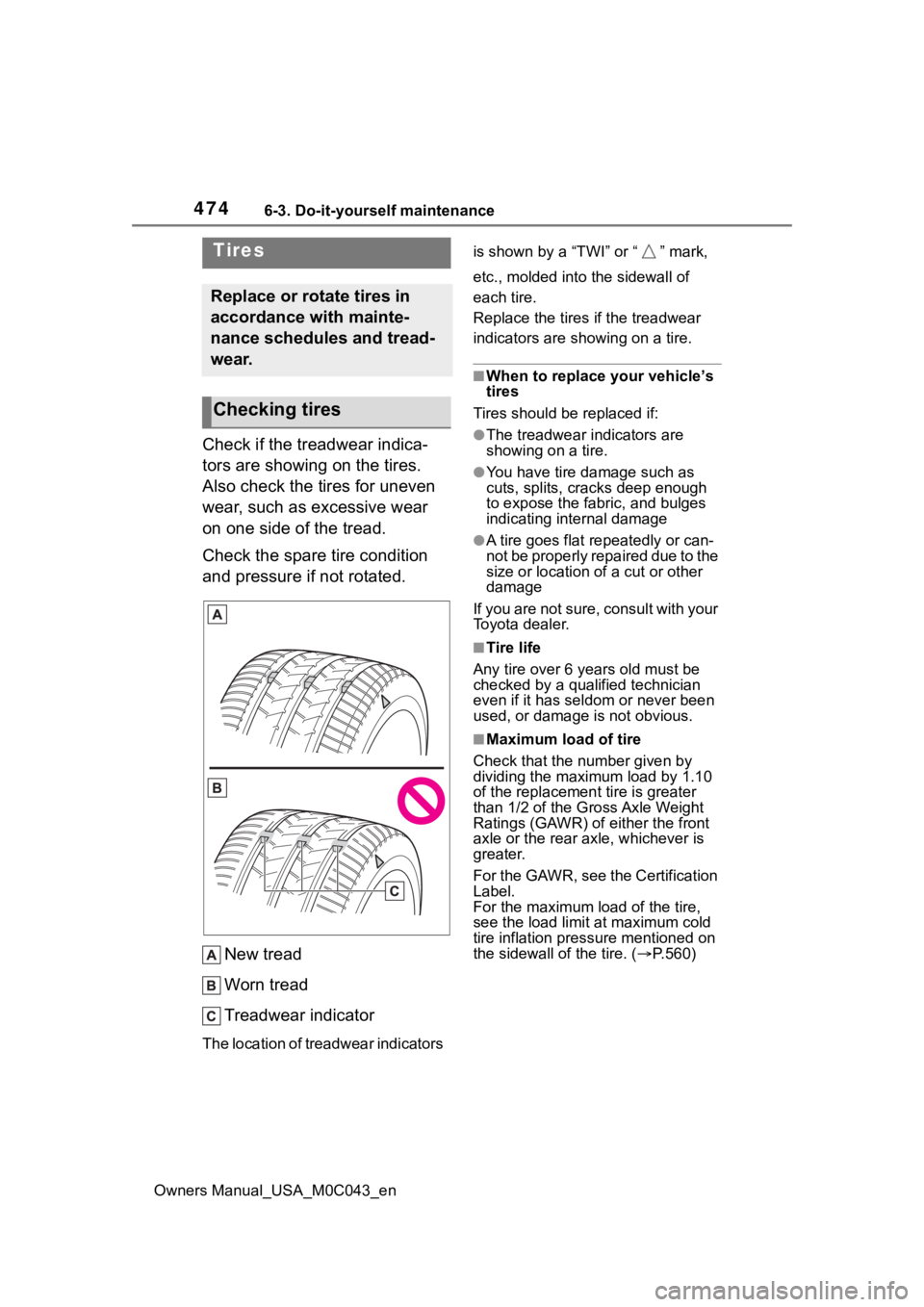
Check if the treadwear indica-
tors are showing on the tires.
Also check the tires for uneven
wear, such as excessive wear
on one side of the tread.
Check the spare tire condition
and pressure if not rotated.
New tread
Worn tread
Treadwear indicator
The location of treadwear indicators is shown by a “TWI” or “ ” mark,
etc., molded into the sidewall of
each tire.
Replace the tires if the treadwear
indicators are s
howing on a tire.
■When to replace your vehicle’s
tires
Tires should be replaced if:
●The treadwear indicators are
showing on a tire.
●You have tire damage such as
cuts, splits, cracks deep enough
to expose the fabric, and bulges
indicating internal damage
●A tire goes flat repeatedly or can-
not be properly repaired due to the
size or location of a cut or other
damage
If you are not sure, consult with your
Toyota dealer.
■Tire life
Any tire over 6 years old must be
checked by a qualified technician
even if it has seldom or never been
used, or damage is not obvious.
■Maximum load of tire
Check that the n umber given by
dividing the maximum load by 1.10
of the replacement tire is greater
than 1/2 of the Gross Axle Weight
Ratings (GAWR) of either the front
axle or the rear axle, whichever is
greater.
For the GAWR, see the Certification
Label.
For the maximum load of the tire,
see the load limit at maximum cold
tire inflation pressure mentioned on
the sidewall of the tire. ( P.560)
Tires
Replace or rotate tires in
accordance with mainte-
nance schedules and tread-
wear.
Checking tires
Page 485 of 628
4856-3. Do-it-yourself maintenance
Owners Manual_USA_M0C043_en
6
Maintenance and care
■Instructions for checking tire
inflation pressure
When checking tire inflation pres-
sure, observe the following:
●Check only when the tires are
cold.
If your vehicle has been parked for
at least 3 hours or has not been
driven for more tha n 1 mile or 1.5
km, you will get an accurate cold
tire inflation pressure reading.
●Always use a tire pressure gauge.
It is difficult to judge if a tire is
properly inflated based only on its
appearance.
●It is normal for the tire inflation
pressure to be higher after driving
as heat is generated in the tire. Do
not reduce tire inflation pressure
after driving.
●Never exceed the vehicle capacity
weight.
Passengers and luggage weight
should be placed so that the vehi-
cle is balanced.
WARNING
■Proper inflation is critical to
save tire performance
Keep your tires properly inflated.
If the tires are not properly
inflated, the following conditions
may occur which could lead to an
accident resulting in death or seri-
ous injury:
●Excessive wear
●Uneven wear
●Poor handling
●Possibility of blowouts resulting
from overheated tires
●Air leaking from between tire
and wheel
●Wheel deformation and/or tire
damage
●Greater possibi lity of tire dam-
age while driving (due to road
hazards, expansion joints,
sharp edges in the road, etc.)
NOTICE
■When inspecting and adjust-
ing tire inflation pressure
Be sure to put the tire valve caps
back on.
If a valve cap is no t installed, dirt
or moisture may get into the valve
and cause an air leak, resulting in
decreased tire inflation pressure.
Page 487 of 628
4876-3. Do-it-yourself maintenance
Owners Manual_USA_M0C043_en
6
Maintenance and care
Use only Toyota wheel nuts
and wheel nut wrenches
designed for use with your
aluminum wheels.
When rotating, repairing or
changing your tires, check
that the wheel nuts are still
tight after driving 1000 miles
(1600 km).
Be careful not to damage the
aluminum wheels when using
tire chains.
Use only Toyota genuine bal-
ance weights or equivalent
and a plastic or rubber ham-
mer when balancing your
wheels. 1
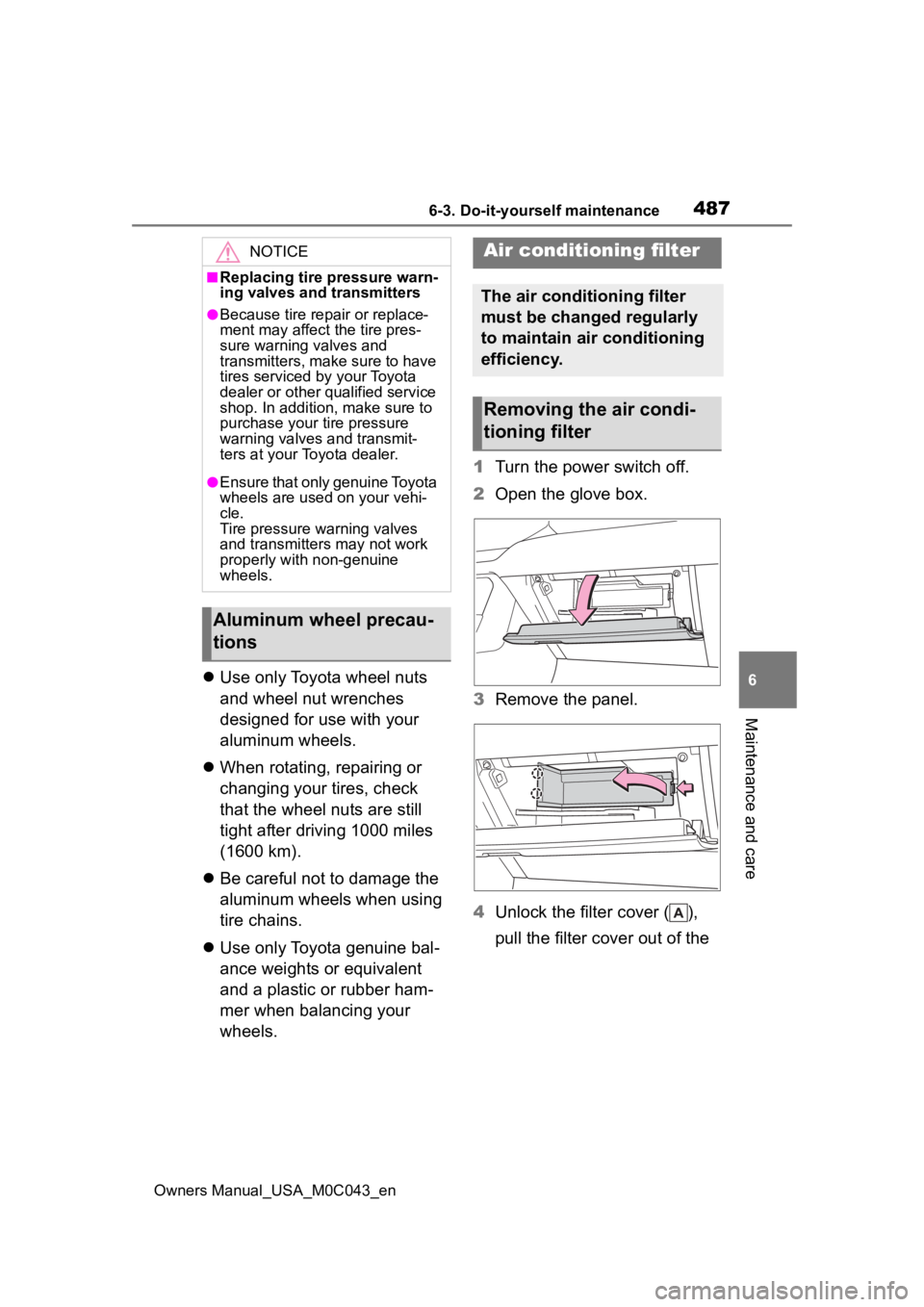
Turn the power switch off.
2 Open the glove box.
3 Remove the panel.
4 Unlock the filter cover ( ),
pull the filter cover out of the
NOTICE
■Replacing tire pressure warn-
ing valves and transmitters
●Because tire repair or replace-
ment may affect the tire pres-
sure warning valves and
transmitters, make sure to have
tires serviced by your Toyota
dealer or other qualified service
shop. In addition, make sure to
purchase your tire pressure
warning valves and transmit-
ters at your Toyota dealer.
●Ensure that only genuine Toyota
wheels are used on your vehi-
cle.
Tire pressure warning valves
and transmitters may not work
properly with non-genuine
wheels.
Aluminum wheel precau-
tions
Air conditioning filter
The air conditioning filter
must be changed regularly
to maintain air conditioning
efficiency.
Removing the air condi-
tioning filter
Page 548 of 628
5488-1. Specifications
Owners Manual_USA_M0C043_en
8-1.Specifications
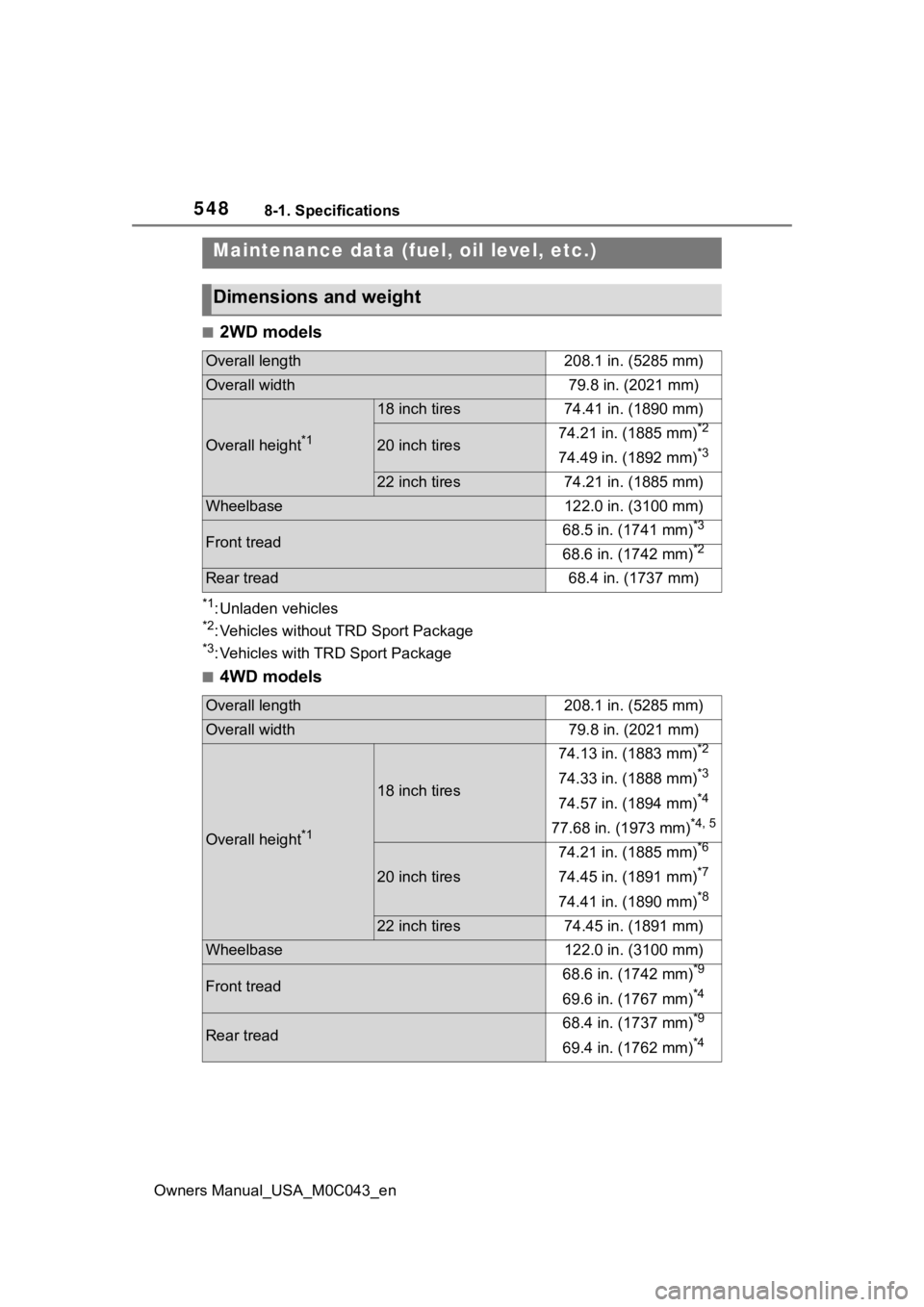
■2WD models
*1: Unladen vehicles
*2: Vehicles without TRD Sport Package
*3: Vehicles with TRD Sport Package
■4WD models
Maintenance data (fuel, oil level, etc.)
Dimensions and weight
Overall length208.1 in. (5285 mm)
Overall width79.8 in. (2021 mm)
Overall height*1
18 inch tires74.41 in. (1890 mm)
20 inch tires74.21 in. (1885 mm)*2
74.49 in. (1892 mm)*3
22 inch tires74.21 in. (1885 mm)
Wheelbase122.0 in. (3100 mm)
Front tread68.5 in. (1741 mm)*3
68.6 in. (1742 mm)*2
Rear tread68.4 in. (1737 mm)
Overall length208.1 in. (5285 mm)
Overall width79.8 in. (2021 mm)
Overall height*1
18 inch tires
74.13 in. (1883 mm)*2
74.33 in. (1888 mm)*3
74.57 in. (1894 mm)*4
77.68 in. (1973 mm)*4, 5
20 inch tires
74.21 in. (1885 mm)*6
74.45 in. (1891 mm)*7
74.41 in. (1890 mm)*8
22 inch tires74.45 in. (1891 mm)
Wheelbase122.0 in. (3100 mm)
Front tread68.6 in. (1742 mm)*9
69.6 in. (1767 mm)*4
Rear tread68.4 in. (1737 mm)*9
69.4 in. (1762 mm)*4
Page 549 of 628
5498-1. Specifications
Owners Manual_USA_M0C043_en
8
Vehicle specifications
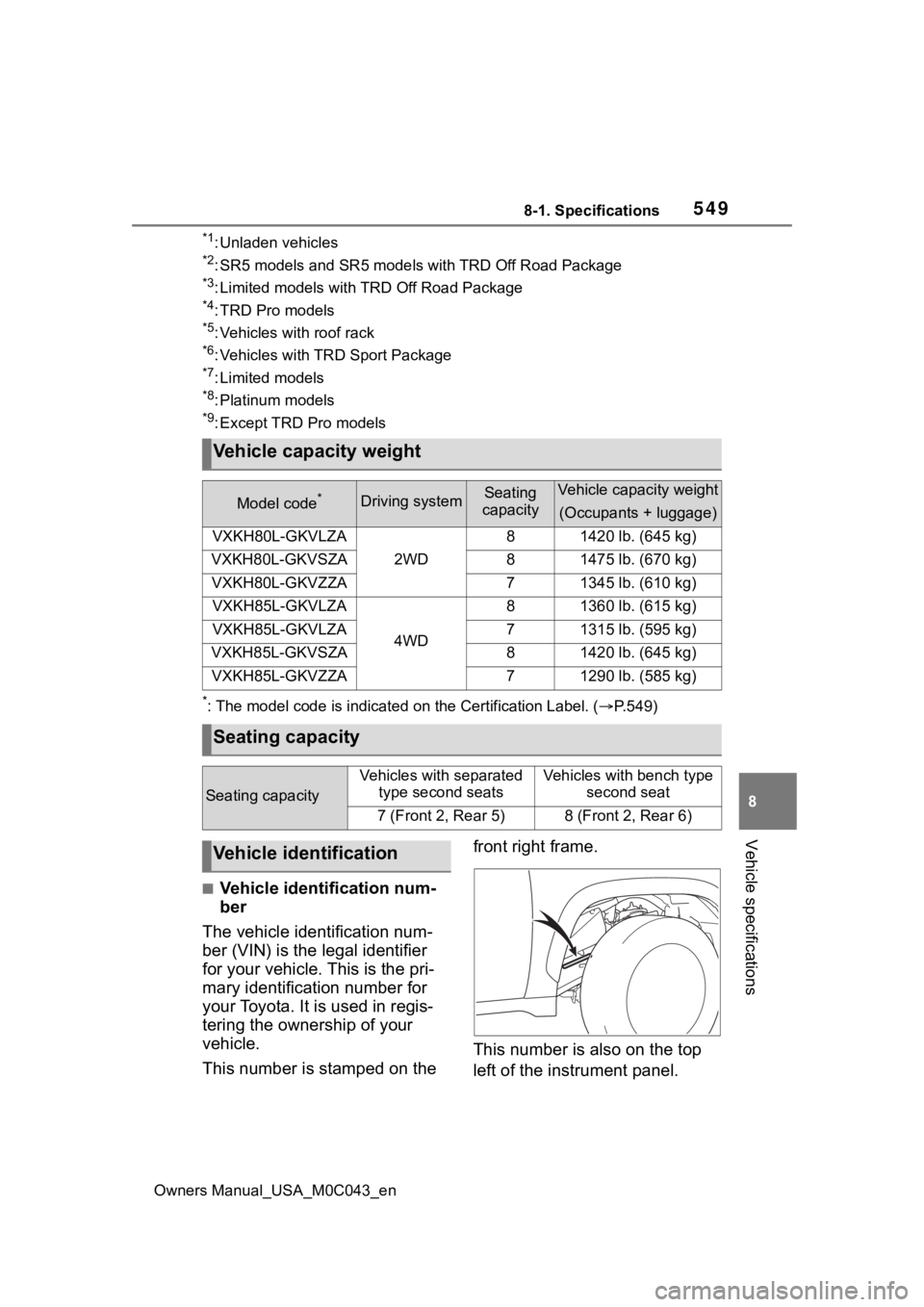
*1: Unladen vehicles
*2: SR5 models and SR5 models with TRD Off Road Package
*3: Limited models with TRD Off Road Package
*4: TRD Pro models
*5: Vehicles with roof rack
*6: Vehicles with TRD Sport Package
*7: Limited models
*8: Platinum models
*9: Except TRD Pro models
*: The model code is indicated on the Certification Label. (P.549)
■Vehicle identification num-
ber
The vehicle identification num-
ber (VIN) is the legal identifier
for your vehicle. This is the pri-
mary identification number for
your Toyota. It is used in regis-
tering the ownership of your
vehicle.
This number is stamped on the front right frame.
This number is also on the top
left of the instrument panel.
Vehicle capacity weight
Model code*Driving systemSeating
capacityVehicle capacity weight
(Occupants + luggage)
VXKH80L-GKVLZA
2WD
81420 lb. (645 kg)
VXKH80L-GKVSZA81475 lb. (670 kg)
VXKH80L-GKVZZA71345 lb. (610 kg)
VXKH85L-GKVLZA
4WD
81360 lb. (615 kg)
VXKH85L-GKVLZA71315 lb. (595 kg)
VXKH85L-GKVSZA81420 lb. (645 kg)
VXKH85L-GKVZZA71290 lb. (585 kg)
Seating capacity
Seating capacity
Vehicles with separated type second seatsVehicles with bench type second seat
7 (Front 2, Rear 5)8 (Front 2, Rear 6)
Vehicle identification
Page 564 of 628
5648-1. Specifications
Owners Manual_USA_M0C043_en
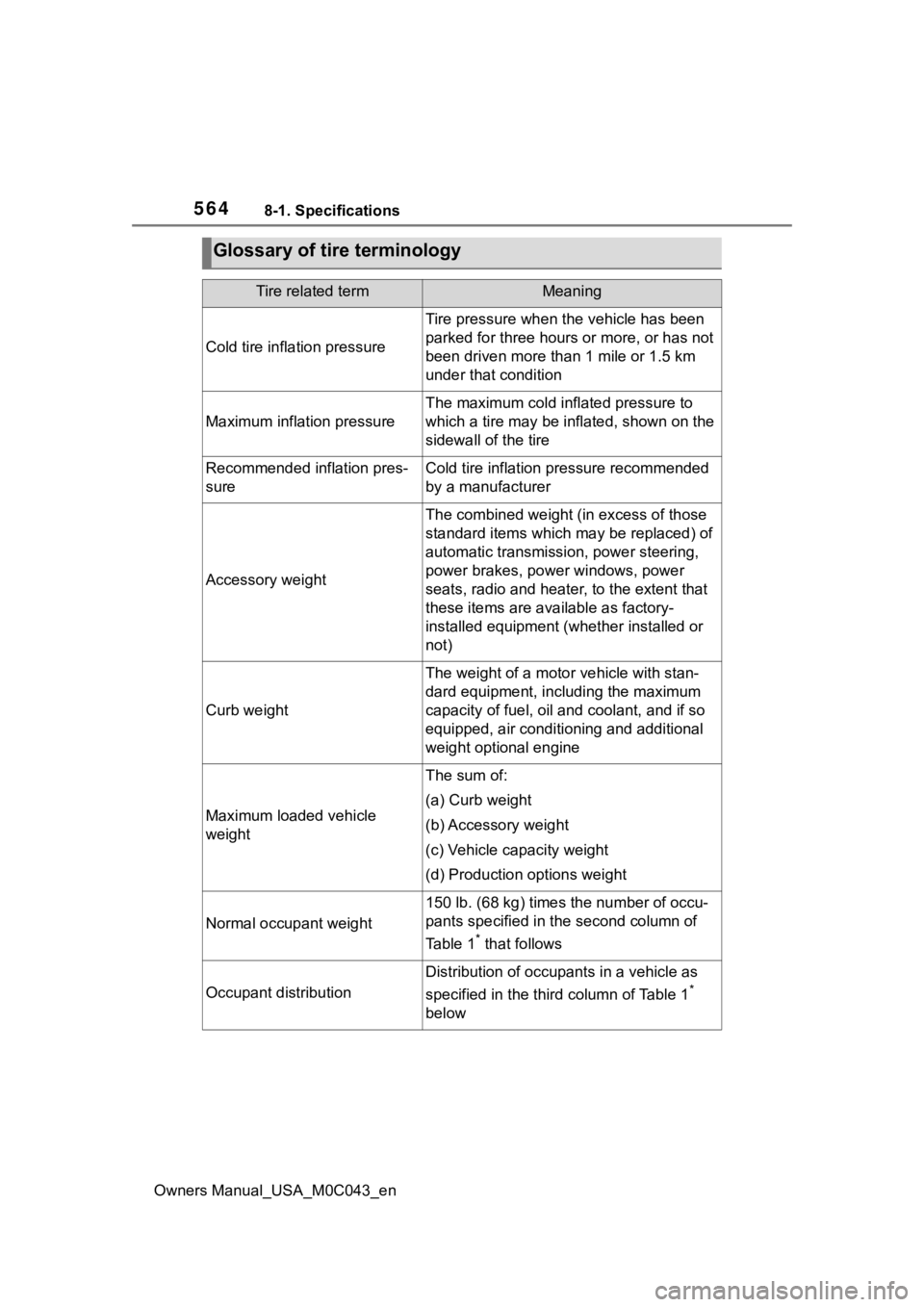
Glossary of tire terminology
Tire related termMeaning
Cold tire inflation pressure
Tire pressure when the vehicle has been
parked for three hours or more, or has not
been driven more than 1 mile or 1.5 km
under that condition
Maximum inflation pressure
The maximum cold inf lated pressure to
which a tire may be inflated, shown on the
sidewall of the tire
Recommended inflation pres-
sureCold tire inflation pressure recommended
by a manufacturer
Accessory weight
The combined weight (in excess of those
standard items which may be replaced) of
automatic transmission, power steering,
power brakes, power windows, power
seats, radio and heater, to the extent that
these items are ava ilable as factory-
installed equipment (whether installed or
not)
Curb weight
The weight of a moto r vehicle with stan-
dard equipment, including the maximum
capacity of fuel, oil and coolant, and if so
equipped, air conditioning and additional
weight optional engine
Maximum loaded vehicle
weight
The sum of:
(a) Curb weight
(b) Accessory weight
(c) Vehicle capacity weight
(d) Production options weight
Normal occupant weight
150 lb. (68 kg) times the number of occu-
pants specified in the second column of
Ta b l e 1
* that follows
Occupant distribution
Distribution of occupants in a vehicle as
specified in the third column of Table 1
*
below
Page 565 of 628
5658-1. Specifications
Owners Manual_USA_M0C043_en
8
Vehicle specifications
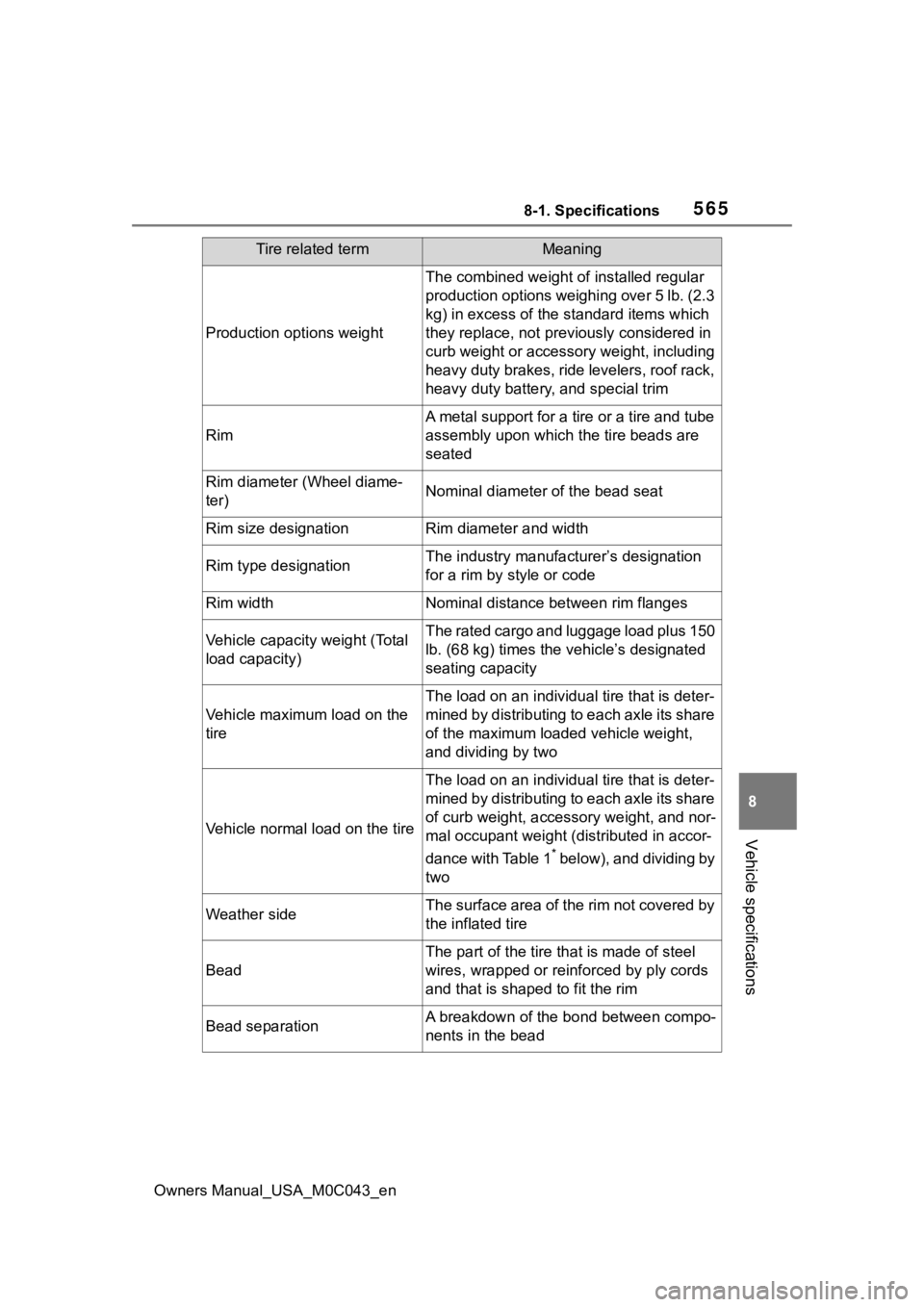
Production options weight
The combined weight of installed regular
production options weighing over 5 lb. (2.3
kg) in excess of the standard items which
they replace, not previously considered in
curb weight or accessory weight, including
heavy duty brakes, ride levelers, roof rack,
heavy duty battery, and special trim
Rim
A metal support for a tire or a tire and tube
assembly upon which the tire beads are
seated
Rim diameter (Wheel diame-
ter)Nominal diameter o f the bead seat
Rim size designationRim diameter and width
Rim type designationThe industry manufacturer’s designation
for a rim by style or code
Rim widthNominal distance between rim flanges
Vehicle capacity weight (Total
load capacity)The rated cargo and luggage load plus 150
lb. (68 kg) times the vehicle’s designated
seating capacity
Vehicle maximum load on the
tire
The load on an individua l tire that is deter-
mined by distributing to each axle its share
of the maximum loaded vehicle weight,
and dividing by two
Vehicle normal load on the tire
The load on an individua l tire that is deter-
mined by distributing to each axle its share
of curb weight, accessory weight, and nor-
mal occupant weight (distributed in accor-
dance with Table 1
* below), and dividing by
two
Weather sideThe surface area of the rim not covered by
the inflated tire
Bead
The part of the tire that is made of steel
wires, wrapped or reinforced by ply cords
and that is shaped to fit the rim
Bead separationA breakdown of the bond between compo-
nents in the bead
Tire related termMeaning
Page 567 of 628
5678-1. Specifications
Owners Manual_USA_M0C043_en
8
Vehicle specifications
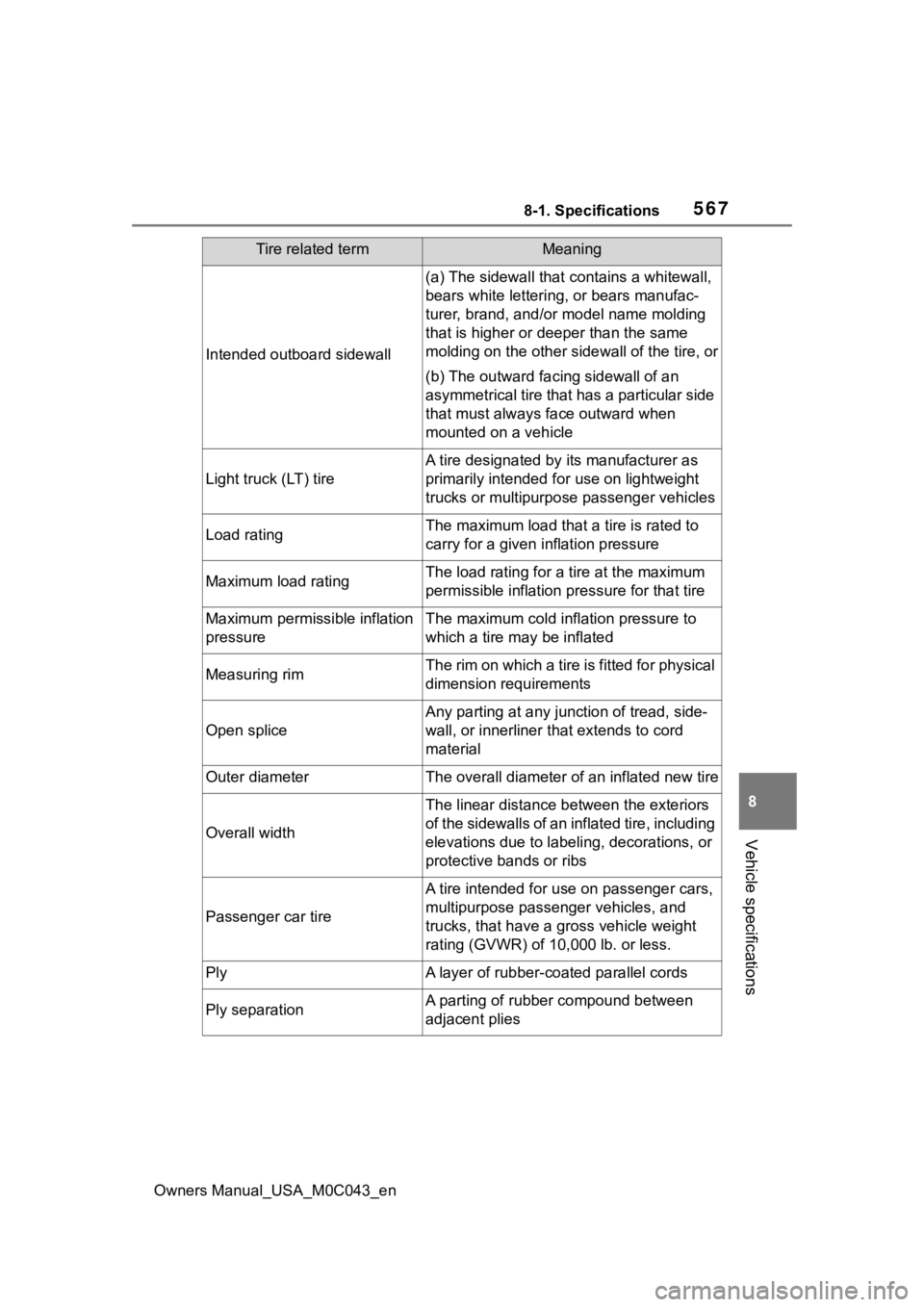
Intended outboard sidewall
(a) The sidewall that c ontains a whitewall,
bears white lettering , or bears manufac-
turer, brand, and/or model name molding
that is higher or deeper than the same
molding on the other s idewall of the tire, or
(b) The outward facing sidewall of an
asymmetrical tire that has a particular side
that must always face outward when
mounted on a vehicle
Light truck (LT) tire
A tire designated by its manufacturer as
primarily intended for use on lightweight
trucks or multipurpose passenger vehicles
Load ratingThe maximum load that a tire is rated to
carry for a given inflation pressure
Maximum load ratingThe load rating for a tire at the maximum
permissible inflation pressure for that tire
Maximum permissible inflation
pressureThe maximum cold inf lation pressure to
which a tire may be inflated
Measuring rimThe rim on which a tire is fitted for physical
dimension requirements
Open splice
Any parting at any junction of tread, side-
wall, or innerliner that extends to cord
material
Outer diameterThe overall diameter of an inflated new tire
Overall width
The linear distance between the exteriors
of the sidewalls of an inflated tire, including
elevations due to labeling, decorations, or
protective bands or ribs
Passenger car tire
A tire intended for use on passenger cars,
multipurpose passenger vehicles, and
trucks, that have a gross vehicle weight
rating (GVWR) of 10,000 lb. or less.
PlyA layer of rubber-coated parallel cords
Ply separationA parting of rubber compound between
adjacent plies
Tire related termMeaning
Page 581 of 628
5818-3. Initialization
Owners Manual_USA_M0C043_en
8
Vehicle specifications
8-3.Initialization
*: If equipped
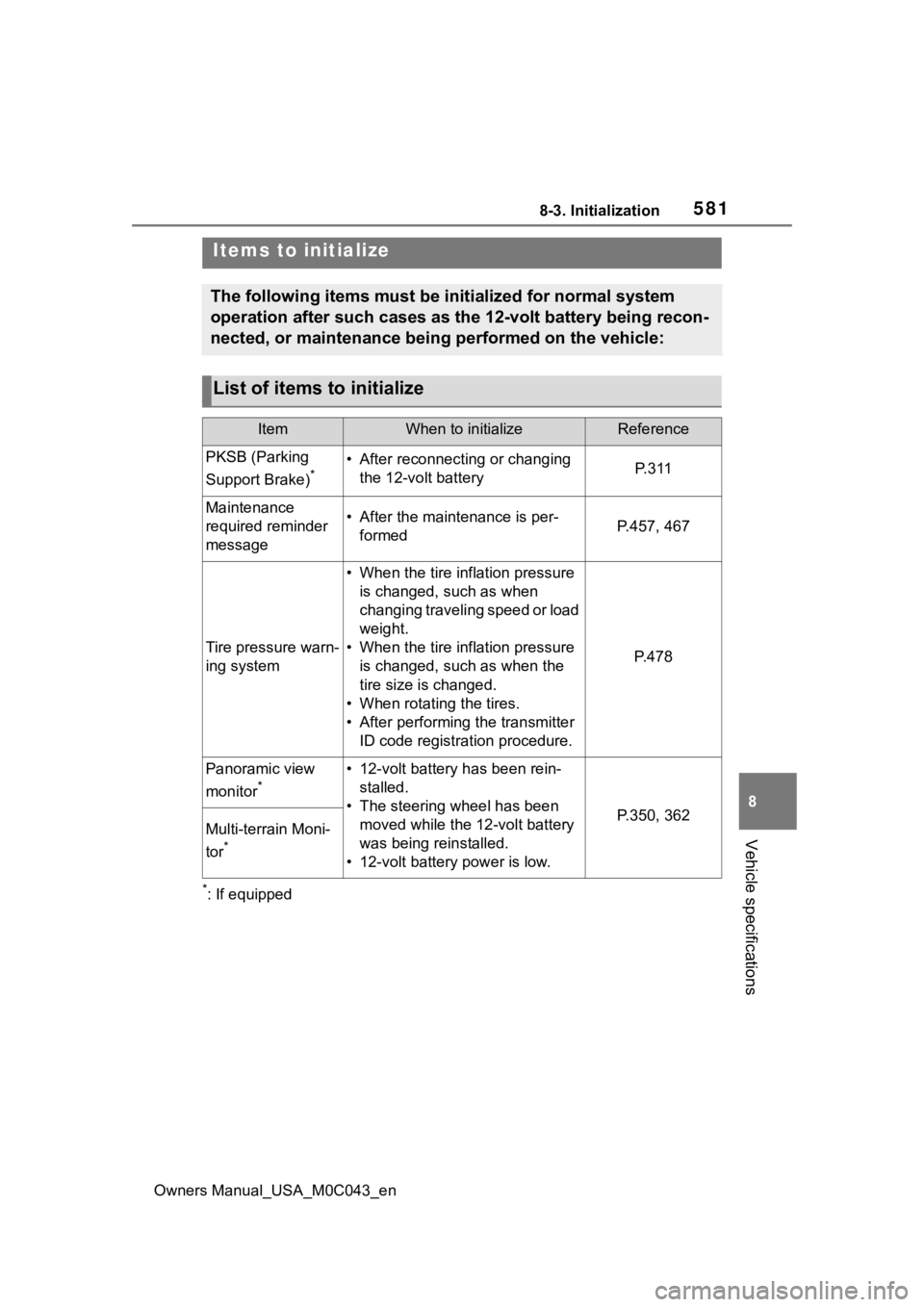
Items to initialize
The following items must be initialized for normal system
operation after such cases as the 12-volt battery being recon-
nected, or maintenance being performed on the vehicle:
List of items to initialize
ItemWhen to initializeReference
PKSB (Parking
Support Brake)
*• After reconnecting or changing the 12-volt batteryP. 3 1 1
Maintenance
required reminder
message• After the maintenance is per-formedP.457, 467
Tire pressure warn-
ing system
• When the tire inflation pressure is changed, such as when
changing traveling speed or load
weight.
• When the tire inflation pressure is changed, such as when the
tire size is changed.
• When rotating the tires.
• After performing the transmitter
ID code registration procedure.
P.478
Panoramic view
monitor
*
• 12-volt battery has been rein-
stalled.
• The steering wheel has been moved while the 12-volt battery
was being reinstalled.
• 12-volt battery power is low.
P.350, 362Multi-terrain Moni-
tor
*