engine TOYOTA SIENNA 2007 Service Repair Manual
[x] Cancel search | Manufacturer: TOYOTA, Model Year: 2007, Model line: SIENNA, Model: TOYOTA SIENNA 2007Pages: 3000, PDF Size: 52.26 MB
Page 1527 of 3000
AX–24U151E AUTOMATIC TRANSAXLE – AUTOMATIC TRANSAXLE SYSTEM
AX
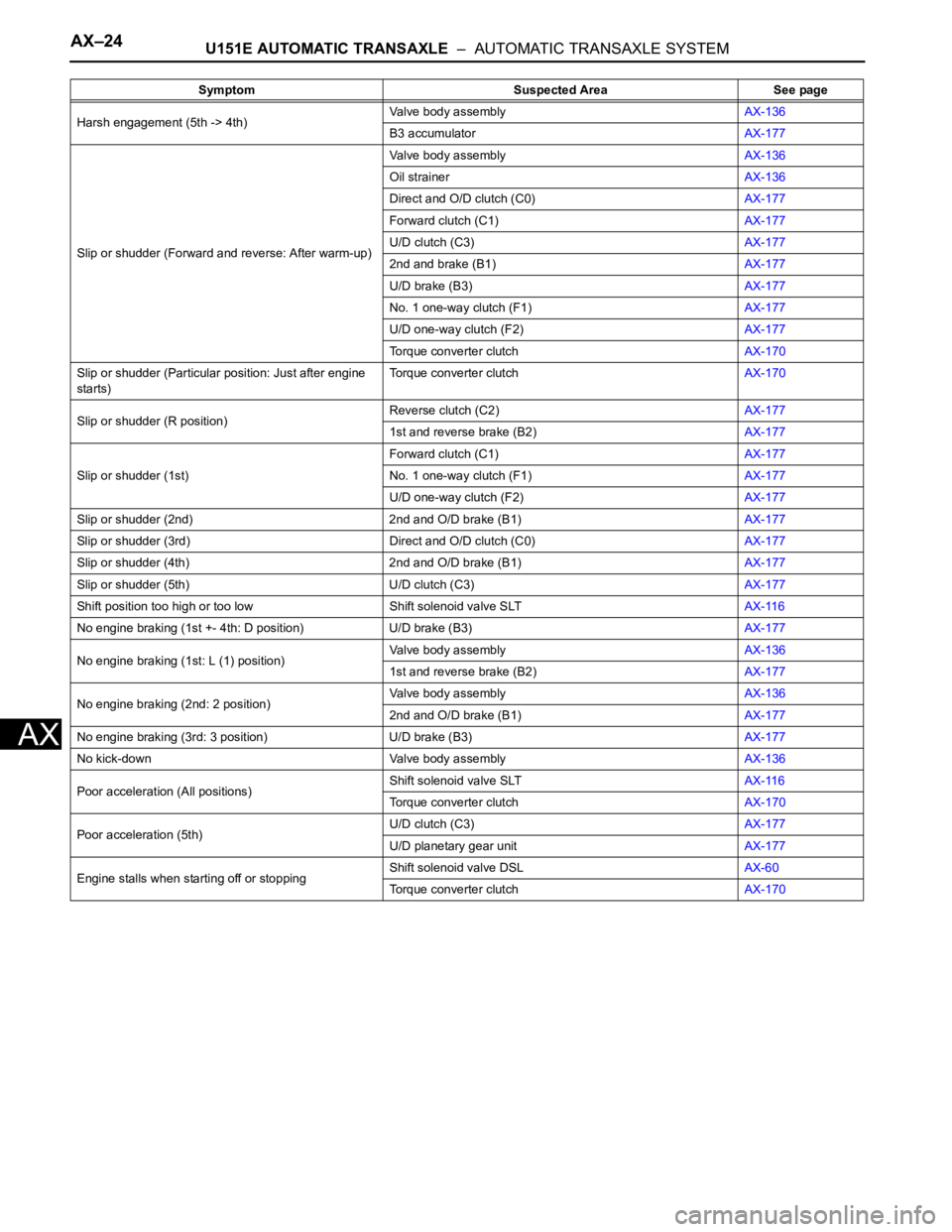
Harsh engagement (5th -> 4th)Valve body assemblyAX-136
B3 accumulatorAX-177
Slip or shudder (Forward and reverse: After warm-up)Valve body assemblyAX-136
Oil strainerAX-136
Direct and O/D clutch (C0)AX-177
Forward clutch (C1)AX-177
U/D clutch (C3)AX-177
2nd and brake (B1)AX-177
U/D brake (B3)AX-177
No. 1 one-way clutch (F1)AX-177
U/D one-way clutch (F2)AX-177
Torque converter clutchAX-170
Slip or shudder (Particular position: Just after engine
starts)Torque converter clutchAX-170
Slip or shudder (R position)Reverse clutch (C2)AX-177
1st and reverse brake (B2)AX-177
Slip or shudder (1st)Forward clutch (C1)AX-177
No. 1 one-way clutch (F1)AX-177
U/D one-way clutch (F2)AX-177
Slip or shudder (2nd) 2nd and O/D brake (B1)AX-177
Slip or shudder (3rd) Direct and O/D clutch (C0)AX-177
Slip or shudder (4th) 2nd and O/D brake (B1)AX-177
Slip or shudder (5th) U/D clutch (C3)AX-177
Shift position too high or too low Shift solenoid valve SLTAX-116
No engine braking (1st +- 4th: D position) U/D brake (B3)AX-177
No engine braking (1st: L (1) position)Valve body assemblyAX-136
1st and reverse brake (B2)AX-177
No engine braking (2nd: 2 position)Valve body assemblyAX-136
2nd and O/D brake (B1)AX-177
No engine braking (3rd: 3 position) U/D brake (B3)AX-177
No kick-down Valve body assemblyAX-136
Poor acceleration (All positions)Shift solenoid valve SLTAX-116
Torque converter clutchAX-170
Poor acceleration (5th)U/D clutch (C3)AX-177
U/D planetary gear unitAX-177
Engine stalls when starting off or stoppingShift solenoid valve DSLAX-60
Torque converter clutchAX-170 Symptom Suspected Area See page
Page 1531 of 3000
AX–26U151E AUTOMATIC TRANSAXLE – AUTOMATIC TRANSAXLE SYSTEM
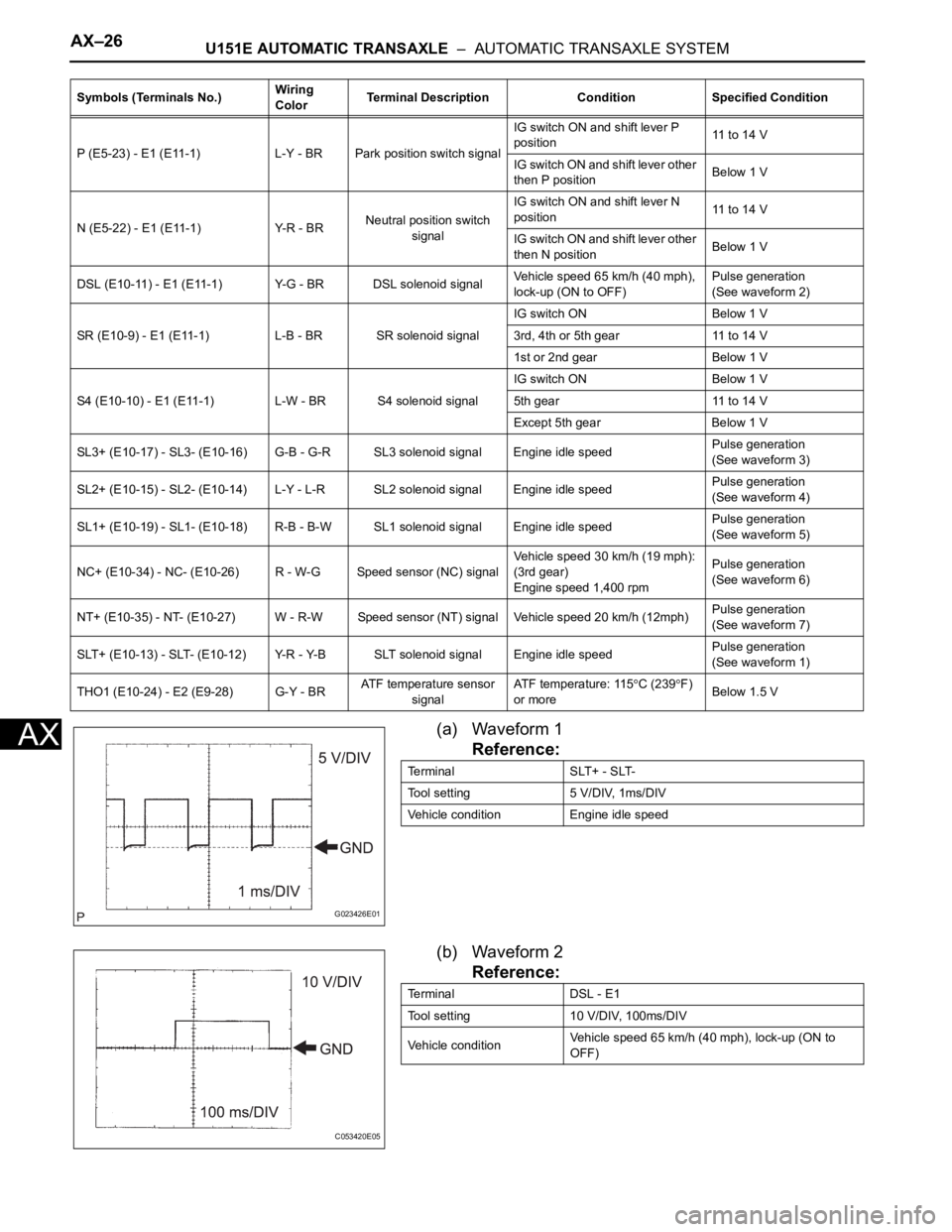
AX(a) Waveform 1
Reference:
(b) Waveform 2
Reference:
P (E5-23) - E1 (E11-1) L-Y - BR Park position switch signalIG switch ON and shift lever P
position11 to 14 V
IG switch ON and shift lever other
then P positionBelow 1 V
N (E5-22) - E1 (E11-1) Y-R - BRNeutral position switch
signalIG switch ON and shift lever N
position11 to 14 V
IG switch ON and shift lever other
then N positionBelow 1 V
DSL (E10-11) - E1 (E11-1) Y-G - BR DSL solenoid signalVehicle speed 65 km/h (40 mph),
lock-up (ON to OFF)Pulse generation
(See waveform 2)
SR (E10-9) - E1 (E11-1) L-B - BR SR solenoid signalIG switch ON Below 1 V
3rd, 4th or 5th gear 11 to 14 V
1st or 2nd gear Below 1 V
S4 (E10-10) - E1 (E11-1) L-W - BR S4 solenoid signalIG switch ON Below 1 V
5th gear 11 to 14 V
Except 5th gear Below 1 V
SL3+ (E10-17) - SL3- (E10-16) G-B - G-R SL3 solenoid signal Engine idle speedPulse generation
(See waveform 3)
SL2+ (E10-15) - SL2- (E10-14) L-Y - L-R SL2 solenoid signal Engine idle speedPulse generation
(See waveform 4)
SL1+ (E10-19) - SL1- (E10-18) R-B - B-W SL1 solenoid signal Engine idle speedPulse generation
(See waveform 5)
NC+ (E10-34) - NC- (E10-26) R - W-G Speed sensor (NC) signalVehicle speed 30 km/h (19 mph):
(3rd gear)
Engine speed 1,400 rpmPulse generation
(See waveform 6)
NT+ (E10-35) - NT- (E10-27) W - R-W Speed sensor (NT) signal Vehicle speed 20 km/h (12mph)Pulse generation
(See waveform 7)
SLT+ (E10-13) - SLT- (E10-12) Y-R - Y-B SLT solenoid signal Engine idle speedPulse generation
(See waveform 1)
THO1 (E10-24) - E2 (E9-28) G-Y - BRATF temperature sensor
signalATF temperature: 115
C (239F)
or moreBelow 1.5 V Symbols (Terminals No.)Wiring
ColorTerminal Description Condition Specified Condition
G023426E01
Terminal SLT+ - SLT-
Tool setting 5 V/DIV, 1ms/DIV
Vehicle condition Engine idle speed
C053420E05
Terminal DSL - E1
Tool setting 10 V/DIV, 100ms/DIV
Vehicle conditionVehicle speed 65 km/h (40 mph), lock-up (ON to
OFF)
Page 1532 of 3000
U151E AUTOMATIC TRANSAXLE – AUTOMATIC TRANSAXLE SYSTEMAX–27
AX
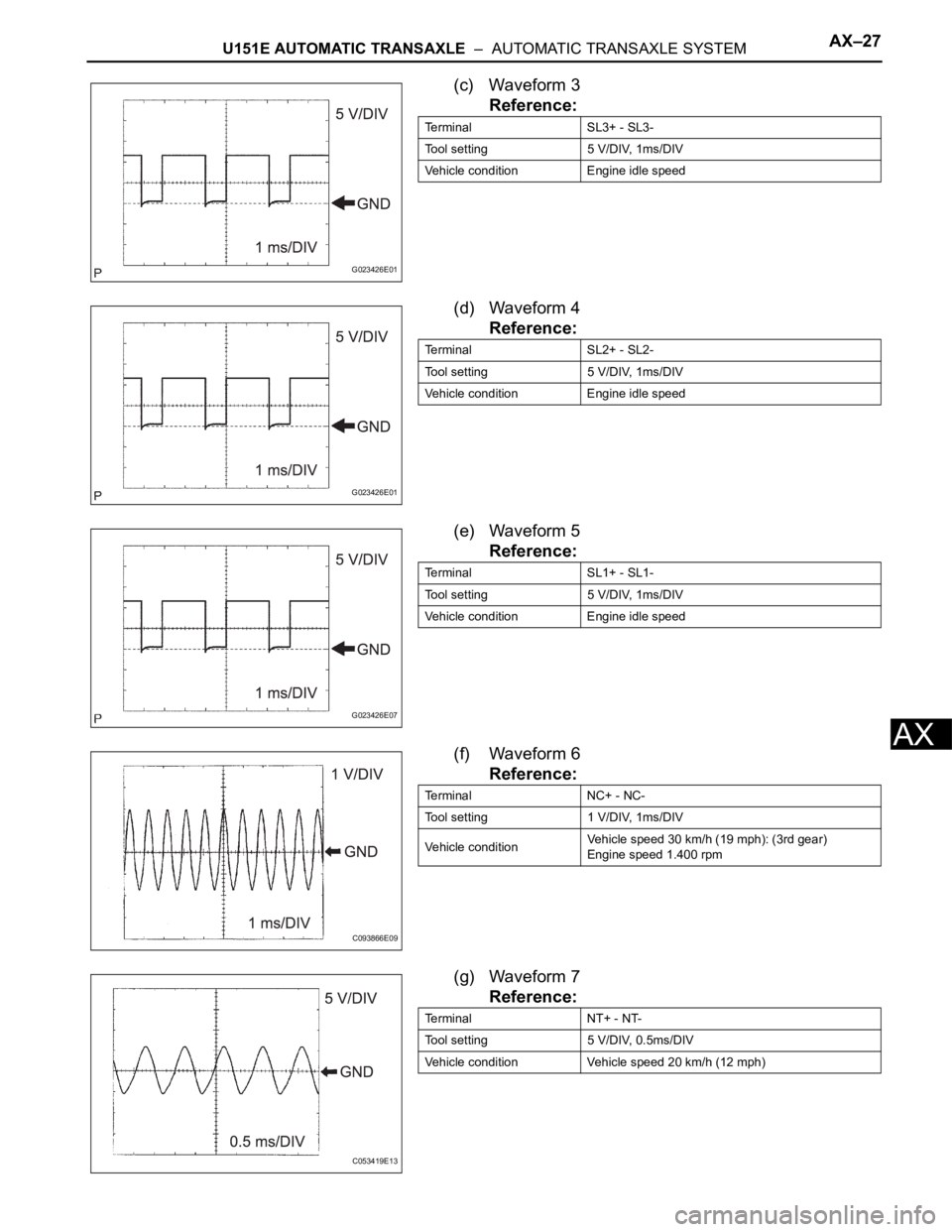
(c) Waveform 3
Reference:
(d) Waveform 4
Reference:
(e) Waveform 5
Reference:
(f) Waveform 6
Reference:
(g) Waveform 7
Reference:
G023426E01
Terminal SL3+ - SL3-
Tool setting 5 V/DIV, 1ms/DIV
Vehicle condition Engine idle speed
G023426E01
Terminal SL2+ - SL2-
Tool setting 5 V/DIV, 1ms/DIV
Vehicle condition Engine idle speed
G023426E07
Terminal SL1+ - SL1-
Tool setting 5 V/DIV, 1ms/DIV
Vehicle condition Engine idle speed
C093866E09
Terminal NC+ - NC-
Tool setting 1 V/DIV, 1ms/DIV
Vehicle conditionVehicle speed 30 km/h (19 mph): (3rd gear)
Engine speed 1.400 rpm
C053419E13
Terminal NT+ - NT-
Tool setting 5 V/DIV, 0.5ms/DIV
Vehicle condition Vehicle speed 20 km/h (12 mph)
Page 1538 of 3000
AX–150U151E AUTOMATIC TRANSAXLE – SHIFT LEVER
AX
ADJUSTMENT
1. INSPECT SHIFT LEVER POSITION
(a) When shifting from P to R position only with ignition
switch ON and brake pedal, make sure that the
shifting lever moves smoothly and can be
moderately operated.
(b) When starting engine, make sure that the vehicle
moves forward when shifting from N to D position
and moves rearward when shifting to R position.
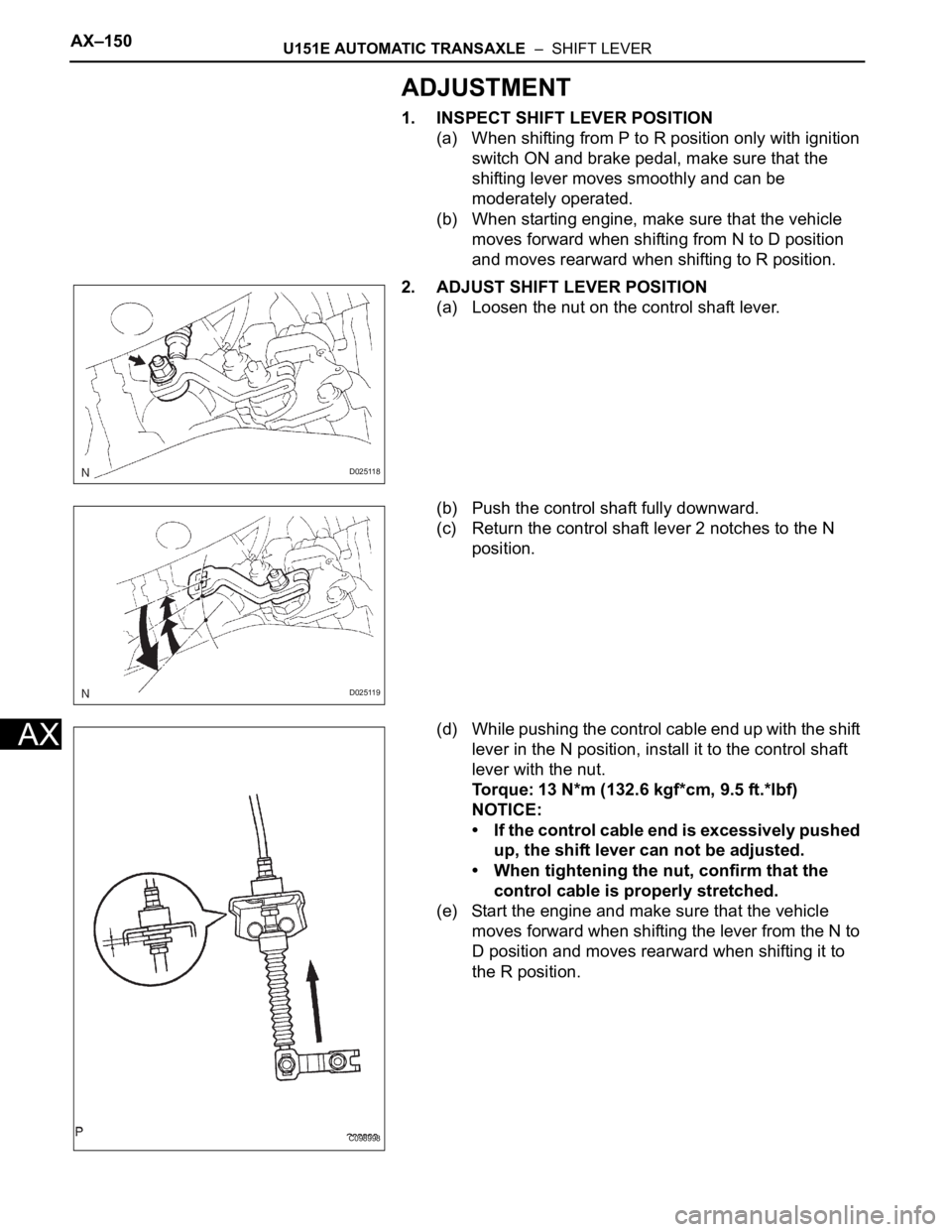
2. ADJUST SHIFT LEVER POSITION
(a) Loosen the nut on the control shaft lever.
(b) Push the control shaft fully downward.
(c) Return the control shaft lever 2 notches to the N
position.
(d) While pushing the control cable end up with the shift
lever in the N position, install it to the control shaft
lever with the nut.
Torque: 13 N*m (132.6 kgf*cm, 9.5 ft.*lbf)
NOTICE:
• If the control cable end is excessively pushed
up, the shift lever can not be adjusted.
• When tightening the nut, confirm that the
control cable is properly stretched.
(e) Start the engine and make sure that the vehicle
moves forward when shifting the lever from the N to
D position and moves rearward when shifting it to
the R position.
D025118
D025119
C098998
Page 1542 of 3000
U151E AUTOMATIC TRANSAXLE – AUTOMATIC TRANSAXLE SYSTEMAX–29
AX
DIAGNOSIS SYSTEM
1. DESCRIPTION
(a) When troubleshooting OBD II vehicles, the only
difference from the usual troubleshooting procedure
is to connect an OBD II scan tool complying with
SAE J1987 or a intelligent tester to the vehicle, and
read off various data output from the vehicle's ECM.
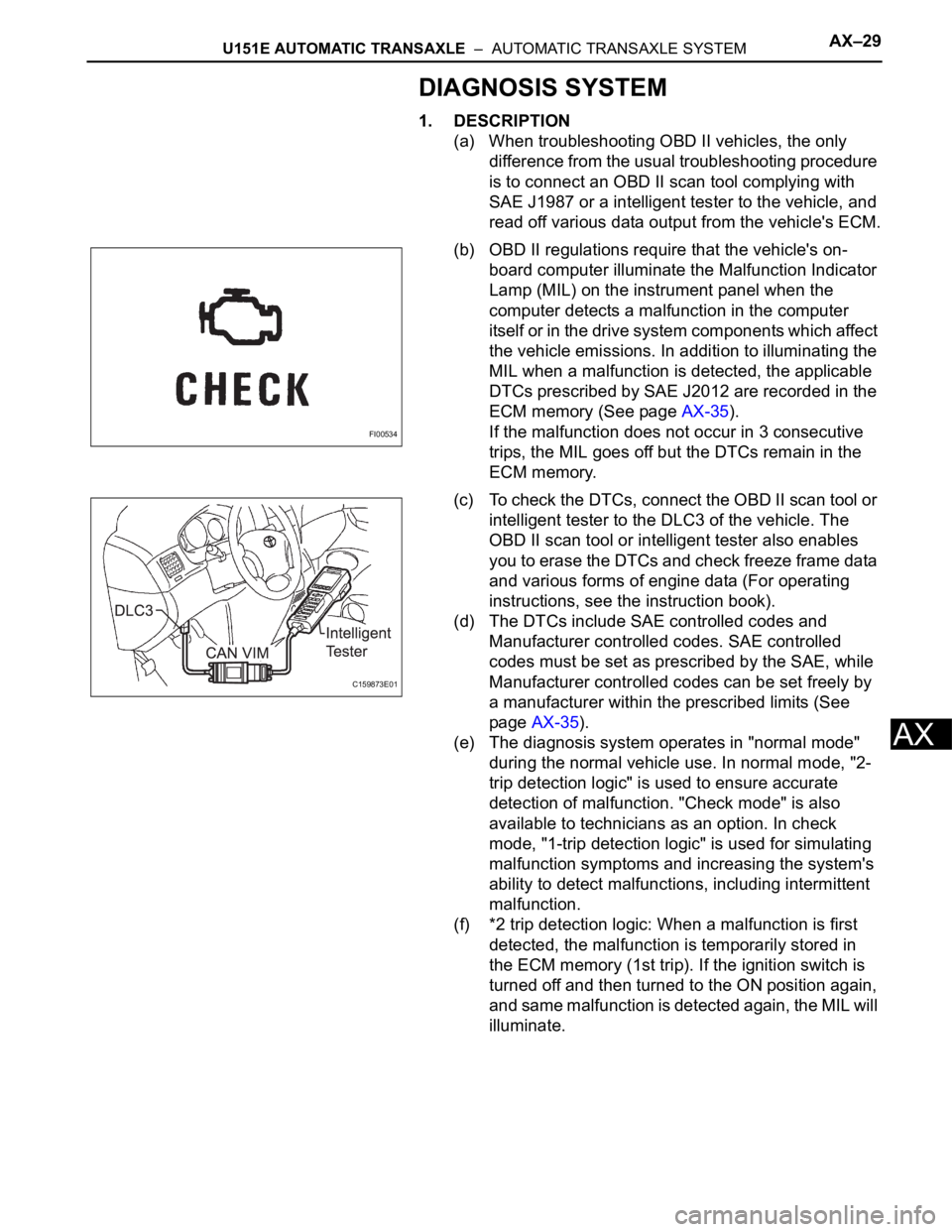
(b) OBD II regulations require that the vehicle's on-
board computer illuminate the Malfunction Indicator
Lamp (MIL) on the instrument panel when the
computer detects a malfunction in the computer
itself or in the drive system components whic h affect
the vehicle emissions. In addition to illuminating the
MIL when a malfunction is detected, the applicable
DTCs prescribed by SAE J2012 are recorded in the
ECM memory (See page AX-35).
If the malfunction does not occur in 3 consecutive
trips, the MIL goes off but the DTCs remain in the
ECM memory.
(c) To check the DTCs, connect the OBD II scan tool or
intelligent tester to the DLC3 of the vehicle. The
OBD II scan tool or intelligent tester also enables
you to erase the DTCs and check freeze frame data
and various forms of engine data (For operating
instructions, see the instruction book).
(d) The DTCs include SAE controlled codes and
Manufacturer controlled codes. SAE controlled
codes must be set as prescribed by the SAE, while
Manufacturer controlled codes can be set freely by
a manufacturer within the prescribed limits (See
page AX-35).
(e) The diagnosis system operates in "normal mode"
during the normal vehicle use. In normal mode, "2-
trip detection logic" is used to ensure accurate
detection of malfunction. "Check mode" is also
available to technicians as an option. In check
mode, "1-trip detection logic" is used for simulating
malfunction symptoms and increasing the system's
ability to detect malfunctions, including intermittent
malfunction.
(f) *2 trip detection logic: When a malfunction is first
detected, the malfunction is temporarily stored in
the ECM memory (1st trip). If the ignition switch is
turned off and then turned to the ON position again,
and same malfunction is detected again, the MIL will
illuminate.
FI00534
C159873E01
Page 1543 of 3000
AX–30U151E AUTOMATIC TRANSAXLE – AUTOMATIC TRANSAXLE SYSTEM
AX
(g) Freeze frame data records the engine conditions
(fuel system, calculated load, engine coolant
temperature, fuel trim, engine speed, vehicle speed,
etc.) when a malfunction is detected. When
troubleshooting, freeze frame data can help
determine if the vehicle was running or stopped, if
the engine was warmed up or not, if the air/fuel ratio
was Lean or Rich, and other data from the time the
malfunction occurred.
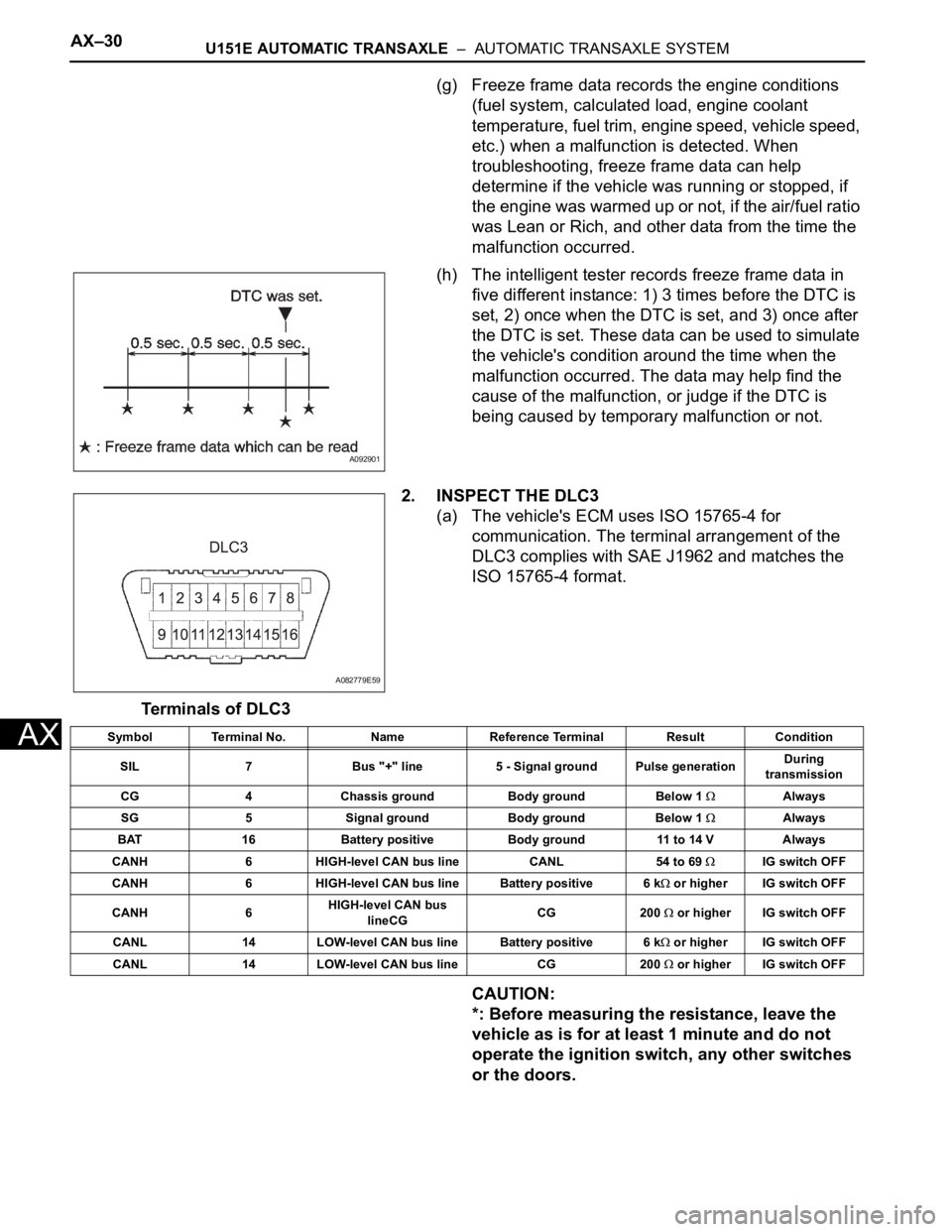
(h) The intelligent tester records freeze frame data in
five different instance: 1) 3 times before the DTC is
set, 2) once when the DTC is set, and 3) once after
the DTC is set. These data can be used to simulate
the vehicle's condition around the time when the
malfunction occurred. The data may help find the
cause of the malfunction, or judge if the DTC is
being caused by temporary malfunction or not.
2. INSPECT THE DLC3
(a) The vehicle's ECM uses ISO 15765-4 for
communication. The terminal arrangement of the
DLC3 complies with SAE J1962 and matches the
ISO 15765-4 format.
Terminals of DLC3
CAUTION:
*: Before measuring the resistance, leave the
vehicle as is for at least 1 minute and do not
operate the ignition switch, any other switches
or the doors.
A092901
A082779E59
Symbol Terminal No. Name Reference Terminal Result Condition
SIL 7 Bus "+" line 5 - Signal ground Pulse generationDuring
transmission
CG 4 Chassis ground Body ground Below 1
Always
SG 5 Signal ground Body ground Below 1
Always
BAT 16 Battery positive Body ground 11 to 14 V Always
CANH 6 HIGH-level CAN bus line CANL 54 to 69
IG switch OFF
CANH 6 HIGH-level CAN bus line Battery positive 6 k
or higher IG switch OFF
CANH 6HIGH-level CAN bus
lineCGCG 200
or higher IG switch OFF
CANL 14 LOW-level CAN bus line Battery positive 6 k
or higher IG switch OFF
CANL 14 LOW-level CAN bus line CG 200
or higher IG switch OFF
Page 1544 of 3000

U151E AUTOMATIC TRANSAXLE – AUTOMATIC TRANSAXLE SYSTEMAX–31
AX
HINT:
If your display shows UNABLE TO CONNECT TO
VEHICLE when you have connected the cable of
the OBD II scan tool or intelligent tester to the
DLC3, turned the ignition switch to the ON position
and operated the scan tool, there is a problem on
the vehicle side or tool side.
• If the communication is normal when the tool is
connected to another vehicle, inspect the DLC3
on the original vehicle.
• If the communication is still impossible when the
tool is connected to another vehicle, the problem
is probably in the tool itself, so consult the
Service Department listed in the tool's instruction
manual.
3. CHECK BATTERY VOLTAGE
(a) Measure the battery voltage.
Battery voltage:
11 to 14 V
If voltage is below 11 V, replace the battery before
proceeding.
4. CHECK MIL
(a) The MIL comes on when the ignition switch is
turned to the ON position and the engine is not
running.
HINT:
If the MIL does not light up, troubleshoot the
combination meter.
(b) When the engine is started, the MIL should go off. If
the lamp remains on, it means that the diagnosis
system has detected a malfunction or abnormality in
the system.
Page 1548 of 3000
AX–156U151E AUTOMATIC TRANSAXLE – TRANSMISSION CONTROL CABLE ASSEMBLY
AX
ADJUSTMENT
1. INSPECT SHIFT LEVER POSITION
(a) When shifting from P to R position only with ignition
switch ON and brake pedal, make sure that the
shifting lever moves smoothly and can be
moderately operated.
(b) When starting engine, make sure that the vehicle
moves forward when shifting from N to D position
and moves rearward when shifting to R position.
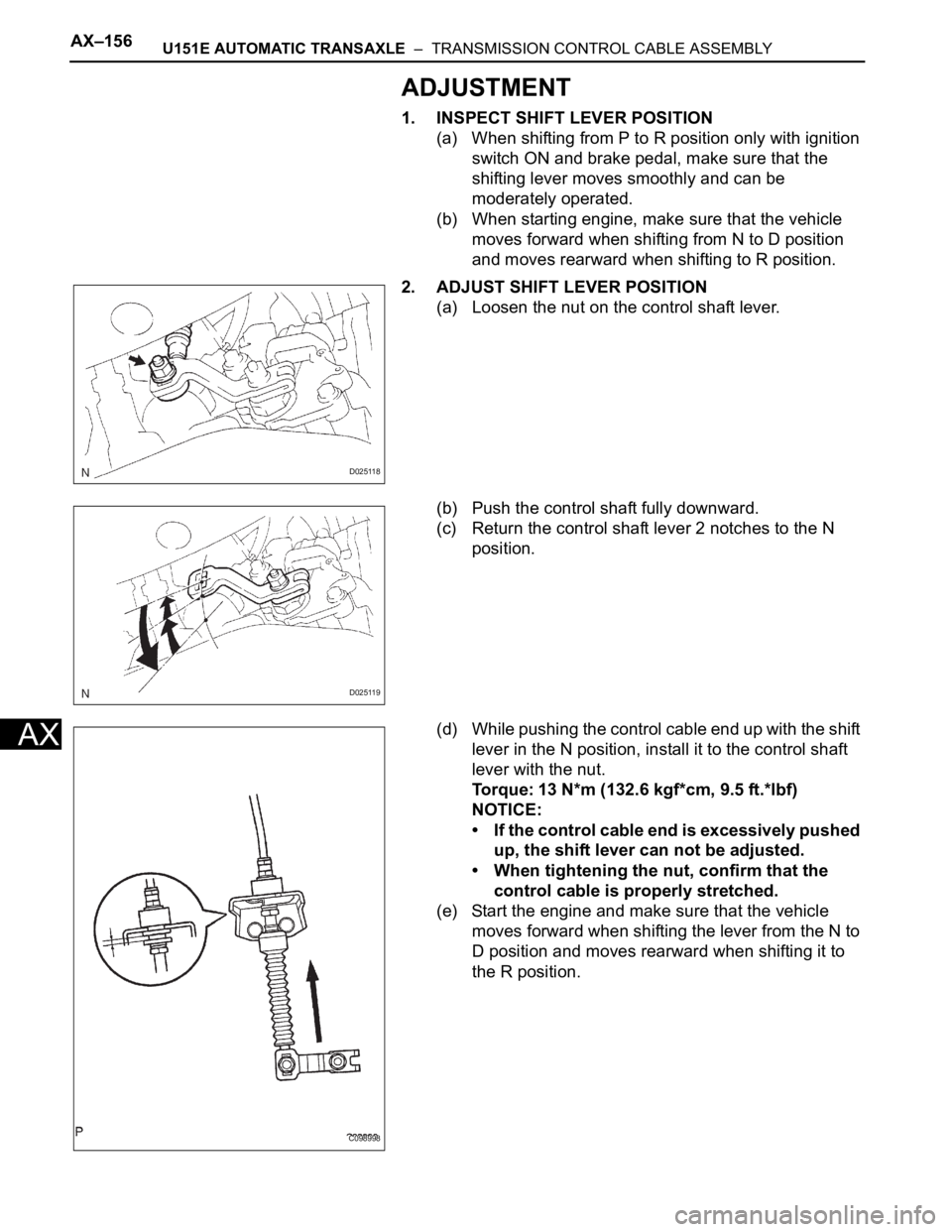
2. ADJUST SHIFT LEVER POSITION
(a) Loosen the nut on the control shaft lever.
(b) Push the control shaft fully downward.
(c) Return the control shaft lever 2 notches to the N
position.
(d) While pushing the control cable end up with the shift
lever in the N position, install it to the control shaft
lever with the nut.
Torque: 13 N*m (132.6 kgf*cm, 9.5 ft.*lbf)
NOTICE:
• If the control cable end is excessively pushed
up, the shift lever can not be adjusted.
• When tightening the nut, confirm that the
control cable is properly stretched.
(e) Start the engine and make sure that the vehicle
moves forward when shifting the lever from the N to
D position and moves rearward when shifting it to
the R position.
D025118
D025119
C098998
Page 1552 of 3000

U151E AUTOMATIC TRANSAXLE – AUTOMATIC TRANSAXLE SYSTEMAX–33
AX
(b) When not using the OBD II scan tool or intelligent
tester: Clearing the DTCs.
(1) Disconnect the battery terminal or remove the
EFI and ETCS fuses from the engine room J/B
for 60 seconds or more. However, if you
disconnect the battery terminal, perform do the
"INITIALIZE" procedure.
Page 1554 of 3000
U151E AUTOMATIC TRANSAXLE – DIFFERENTIAL OIL SEALAX–159
AX
REMOVAL
1. REMOVE FRONT WHEELS
2. REMOVE ENGINE UNDER COVER NO.1
3. DRAIN AUTOMATIC TRANSAXLE FLUID
(a) Remove the drain plug, gasket and drain ATF.
(b) Install a new gasket and the drain plug.
Torque: 49 N*m (500 kgf*cm, 36 ft.*lbf)
4. REMOVE FRONT DRIVE SHAFT ASSEMBLY LH
HINT:
(See page DS-6)
SST 09520-01010, 09520-24010 (09520-32040)
5. REMOVE FRONT DRIVE SHAFT ASSEMBLY RH (for
2WD)
HINT:
(See page DS-6)
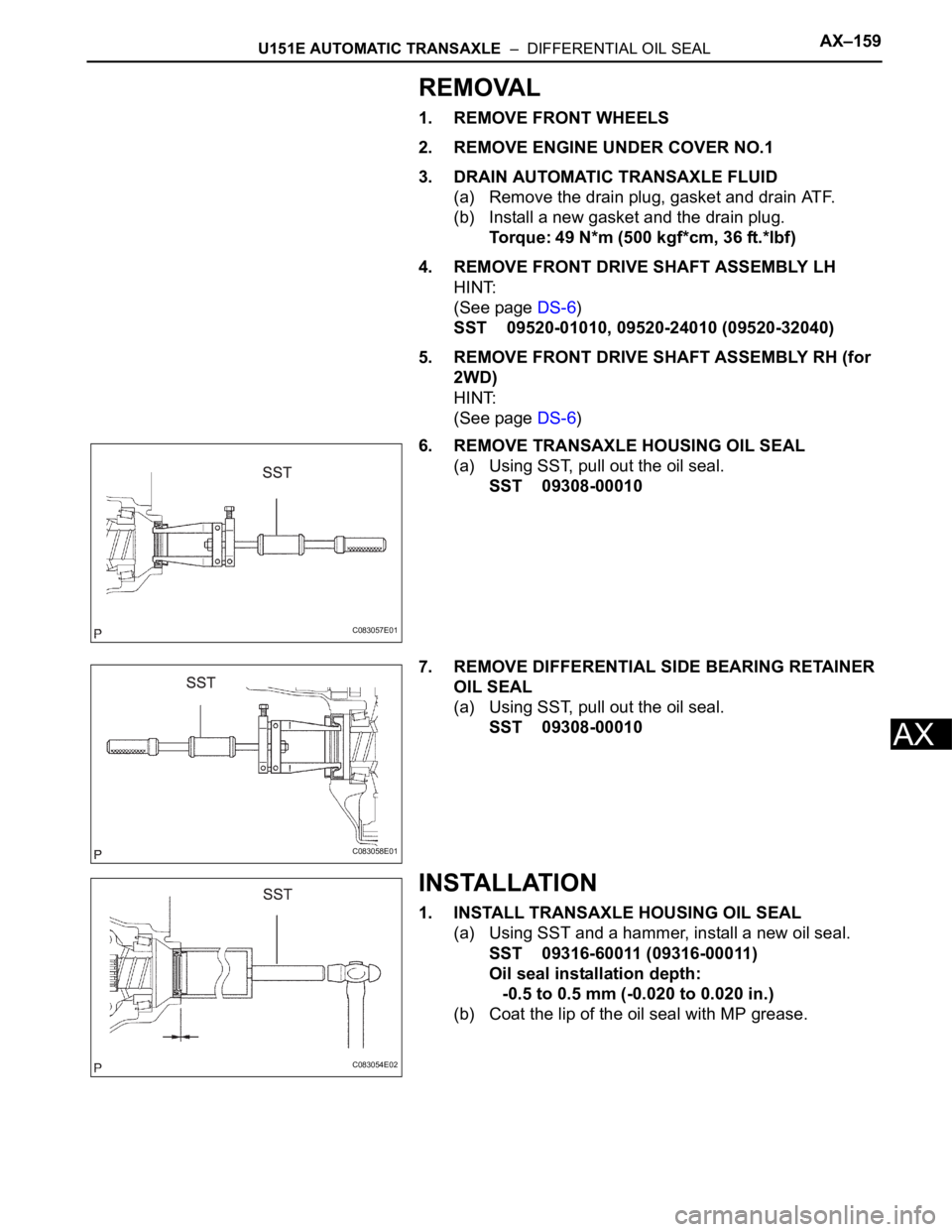
6. REMOVE TRANSAXLE HOUSING OIL SEAL
(a) Using SST, pull out the oil seal.
SST 09308-00010
7. REMOVE DIFFERENTIAL SIDE BEARING RETAINER
OIL SEAL
(a) Using SST, pull out the oil seal.
SST 09308-00010
INSTALLATION
1. INSTALL TRANSAXLE HOUSING OIL SEAL
(a) Using SST and a hammer, install a new oil seal.
SST 09316-60011 (09316-00011)
Oil seal installation depth:
-0.5 to 0.5 mm (-0.020 to 0.020 in.)
(b) Coat the lip of the oil seal with MP grease.
C083057E01
C083058E01
C083054E02