sensor TOYOTA SIENNA 2007 Service Repair Manual
[x] Cancel search | Manufacturer: TOYOTA, Model Year: 2007, Model line: SIENNA, Model: TOYOTA SIENNA 2007Pages: 3000, PDF Size: 52.26 MB
Page 390 of 3000

ES–842GR-FE ENGINE CONTROL SYSTEM – SFI SYSTEM
ES
MONITOR DESCRIPTION
After the ECM sends the "target" duty-cycle signal to the OCV, the ECM monitors the OCV current to
establish an "actual" duty-cycle. The ECM detects a malfunction and sets a DTC when the actual duty-
cycle ratio varies from the target duty-cycle ratio.
MONITOR STRATEGY
TYPICAL ENABLING CONDITIONS
TYPICAL MALFUNCTION THRESHOLDS
COMPONENT OPERATING RANGE
Related DTCsP0010: VVT OCV (bank 1) open/short
P0020: VVT OCV (bank 2) open/short
Required sensors / components (Main) VVT OCV (Variable Valve Timing oil control valve)
Required sensors / components (Sub) -
Frequency of operation Continuous
Duration 1 second
MIL operation Immediately
Sequence of operation None
Monitor will run whenever these DTCs are not present None
All of the following conditions are met: -
Starter OFF
Engine switch ON
Time after turning ignition switch off to on 0.5 seconds or more
One of the following conditions is met: Condition A, B or C
A. All of the following conditions are met: -
Battery voltage 11 to 13 V
Target duty ratio Less than 70 %
Output signal duty ratio 100 %
B. All of the following conditions are met: -
Battery voltage 13 V or more
Target duty ratio Less than 80 %
Output signal duty ratio 100 %
C. All of the following conditions are met: -
Current cut status Not cut
Output signal duty ratio 3 % or less
VVT OCV duty ratio More than 3 %, and Less than 100 %
Page 395 of 3000

2GR-FE ENGINE CONTROL SYSTEM – SFI SYSTEMES–89
ES
3) After above conditions 1) and 2) are met, the OCV is forcibly activated 63 times or more.
DTCs P0011 and P0021 (Advanced Cam Timing) are detected with 1 trip detection logic.
DTCs P0012 and P0022 (Retarded Cam Timing) are detected with 2 trip detection logic.
These DTCs indicate that the VVT controller cannot operate properly due to OCV malfunctions or the
presence of foreign objects in the OCV.
The monitor will not run unless the following conditions are met:
- The engine is warm (the engine coolant temperature is 75
C [167F] or more).
- The vehicle has been driven at more than 40 mph (64 km/h) for 3 minutes.
- The engine has idled for 3 minutes.
MONITOR STRATEGY
TYPICAL ENABLING CONDITIONS
TYPICAL MALFUNCTION THRESHOLDS
P0011, P0021:
P0012, P0022:
If the difference between the target and actual camshaft timings is greater than the specified value, the
ECM operates the VVT actuator.
Then, the ECM monitors the camshaft timing change for 5 seconds.
WIRING DIAGRAM
Refer to DTC P0010 (See page ES-77).
INSPECTION PROCEDURE
Related DTCsP0011: Advanced intake camshaft timing (bank 1)
P0012: Retarded intake camshaft timing (bank 1)
P0021: Advanced intake camshaft timing (bank 2)
P0022: Retarded intake camshaft timing (bank 2)
Required sensors / components (Main) VVT OCV, VVT Actuator
Required sensors / components (Related) Crankshaft position sensor, Camshaft position sensor, ECT sensor
Frequency of operation Once per driving cycles
Duration Less than 10 seconds
MIL operationP0011 and P0021: Immediate
P0012 and P0022: 2 driving cycles
Sequence operation None
The monitor will run whenever these DTCs are not
presentP0100, P0101, P0102, P0103 (MAF Sensor), P0115, P0116, P0117, P0118 (ECT
Sensor), P0125 (Insufficient ECT for Closed Loop), P0335 (CKP Sensor), P0340
(CMP Sensor), P0351, P0352, P0353, P0354, P0355, P0356 (Ignitor)
Battery voltage 11 V or more
Engine RPM 500 to 4000 rpm
ECT 75 to 100
C (167 to 212F)
Duration of actual valve timing and target valve timing More than 5
CA (Crankshaft angle)
Valve timing No change in advanced valve timing
Duration of actual valve timing and target valve timing More than 5
CA (Crankshaft angle)
Valve timing No change in retarded valve timing
Abnormal bankAdvanced timing over
(Valve timing is out of specified range)Retarded timing over
(Valve timing is out of specified range)
Bank 1 P0011 P0012
Bank 2 P0021 P0022
Page 401 of 3000
2GR-FE ENGINE CONTROL SYSTEM – SFI SYSTEMES–95
ES
DESCRIPTION
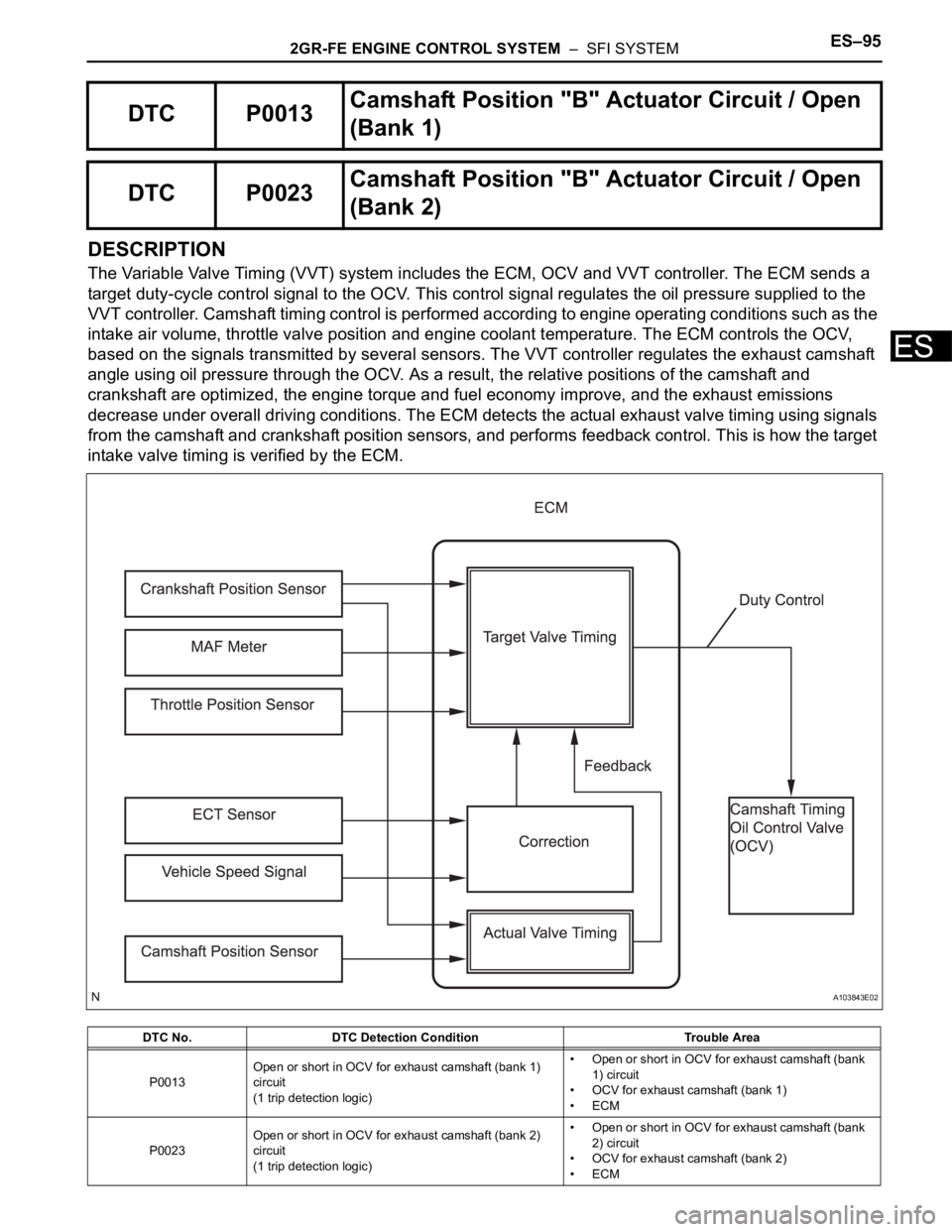
The Variable Valve Timing (VVT) system includes the ECM, OCV and VVT controller. The ECM sends a
target duty-cycle control signal to the OCV. This control signal regulates the oil pressure supplied to the
VVT controller. Camshaft timing control is performed according to engine operating conditions such as the
intake air volume, throttle valve position and engine coolant temperature. The ECM controls the OCV,
based on the signals transmitted by several sensors. The VVT controller regulates the exhaust camshaft
angle using oil pressure through the OCV. As a result, the relative positions of the camshaft and
crankshaft are optimized, the engine torque and fuel economy improve, and the exhaust emissions
decrease under overall driving conditions. The ECM detects the actual exhaust valve timing using signals
from the camshaft and crankshaft position sensors, and performs feedback control. This is how the target
intake valve timing is verified by the ECM.
DTC P0013Camshaft Position "B" Actuator Circuit / Open
(Bank 1)
DTC P0023Camshaft Position "B" Actuator Circuit / Open
(Bank 2)
DTC No. DTC Detection Condition Trouble Area
P0013Open or short in OCV for exhaust camshaft (bank 1)
circuit
(1 trip detection logic)• Open or short in OCV for exhaust camshaft (bank
1) circuit
• OCV for exhaust camshaft (bank 1)
•ECM
P0023Open or short in OCV for exhaust camshaft (bank 2)
circuit
(1 trip detection logic)• Open or short in OCV for exhaust camshaft (bank
2) circuit
• OCV for exhaust camshaft (bank 2)
•ECM
A103843E02
Page 402 of 3000

ES–962GR-FE ENGINE CONTROL SYSTEM – SFI SYSTEM
ES
MONITOR DESCRIPTION
The ECM optimizes the valve timing using the VVT system to control the exhaust camshaft. The VVT
system includes the ECM, the OCV and the VVT controller. The ECM sends a target duty-cycle control
signal to the OCV. This control signal regulates the oil pressure supplied to the VVT controller. The VVT
controller can advance or retard the exhaust camshaft.
After the ECM sends the target duty-cycle signal to the OCV, the ECM monitors the OCV current to
establish an actual duty-cycle. The ECM determines the existence of a malfunction and sets the DTC
when the actual duty-cycle ratio varies from the target duty-cycle ratio.
MONITOR STRATEGY
TYPICAL ENABLING CONDITIONS
TYPICAL MALFUNCTION THRESHOLDS
COMPONENT OPERATING RANGE
Related DTCsP0013: VVT OCV (bank 1) open/short
P0023: VVT OCV (bank 2) open/short
Required sensors / components (Main) VVT OCV (Variable Valve Timing oil control valve)
Required sensors / components (Sub) -
Frequency of operation Continuous
Duration 1 second
MIL operation Immediate
Sequence of operation None
Monitor runs whenever following DTCs are not present None
All of the following conditions are met: -
Starter OFF
Engine switch ON
Time after engine switch off to on 0.5 seconds or more
One of the following conditions is met: Condition A, B or C
A. All of the following conditions are met: -
Battery voltage 11 to 13 V
Target duty ratio Less than 70%
B. All of the following conditions are met: -
Battery voltage 13 V or more
Target duty ratio Less than 80%
C. All of the following conditions are met: -
Current cut status Not cut
VVT duty ratio More than 3 %, and less than 100 %
Page 407 of 3000

2GR-FE ENGINE CONTROL SYSTEM – SFI SYSTEMES–101
ES
MONITOR STRATEGY
TYPICAL ENABLING CONDITIONS
TYPICAL MALFUNCTION THRESHOLDS
Advanced camshaft timing:
Retarded camshaft timing:
If the difference between the target and actual camshaft timings is greater than the specified value, the
ECM operates the VVT actuator.
Then, the ECM monitors the camshaft timing change for 5 seconds.
WIRING DIAGRAM
Refer to DTC P0013 (See page ES-89).
INSPECTION PROCEDURE
HINT:
• If DTC P0014 or P0015 is displayed, check the bank 1 VVT system circuit.
• Bank 1 refers to the bank that includes cylinder No. 1.
• If DTC P0024 or P0025 is displayed, check the bank 2 VVT system circuit.
• Bank 2 refers to the bank that does not include cylinder No. 1.
Related DTCsP0014: Advanced exhaust camshaft timing (bank 1)
P0015: Retarded exhaust camshaft timing (bank 1)
P0024: Advanced exhaust camshaft timing (bank 2)
P0025: Retarded exhaust camshaft timing (bank 2)
Required Sensors / Components (Main) VVT OCV and VVT Actuator
Required Sensors / Components (Related)P0014 and P0015:
Exhaust camshaft control actuator bank 1
Exhaust OCV bank 1
P0024 and P0025:
Exhaust camshaft control actuator bank 2
Exhaust OCV bank 2
Frequency of Operation Continuously
Duration Less than 10 seconds
MIL OperationP0014 and P0024: Immediate
P0015 and P0025: 2 driving cycles
Sequence of Operation None
The monitor will run whenever these DTCs are not
presentNone
Battery voltage 11 V or more
Engine RPM 500 to 4000 rpm
Engine coolant temperature 75 to 100
C (167 to 212F)
Valve timing No change
Valve timing Advanced position
Valve timing No change
Valve timing Retarded position
Abnormal bankAdvanced timing over
(Valve timing is out of specified range)Retarded timing over
(Valve timing is out of specified range)
Bank 1 P0014 P0015
Bank 2 P0024 P0025
Page 412 of 3000

ES–1062GR-FE ENGINE CONTROL SYSTEM – SFI SYSTEM
ES
DESCRIPTION
Refer to DTC P0335 (See page ES-220).
MONITOR DESCRIPTION
DTC P0016 and P0018
The ECM optimizes the valve timing by using the VVT (Variable Valve Timing) system to control the intake
camshaft. The VVT system includes the ECM, the Oil Control Valve (OCV) and the VVT controller.
The ECM sends a target duty-cycle control signal to the OCV. This control signal regulates the oil
pressure applied to the VVT controller. The VVT controller can advance or retard the intake camshaft. The
ECM calibrates the intake valve timing by setting the intake camshaft to the most retarded angle while the
engine is idling. The ECM closes the OCV to retard the cam. The ECM stores this value as the VVT
learning value. When the difference between the target and actual intake valve timings is 5
CA
(Crankshaft Angle) or less, the ECM stores it.
If the VVT learning value matches the following conditions, the ECM determines the existence of a
malfunction in the VVT system, and sets the DTC.
• The VVT learning value: Less than 18.5
CA, or more than 43.5 CA.
• The above condition continues for 18 seconds or more.
This DTC indicates that the intake camshaft has been installed toward the crankshaft at an incorrect
angle, caused by factors such as the timing chain having jumped a tooth.
This monitor begins to run after the engine has idled for 5 minutes.
DTC P0017 and P0019
The ECM checks valve timing (VVT learning value) on the exhaust side while the engine is running at a
low speed, in order to monitor the gap between current and target valve timings on the exhaust side. The
VVT learning value is calculated from the positions of the camshaft and crankshaft. The camshaft will
come to the most retarded position when the engine is running at a low speed. If the camshaft position is
normal, the VVT learning value should be within the specified range. If the VVT learning value is not within
the specified range, the ECM determines this as a malfunction.
DTC P0016Crankshaft Position - Camshaft Position Corre-
lation (Bank 1 Sensor A)
DTC P0017Crankshaft Position - Camshaft Position Corre-
lation (Bank 1 Sensor B)
DTC P0018Crankshaft Position - Camshaft Position Corre-
lation (Bank 2 Sensor A)
DTC P0019Crankshaft Position - Camshaft Position Corre-
lation (Bank 2 Sensor B)
DTC No. DTC Detection Condition Trouble Area
P0016Deviations in crankshaft and camshaft position sensor
(for intake camshaft) 1 signals (2 trip detection logic)
• Mechanical system (Timing chain has jumped teeth
or chain stretched)
•ECM P0017Deviations in crankshaft and camshaft position sensor
(for exhaust camshaft) 1 signals (2 trip detection logic)
P0018Deviations in crankshaft and camshaft position sensor
(for intake camshaft) 2 signals (2 trip detection logic)
P0019Deviations in crankshaft and camshaft position sensor
(for exhaust camshaft) 2 signals (2 trip detection logic)
Page 413 of 3000

2GR-FE ENGINE CONTROL SYSTEM – SFI SYSTEMES–107
ES
MONITOR STRATEGY
TYPICAL ENABLING CONDITIONS
All:
P0016 and P0018:
P0017 and P0019:
TYPICAL MALFUNCTION THRESHOLDS
P0016 and P0018:
P0017 and P0019:
WIRING DIAGRAM
Refer to DTC P0335 (See page ES-222).
INSPECTION PROCEDURE
HINT:
Read freeze frame data using the intelligent tester. The ECM records vehicle and driving condition
information as freeze frame data the moment a DTC is stored. When troubleshooting, freeze frame data
can be helpful in determining whether the vehicle was running or stopped, whether the engine was
warmed up or not, whether the air-fuel ratio was lean or rich, as well as other data recorded at the time of
a malfunction.
Related DTCsP0016: Deviation in crankshaft position sensor signal and camshaft position sensor
signal (Bank 1)
P0017: Deviation in crankshaft position sensor signal and camshaft position sensor
signal (Bank 1 Sensor 2)
P0018: Deviation in crankshaft position sensor signal and camshaft position sensor
signal (Bank 2)
P0019: Deviation in crankshaft position sensor signal and camshaft position sensor
signal (Bank 2 Sensor 2)
Required Sensors / Components (Main)P0016 and P0018: VVT actuator
P0017 and P0019: Timing chain/belt
Required Sensors / Components (Related)P0016 and P0018: Camshaft position sensor, Crankshaft position sensor
P0017 and P0019: None
Frequency of Operation Once per driving cycle
Duration Less than 60 seconds
MIL Operation 2 driving cycles
Sequence of Operation None
The monitor will run whenever these DTCs are not
presentP0011, P0012 (VVT System 1-Advance, Retard), P0021, P0022 (VVT System 2-
Adavance, Retard), P0115, P0116, P0117, P0118 (ECT Sensor)
Engine RPM 500 to 1000 rpm
VVT feedback mode Executing
VVT Maximum advanced position
Engine RPM 500 to 1000 rpm
One of the following conditions is met: Condition 1 or 2
1. VVT learning value at maximum retarded valve
timingLess than 18.5
CA
2. VVT learning value at maximum retarded valve
timingMore than 43.5
CA
One of the following conditions is met: Condition 1 or 2
1. VVT learning value Less than 77
CA
2. VVT learning value More than 102
CA
Page 415 of 3000
2GR-FE ENGINE CONTROL SYSTEM – SFI SYSTEMES–109
ES
HINT:
• Although the DTC titles say the oxygen sensor, these DTCs relate to the Air-Fuel Ratio (A/F) sensor.
• Sensor 1 refers to the sensor mounted in front of the Three-Way Catalytic Converter (TWC) and
located near the engine assembly.
DESCRIPTION
Refer to DTC P2195 (See page ES-355).
HINT:
• When any of these DTCs are set, the ECM enters fail-safe mode. The ECM turns off the A/F sensor
heater in fail-safe mode. Fail-safe mode continues until the ignition switch is turned off.
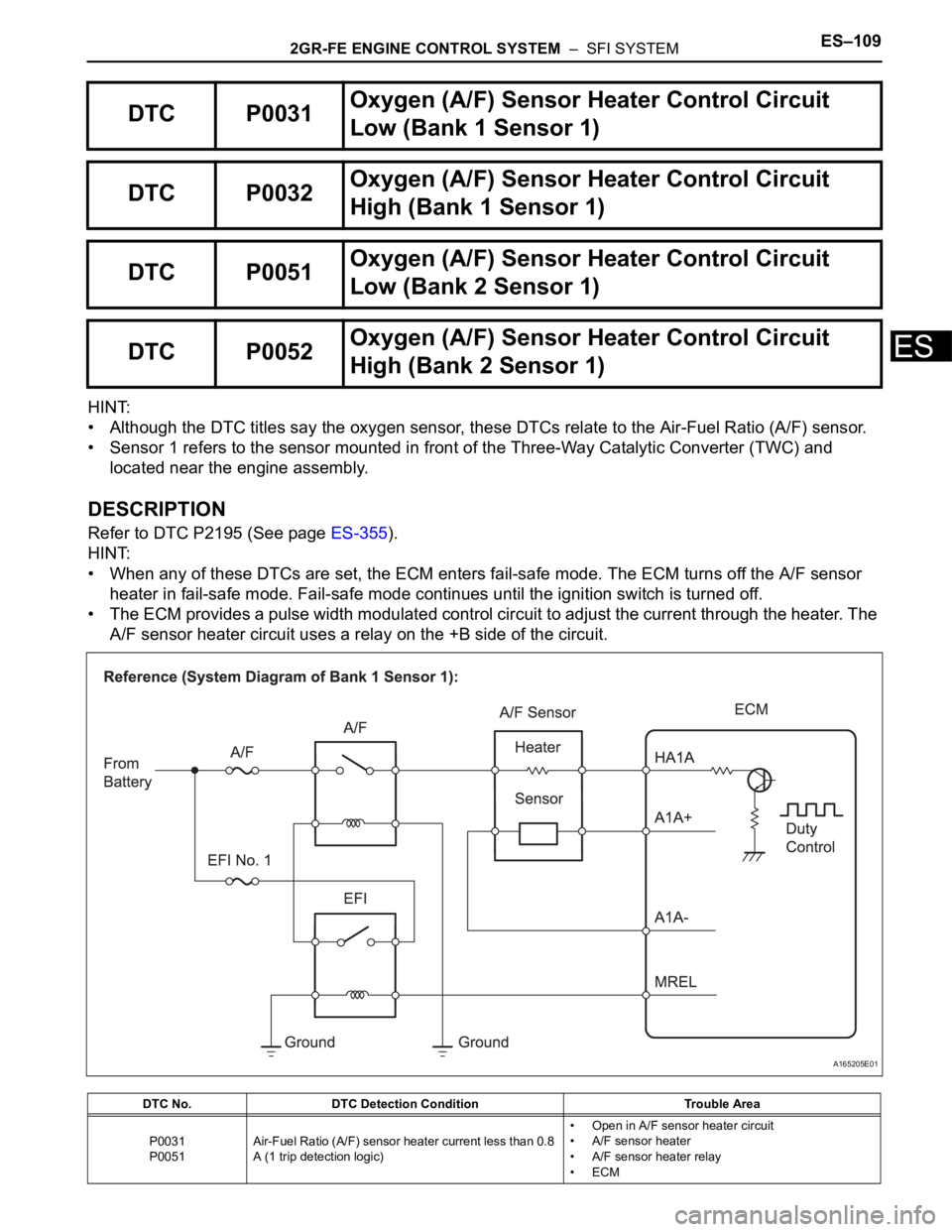
• The ECM provides a pulse width modulated control circuit to adjust the current through the heater. The
A/F sensor heater circuit uses a relay on the +B side of the circuit.
DTC P0031Oxygen (A/F) Sensor Heater Control Circuit
Low (Bank 1 Sensor 1)
DTC P0032Oxygen (A/F) Sensor Heater Control Circuit
High (Bank 1 Sensor 1)
DTC P0051Oxygen (A/F) Sensor Heater Control Circuit
Low (Bank 2 Sensor 1)
DTC P0052Oxygen (A/F) Sensor Heater Control Circuit
High (Bank 2 Sensor 1)
DTC No. DTC Detection Condition Trouble Area
P0031
P0051Air-Fuel Ratio (A/F) sensor heater current less than 0.8
A (1 trip detection logic)• Open in A/F sensor heater circuit
• A/F sensor heater
• A/F sensor heater relay
•ECM
A165205E01
Page 416 of 3000

ES–1102GR-FE ENGINE CONTROL SYSTEM – SFI SYSTEM
ES
HINT:
• Bank 1 refers to the bank that includes cylinder No. 1.
• Bank 2 refers to the bank that does not include cylinder No. 1.
• Sensor 1 refers to the closest sensor to the engine assembly.
• Sensor 2 refers to the furthest sensor away from the engine assembly.
MONITOR DESCRIPTION
The ECM uses information from the Air-Fuel Ratio (A/F) sensor to regulate the air-fuel ratio and keep it
close to the stoichiometric level. This maximizes the ability of the Three-Way Catalytic Converter (TWC) to
purify the exhaust gas.
The A/F sensor detects oxygen levels in the exhaust gas and transmits the information to the ECM. The
inner surface of the sensor element is exposed to the outside air. The outer surface of the sensor element
is exposed to the exhaust gas. The sensor element is made of platinum coated zirconia and includes an
integrated heating element.
The zirconia element generates small voltage when there is a large difference in the oxygen
concentrations between the exhaust gas and outside air. The platinum coating amplifies this voltage
generation.
The A/F sensor is more efficient when heated. When the exhaust gas temperature is low, the sensor
cannot generate useful voltage signals without supplementary heating. The ECM regulates the
supplementary heating using a duty-cycle approach to adjust the average current in the sensor heater
element. If the heater current is outside the normal range, the signal transmitted by the A/F sensor will be
inaccurate, as a result, the ECM will be unable to regulate air-fuel ratio properly.
When the current in the A/F sensor heater is outside the normal operating range, the ECM interprets this
as a malfunction in the sensor heater and sets a DTC.
Example:
The ECM sets DTC P0032 or P0052 when the current in the A/F sensor heater is more than 10 A.
Conversely, when the heater current is less than 0.8 A, DTC P0031 or P0051 is set.
MONITOR STRATEGY
TYPICAL ENABLING CONDITIONS
All:
P0031 and P0051:
P0032
P0052Air-Fuel Ratio (A/F) sensor heater current more than 10
A (1 trip detection logic)• Short in A/F sensor heater circuit
• A/F sensor heater
• A/F sensor heater relay
•ECM
Related DTCsP0031: A/F sensor heater (Bank 1) range check (Low current)
P0032: A/F sensor heater (Bank 1) range check (High current)
P0051: A/F sensor heater (Bank 2) range check (Low current)
P0052: A/F sensor heater (Bank 2) range check (High current)
Required sensors / components (Main) A/F sensor heater
Required sensors / components (Related) -
Frequency of operation Continuous
Duration 10 seconds
MIL operation Immediate
Sequence operation None
The monitor will run whenever these DTCs are not
presentNone
Battery voltage 10.5 V or more
Heater ON duty ratio 50% or moreDTC No. DTC Detection Condition Trouble Area
Page 417 of 3000
2GR-FE ENGINE CONTROL SYSTEM – SFI SYSTEMES–111
ES
P0032 and P0052:
TYPICAL MALFUNCTION THRESHOLDS
P0031 and P0051:
P0032 and P0052:
COMPONENT OPERATING RANGE
MONITOR RESULT
Refer to CHECKING MONITOR STATUS (See page ES-19).
WIRING DIAGRAM
Refer to DTC P2195 (See page ES-359).
INSPECTION PROCEDURE
HINT:
Read freeze frame data using the intelligent tester. The ECM records vehicle and driving condition
information as freeze frame data the moment a DTC is stored. When troubleshooting, freeze frame data
can be helpful in determining whether the vehicle was running or stopped, whether the engine was
warmed up or not, whether the air-fuel ratio was lean or rich, as well as other data recorded at the time of
a malfunction.
Time after engine starts 10 seconds or more
Time after engine starts 10 seconds or more
Heater current Less than 0.8 A
Hybrid IC high current limit port Fail
A/F sensor heater current 0.8 A or more