coolant TOYOTA SIENNA 2007 Service Repair Manual
[x] Cancel search | Manufacturer: TOYOTA, Model Year: 2007, Model line: SIENNA, Model: TOYOTA SIENNA 2007Pages: 3000, PDF Size: 52.26 MB
Page 1774 of 3000

AX–102U151F AUTOMATIC TRANSAXLE – AUTOMATIC TRANSAXLE SYSTEM
AX
SYSTEM DESCRIPTION
The ECM uses signals from the vehicle speed sensor to detect the actual gear position (1st, 2nd, 3rd, 4th
or 5th gear).
Then the ECM compares the actual gear with the shift schedule in the ECM memory to detect mechanical
troubles of the shift solenoid valves and valve body.
MONITOR DESCRIPTION
The ECM commands gear shifts by turning the shift solenoid valves "ON/OFF". According to the input
shaft revolution, intermediate (counter) shaft revolution and output shaft revolution, the ECM detects the
actual gear position (1st, 2nd, 3rd, 4th or 5th gear position). When the gear position commanded by the
ECM and the actual gear position are not the same, the ECM illuminates the MIL and stores the DTC.
MONITOR STRATEGY
TYPICAL ENABLING CONDITIONS
All:
DTC P0796Pressure Control Solenoid "C" Performance
(Shift Solenoid Valve SL3)
DTC No. DTC Detection Condition Trouble Area
P0796The gear required by the ECM does not match the
actual gear when driving (2-trip detection logic)• Shift solenoid valve SL3 remains open or closed
• Valve body is blocked
• Automatic transaxle (clutch, brake or gear etc.)
Related DTCsP0796:
Shift solenoid valve SL3/OFF malfunction
Shift solenoid valve SL3/ON malfunction
Required sensors/ComponentsShift solenoid valve SL3, Speed sensor (NT), Speed sensor (NC), Crankshaft
position sensor (NE)
Frequency of operation Continuous
DurationOFF malfunction (A)
0.8 sec.
OFF malfunction (B)
1 sec.
ON malfunction (A) and (B)
0.8 sec.
ON malfunction (C)
0.4 sec.
MIL operation 2 driving cycles
Sequence of operation None
The monitor will run whenever this DTC is not present.P0115 - P0118 (ECT sensor)
P0125 (Insufficient ECT for closed loop)
P0500 (VSS)
P0748, P0778, P0798 (Shift solenoid valve (range))
ECT (Engine coolant temperature) 10
C (50F) or more
Transmission range"D"
TFT (Transmission fluid temperature) -20
C (-4F) or more
TFT sensor circuitNot circuit malfunction
ECT sensor circuitNot circuit malfunction
Turbine speed sensor circuit Not circuit malfunction
Intermediate shaft speed sensor circuit Not circuit malfunction
Output speed sensor circuit Not circuit malfunction
Shift solenoid valve SL1 circuit Not circuit malfunction
Shift solenoid valve SL2 circuit Not circuit malfunction
Page 1802 of 3000
AX–10U151F AUTOMATIC TRANSAXLE – AUTOMATIC TRANSAXLE SYSTEM
AX
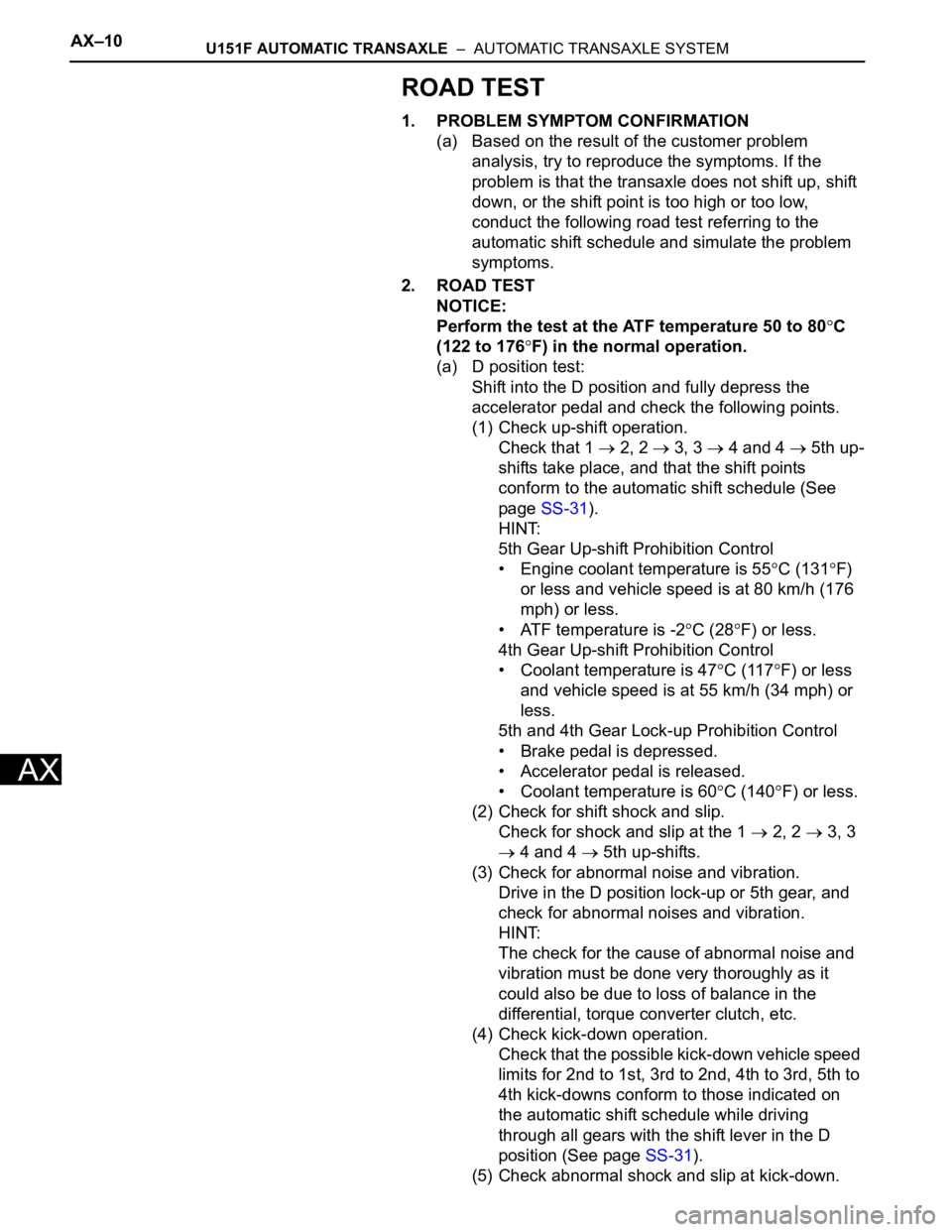
ROAD TEST
1. PROBLEM SYMPTOM CONFIRMATION
(a) Based on the result of the customer problem
analysis, try to reproduce the symptoms. If the
problem is that the transaxle does not shift up, shift
down, or the shift point is too high or too low,
conduct the following road test referring to the
automatic shift schedule and simulate the problem
symptoms.
2. ROAD TEST
NOTICE:
Perform the test at the ATF temperature 50 to 80
C
(122 to 176
F) in the normal operation.
(a) D position test:
Shift into the D position and fully depress the
accelerator pedal and check the following points.
(1) Check up-shift operation.
Check that 1
2, 2 3, 3 4 and 4 5th up-
shifts take place, and that the shift points
conform to the automatic shift schedule (See
page SS-31).
HINT:
5th Gear Up-shift Prohibition Control
• Engine coolant temperature is 55
C (131F)
or less and vehicle speed is at 80 km/h (176
mph) or less.
• ATF temperature is -2
C (28F) or less.
4th Gear Up-shift Prohibition Control
• Coolant temperature is 47
C (117F) or less
and vehicle speed is at 55 km/h (34 mph) or
less.
5th and 4th Gear Lock-up Prohibition Control
• Brake pedal is depressed.
• Accelerator pedal is released.
• Coolant temperature is 60
C (140F) or less.
(2) Check for shift shock and slip.
Check for shock and slip at the 1
2, 2 3, 3
4 and 4 5th up-shifts.
(3) Check for abnormal noise and vibration.
Drive in the D position lock-up or 5th gear, and
check for abnormal noises and vibration.
HINT:
The check for the cause of abnormal noise and
vibration must be done very thoroughly as it
could also be due to loss of balance in the
differential, torque converter clutch, etc.
(4) Check kick-down operation.
Check that the possible kick-down vehicle speed
limits for 2nd to 1st, 3rd to 2nd, 4th to 3rd, 5th to
4th kick-downs conform to those indicated on
the automatic shift schedule while driving
through all gears with the shift lever in the D
position (See page SS-31).
(5) Check abnormal shock and slip at kick-down.
Page 1820 of 3000

AX–20U151F AUTOMATIC TRANSAXLE – AUTOMATIC TRANSAXLE SYSTEM
AX
MONITOR DRIVE PATTERN
1. MONITOR DRIVE PATTERN FOR ECT TEST
(a) Perform this drive pattern as one method to
simulate the detection conditions of the ECT
malfunctions. (The DTCs may not be detected due
the actual driving conditions. And some codes may
not be detected through this drive pattern.)
HINT:
Preparation for driving
• Warm up the engine sufficiently. (Engine coolant
temperature is 60
C (140F) or higher)
• Drive the vehicle when the atmospheric
temperature is -10
C (14F) or higher.
(Malfunction is not detected when the
atmospheric temperature is less than -10
C
(14
F))
Driving note
• Drive the vehicle through all gears.
Stop
1st 2nd 3rd 4th 5th 5th
(lock-up ON).
• Repeat the above driving pattern three times or
more.
NOTICE:
• The monitor status can be checked using the
OBD II scan tool or intelligent tester. When
using the intelligent tester, monitor status
can be found in the "ENHANCED OBD II /
DATA LIST" or under "CARB OBD II".
• In the event that the drive pattern must be
interrupted (possibly due to traffic conditions
or other factors), the drive pattern can be
resumed and, in most cases, the monitor can
be completed.
• Perform this drive pattern on a level road as
much as possible and strictly observe the
posted speed limits and traffic laws while
driving.
Page 1828 of 3000
AX–22U151F AUTOMATIC TRANSAXLE – AUTOMATIC TRANSAXLE SYSTEM
AX
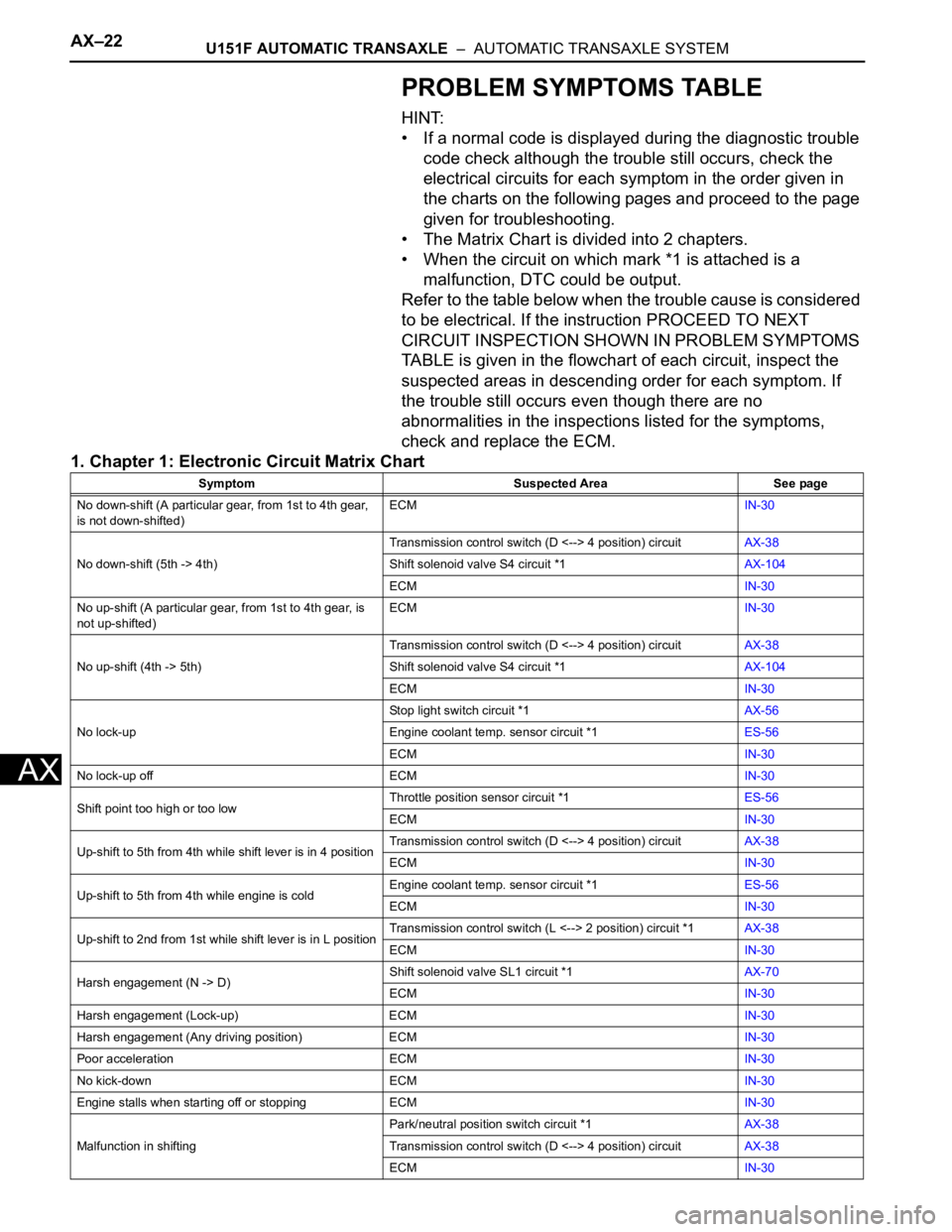
PROBLEM SYMPTOMS TABLE
HINT:
• If a normal code is displayed during the diagnostic trouble
code check although the trouble still occurs, check the
electrical circuits for each symptom in the order given in
the charts on the following pages and proceed to the page
given for troubleshooting.
• The Matrix Chart is divided into 2 chapters.
• When the circuit on which mark *1 is attached is a
malfunction, DTC could be output.
Refer to the table below when the trouble cause is considered
to be electrical. If the instruction PROCEED TO NEXT
CIRCUIT INSPECTION SHOWN IN PROBLEM SYMPTOMS
TABLE is given in the flowchart of each circuit, inspect the
suspected areas in descending order for each symptom. If
the trouble still occurs even though there are no
abnormalities in the inspections listed for the symptoms,
check and replace the ECM.
1. Chapter 1: Electronic Circuit Matrix Chart
Symptom Suspected Area See page
No down-shift (A particular gear, from 1st to 4th gear,
is not down-shifted)ECMIN-30
No down-shift (5th -> 4th)Transmission control switch (D <--> 4 position) circuitAX-38
Shift solenoid valve S4 circuit *1AX-104
ECMIN-30
No up-shift (A particular gear, from 1st to 4th gear, is
not up-shifted)ECMIN-30
No up-shift (4th -> 5th)Transmission control switch (D <--> 4 position) circuitAX-38
Shift solenoid valve S4 circuit *1AX-104
ECMIN-30
No lock-upStop light switch circuit *1AX-56
Engine coolant temp. sensor circuit *1ES-56
ECMIN-30
No lock-up off ECMIN-30
Shift point too high or too lowThrottle position sensor circuit *1ES-56
ECMIN-30
Up-shift to 5th from 4th while shift lever is in 4 positionTransmission control switch (D <--> 4 position) circuitAX-38
ECMIN-30
Up-shift to 5th from 4th while engine is coldEngine coolant temp. sensor circuit *1ES-56
ECMIN-30
Up-shift to 2nd from 1st while shift lever is in L positionTransmission control switch (L <--> 2 position) circuit *1AX-38
ECMIN-30
Harsh engagement (N -> D)Shift solenoid valve SL1 circuit *1AX-70
ECMIN-30
Harsh engagement (Lock-up) ECMIN-30
Harsh engagement (Any driving position) ECMIN-30
Poor acceleration ECMIN-30
No kick-down ECMIN-30
Engine stalls when starting off or stopping ECMIN-30
Malfunction in shiftingPark/neutral position switch circuit *1AX-38
Transmission control switch (D <--> 4 position) circuitAX-38
ECMIN-30
Page 1846 of 3000
AX–30U151F AUTOMATIC TRANSAXLE – AUTOMATIC TRANSAXLE SYSTEM
AX
(g) Freeze frame data records the engine conditions
(fuel system, calculated load, engine coolant
temperature, fuel trim, engine speed, vehicle speed,
etc.) when a malfunction is detected. When
troubleshooting, freeze frame data can help
determine if the vehicle was running or stopped, if
the engine was warmed up or not, if the air/fuel ratio
was Lean or Rich, and other data from the time the
malfunction occurred.
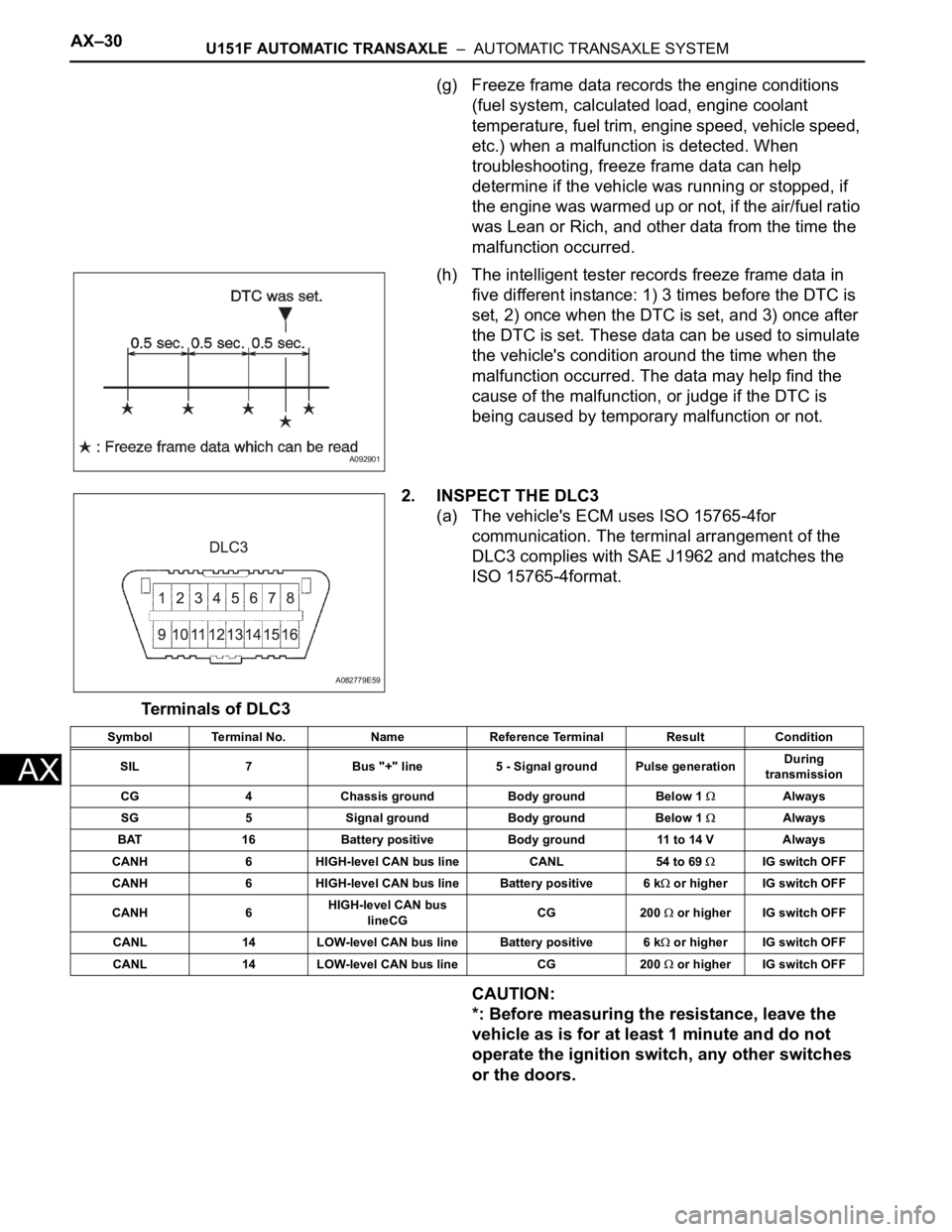
(h) The intelligent tester records freeze frame data in
five different instance: 1) 3 times before the DTC is
set, 2) once when the DTC is set, and 3) once after
the DTC is set. These data can be used to simulate
the vehicle's condition around the time when the
malfunction occurred. The data may help find the
cause of the malfunction, or judge if the DTC is
being caused by temporary malfunction or not.
2. INSPECT THE DLC3
(a) The vehicle's ECM uses ISO 15765-4for
communication. The terminal arrangement of the
DLC3 complies with SAE J1962 and matches the
ISO 15765-4format.
Terminals of DLC3
CAUTION:
*: Before measuring the resistance, leave the
vehicle as is for at least 1 minute and do not
operate the ignition switch, any other switches
or the doors.
A092901
A082779E59
Symbol Terminal No. Name Reference Terminal Result Condition
SIL 7 Bus "+" line 5 - Signal ground Pulse generationDuring
transmission
CG 4 Chassis ground Body ground Below 1
Always
SG 5 Signal ground Body ground Below 1
Always
BAT 16 Battery positive Body ground 11 to 14 V Always
CANH 6 HIGH-level CAN bus line CANL 54 to 69
IG switch OFF
CANH 6 HIGH-level CAN bus line Battery positive 6 k
or higher IG switch OFF
CANH 6HIGH-level CAN bus
lineCGCG 200
or higher IG switch OFF
CANL 14 LOW-level CAN bus line Battery positive 6 k
or higher IG switch OFF
CANL 14 LOW-level CAN bus line CG 200
or higher IG switch OFF
Page 2918 of 3000

AC–18AIR CONDITIONING – AIR CONDITIONING SYSTEM (for Automatic Air Conditioning Sys-
tem)
AC
DATA LIST / ACTIVE TEST
1. DATA LIST
HINT:
Using the intelligent tester to read the Data List allows
the values or states of switches, sensors, actuators and
other items to be read without removing any parts. This
non-intrusive inspection can be very useful because
intermittent conditions or signals may be discovered
before parts or wiring is disturbed. Reading the Data List
information early in troubleshooting is one way to save
diagnostic time.
(a) Connect the intelligent tester to the DLC3.
(b) Turn the ignition switch to the ON position.
(c) From the display on the tester, read the "DATA
LIST".
AIR CONDITIONER / DATA LIST
Tester Display Measurement Item/Range Normal Condition Diagnostic Note
ROOM TEMPRoom temperature sensor / min.:
-6.5
C (20.3F), max.: 57.25C
(135.05
F)Actual cabin temperature -
AMBI TEMP SENSAmbient temperature sensor /
min.: -23.3
C (-9.94F), max.:
65..95C (150.71F)Actual ambient temperature -
AMBI TEMPAdjusted ambient temperature /
min.: -30.8
C (-23.44F), max.:
50.8
C (123.44F)--
EVAP TEMPEvaporator temperature sensor /
min.: -29.7
C (-21.46F), max.:
59.55
C (139.19F)Actual evaporator temperature -
SOLAR SENS-DSolar sensor (D side) / min.: 0,
max.: 255Changes depending on
brightness (D side)-
SOLAR SENS-PSolar sensor (P side) / min.: 0,
max.: 255Changes depending on
brightness (P side)-
COOLANT TEMPEngine coolant temperature /
min.: 1.3
C (34.34F), max.:
90.55C (194.99F)Actual engine coolant
temperature-
SET TEMP-DSet temperature (D side) / min.: 0,
max. 255Actual set temperature (D side) -
SET TEMP-PSet temperature (P side) / min.: 0,
max. 255Actual set temperature (P side) -
ESTIMATE TEMP-DEstimated temperature (D side) /
min.: -358.4
C (-613.12F), max.:
358.4
C (677.12F)--
ESTIMATE TEMP-PEstimated temperature (P side) /
min.: -358.4
C (-613.12F), max.:
358.4
C (677.12F)--
A/M DAMP POS-DAir mix damper position (D side) /
min.: -14%, max.: 113.5%Changes depending on the set
temperature (D side)-
A/M DAMP POS-PAir mix damper position (P side) /
min.: -14%, max.: 113.5%Changes depending on the set
temperature (P side)-
A/I DAMP POSAir inlet damper position / min.: -
14%, max.: 113.5%Changes depending on air inlet
damper position-
A/O DAMP POSAir outlet damper position / min.: -
14%, max.: 113.5%Changes depending on air outlet
damper position-
A/M DAMP TARG-DAir mix damper target position (D
side) / min.: -14%, max.: 113.5%Changes depending on the set
temperature (D side)-
A/M DAMP TARG-PAir mix damper target position (P
side) / min.: -14%, max.: 113.5%Changes depending on the set
temperature (P side)-