engine TOYOTA SIENNA 2007 Service Repair Manual
[x] Cancel search | Manufacturer: TOYOTA, Model Year: 2007, Model line: SIENNA, Model: TOYOTA SIENNA 2007Pages: 3000, PDF Size: 52.26 MB
Page 483 of 3000
2GR-FE ENGINE CONTROL SYSTEM – SFI SYSTEMES–177
ES
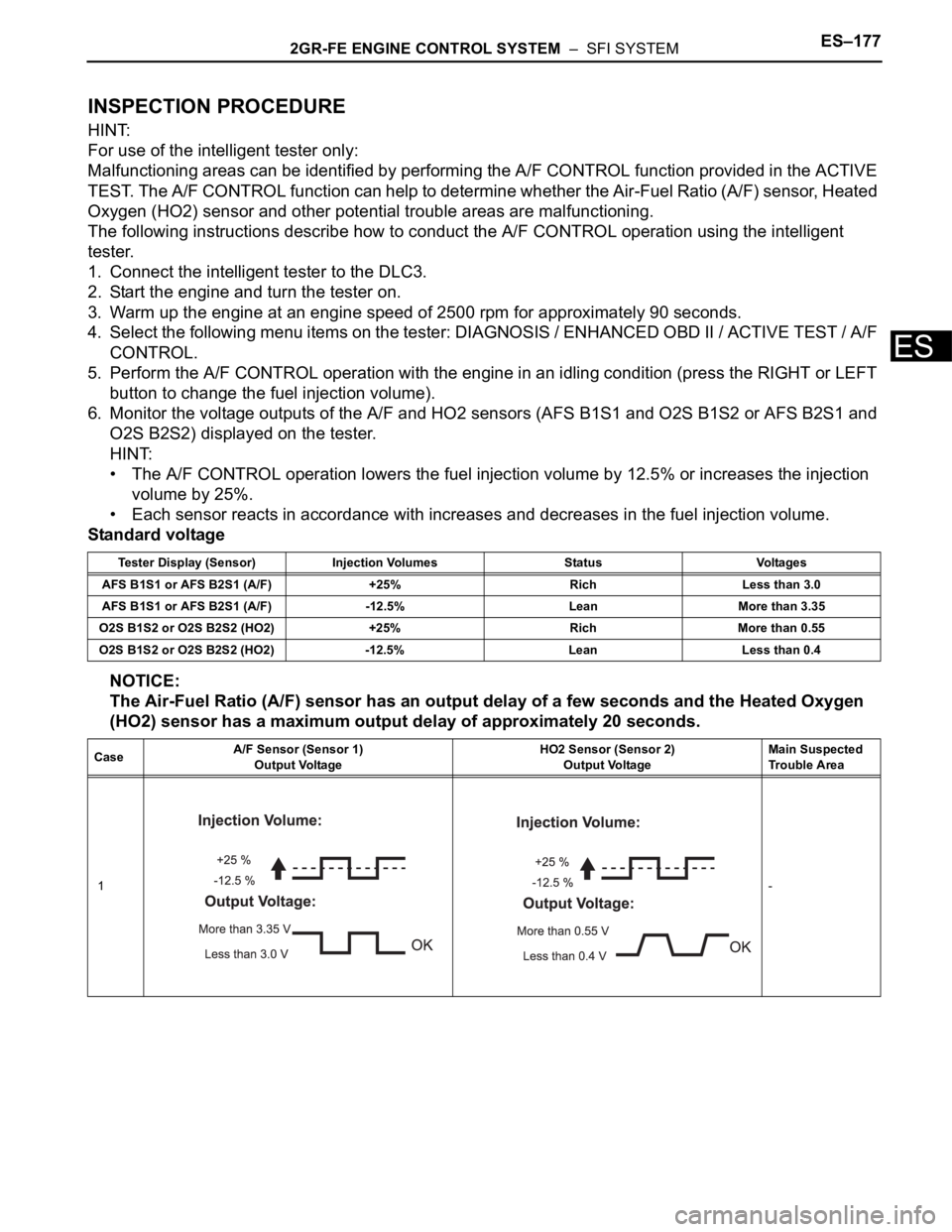
INSPECTION PROCEDURE
HINT:
For use of the intelligent tester only:
Malfunctioning areas can be identified by performing the A/F CONTROL function provided in the ACTIVE
TEST. The A/F CONTROL function can help to determine whether the Air-Fuel Ratio (A/F) sensor, Heated
Oxygen (HO2) sensor and other potential trouble areas are malfunctioning.
The following instructions describe how to conduct the A/F CONTROL operation using the intelligent
tester.
1. Connect the intelligent tester to the DLC3.
2. Start the engine and turn the tester on.
3. Warm up the engine at an engine speed of 2500 rpm for approximately 90 seconds.
4. Select the following menu items on the tester: DIAGNOSIS / ENHANCED OBD II / ACTIVE TEST / A/F
CONTROL.
5. Perform the A/F CONTROL operation with the engine in an idling condition (press the RIGHT or LEFT
button to change the fuel injection volume).
6. Monitor the voltage outputs of the A/F and HO2 sensors (AFS B1S1 and O2S B1S2 or AFS B2S1 and
O2S B2S2) displayed on the tester.
HINT:
• The A/F CONTROL operation lowers the fuel injection volume by 12.5% or increases the injection
volume by 25%.
• Each sensor reacts in accordance with increases and decreases in the fuel injection volume.
Standard voltage
NOTICE:
The Air-Fuel Ratio (A/F) sensor has an output delay of a few seconds and the Heated Oxygen
(HO2) sensor has a maximum output delay of approximately 20 seconds.
Tester Display (Sensor) Injection Volumes Status Voltages
AFS B1S1 or AFS B2S1 (A/F) +25% Rich Less than 3.0
AFS B1S1 or AFS B2S1 (A/F) -12.5% Lean More than 3.35
O2S B1S2 or O2S B2S2 (HO2) +25% Rich More than 0.55
O2S B1S2 or O2S B2S2 (HO2) -12.5% Lean Less than 0.4
CaseA/F Sensor (Sensor 1)
Output VoltageHO2 Sensor (Sensor 2)
Output VoltageMain Suspected
Trouble Area
1-
Page 484 of 3000
ES–1782GR-FE ENGINE CONTROL SYSTEM – SFI SYSTEM
ES
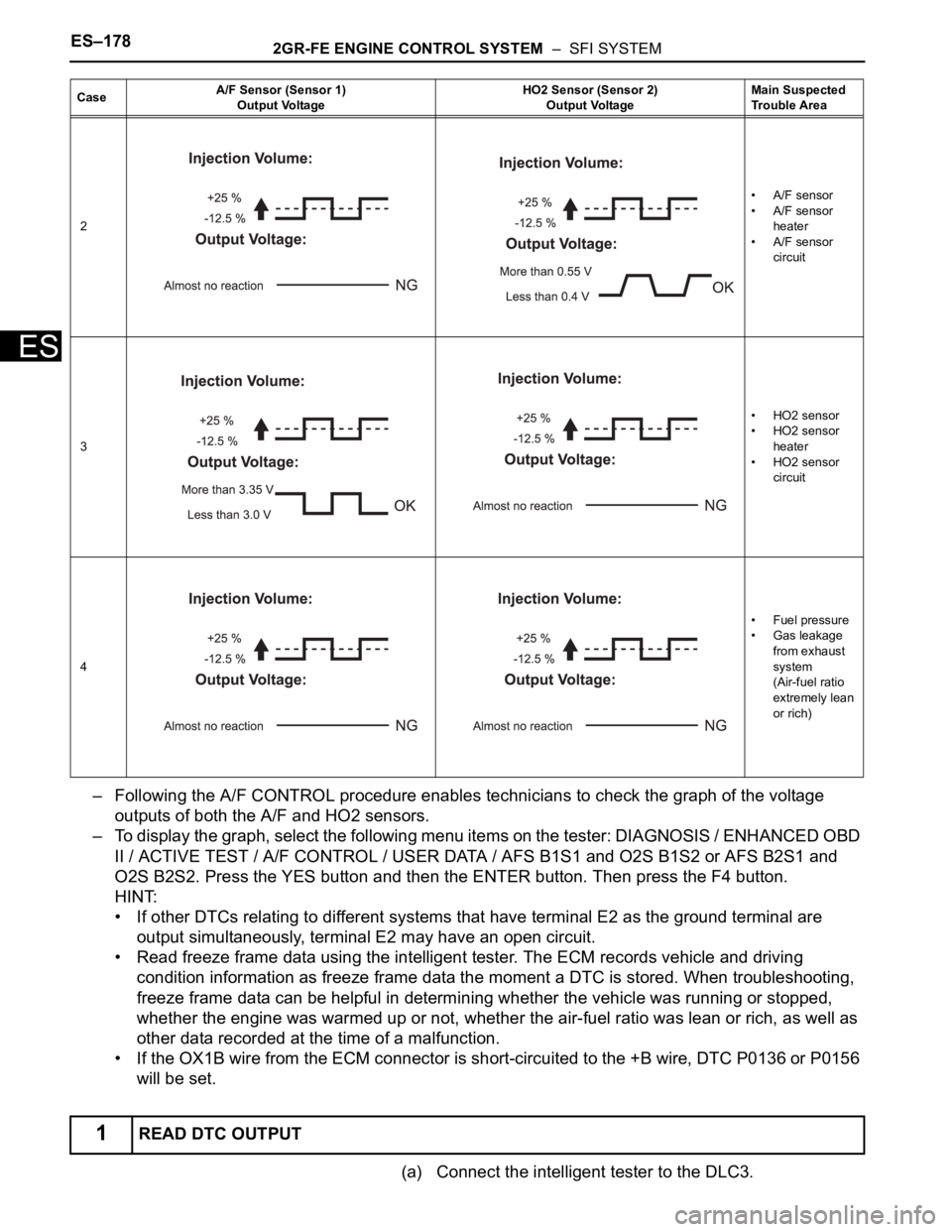
– Following the A/F CONTROL procedure enables technicians to check the graph of the voltage
outputs of both the A/F and HO2 sensors.
– To display the graph, select the following menu items on the tester: DIAGNOSIS / ENHANCED OBD
II / ACTIVE TEST / A/F CONTROL / USER DATA / AFS B1S1 and O2S B1S2 or AFS B2S1 and
O2S B2S2. Press the YES button and then the ENTER button. Then press the F4 button.
HINT:
• If other DTCs relating to different systems that have terminal E2 as the ground terminal are
output simultaneously, terminal E2 may have an open circuit.
• Read freeze frame data using the intelligent tester. The ECM records vehicle and driving
condition information as freeze frame data the moment a DTC is stored. When troubleshooting,
freeze frame data can be helpful in determining whether the vehicle was running or stopped,
whether the engine was warmed up or not, whether the air-fuel ratio was lean or rich, as well as
other data recorded at the time of a malfunction.
• If the OX1B wire from the ECM connector is short-circuited to the +B wire, DTC P0136 or P0156
will be set.
(a) Connect the intelligent tester to the DLC3.
2• A/F sensor
• A/F sensor
heater
• A/F sensor
circuit
3• HO2 sensor
• HO2 sensor
heater
• HO2 sensor
circuit
4•Fuel pressure
• Gas leakage
from exhaust
system
(Air-fuel ratio
extremely lean
or rich)
1READ DTC OUTPUT
CaseA/F Sensor (Sensor 1)
Output VoltageHO2 Sensor (Sensor 2)
Output VoltageMain Suspected
Trouble Area
Page 485 of 3000
2GR-FE ENGINE CONTROL SYSTEM – SFI SYSTEMES–179
ES
(b) Turn the ignition switch to the ON position and turn the
tester on.
(c) Select the following menu items: DIAGNOSIS /
ENHANCED OBD II / DTC INFO / CURRENT CODES.
(d) Read the DTCs.
Result
B
C
A
(a) Connect the intelligent tester to the DLC3.
(b) Turn the ignition switch to the ON position and turn the
tester on.
(c) Select the following menu items: DIAGNOSIS /
ENHANCED OBD II / DATA LIST / PRIMARY / O2S
B1S2 or O2S B2S2.
(d) Allow the engine to idle.
(e) Read the Heated Oxygen (HO2) sensor output voltage
while idling.
Result
B
A
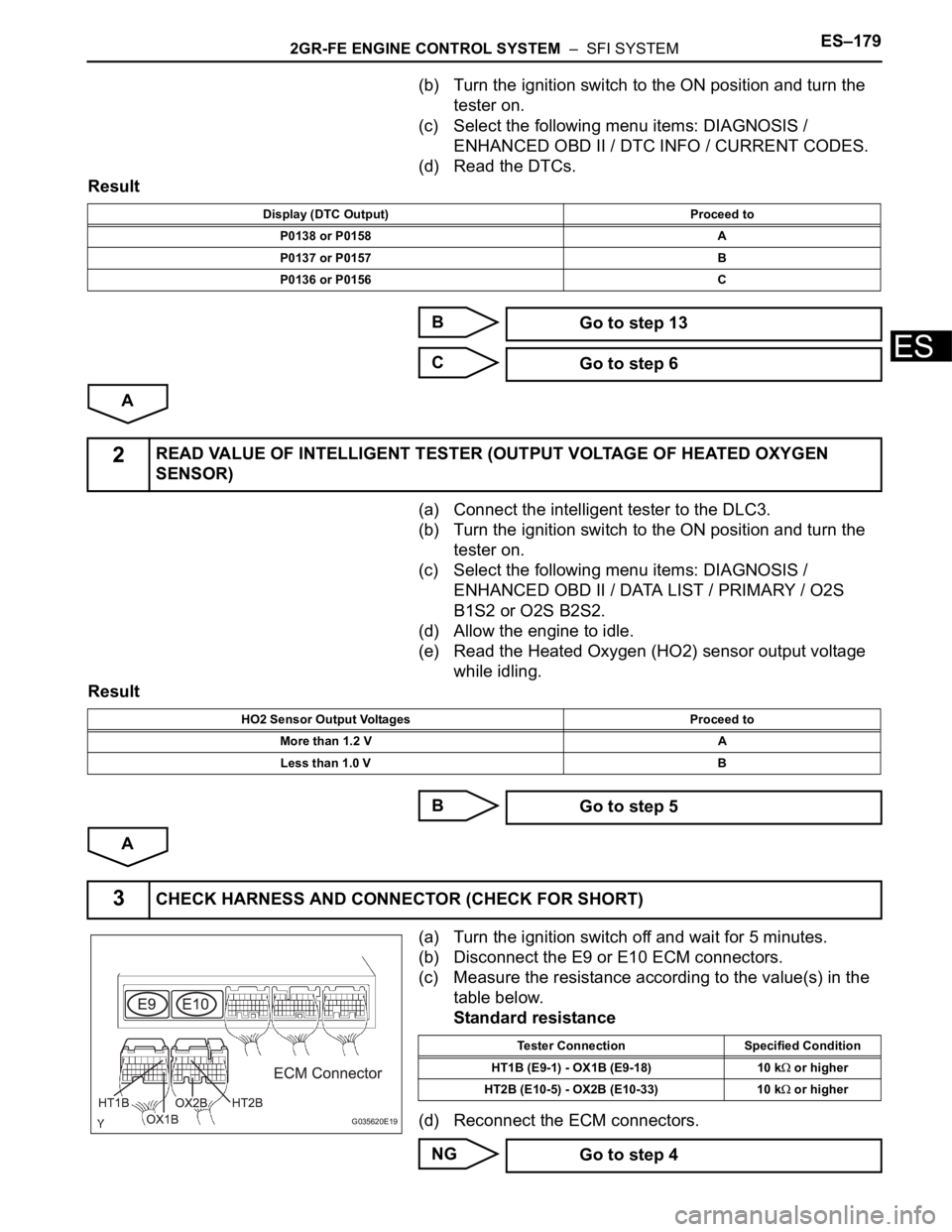
(a) Turn the ignition switch off and wait for 5 minutes.
(b) Disconnect the E9 or E10 ECM connectors.
(c) Measure the resistance according to the value(s) in the
table below.
Standard resistance
(d) Reconnect the ECM connectors.
NG
Display (DTC Output) Proceed to
P0138 or P0158 A
P0137 or P0157 B
P0136 or P0156 C
Go to step 13
Go to step 6
2READ VALUE OF INTELLIGENT TESTER (OUTPUT VOLTAGE OF HEATED OXYGEN
SENSOR)
HO2 Sensor Output Voltages Proceed to
More than 1.2 V A
Less than 1.0 V B
Go to step 5
3CHECK HARNESS AND CONNECTOR (CHECK FOR SHORT)
G035620E19
Tester Connection Specified Condition
HT1B (E9-1) - OX1B (E9-18) 10 k
or higher
HT2B (E10-5) - OX2B (E10-33) 10 k
or higher
Go to step 4
Page 486 of 3000
ES–1802GR-FE ENGINE CONTROL SYSTEM – SFI SYSTEM
ES
OK
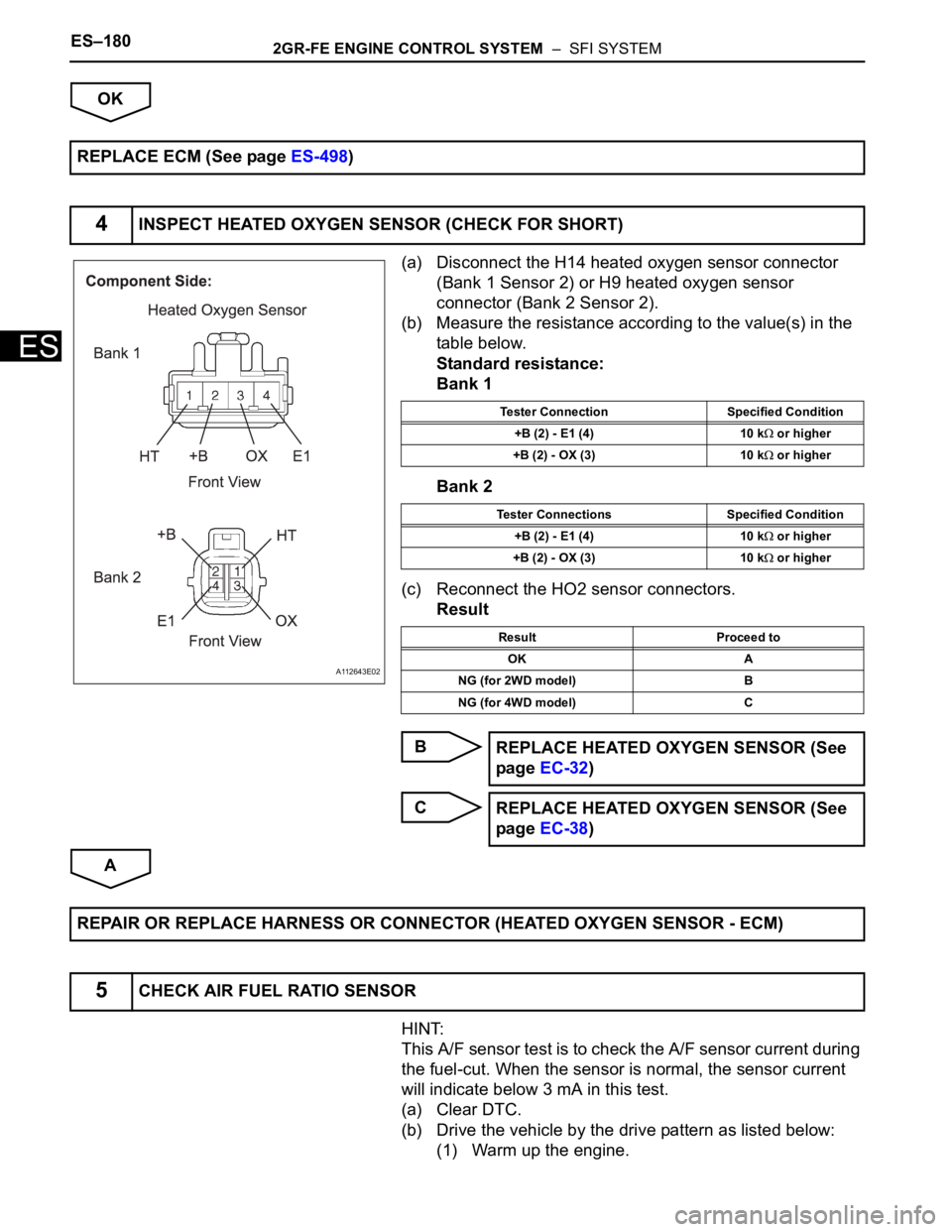
(a) Disconnect the H14 heated oxygen sensor connector
(Bank 1 Sensor 2) or H9 heated oxygen sensor
connector (Bank 2 Sensor 2).
(b) Measure the resistance according to the value(s) in the
table below.
Standard resistance:
Bank 1
Bank 2
(c) Reconnect the HO2 sensor connectors.
Result
B
C
A
HINT:
This A/F sensor test is to check the A/F sensor current during
the fuel-cut. When the sensor is normal, the sensor current
will indicate below 3 mA in this test.
(a) Clear DTC.
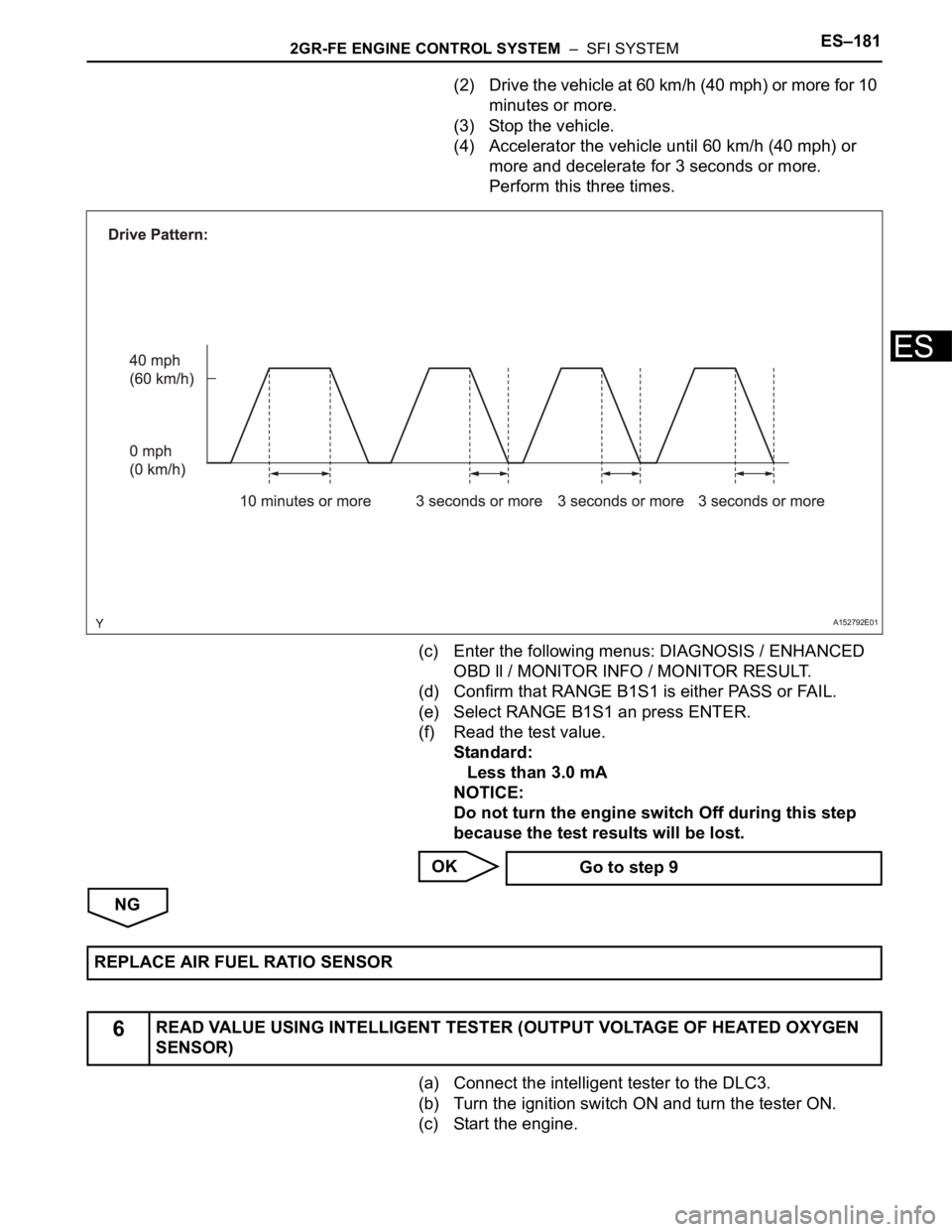
(b) Drive the vehicle by the drive pattern as listed below:
(1) Warm up the engine. REPLACE ECM (See page ES-498)
4INSPECT HEATED OXYGEN SENSOR (CHECK FOR SHORT)
A112643E02
Tester Connection Specified Condition
+B (2) - E1 (4) 10 k
or higher
+B (2) - OX (3) 10 k
or higher
Tester Connections Specified Condition
+B (2) - E1 (4) 10 k
or higher
+B (2) - OX (3) 10 k
or higher
Result Proceed to
OK A
NG (for 2WD model) B
NG (for 4WD model) C
REPLACE HEATED OXYGEN SENSOR (See
page EC-32)
REPLACE HEATED OXYGEN SENSOR (See
page EC-38)
REPAIR OR REPLACE HARNESS OR CONNECTOR (HEATED OXYGEN SENSOR - ECM)
5CHECK AIR FUEL RATIO SENSOR
Page 487 of 3000
2GR-FE ENGINE CONTROL SYSTEM – SFI SYSTEMES–181
ES
(2) Drive the vehicle at 60 km/h (40 mph) or more for 10
minutes or more.
(3) Stop the vehicle.
(4) Accelerator the vehicle until 60 km/h (40 mph) or
more and decelerate for 3 seconds or more.
Perform this three times.
(c) Enter the following menus: DIAGNOSIS / ENHANCED
OBD ll / MONITOR INFO / MONITOR RESULT.
(d) Confirm that RANGE B1S1 is either PASS or FAIL.
(e) Select RANGE B1S1 an press ENTER.
(f) Read the test value.
Standard:
Less than 3.0 mA
NOTICE:
Do not turn the engine switch Off during this step
because the test results will be lost.
OK
NG
(a) Connect the intelligent tester to the DLC3.
(b) Turn the ignition switch ON and turn the tester ON.
(c) Start the engine.
A152792E01
Go to step 9
REPLACE AIR FUEL RATIO SENSOR
6READ VALUE USING INTELLIGENT TESTER (OUTPUT VOLTAGE OF HEATED OXYGEN
SENSOR)
Page 488 of 3000
ES–1822GR-FE ENGINE CONTROL SYSTEM – SFI SYSTEM
ES
(d) Select the following menu items: DIAGNOSIS /
ENHANCED OBD ll / DATA LIST / PRIMARY / O2S B1
S2 or O2S B2 S2.
(e) After warming up the engine, run the engine at an engine
speed of 2500 rpm for 3 minutes.
(f) Read the output voltage of the HO2 sensor when the
engine rpm is suddenly increased.
HINT:
Quickly accelerate the engine to 4000 rpm 3 times using
the accelerator pedal.
Standard voltage :
Fluctuates between 0.4 V or less and 0.5 V or more.
NG
OK
NEXT
(a) On the intelligent tester, select the following menu items:
DIAGNOSIS / ENHANCED OBD ll / DTC INFO /
CURRENT CODES.
(b) Read DTCs.
Result
B
A
NEXT
NEXT
(a) On the intelligent tester, select the following menu items:
DIAGNOSIS / ENHANCED OBD ll / DTC INFO /
CURRENT CODES. Go to step 13
7PERFORM CONFIRMATION DRIVING PATTERN
8CHECK WHETHER DTC OUTPUT RECURS (DTC P0136 OR P0156)
Display (DTC Output) Proceed to
P0136 or P0156 A
No output B
CHECK FOR INTERMITTENT PROBLEMS
9REPLACE HEATED OXYGEN SENSOR
10PERFORM CONFIRMATION DRIVING PATTERN
11CHECK WHETHER DTC OUTPUT RECURS (DTC P0136 OR P0156)
Page 489 of 3000
2GR-FE ENGINE CONTROL SYSTEM – SFI SYSTEMES–183
ES
(b) Read DTCs.
Result
B
A
(a) Connect the intelligent tester to the DLC3.
(b) Start the engine and turn the tester on.
(c) Warm up the engine.
(d) Select the following menu items: DIAGNOSIS /
ENHANCED OBD II / ACTIVE TEST / INJ VOL.
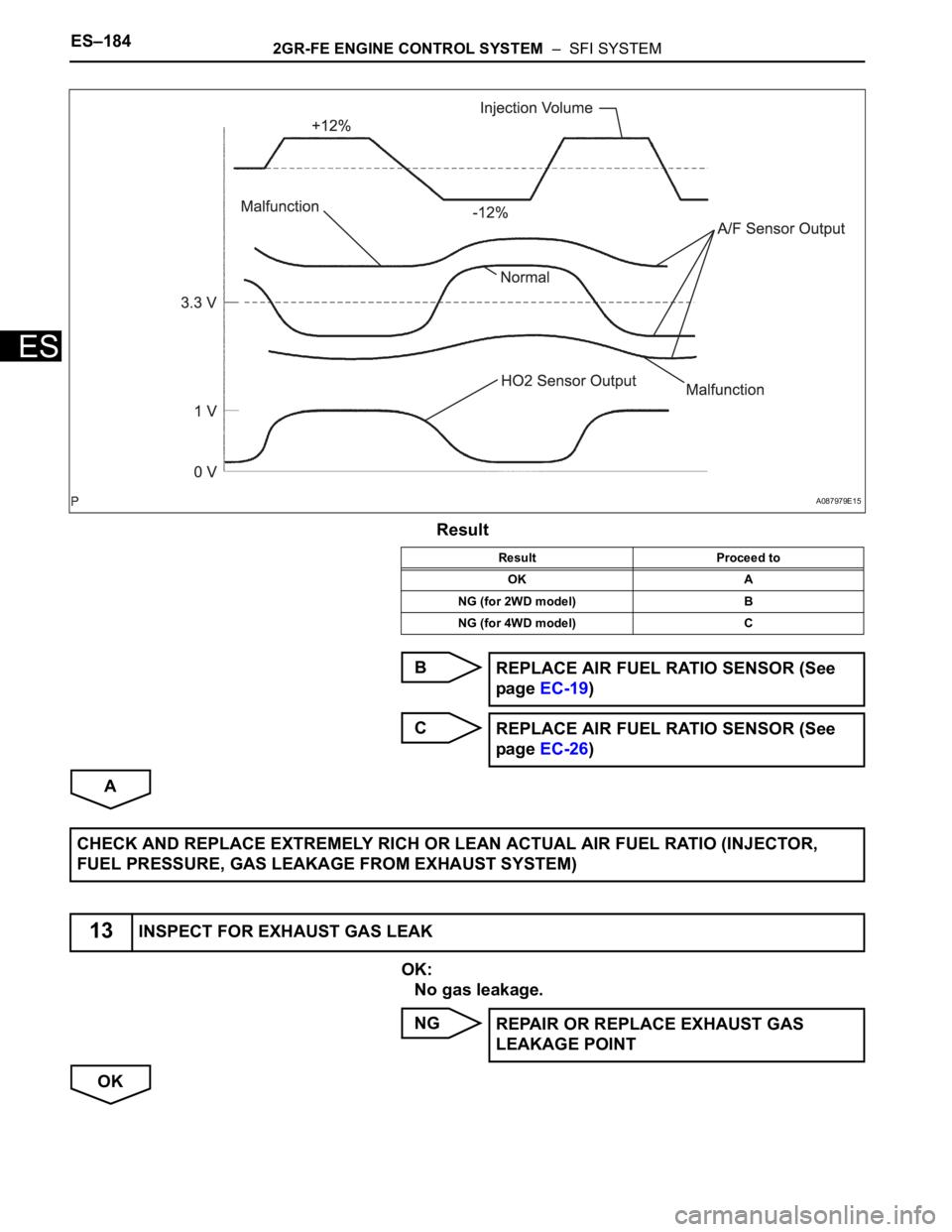
(e) Change the fuel injection volume using the tester, while
monitoring the voltage output of Air-Fuel Ratio (A/F) and
HO2 sensors displayed on the tester.
HINT:
• Change the fuel injection volume within the range of -
12% and +12%. The injection volume can be changed
in 1% graduations within the range.
• The A/F sensor is displayed as AFS B1S1 or AFS
B2S1, and the HO2 sensor is displayed as O2S B1S2
or O2S B2S2, on the intelligent tester.
Result
HINT:
A normal HO2 sensor voltage (O2S B1S2 or O2S B2S2)
reacts in accordance with increases and decreases in
fuel injection volumes. When the A/F sensor voltage
remains at either less or more than 3.3 V despite the
HO2 sensor indicating a normal reaction, the A/F sensor
is malfunctioning.
Display (DTC Output) Proceed to
P0136 or P0156 A
No output B
REPAIR COMPLETED
12PERFORM ACTIVE TEST BY INTELLIGENT TESTER (INJECTION VOLUME)
Tester Display (Sensor) Voltage Variations Proceed to
AFS B1S1 (A/F)
AFS B2S1 (A/F)Alternates between more and less than 3.3 V OK
AFS B1S1 (A/F)
AFS B2S1 (A/F)Remains at more than 3.3 V NG
AFS B1S1 (A/F)
AFS B2S1 (A/F)Remains at less than 3.3 V NG
Page 490 of 3000
ES–1842GR-FE ENGINE CONTROL SYSTEM – SFI SYSTEM
ES
Result
B
C
A
OK:
No gas leakage.
NG
OK
A087979E15
Result Proceed to
OK A
NG (for 2WD model) B
NG (for 4WD model) C
REPLACE AIR FUEL RATIO SENSOR (See
page EC-19)
REPLACE AIR FUEL RATIO SENSOR (See
page EC-26)
CHECK AND REPLACE EXTREMELY RICH OR LEAN ACTUAL AIR FUEL RATIO (INJECTOR,
FUEL PRESSURE, GAS LEAKAGE FROM EXHAUST SYSTEM)
13INSPECT FOR EXHAUST GAS LEAK
REPAIR OR REPLACE EXHAUST GAS
LEAKAGE POINT
Page 491 of 3000
2GR-FE ENGINE CONTROL SYSTEM – SFI SYSTEMES–185
ES
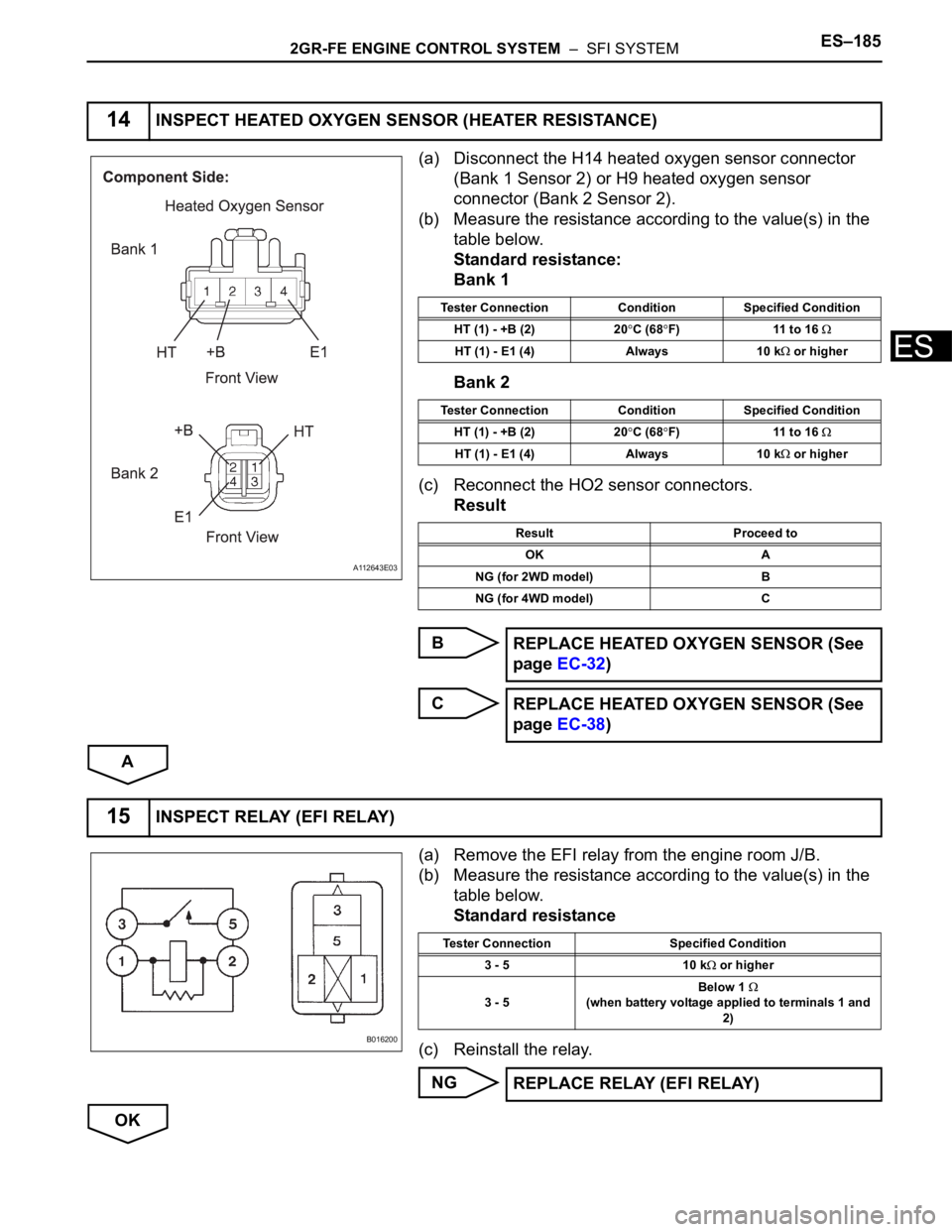
(a) Disconnect the H14 heated oxygen sensor connector
(Bank 1 Sensor 2) or H9 heated oxygen sensor
connector (Bank 2 Sensor 2).
(b) Measure the resistance according to the value(s) in the
table below.
Standard resistance:
Bank 1
Bank 2
(c) Reconnect the HO2 sensor connectors.
Result
B
C
A
(a) Remove the EFI relay from the engine room J/B.
(b) Measure the resistance according to the value(s) in the
table below.
Standard resistance
(c) Reinstall the relay.
NG
OK
14INSPECT HEATED OXYGEN SENSOR (HEATER RESISTANCE)
A112643E03
Tester Connection Condition Specified Condition
HT (1) - +B (2) 20
C (68F) 11 to 16
HT (1) - E1 (4) Always 10 k or higher
Tester Connection Condition Specified Condition
HT (1) - +B (2) 20
C (68F) 11 to 16
HT (1) - E1 (4) Always 10 k or higher
Result Proceed to
OK A
NG (for 2WD model) B
NG (for 4WD model) C
REPLACE HEATED OXYGEN SENSOR (See
page EC-32)
REPLACE HEATED OXYGEN SENSOR (See
page EC-38)
15INSPECT RELAY (EFI RELAY)
B016200
Tester Connection Specified Condition
3 - 5 10 k
or higher
3 - 5Below 1
(when battery voltage applied to terminals 1 and
2)
REPLACE RELAY (EFI RELAY)
Page 492 of 3000
ES–1862GR-FE ENGINE CONTROL SYSTEM – SFI SYSTEM
ES
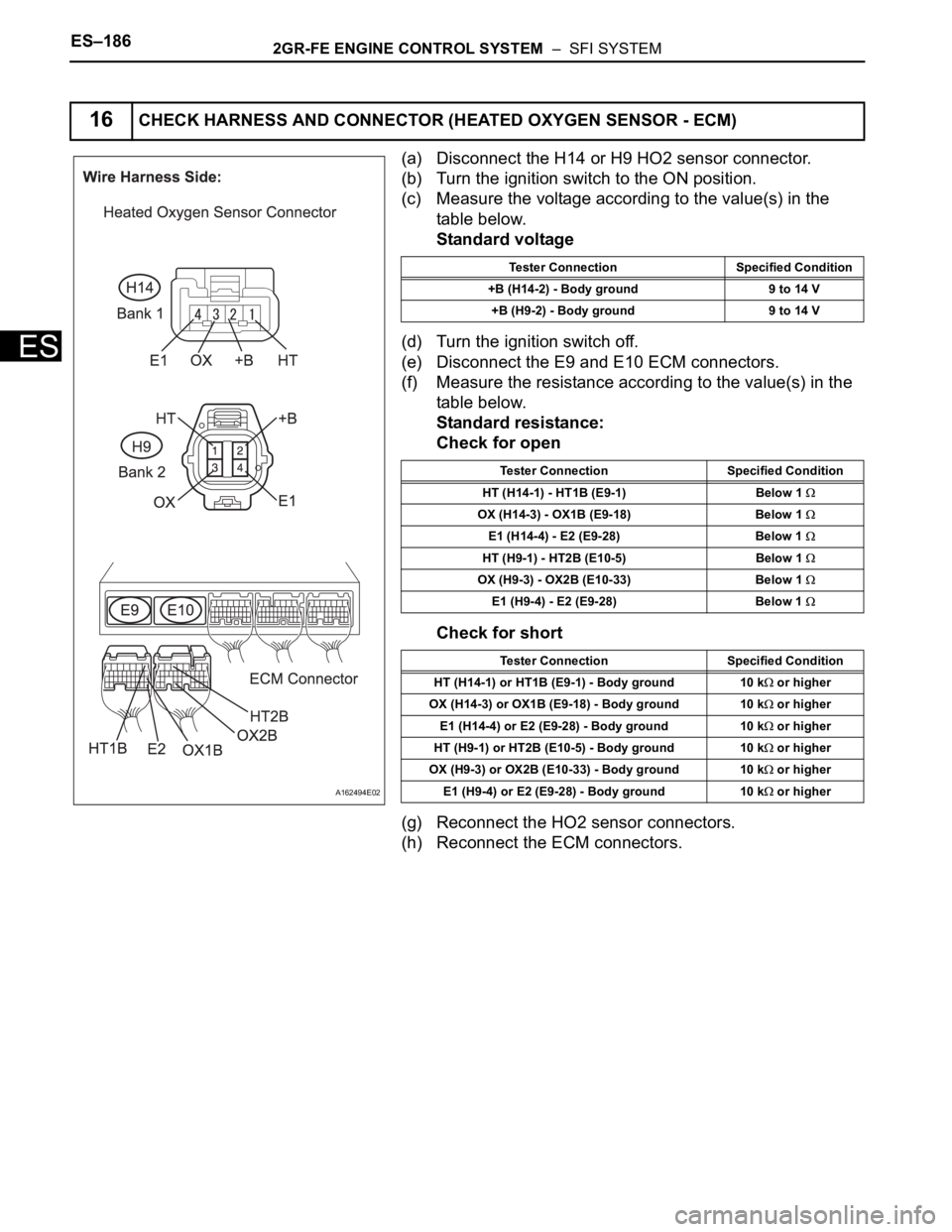
(a) Disconnect the H14 or H9 HO2 sensor connector.
(b) Turn the ignition switch to the ON position.
(c) Measure the voltage according to the value(s) in the
table below.
Standard voltage
(d) Turn the ignition switch off.
(e) Disconnect the E9 and E10 ECM connectors.
(f) Measure the resistance according to the value(s) in the
table below.
Standard resistance:
Check for open
Check for short
(g) Reconnect the HO2 sensor connectors.
(h) Reconnect the ECM connectors.
16CHECK HARNESS AND CONNECTOR (HEATED OXYGEN SENSOR - ECM)
A162494E02
Tester Connection Specified Condition
+B (H14-2) - Body ground 9 to 14 V
+B (H9-2) - Body ground 9 to 14 V
Tester Connection Specified Condition
HT (H14-1) - HT1B (E9-1) Below 1
OX (H14-3) - OX1B (E9-18) Below 1
E1 (H14-4) - E2 (E9-28) Below 1
HT (H9-1) - HT2B (E10-5) Below 1
OX (H9-3) - OX2B (E10-33) Below 1
E1 (H9-4) - E2 (E9-28) Below 1
Tester Connection Specified Condition
HT (H14-1) or HT1B (E9-1) - Body ground 10 k
or higher
OX (H14-3) or OX1B (E9-18) - Body ground 10 k
or higher
E1 (H14-4) or E2 (E9-28) - Body ground 10 k
or higher
HT (H9-1) or HT2B (E10-5) - Body ground 10 k
or higher
OX (H9-3) or OX2B (E10-33) - Body ground 10 k
or higher
E1 (H9-4) or E2 (E9-28) - Body ground 10 k
or higher