engine TOYOTA SIENNA 2007 Service Repair Manual
[x] Cancel search | Manufacturer: TOYOTA, Model Year: 2007, Model line: SIENNA, Model: TOYOTA SIENNA 2007Pages: 3000, PDF Size: 52.26 MB
Page 503 of 3000
2GR-FE ENGINE CONTROL SYSTEM – SFI SYSTEMES–197
ES
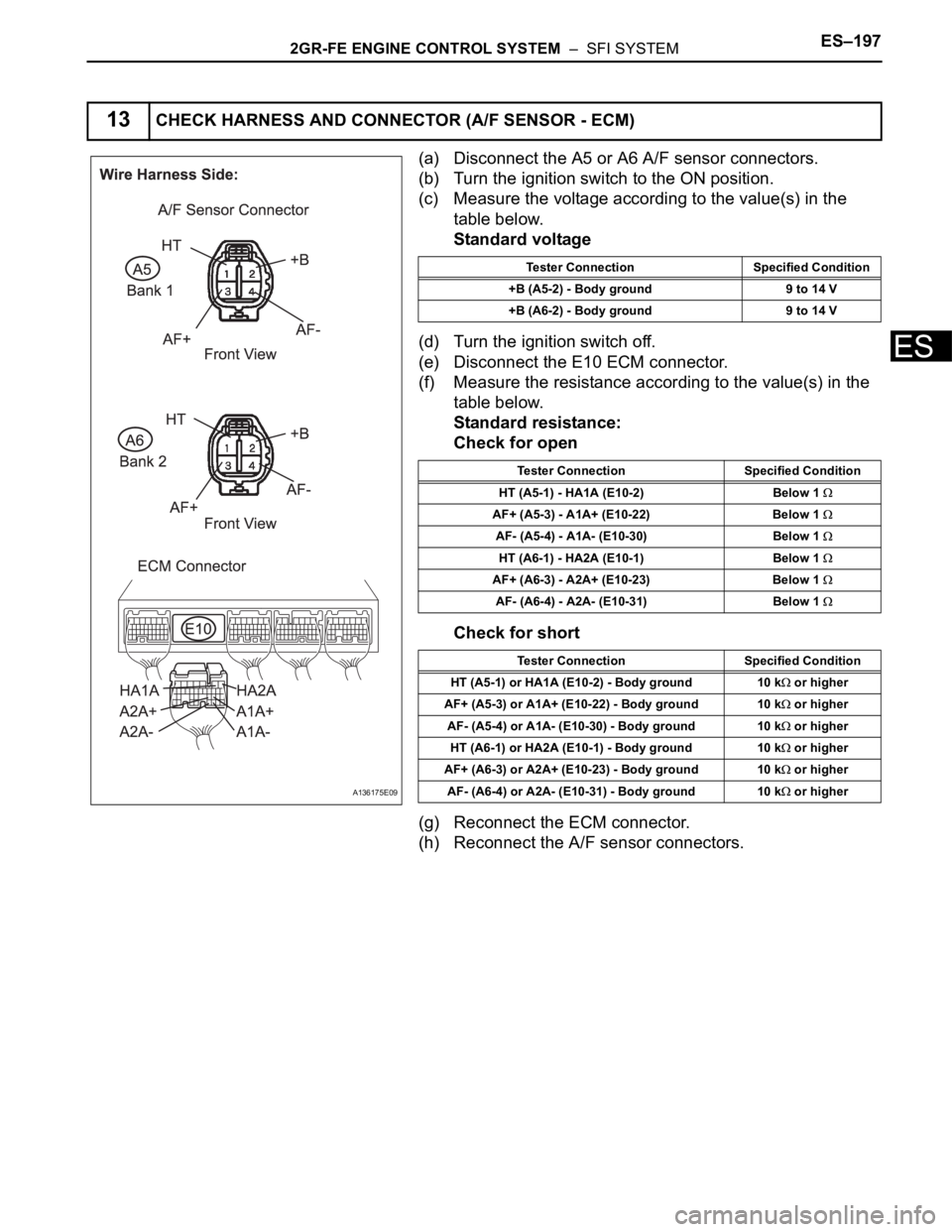
(a) Disconnect the A5 or A6 A/F sensor connectors.
(b) Turn the ignition switch to the ON position.
(c) Measure the voltage according to the value(s) in the
table below.
Standard voltage
(d) Turn the ignition switch off.
(e) Disconnect the E10 ECM connector.
(f) Measure the resistance according to the value(s) in the
table below.
Standard resistance:
Check for open
Check for short
(g) Reconnect the ECM connector.
(h) Reconnect the A/F sensor connectors.
13CHECK HARNESS AND CONNECTOR (A/F SENSOR - ECM)
A136175E09
Tester Connection Specified Condition
+B (A5-2) - Body ground 9 to 14 V
+B (A6-2) - Body ground 9 to 14 V
Tester Connection Specified Condition
HT (A5-1) - HA1A (E10-2) Below 1
AF+ (A5-3) - A1A+ (E10-22) Below 1
AF- (A5-4) - A1A- (E10-30) Below 1
HT (A6-1) - HA2A (E10-1) Below 1
AF+ (A6-3) - A2A+ (E10-23) Below 1
AF- (A6-4) - A2A- (E10-31) Below 1
Tester Connection Specified Condition
HT (A5-1) or HA1A (E10-2) - Body ground 10 k
or higher
AF+ (A5-3) or A1A+ (E10-22) - Body ground 10 k
or higher
AF- (A5-4) or A1A- (E10-30) - Body ground 10 k
or higher
HT (A6-1) or HA2A (E10-1) - Body ground 10 k
or higher
AF+ (A6-3) or A2A+ (E10-23) - Body ground 10 k
or higher
AF- (A6-4) or A2A- (E10-31) - Body ground 10 k
or higher
Page 504 of 3000
ES–1982GR-FE ENGINE CONTROL SYSTEM – SFI SYSTEM
ES
NG
OK
(a) Replace the air fuel ratio sensor (for 2WD model (See
page EC-19) or 4WD model (See page EC-26)).
NEXT
(a) Connect the intelligent tester to the DLC3 (Procedure A).
(b) Turn the ignition switch to the ON position and turn the
tester on (Procedure B).
(c) Clear the DTCs (See page ES-39) (Procedure C).
(d) Select the check mode using the tester (See page ES-
43) (Procedure D).
(e) Start the engine and warm it up with all the accessories
switched off (Procedure E).
(f) Drive the vehicle at between 38 mph and 75 mph (60
km/h and 120 km/h) and at an engine speed of between
1400 rpm and 3200 rpm for 3 to 5 minutes (Procedure
F).
A165205E01
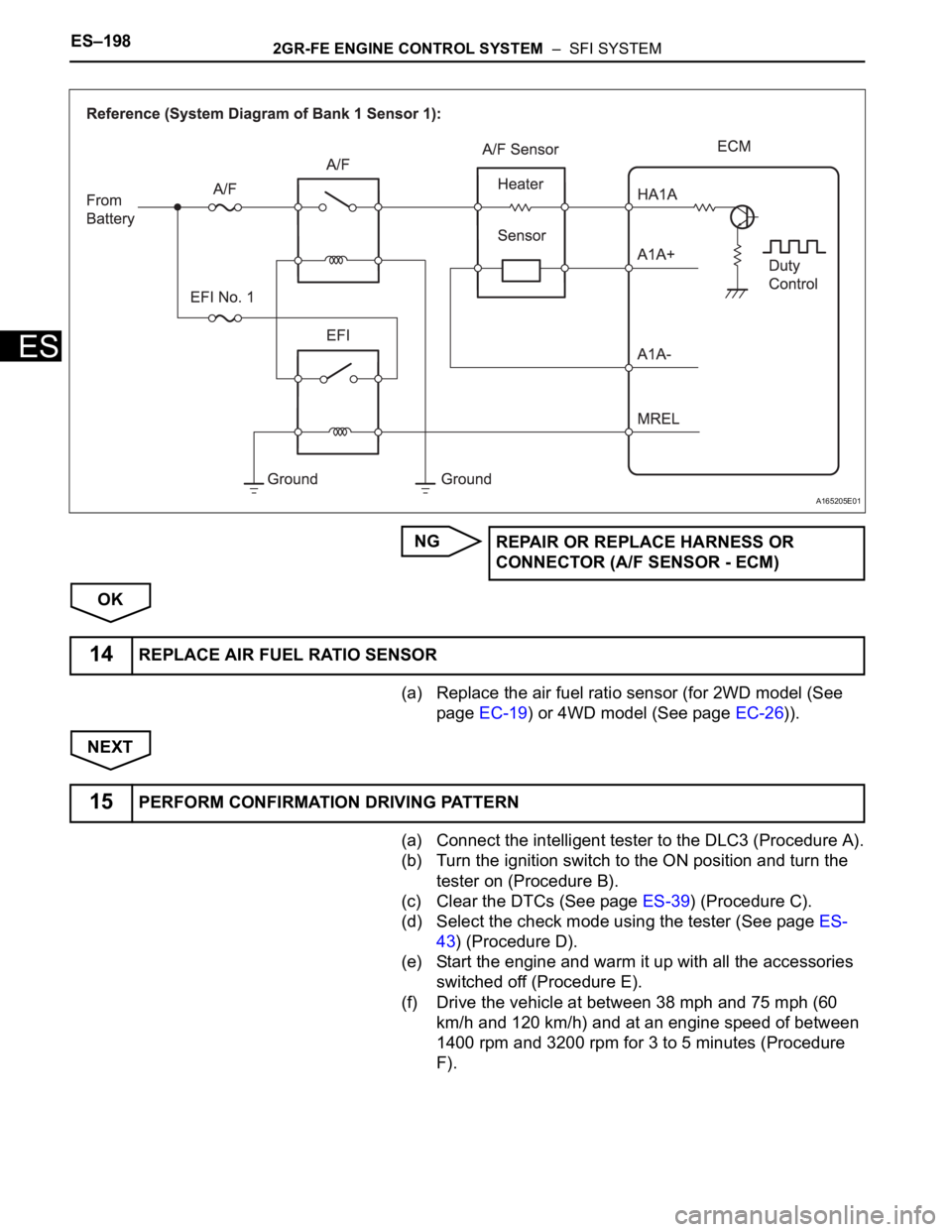
REPAIR OR REPLACE HARNESS OR
CONNECTOR (A/F SENSOR - ECM)
14REPLACE AIR FUEL RATIO SENSOR
15PERFORM CONFIRMATION DRIVING PATTERN
Page 505 of 3000
2GR-FE ENGINE CONTROL SYSTEM – SFI SYSTEMES–199
ES
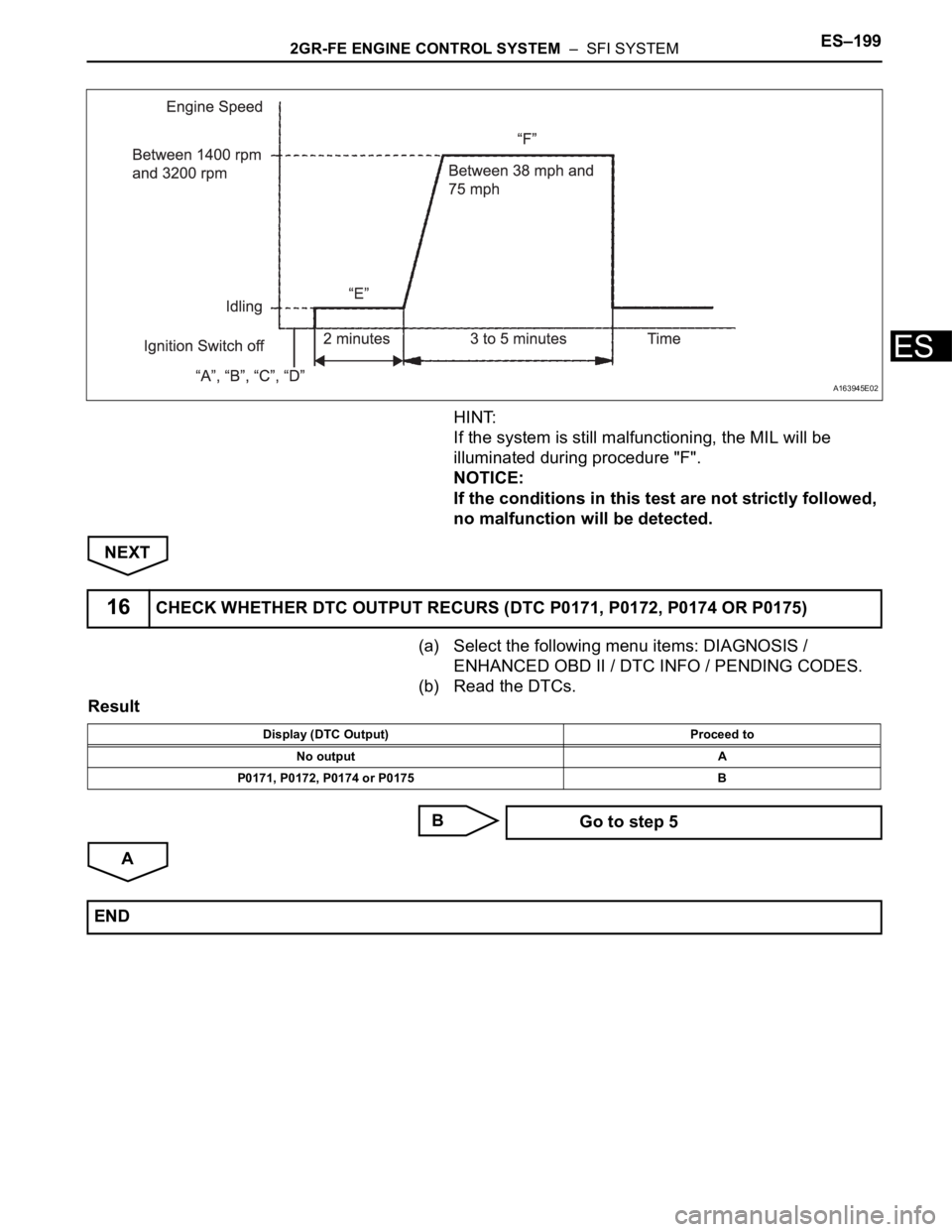
HINT:
If the system is still malfunctioning, the MIL will be
illuminated during procedure "F".
NOTICE:
If the conditions in this test are not strictly followed,
no malfunction will be detected.
NEXT
(a) Select the following menu items: DIAGNOSIS /
ENHANCED OBD II / DTC INFO / PENDING CODES.
(b) Read the DTCs.
Result
B
A
A163945E02
16CHECK WHETHER DTC OUTPUT RECURS (DTC P0171, P0172, P0174 OR P0175)
Display (DTC Output) Proceed to
No output A
P0171, P0172, P0174 or P0175 B
Go to step 5
END
Page 506 of 3000

ES–2002GR-FE ENGINE CONTROL SYSTEM – SFI SYSTEM
ES
DESCRIPTION
• This DTC is designed to detect a malfunction in the fuel pump (FUEL PUMP) relay circuit. When the
system is normal, the battery voltage is applied to FPR terminal of the ECM while the FUEL PUMP
relay is turned OFF. If the battery voltage is not applied to the FPR terminal while the FUEL PUMP
relay is OFF, the ECM interprets this as a malfunction. The ECM then illuminates the MIL and sets a
DTC.
• The FUEL PUMP relay switches the fuel pump speed according to the engine conditions. The fuel
pump operates when the ECM receives the starter-operating signal (STA) and crankshaft-rotating
signal (NE). The FUEL PUMP relay is turned ON while the engine is idling or operating at low load.
This causes current to flow through the fuel pump resistor to the fuel pump. The fuel pump then
operates at low speed. The FUEL PUMP relay is turned OFF while the engine is cranking or operating
at high load. The fuel pump then operates at normal speed.
DTC P0230 Fuel Pump Primary Circuit
DTC No. DTC Detection Condition Trouble Area
P0230Open or short in FUEL PUMP relay circuit (1 trip
detection logic)• Open or short in FUEL PUMP relay circuit
• FUEL PUMP relay
•ECM
Page 507 of 3000
2GR-FE ENGINE CONTROL SYSTEM – SFI SYSTEMES–201
ES
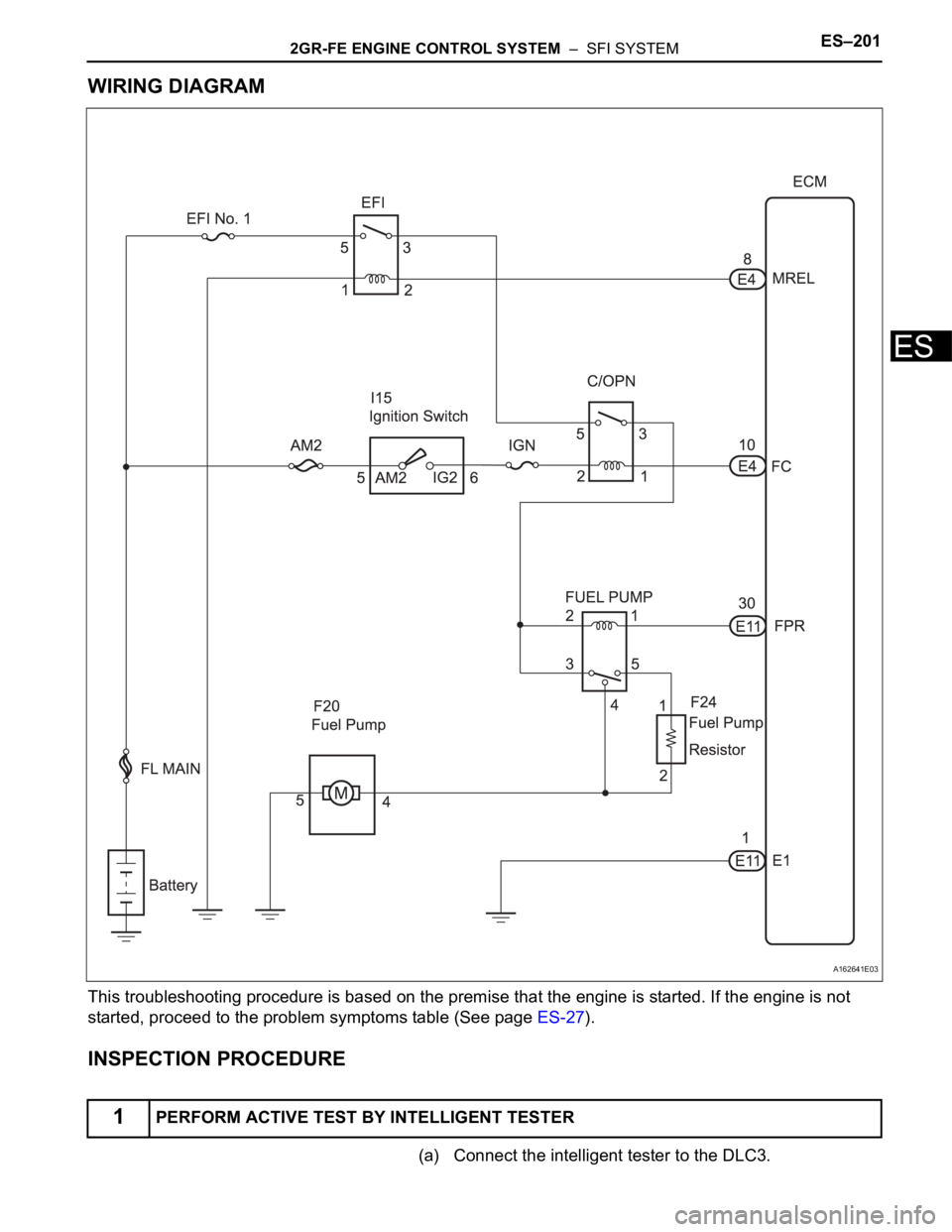
WIRING DIAGRAM
This troubleshooting procedure is based on the premise that the engine is started. If the engine is not
started, proceed to the problem symptoms table (See page ES-27).
INSPECTION PROCEDURE
(a) Connect the intelligent tester to the DLC3.
1PERFORM ACTIVE TEST BY INTELLIGENT TESTER
A162641E03
Page 508 of 3000
ES–2022GR-FE ENGINE CONTROL SYSTEM – SFI SYSTEM
ES
(b) Turn the ignition switch to the ON position and turn the
intelligent tester ON.
(c) Enter the following menus: DIAGNOSIS / ENHANCED
OBD II / ACTIVE TEST / FUEL PUMP SP CTL.
(d) Check the operation of the relay while operating it using
the intelligent tester.
OK:
Operating noise can be heard from the relay.
OK
NG
(a) Remove the FUEL PUMP relay from the engine room
junction block.
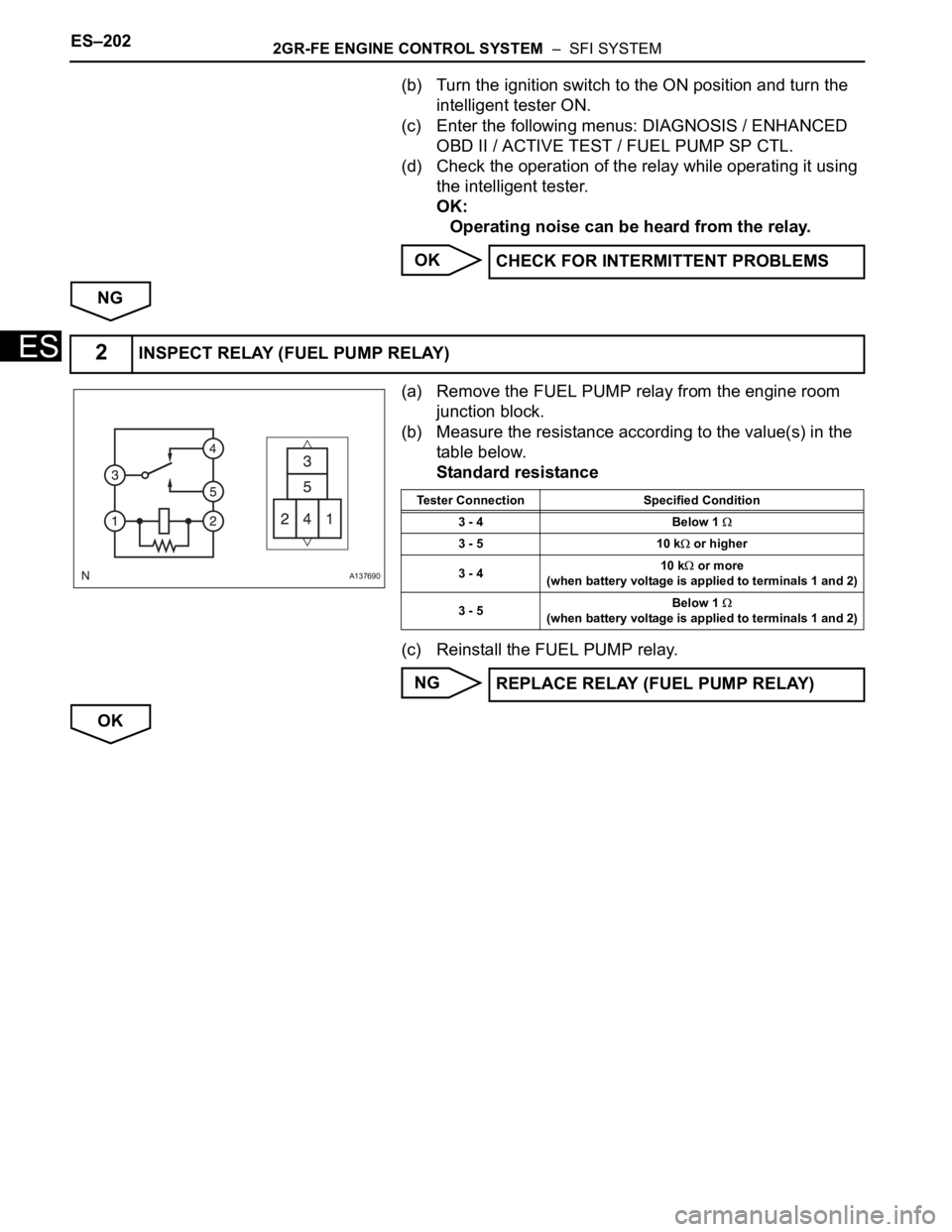
(b) Measure the resistance according to the value(s) in the
table below.
Standard resistance
(c) Reinstall the FUEL PUMP relay.
NG
OKCHECK FOR INTERMITTENT PROBLEMS
2INSPECT RELAY (FUEL PUMP RELAY)
A137690
Tester Connection Specified Condition
3 - 4 Below 1
3 - 5 10 k or higher
3 - 410 k
or more
(when battery voltage is applied to terminals 1 and 2)
3 - 5Below 1
(when battery voltage is applied to terminals 1 and 2)
REPLACE RELAY (FUEL PUMP RELAY)
Page 509 of 3000
2GR-FE ENGINE CONTROL SYSTEM – SFI SYSTEMES–203
ES
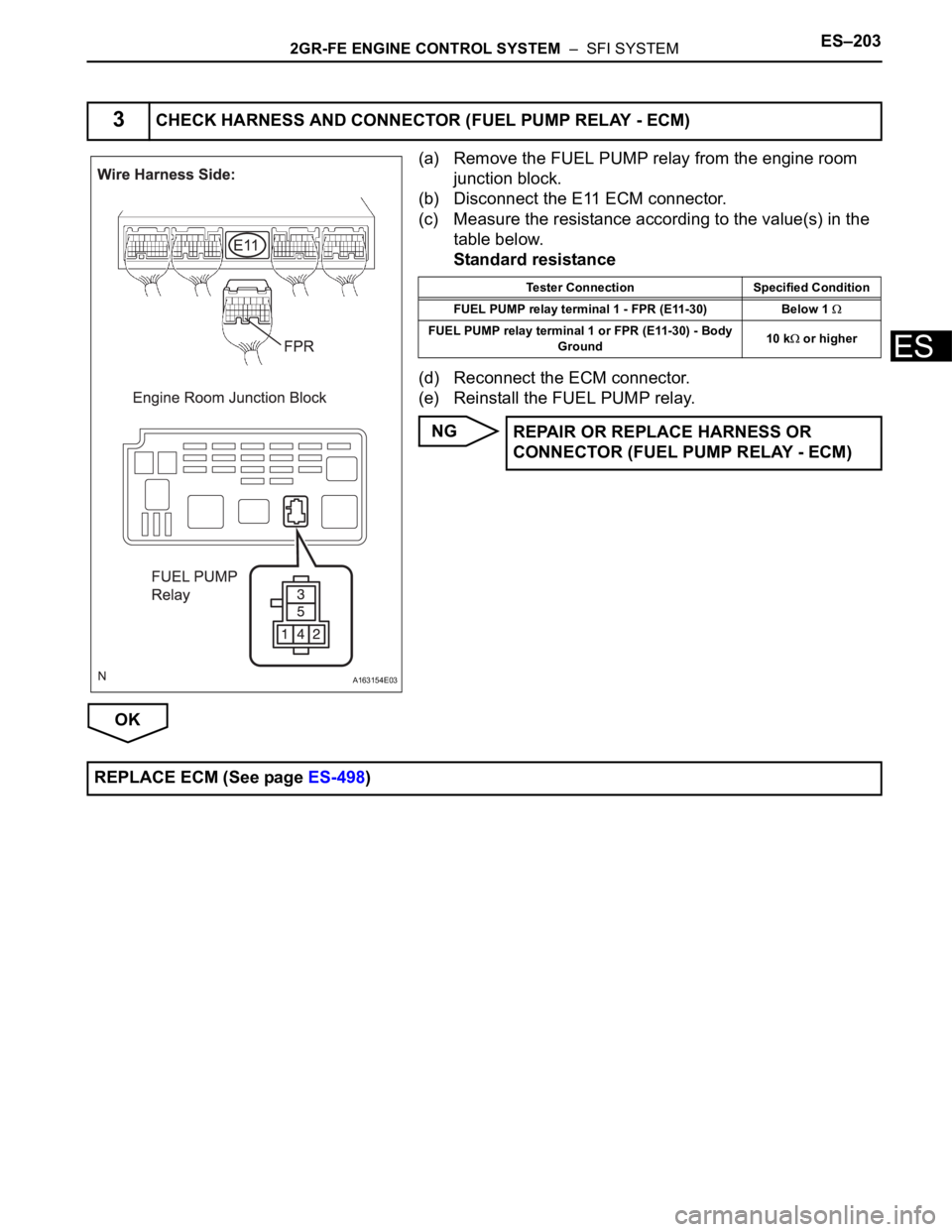
(a) Remove the FUEL PUMP relay from the engine room
junction block.
(b) Disconnect the E11 ECM connector.
(c) Measure the resistance according to the value(s) in the
table below.
Standard resistance
(d) Reconnect the ECM connector.
(e) Reinstall the FUEL PUMP relay.
NG
OK
3CHECK HARNESS AND CONNECTOR (FUEL PUMP RELAY - ECM)
A163154E03
Tester Connection Specified Condition
FUEL PUMP relay terminal 1 - FPR (E11-30) Below 1
FUEL PUMP relay terminal 1 or FPR (E11-30) - Body
Ground10 k or higher
REPAIR OR REPLACE HARNESS OR
CONNECTOR (FUEL PUMP RELAY - ECM)
REPLACE ECM (See page ES-498)
Page 510 of 3000
ES–2042GR-FE ENGINE CONTROL SYSTEM – SFI SYSTEM
ES
DESCRIPTION
When the engine misfires, high concentrations of hydrocarbons (HC) enter the exhaust gas. High HC
concentration levels can cause increase in exhaust emission levels. Extremely high concentrations of HC
can also cause increases in the Three-Way Catalytic Converter (TWC) temperature, which may cause
damage to the TWC. To prevent this increase in emissions and to limit the possibility of thermal damage,
the ECM monitors the misfire rate. When the temperature of the TWC reaches the point of thermal
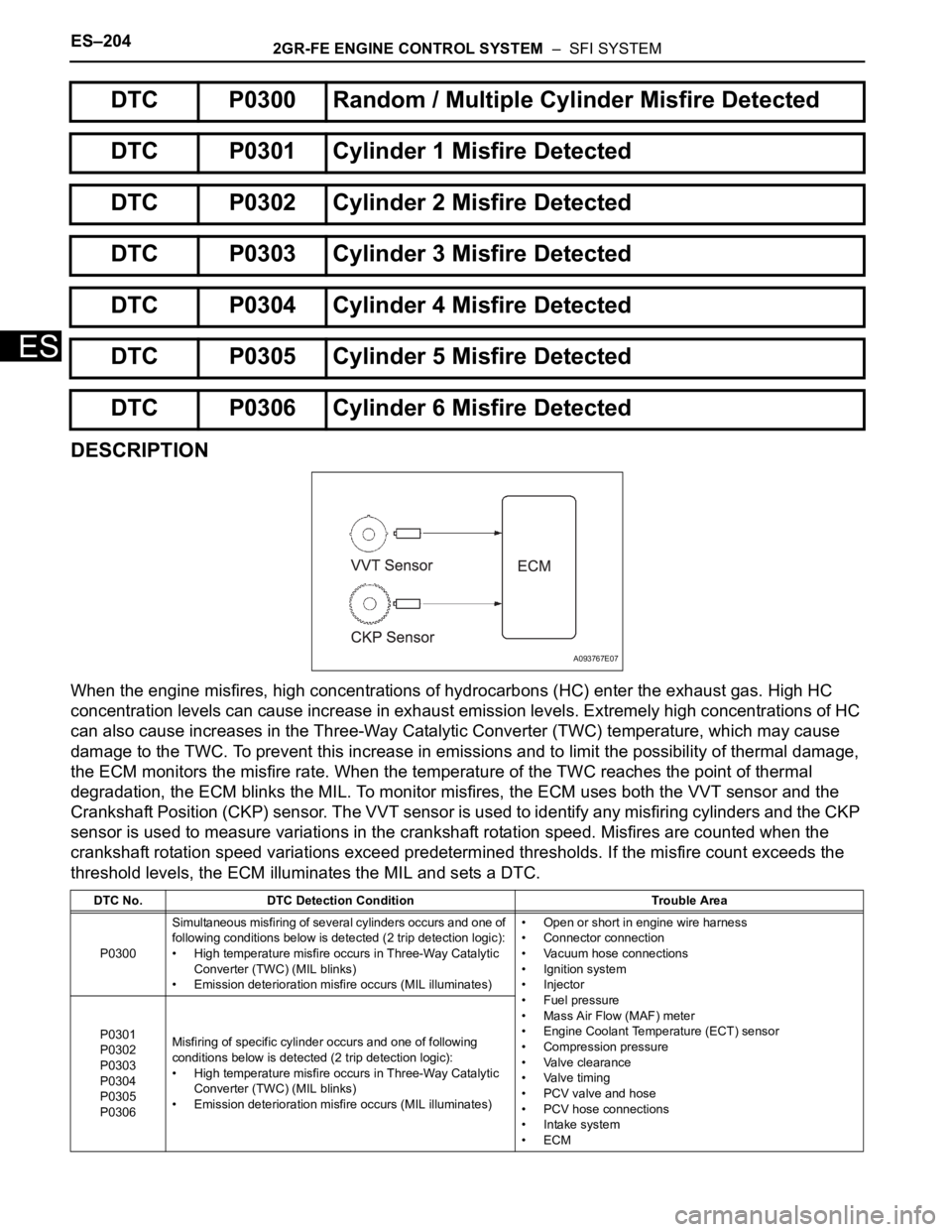
degradation, the ECM blinks the MIL. To monitor misfires, the ECM uses both the VVT sensor and the
Crankshaft Position (CKP) sensor. The VVT sensor is used to identify any misfiring cylinders and the CKP
sensor is used to measure variations in the crankshaft rotation speed. Misfires are counted when the
crankshaft rotation speed variations exceed predetermined thresholds. If the misfire count exceeds the
threshold levels, the ECM illuminates the MIL and sets a DTC.
DTC P0300 Random / Multiple Cylinder Misfire Detected
DTC P0301 Cylinder 1 Misfire Detected
DTC P0302 Cylinder 2 Misfire Detected
DTC P0303 Cylinder 3 Misfire Detected
DTC P0304 Cylinder 4 Misfire Detected
DTC P0305 Cylinder 5 Misfire Detected
DTC P0306 Cylinder 6 Misfire Detected
DTC No. DTC Detection Condition Trouble Area
P0300Simultaneous misfiring of several cylinders occurs and one of
following conditions below is detected (2 trip detection logic):
• High temperature misfire occurs in Three-Way Catalytic
Converter (TWC) (MIL blinks)
• Emission deterioration misfire occurs (MIL illuminates)• Open or short in engine wire harness
• Connector connection
• Vacuum hose connections
• Ignition system
• Injector
• Fuel pressure
• Mass Air Flow (MAF) meter
• Engine Coolant Temperature (ECT) sensor
• Compression pressure
• Valve clearance
• Valve timing
• PCV valve and hose
• PCV hose connections
• Intake system
•ECM P0301
P0302
P0303
P0304
P0305
P0306Misfiring of specific cylinder occurs and one of following
conditions below is detected (2 trip detection logic):
• High temperature misfire occurs in Three-Way Catalytic
Converter (TWC) (MIL blinks)
• Emission deterioration misfire occurs (MIL illuminates)
A093767E07
Page 511 of 3000

2GR-FE ENGINE CONTROL SYSTEM – SFI SYSTEMES–205
ES
When multiple DTCs for misfiring cylinders are set, but DTC P0300 is not set, it indicates that misfires
have been detected in different cylinders at different times. DTC P0300 is only set when several misfiring
cylinders are detected at the same time.
MONITOR DESCRIPTION
The ECM illuminates the MIL and sets a DTC when either one of the following conditions, which could
cause emission deterioration, is detected (2 trip detection logic).
• Within the first 1000 crankshaft revolutions of the engine starting, an excessive misfiring rate
(approximately 20 to 50 misfires per 1000 crankshaft revolutions) occurs once.
• An excessive misfiring rate (approximately 20 to 50 misfires per 1,000 crankshaft revolutions) occurs a
total of 4 times.
The ECM flashes the MIL and sets a DTC when either one of the following conditions, which could cause
the Three-Way Catalytic Converter (TWC) damage, is detected (2 trip detection logic).
• At a high engine rpm, a catalyst damage misfire, which monitored every 200 crankshaft revolutions,
occurs once.
• At a normal engine rpm, a catalyst damage misfire, which monitored every 200 crankshaft revolutions,
occurs 3 times.
HINT:
If a catalyst damage misfire occurs, the ECM informs the driver by flashing the MIL.
MONITOR STRATEGY
TYPICAL ENABLING CONDITIONS
Misfire:
Monitor period of emission-related-misfire:
Related DTCsP0300: Multiple cylinder misfire
P0301: Cylinder 1 misfire
P0302: Cylinder 2 misfire
P0303: Cylinder 3 misfire
P0304: Cylinder 4 misfire
P0305: Cylinder 5 misfire
P0306: Cylinder 6 misfire
Required Sensors / Components (Main) Injector, Ignition coil, Spark plug
Required Sensors / Components (Related)Crankshaft, Camshaft, Engine coolant temperature and intake air temperature
sensors and Mass air flow meter
Frequency of Operation Continuous
Duration1000 to 4000 crankshaft revolutions: Emission related misfire
200 to 600 crankshaft revolutions: Catalyst damaged misfire
MIL Operation2 driving cycles: Emission related misfire
MIL flashes immediately: Catalyst damaged misfire
Sequence of Operation None
The monitor will run whenever these DTCs are not
presentP0100, P0101, P0102, P0103 (MAF Sensor), P0110, P0112, P0113 (IAT Sensor),
P0115, P0116, P0117, P0118 (ECT Sensor), P0120, P0121, P0122, P0123, P0220,
P0222, P0223, P2135 (TP Sensor), P0125 (Insufficient ECT for Closed Loop),
P0327, P0328, P0332, P0333 (Knock Sensor), P0335 (CKP Sensor), P0340, (CMP
Sensor), P0500 (VSS)
Battery voltage 8 V or more
VVT system No operate by scan tool
Engine RPM 450 to 6500 rpm
Either of the following conditions is met Condition (a) or (b)
(a) Engine start ECT More than -7
C (19F)
(b) ECT More than 20
C (68F)
Fuel-cut OFF
First 1000 revolutions after engine start, or check mode Crankshaft 1000 revolutions
Page 512 of 3000
ES–2062GR-FE ENGINE CONTROL SYSTEM – SFI SYSTEM
ES
Monitor period of catalyst-damage-misfire (MIL blinks):
TYPICAL MALFUNCTION THRESHOLDS
Monitor period of emission-related-misfire:
Monitor period of catalyst-damage-misfire (MIL blinks):
MONITOR RESULT
Refer to CHECKING MONITOR STATUS (See page ES-19).
WIRING DIAGRAM
Refer to DTC P0351 for wiring diagram of the ignition system (See page ES-238).
Except above Crankshaft 1000 revolutions x 4
All of the following conditions 1, 2 and 3 are met Crankshaft 200 revolutions
1. Driving cycle 1st
2. Check mode OFF
3. Engine RPM Less than 2600 rpm
Except above (MIL blinks immediately) Crankshaft 200 revolutions x 3
Misfire rate 1% or more
Number of misfire per 200 revolutions 94 or more (varies with intake air amount and RPM)
Paired cylinders misfire (MIL blinks immediately) Detected