check oil TOYOTA SIENNA 2007 Service Owner's Manual
[x] Cancel search | Manufacturer: TOYOTA, Model Year: 2007, Model line: SIENNA, Model: TOYOTA SIENNA 2007Pages: 3000, PDF Size: 52.26 MB
Page 408 of 3000
ES–1022GR-FE ENGINE CONTROL SYSTEM – SFI SYSTEM
ES
• Read freeze frame data using the intelligent tester. The ECM records vehicle and driving condition
information as freeze frame data the moment a DTC is stored. When troubleshooting, freeze frame
data can be helpful in determining whether the vehicle was running or stopped, whether the engine
was warmed up or not, whether the air-fuel ratio was lean or rich, as well as other data recorded at the
time of a malfunction.
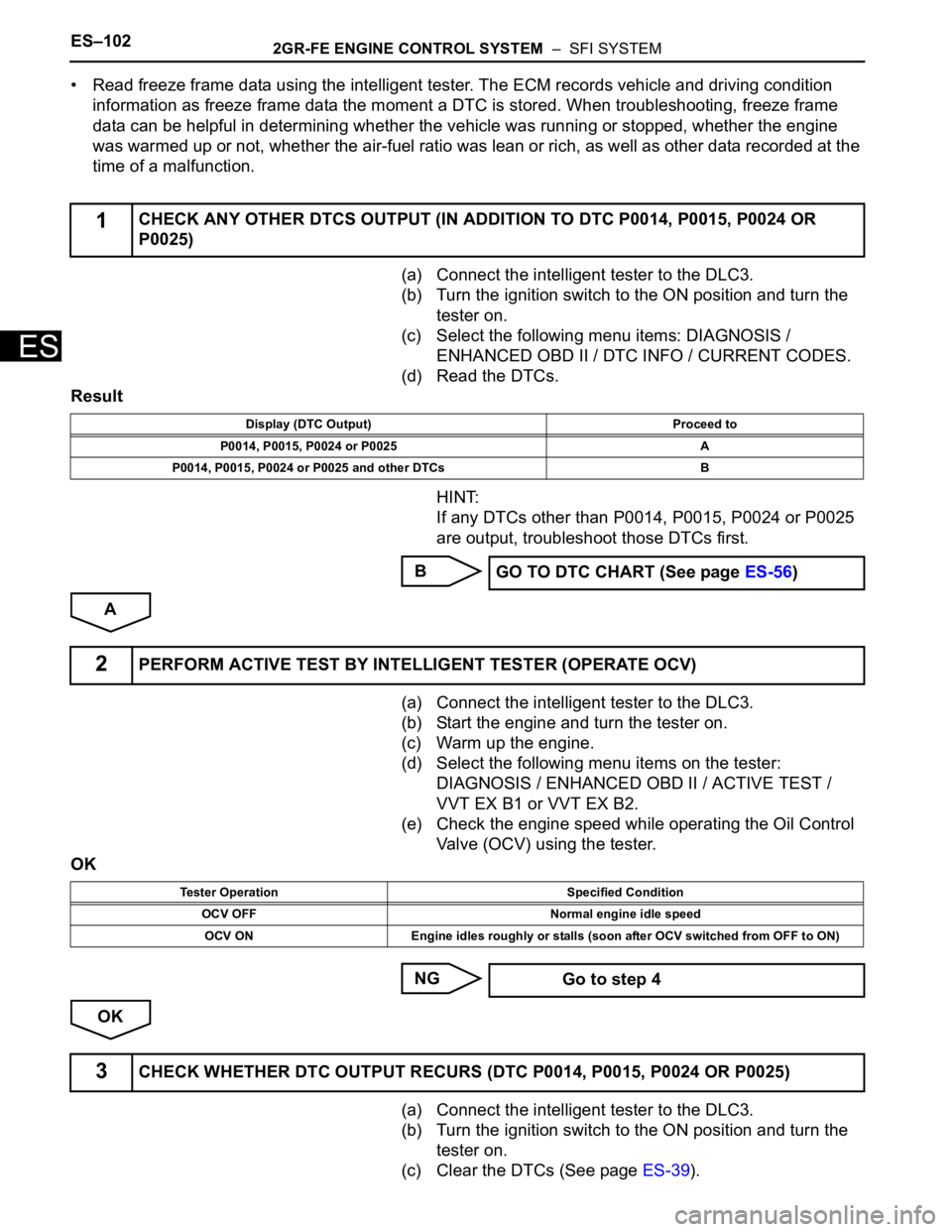
(a) Connect the intelligent tester to the DLC3.
(b) Turn the ignition switch to the ON position and turn the
tester on.
(c) Select the following menu items: DIAGNOSIS /
ENHANCED OBD II / DTC INFO / CURRENT CODES.
(d) Read the DTCs.
Result
HINT:
If any DTCs other than P0014, P0015, P0024 or P0025
are output, troubleshoot those DTCs first.
B
A
(a) Connect the intelligent tester to the DLC3.
(b) Start the engine and turn the tester on.
(c) Warm up the engine.
(d) Select the following menu items on the tester:
DIAGNOSIS / ENHANCED OBD II / ACTIVE TEST /
VVT EX B1 or VVT EX B2.
(e) Check the engine speed while operating the Oil Control
Valve (OCV) using the tester.
OK
NG
OK
(a) Connect the intelligent tester to the DLC3.
(b) Turn the ignition switch to the ON position and turn the
tester on.
(c) Clear the DTCs (See page ES-39).
1CHECK ANY OTHER DTCS OUTPUT (IN ADDITION TO DTC P0014, P0015, P0024 OR
P0025)
Display (DTC Output) Proceed to
P0014, P0015, P0024 or P0025 A
P0014, P0015, P0024 or P0025 and other DTCs B
GO TO DTC CHART (See page ES-56)
2PERFORM ACTIVE TEST BY INTELLIGENT TESTER (OPERATE OCV)
Tester Operation Specified Condition
OCV OFF Normal engine idle speed
OCV ON Engine idles roughly or stalls (soon after OCV switched from OFF to ON)
Go to step 4
3CHECK WHETHER DTC OUTPUT RECURS (DTC P0014, P0015, P0024 OR P0025)
Page 410 of 3000
ES–1042GR-FE ENGINE CONTROL SYSTEM – SFI SYSTEM
ES
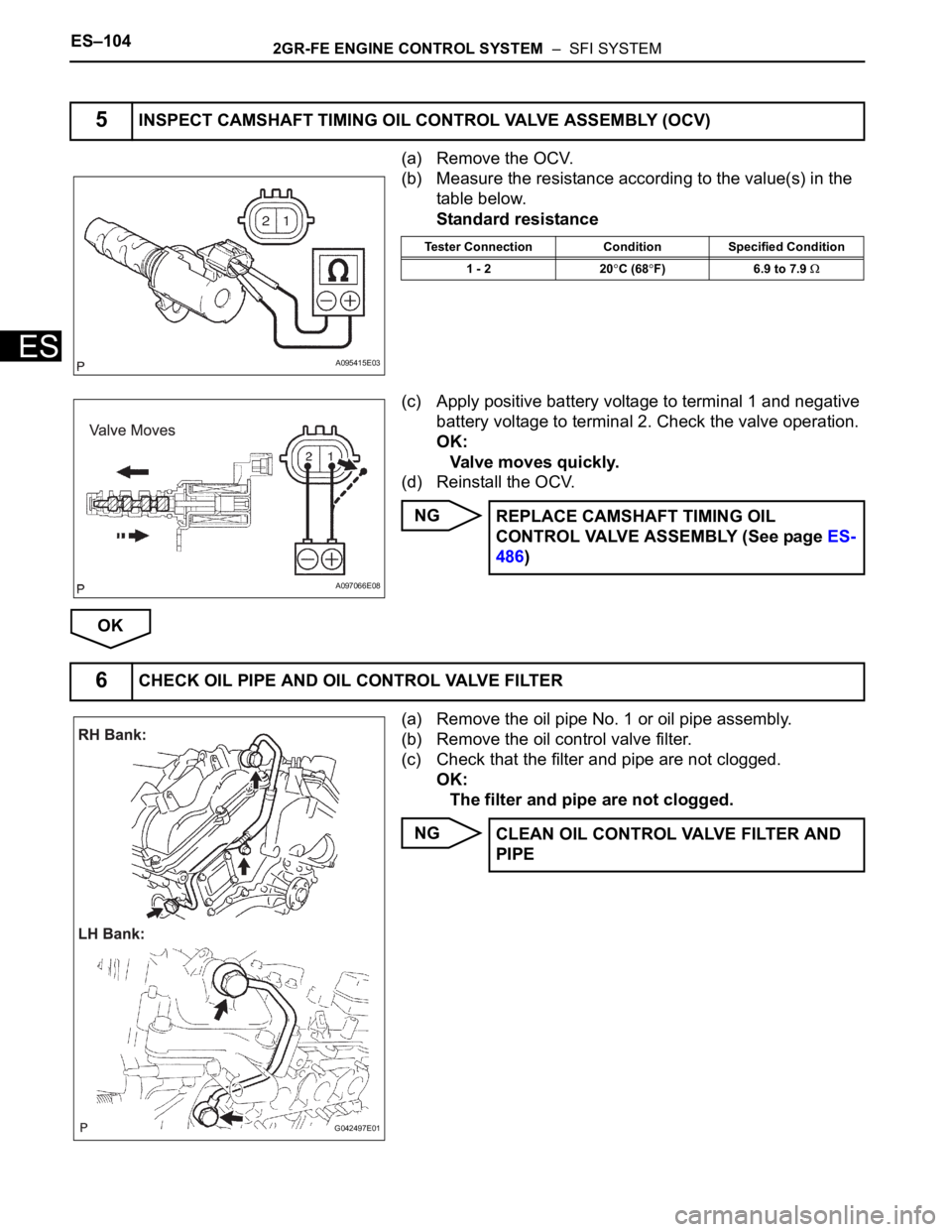
(a) Remove the OCV.
(b) Measure the resistance according to the value(s) in the
table below.
Standard resistance
(c) Apply positive battery voltage to terminal 1 and negative
battery voltage to terminal 2. Check the valve operation.
OK:
Valve moves quickly.
(d) Reinstall the OCV.
NG
OK
(a) Remove the oil pipe No. 1 or oil pipe assembly.
(b) Remove the oil control valve filter.
(c) Check that the filter and pipe are not clogged.
OK:
The filter and pipe are not clogged.
NG
5INSPECT CAMSHAFT TIMING OIL CONTROL VALVE ASSEMBLY (OCV)
A095415E03
Tester Connection Condition Specified Condition
1 - 2 20
C (68F) 6.9 to 7.9
A097066E08
REPLACE CAMSHAFT TIMING OIL
CONTROL VALVE ASSEMBLY (See page ES-
486)
6CHECK OIL PIPE AND OIL CONTROL VALVE FILTER
G042497E01
CLEAN OIL CONTROL VALVE FILTER AND
PIPE
Page 411 of 3000
2GR-FE ENGINE CONTROL SYSTEM – SFI SYSTEMES–105
ES
OK
NEXT
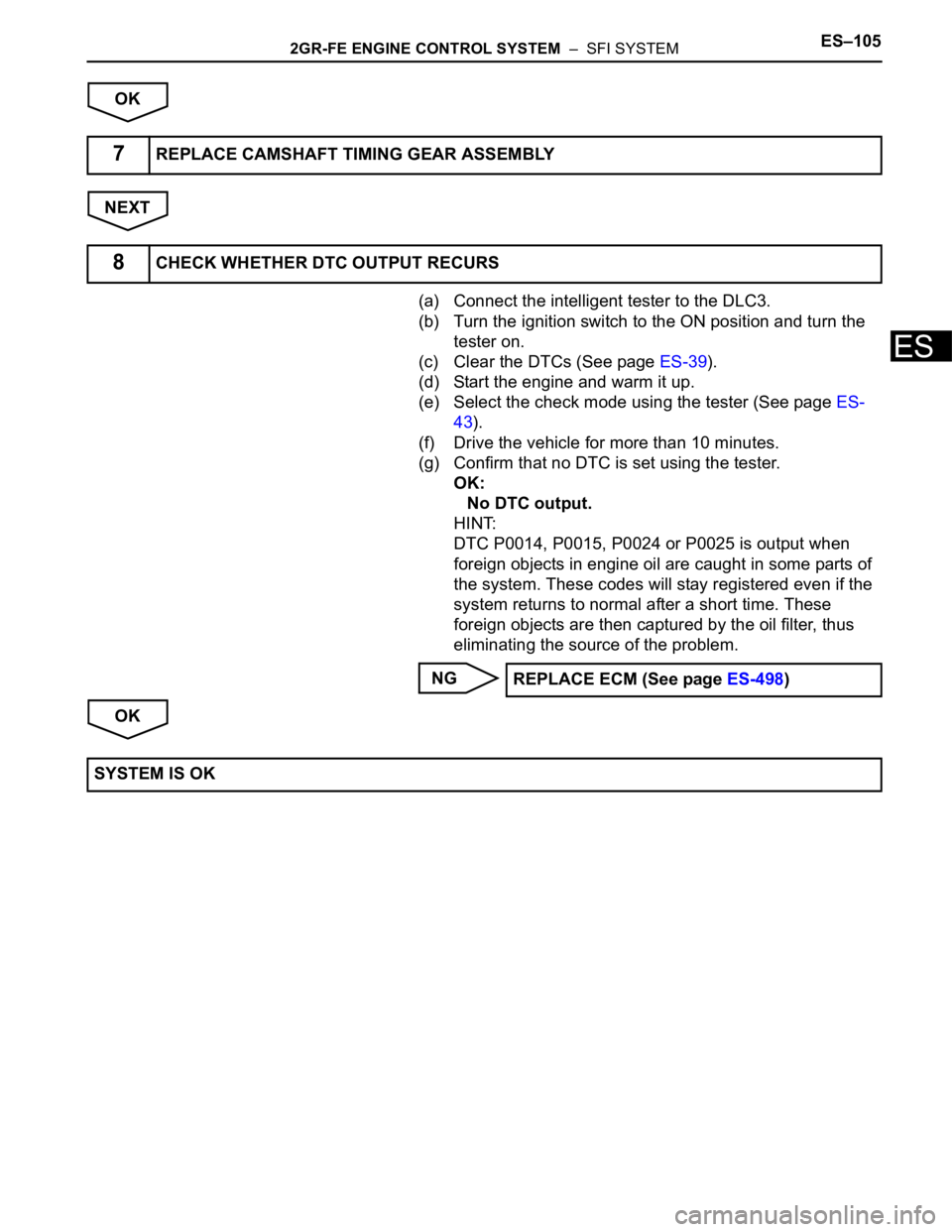
(a) Connect the intelligent tester to the DLC3.
(b) Turn the ignition switch to the ON position and turn the
tester on.
(c) Clear the DTCs (See page ES-39).
(d) Start the engine and warm it up.
(e) Select the check mode using the tester (See page ES-
43).
(f) Drive the vehicle for more than 10 minutes.
(g) Confirm that no DTC is set using the tester.
OK:
No DTC output.
HINT:
DTC P0014, P0015, P0024 or P0025 is output when
foreign objects in engine oil are caught in some parts of
the system. These codes will stay registered even if the
system returns to normal after a short time. These
foreign objects are then captured by the oil filter, thus
eliminating the source of the problem.
NG
OK
7REPLACE CAMSHAFT TIMING GEAR ASSEMBLY
8CHECK WHETHER DTC OUTPUT RECURS
REPLACE ECM (See page ES-498)
SYSTEM IS OK
Page 412 of 3000
ES–1062GR-FE ENGINE CONTROL SYSTEM – SFI SYSTEM
ES
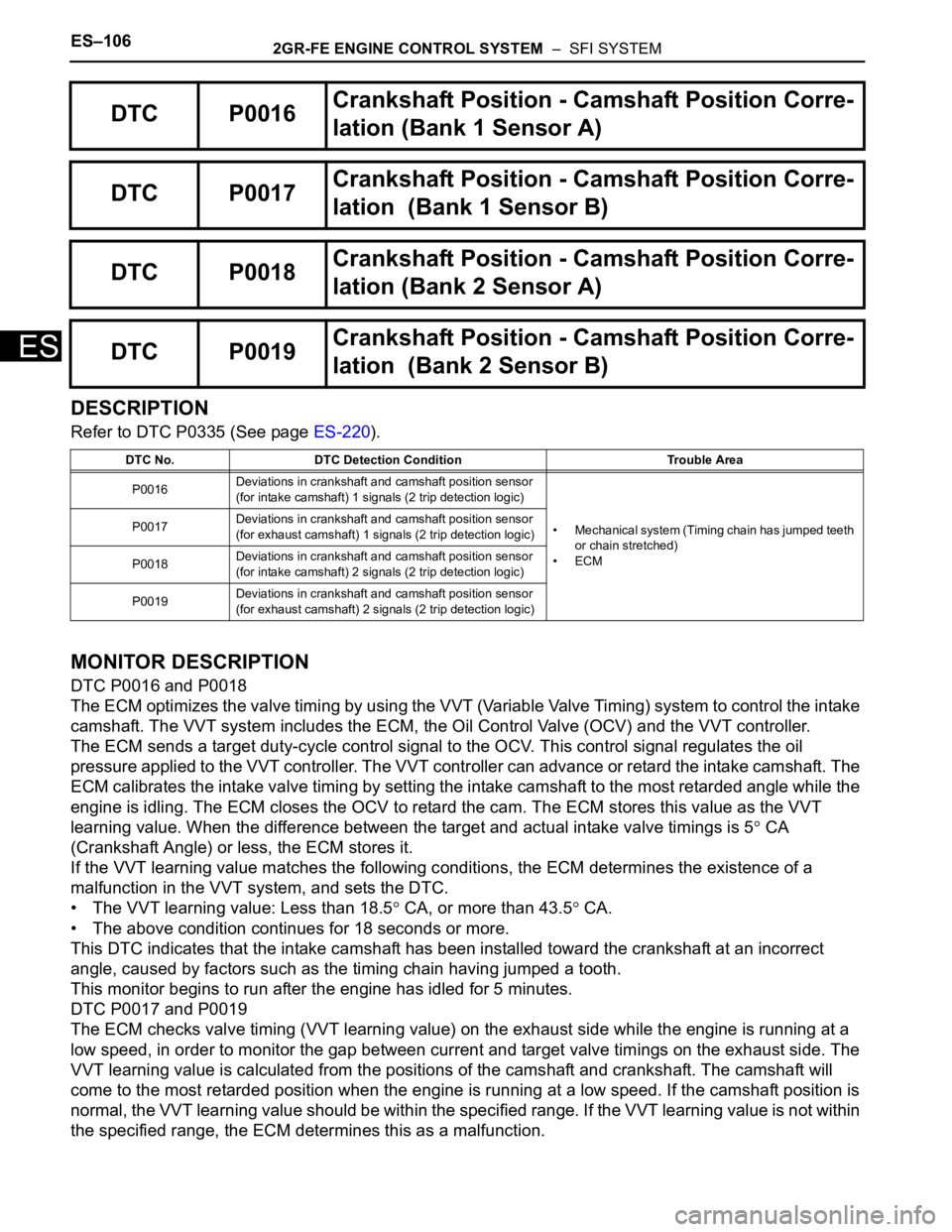
DESCRIPTION
Refer to DTC P0335 (See page ES-220).
MONITOR DESCRIPTION
DTC P0016 and P0018
The ECM optimizes the valve timing by using the VVT (Variable Valve Timing) system to control the intake
camshaft. The VVT system includes the ECM, the Oil Control Valve (OCV) and the VVT controller.
The ECM sends a target duty-cycle control signal to the OCV. This control signal regulates the oil
pressure applied to the VVT controller. The VVT controller can advance or retard the intake camshaft. The
ECM calibrates the intake valve timing by setting the intake camshaft to the most retarded angle while the
engine is idling. The ECM closes the OCV to retard the cam. The ECM stores this value as the VVT
learning value. When the difference between the target and actual intake valve timings is 5
CA
(Crankshaft Angle) or less, the ECM stores it.
If the VVT learning value matches the following conditions, the ECM determines the existence of a
malfunction in the VVT system, and sets the DTC.
• The VVT learning value: Less than 18.5
CA, or more than 43.5 CA.
• The above condition continues for 18 seconds or more.
This DTC indicates that the intake camshaft has been installed toward the crankshaft at an incorrect
angle, caused by factors such as the timing chain having jumped a tooth.
This monitor begins to run after the engine has idled for 5 minutes.
DTC P0017 and P0019
The ECM checks valve timing (VVT learning value) on the exhaust side while the engine is running at a
low speed, in order to monitor the gap between current and target valve timings on the exhaust side. The
VVT learning value is calculated from the positions of the camshaft and crankshaft. The camshaft will
come to the most retarded position when the engine is running at a low speed. If the camshaft position is
normal, the VVT learning value should be within the specified range. If the VVT learning value is not within
the specified range, the ECM determines this as a malfunction.
DTC P0016Crankshaft Position - Camshaft Position Corre-
lation (Bank 1 Sensor A)
DTC P0017Crankshaft Position - Camshaft Position Corre-
lation (Bank 1 Sensor B)
DTC P0018Crankshaft Position - Camshaft Position Corre-
lation (Bank 2 Sensor A)
DTC P0019Crankshaft Position - Camshaft Position Corre-
lation (Bank 2 Sensor B)
DTC No. DTC Detection Condition Trouble Area
P0016Deviations in crankshaft and camshaft position sensor
(for intake camshaft) 1 signals (2 trip detection logic)
• Mechanical system (Timing chain has jumped teeth
or chain stretched)
•ECM P0017Deviations in crankshaft and camshaft position sensor
(for exhaust camshaft) 1 signals (2 trip detection logic)
P0018Deviations in crankshaft and camshaft position sensor
(for intake camshaft) 2 signals (2 trip detection logic)
P0019Deviations in crankshaft and camshaft position sensor
(for exhaust camshaft) 2 signals (2 trip detection logic)
Page 511 of 3000

2GR-FE ENGINE CONTROL SYSTEM – SFI SYSTEMES–205
ES
When multiple DTCs for misfiring cylinders are set, but DTC P0300 is not set, it indicates that misfires
have been detected in different cylinders at different times. DTC P0300 is only set when several misfiring
cylinders are detected at the same time.
MONITOR DESCRIPTION
The ECM illuminates the MIL and sets a DTC when either one of the following conditions, which could
cause emission deterioration, is detected (2 trip detection logic).
• Within the first 1000 crankshaft revolutions of the engine starting, an excessive misfiring rate
(approximately 20 to 50 misfires per 1000 crankshaft revolutions) occurs once.
• An excessive misfiring rate (approximately 20 to 50 misfires per 1,000 crankshaft revolutions) occurs a
total of 4 times.
The ECM flashes the MIL and sets a DTC when either one of the following conditions, which could cause
the Three-Way Catalytic Converter (TWC) damage, is detected (2 trip detection logic).
• At a high engine rpm, a catalyst damage misfire, which monitored every 200 crankshaft revolutions,
occurs once.
• At a normal engine rpm, a catalyst damage misfire, which monitored every 200 crankshaft revolutions,
occurs 3 times.
HINT:
If a catalyst damage misfire occurs, the ECM informs the driver by flashing the MIL.
MONITOR STRATEGY
TYPICAL ENABLING CONDITIONS
Misfire:
Monitor period of emission-related-misfire:
Related DTCsP0300: Multiple cylinder misfire
P0301: Cylinder 1 misfire
P0302: Cylinder 2 misfire
P0303: Cylinder 3 misfire
P0304: Cylinder 4 misfire
P0305: Cylinder 5 misfire
P0306: Cylinder 6 misfire
Required Sensors / Components (Main) Injector, Ignition coil, Spark plug
Required Sensors / Components (Related)Crankshaft, Camshaft, Engine coolant temperature and intake air temperature
sensors and Mass air flow meter
Frequency of Operation Continuous
Duration1000 to 4000 crankshaft revolutions: Emission related misfire
200 to 600 crankshaft revolutions: Catalyst damaged misfire
MIL Operation2 driving cycles: Emission related misfire
MIL flashes immediately: Catalyst damaged misfire
Sequence of Operation None
The monitor will run whenever these DTCs are not
presentP0100, P0101, P0102, P0103 (MAF Sensor), P0110, P0112, P0113 (IAT Sensor),
P0115, P0116, P0117, P0118 (ECT Sensor), P0120, P0121, P0122, P0123, P0220,
P0222, P0223, P2135 (TP Sensor), P0125 (Insufficient ECT for Closed Loop),
P0327, P0328, P0332, P0333 (Knock Sensor), P0335 (CKP Sensor), P0340, (CMP
Sensor), P0500 (VSS)
Battery voltage 8 V or more
VVT system No operate by scan tool
Engine RPM 450 to 6500 rpm
Either of the following conditions is met Condition (a) or (b)
(a) Engine start ECT More than -7
C (19F)
(b) ECT More than 20
C (68F)
Fuel-cut OFF
First 1000 revolutions after engine start, or check mode Crankshaft 1000 revolutions
Page 517 of 3000
2GR-FE ENGINE CONTROL SYSTEM – SFI SYSTEMES–211
ES
(d) Read the CYL #1 to #6 or DTCs displayed on the tester.
Result
HINT:
• If it is difficult to reproduce misfires for each cylinder, check
the Data List item called MISFIRE MARGIN. Try to find
vehicle driving conditions that lower the MISFIRE
MARGIN value. Values above 30% are considered normal.
• If the freeze frame data's record of the ECT is below 75
C
(167
F), the misfire may be detected only when the engine
is cold.
• If the freeze frame data's record of the ENG RUN TIME is
below 120 seconds, the misfire may be detected
immediately after the engine is started.
B
A
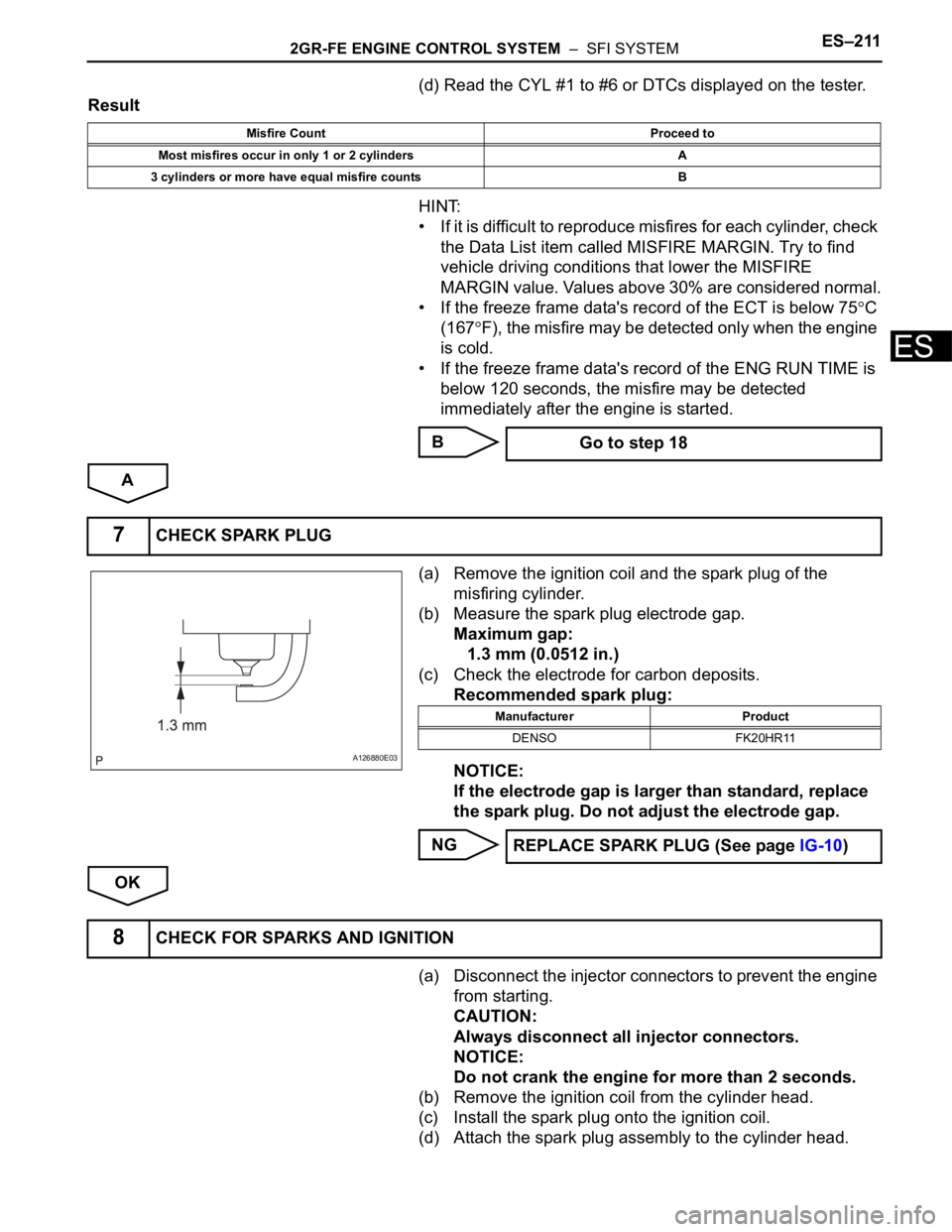
(a) Remove the ignition coil and the spark plug of the
misfiring cylinder.
(b) Measure the spark plug electrode gap.
Maximum gap:
1.3 mm (0.0512 in.)
(c) Check the electrode for carbon deposits.
Recommended spark plug:
NOTICE:
If the electrode gap is larger than standard, replace
the spark plug. Do not adjust the electrode gap.
NG
OK
(a) Disconnect the injector connectors to prevent the engine
from starting.
CAUTION:
Always disconnect all injector connectors.
NOTICE:
Do not crank the engine for more than 2 seconds.
(b) Remove the ignition coil from the cylinder head.
(c) Install the spark plug onto the ignition coil.
(d) Attach the spark plug assembly to the cylinder head.
Misfire Count Proceed to
Most misfires occur in only 1 or 2 cylinders A
3 cylinders or more have equal misfire counts B
Go to step 18
7CHECK SPARK PLUG
A126880E03
Manufacturer Product
DENSO FK20HR11
REPLACE SPARK PLUG (See page IG-10)
8CHECK FOR SPARKS AND IGNITION
Page 518 of 3000
ES–2122GR-FE ENGINE CONTROL SYSTEM – SFI SYSTEM
ES
(e) Crank the engine for less than 2 seconds and check the
spark.
OK:
Sparks jump across electrode gap.
(f) Install the ignition coil.
(g) Reconnect the injector connectors.
NG
OK
(a) Measure the cylinder compression pressure of the
misfiring cylinder (See page EM-3).
NG
OK
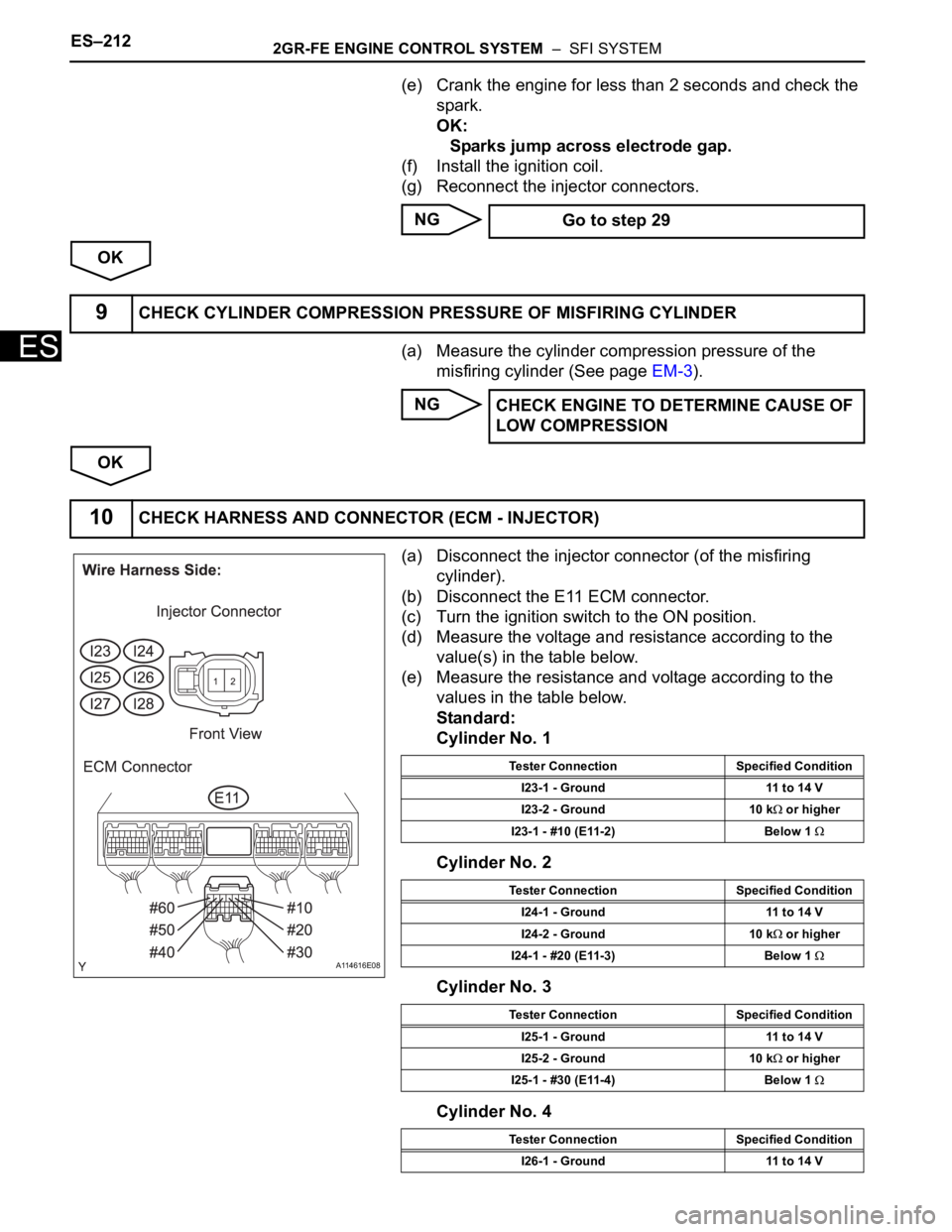
(a) Disconnect the injector connector (of the misfiring
cylinder).
(b) Disconnect the E11 ECM connector.
(c) Turn the ignition switch to the ON position.
(d) Measure the voltage and resistance according to the
value(s) in the table below.
(e) Measure the resistance and voltage according to the
values in the table below.
Standard:
Cylinder No. 1
Cylinder No. 2
Cylinder No. 3
Cylinder No. 4 Go to step 29
9CHECK CYLINDER COMPRESSION PRESSURE OF MISFIRING CYLINDER
CHECK ENGINE TO DETERMINE CAUSE OF
LOW COMPRESSION
10CHECK HARNESS AND CONNECTOR (ECM - INJECTOR)
A114616E08
Tester Connection Specified Condition
I23-1 - Ground 11 to 14 V
I23-2 - Ground 10 k
or higher
I23-1 - #10 (E11-2) Below 1
Tester Connection Specified Condition
I24-1 - Ground 11 to 14 V
I24-2 - Ground 10 k
or higher
I24-1 - #20 (E11-3) Below 1
Tester Connection Specified Condition
I25-1 - Ground 11 to 14 V
I25-2 - Ground 10 k
or higher
I25-1 - #30 (E11-4) Below 1
Tester Connection Specified Condition
I26-1 - Ground 11 to 14 V
Page 523 of 3000
2GR-FE ENGINE CONTROL SYSTEM – SFI SYSTEMES–217
ES
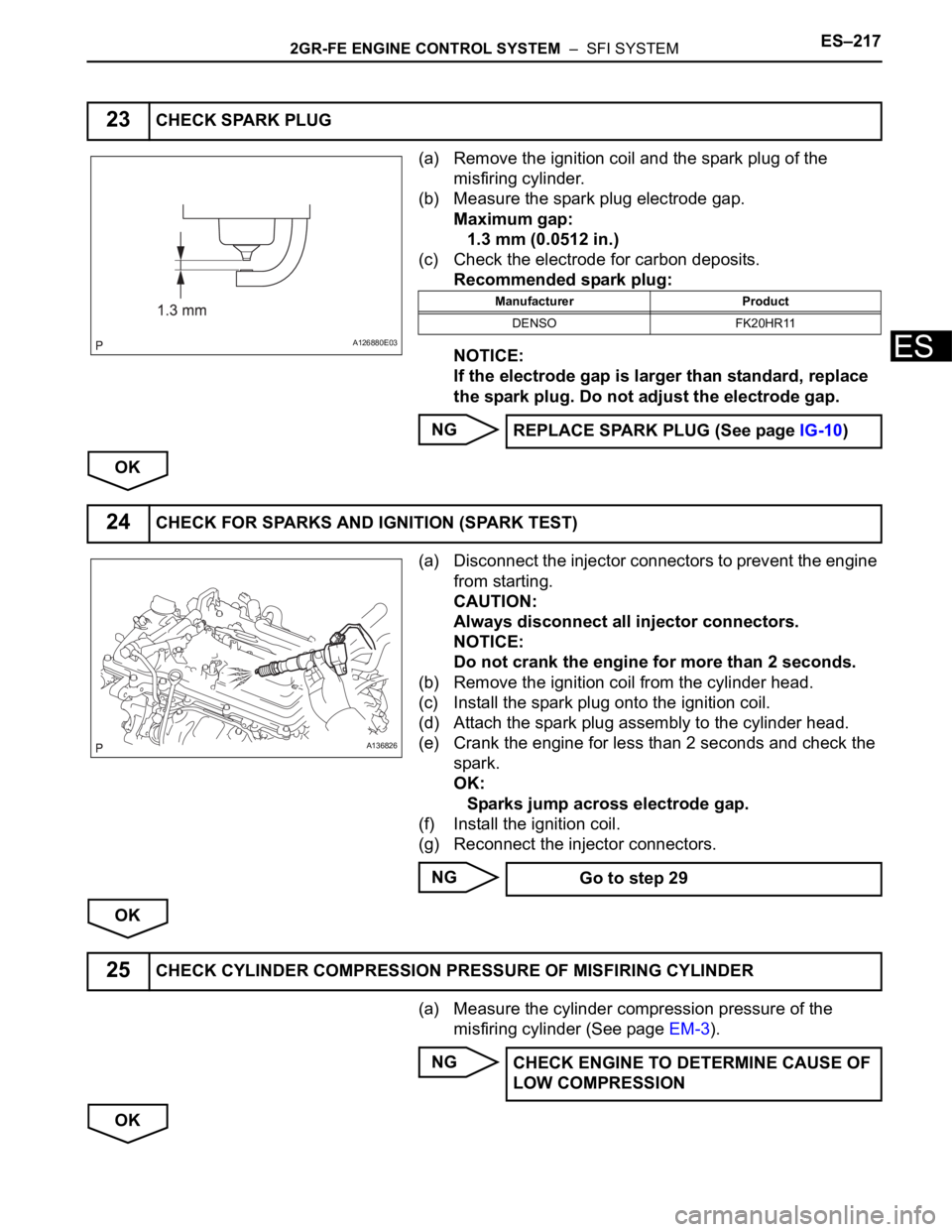
(a) Remove the ignition coil and the spark plug of the
misfiring cylinder.
(b) Measure the spark plug electrode gap.
Maximum gap:
1.3 mm (0.0512 in.)
(c) Check the electrode for carbon deposits.
Recommended spark plug:
NOTICE:
If the electrode gap is larger than standard, replace
the spark plug. Do not adjust the electrode gap.
NG
OK
(a) Disconnect the injector connectors to prevent the engine
from starting.
CAUTION:
Always disconnect all injector connectors.
NOTICE:
Do not crank the engine for more than 2 seconds.
(b) Remove the ignition coil from the cylinder head.
(c) Install the spark plug onto the ignition coil.
(d) Attach the spark plug assembly to the cylinder head.
(e) Crank the engine for less than 2 seconds and check the
spark.
OK:
Sparks jump across electrode gap.
(f) Install the ignition coil.
(g) Reconnect the injector connectors.
NG
OK
(a) Measure the cylinder compression pressure of the
misfiring cylinder (See page EM-3).
NG
OK
23CHECK SPARK PLUG
A126880E03
Manufacturer Product
DENSO FK20HR11
REPLACE SPARK PLUG (See page IG-10)
24CHECK FOR SPARKS AND IGNITION (SPARK TEST)
A136826
Go to step 29
25CHECK CYLINDER COMPRESSION PRESSURE OF MISFIRING CYLINDER
CHECK ENGINE TO DETERMINE CAUSE OF
LOW COMPRESSION
Page 525 of 3000
2GR-FE ENGINE CONTROL SYSTEM – SFI SYSTEMES–219
ES
OK
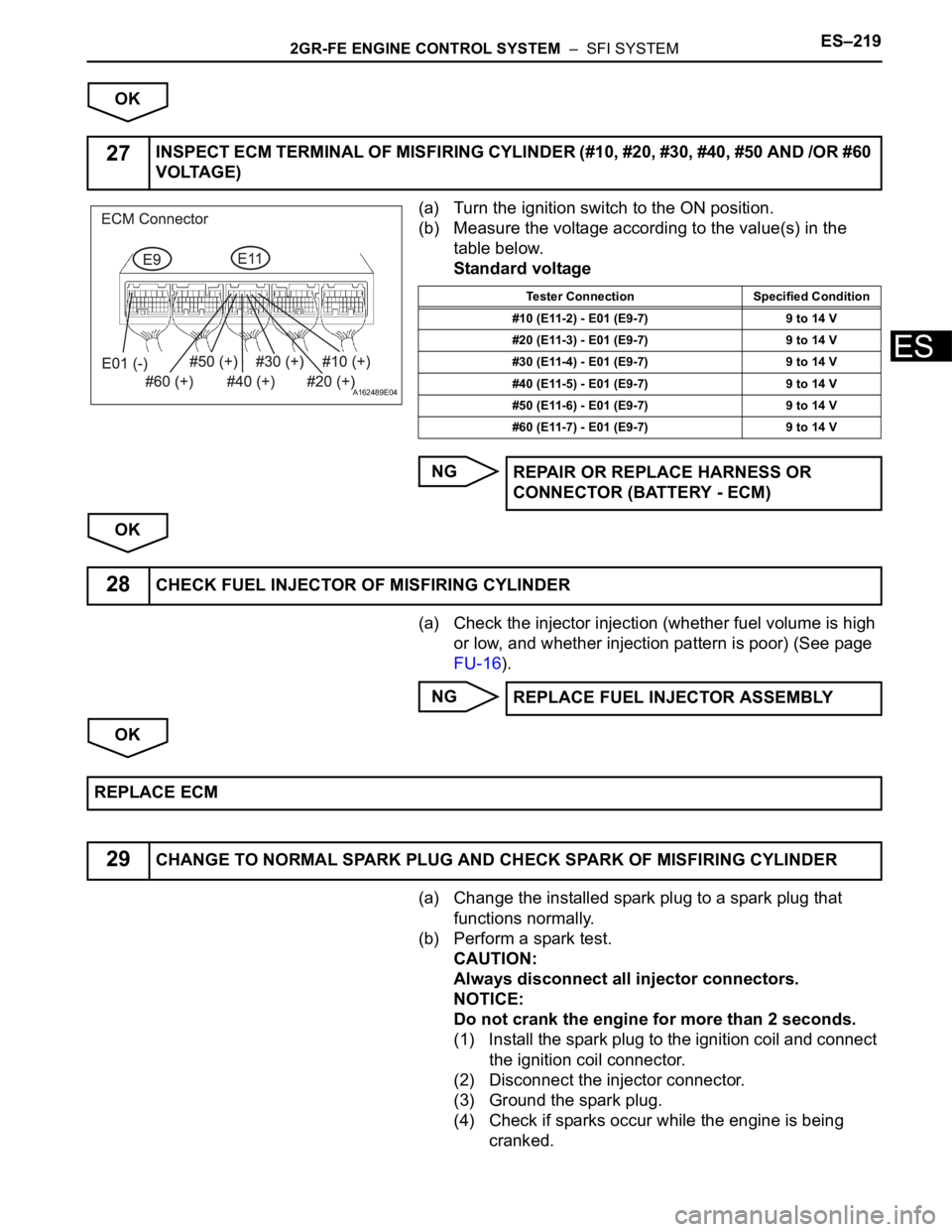
(a) Turn the ignition switch to the ON position.
(b) Measure the voltage according to the value(s) in the
table below.
Standard voltage
NG
OK
(a) Check the injector injection (whether fuel volume is high
or low, and whether injection pattern is poor) (See page
FU-16).
NG
OK
(a) Change the installed spark plug to a spark plug that
functions normally.
(b) Perform a spark test.
CAUTION:
Always disconnect all injector connectors.
NOTICE:
Do not crank the engine for more than 2 seconds.
(1) Install the spark plug to the ignition coil and connect
the ignition coil connector.
(2) Disconnect the injector connector.
(3) Ground the spark plug.
(4) Check if sparks occur while the engine is being
cranked.
27INSPECT ECM TERMINAL OF MISFIRING CYLINDER (#10, #20, #30, #40, #50 AND /OR #60
VOLTAGE)
A162489E04
Tester Connection Specified Condition
#10 (E11-2) - E01 (E9-7) 9 to 14 V
#20 (E11-3) - E01 (E9-7) 9 to 14 V
#30 (E11-4) - E01 (E9-7) 9 to 14 V
#40 (E11-5) - E01 (E9-7) 9 to 14 V
#50 (E11-6) - E01 (E9-7) 9 to 14 V
#60 (E11-7) - E01 (E9-7) 9 to 14 V
REPAIR OR REPLACE HARNESS OR
CONNECTOR (BATTERY - ECM)
28CHECK FUEL INJECTOR OF MISFIRING CYLINDER
REPLACE FUEL INJECTOR ASSEMBLY
REPLACE ECM
29CHANGE TO NORMAL SPARK PLUG AND CHECK SPARK OF MISFIRING CYLINDER
Page 526 of 3000
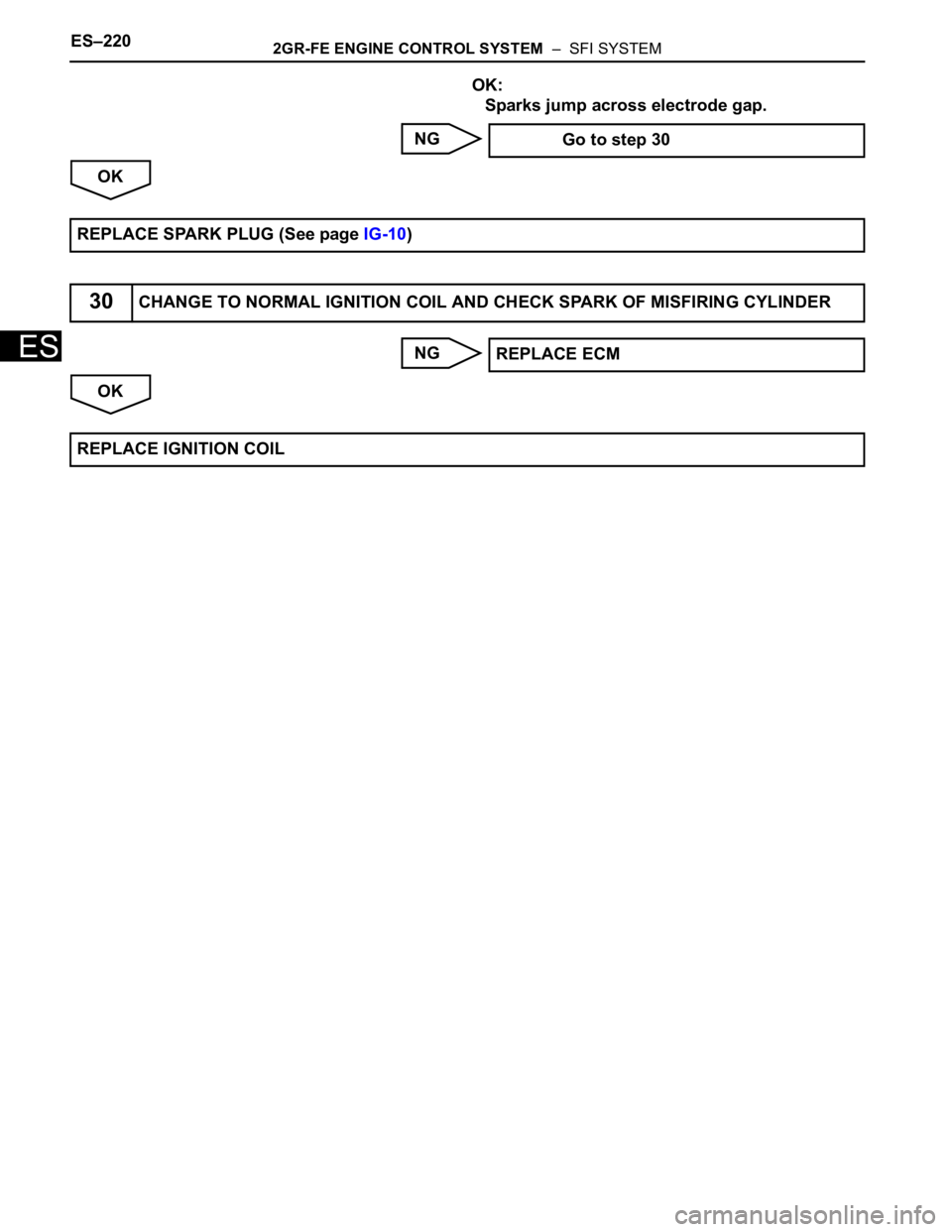
ES–2202GR-FE ENGINE CONTROL SYSTEM – SFI SYSTEM
ES
OK:
Sparks jump across electrode gap.
NG
OK
NG
OK Go to step 30
REPLACE SPARK PLUG (See page IG-10)
30CHANGE TO NORMAL IGNITION COIL AND CHECK SPARK OF MISFIRING CYLINDER
REPLACE ECM
REPLACE IGNITION COIL