check engine TOYOTA SIENNA 2007 Service Repair Manual
[x] Cancel search | Manufacturer: TOYOTA, Model Year: 2007, Model line: SIENNA, Model: TOYOTA SIENNA 2007Pages: 3000, PDF Size: 52.26 MB
Page 805 of 3000
2GR-FE ENGINE CONTROL SYSTEM – SFI SYSTEMES–29
ES
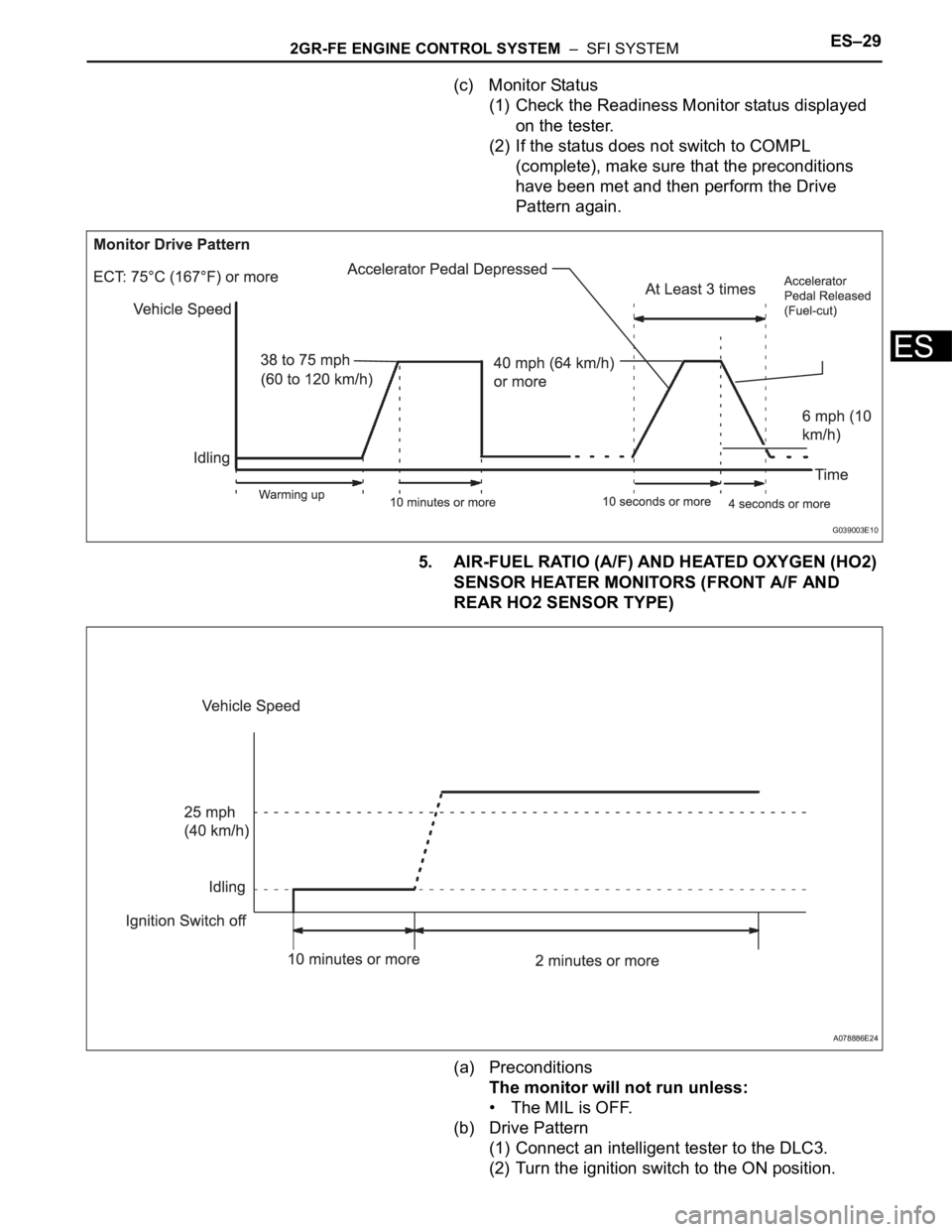
(c) Monitor Status
(1) Check the Readiness Monitor status displayed
on the tester.
(2) If the status does not switch to COMPL
(complete), make sure that the preconditions
have been met and then perform the Drive
Pattern again.
5. AIR-FUEL RATIO (A/F) AND HEATED OXYGEN (HO2)
SENSOR HEATER MONITORS (FRONT A/F AND
REAR HO2 SENSOR TYPE)
(a) Preconditions
The monitor will not run unless:
• The MIL is OFF.
(b) Drive Pattern
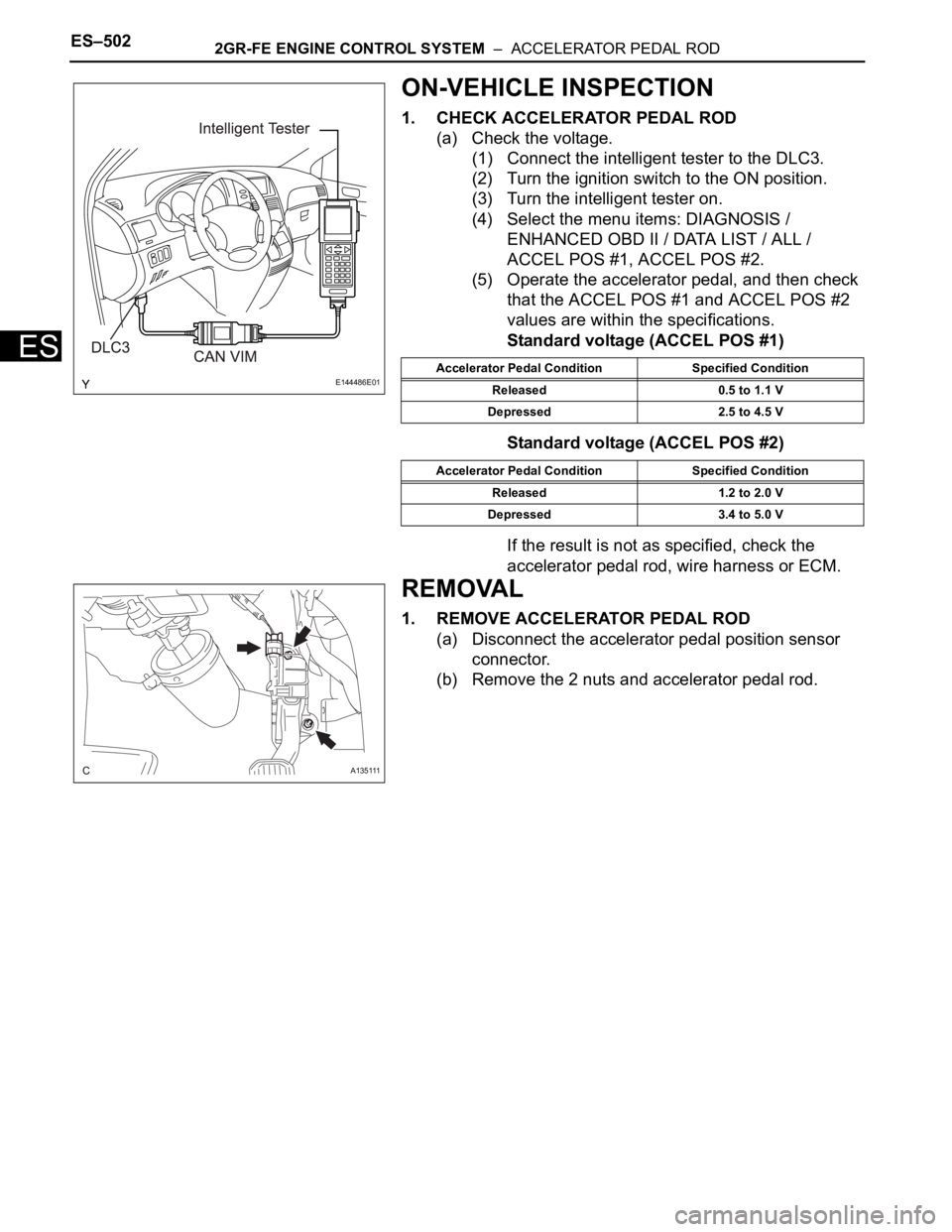
(1) Connect an intelligent tester to the DLC3.
(2) Turn the ignition switch to the ON position.
G039003E10
A078886E24
Page 806 of 3000

ES–302GR-FE ENGINE CONTROL SYSTEM – SFI SYSTEM
ES
(3) Clear the DTCs.
(4) Start the engine.
(5) Allow the engine to idle for 10 minutes or more.
(6) Drive the vehicle at 25 mph (40 km/h) or more
for at least 2 minutes.
(c) Monitor Status
(1) Check the Readiness Monitor status displayed
on the tester or scan tool.
If the status does not switch to COMPL
(complete), make sure that the preconditions
have been met, and repeat the Drive Pattern.
Page 808 of 3000
ES–5022GR-FE ENGINE CONTROL SYSTEM – ACCELERATOR PEDAL ROD
ES
ON-VEHICLE INSPECTION
1. CHECK ACCELERATOR PEDAL ROD
(a) Check the voltage.
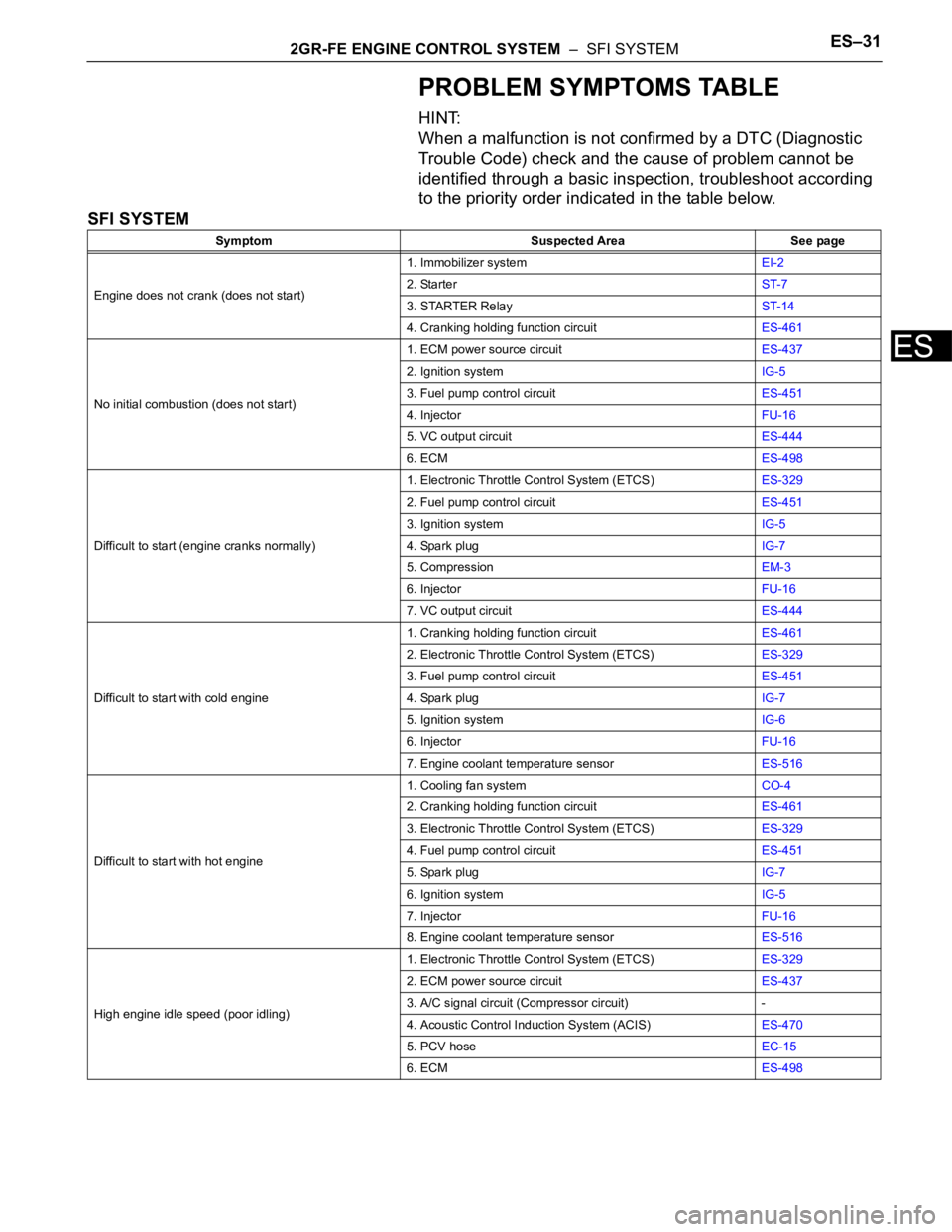
(1) Connect the intelligent tester to the DLC3.
(2) Turn the ignition switch to the ON position.
(3) Turn the intelligent tester on.
(4) Select the menu items: DIAGNOSIS /
ENHANCED OBD II / DATA LIST / ALL /
ACCEL POS #1, ACCEL POS #2.
(5) Operate the accelerator pedal, and then check
that the ACCEL POS #1 and ACCEL POS #2
values are within the specifications.
Standard voltage (ACCEL POS #1)
Standard voltage (ACCEL POS #2)
If the result is not as specified, check the
accelerator pedal rod, wire harness or ECM.
REMOVAL
1. REMOVE ACCELERATOR PEDAL ROD
(a) Disconnect the accelerator pedal position sensor
connector.
(b) Remove the 2 nuts and accelerator pedal rod.
E144486E01Accelerator Pedal Condition Specified Condition
Released 0.5 to 1.1 V
Depressed 2.5 to 4.5 V
Accelerator Pedal Condition Specified Condition
Released 1.2 to 2.0 V
Depressed 3.4 to 5.0 V
A135111
Page 809 of 3000
2GR-FE ENGINE CONTROL SYSTEM – SFI SYSTEMES–31
ES
PROBLEM SYMPTOMS TABLE
HINT:
When a malfunction is not confirmed by a DTC (Diagnostic
Trouble Code) check and the cause of problem cannot be
identified through a basic inspection, troubleshoot according
to the priority order indicated in the table below.
SFI SYSTEM
Symptom Suspected Area See page
Engine does not crank (does not start)1. Immobilizer systemEI-2
2. StarterST-7
3. STARTER RelayST-14
4. Cranking holding function circuitES-461
No initial combustion (does not start)1. ECM power source circuitES-437
2. Ignition systemIG-5
3. Fuel pump control circuitES-451
4. InjectorFU-16
5. VC output circuitES-444
6. ECMES-498
Difficult to start (engine cranks normally)1. Electronic Throttle Control System (ETCS)ES-329
2. Fuel pump control circuitES-451
3. Ignition systemIG-5
4. Spark plugIG-7
5. CompressionEM-3
6. InjectorFU-16
7. VC output circuitES-444
Difficult to start with cold engine1. Cranking holding function circuitES-461
2. Electronic Throttle Control System (ETCS)ES-329
3. Fuel pump control circuitES-451
4. Spark plugIG-7
5. Ignition systemIG-6
6. InjectorFU-16
7. Engine coolant temperature sensorES-516
Difficult to start with hot engine1. Cooling fan systemCO-4
2. Cranking holding function circuitES-461
3. Electronic Throttle Control System (ETCS)ES-329
4. Fuel pump control circuitES-451
5. Spark plugIG-7
6. Ignition systemIG-5
7. InjectorFU-16
8. Engine coolant temperature sensorES-516
High engine idle speed (poor idling)1. Electronic Throttle Control System (ETCS)ES-329
2. ECM power source circuitES-437
3. A/C signal circuit (Compressor circuit) -
4. Acoustic Control Induction System (ACIS)ES-470
5. PCV hoseEC-15
6. ECMES-498
Page 813 of 3000
2GR-FE ENGINE CONTROL SYSTEM – SFI SYSTEMES–33
ES
TERMINALS OF ECM
1. SFI SYSTEM
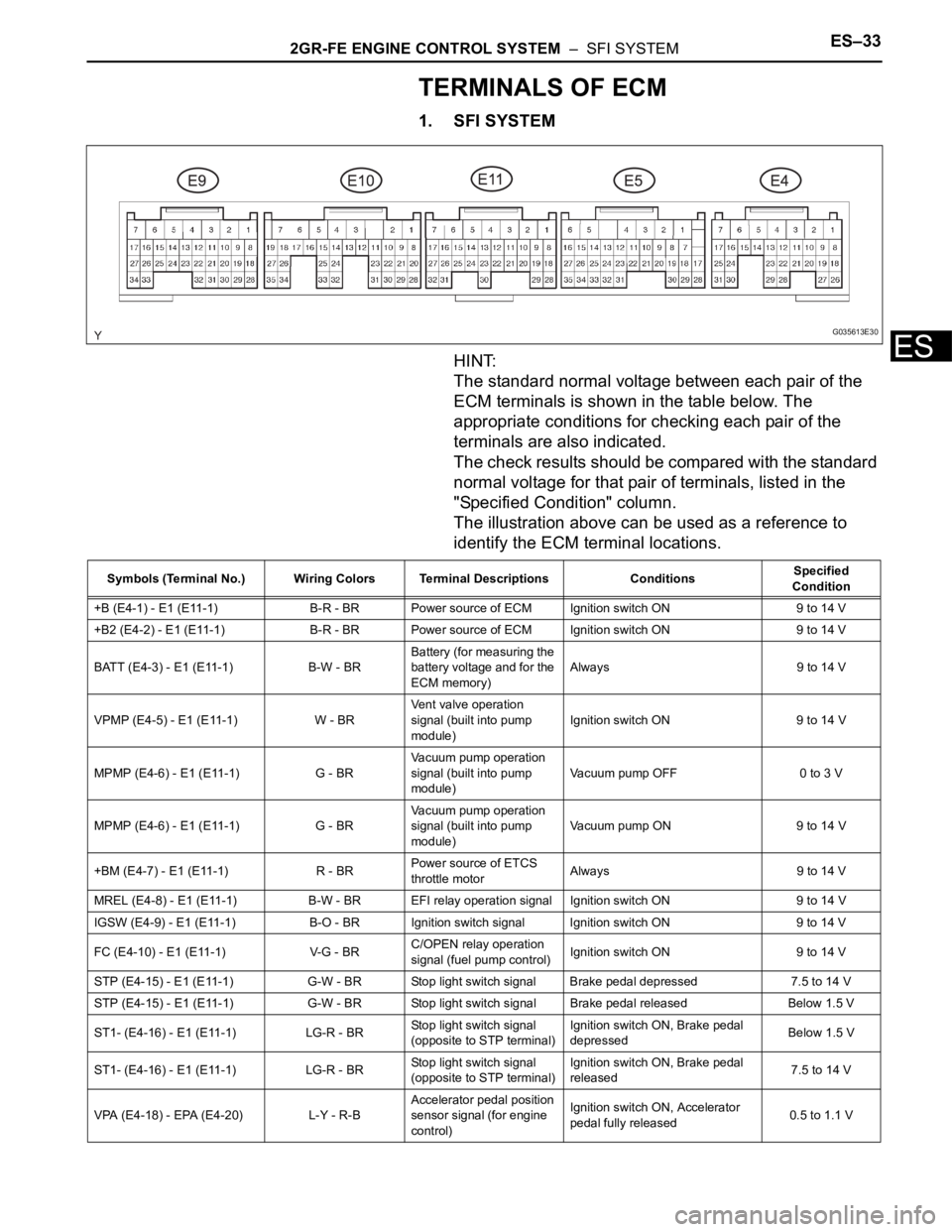
HINT:
The standard normal voltage between each pair of the
ECM terminals is shown in the table below. The
appropriate conditions for checking each pair of the
terminals are also indicated.
The check results should be compared with the standard
normal voltage for that pair of terminals, listed in the
"Specified Condition" column.
The illustration above can be used as a reference to
identify the ECM terminal locations.
G035613E30
Symbols (Terminal No.) Wiring Colors Terminal Descriptions ConditionsSpecified
Condition
+B (E4-1) - E1 (E11-1) B-R - BR Power source of ECM Ignition switch ON 9 to 14 V
+B2 (E4-2) - E1 (E11-1) B-R - BR Power source of ECM Ignition switch ON 9 to 14 V
BATT (E4-3) - E1 (E11-1) B-W - BRBattery (for measuring the
battery voltage and for the
ECM memory)Always 9 to 14 V
VPMP (E4-5) - E1 (E11-1) W - BRVent valve operation
signal (built into pump
module)Ignition switch ON 9 to 14 V
MPMP (E4-6) - E1 (E11-1) G - BRVacuum pump operation
signal (built into pump
module)Vacuum pump OFF 0 to 3 V
MPMP (E4-6) - E1 (E11-1) G - BRVacuum pump operation
signal (built into pump
module)Vacuum pump ON 9 to 14 V
+BM (E4-7) - E1 (E11-1) R - BRPower source of ETCS
throttle motorAlways 9 to 14 V
MREL (E4-8) - E1 (E11-1) B-W - BR EFI relay operation signal Ignition switch ON 9 to 14 V
IGSW (E4-9) - E1 (E11-1) B-O - BRIgnition switch signal Ignition switch ON 9 to 14 V
FC (E4-10) - E1 (E11-1) V-G - BRC/OPEN relay operation
signal (fuel pump control)Ignition switch ON 9 to 14 V
STP (E4-15) - E1 (E11-1) G-W - BR Stop light switch signal Brake pedal depressed 7.5 to 14 V
STP (E4-15) - E1 (E11-1) G-W - BR Stop light switch signal Brake pedal released Below 1.5 V
ST1- (E4-16) - E1 (E11-1) LG-R - BRStop light switch signal
(opposite to STP terminal)Ignition switch ON, Brake pedal
depressedBelow 1.5 V
ST1- (E4-16) - E1 (E11-1) LG-R - BRStop light switch signal
(opposite to STP terminal)Ignition switch ON, Brake pedal
released7.5 to 14 V
VPA (E4-18) - EPA (E4-20) L-Y - R-BAccelerator pedal position
sensor signal (for engine
control)Ignition switch ON, Accelerator
pedal fully released0.5 to 1.1 V
Page 819 of 3000
2GR-FE ENGINE CONTROL SYSTEM – SFI SYSTEMES–39
ES
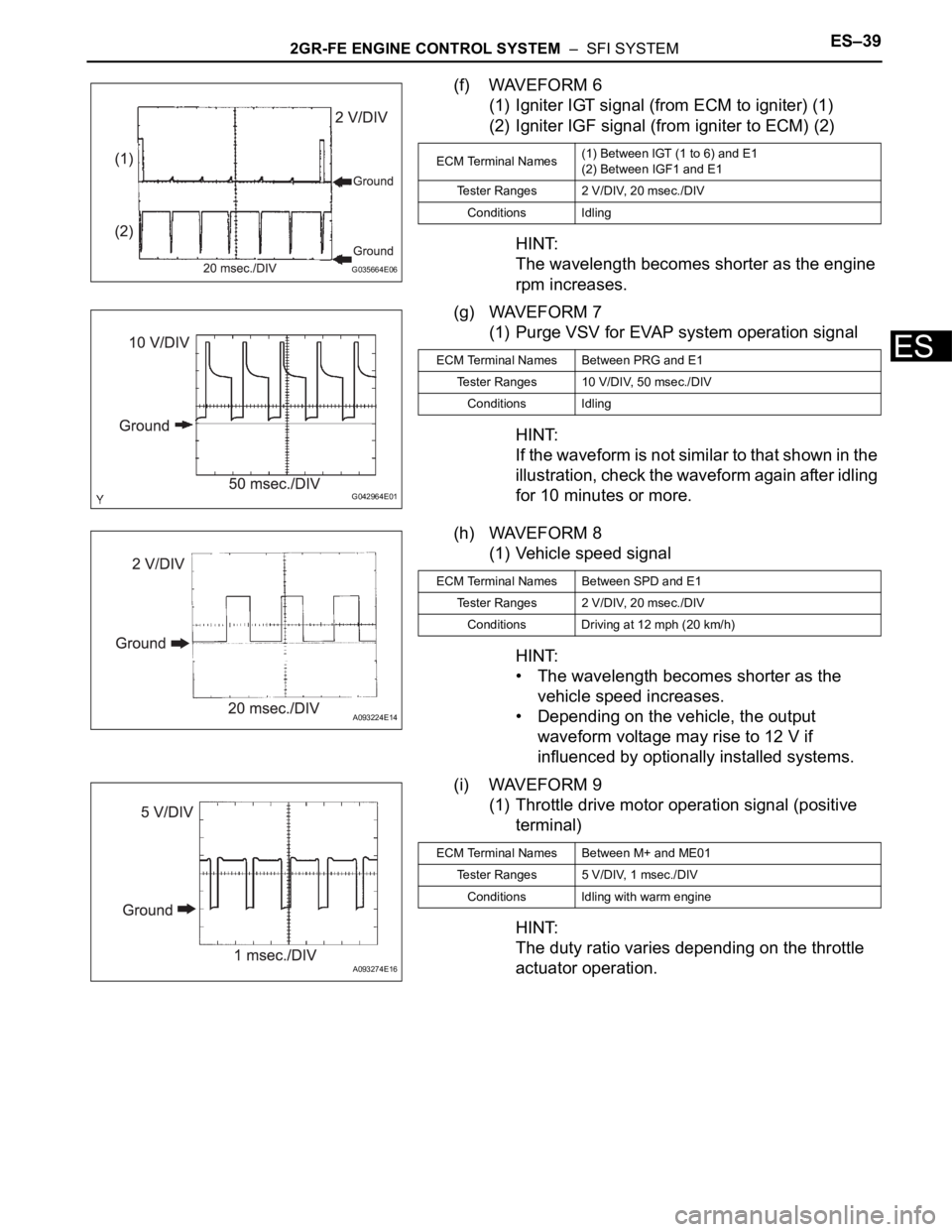
(f) WAVEFORM 6
(1) Igniter IGT signal (from ECM to igniter) (1)
(2) Igniter IGF signal (from igniter to ECM) (2)
HINT:
The wavelength becomes shorter as the engine
rpm increases.
(g) WAVEFORM 7
(1) Purge VSV for EVAP system operation signal
HINT:
If the waveform is not similar to that shown in the
illustration, check the waveform again after idling
for 10 minutes or more.
(h) WAVEFORM 8
(1) Vehicle speed signal
HINT:
• The wavelength becomes shorter as the
vehicle speed increases.
• Depending on the vehicle, the output
waveform voltage may rise to 12 V if
influenced by optionally installed systems.
(i) WAVEFORM 9
(1) Throttle drive motor operation signal (positive
terminal)
HINT:
The duty ratio varies depending on the throttle
actuator operation.
G035664E06
ECM Terminal Names(1) Between IGT (1 to 6) and E1
(2) Between IGF1 and E1
Tester Ranges 2 V/DIV, 20 msec./DIV
Conditions Idling
G042964E01
ECM Terminal Names Between PRG and E1
Tester Ranges 10 V/DIV, 50 msec./DIV
Conditions Idling
A093224E14
ECM Terminal Names Between SPD and E1
Tester Ranges 2 V/DIV, 20 msec./DIV
Conditions Driving at 12 mph (20 km/h)
A093274E16
ECM Terminal Names Between M+ and ME01
Tester Ranges 5 V/DIV, 1 msec./DIV
Conditions Idling with warm engine
Page 821 of 3000
2GR-FE ENGINE CONTROL SYSTEM – VVT SENSORES–509
ES
ON-VEHICLE INSPECTION
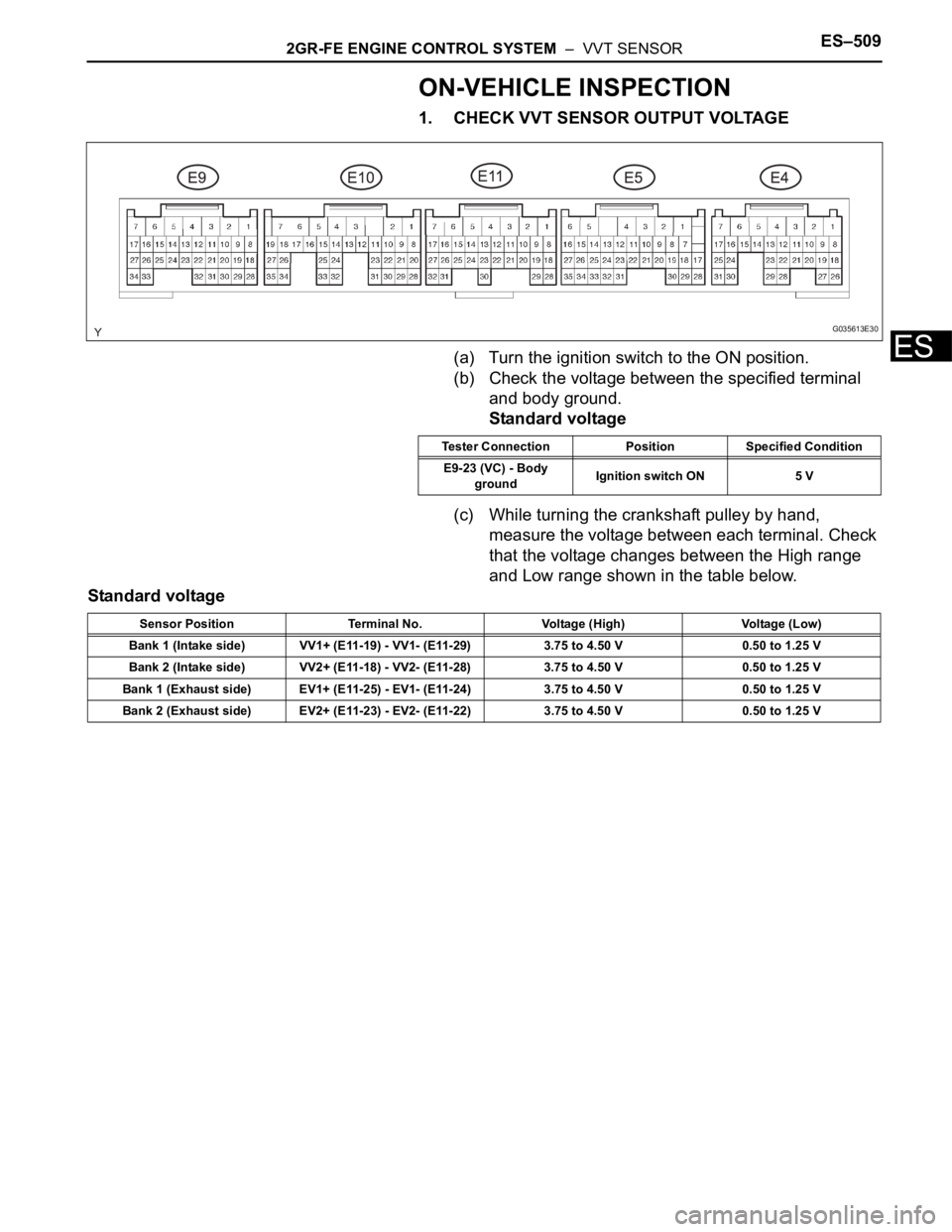
1. CHECK VVT SENSOR OUTPUT VOLTAGE
(a) Turn the ignition switch to the ON position.
(b) Check the voltage between the specified terminal
and body ground.
Standard voltage
(c) While turning the crankshaft pulley by hand,
measure the voltage between each terminal. Check
that the voltage changes between the High range
and Low range shown in the table below.
Standard voltage
G035613E30
Tester Connection Position Specified Condition
E9-23 (VC) - Body
groundIgnition switch ON 5 V
Sensor Position Terminal No. Voltage (High) Voltage (Low)
Bank 1 (Intake side) VV1+ (E11-19) - VV1- (E11-29) 3.75 to 4.50 V0.50 to 1.25 V
Bank 2 (Intake side) VV2+ (E11-18) - VV2- (E11-28) 3.75 to 4.50 V0.50 to 1.25 V
Bank 1 (Exhaust side) EV1+ (E11-25) - EV1- (E11-24) 3.75 to 4.50 V 0.50 to 1.25 V
Bank 2 (Exhaust side) EV2+ (E11-23) - EV2- (E11-22) 3.75 to 4.50 V 0.50 to 1.25 V
Page 823 of 3000
2GR-FE ENGINE CONTROL SYSTEM – SFI SYSTEMES–41
ES
DIAGNOSIS SYSTEM
1. DESCRIPTION
(a) When troubleshooting OBD II (On-Board
Diagnostics) vehicles, an intelligent tester
(complying with SAE J1987) must be connected to
the DLC3 (Data Link Connector 3) of the vehicle.
Various data in the vehicle's ECM (Engine Control
Module) can be then read.
(b) OBD II regulations require that the vehicle's on-
board computer illuminates the MIL (Malfunction
Indicator Lamp) on the instrument panel when the
computer detects a malfunction in:
(1) The emission control systems and components
(2) The power train control components (which
affect vehicle emissions)
(3) The computer itself
In addition, the applicable DTCs (Diagnostic
Trouble Codes) prescribed by SAE J2012 are
recorded on 3 consecutive trips, the MIL turns
off automatically but the DTCs remain recorded
in the ECM memory.
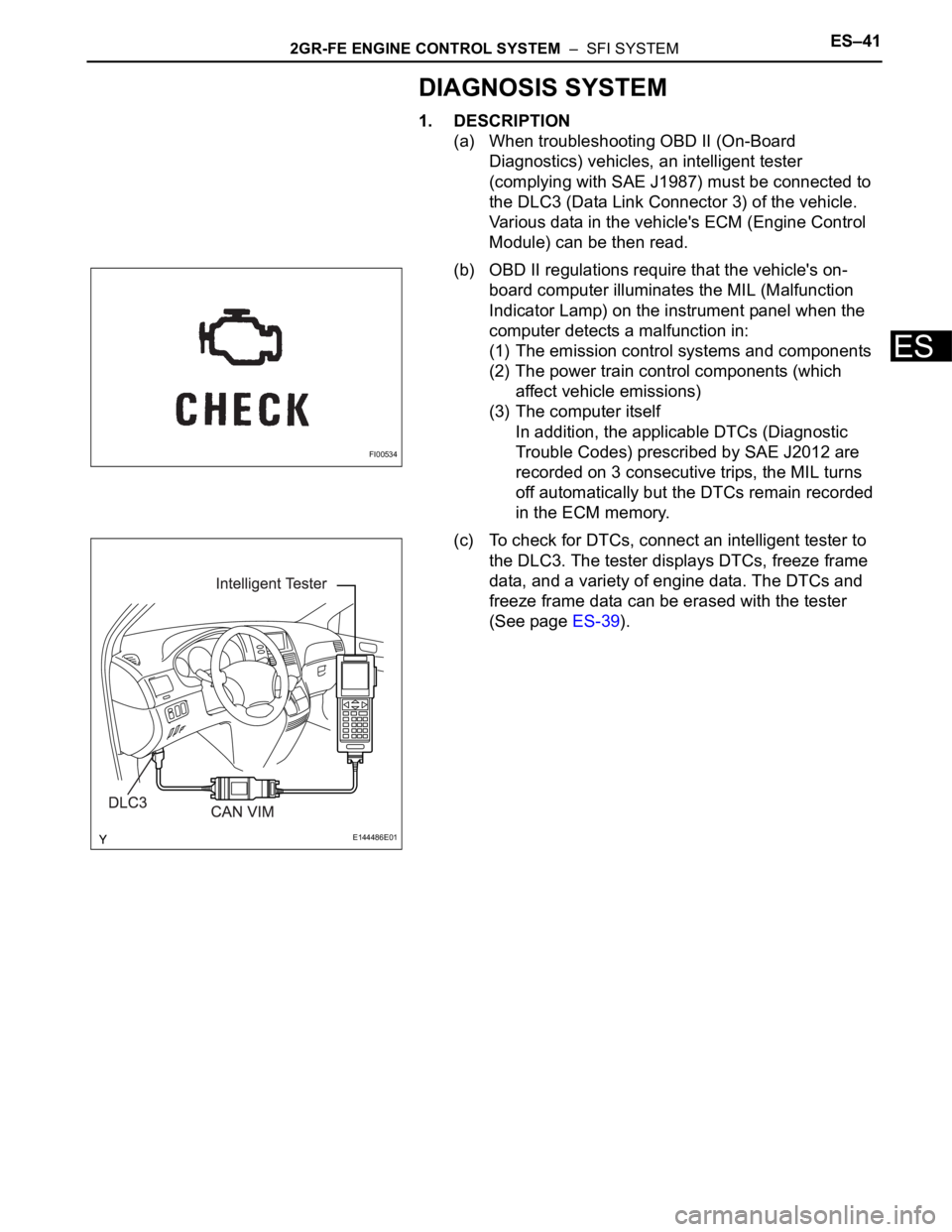
(c) To check for DTCs, connect an intelligent tester to
the DLC3. The tester displays DTCs, freeze frame
data, and a variety of engine data. The DTCs and
freeze frame data can be erased with the tester
(See page ES-39).
FI00534
E144486E01
Page 824 of 3000
ES–422GR-FE ENGINE CONTROL SYSTEM – SFI SYSTEM
ES
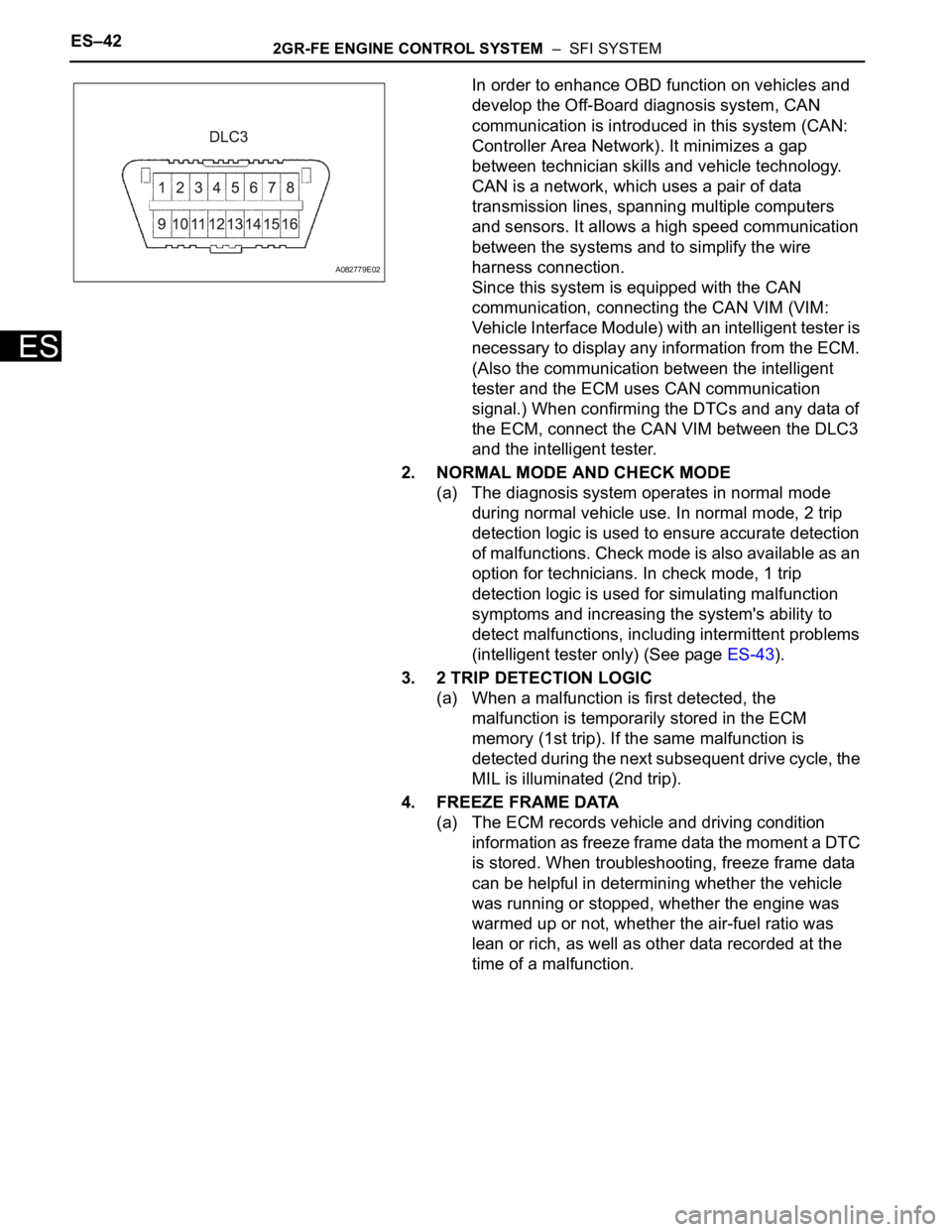
In order to enhance OBD function on vehicles and
develop the Off-Board diagnosis system, CAN
communication is introduced in this system (CAN:
Controller Area Network). It minimizes a gap
between technician skills and vehicle technology.
CAN is a network, which uses a pair of data
transmission lines, spanning multiple computers
and sensors. It allows a high speed communication
between the systems and to simplify the wire
harness connection.
Since this system is equipped with the CAN
communication, connecting the CAN VIM (VIM:
Vehicle Interface Module) with an intelligent tester is
necessary to display any information from the ECM.
(Also the communication between the intelligent
tester and the ECM uses CAN communication
signal.) When confirming the DTCs and any data of
the ECM, connect the CAN VIM between the DLC3
and the intelligent tester.
2. NORMAL MODE AND CHECK MODE
(a) The diagnosis system operates in normal mode
during normal vehicle use. In normal mode, 2 trip
detection logic is used to ensure accurate detection
of malfunctions. Check mode is also available as an
option for technicians. In check mode, 1 trip
detection logic is used for simulating malfunction
symptoms and increasing the system's ability to
detect malfunctions, including intermittent problems
(intelligent tester only) (See page ES-43).
3. 2 TRIP DETECTION LOGIC
(a) When a malfunction is first detected, the
malfunction is temporarily stored in the ECM
memory (1st trip). If the same malfunction is
detected during the next subsequent drive cycle, the
MIL is illuminated (2nd trip).
4. FREEZE FRAME DATA
(a) The ECM records vehicle and driving condition
information as freeze frame data the moment a DTC
is stored. When troubleshooting, freeze frame data
can be helpful in determining whether the vehicle
was running or stopped, whether the engine was
warmed up or not, whether the air-fuel ratio was
lean or rich, as well as other data recorded at the
time of a malfunction.
A082779E02
Page 826 of 3000

ES–442GR-FE ENGINE CONTROL SYSTEM – SFI SYSTEM
ES
(b) The MIL should turn off when the engine is started.
If the MIL remains illuminated, the diagnosis system
has detected a malfunction or abnormality in the
system.
HINT:
If the MIL is not illuminated when the ignition switch
is first turned to the ON position, check the MIL
circuit (See page ES-478).