fuel cap TOYOTA SIENNA 2007 Service Owner's Guide
[x] Cancel search | Manufacturer: TOYOTA, Model Year: 2007, Model line: SIENNA, Model: TOYOTA SIENNA 2007Pages: 3000, PDF Size: 52.26 MB
Page 1144 of 3000
FU–262GR-FE FUEL – FUEL PRESSURE PULSATION DAMPER
FU
2. INSTALL INTAKE AIR SURGE TANK ASSEMBLY (See
page FU-19)
3. INSTALL AIR CLEANER CAP SUB-ASSEMBLY (See
page FU-20)
4. ADD ENGINE COOLANT (See page CO-7)
5. CONNECT CABLE TO NEGATIVE BATTERY
TERMINAL
6. INSPECT FOR ENGINE COOLANT LEAK (See page
CO-1)
7. INSTALL NO. 1 ENGINE UNDER COVER
8. INSPECT FOR FUEL LEAK (See page FU-7)
9. INSTALL V-BANK COVER SUB-ASSEMBLY (See
page EM-63)
10. INSTALL COWL TOP PANEL SUB-ASSEMBLY
OUTER FRONT (See page FU-21)
11. INSTALL NO. 1 COWL TOP TO COWL BRACE INNER
(See page FU-21)
12. INSTALL WINDSHIELD WIPER MOTOR AND LINK
ASSEMBLY (See page WW-6)
13. INSTALL FRONT WIPER ARM LH (See page WW-6)
14. INSTALL FRONT WIPER ARM RH (See page WW-7)
Page 1175 of 3000
2GR-FE EMISSION CONTROL – EMISSION CONTROL SYSTEMEC–5
EC
ON-VEHICLE INSPECTION
1. INSPECT FUEL CUT RPM
(a) Increase the engine speed to at least 3500 rpm.
(b) Use a sound scope to check for injector operating
sounds.
(c) Check that when the throttle lever is released,
injector operating sounds stop momentarily (at 2500
rpm) and then resume (at 1400 rpm).
Standard
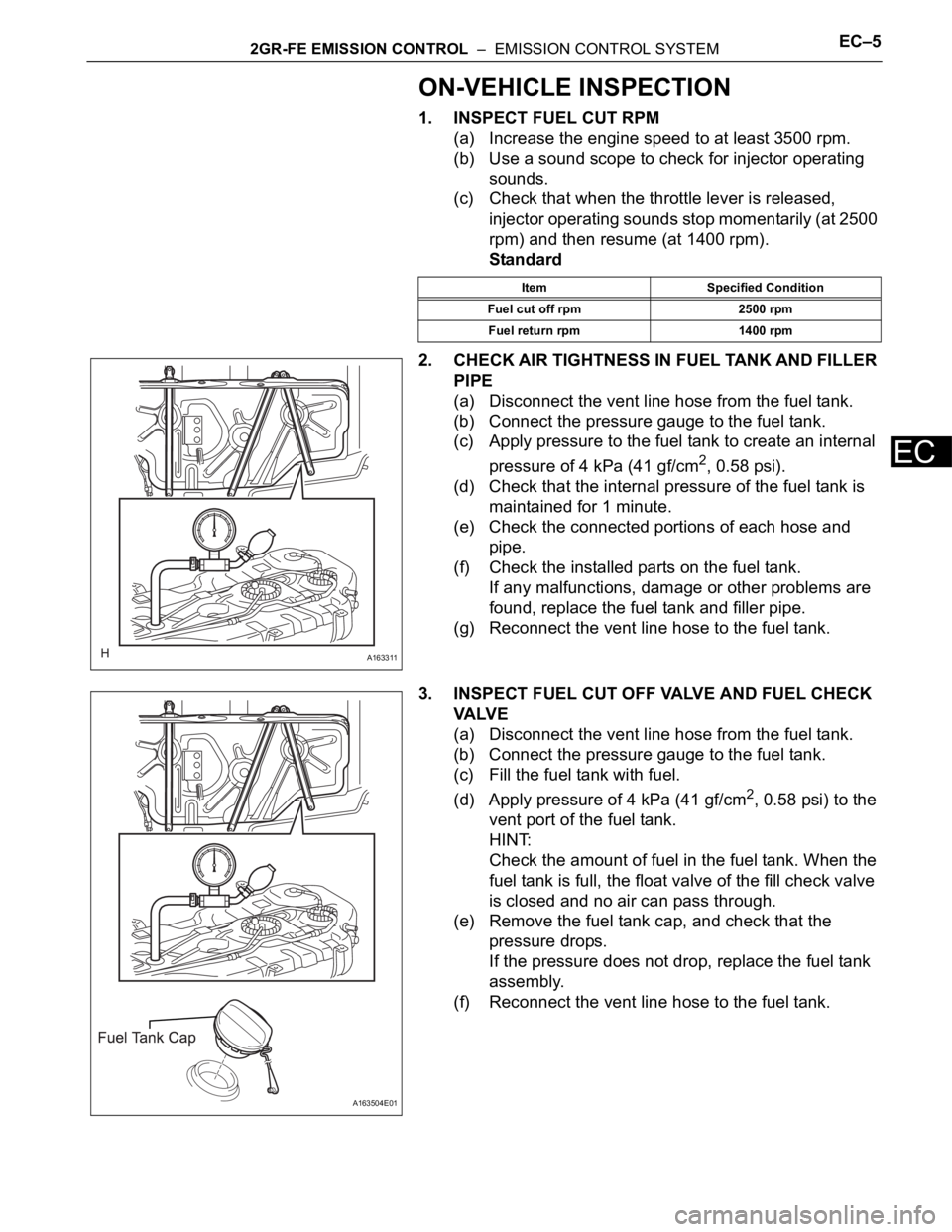
2. CHECK AIR TIGHTNESS IN FUEL TANK AND FILLER
PIPE
(a) Disconnect the vent line hose from the fuel tank.
(b) Connect the pressure gauge to the fuel tank.
(c) Apply pressure to the fuel tank to create an internal
pressure of 4 kPa (41 gf/cm
2, 0.58 psi).
(d) Check that the internal pressure of the fuel tank is
maintained for 1 minute.
(e) Check the connected portions of each hose and
pipe.
(f) Check the installed parts on the fuel tank.
If any malfunctions, damage or other problems are
found, replace the fuel tank and filler pipe.
(g) Reconnect the vent line hose to the fuel tank.
3. INSPECT FUEL CUT OFF VALVE AND FUEL CHECK
VA LV E
(a) Disconnect the vent line hose from the fuel tank.
(b) Connect the pressure gauge to the fuel tank.
(c) Fill the fuel tank with fuel.
(d) Apply pressure of 4 kPa (41 gf/cm
2, 0.58 psi) to the
vent port of the fuel tank.
HINT:
Check the amount of fuel in the fuel tank. When the
fuel tank is full, the float valve of the fill check valve
is closed and no air can pass through.
(e) Remove the fuel tank cap, and check that the
pressure drops.
If the pressure does not drop, replace the fuel tank
assembly.
(f) Reconnect the vent line hose to the fuel tank.
Item Specified Condition
Fuel cut off rpm 2500 rpm
Fuel return rpm 1400 rpm
A163311
A163504E01
Page 1210 of 3000
EC–422GR-FE EMISSION CONTROL – FUEL TANK CAP
EC
FUEL TANK CAP
INSPECTION
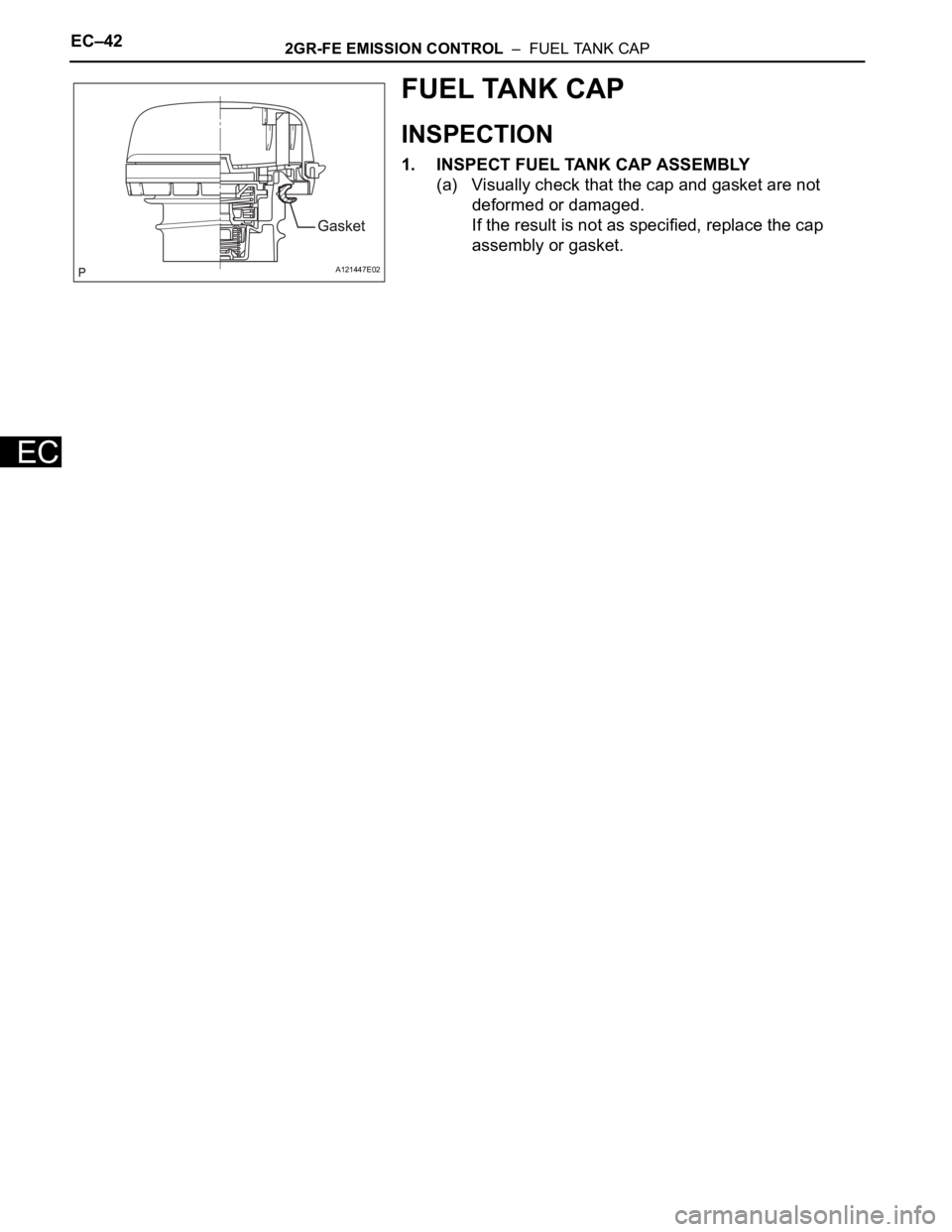
1. INSPECT FUEL TANK CAP ASSEMBLY
(a) Visually check that the cap and gasket are not
deformed or damaged.
If the result is not as specified, replace the cap
assembly or gasket.
A121447E02
Page 2994 of 3000

SUPPLEMENTAL RESTRAINT SYSTEM – AIRBAG SYSTEMRS–17
RS
• The center airbag sensor assembly receives
signals from the deceleration sensor and the
safing sensor built into the center airbag
sensor assembly and the side airbag sensor
and the rear airbag sensor, and determines
whether or not the front seat side airbag and
curtain shield airbag assemblies should be
activated, and diagnoses system
malfunctions.
• The center airbag sensor assembly sends the
airbag deployment signal to the ECM through
BEAN and CAN to operate fuel pump control.
• The center airbag sensor assembly sends the
airbag deployment signal to the main body
ECU through a discrete line to operate
collision door lock release control.
(2) Deceleration sensor and ignition control circuit
• The deceleration sensor is built into the
center airbag sensor assembly, front airbag
sensor, side airbag sensor and rear airbag
sensor, and the distortion created based on
the deceleration of the vehicle during a
frontal, front side or rear side collision is
converted into an electric signal.
• The ignition control circuit performs
calculations based on the signal output from
the deceleration sensors of the center airbag
sensor assembly, front airbag sensor, side
airbag sensor and rear airbag sensor. If the
calculated values are greater than the
specified values, it activates an ignition
operation.
(3) Safing sensor
• The safing sensor is built into the center
airbag sensor assembly. During a frontal
collision, the sensor turns on and outputs an
ON signal to the center airbag sensor
assembly if a deceleration rate greater than
the specified value is applied to the safing
sensor.
(4) Backup power source
• The backup power source consists of a
power supply capacitor and a DC-DC
converter. If the power system does not
function during a collision, the power supply
capacitor discharges and supplies electric
power to the system. The DC-DC converter
operates as a boosting transformer when the
battery voltage falls below a predetermined
level.