battery TOYOTA SIENNA 2007 Service Manual PDF
[x] Cancel search | Manufacturer: TOYOTA, Model Year: 2007, Model line: SIENNA, Model: TOYOTA SIENNA 2007Pages: 3000, PDF Size: 52.26 MB
Page 550 of 3000
ES–2442GR-FE ENGINE CONTROL SYSTEM – SFI SYSTEM
ES
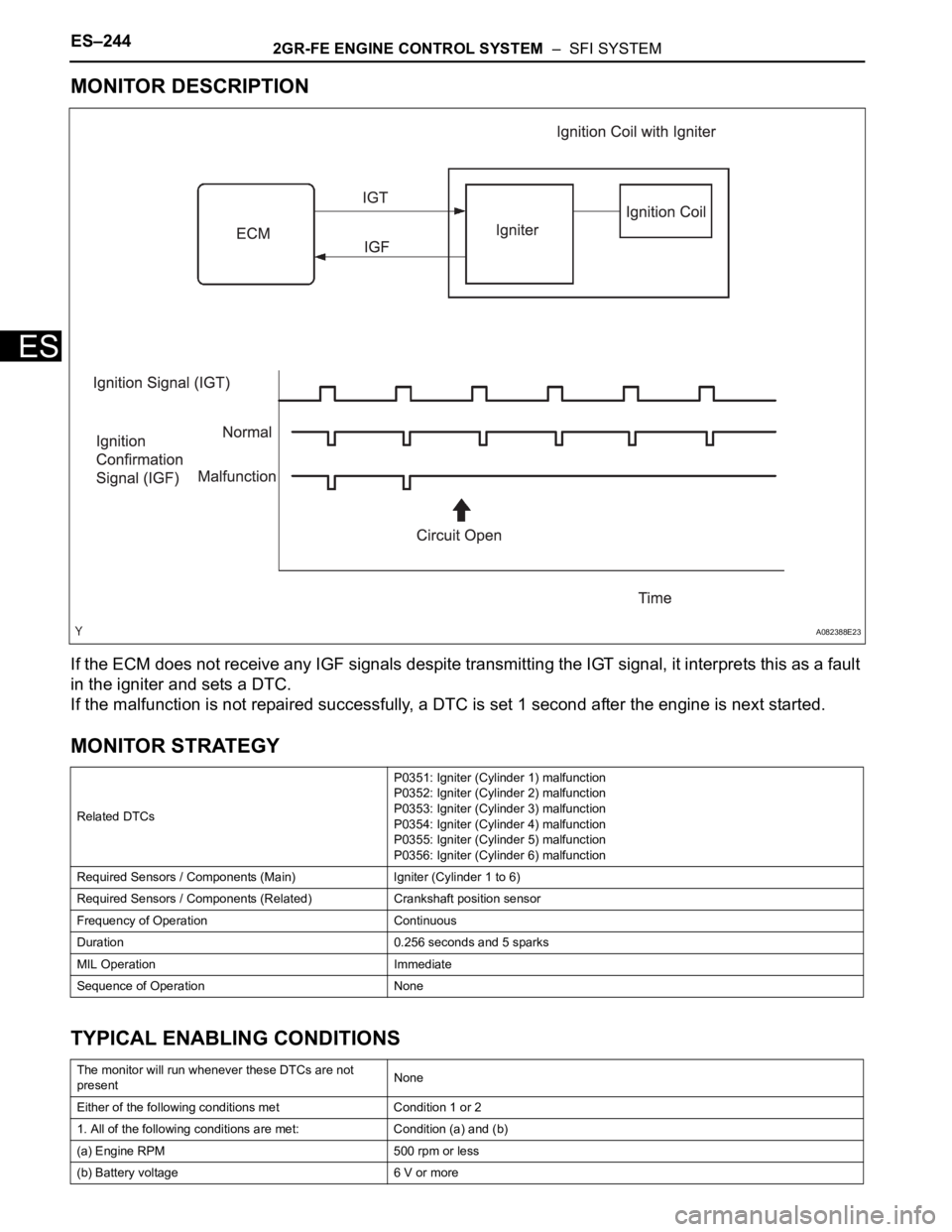
MONITOR DESCRIPTION
If the ECM does not receive any IGF signals despite transmitting the IGT signal, it interprets this as a fault
in the igniter and sets a DTC.
If the malfunction is not repaired successfully, a DTC is set 1 second after the engine is next started.
MONITOR STRATEGY
TYPICAL ENABLING CONDITIONS
Related DTCsP0351: Igniter (Cylinder 1) malfunction
P0352: Igniter (Cylinder 2) malfunction
P0353: Igniter (Cylinder 3) malfunction
P0354: Igniter (Cylinder 4) malfunction
P0355: Igniter (Cylinder 5) malfunction
P0356: Igniter (Cylinder 6) malfunction
Required Sensors / Components (Main) Igniter (Cylinder 1 to 6)
Required Sensors / Components (Related) Crankshaft position sensor
Frequency of Operation Continuous
Duration 0.256 seconds and 5 sparks
MIL Operation Immediate
Sequence of Operation None
The monitor will run whenever these DTCs are not
presentNone
Either of the following conditions met Condition 1 or 2
1. All of the following conditions are met: Condition (a) and (b)
(a) Engine RPM 500 rpm or less
(b) Battery voltage 6 V or more
A082388E23
Page 551 of 3000

2GR-FE ENGINE CONTROL SYSTEM – SFI SYSTEMES–245
ES
TYPICAL MALFUNCTION THRESHOLDS
COMPONENT OPERATING RANGE
2. All of the following conditions are met: Condition (c) and (d)
(c) Engine RPM More than 500 rpm
(d) Battery voltage 10 V or more
Ignition signal fail count More than 2 times
Ignition signal fail count is on the right No ignition confirmation signal from igniter.
IGF signal Igniter transmits IGF signal when it receives IGT signal from ECM
Page 557 of 3000
2GR-FE ENGINE CONTROL SYSTEM – SFI SYSTEMES–251
ES
Standard voltage
(e) Reconnect the ignition coil with igniter connector.
NG
OK
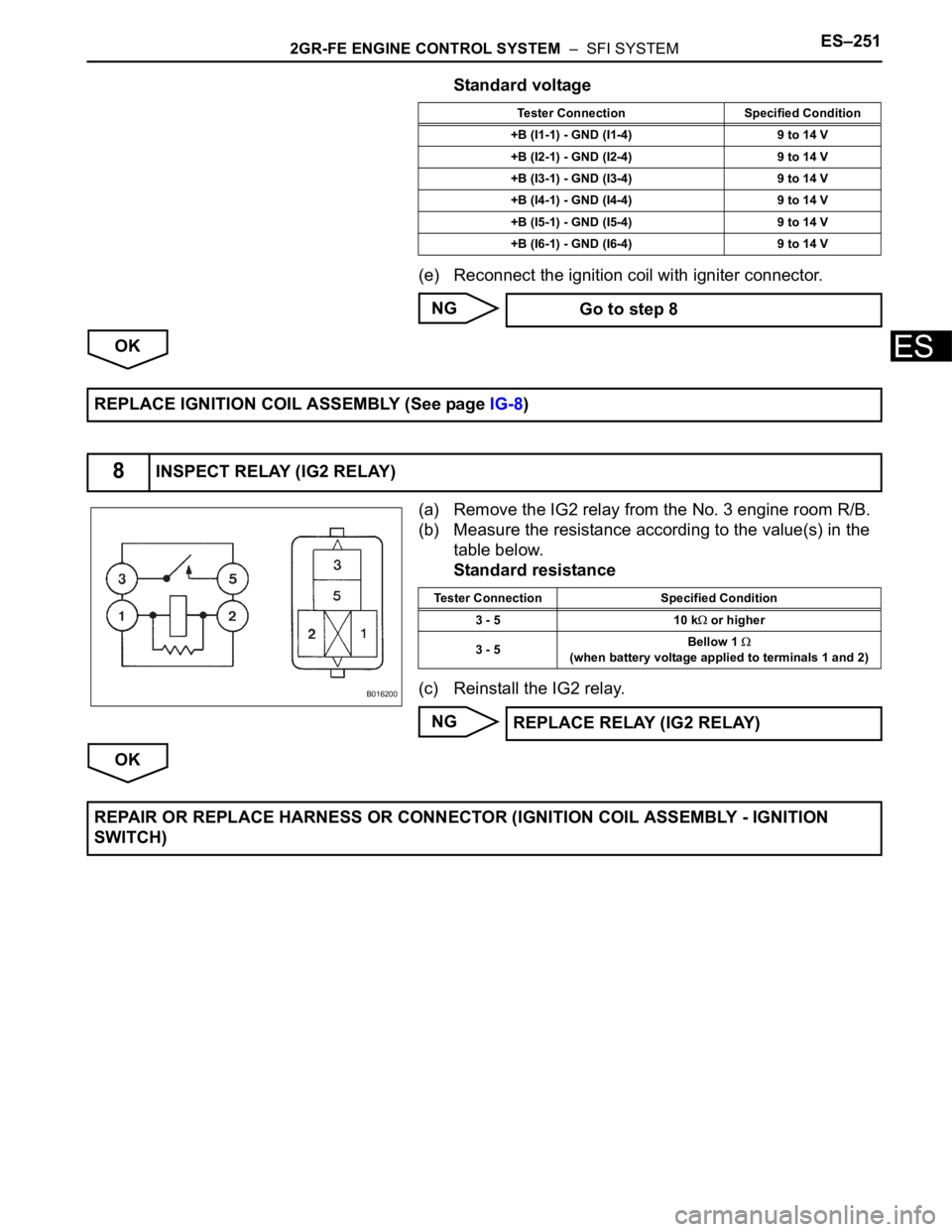
(a) Remove the IG2 relay from the No. 3 engine room R/B.
(b) Measure the resistance according to the value(s) in the
table below.
Standard resistance
(c) Reinstall the IG2 relay.
NG
OK
Tester Connection Specified Condition
+B (I1-1) - GND (I1-4) 9 to 14 V
+B (I2-1) - GND (I2-4) 9 to 14 V
+B (I3-1) - GND (I3-4) 9 to 14 V
+B (I4-1) - GND (I4-4) 9 to 14 V
+B (I5-1) - GND (I5-4) 9 to 14 V
+B (I6-1) - GND (I6-4) 9 to 14 V
Go to step 8
REPLACE IGNITION COIL ASSEMBLY (See page IG-8)
8INSPECT RELAY (IG2 RELAY)
B016200
Tester Connection Specified Condition
3 - 5 10 k
or higher
3 - 5Bellow 1
(when battery voltage applied to terminals 1 and 2)
REPLACE RELAY (IG2 RELAY)
REPAIR OR REPLACE HARNESS OR CONNECTOR (IGNITION COIL ASSEMBLY - IGNITION
SWITCH)
Page 560 of 3000
2GR-FE ENGINE CONTROL SYSTEM – SFI SYSTEMES–267
ES
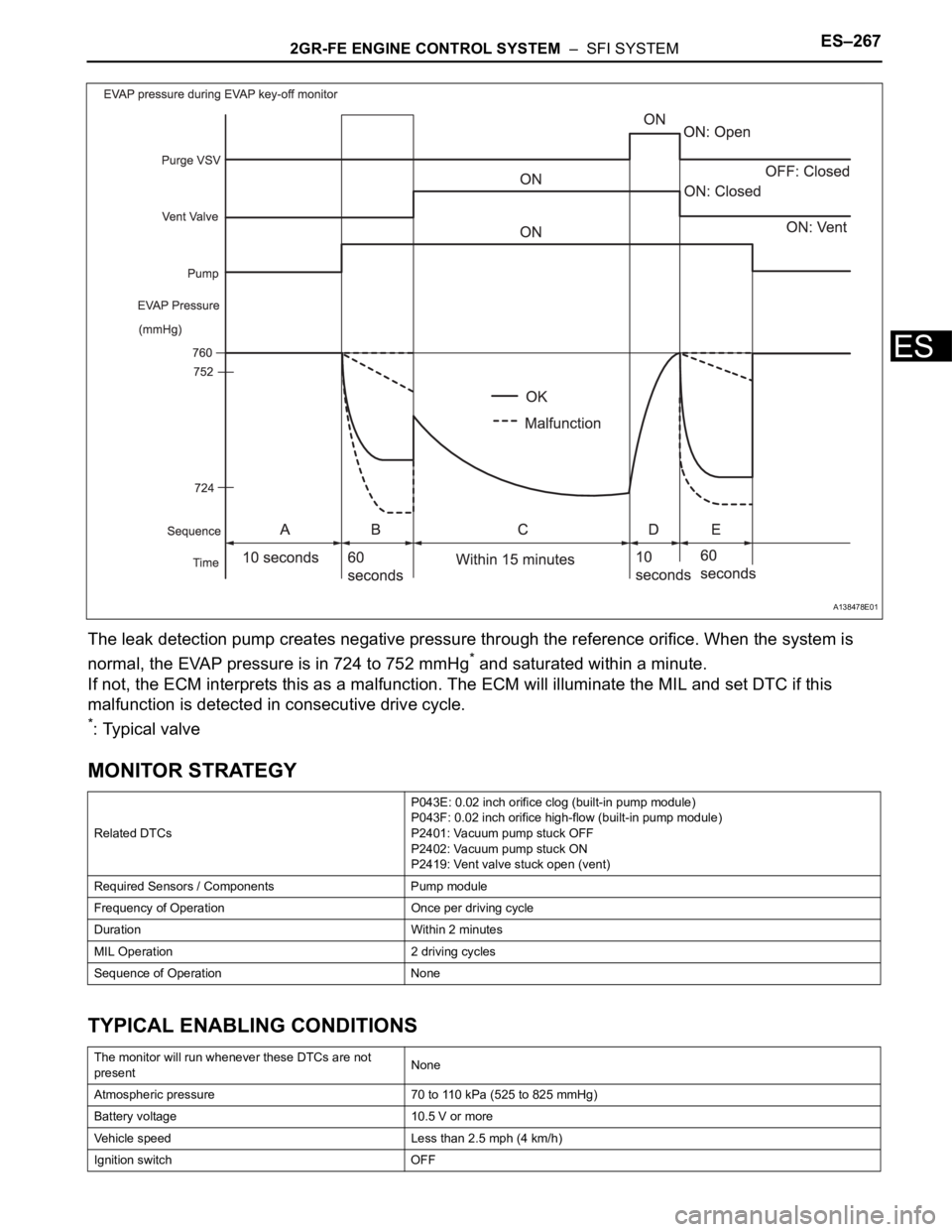
The leak detection pump creates negative pressure through the reference orifice. When the system is
normal, the EVAP pressure is in 724 to 752 mmHg
* and saturated within a minute.
If not, the ECM interprets this as a malfunction. The ECM will illuminate the MIL and set DTC if this
malfunction is detected in consecutive drive cycle.
*: Typical valve
MONITOR STRATEGY
TYPICAL ENABLING CONDITIONS
Related DTCsP043E: 0.02 inch orifice clog (built-in pump module)
P043F: 0.02 inch orifice high-flow (built-in pump module)
P2401: Vacuum pump stuck OFF
P2402: Vacuum pump stuck ON
P2419: Vent valve stuck open (vent)
Required Sensors / Components Pump module
Frequency of Operation Once per driving cycle
Duration Within 2 minutes
MIL Operation 2 driving cycles
Sequence of Operation None
The monitor will run whenever these DTCs are not
presentNone
Atmospheric pressure 70 to 110 kPa (525 to 825 mmHg)
Battery voltage 10.5 V or more
Vehicle speed Less than 2.5 mph (4 km/h)
Ignition switch OFF
A138478E01
Page 568 of 3000

2GR-FE ENGINE CONTROL SYSTEM – SFI SYSTEMES–275
ES
MONITOR STRATEGY
TYPICAL ENABLING CONDITIONS
All:
Purge flow:
Purge VSV stuck open and closed:
Key-off monitor sequence 1 to 8
1. Atmospheric pressure measurement
Related DTCsP0441: Purge VSV stuck open
P0441: Purge VSV stuck closed
P0441: Purge flow
Required Sensors / Components Purge VSV and pump module
Frequency of Operation Once per driving cycle
Duration Within 15 minutes
MIL Operation 2 driving cycles
Sequence of Operation None
The monitor is run whenever this DTC is not presentP0011, P0012 (VVT System 1-Advance, Retard), P0021, P0022 (VVT System 2-
Adavance, Retard), P0100, P0101, P0102, P0103 (MAF Sensor), P0110, P0112,
P0113 (IAT Sensor), P0115, P0116, P0117, P0118 (ECT Sensor), P0120, P0121,
P0122, P0123, P0220, P0222, P0223 , P2135 (TP Sensor), P0125 (Insufficient ECT
for Closed Loop), P0171,P0172 (Fuel System), P0300, P0301, P0302, P0303,
P0304, P0305, P0306 (Misfire), P0335 (CKP Sensor), P0340 (CMP Sensor), P0351,
P0352, P0353, P0354, P0355, P0356 (Ignitor), P0450, P0451, P0452, P0453 (EVAP
pressure Sensor), P0500 (VSS)
Engine Running
ECT 4.4
C (40F) or more
IAT 4.4
C (40F) or more
EVAP pressure sensor Not detected
EVAP canister purge valve Not operated by scan tool
EVAP system check Not operated by scan tool
Battery voltage 10 V or more
Purge duty cycle 8% or more
Atmospheric pressure 70 to 110 kPa (525 to 825 mmHg)
Battery voltage 10.5 V or more
Vehicle speed Less than 2.5 mph (4 km/h)
Ignition switch OFF
Time after key-off 5 or 7 or 9.5 hours
EVAP pressure sensor malfunction (P0450, P0452,
P0453)Not detected
EVAP canister purge valve Not operated by scan tool
EVAP canister vent valve Not operated by scan tool
EVAP leak detection pump Not operated by scan tool
Both of the following conditions 1 and 2 are met before
key-off-
1. Duration that vehicle driven 5 minutes or more
2. EVAP purge operation Performed
ECT 4.4 to 35
C (40 to 95F)
IAT 4.4 to 35
C (40 to 95F)
Next sequence is run if the following condition is met -
Atmospheric pressure change Less than 0.3 kPa (2.25 mmHg) in 1 second
Page 572 of 3000

2GR-FE ENGINE CONTROL SYSTEM – SFI SYSTEMES–279
ES
TYPICAL ENABLING CONDITIONS
All:
P0451 (Noise monitor):
P0451 (Stuck monitor):
P0450, P0452 and P0453:
TYPICAL MALFUNCTION THRESHOLDS
(a) P0450: Pressure sensor chattering
(b) P0451: Pressure sensor noise
(c) P0451: Pressure sensor stuck
(d) P0452: Pressure sensor low voltage
(e) P0453: Pressure sensor high voltage
DurationLess than 15 seconds: P0451 (Pressure sensor noise)
Within 2 minutes: P0451 (Pressure sensor stuck)
0.5 seconds: P0450, P0452, P0453
MIL OperationImmediate: P0450, P0452, P0453
2 driving cycles: P0451
Sequence of Operation None
The monitor will run whenever these DTCs are not
presentNone
Atmospheric pressure 70 to 110 kPa (525 to 825 mmHg)
Battery voltage 10.5 V or more
IAT 4.4 to 35
C (40 to 95F)
EVAP pressure sensor malfunction (P0450, P0452,
P0453)Not detected
Either of the following conditions 1 or 2 is met -
1. Engine condition Running
2. Time after key-off 5 or 7 or 9.5 hours
Battery voltage 10.5 V or more
IAT 4.4 to 35
C (40 to 95F)
EVAP pressure sensor malfunction (P0450, P0452,
P0453)Not detected
Atmospheric pressure 70 to 110 kPa (525 to 825 mmHg)
Time after key-off 5 or 7 or 9.5 hours
Ignition switch ON
Battery voltage 8 V or more
Sta r t e r OF F
EVAP pressure Less than 42.11 kPa (316 mmHg), or more than 123.761 kPa (928 mmHg)
Frequency that EVAP pressure change is 0.3 kPa (2.25
mmHg) or more10 times or more in 10 seconds
EVAP pressure change during reference pressure
measurementLess than 0.65 kPa (4.876 mmHg)
EVAP pressure Less than 42.11 kPa (316 mmHg)
EVAP pressure More than 123.761 kPa (928 mmHg)
Page 581 of 3000
ES–2882GR-FE ENGINE CONTROL SYSTEM – SFI SYSTEM
ES
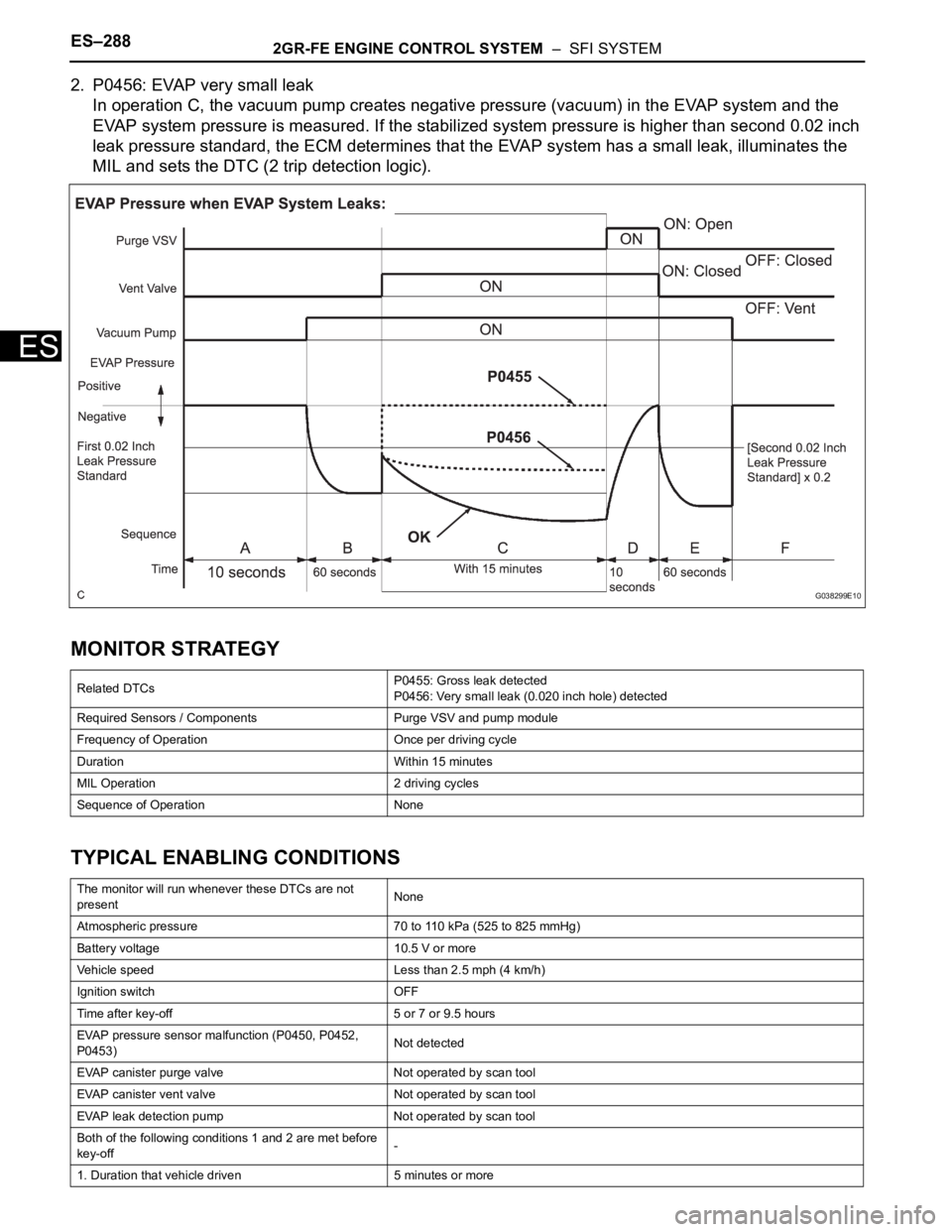
2. P0456: EVAP very small leak
In operation C, the vacuum pump creates negative pressure (vacuum) in the EVAP system and the
EVAP system pressure is measured. If the stabilized system pressure is higher than second 0.02 inch
leak pressure standard, the ECM determines that the EVAP system has a small leak, illuminates the
MIL and sets the DTC (2 trip detection logic).
MONITOR STRATEGY
TYPICAL ENABLING CONDITIONS
Related DTCsP0455: Gross leak detected
P0456: Very small leak (0.020 inch hole) detected
Required Sensors / Components Purge VSV and pump module
Frequency of Operation Once per driving cycle
Duration Within 15 minutes
MIL Operation 2 driving cycles
Sequence of Operation None
The monitor will run whenever these DTCs are not
presentNone
Atmospheric pressure 70 to 110 kPa (525 to 825 mmHg)
Battery voltage 10.5 V or more
Vehicle speed Less than 2.5 mph (4 km/h)
Ignition switch OFF
Time after key-off 5 or 7 or 9.5 hours
EVAP pressure sensor malfunction (P0450, P0452,
P0453)Not detected
EVAP canister purge valve Not operated by scan tool
EVAP canister vent valve Not operated by scan tool
EVAP leak detection pump Not operated by scan tool
Both of the following conditions 1 and 2 are met before
key-off-
1. Duration that vehicle driven 5 minutes or more
G038299E10
Page 585 of 3000
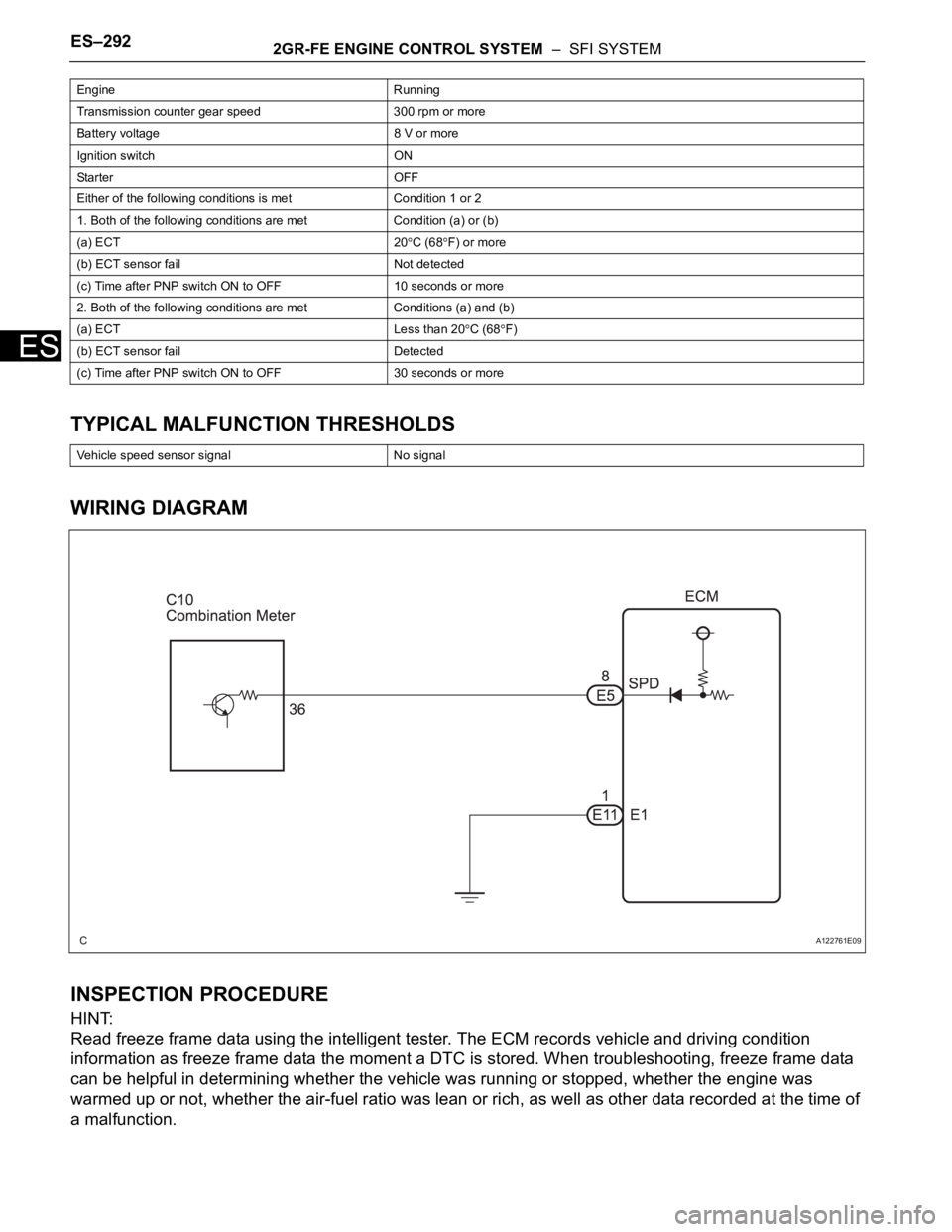
ES–2922GR-FE ENGINE CONTROL SYSTEM – SFI SYSTEM
ES
TYPICAL MALFUNCTION THRESHOLDS
WIRING DIAGRAM
INSPECTION PROCEDURE
HINT:
Read freeze frame data using the intelligent tester. The ECM records vehicle and driving condition
information as freeze frame data the moment a DTC is stored. When troubleshooting, freeze frame data
can be helpful in determining whether the vehicle was running or stopped, whether the engine was
warmed up or not, whether the air-fuel ratio was lean or rich, as well as other data recorded at the time of
a malfunction.
Engine Running
Transmission counter gear speed 300 rpm or more
Battery voltage 8 V or more
Ignition switch ON
Starter OFF
Either of the following conditions is met Condition 1 or 2
1. Both of the following conditions are met Condition (a) or (b)
(a) ECT 20
C (68F) or more
(b) ECT sensor fail Not detected
(c) Time after PNP switch ON to OFF 10 seconds or more
2. Both of the following conditions are met Conditions (a) and (b)
(a) ECT Less than 20
C (68F)
(b) ECT sensor fail Detected
(c) Time after PNP switch ON to OFF 30 seconds or more
Vehicle speed sensor signal No signal
A122761E09
Page 589 of 3000

ES–2962GR-FE ENGINE CONTROL SYSTEM – SFI SYSTEM
ES
DESCRIPTION
The stop light switch is a duplex system that transmits two signals: STP and ST1-. These two signals are
used by the ECM to monitor whether or not the brake system is working properly. If the signals, which
indicate the brake pedal is being depressed or released, are detected simultaneously, the ECM interprets
this as a malfunction in the stop light switch and sets the DTC.
HINT:
The normal conditions are as shown in the table below. The signals can be read using the intelligent
tester.
MONITOR DESCRIPTION
This DTC indicates that the stop light switch remains on. When the stop light switch remains ON during
"stop and go" driving, the ECM interprets this as a fault in the stop light switch and the MIL comes on and
the ECM stores the DTC. The vehicle must stop (less than 2 mph (3 km/h)) and go (19 mph (30 km/h) or
more) 5 times for two driving cycles in order to detect a malfunction.
MONITOR STRATEGY
TYPICAL ENABLING CONDITIONS
DTC P0504 Brake Switch "A" / "B" Correlation
DTC P0724 Brake Switch "B" Circuit High
Signals Brake Pedal Released In Transition Brake Pedal Depressed
STP OFF ON ON
ST1- ON ON OFF
DTC No. DTC Detection Condition Trouble Area
P0504Conditions (a), (b) and (c) continue for 0.5 seconds or
more (1 trip detection logic):
(a) Ignition switch in the ON position
(b) Brake pedal released
(c) STP signal OFF when ST1- signal OFF• Short in stop light switch signal circuit
• STOP fuse
• Stop light switch
•ECM
P0724The stop light switch remains ON even when the
vehicle is driven in a STOP (less than 2 mph (3 km/h))
and GO (19 mph (30 km/h) or more) fashion 5 times. (2
trip detection logic)• Short in stop light switch signal circuit
• Stop light switch
•ECM
Related DTCs P0724: Stop light switch/Rationality
Required sensors/Components Stop light switch, Vehicle speed sensor
Frequency of operation Continuous
Duration GO and STOP 5 times
MIL operation 2 driving cycles
Sequence of operation None
The monitor will run whenever this DTC is not present None
Ignition switch ON
Starter OFF
Battery voltage 8 V or more
GO (Vehicle speed is 18.65 mph (30 km/h) or more) Once
STOP (Vehicle speed is less than 1.86 mph (3 km/h)) Once
Page 597 of 3000

ES–3042GR-FE ENGINE CONTROL SYSTEM – SFI SYSTEM
ES
DESCRIPTION
This monitor will run when the engine is started at -10 to 50C (14 to 122F) of the engine coolant
temperature. The DTC will set after the engine idling for 13 seconds (2 trip detection logic).
The DTC is designed to monitor the idle air control at cold start. When the engine is started at lower than
50
C (122F) of the engine coolant temperature, the ECM measures the accumulated mass air flow at the
engine idling. If it does not reach the criteria within 10 seconds, the ECM interprets this as a malfunction.
The MIL is illuminated and a DTC is set when the malfunction is detected in consecutive driving cycles (2
trip detection logic).
The ETCS (Electrical Throttle Control System) controls the idle speed. The ETCS operates the throttle
actuator to open and close the throttle valve, and adjusts the intake air amount to achieve the target idle
speed.
NOTICE:
When the negative battery terminal is disconnected during inspection or repairs, the ISC (Idle
Speed Control) learned values are cleared. ISC learning is performed when the engine has been
warmed up and idled for 5 minutes because this DTC cannot be set after the ISC learned values
cleared.
DTC P050A Cold Start Idle Air Control System Performance
DTC No. DTC Detection Condition Trouble Area
P050AAccumulated intake air amount for 10 seconds of idling after
cold start is less than threshold (2 trip detection logic)• Throttle body assembly
• Mass air flow meter
• Intake system
• PCV hose connections
• VVT system
• Air cleaner filter element
•ECM