battery TOYOTA SIENNA 2007 Service Owner's Guide
[x] Cancel search | Manufacturer: TOYOTA, Model Year: 2007, Model line: SIENNA, Model: TOYOTA SIENNA 2007Pages: 3000, PDF Size: 52.26 MB
Page 390 of 3000

ES–842GR-FE ENGINE CONTROL SYSTEM – SFI SYSTEM
ES
MONITOR DESCRIPTION
After the ECM sends the "target" duty-cycle signal to the OCV, the ECM monitors the OCV current to
establish an "actual" duty-cycle. The ECM detects a malfunction and sets a DTC when the actual duty-
cycle ratio varies from the target duty-cycle ratio.
MONITOR STRATEGY
TYPICAL ENABLING CONDITIONS
TYPICAL MALFUNCTION THRESHOLDS
COMPONENT OPERATING RANGE
Related DTCsP0010: VVT OCV (bank 1) open/short
P0020: VVT OCV (bank 2) open/short
Required sensors / components (Main) VVT OCV (Variable Valve Timing oil control valve)
Required sensors / components (Sub) -
Frequency of operation Continuous
Duration 1 second
MIL operation Immediately
Sequence of operation None
Monitor will run whenever these DTCs are not present None
All of the following conditions are met: -
Starter OFF
Engine switch ON
Time after turning ignition switch off to on 0.5 seconds or more
One of the following conditions is met: Condition A, B or C
A. All of the following conditions are met: -
Battery voltage 11 to 13 V
Target duty ratio Less than 70 %
Output signal duty ratio 100 %
B. All of the following conditions are met: -
Battery voltage 13 V or more
Target duty ratio Less than 80 %
Output signal duty ratio 100 %
C. All of the following conditions are met: -
Current cut status Not cut
Output signal duty ratio 3 % or less
VVT OCV duty ratio More than 3 %, and Less than 100 %
Page 395 of 3000

2GR-FE ENGINE CONTROL SYSTEM – SFI SYSTEMES–89
ES
3) After above conditions 1) and 2) are met, the OCV is forcibly activated 63 times or more.
DTCs P0011 and P0021 (Advanced Cam Timing) are detected with 1 trip detection logic.
DTCs P0012 and P0022 (Retarded Cam Timing) are detected with 2 trip detection logic.
These DTCs indicate that the VVT controller cannot operate properly due to OCV malfunctions or the
presence of foreign objects in the OCV.
The monitor will not run unless the following conditions are met:
- The engine is warm (the engine coolant temperature is 75
C [167F] or more).
- The vehicle has been driven at more than 40 mph (64 km/h) for 3 minutes.
- The engine has idled for 3 minutes.
MONITOR STRATEGY
TYPICAL ENABLING CONDITIONS
TYPICAL MALFUNCTION THRESHOLDS
P0011, P0021:
P0012, P0022:
If the difference between the target and actual camshaft timings is greater than the specified value, the
ECM operates the VVT actuator.
Then, the ECM monitors the camshaft timing change for 5 seconds.
WIRING DIAGRAM
Refer to DTC P0010 (See page ES-77).
INSPECTION PROCEDURE
Related DTCsP0011: Advanced intake camshaft timing (bank 1)
P0012: Retarded intake camshaft timing (bank 1)
P0021: Advanced intake camshaft timing (bank 2)
P0022: Retarded intake camshaft timing (bank 2)
Required sensors / components (Main) VVT OCV, VVT Actuator
Required sensors / components (Related) Crankshaft position sensor, Camshaft position sensor, ECT sensor
Frequency of operation Once per driving cycles
Duration Less than 10 seconds
MIL operationP0011 and P0021: Immediate
P0012 and P0022: 2 driving cycles
Sequence operation None
The monitor will run whenever these DTCs are not
presentP0100, P0101, P0102, P0103 (MAF Sensor), P0115, P0116, P0117, P0118 (ECT
Sensor), P0125 (Insufficient ECT for Closed Loop), P0335 (CKP Sensor), P0340
(CMP Sensor), P0351, P0352, P0353, P0354, P0355, P0356 (Ignitor)
Battery voltage 11 V or more
Engine RPM 500 to 4000 rpm
ECT 75 to 100
C (167 to 212F)
Duration of actual valve timing and target valve timing More than 5
CA (Crankshaft angle)
Valve timing No change in advanced valve timing
Duration of actual valve timing and target valve timing More than 5
CA (Crankshaft angle)
Valve timing No change in retarded valve timing
Abnormal bankAdvanced timing over
(Valve timing is out of specified range)Retarded timing over
(Valve timing is out of specified range)
Bank 1 P0011 P0012
Bank 2 P0021 P0022
Page 399 of 3000
2GR-FE ENGINE CONTROL SYSTEM – SFI SYSTEMES–93
ES
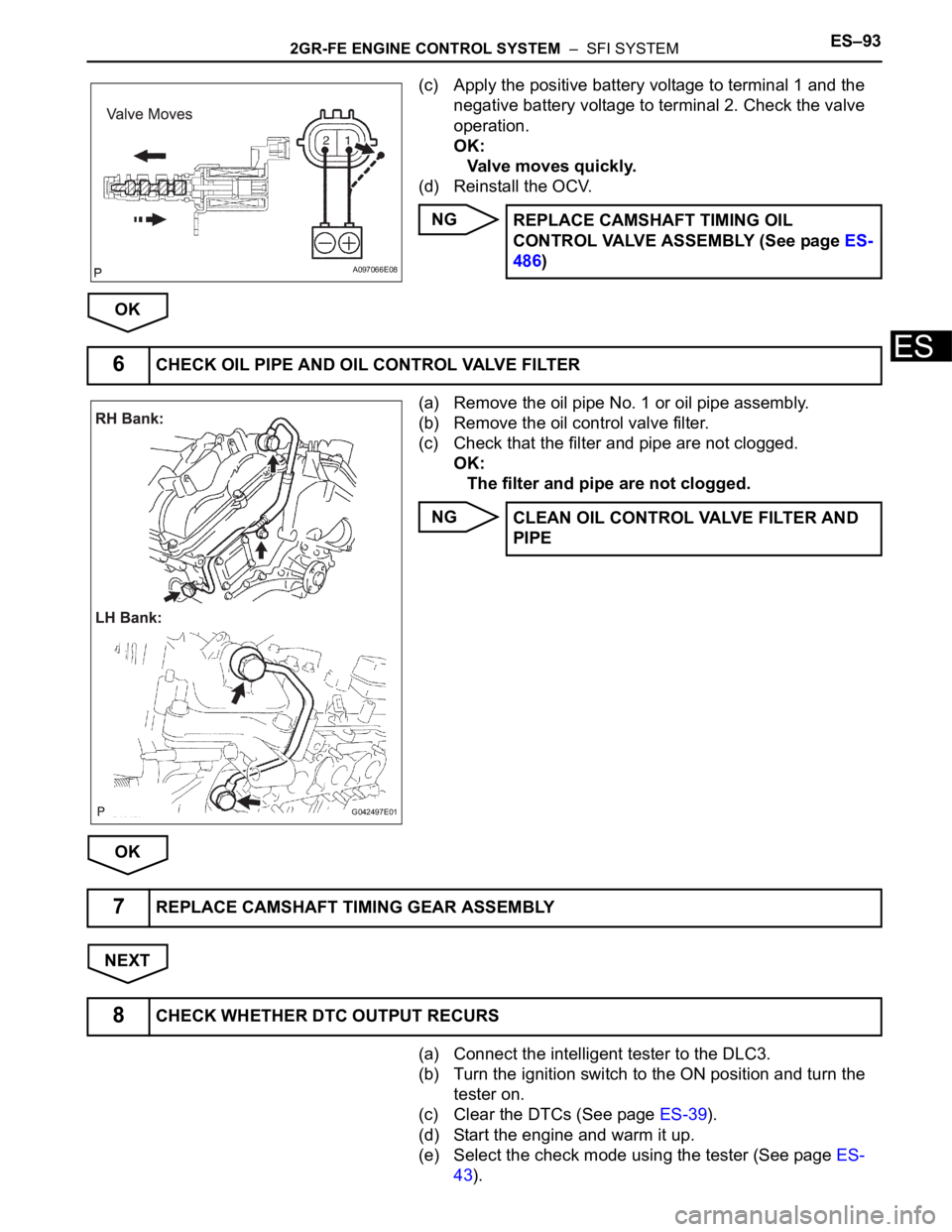
(c) Apply the positive battery voltage to terminal 1 and the
negative battery voltage to terminal 2. Check the valve
operation.
OK:
Valve moves quickly.
(d) Reinstall the OCV.
NG
OK
(a) Remove the oil pipe No. 1 or oil pipe assembly.
(b) Remove the oil control valve filter.
(c) Check that the filter and pipe are not clogged.
OK:
The filter and pipe are not clogged.
NG
OK
NEXT
(a) Connect the intelligent tester to the DLC3.
(b) Turn the ignition switch to the ON position and turn the
tester on.
(c) Clear the DTCs (See page ES-39).
(d) Start the engine and warm it up.
(e) Select the check mode using the tester (See page ES-
43).
A097066E08
REPLACE CAMSHAFT TIMING OIL
CONTROL VALVE ASSEMBLY (See page ES-
486)
6CHECK OIL PIPE AND OIL CONTROL VALVE FILTER
G042497E01
CLEAN OIL CONTROL VALVE FILTER AND
PIPE
7REPLACE CAMSHAFT TIMING GEAR ASSEMBLY
8CHECK WHETHER DTC OUTPUT RECURS
Page 402 of 3000

ES–962GR-FE ENGINE CONTROL SYSTEM – SFI SYSTEM
ES
MONITOR DESCRIPTION
The ECM optimizes the valve timing using the VVT system to control the exhaust camshaft. The VVT
system includes the ECM, the OCV and the VVT controller. The ECM sends a target duty-cycle control
signal to the OCV. This control signal regulates the oil pressure supplied to the VVT controller. The VVT
controller can advance or retard the exhaust camshaft.
After the ECM sends the target duty-cycle signal to the OCV, the ECM monitors the OCV current to
establish an actual duty-cycle. The ECM determines the existence of a malfunction and sets the DTC
when the actual duty-cycle ratio varies from the target duty-cycle ratio.
MONITOR STRATEGY
TYPICAL ENABLING CONDITIONS
TYPICAL MALFUNCTION THRESHOLDS
COMPONENT OPERATING RANGE
Related DTCsP0013: VVT OCV (bank 1) open/short
P0023: VVT OCV (bank 2) open/short
Required sensors / components (Main) VVT OCV (Variable Valve Timing oil control valve)
Required sensors / components (Sub) -
Frequency of operation Continuous
Duration 1 second
MIL operation Immediate
Sequence of operation None
Monitor runs whenever following DTCs are not present None
All of the following conditions are met: -
Starter OFF
Engine switch ON
Time after engine switch off to on 0.5 seconds or more
One of the following conditions is met: Condition A, B or C
A. All of the following conditions are met: -
Battery voltage 11 to 13 V
Target duty ratio Less than 70%
B. All of the following conditions are met: -
Battery voltage 13 V or more
Target duty ratio Less than 80%
C. All of the following conditions are met: -
Current cut status Not cut
VVT duty ratio More than 3 %, and less than 100 %
Page 407 of 3000

2GR-FE ENGINE CONTROL SYSTEM – SFI SYSTEMES–101
ES
MONITOR STRATEGY
TYPICAL ENABLING CONDITIONS
TYPICAL MALFUNCTION THRESHOLDS
Advanced camshaft timing:
Retarded camshaft timing:
If the difference between the target and actual camshaft timings is greater than the specified value, the
ECM operates the VVT actuator.
Then, the ECM monitors the camshaft timing change for 5 seconds.
WIRING DIAGRAM
Refer to DTC P0013 (See page ES-89).
INSPECTION PROCEDURE
HINT:
• If DTC P0014 or P0015 is displayed, check the bank 1 VVT system circuit.
• Bank 1 refers to the bank that includes cylinder No. 1.
• If DTC P0024 or P0025 is displayed, check the bank 2 VVT system circuit.
• Bank 2 refers to the bank that does not include cylinder No. 1.
Related DTCsP0014: Advanced exhaust camshaft timing (bank 1)
P0015: Retarded exhaust camshaft timing (bank 1)
P0024: Advanced exhaust camshaft timing (bank 2)
P0025: Retarded exhaust camshaft timing (bank 2)
Required Sensors / Components (Main) VVT OCV and VVT Actuator
Required Sensors / Components (Related)P0014 and P0015:
Exhaust camshaft control actuator bank 1
Exhaust OCV bank 1
P0024 and P0025:
Exhaust camshaft control actuator bank 2
Exhaust OCV bank 2
Frequency of Operation Continuously
Duration Less than 10 seconds
MIL OperationP0014 and P0024: Immediate
P0015 and P0025: 2 driving cycles
Sequence of Operation None
The monitor will run whenever these DTCs are not
presentNone
Battery voltage 11 V or more
Engine RPM 500 to 4000 rpm
Engine coolant temperature 75 to 100
C (167 to 212F)
Valve timing No change
Valve timing Advanced position
Valve timing No change
Valve timing Retarded position
Abnormal bankAdvanced timing over
(Valve timing is out of specified range)Retarded timing over
(Valve timing is out of specified range)
Bank 1 P0014 P0015
Bank 2 P0024 P0025
Page 410 of 3000
ES–1042GR-FE ENGINE CONTROL SYSTEM – SFI SYSTEM
ES
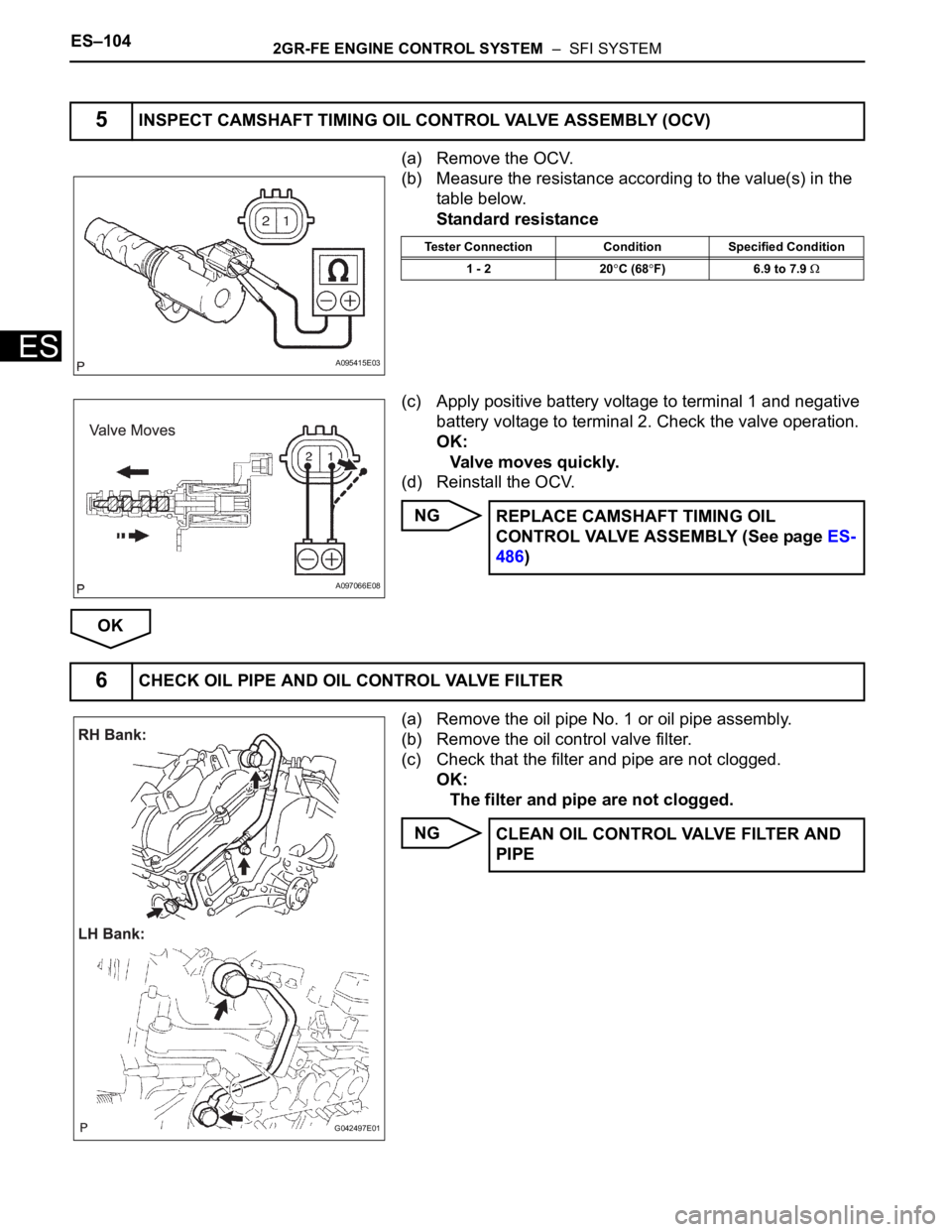
(a) Remove the OCV.
(b) Measure the resistance according to the value(s) in the
table below.
Standard resistance
(c) Apply positive battery voltage to terminal 1 and negative
battery voltage to terminal 2. Check the valve operation.
OK:
Valve moves quickly.
(d) Reinstall the OCV.
NG
OK
(a) Remove the oil pipe No. 1 or oil pipe assembly.
(b) Remove the oil control valve filter.
(c) Check that the filter and pipe are not clogged.
OK:
The filter and pipe are not clogged.
NG
5INSPECT CAMSHAFT TIMING OIL CONTROL VALVE ASSEMBLY (OCV)
A095415E03
Tester Connection Condition Specified Condition
1 - 2 20
C (68F) 6.9 to 7.9
A097066E08
REPLACE CAMSHAFT TIMING OIL
CONTROL VALVE ASSEMBLY (See page ES-
486)
6CHECK OIL PIPE AND OIL CONTROL VALVE FILTER
G042497E01
CLEAN OIL CONTROL VALVE FILTER AND
PIPE
Page 416 of 3000

ES–1102GR-FE ENGINE CONTROL SYSTEM – SFI SYSTEM
ES
HINT:
• Bank 1 refers to the bank that includes cylinder No. 1.
• Bank 2 refers to the bank that does not include cylinder No. 1.
• Sensor 1 refers to the closest sensor to the engine assembly.
• Sensor 2 refers to the furthest sensor away from the engine assembly.
MONITOR DESCRIPTION
The ECM uses information from the Air-Fuel Ratio (A/F) sensor to regulate the air-fuel ratio and keep it
close to the stoichiometric level. This maximizes the ability of the Three-Way Catalytic Converter (TWC) to
purify the exhaust gas.
The A/F sensor detects oxygen levels in the exhaust gas and transmits the information to the ECM. The
inner surface of the sensor element is exposed to the outside air. The outer surface of the sensor element
is exposed to the exhaust gas. The sensor element is made of platinum coated zirconia and includes an
integrated heating element.
The zirconia element generates small voltage when there is a large difference in the oxygen
concentrations between the exhaust gas and outside air. The platinum coating amplifies this voltage
generation.
The A/F sensor is more efficient when heated. When the exhaust gas temperature is low, the sensor
cannot generate useful voltage signals without supplementary heating. The ECM regulates the
supplementary heating using a duty-cycle approach to adjust the average current in the sensor heater
element. If the heater current is outside the normal range, the signal transmitted by the A/F sensor will be
inaccurate, as a result, the ECM will be unable to regulate air-fuel ratio properly.
When the current in the A/F sensor heater is outside the normal operating range, the ECM interprets this
as a malfunction in the sensor heater and sets a DTC.
Example:
The ECM sets DTC P0032 or P0052 when the current in the A/F sensor heater is more than 10 A.
Conversely, when the heater current is less than 0.8 A, DTC P0031 or P0051 is set.
MONITOR STRATEGY
TYPICAL ENABLING CONDITIONS
All:
P0031 and P0051:
P0032
P0052Air-Fuel Ratio (A/F) sensor heater current more than 10
A (1 trip detection logic)• Short in A/F sensor heater circuit
• A/F sensor heater
• A/F sensor heater relay
•ECM
Related DTCsP0031: A/F sensor heater (Bank 1) range check (Low current)
P0032: A/F sensor heater (Bank 1) range check (High current)
P0051: A/F sensor heater (Bank 2) range check (Low current)
P0052: A/F sensor heater (Bank 2) range check (High current)
Required sensors / components (Main) A/F sensor heater
Required sensors / components (Related) -
Frequency of operation Continuous
Duration 10 seconds
MIL operation Immediate
Sequence operation None
The monitor will run whenever these DTCs are not
presentNone
Battery voltage 10.5 V or more
Heater ON duty ratio 50% or moreDTC No. DTC Detection Condition Trouble Area
Page 419 of 3000
2GR-FE ENGINE CONTROL SYSTEM – SFI SYSTEMES–113
ES
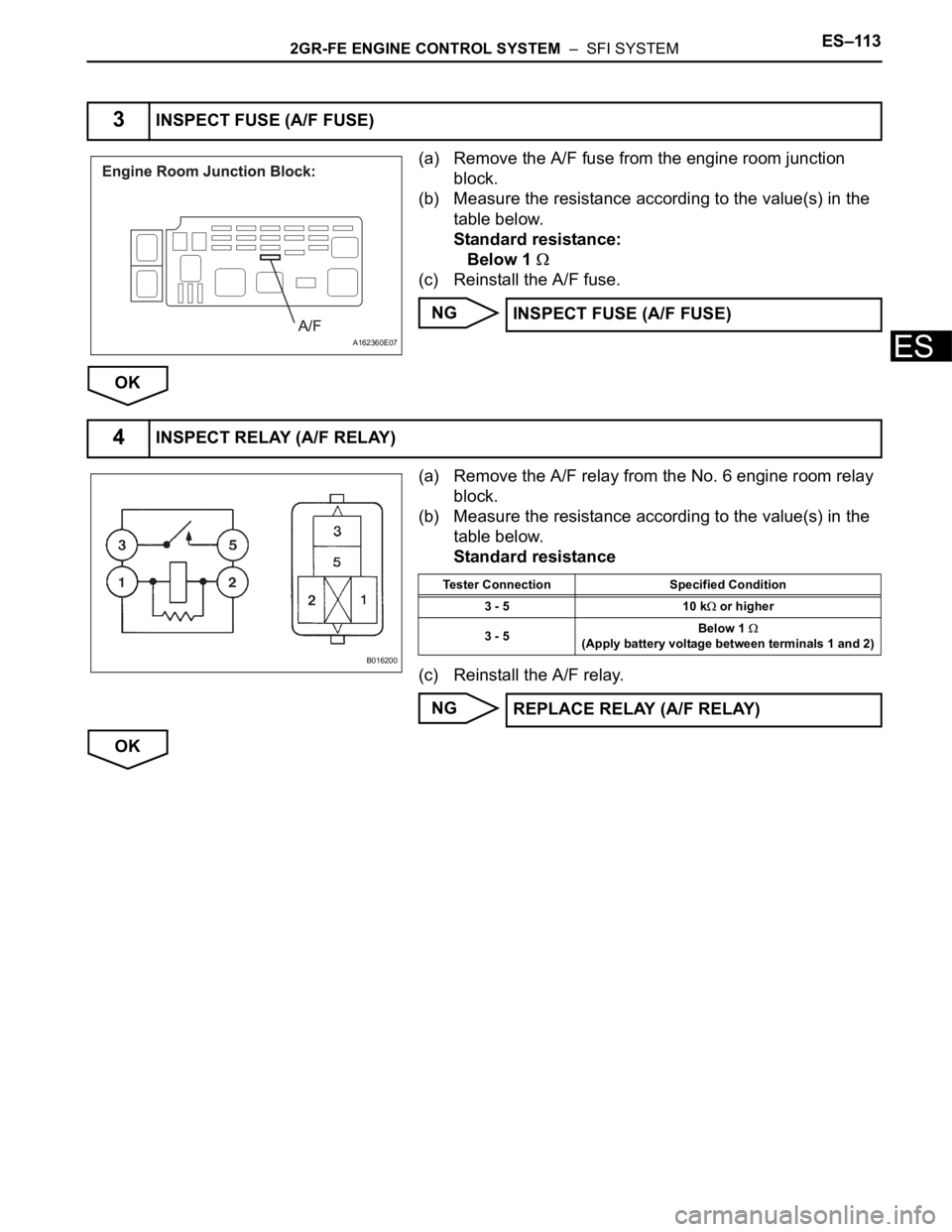
(a) Remove the A/F fuse from the engine room junction
block.
(b) Measure the resistance according to the value(s) in the
table below.
Standard resistance:
Below 1
(c) Reinstall the A/F fuse.
NG
OK
(a) Remove the A/F relay from the No. 6 engine room relay
block.
(b) Measure the resistance according to the value(s) in the
table below.
Standard resistance
(c) Reinstall the A/F relay.
NG
OK
3INSPECT FUSE (A/F FUSE)
A162360E07
INSPECT FUSE (A/F FUSE)
4INSPECT RELAY (A/F RELAY)
B016200
Tester Connection Specified Condition
3 - 5 10 k
or higher
3 - 5Below 1
(Apply battery voltage between terminals 1 and 2)
REPLACE RELAY (A/F RELAY)
Page 421 of 3000
2GR-FE ENGINE CONTROL SYSTEM – SFI SYSTEMES–115
ES
OK
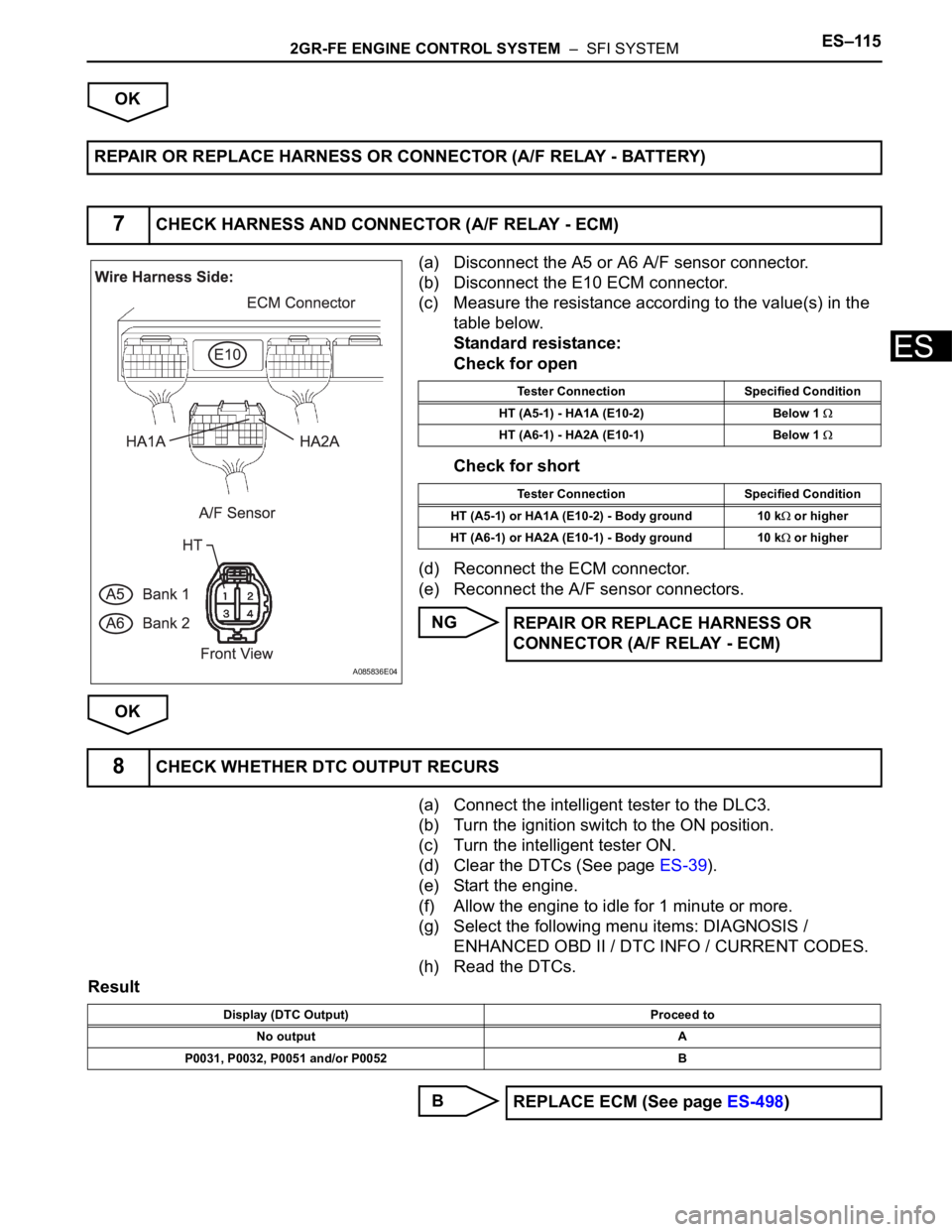
(a) Disconnect the A5 or A6 A/F sensor connector.
(b) Disconnect the E10 ECM connector.
(c) Measure the resistance according to the value(s) in the
table below.
Standard resistance:
Check for open
Check for short
(d) Reconnect the ECM connector.
(e) Reconnect the A/F sensor connectors.
NG
OK
(a) Connect the intelligent tester to the DLC3.
(b) Turn the ignition switch to the ON position.
(c) Turn the intelligent tester ON.
(d) Clear the DTCs (See page ES-39).
(e) Start the engine.
(f) Allow the engine to idle for 1 minute or more.
(g) Select the following menu items: DIAGNOSIS /
ENHANCED OBD II / DTC INFO / CURRENT CODES.
(h) Read the DTCs.
Result
B REPAIR OR REPLACE HARNESS OR CONNECTOR (A/F RELAY - BATTERY)
7CHECK HARNESS AND CONNECTOR (A/F RELAY - ECM)
A085836E04
Tester Connection Specified Condition
HT (A5-1) - HA1A (E10-2) Below 1
HT (A6-1) - HA2A (E10-1) Below 1
Tester Connection Specified Condition
HT (A5-1) or HA1A (E10-2) - Body ground 10 k
or higher
HT (A6-1) or HA2A (E10-1) - Body ground 10 k
or higher
REPAIR OR REPLACE HARNESS OR
CONNECTOR (A/F RELAY - ECM)
8CHECK WHETHER DTC OUTPUT RECURS
Display (DTC Output) Proceed to
No output A
P0031, P0032, P0051 and/or P0052 B
REPLACE ECM (See page ES-498)
Page 424 of 3000

ES–1182GR-FE ENGINE CONTROL SYSTEM – SFI SYSTEM
ES
HINT:
• Bank 1 refers to the bank that includes cylinder No. 1.
• Bank 2 refers to the bank that does not include cylinder No. 1.
• Sensor 1 refers to the sensor closest to the engine assembly.
• Sensor 2 refers to the sensor furthest away from the engine assembly.
MONITOR DESCRIPTION
The sensing position of the Heated Oxygen (HO2) sensor has a zirconia element which is used to detect
the oxygen concentration in the exhaust gas. If the zirconia element is at the appropriate temperature,
and the difference between the oxygen concentrations surrounding the inside and outside surfaces of the
sensor is large, the zirconia element generates voltage signals. In order to increase the oxygen
concentration detecting capacity of the zirconia element, the ECM supplements the heat from the exhaust
with heat from a heating element inside the sensor.
Heated oxygen sensor heater range check (P0037, P0038, P0057 and P0058):
The ECM monitors the current applied to the O2 sensor heater to check the heater for malfunctions. If the
current is below the threshold value, the ECM will determine that there is an open circuit in the heater. If
the current is above the threshold value, the ECM will determine that there is a short circuit in the heater.
Example:
The ECM sets DTC P0038 or P0058 when the current in the HO2 sensor heater is more than 2 A.
Conversely, when the heater current is less than 0.3 A, DTC P0037 or P0057 is set.
Heated oxygen sensor heater performance (P0141 and P0161):
After the accumulated heater ON time exceeds 100 seconds, the ECM calculates the heater resistance
using the battery voltage and the current applied to the heater. If the resistance is above the threshold
value, the ECM will determine that there is a malfunction in the HO2S heater and set DTC P0141 and
P0161.
MONITOR STRATEGY
DTC No. DTC Detection Condition Trouble Area
P0037
P0057Heated Oxygen (HO2) sensor heater current is less
than 0.3 A (1 trip detection logic)• Open in HO2 sensor heater circuit
• HO2 sensor heater
• EFI relay
•ECM
P0038
P0058Heated Oxygen (HO2) sensor heater current is more
than 2 A (1 trip detection logic)• Open in HO2 sensor heater circuit
• HO2 sensor heater
• EFI relay
•ECM
P0141
P0161Cumulative heater resistance correction value exceeds
the acceptable threshold (2 trip detection logic)• HO2 sensor
•ECM
Related DTCsP0037: Heated oxygen sensor heater (bank 1) open/short (Low electrical current)
P0038: Heated oxygen sensor heater (bank 1) open/short (High electrical current)
P0057: Heated oxygen sensor heater (bank 2) open/short (Low electrical current)
P0058: Heated oxygen sensor heater (bank 2) open/short (High electrical current)
P0141: Heated oxygen sensor heater performance (bank 1 sensor 2)
P0161: Heated oxygen sensor heater performance (bank 2 sensor 2)
Required Sensors / Components (Main) Heated oxygen sensor heater (bank 1 and 2)
Required Sensors / Components (Related) Vehicle speed sensor
Frequency of Operation Continuous
Duration0.5 seconds: P0037 and P0057
1 second: P0038 and P0058
10 seconds: P0141 and P0161
MIL OperationImmediate: P0037, P0038, P0057 and P0058
2 driving cycles: P0141 and P0161
Sequence of Operation None