tire type TOYOTA SIENNA 2018 Owners Manual (in English)
[x] Cancel search | Manufacturer: TOYOTA, Model Year: 2018, Model line: SIENNA, Model: TOYOTA SIENNA 2018Pages: 584, PDF Size: 14.47 MB
Page 16 of 584

16Pictorial index
SIENNA_OM_OM08019U_(U)Front doors . . . . . . . . . . . . . . . . . . . . . . . . . . . . . . . . . . . . . . . P. 110
Locking/unlocking . . . . . . . . . . . . . . . . . . . . . . . . . . . . . . . . . . P. 110
Opening/closing the door glasses . . . . . . . . . . . . . . . . . . . . . . P. 184
Locking/unlocking by using the mechanical key
*1. . . . . . . . . . P. 503
Warning messages . . . . . . . . . . . . . . . . . . . . . . . . . . . . . . . . . P. 481
Sliding doors . . . . . . . . . . . . . . . . . . . . . . . . . . . . . . . . . . . . . P. 121
Locking/unlocking . . . . . . . . . . . . . . . . . . . . . . . . . . . . . . . . . . P. 121
Opening from outside . . . . . . . . . . . . . . . . . . . . . . . . . . . . . . . P. 122
Opening/closing the rear side windows . . . . . . . . . . . . . . . . . . P. 184
Warning messages . . . . . . . . . . . . . . . . . . . . . . . . . . . . . . . . . P. 481
Back door . . . . . . . . . . . . . . . . . . . . . . . . . . . . . . . . . . . . . . . . P. 133
Opening from outside . . . . . . . . . . . . . . . . . . . . . . . . . . . . . . . P. 134
Warning messages . . . . . . . . . . . . . . . . . . . . . . . . . . . . . . . . . P. 481
Outside rear view mirrors . . . . . . . . . . . . . . . . . . . . . . . . . . . P. 181
Adjusting the mirror angle . . . . . . . . . . . . . . . . . . . . . . . . . . . . P. 181
Folding the mirrors . . . . . . . . . . . . . . . . . . . . . . . . . . . . . . . . . . P. 181
Driving position memory
*1. . . . . . . . . . . . . . . . . . . . . . . . . . . . P. 169
Defogging the mirrors
*1. . . . . . . . . . . . . . . . . . . . . . . . . . . . . . P. 336
Windshield wipers . . . . . . . . . . . . . . . . . . . . . . . . . . . . . . . . . P. 252
Precautions against winter season . . . . . . . . . . . . . . . . . . . . . P. 327
To prevent freezing (windshield wiper de-icer)
*1. . . . . . . . . . . P. 336
Precautions against car wash . . . . . . . . . . . . . . . . . . . . . . . . . P. 394
Fuel filler door . . . . . . . . . . . . . . . . . . . . . . . . . . . . . . . . . . . . P. 258
Refueling method . . . . . . . . . . . . . . . . . . . . . . . . . . . . . . . . . . . P. 258
Fuel type/fuel tank capacity . . . . . . . . . . . . . . . . . . . . . . . . . . . P. 518
Tires . . . . . . . . . . . . . . . . . . . . . . . . . . . . . . . . . . . . . . . . . . P. 420
Tire size/inflation pressure . . . . . . . . . . . . . . . . . . . . . . . . . P. 522
Winter tires/tire chain . . . . . . . . . . . . . . . . . . . . . . . . . . . . . P. 327
Checking/rotation/tire pressur e warning system . . . . . . . . .P. 420
Coping with flat tires . . . . . . . . . . . . . . . . . . . . . . . . . . P. 485, 499
Hood . . . . . . . . . . . . . . . . . . . . . . . . . . . . . . . . . . . . . . . . . . . . P. 407
Opening . . . . . . . . . . . . . . . . . . . . . . . . . . . . . . . . . . . . . . . . . . P. 407
Engine oil . . . . . . . . . . . . . . . . . . . . . . . . . . . . . . . . . . . . . . . . . P. 518
Coping with overheat . . . . . . . . . . . . . . . . . . . . . . . . . . . . . . . . P. 509
Warning messages . . . . . . . . . . . . . . . . . . . . . . . . . . . . . . . . . P. 481
1
2
3
4
5
6
7
8
Page 195 of 584

SIENNA_OM_OM08019U_(U)
1954-1. Before driving
4
Driving
■When starting off on a uphill
The hill-start assist control is available. ( P. 322)
■ Driving in the rain
●Drive carefully when it is raining, because visibility will be reduced, the win-
dows may become fogged-up, and the road will be slippery.
● Drive carefully when it starts to rain, because the road surface will be espe-
cially slippery.
● Refrain from high speeds when driving on an expressway in the r ain,
because there may be a layer of water between the tires and the road sur-
face, preventing the steering and brakes from operating properl y.
■ Engine speed while driving
In the following conditions, the engine speed may become high w hile driving.
This is due to automatic up-shifting control or down-shifting implementation to
meet driving conditions. It does not indicate sudden acceleration.
● The vehicle is judged to be driving uphill or downhill
● When the accelerator pedal is released
■ Restraining the engine out put (Brake Override System)
● When the accelerator and brake pedals are depressed at the same time, the
engine output may be restrained.
● A warning message is displayed on the multi-information display while the
system is operating. ( P. 474, 481)
■ Breaking in your new Toyota
To extend the life of the vehicle, observing the following prec autions is recom-
mended:
● For the first 200 miles (300 km):
Avoid sudden stops.
● For the first 500 miles (800 km):
Do not tow a trailer.
● For the first 1000 miles (1600 km):
• Do not drive at extremely high speeds.
• Avoid sudden acceleration.
• Do not drive continuously in low gears.
• Do not drive at a constant speed for extended periods.
■ Drum-in-disc type parking brake system
Your vehicle has a drum-in-disc type parking brake system. This type of brake
system needs bedding-down of the brake shoes periodically or wh enever the
parking brake shoes and/or drum are replaced. Have your Toyota dealer per-
form the bedding down operation.
■ Operating your vehicle in a foreign country
Comply with the relevant vehicle registration laws and confirm the availability
of the correct fuel. ( P. 518)
Page 328 of 584
328
SIENNA_OM_OM08019U_(U)
4-6. Driving tips
Accelerate the vehicle slowly, keep a safe distance between you and
the vehicle ahead, and drive at a reduced speed suitable to roa d con-
ditions.
● Park the vehicle and move the shift lever to P without setting the
parking brake. The parking brake may freeze up, preventing it from
being released. If the vehicle is parked without setting the pa rking
brake, make sure b lock the wheels.
Failure to do so may be dangerou s because it may cause the vehi-
cle to move unexpectedly, pos sibly leading to an accident.
● If the vehicle is parked without setting the parking brake, confirm
that the shift lever c annot be moved out of P
*.
*: The shift lever will be locked if it is attempted to be shifte d from P to any
other position without depressing the brake pedal. If the shift lever can be
shifted from P, there may be a problem with the shift lock syst em. Have the
vehicle inspected by your Toyota dealer immediately.
Use the tire chains of c orrect size and type.
Use SAE Class “S” type radial tire chains, with the exception o f radial
cable chains or V-bar type chains.
Regulations regarding the use of tire chains vary depending on loca-
tion and type of road. Always chec k local regulations before installing
chains.
■ Tire chain installation
Observe the following precautions when installing and removing chains.
● Install and remove tire chains in a safe location.
● Install tire chains on the front tires only. Do not install tir e chains on the rear
tires.
● Install tire chains on front tires as tightly as possible. Reti ghten chains after
driving 1/4 - 1/2 mile (0.5 - 1.0 km).
● Install tire chains following the instructions provided with th e tire chains.
When driving the vehicle
When parking the vehicle
Selecting tire chains
Regulations on the use of tire chains
Page 329 of 584

SIENNA_OM_OM08019U_(U)
3294-6. Driving tips
4
Driving
WARNING
■Driving with snow tires
Observe the following precautions to reduce the risk of acciden ts.
Failing to do so may result in a loss of vehicle control and ca use death or
serious injury.
● Use tires of the specified size.
● Maintain the recommended level of air pressure.
● Do not drive in excess of 75 mph (120 km/h), regardless of the type of
snow tires being used.
● Use snow tires on all, not just some wheels.
■ Driving with tire chains
Observe the following precautions to reduce the risk of acciden ts.
Failing to do so may result in the vehicle being unable to be d riven safely,
and may cause death or serious injury.
● Do not drive in excess of the speed limit specified for the tir e chains being
used or 30 mph (50 km/h), whichever is lower.
● Avoid driving on bumpy road surfaces or over potholes.
● Avoid sudden acceleration, abrupt steering, sudden braking and shifting
operations that cause sudden engine braking.
● Slow down sufficiently before entering a curve to ensure that v ehicle con-
trol is maintained.
NOTICE
■ Repairing or replacing snow tires
Request repairs or replacement of snow tires from Toyota dealer s or legiti-
mate tire retailers.
This is because the removal and attachment of snow tires affect s the opera-
tion of the tire pressure warning valves and transmitters.
■ Fitting tire chains
The tire pressure warning valves and transmitters may not funct ion correctly
when tire chains are fitted.
Page 424 of 584

424
SIENNA_OM_OM08019U_(U)
6-3. Do-it-yourself maintenance
■Tire types
●Summer tires
Summer tires are high-speed performance tires best suited to highway
driving under dry conditions. Si nce summer tires do not have th e same
traction performance as snow tires, summer tires are inadequate for
driving on snow-covered or icy ro ads. For driving on snow-covered
roads or icy roads, the use of snow tires is recommended. When install-
ing snow tires, be sure to replace all four tires.
●All season tires
All season tires are designed to provide better traction in sno w and to
be adequate for driving in most winter conditions, as well as f or use
year round. All season tires, however, do not have adequate tra ction
performance compared with snow tires in heavy or loose snow. Al so, all
season tires fall short in acceleration and handling performanc e com-
pared with summer tires in highway driving.
●Snow tires
For driving on snow-covered roads or icy roads, we recommend us ing
snow tires. If you need snow tires, select tires of the same si ze, con-
struction and load capacity as t he originally installed tires. Since your
vehicle has radial tires as original equipment, make sure your snow
tires also have radial construct ion. Do not install studded tires without
first checking local regulations f or possible restriction. Snow tires
should be install ed on all wheels. ( P. 327)
■If the tread on snow tires wea rs down below 0.16 in. (4 mm)
The effectiveness of the tires as snow tires is lost.
Page 425 of 584

SIENNA_OM_OM08019U_(U)
4256-3. Do-it-yourself maintenance
6
Maintenance and care
■Situations in which the tire pressure warning system may not oper-
ate properly
The tire pressure warning syst em will be disabled in the follow ing condi-
tions:
(When the condition becomes normal, the system will work properly.)
●If tires not equipped with tire pressure warning valves and tra nsmitters
are used.
●If the ID code on the tire pressure warning valves and transmit ters is not
registered in the tire pr essure warning computer.
●If the tire inflation pressure is 73 psi (500 kPa, 5.1 kgf/cm2 or bar) or
higher.
The tire pressure warning system may be disabled in the followi ng condi-
tions:
(When the condition becomes normal, the system will work properly.)
●If electronic devices or facilitie s using similar radio wave frequencies are
nearby.
●If a radio set at similar frequen cies is in use in the vehicle.
●If a window tint that affects the radio wave signals is installed.
●If there is a lot of snow or ice on the vehicle, in particular around the
wheels or wheel housings.
●If non-genuine Toyota wheels are used. (Even if you use Toyota wheels,
the tire pressure warning system may not work properly with som e types
of tires.)
●If tire chains are used.
■Initializing the tire pressure warning system
Initialize the system with the tire inflation pressure adjusted to the speci-
fied level.
■If you press the tire pressure warning reset switch accidentall y
If initialization is performed, adjust the tire inflation press ure to the speci-
fied level and initialize the tire pressure warning system again.
■When the initializati on of the tire pressure warning system has failed
Initialization can be completed i n a few minutes. However, in the following
cases, the settings has not been recorded and the system will n ot operate
properly. If repeated attempts to record tire inflation pressur e settings are
unsuccessful, have the vehicle in spected by your Toyota dealer.
●When operating the tire pressure warning reset switch, the tire pressure
warning light does no t blink 3 times.
●After driving for a certain period of time since the initializa tion has been
completed, the warning light comes on after blinking for 1 minute.
Page 432 of 584
432
SIENNA_OM_OM08019U_(U)
6-3. Do-it-yourself maintenance
Wheels
When replacing wheels, care should be taken to ensure that they are
equivalent to those removed in load capacity, diameter, rim wid th and
inset
*.
Replacement wheels are available at your Toyota dealer.
*: Conventionally referred to as “offset”.
Toyota does not recommend using the following:
● Wheels of different sizes or types
● Used wheels
● Bent wheels that hav e been straightened
● Use only Toyota wheel nuts and wrenches designed for use with
your aluminum wheels.
● When rotating, repairing or changi ng your tires, check that the
wheel nuts are still tight afte r driving 1000 miles (1600 km).
● Be careful not to damage the aluminum wheels when using tire
chains.
● Use only Toyota genuine balance we ights or equivalent and a plas-
tic or rubber hammer when balancing your wheels.
■When replacing wheels
The wheels of your vehicle are equipped with tire pressure warn ing
valves and transmitters that allow the tire pressure warning sy stem to
provide advanced warning in the event of a loss in tire inflati on pressure.
Whenever wheels are replaced, tir e pressure warning valves and trans-
mitters must be installed. ( P. 421)
If a wheel is bent, cracked or heavily corroded, it should be
replaced.
Otherwise, the tire may separate from the wheel or cause a loss
of handling control.
Wheel selection
Aluminum wheel precautions
Page 522 of 584
522
SIENNA_OM_OM08019U_(U)
8-1. Specifications
*1: Minimum pedal clearance when depressed with a force of 110 lbf (490 N,
50 kgf) while the engine is running
*2: Parking brake pedal travel when depressed with a force of 67.4 lbf (300 N,
30.6 kgf)
17-inch tires
Brakes
Pedal clearance*12.99 in. (76 mm)
Pedal free play 0.04 0.24 in. (1 6 mm)
Brake pad wear limit0.04 in. (1.0 mm)
Parking brake lining wear limit 0.04 in. (1.0 mm)
Parking brake pedal travel*23 6 clicks
Fluid type SAE J1703 or FMVSS No.116 DOT 3
Steering
Free play Less than 1.2 in. (30 mm)
Tires and wheels
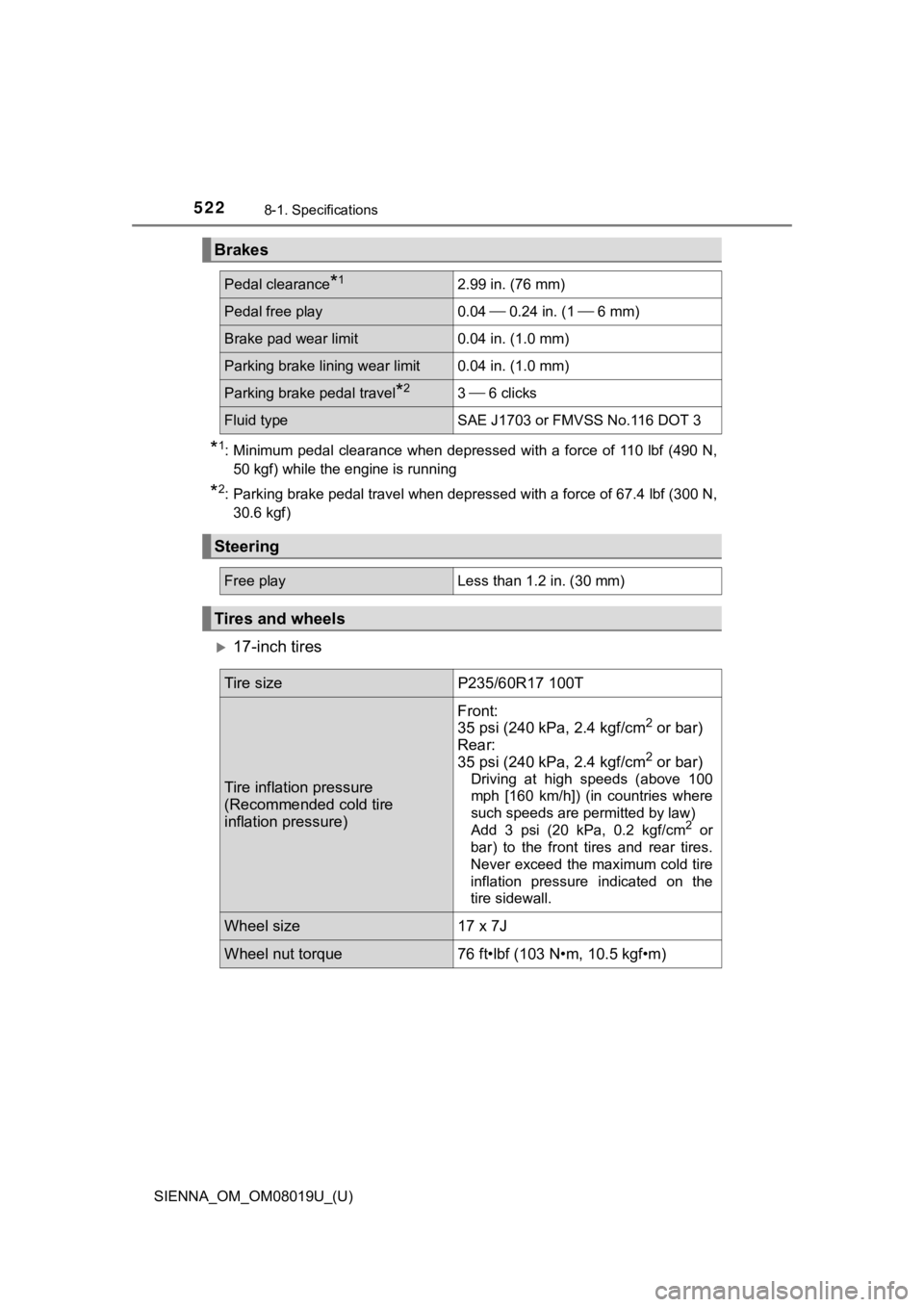
Tire sizeP235/60R17 100T
Tire inflation pressure
(Recommended cold tire
inflation pressure)Front:
35 psi (240 kPa, 2.4 kgf/cm
2 or bar)
Rear:
35 psi (240 kPa, 2.4 kgf/cm
2 or bar)
Driving at high speeds (above 100
mph [160 km/h]) (in countries where
such speeds are permitted by law)
Add 3 psi (20 kPa, 0.2 kgf/cm
2 or
bar) to the front tires and rear tires.
Never exceed the maximum cold tire
inflation pressure indicated on the
tire sidewall.
Wheel size 17 x 7J
Wheel nut torque76 ft•lbf (103 N•m, 10.5 kgf•m)
Page 530 of 584

530
SIENNA_OM_OM08019U_(U)
8-1. Specifications
Tire size( P. 5 3 2 )
DOT and Tire Identification Number (TIN) ( P. 5 3 1 )
Uniform tire quality grading
For details, see “Uniform Tire Q uality Grading” that follows.
Location of treadwear indicators ( P. 4 2 0 )
Run-flat tire (RFT) or standard tire ( P. 4 9 9 )
This vehicle can be equipped with either run-flat tires (RFT) o r stan-
dard tires. A “RFT” or “DSST” mark is molded on the sidewall of the
run-flat tire.
Tire ply composition and materials
Plies are layers of rubber-coated parallel cords. Cords are the strands
which form the p lies in a tire.
Radial tires or bias-ply tires
A radial tire has “RADIAL” on the sidewall. A tire not marked “ RADIAL”
is a bias-ply tire.
TUBELESS or TUBE TYPE
A tubeless tire does not have a tube and air is directly put into the tire.
A tube type tire has a tube insi de the tire and the tube mainta ins the air
pressure.
Load limit at maximum cold tire inflation pressure ( P. 4 2 3 )
Maximum cold tire in flation pressure (P. 5 2 2 )
This means the press ure to which a tire may be inflated.
Summer tires or all season tires ( P. 4 2 4 )
An all season tire has “M+S” on the sidewall. A tire not marked “M+S”
is a summer tire.
“TEMPORARY USE ONLY” ( P. 4 9 6 )
A compact spare tire is identified by the phrase “TEMPORARY USE
ONLY” molded on its sidewall. This tire is designed for tempora ry
emergency use only.
1
2
3
4
5
6
7
8
9
10
11
12
Page 531 of 584
SIENNA_OM_OM08019U_(U)
5318-1. Specifications
8
Vehicle specifications
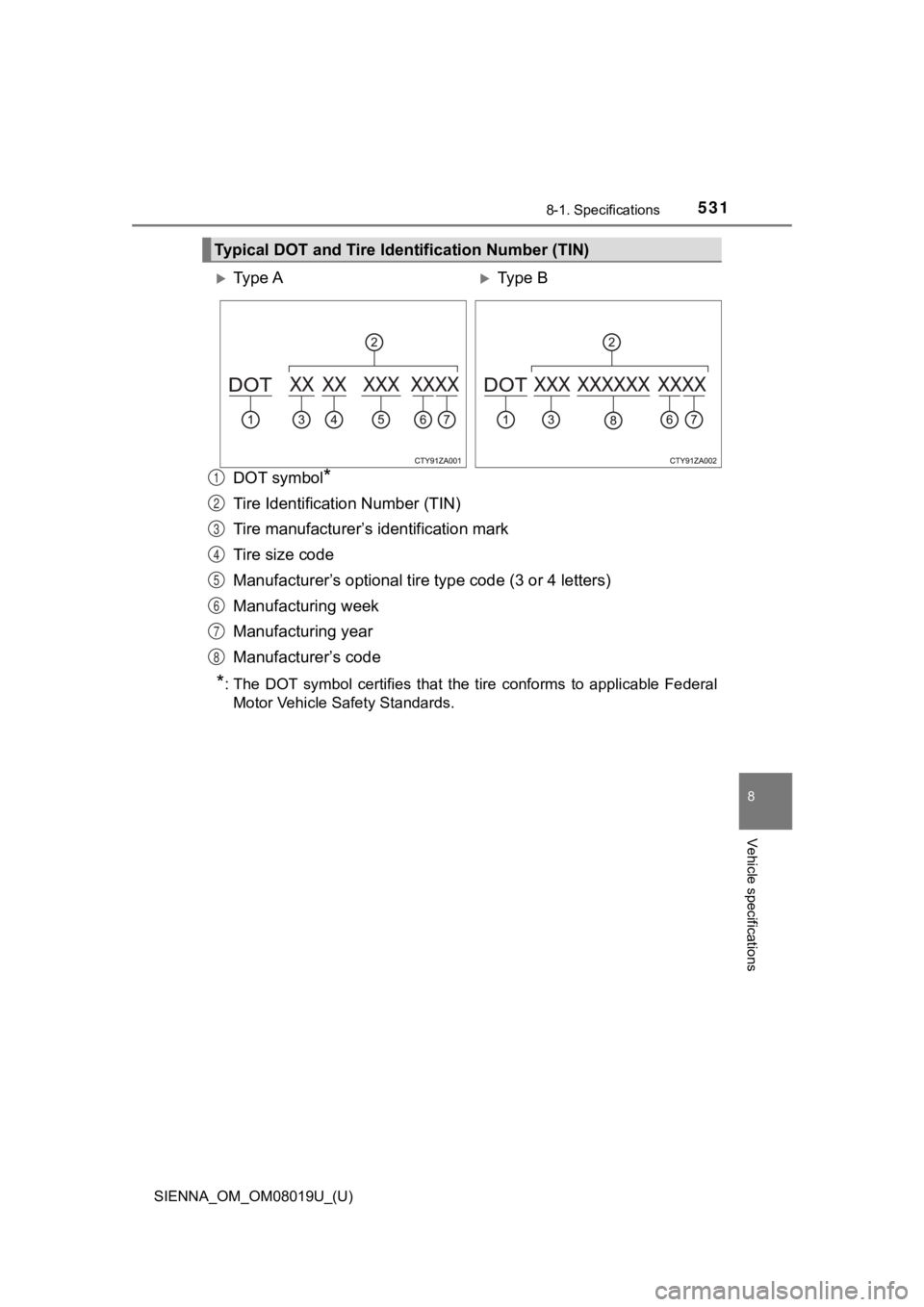
DOT symbol*
Tire Identification Number (TIN)
Tire manufacturer’s identification mark
Tire size code
Manufacturer’s optional tire type code (3 or 4 letters)
Manufacturing week
Manufacturing year
Manufacturer’s code
*: The DOT symbol certifies that the tire conforms to applicable Federal
Motor Vehicle Safety Standards.
Typical DOT and Tire Iden tification Number (TIN)
Ty p e AType B
1
2
3
4
5
6
7
8