steering wheel adjustment TOYOTA SIENNA 2019 Owners Manual (in English)
[x] Cancel search | Manufacturer: TOYOTA, Model Year: 2019, Model line: SIENNA, Model: TOYOTA SIENNA 2019Pages: 56, PDF Size: 3.1 MB
Page 3 of 56
1
OVERVIEW
FEATURES & OPERATIONS
TOYOTA SAFETY SENSE
SAFETY & EMERGENCY FEATURES
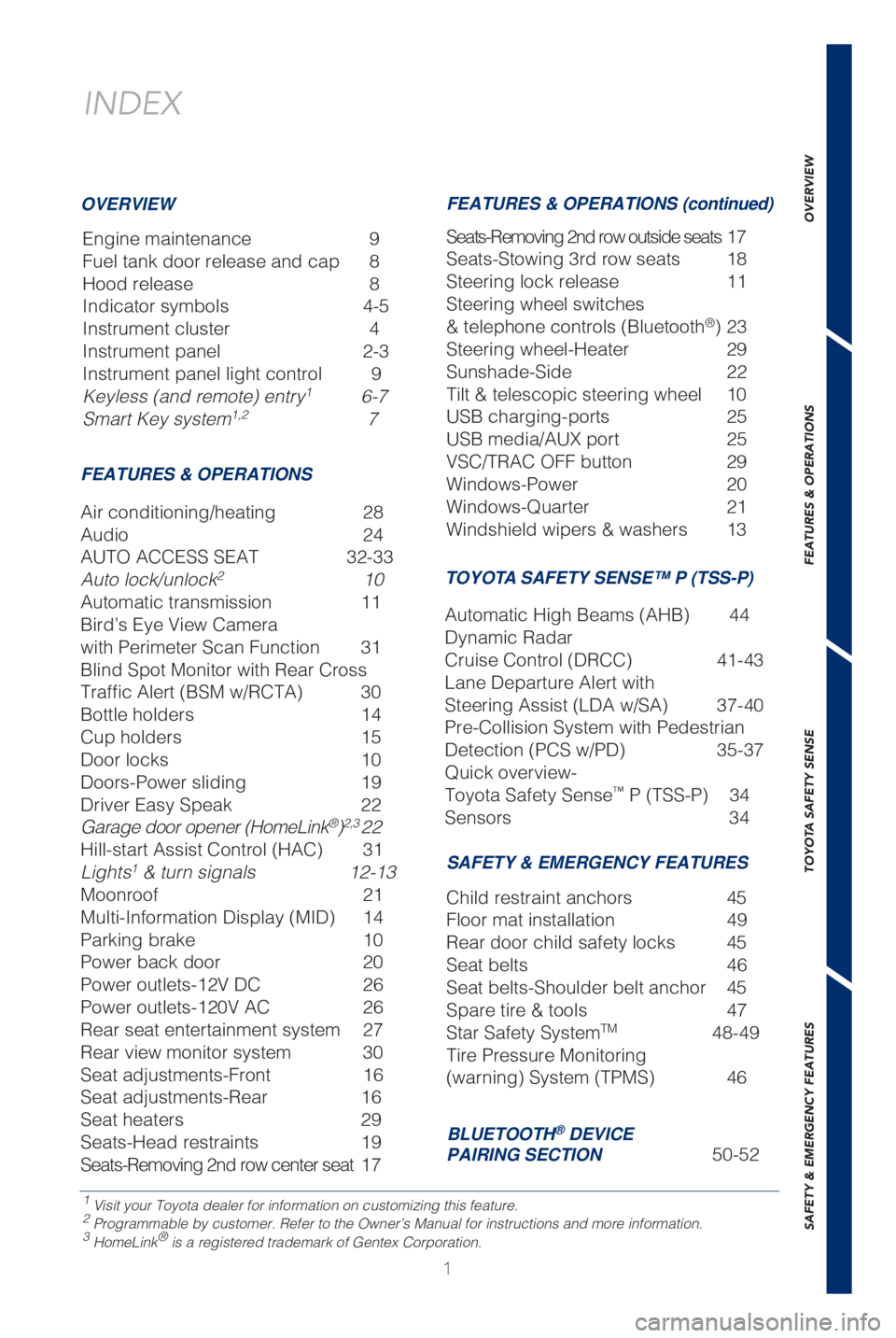
INDEX
Engine maintenance 9
Fuel tank door release and cap 8
Hood release 8
Indicator symbols 4-5
Instrument cluster 4
Instrument panel 2-3
Instrument panel light control 9
Keyless (and remote) entry
1 6-7
Smart Key system1,2 7
1 Visit your Toyota dealer for information on customizing this feature.2 Programmable by customer. Refer to the Owner’s Manual for instructio\
ns and more information.3 HomeLink® is a registered trademark of Gentex Corporation.
OVERVIEW
FEATURES & OPERATIONS FEATURES & OPERATIONS (continued)
SAFETY & EMERGENCY FEATURES
Air conditioning/heating 28
Audio
24
AUTO ACCESS SEAT 32-33
Auto lock/unlock
2 10
Automatic transmission 11
Bird’s Eye View Camera
with Perimeter Scan Function 31
Blind Spot Monitor with Rear Cross
Traffic Alert (BSM w/RCTA) 30
Bottle holders 14
Cup holders 15
Door locks 10
Doors-Power sliding 19
Driver Easy Speak 22
Garage door opener (HomeLink
®)2,3 22
Hill-start Assist Control (HAC) 31
Lights
1 & turn signals 12-13
Moonroof 21
Multi-Information Display (MID) 14
Parking brake 10
Power back door 20
Power outlets-12V DC 26
Power outlets-120V AC 26
Rear seat entertainment system 27
Rear view monitor system 30
Seat adjustments-Front 16
Seat adjustments-Rear 16
Seat heaters 29
Seats-Head restraints 19
Seats-Removing 2nd row center seat 17 Seats-Removing 2nd row outside seats 17
Seats-Stowing 3rd row seats 18
Steering lock release
11
Steering wheel switches
& telephone controls (Bluetooth
®) 23
Steering wheel-Heater 29
Sunshade-Side 22
Tilt & telescopic steering wheel 10
USB charging-ports 25
USB media/AUX port 25
VSC/TRAC OFF button 29
Windows-Power 20
Windows-Quarter 21
Windshield wipers & washers 13
Child restraint anchors 45
Floor mat installation 49
Rear door child safety locks 45
Seat belts 46
Seat belts-Shoulder belt anchor 45
Spare tire & tools 47
Star Safety System
TM 48-49
Tire Pressure Monitoring
(warning) System (TPMS) 46
BLUETOOTH® DEVICE
PAIRING SECTION 50-52
TOYOTA SAFETY SENSE™ P (TSS-P)
Automatic High Beams (AHB) 44
Dynamic Radar
Cruise Control (DRCC) 41-43
Lane Departure Alert with
Steering Assist (LDA w/SA) 37-40
Pre-Collision System with Pedestrian
Detection (PCS w/PD) 35-37
Quick overview-
Toyota Safety Sense
™ P (TSS-P) 34
Sensors 34
Page 36 of 56
 34
Quick overview-Toyota Safety Sense™ P (TSS-P)
Sensors
TSS-P combines an in-vehicle camera mounted in front of the inside rear \
view mirror
and a millimeter-wave radar mounted in the front grill")
34
Quick overview-Toyota Safety Sense™ P (TSS-P)
Sensors
TSS-P combines an in-vehicle camera mounted in front of the inside rear \
view mirror
and a millimeter-wave radar mounted in the front grill. These sensors su\
pport the
driver assist systems.
Camera sensor
Radar sensor
TOYOTA SAFETY SENSE™
Toyota Safety Sense™ P (TSS-P) is a set of active safety technologies designed
to help mitigate or prevent collisions across a wide range of traffic si\
tuations, in
certain conditions. TSS-P is designed to help support the driver’s aw\
areness,
decision making and vehicle operation contributing to a safe driving exp\
erience.
Refer to the Owner’s Manual for operation, setting adjustments, limitations and
more details to understand these functions and complete safety precautions. For
more information, please go to http://www.toyota.com/safety-sense
Lane Departure Alert with Steering Assist (LDA w/SA)
LDA w/SA is designed to provide notification when the system detects
an unintended lane departure.
The Steering Assist function is designed to provide small corrective
steering inputs to the steering wheel for a short period of time to help\
keep the vehicle in its lane.
Automatic High Beams (AHB)
AHB is designed to detect the headlights of oncoming vehicles and the
tail lights of preceding vehicles and switch between high beams and
low beams as appropriate.
Pre-Collision System with Pedestrian Detection (PCS w/PD)
PCS w/PD is designed to provide alert, mitigation, and/or avoidance
support in certain conditions, when the system detects a potential
collision with a preceding vehicle is likely to occur.
Advanced millimeter-wave radar sensor system is designed to work
with the camera sensor to help recognize a preceding pedestrian,
and provide an alert, mitigation and/or avoidance support in certain
conditions.
Dynamic Radar Cruise Control (DRCC)
DRCC is designed to help maintain a pre-set distance to a preceding
vehicle when the preceding vehicle is traveling at a lower speed.
Page 41 of 56

39
OVERVIEW
FEATURES & OPERATIONS
TOYOTA SAFETY SENSE
SAFETY & EMERGENCY FEATURES
DISABLING STEERING ASSIST
(1) Press “” switches to find and select .
(2) Press “
or ” switches to find the setting function and then press
“
”. The LDA Steering Assist system will be disabled.
(3) You can press “
” to go back to the menu.
Note: Operation of the LDA system and setting adjustments continues in the same
condition regardless of Ignition cycle until changed by the driver or the system is reset.
ADJUSTING LDA ALERT SENSITIVITY
The driver can adjust the sensitivity of the LDA (warning) function from the
Multi-Information Display (MID) customization screen.
High - Is designed to warn approximately before the front tire crosses the
lane marker.
Normal - Is designed to warn approximately when the front tire crosses
the lane marker.
(1) Press “
” switches to find and select .
(2) Press “
or ” switches to find the setting function and then press
“
”. The setting screen is displayed.
(3) Select “Sensitivity” and then press “
.” Each time “” is pressed, the
response to the LDA alert sensitivity changes. You can press “
” to go back to the
menu.
Note: Operation of the LDA system and setting adjustments continues in the
same condition regardless of Ignition cycle until changed by the driver or the
system is reset.
SWAY WARNING SYSTEM
SWS is a function of LDA and is designed to detect swaying based on the \
vehicle
location in the lane and the driver’s steering wheel operation. To he\
lp prevent
swaying, the system alerts the driver using a buzzer sound and a warning\
displays
in the MID.
Continuous lane deviations from
swaying.
Gentle swaying from driver’s
inattentiveness.
Acute steering wheel operation after the
number of operations decrease due to driver’s
inattentiveness.