light TOYOTA SUPRA 2023 Owners Manual
[x] Cancel search | Manufacturer: TOYOTA, Model Year: 2023, Model line: SUPRA, Model: TOYOTA SUPRA 2023Pages: 372, PDF Size: 6.32 MB
Page 306 of 372
3065-1. MOBILITY
mercially available additives are
suitable for the vehicle. The
vehicle manufacturer recom-
mends using coolant with the
BMW LC-18 specification. Do
not mix additives of different col-
ors. Observe the water - additive
mixture ratio of 50:50. Informa-
tion about suitable additives is
available from your Toyota
dealer.
Depending on the motorization,
there are up to two coolant res-
ervoirs in the engine compart-
ment. Check and top up the
coolant levels on a regular
basis.The coolant may be overfilled in
the coolant reservoir when the
vehicle is delivered from the fac-
tory. The normal coolant level is
achieved by operating the vehi-
cle for a longer period.
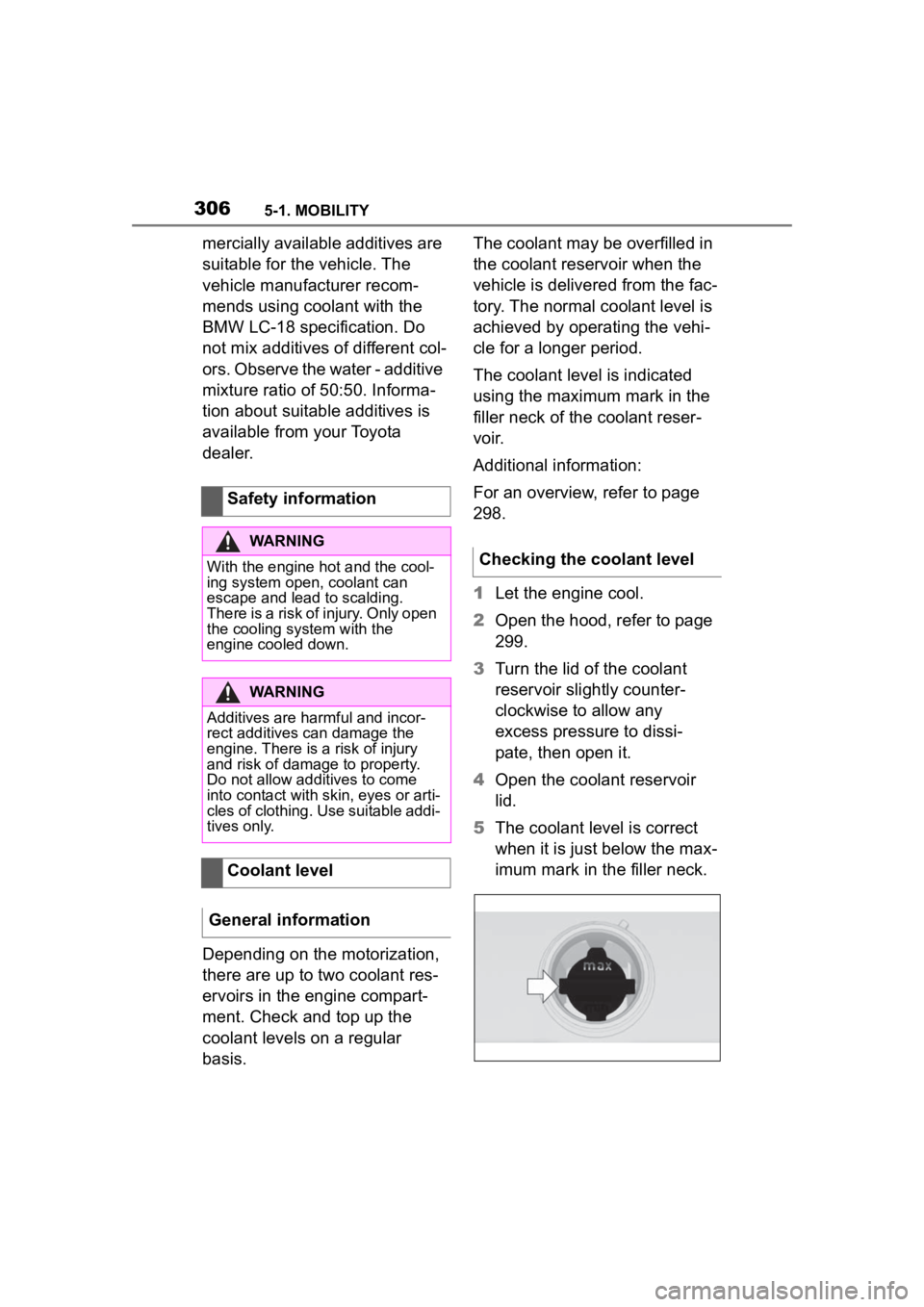
The coolant level is indicated
using the maximum mark in the
filler neck of the coolant reser-
voir.
Additional information:
For an overview, refer to page
298.
1
Let the engine cool.
2 Open the hood, refer to page
299.
3 Turn the lid of the coolant
reservoir slightly counter-
clockwise to allow any
excess pressure to dissi-
pate, then open it.
4 Open the coolant reservoir
lid.
5 The coolant level is correct
when it is just below the max-
imum mark in the filler neck.
Safety information
WARNING
With the engine hot and the cool-
ing system open, coolant can
escape and lead to scalding.
There is a risk of injury. Only open
the cooling system with the
engine cooled down.
WARNING
Additives are harmful and incor-
rect additives can damage the
engine. There is a risk of injury
and risk of damage to property.
Do not allow additives to come
into contact with skin, eyes or arti-
cles of clothing. Use suitable addi-
tives only.
Coolant level
General information
Checking the coolant level
Page 307 of 372
3075-1. MOBILITY
5
MOBILITY
6Close the cap.
1 Let the engine cool.
2 Open the hood, refer to page
299.
3 Turn the lid of the coolant
reservoir slightly counter-
clockwise to allow any
excess pressure to dissi-
pate, then open it.
4 Open the coolant reservoir
lid.
5 If the coolant is low, slowly
add coolant up to the speci-
fied level; do not overfill.
6 Close the cap.
7 Have the cause of the cool-
ant loss eliminated as soon
as possible.
Comply with the relevant envi-
ronmental protection regulations
when disposing of coolant and
coolant additives.
All washer nozzles are supplied
from one reservoir.
Use a mixture of tap water and windshield washer concentrate.
If desired, a windshield washer
concentrate containing anti-
freeze can be used.
Recommended minimum fill
quantity:0.2 US gal/1 liter.
Adding
Disposal
Washer fluid
General information
Safety information
WARNING
Some antifreeze agents can con-
tain harmful substances and are
flammable. There i s a risk of fire
and a risk of inj ury. Follow the
instructions on the containers.
Keep antifreeze away from igni-
tion sources. Do no t refill operat-
ing materials into different bottles.
Store operating materials out of
reach of children.
United States: th e washer fluid
mixture ratio is regulated by the
U.S. EPA and many individual
states; do not exceed the allow-
able washer fluid dilution ratio lim-
its that apply. Follow the usage
instructions on th e washer fluid
container.
WARNING
Washer fluid can ignite and catch
fire on contact with hot engine
parts. There is a risk of injury or
risk of damage to property. Only
add washer fluid when the engine
is cooled down. Next, fully close
the lid of the washer fluid reser-
v oi r.
Page 310 of 372
3105-1. MOBILITY
before locking the vehicle.
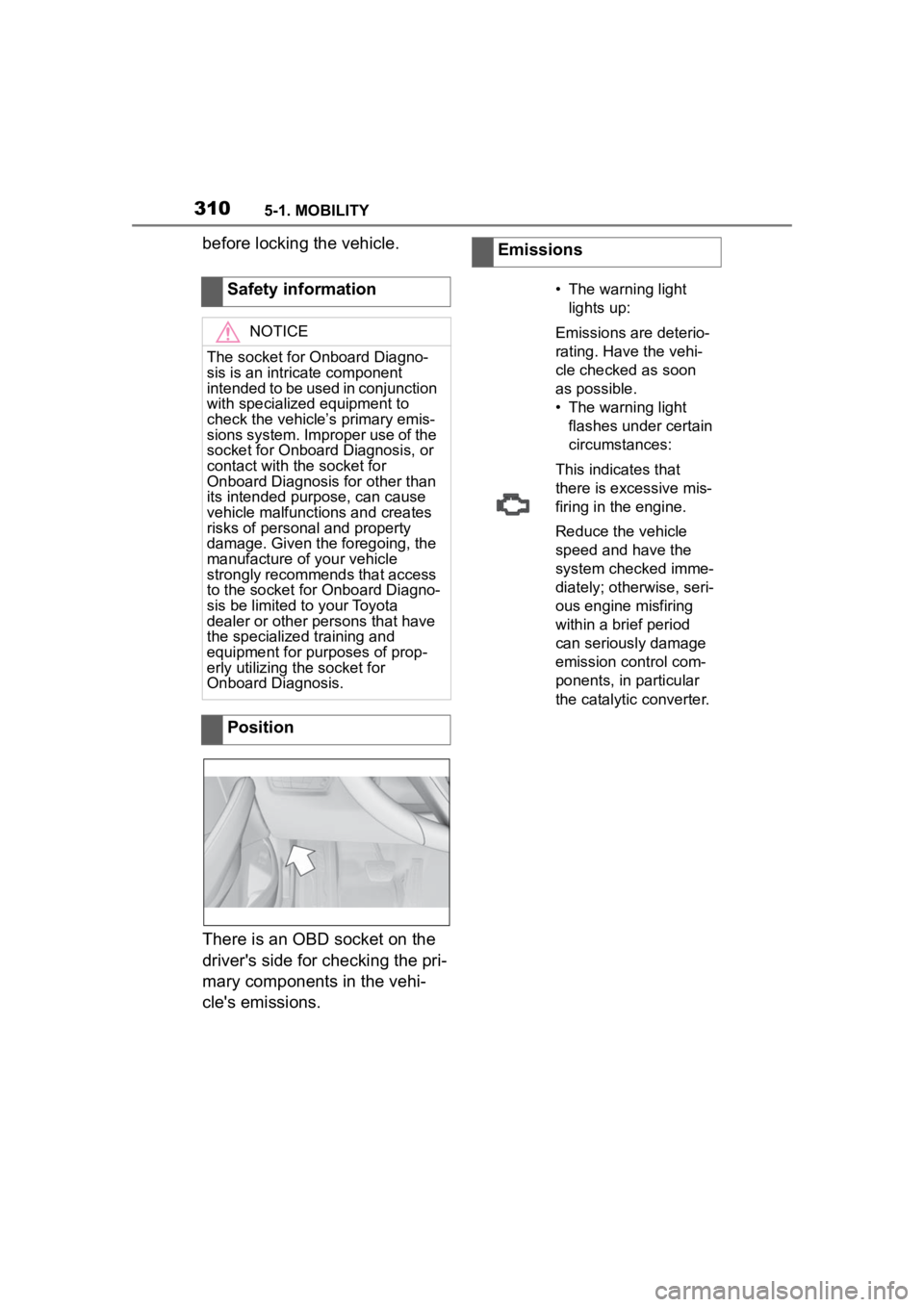
There is an OBD socket on the
driver's side for checking the pri-
mary components in the vehi-
cle's emissions.Safety information
NOTICE
The socket for Onboard Diagno-
sis is an intricate component
intended to be used in conjunction
with specialized equipment to
check the vehicle’s primary emis-
sions system. Improper use of the
socket for Onboard Diagnosis, or
contact with the socket for
Onboard Diagnosis for other than
its intended purpose, can cause
vehicle malfunctions and creates
risks of personal and property
damage. Given the foregoing, the
manufacture of your vehicle
strongly recommends that access
to the socket for Onboard Diagno-
sis be limited to your Toyota
dealer or other persons that have
the specialized
training and
equipment for purposes of prop-
erly utilizing the socket for
Onboard Diagnosis.
Position
Emissions
• The warning light
lights up:
Emissions are deterio-
rating. Have the vehi-
cle checked as soon
as possible.
• The warning light flashes under certain
circumstances:
This indicates that
there is excessive mis-
firing in the engine.
Reduce the vehicle
speed and have the
system checked imme-
diately; otherwise, seri-
ous engine misfiring
within a brief period
can seriously damage
emission control com-
ponents, in particular
the catalytic converter.
Page 312 of 372
3125-1. MOBILITY
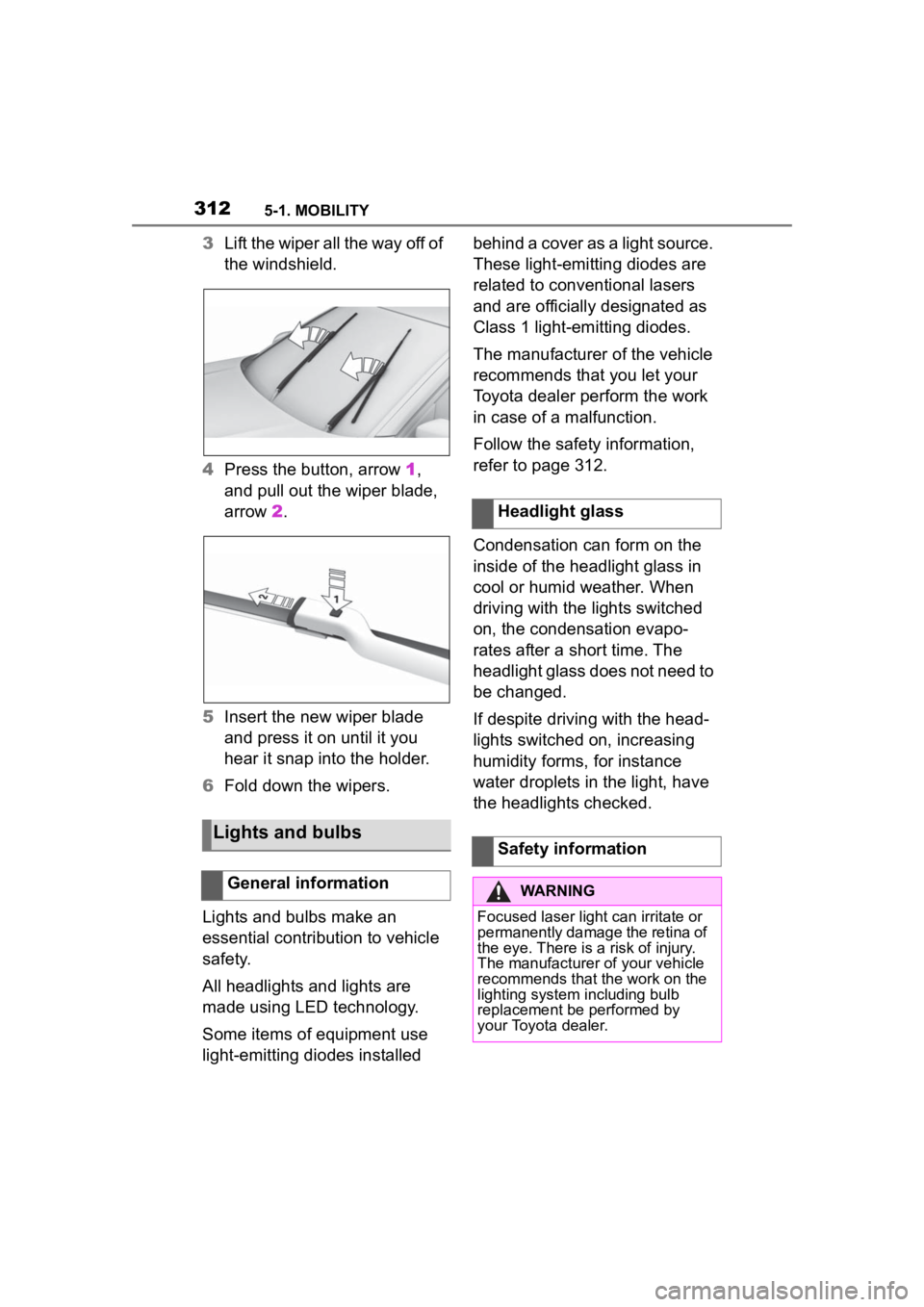
3Lift the wiper all the way off of
the windshield.
4 Press the button, arrow 1,
and pull out the wiper blade,
arrow 2.
5 Insert the new wiper blade
and press it on until it you
hear it snap into the holder.
6 Fold down the wipers.
Lights and bulbs make an
essential contribution to vehicle
safety.
All headlights and lights are
made using LED technology.
Some items of equipment use
light-emitting diodes installed behind a cover as a light source.
These light-emitting diodes are
related to conventional lasers
and are officially designated as
Class 1 light-emitting diodes.
The manufacturer of the vehicle
recommends that you let your
Toyota dealer perform the work
in case of a malfunction.
Follow the safety information,
refer to page 312.
Condensation can form on the
inside of the headlight glass in
cool or humid weather. When
driving with the lights switched
on, the condensation evapo-
rates after a short time. The
headlight glass does not need to
be changed.
If despite driving with the head-
lights switched on, increasing
humidity forms, for instance
water droplets in the light, have
the headlights checked.
Lights and bulbs
General information
Headlight glass
Safety information
WARNING
Focused laser light can irritate or
permanently damage the retina of
the eye. There is a risk of injury.
The manufacturer of your vehicle
recommends that the work on the
lighting system including bulb
replacement be performed by
your Toyota dealer.
Page 313 of 372
3135-1. MOBILITY
5
MOBILITY
The battery is maintenance-free.
More information regarding the
battery can be requested from
your Toyota dealer.
The manufacturer of your vehi-
cle recommends that you have
your Toyota dealer register the
vehicle battery to the vehicle
after the battery has been
replaced. Once the battery has
been registered again, all com-
fort features will be available
without restriction and any vehi-
cle messages displayed which
relate to comfort features will
disappear.
The installed battery is designed
specifically for this vehicle. If an
inappropriate battery is used,
operation of the Auto Start Stop
function may be restricted in
order to protect the battery.
Also, the battery may deterio-
rate faster than normal and the engine may not be able to be
restarted. Contact your Toyota
dealer for details.
Make sure that the battery is
always sufficiently charged to
guarantee that the battery
remains usable for its full ser-
vice life.
Charge the battery when accel-
eration is insufficient.
The following circumstances
can have a negative effect on
the performance of the battery:
Frequent short-distance
drives.
The vehicle is not used for
more than a month.
WARNING
Intensive brightness can irritate or
damage the retina of the eye.
There is a risk of injury. Do not
look directly into the headlights or
other light sources. Do not
remove the LED covers.
Vehicle battery
General information
When replacing the bat-
tery
Safety information
WARNING
Vehicle batteries that are not com-
patible can damage vehicle sys-
tems and impair vehicle functions.
There is a risk of personal and
property damage. Only vehicle
batteries that are compatible with
your vehicle type should be
installed in your vehicle. Informa-
tion on compatible vehicle batter-
ies is available at your Toyota
dealer.
Charging the battery
General information
A discharged battery is
indicated by a red indi-
cator light.
Page 319 of 372
3195-1. MOBILITY
5
MOBILITY
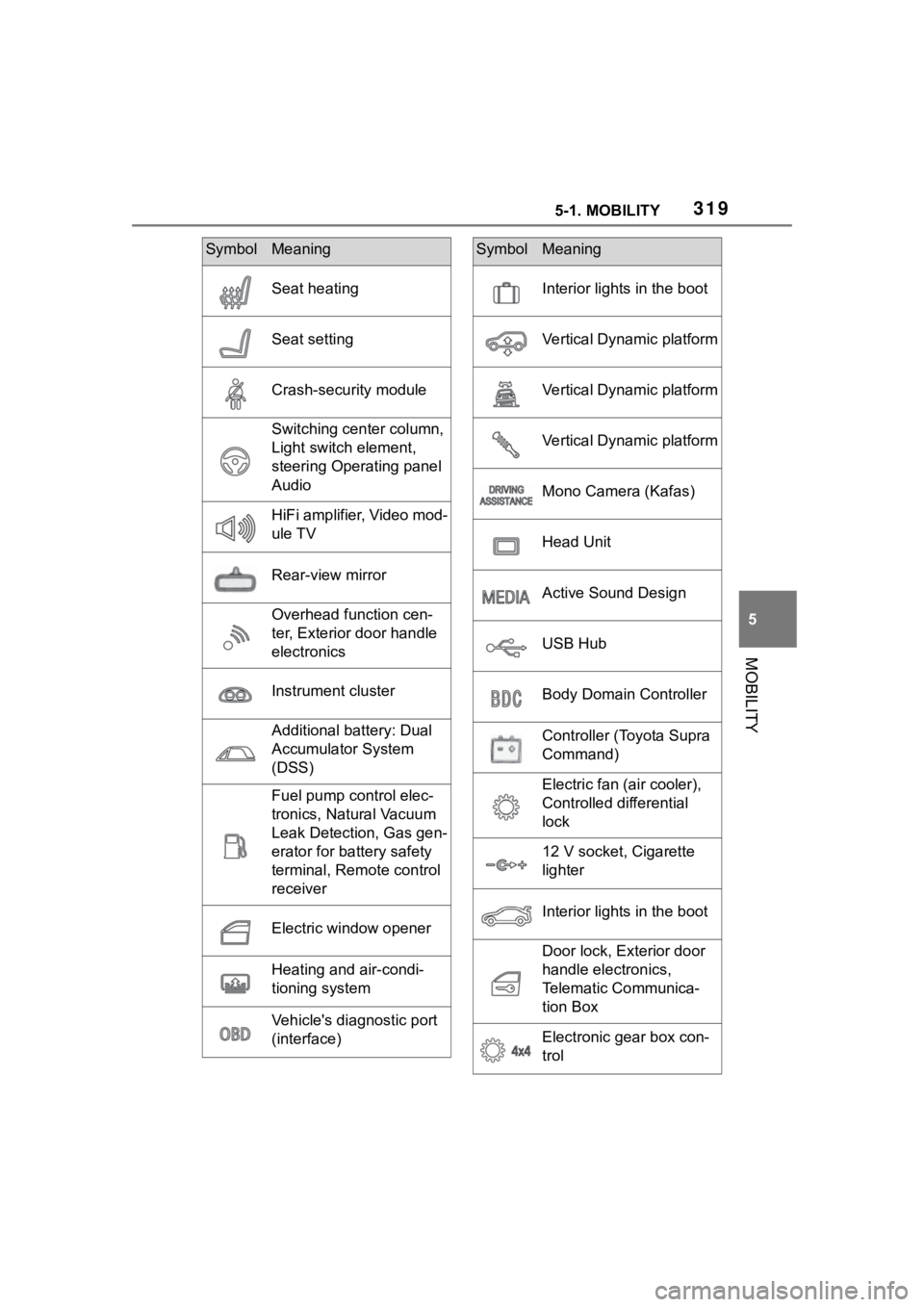
Seat heating
Seat setting
Crash-security module
Switching center column,
Light switch element,
steering Operating panel
Audio
HiFi amplifier, Video mod-
ule TV
Rear-view mirror
Overhead function cen-
ter, Exterior door handle
electronics
Instrument cluster
Additional battery: Dual
Accumulator System
(DSS)
Fuel pump control elec-
tronics, Natural Vacuum
Leak Detection, Gas gen-
erator for battery safety
terminal, Remote control
receiver
Electric window opener
Heating and air-condi-
tioning system
Vehicle's diagnostic port
(interface)
SymbolMeaning
Interior lights in the boot
Vertical Dynamic platform
Vertical Dynamic platform
Vertical Dynamic platform
Mono Camera (Kafas)
Head Unit
Active Sound Design
USB Hub
Body Domain Controller
Controller (Toyota Supra
Command)
Electric fan (air cooler),
Controlled differential
lock
12 V socket, Cigarette
lighter
Interior lights in the boot
Door lock, Exterior door
handle electronics,
Telematic Communica-
tion Box
Electronic gear box con-
trol
SymbolMeaning
Page 320 of 372
3205-1. MOBILITY
This chapter describes all stan-
dard, country-specific and
optional features offered with
the series. It also describes fea-
tures and functions that are not
necessarily available in your
vehicle, e.g., due to the selected
options or country versions. This
also applies to safety-related
functions and systems. When
using these functions and sys-
tems, the applicable laws and
regulations must be observed.
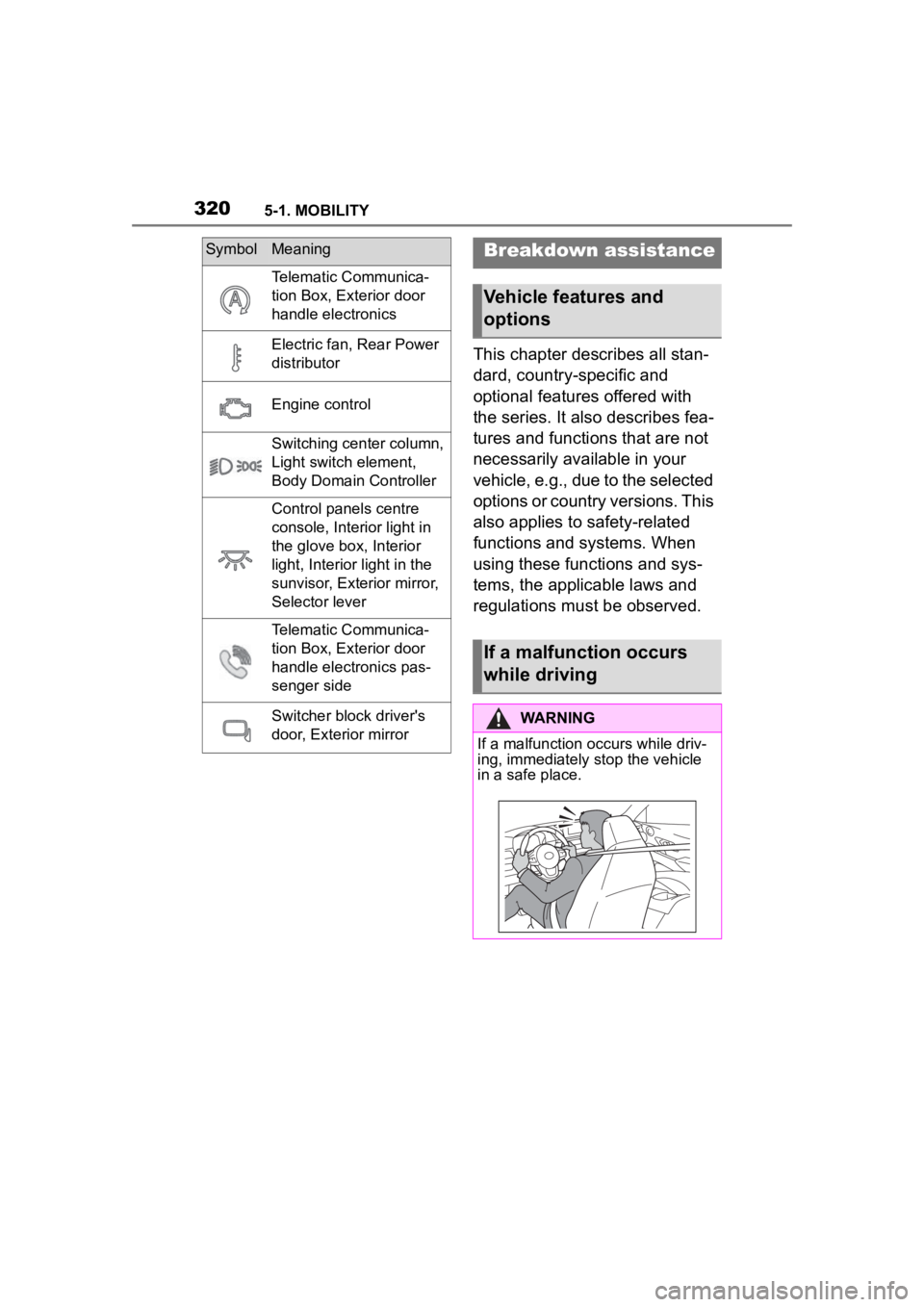
Telematic Communica-
tion Box, Exterior door
handle electronics
Electric fan, Rear Power
distributor
Engine control
Switching center column,
Light switch element,
Body Domain Controller
Control panels centre
console, Interior light in
the glove box, Interior
light, Interior light in the
sunvisor, Exterior mirror,
Selector lever
Telematic Communica-
tion Box, Exterior door
handle electronics pas-
senger side
Switcher block driver's
door, Exterior mirror
SymbolMeaningBreakdown assistance
Vehicle features and
options
If a malfunction occurs
while driving
WARNING
If a malfunction occurs while driv-
ing, immediately stop the vehicle
in a safe place.
Page 321 of 372
3215-1. MOBILITY
5
MOBILITY
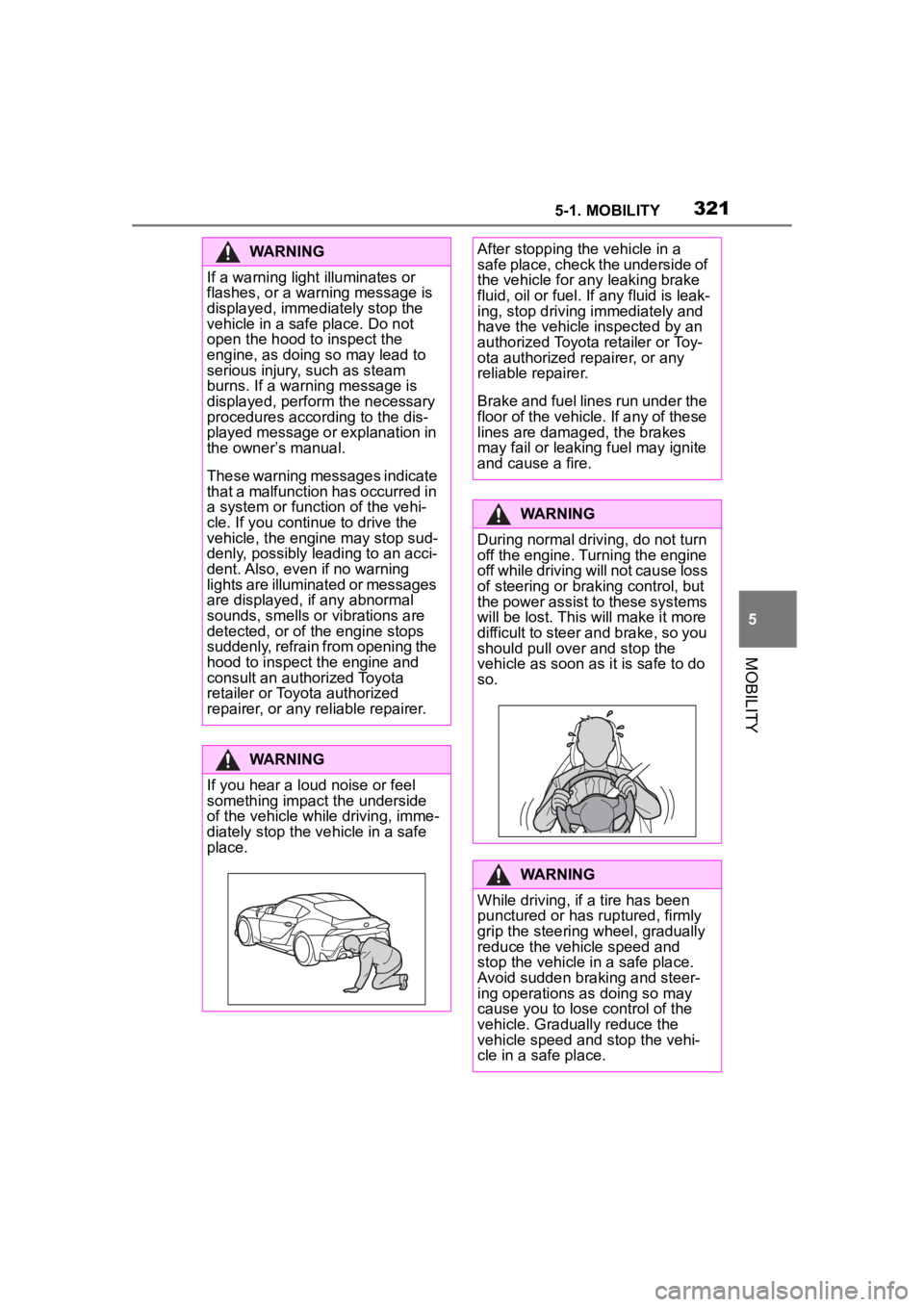
WARNING
If a warning light illuminates or
flashes, or a warning message is
displayed, immediately stop the
vehicle in a safe place. Do not
open the hood to inspect the
engine, as doing so may lead to
serious injury, such as steam
burns. If a warning message is
displayed, perform the necessary
procedures according to the dis-
played message or explanation in
the owner
Page 322 of 372
3225-1. MOBILITY
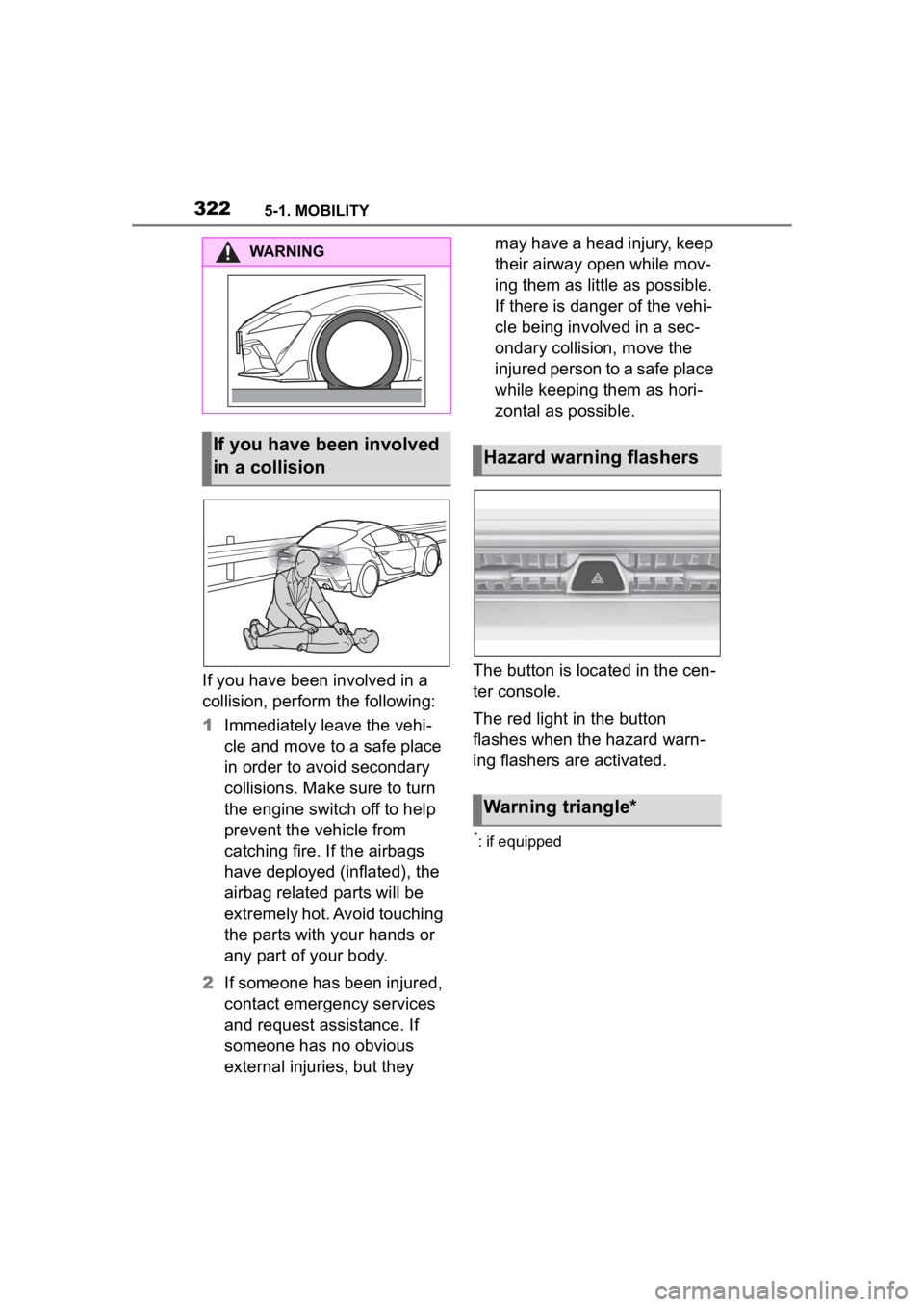
If you have been involved in a
collision, perform the following:
1Immediately leave the vehi-
cle and move to a safe place
in order to avoid secondary
collisions. Make sure to turn
the engine switch off to help
prevent the vehicle from
catching fire. If the airbags
have deployed (inflated), the
airbag related parts will be
extremely hot. Avoid touching
the parts with your hands or
any part of your body.
2 If someone has been injured,
contact emergency services
and request assistance. If
someone has no obvious
external injuries, but they may have a head injury, keep
their airway open while mov-
ing them as little as possible.
If there is danger of the vehi-
cle being involved in a sec-
ondary collision, move the
injured person to a safe place
while keeping them as hori-
zontal as possible.
The button is located in the cen-
ter console.
The red light in the button
flashes when the hazard warn-
ing flashers are activated.
*: if equipped
WARNING
If you have been involved
in a collisionHazard warning flashers
Warning triangle*
Page 327 of 372
3275-1. MOBILITY
5
MOBILITY
A broken-down vehicle can be
towed or pushed.
Follow the following instructions:
Make sure that the standby
state isswitched on; other-
wise, the low beams, tail
lights, turn signals, and wipers
may be unavailable.
Do not tow the vehicle with
the rear axle tilted, as the
front wheels could turn.
When the engine is stopped,
there is no power assistance.
Consequently, more effort
needs to be applied when
braking and steering.
Larger steering wheel move-
ments are required.
The towing vehicle must not
be lighter than the vehicle
being towed; otherwise, it will
not be possible to control han-
dling.
Do not exceed a towing
speed of 30 mph/50 km/h.
Do not exceed a towing dis-
tance of 30 miles/50 km.
Additional information:
Rolling or pushing the vehicle,
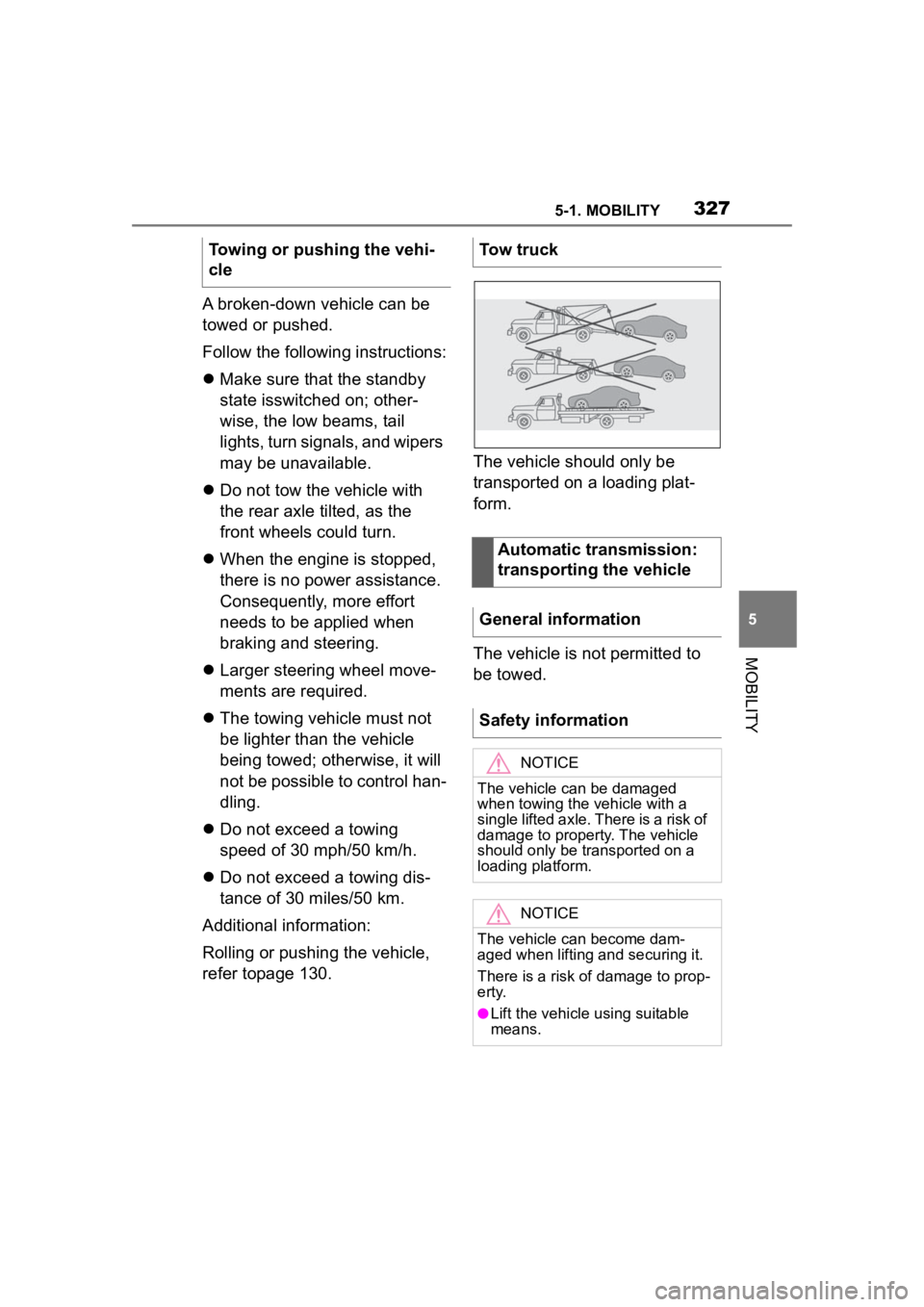
refer topage 130. The vehicle should only be
transported on a loading plat-
form.
The vehicle is not permitted to
be towed.
Towing or pushing the vehi-
cle
Tow truck
Automatic transmission:
transporting the vehicle
General information
Safety information
NOTICE
The vehicle can be damaged
when towing the vehicle with a
single lifted axle. There is a risk of
damage to property. The vehicle
should only be transported on a
loading platform.
NOTICE
The vehicle can become dam-
aged when lifting and securing it.
There is a risk of damage to prop-
erty.
●Lift the vehicle using suitable
means.