belt TOYOTA TACOMA 1996 User Guide
[x] Cancel search | Manufacturer: TOYOTA, Model Year: 1996, Model line: TACOMA, Model: TOYOTA TACOMA 1996Pages: 196, PDF Size: 1.8 MB
Page 28 of 196
26
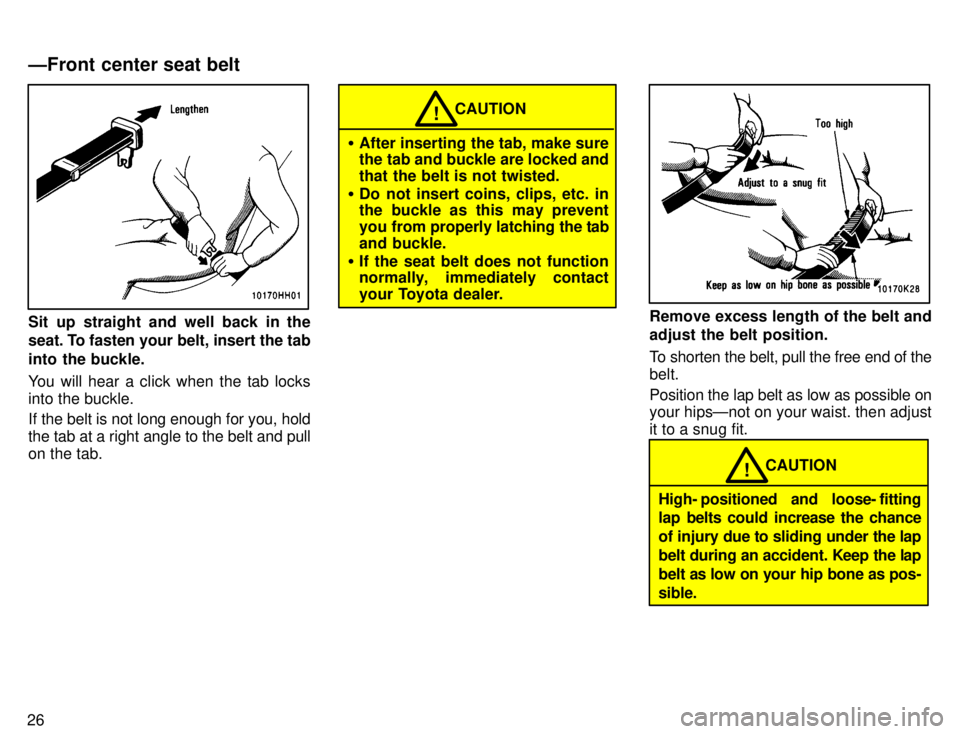
Sit up straight and well back in the
seat. To fasten your belt, insert the tab
into the buckle.
You will hear a click when the tab locks into the buckle.
If the belt is not long enough for you, hold the tab at a right angle to the belt and pull
on the tab.
CAUTION!
After inserting the tab, make sure
the tab and buckle are locked and
that the belt is not twisted.
Do not insert coins, clips, etc. in
the buckle as this may prevent
you from properly latching the tab
and buckle.
If the seat belt does not function
normally, immediately contact
your Toyota dealer.
Remove excess length of the belt and adjust the belt position.
To shorten the belt, pull the free end of the belt. Position the lap belt as low as possible on your hipsÐnot on your waist. then adjust it to a snug fit.
CAUTION!
High- positioned and loose- fitting
lap belts could increase the chance
of injury due to sliding under the lap
belt during an accident. Keep the lap
belt as low on your hip bone as pos-
sible.
ÐFront center seat belt
Page 29 of 196
27
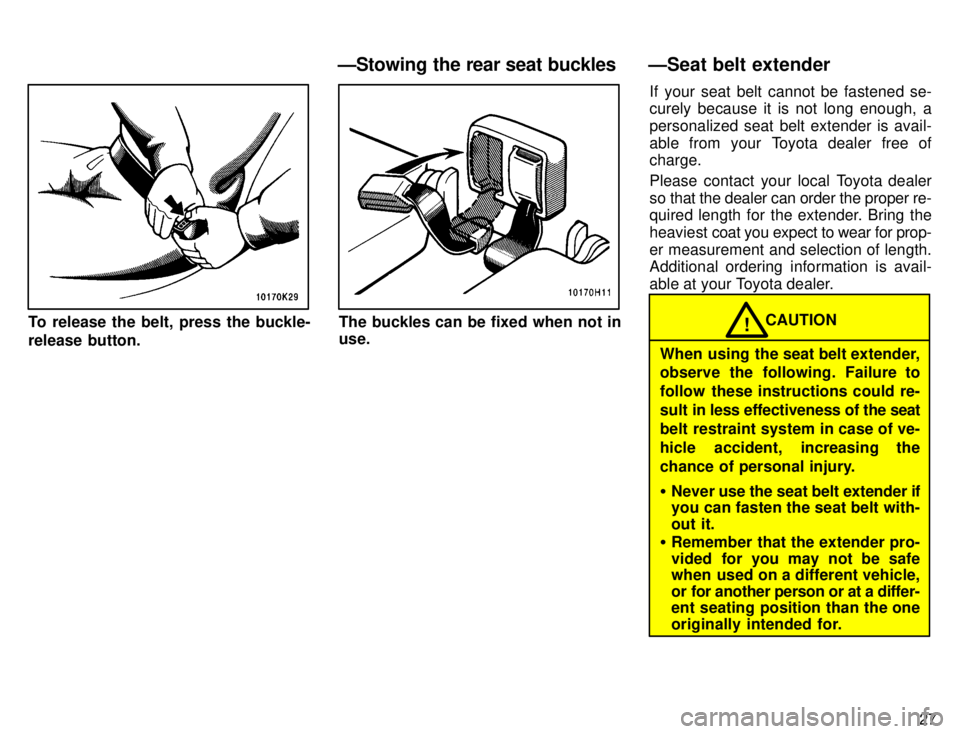
To release the belt, press the buckle-
release button.The buckles can be fixed when not in use.If your seat belt cannot be fastened se-curely because it is not long enough, a
personalized seat belt extender is avail-
able from your Toyota dealer free of charge.
Please contact your local Toyota dealer
so that the dealer can order the proper re-
quired length for the extender. Bring the heaviest
coat you expect to wear for prop-
er measurement and selection of length.
Additional ordering information is avail-
able at your Toyota dealer.CAUTION!
When using the seat belt extender,
observe the following. Failure to
follow these instructions could re-
sult in less effectiveness of the seat
belt restraint system in case of ve-
hicle accident, increasing the
chance of personal injury. Never use the seat belt extender if
you can fasten the seat belt with- out it.
Remember that the extender pro-
vided for you may not be safe
when used on a different vehicle,
or for another person or at a differ-
ent seating position than the one
originally intended for.
ÐStowing the rear seat buckles ÐSeat belt extender
Page 30 of 196
28
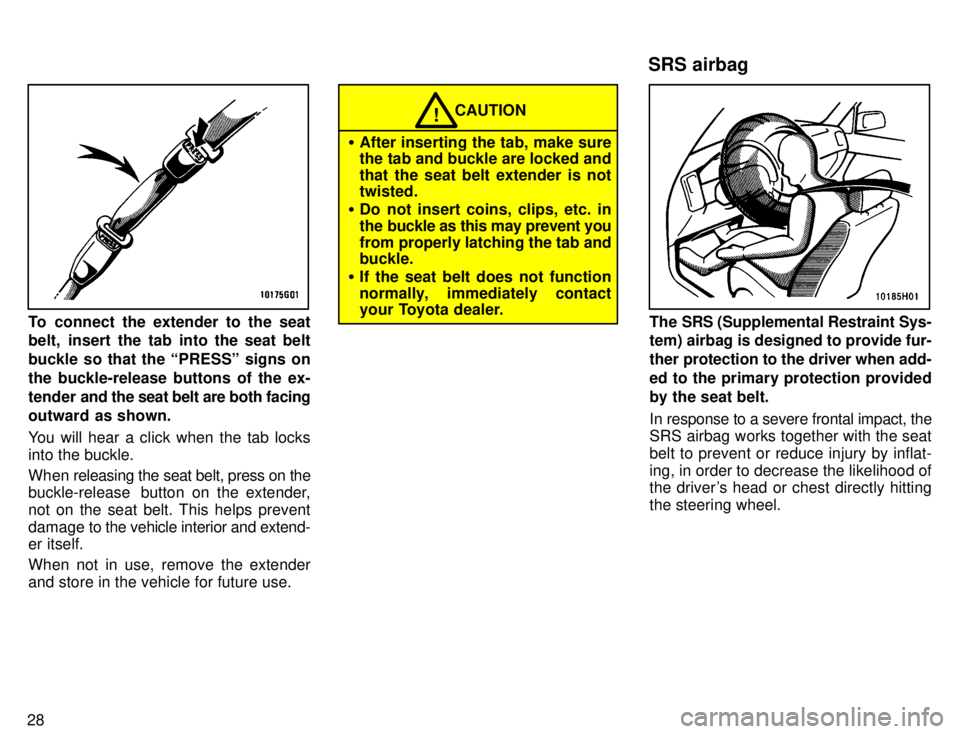
To connect the extender to the seat
belt, insert the tab into the seat belt
buckle so that the PRESSº signs onthe buckle-release buttons of the ex-
tender and the seat belt are both facing
outward as shown.
You will hear a click when the tab locks into the buckle.
When releasing the seat belt, press on the
buckle-release button on the extender, not on the seat belt. This helps prevent
damage to the vehicle interior and extend- er itself.
When not in use, remove the extender
and store in the vehicle for future use.
CAUTION!
After inserting the tab, make sure
the tab and buckle are locked and
that the seat belt extender is not twisted.
Do not insert coins, clips, etc. in
the buckle as this may prevent you
from properly latching the tab and buckle.
If the seat belt does not function
normally, immediately contact
your Toyota dealer.
The SRS (Supplemental Restraint Sys-
tem) airbag is designed to provide fur-
ther protection to the driver when add-
ed to the primary protection providedby the seat belt.
In response to a severe frontal impact, the
SRS airbag works together with the seat belt to prevent or reduce injury by inflat-ing, in order to decrease the likelihood of
the driver's head or chest directly hitting the steering wheel.
SRS airbag
Page 31 of 196

29
This indicator comes on when the
ignition key is turned to the ACCº or
ONº position. It goes off after about 6
seconds. This means the SRS airbag
is operating properly.
The SRS airbag warning light system
monitors the airbag sensor assembly,
inflator, warning light, interconnecting wir-
ing and power sources.The SRS airbag system is designed to
activate in response to a severe frontal
impact within the shaded area be-
tween the arrows in the illustration.
The SRS airbags will deploy if the severity
of the impact is above the designed
threshold level, comparable to an approxi-
mate 20 km/h (14 mph) collision when im-
pacting straight into a fixed barrier that
does not move or deform.
If the severity of the impact is below the
above threshold level, the SRS airbag
may not deploy. However, this threshold velocity will be
considerably higher if the vehicle strikes
an object, such as a parked vehicle or sign
pole, which can move or deform on im-
pact, or if it is
involved in an underride col-
lision (a collision in which the nose of the
vehicle underridesº, or goes under, the
bed of a truck).
For your safety, be sure to always wear your seat belt.
Page 33 of 196
31
CAUTION!
The SRS airbag system is designed
only as a supplement to the primary protection of the seat belt system of
the driver. The driver is particularlysusceptible to injury if he/she does
not wear his/her seat belt; when
sudden braking or a collision oc-
curs, he/she may be thrown for-
ward. To obtain further protection in
an accident, the driver and all pas-
sengers in the vehicle should al-ways wear their seat belts when
driving. For instructions and pre-
cautions concerning the seat belt
systems, see Seat beltsº in this
chapter.
CAUTION!
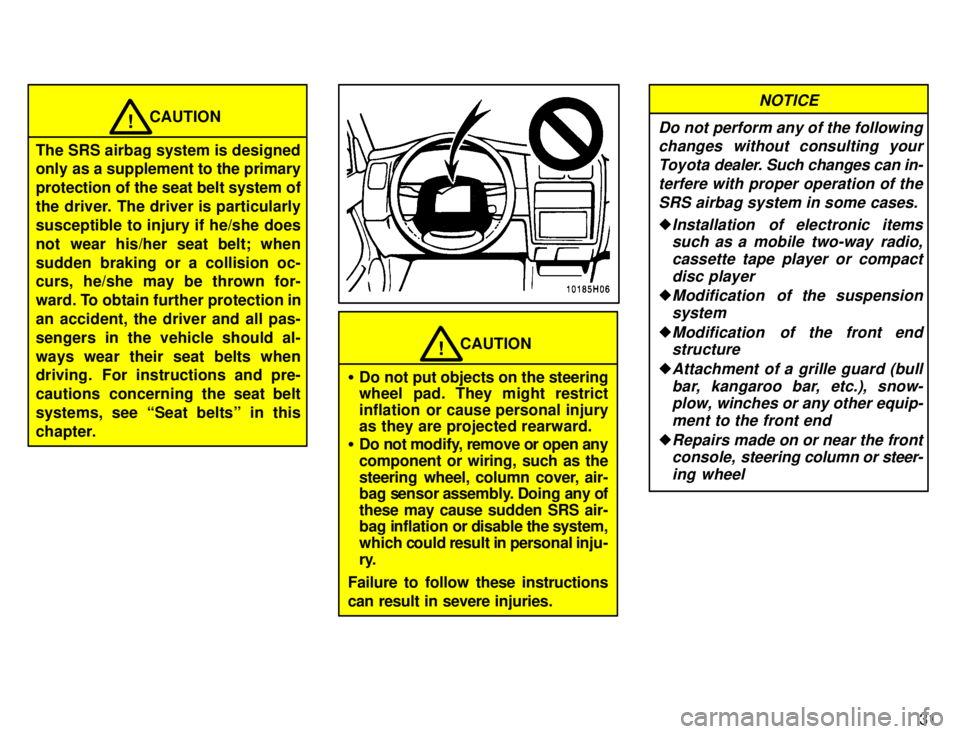
Do not put objects on the steering
wheel pad. They might restrict
inflation or cause personal injury as they are projected rearward.
Do not modify, remove or open any
component or wiring, such as the
steering wheel, column cover, air-
bag sensor assembly. Doing any of
these may cause sudden SRS air-
bag inflation or disable the system,
which could result in personal inju-
ry.
Failure to follow these instructions
can result in severe injuries.
NOTICE
Do not perform any of the following changes without consulting your
Toyota dealer. Such changes can in-
terfere with proper operation of the SRS airbag system in some cases.
Installation of electronic itemssuch as a mobile two-way radio,
cassette tape player or compactdisc player
Modification of the suspension system
Modification of the front endstructure
Attachment of a grille guard (bull
bar, kangaroo bar, etc.), snow-plow, winches or any other equip-
ment to the front end
Repairs made on or near the frontconsole, steering column or steer-
ing wheel
Page 36 of 196
33
A child restraint system for a small
child or baby must itself be restrained
on the seat with the lap portion of thelap/shoulder belt.
The child restraint system should conform
to the size of the child and properly fit the
vehicle seat. For greater safety, the child
restraint
system should be installed in the
rear seat if your vehicle is equipped with rear seats. According to accident statis-
tics, children are safer when properly re-strained in the rear seat than in the front
seat. However, the shape of a child re-
straint system may not allow to be
installed securely in the rear seat. In this
case, we recommend to install the child
restraint system in the front seat. When installing a child restraint system,
follow the instructions provided by the
manufacturer of the system. General di- rections are also provided under the fol-
lowing illustrations.
CAUTION!
After installing the child restraint system, make sure it is secured in
place. If it is not restrained securely,
it may cause injury to the child in theevent of a sudden stop or accident. When not using the child restraint system, keep it secured with
the seat belt or place
it somewhere other than in passenger
compartment. This will prevent it injuring passengers in the event of a sudden stop or accident.
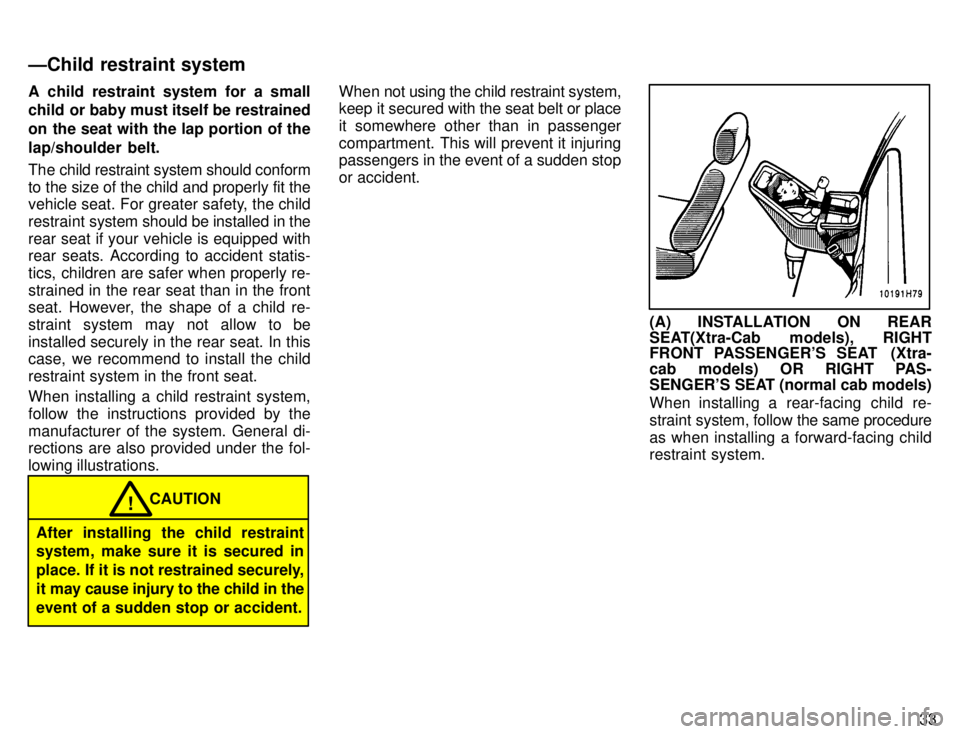
(A) INSTALLATION ON REAR
SEAT(Xtra-Cab models), RIGHT
FRONT PASSENGER'S SEAT (Xtra-
cab models) OR RIGHT PAS-
SENGER'S SEAT (normal cab models)
When installing a rear-facing child re-
straint system, follow the same procedure
as when installing a forward-facing child
restraint system.
ÐChild restraint system
Page 37 of 196
34
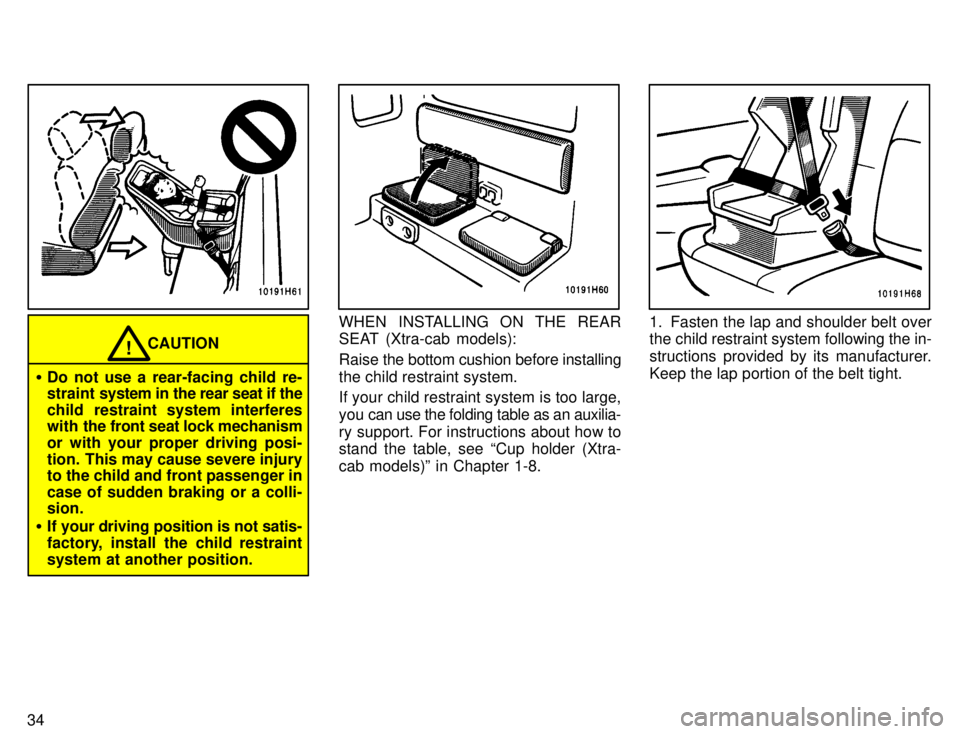
CAUTION!
Do not use a rear-facing child re-
straint system in the rear seat if the
child restraint system interferes
with the front seat lock mechanism
or with your proper driving posi-
tion. This may cause severe injury to the child and front passenger in
case of sudden braking or a colli- sion.
If your driving position is not satis-
factory, install the child restraint
system at another position.
WHEN INSTALLING ON THE REAR
SEAT (Xtra-cab models):
Raise the bottom cushion before installing
the child restraint system. If your child restraint system is too large,
you can use the folding table as an auxilia-
ry support. For instructions about how to stand the table, see Cup holder (Xtra- cab models)º in Chapter 1-8.1. Fasten the lap and shoulder belt over
the child restraint system following the in-
structions provided by its manufacturer.
Keep the lap portion of the belt tight.
Page 38 of 196
35
CAUTION!
After inserting the tab, make sure
the tab and buckle are locked.
Do not insert coins, clips, etc. in
the buckle as this may prevent you
from properly latching the tab and buckle.
If the seat belt does not function
normally, immediately contact
your Toyota dealer.
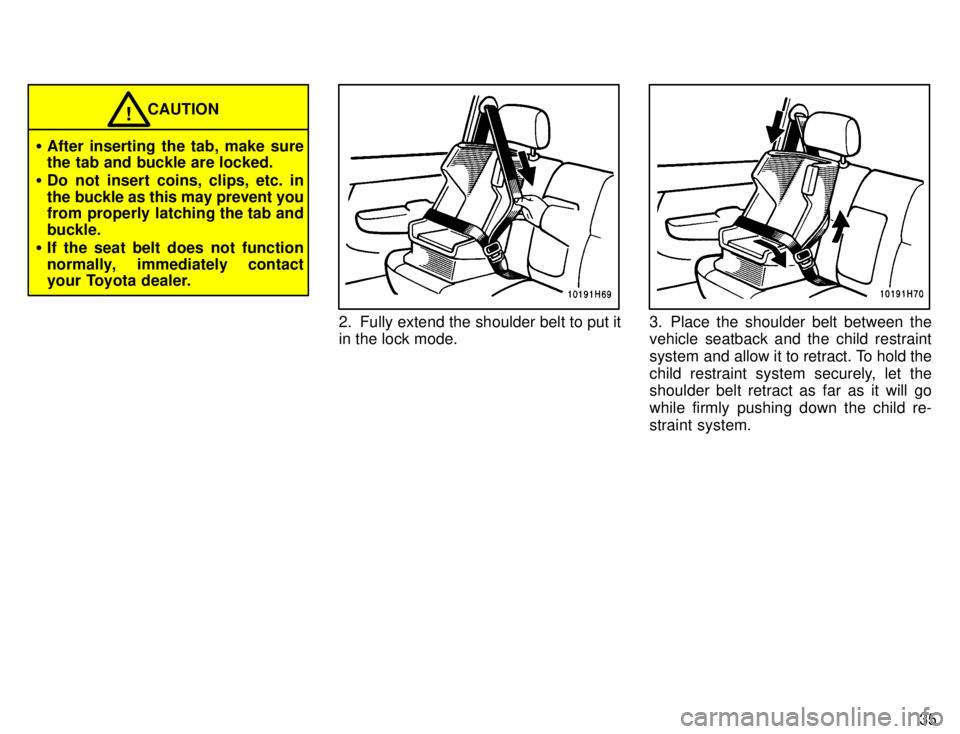
2. Fully extend the shoulder belt to put it in the lock mode.3. Place the shoulder belt between the vehicle seatback and the child restraint
system and allow it to retract. To hold the
child restraint system securely, let the
shoulder belt retract as far as it will go
while firmly pushing down the child re-
straint system.
Page 39 of 196
36
CAUTION!
Make sure the the seat belt is secure-
ly locked. Also make sure the child
restraint system is secure by push-
ing and pulling it in different direc-
tions.
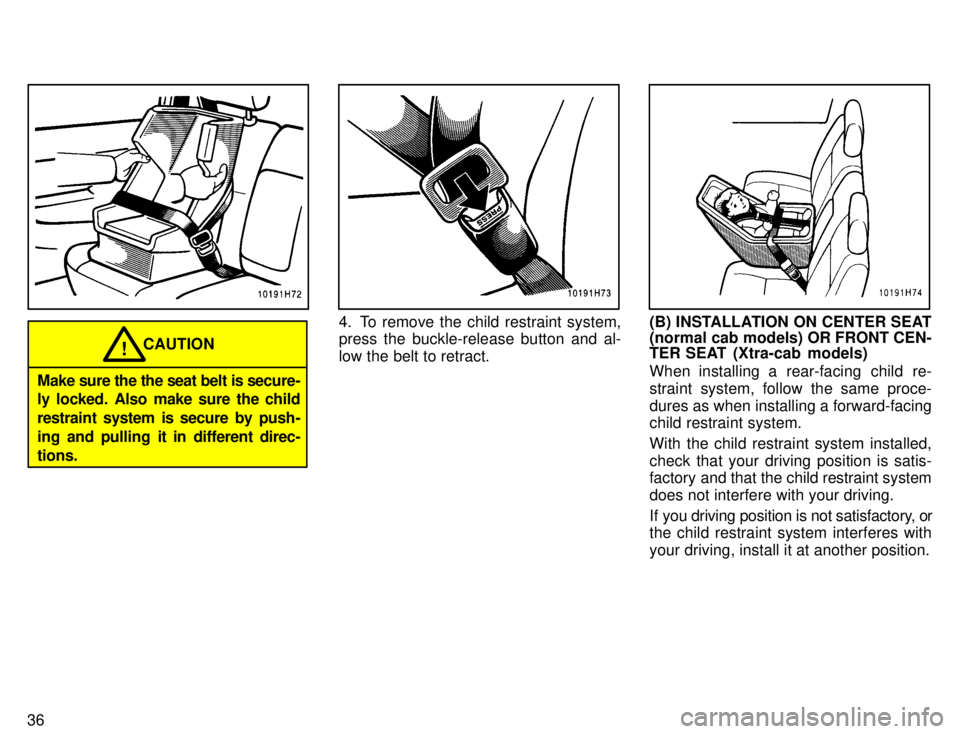
4. To remove the child restraint system, press the buckle-release button and al-
low the belt to retract.(B) INSTALLATION ON CENTER SEAT
(normal cab models) OR FRONT CEN-
TER SEAT (Xtra-cab models)
When installing a rear-facing child re-
straint system, follow the same proce-dures as when installing a forward-facing
child restraint system.
With the child restraint system installed, check that your driving position is satis-
factory and that the child restraint system
does not interfere with your driving.
If you driving position is not satisfactory, or the child restraint system interferes with your driving, install it at another position.
Page 40 of 196
37
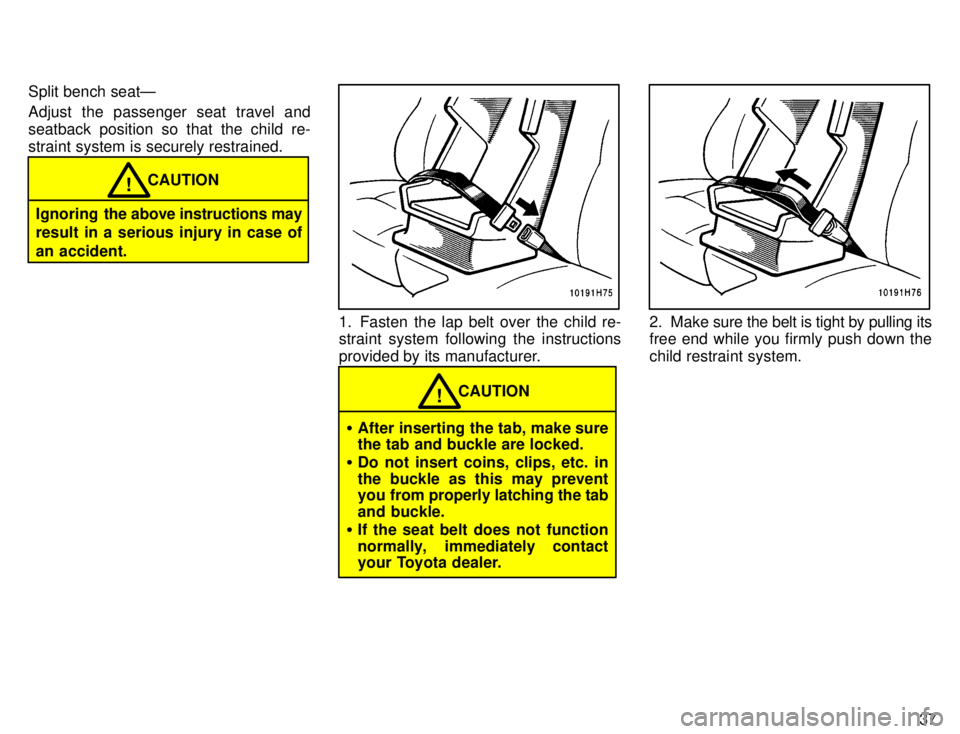
Split bench seatÐ
Adjust the passenger seat travel and
seatback position so that the child re-
straint system is securely restrained.
CAUTION!
Ignoring the above instructions may
result in a serious injury in case of
an accident.
1. Fasten the lap belt over the child re-
straint system following the instructions
provided by its manufacturer.
CAUTION!
After inserting the tab, make sure the tab and buckle are locked.
Do not insert coins, clips, etc. in
the buckle as this may prevent
you from properly latching the tab
and buckle.
If the seat belt does not function
normally, immediately contact
your Toyota dealer.
2. Make sure the belt is tight by pulling its
free end while you firmly push down the
child restraint system.