cooling TOYOTA TACOMA 2009 Owners Manual (in English)
[x] Cancel search | Manufacturer: TOYOTA, Model Year: 2009, Model line: TACOMA, Model: TOYOTA TACOMA 2009Pages: 520, PDF Size: 10.75 MB
Page 221 of 520
221
3-1. Using the air conditioning system
and defogger
3
Interior and exterior features
Adjusting the settings
■ Adjusting the temperature setting (Type A)
Turn the temperature control dial clockwise to increase the temper-
ature.
■ Adjusting the temperature setting (Type B)
Turn the temperature control dial clockwise (warm) or counter-
clockwise (cool).
If is not pressed, the system will blow ambient temperature air or
heated air.
For quick cooling, turn the temperature control dial to the MAX A/C posi-
tion. The air conditioning will automatically turn on and the air intake
selector will be set to recirculated air mode.
■ Adjusting the fan speed
Turn the fan speed control dial clockwise (increase) or counter-
clockwise (decrease).
Set the dial to OFF to turn the fan off.
■ Selecting the air outlets
Set the air outlet selection di al to an appropriate position.
The positions between the air outlet selections shown below can also be
selected for more detailed adjustment.
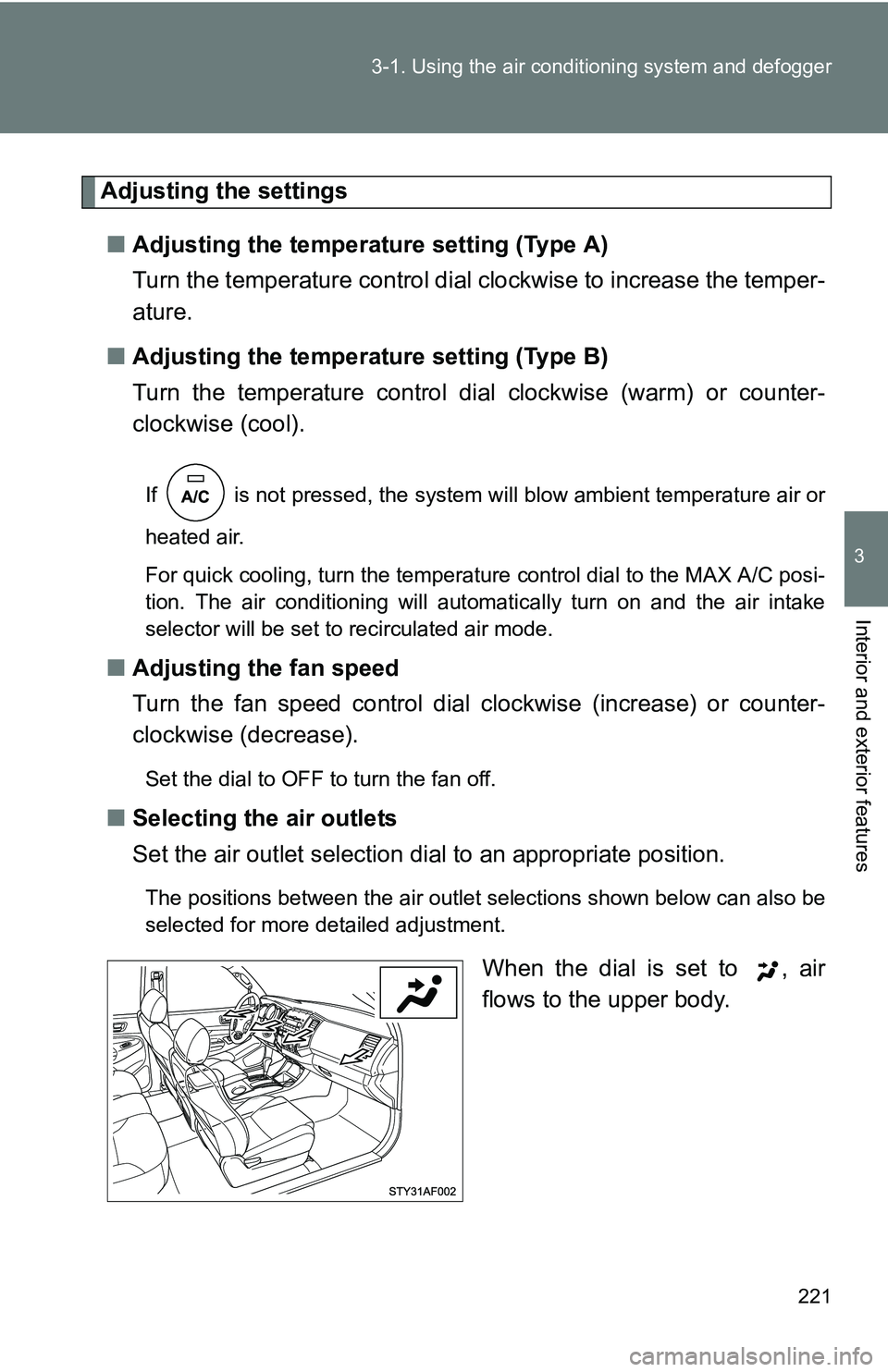
When the dial is set to , air
flows to the upper body.
Page 312 of 520
312 3-6. Other interior features
• The shift lever is in N and the clutch pedal is not depressed.(manual transmission)
A maximum capacity of 400W can only be restored by turning the
power outlet main switch off and then on again under condition
described above.
● The maximum capacity is 115V AC/100W when the following con-
dition applies:
• The shift lever is moved to any positions other than P and N.
(automatic transmission)
• The clutch pedal is depressed. (manual transmission)
■ The power outlet can be used when
The engine is started.
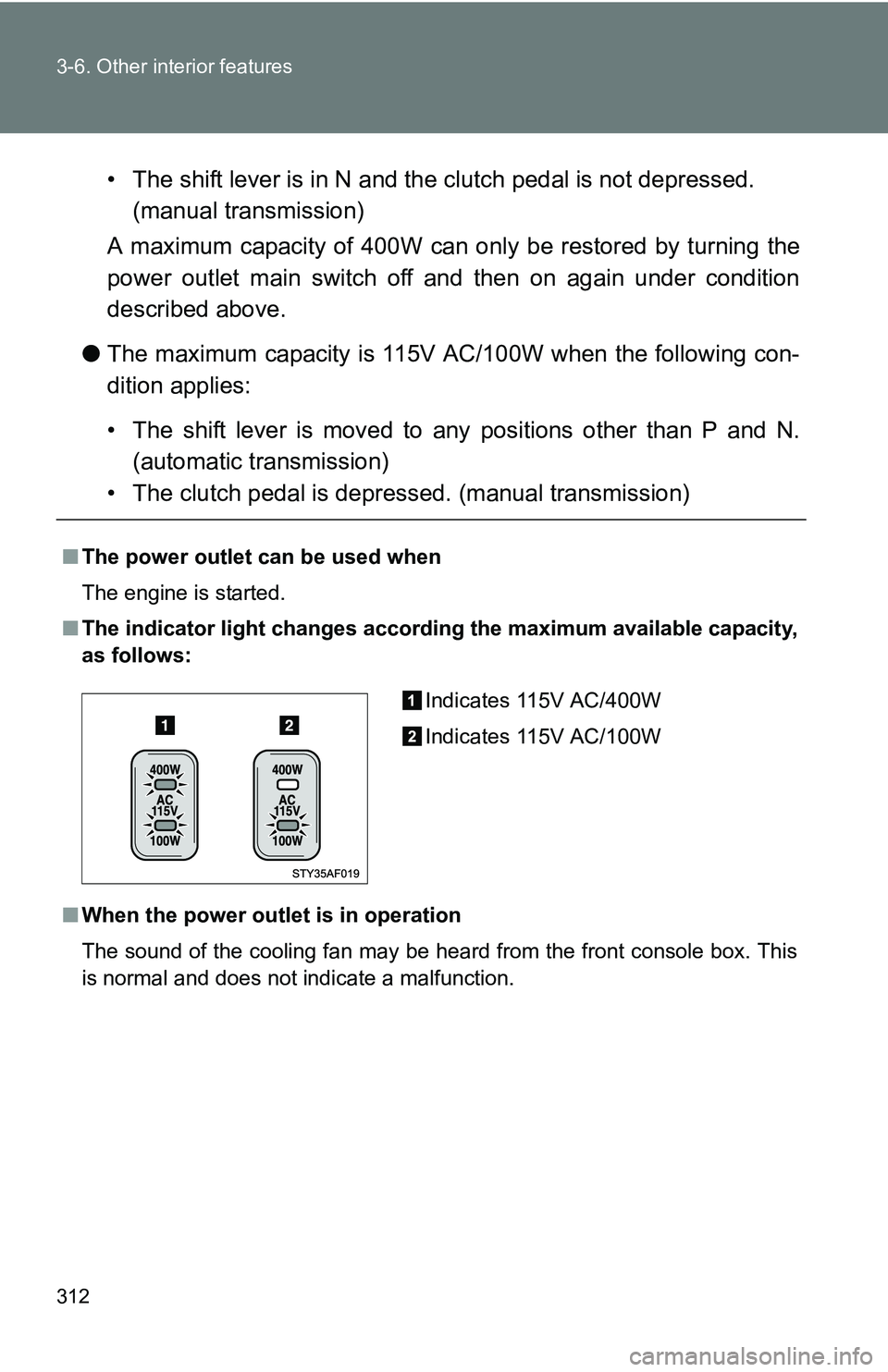
■ The indicator light changes accord ing the maximum available capacity,
as follows:
■ When the power outlet is in operation
The sound of the cooling fan may be heard from the front console box. This
is normal and does not indicate a malfunction.
Indicates 115V AC/400W
Indicates 115V AC/100W
Page 351 of 520
351
4-3. Do-it-yourself maintenance
4
Maintenance and care
CAUTION
The engine compartment contains many mechanisms and fluids that may
move suddenly, become hot, or become electrically energized. To avoid death
or serious injury observe the following precautions.
■
When working on the engine compartment
●Keep hands, clothing, and tools away from the moving fan and engine
drive belt.
● Be careful not to touch the engine, radiator, exhaust manifold, etc. right
after driving as they may be hot. Oil and other fluids may also be hot.
● Do not leave anything that may burn easily, such as paper or rags, in the
engine compartment.
● Do not smoke, cause sparks or expose an open flame to fuel or the bat-
tery. Fuel and battery fumes are flammable.
● Be extremely cautious when working on the battery. It contains poisonous
and corrosive sulfuric acid.
● Take care because brake fluid can harm your hands or eyes and damage
painted surfaces.
If fluid gets on your hands or in your eyes, flush the affected area with
clean water immediately.
If you still experience discomfort, see a doctor.
■ When working near the cooling fan or radiator grille
Be sure the engine switch is off.
With the engine switch on, the cooling fan may automatically start to run if
the air conditioning is on and/or the coolant temperature is high.
■ Safety glasses
Wear safety glasses to prevent flying or falling material, fluid spray, etc. from
getting in the eyes.
Page 363 of 520
363
4-3. Do-it-yourself maintenance
4
Maintenance and care
Engine coolant
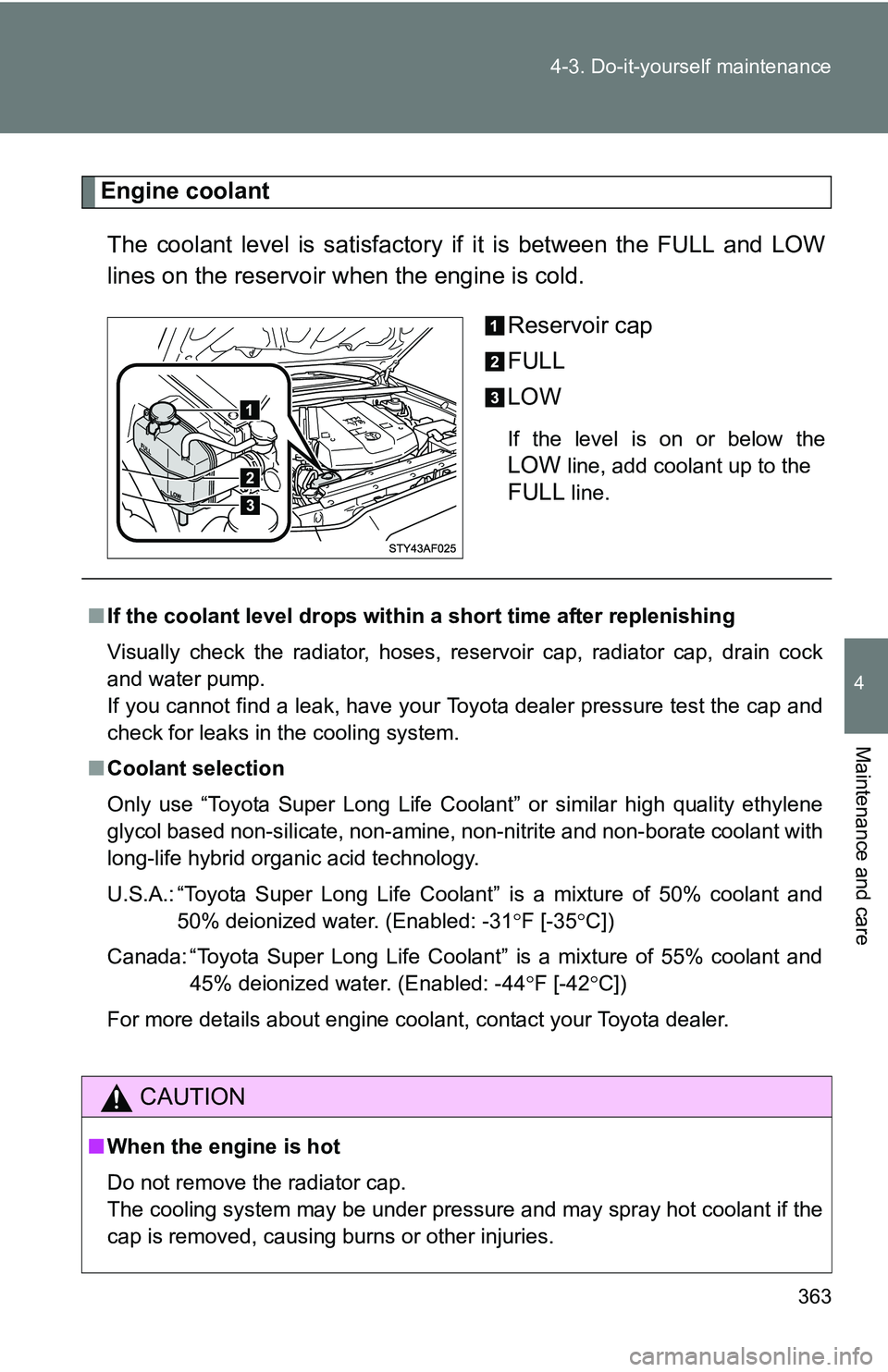
The coolant level is satisfactory if it is between the FULL and LOW
lines on the reservoir when the engine is cold.
Reservoir cap
FULL
LOW
If the level is on or below the
LOW line, add coolant up to the
FULL line.
■If the coolant level drops within a short time after replenishing
Visually check the radiator, hoses, reservoir cap, radiator cap, drain cock
and water pump.
If you cannot find a leak, have your Toyota dealer pressure test the cap and
check for leaks in the cooling system.
■ Coolant selection
Only use “Toyota Super Long Life Coolant” or similar high quality ethylene
glycol based non-silicate, non-amine, non-nitrite and non-borate coolant with
long-life hybrid organic acid technology.
U.S.A.: “Toyota Super Long Life Coolant” is a mixture of 50% coolant and 50% deionized water. (Enabled: -31 F [-35 C])
Canada: “Toyota Super Long Life Coolant” is a mixture of 55% coolant and 45% deionized water. (Enabled: -44 F [-42 C])
For more details about engine coolant, contact your Toyota dealer.
CAUTION
■ When the engine is hot
Do not remove the radiator cap.
The cooling system may be under pressure and may spray hot coolant if the
cap is removed, causing burns or other injuries.
Page 364 of 520
364 4-3. Do-it-yourself maintenance
Radiator and condenserCheck the radiator and condenser and clear any foreign objects.
If either of the above parts are ex tremely dirty or you are not sure of
their condition, have your vehicl e checked by your Toyota dealer.
Brake fluid
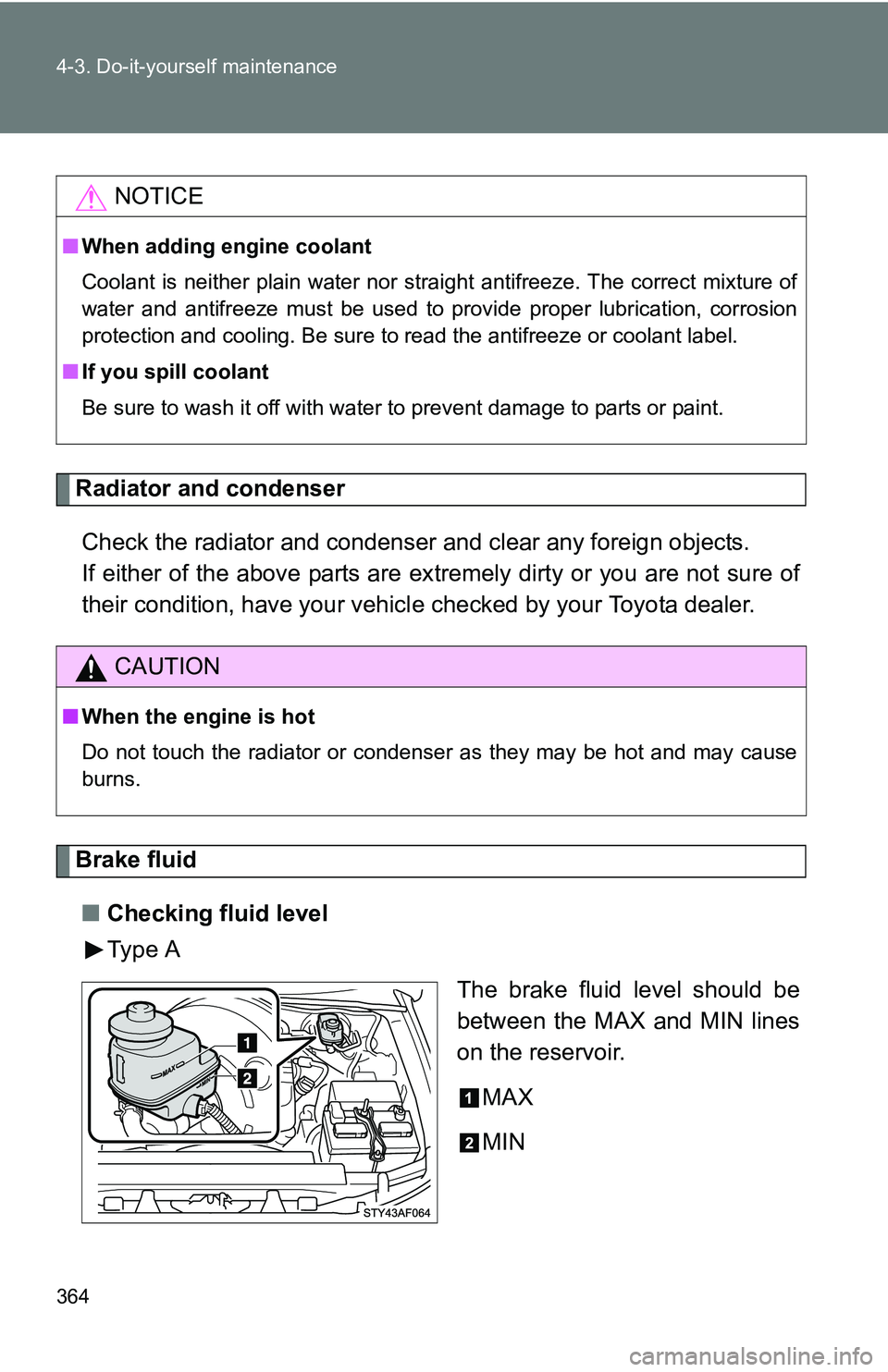
■ Checking fluid level
Type A
The brake fluid level should be
between the MAX and MIN lines
on the reservoir.
MAX
MIN
NOTICE
■When adding engine coolant
Coolant is neither plain water nor stra ight antifreeze. The correct mixture of
water and antifreeze must be used to provide proper lubrication, corrosion
protection and cooling. Be sure to read the antifreeze or coolant label.
■ If you spill coolant
Be sure to wash it off with water to prevent damage to parts or paint.
CAUTION
■When the engine is hot
Do not touch the radiator or condenser as they may be hot and may cause
burns.
Page 455 of 520

5
When trouble arises
455
5-2. Steps to take in an emergency
CAUTION
■
Battery precautions
●Always wash your hands after handling the battery support, terminals, and
other battery-related parts.
● Do not allow children near the battery.
NOTICE
■To prevent damaging the vehicle (vehicles with a manual transmission)
Do not pull- or push-start the vehicle, because the three-way catalytic con-
verter may overheat and become a fire hazard.
■ When handling jumper cables
Be careful that the jumper cables do not become tangled in the cooling fan
or any of the belts when connecting or disconnecting them.
Page 456 of 520
456
5-2. Steps to take in an emergency
If your vehicle overheats
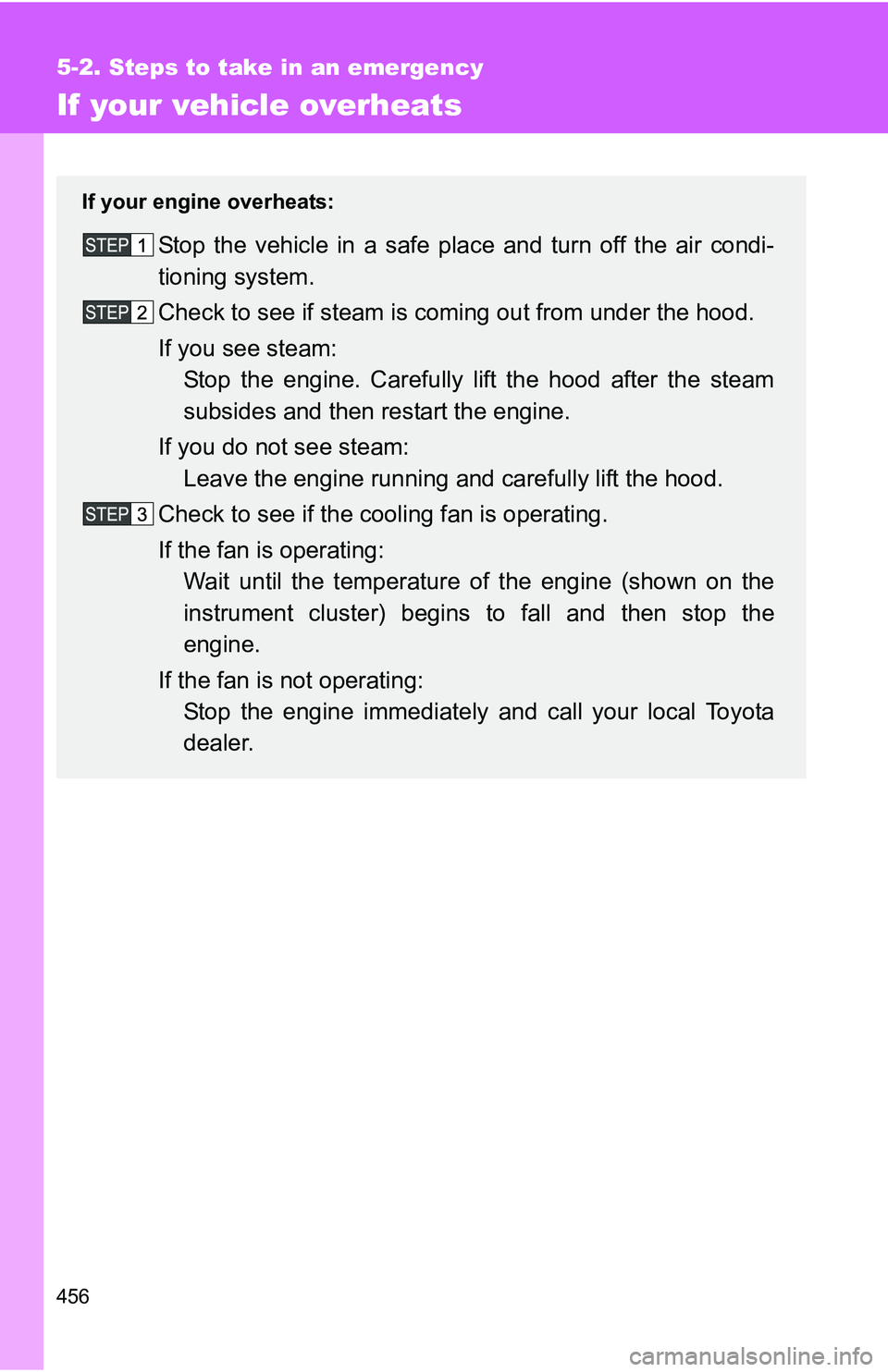
If your engine overheats:
Stop the vehicle in a safe place and turn off the air condi-
tioning system.
Check to see if steam is coming out from under the hood.
If you see steam: Stop the engine. Carefully lift the hood after the steam
subsides and then restart the engine.
If you do not see steam: Leave the engine running and carefully lift the hood.
Check to see if the cooling fan is operating.
If the fan is operating: Wait until the temperature of the engine (shown on the
instrument cluster) begins to fall and then stop the
engine.
If the fan is not operating: Stop the engine immediately and call your local Toyota
dealer.
Page 470 of 520
470 6-1. Specifications
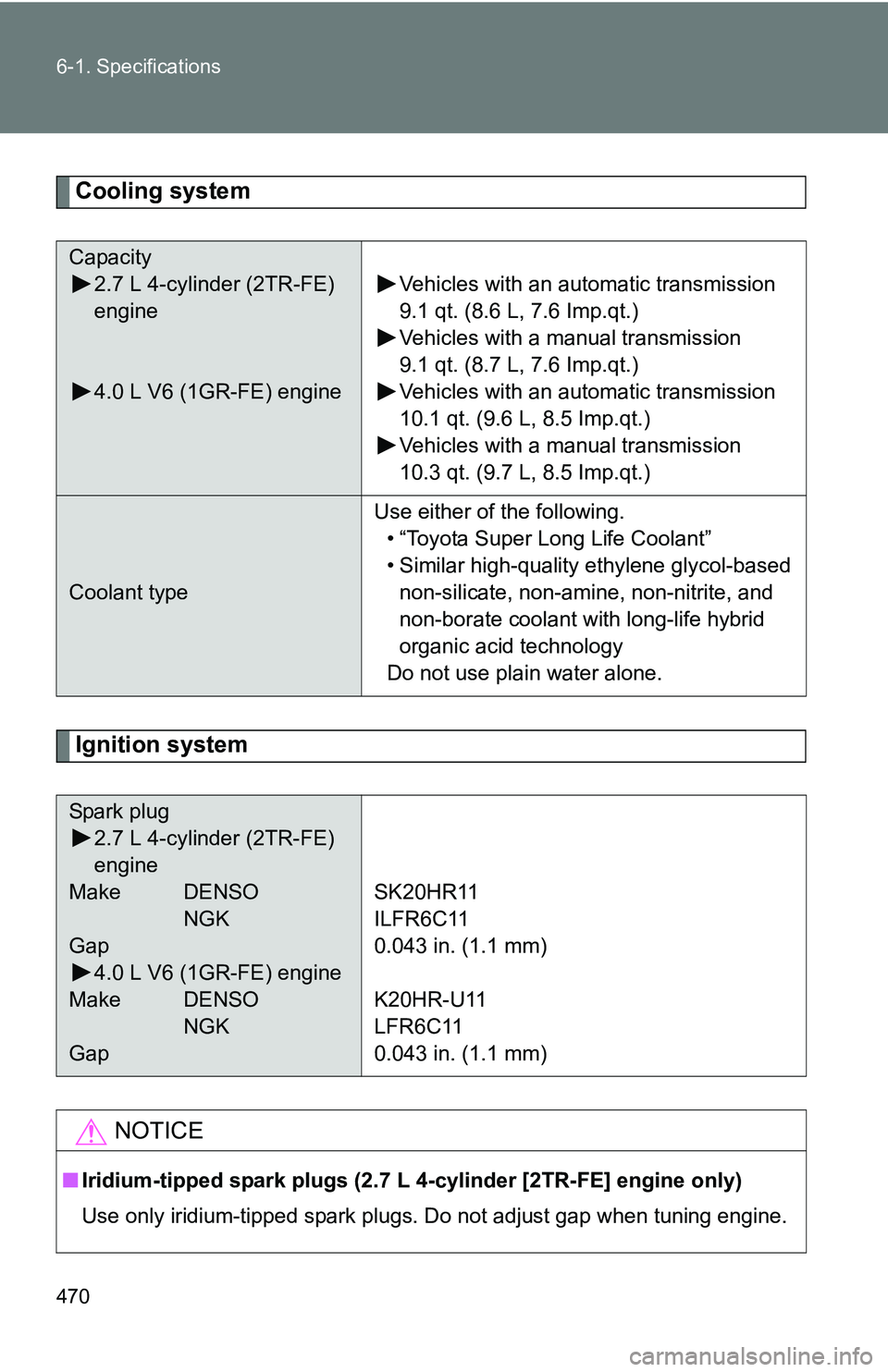
Cooling system
Ignition system
Capacity2.7 L 4-cylinder (2TR-FE)
engine
4.0 L V6 (1GR-FE) engine Vehicles with an automatic transmission
9.1 qt. (8.6 L, 7.6 Imp.qt.)
Vehicles with a manual transmission
9.1 qt. (8.7 L, 7.6 Imp.qt.)
Vehicles with an automatic transmission
10.1 qt. (9.6 L, 8.5 Imp.qt.)
Vehicles with a manual transmission
10.3 qt. (9.7 L, 8.5 Imp.qt.)
Coolant type
Use either of the following.
• “Toyota Super Long Life Coolant”
• Similar high-quality ethylene glycol-based non-silicate, non-amine, non-nitrite, and
non-borate coolant with long-life hybrid
organic acid technology
Do not use plain water alone.
Spark plug 2.7 L 4-cylinder (2TR-FE)
engine
Make DENSO NGK
Gap 4.0 L V6 (1GR-FE) engine
Make DENSO NGK
Gap SK20HR11
ILFR6C11
0.043 in. (1.1 mm)
K20HR-U11
LFR6C11
0.043 in. (1.1 mm)
NOTICE
■
Iridium-tipped spark plugs (2.7 L 4-cylinder [2TR-FE] engine only)
Use only iridium-tipped spark plugs. Do not adjust gap when tuning engine.
Page 509 of 520
509
Alphabetical index
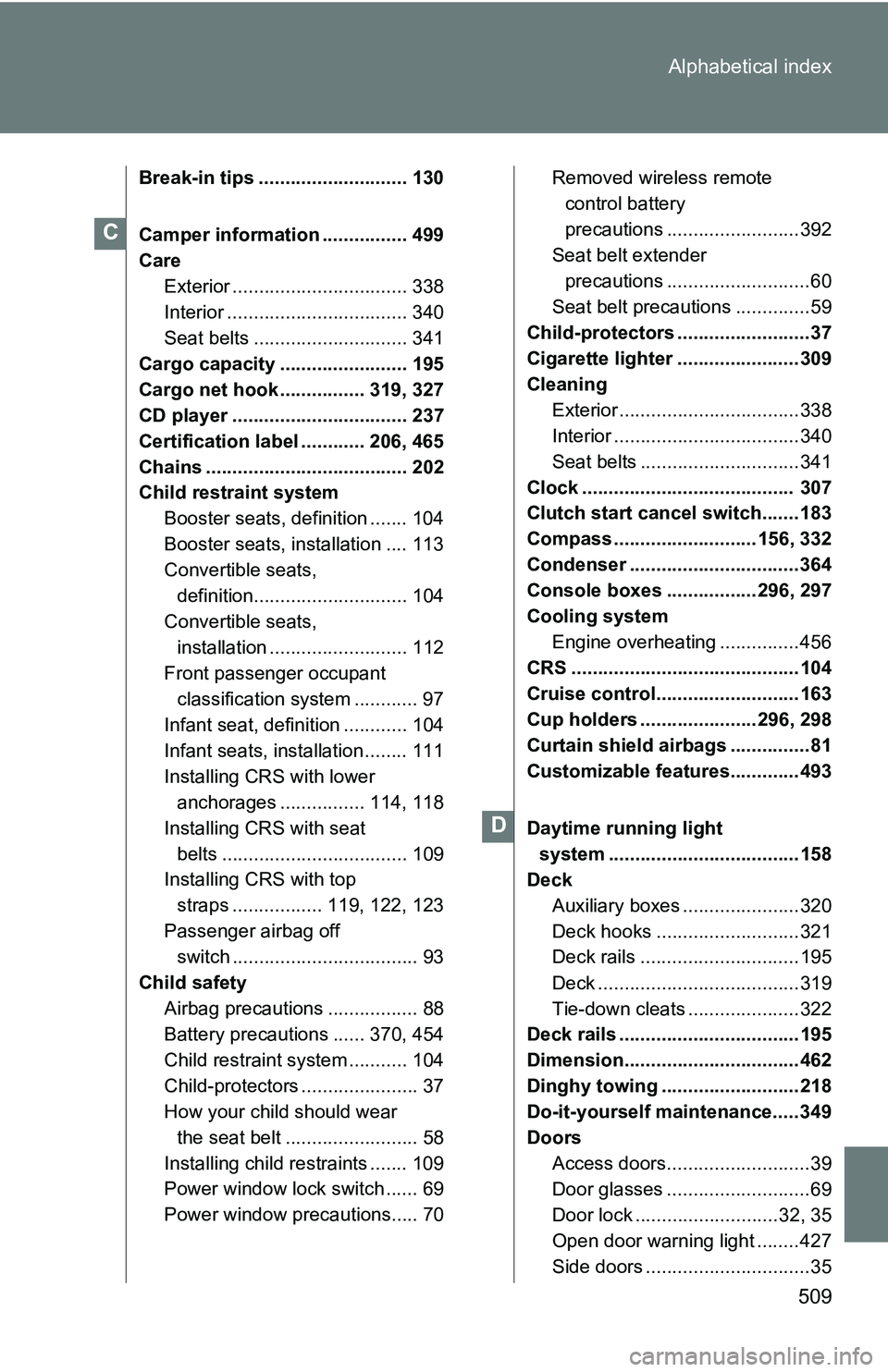
Break-in tips ............................ 130
Camper information ................ 499
Care
Exterior ................................. 338
Interior .................................. 340
Seat belts ............................. 341
Cargo capacity ........................ 195
Cargo net hook ................ 319, 327
CD player ................................. 237
Certification label ............ 206, 465
Chains ...................................... 202
Child restraint system Booster seats, definition ....... 104
Booster seats, installation .... 113
Convertible seats, definition............................. 104
Convertible seats, installation .......................... 112
Front passenger occupant classification system ............ 97
Infant seat, definition ............ 104
Infant seats, installation ........ 111
Installing CRS with lower anchorages ................ 114, 118
Installing CRS with seat belts ................................... 109
Installing CRS with top
straps ................. 119, 122, 123
Passenger airbag off switch ................................... 93
Child safety Airbag precautions ................. 88
Battery precautions ...... 370, 454
Child restraint system ........... 104
Child-protectors ...................... 37
How your child should wear the seat belt ......................... 58
Installing child restraints ....... 109
Power window lock switch ...... 69
Power window precautions..... 70 Removed wireless remote
control battery
precautions .........................392
Seat belt extender precautions ...........................60
Seat belt precautions ..............59
Child-protectors .........................37
Cigarette lighter .......................309
Cleaning Exterior ..................................338
Interior ...................................340
Seat belts ..............................341
Clock ........................................ 307
Clutch start cancel switch.......183
Compass ...........................156, 332
Condenser ................................364
Console boxes .................296, 297
Cooling system Engine overheating ...............456
CRS ...........................................104
Cruise control...........................163
Cup holders ......................296, 298
Curtain shield airbags ...............81
Customizable features.............493
Daytime running light
system ....................................158
Deck
Auxiliary boxes ......................320
Deck hooks ...........................321
Deck rails ..............................195
Deck ......................................319
Tie-down cleats .....................322
Deck rails ..................................195
Dimension.................................462
Dinghy towing ..........................218
Do-it-yourself main tenance.....349
Doors Access doors...........................39
Door glasses ...........................69
Door lock ...........................32, 35
Open door warning light ........427
Side doors ...............................35
C
D