maintenance TOYOTA TACOMA 2009 Owners Manual (in English)
[x] Cancel search | Manufacturer: TOYOTA, Model Year: 2009, Model line: TACOMA, Model: TOYOTA TACOMA 2009Pages: 520, PDF Size: 10.75 MB
Page 1 of 520
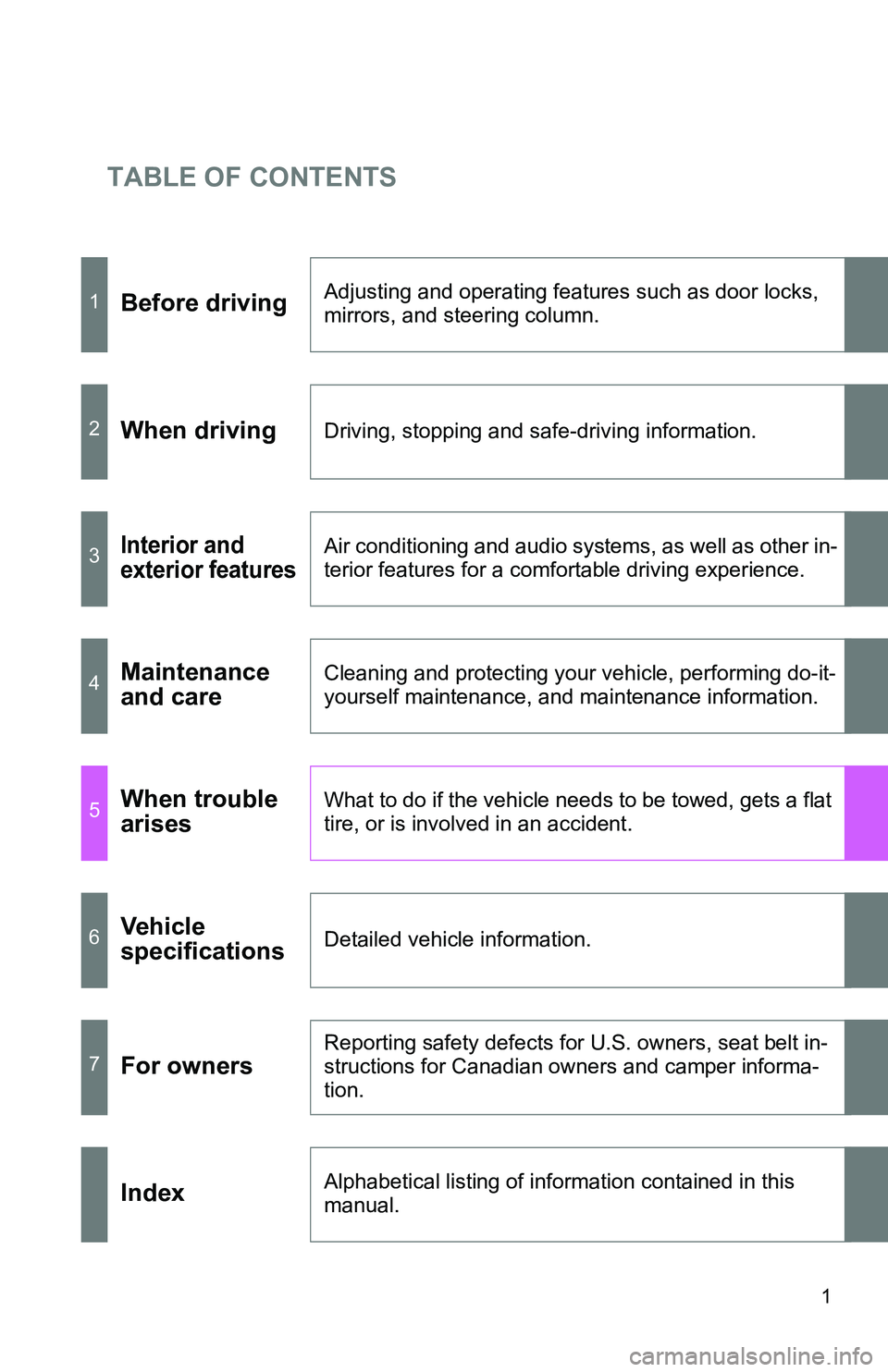
TABLE OF CONTENTS
1
1Before drivingAdjusting and operating features such as door locks,
mirrors, and steering column.
2When drivingDriving, stopping and safe-driving information.
3Interior and
exterior featuresAir conditioning and audio systems, as well as other in-
terior features for a comfortable driving experience.
4Maintenance
and careCleaning and protecting your vehicle, performing do-it-
yourself maintenance, and maintenance information.
5When trouble
arisesWhat to do if the vehicle needs to be towed, gets a flat
tire, or is involved in an accident.
6Vehicle
specificationsDetailed vehicle information.
7For owners
Reporting safety defects for U.S. owners, seat belt in-
structions for Canadian owners and camper informa-
tion.
IndexAlphabetical listing of information contained in this
manual.
Page 4 of 520
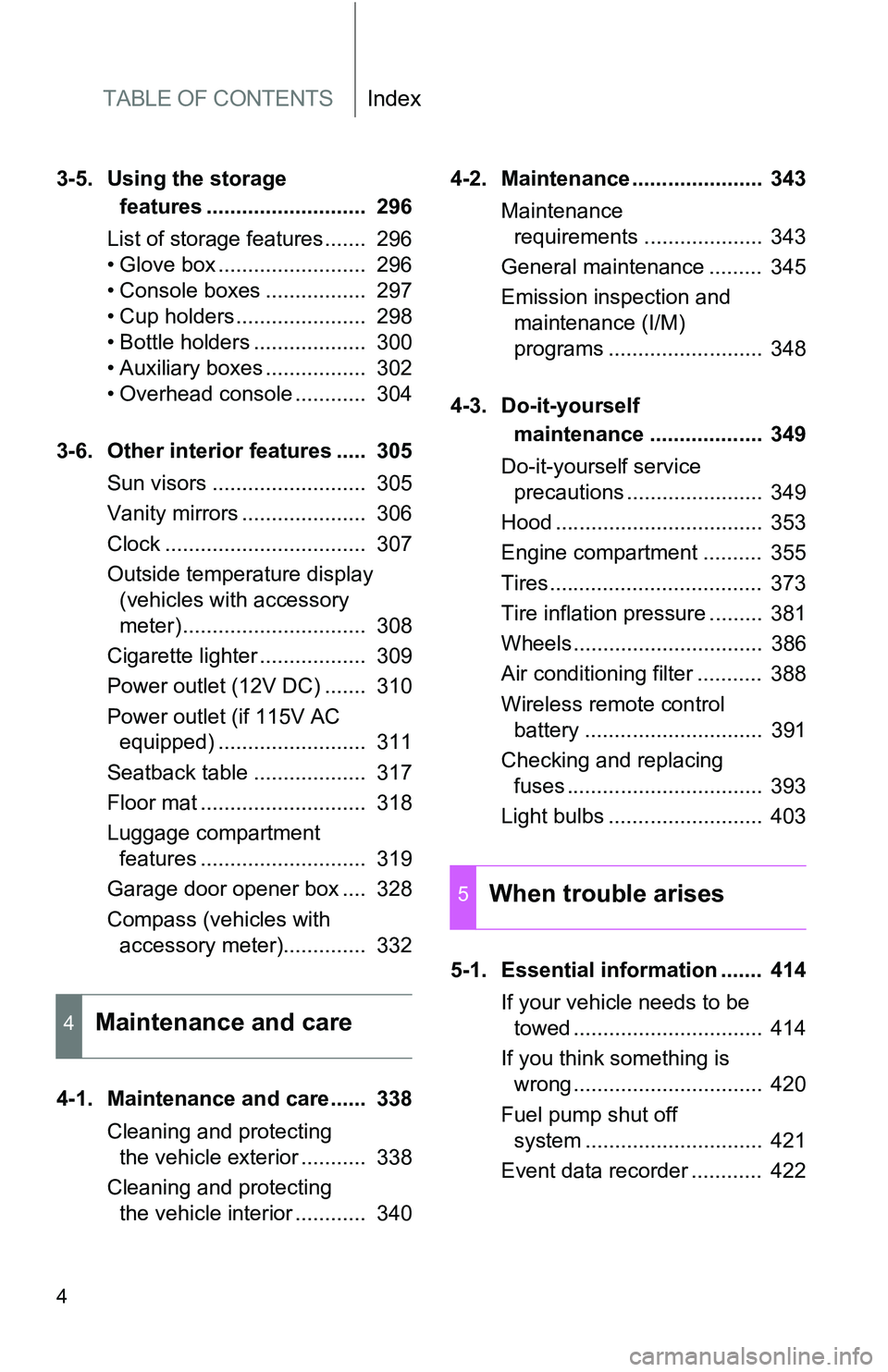
TABLE OF CONTENTSIndex
4
3-5. Using the storage features ........................... 296
List of storage features....... 296
• Glove box ......................... 296
• Console boxes ................. 297
• Cup holders ...................... 298
• Bottle holders ................... 300
• Auxiliary boxes ................. 302
• Overhead console ............ 304
3-6. Other interior features ..... 305 Sun visors .......................... 305
Vanity mirrors ..................... 306
Clock .................................. 307
Outside temperature display (vehicles with accessory
meter) ............................... 308
Cigarette lighter .................. 309
Power outlet (12V DC) ....... 310
Power outlet (if 115V AC equipped) ......................... 311
Seatback table ................... 317
Floor mat ............................ 318
Luggage compartment features ............................ 319
Garage door opener box .... 328
Compass (vehicles with accessory meter).............. 332
4-1. Maintenance and care...... 338 Cleaning and protecting the vehicle exterior ........... 338
Cleaning and protecting the vehicle interior ............ 340 4-2. Maintenance ...................... 343
Maintenance requirements .................... 343
General maintenance ......... 345
Emission inspection and maintenance (I/M)
programs .......................... 348
4-3. Do-it-yourself maintenance ................... 349
Do-it-yourself service precautions ....................... 349
Hood ................................... 353
Engine compartment .......... 355
Tires.................................... 373
Tire inflation pressure ......... 381
Wheels................................ 386
Air conditioning filter ........... 388
Wireless remote control battery .............................. 391
Checking and replacing fuses ................................. 393
Light bulbs .......................... 403
5-1. Essential information ....... 414 If your vehicle needs to be towed ................................ 414
If you think something is wrong ................................ 420
Fuel pump shut off system .............................. 421
Event data recorder ............ 422
4Maintenance and care
5When trouble arises
Page 5 of 520
1
2
3
4
5
6
7
5
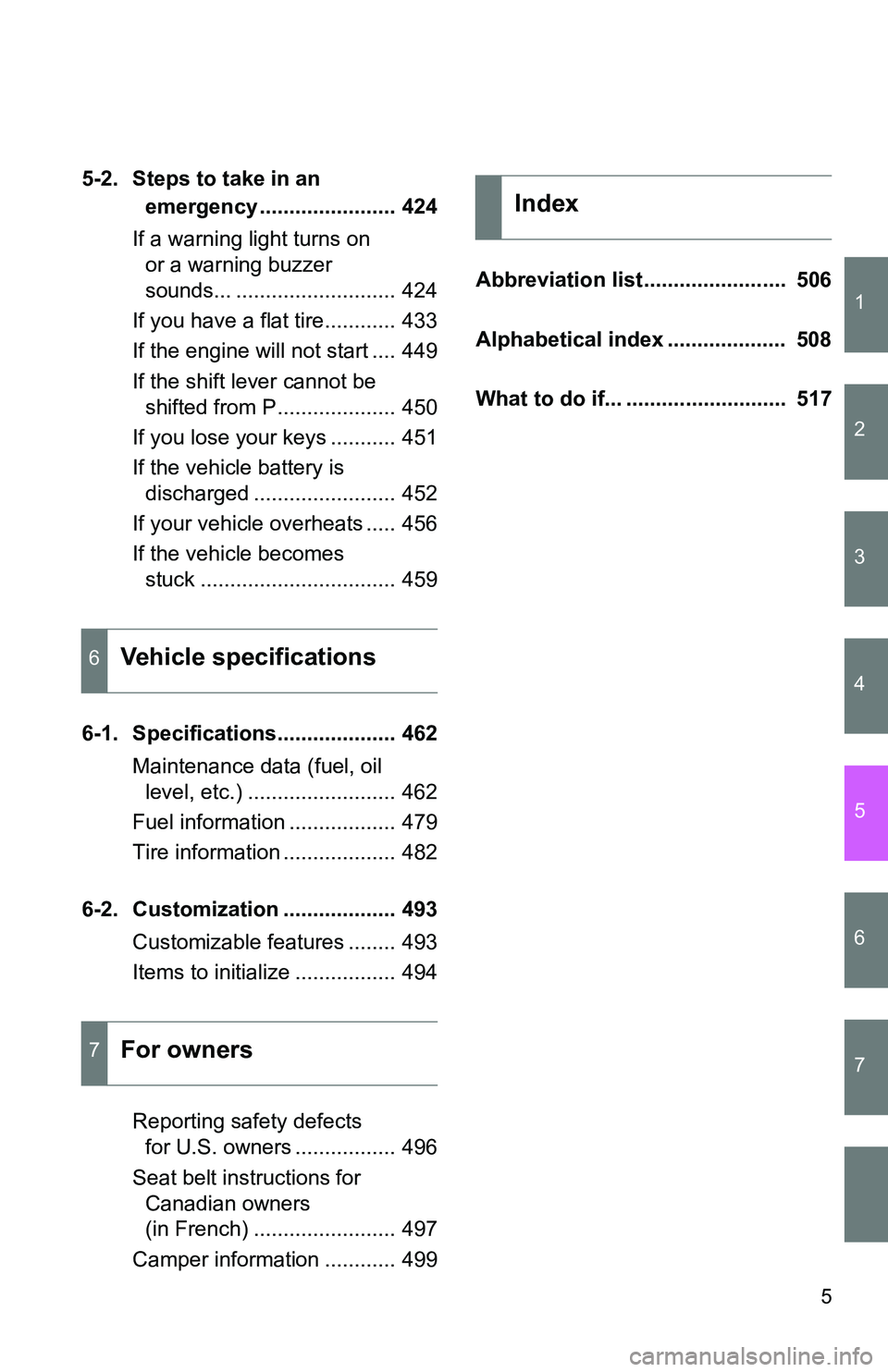
5-2. Steps to take in an emergency ....................... 424
If a warning light turns on or a warning buzzer
sounds... ........................... 424
If you have a flat tire............ 433
If the engine will not start .... 449
If the shift lever cannot be shifted from P.................... 450
If you lose your keys ........... 451
If the vehicle battery is discharged ........................ 452
If your vehicle overheats ..... 456
If the vehicle becomes stuck ................................. 459
6-1. Specifications.................... 462 Maintenance data (fuel, oil level, etc.) ......................... 462
Fuel information .................. 479
Tire information ................... 482
6-2. Customization ................... 493 Customizable features ........ 493
Items to initialize ................. 494
Reporting safety defects for U.S. owners ................. 496
Seat belt instructions for Canadian owners
(in French) ........................ 497
Camper information ............ 499 Abbreviation list ........................ 506
Alphabetical index .................... 508
What to do if... ........................... 517
6Vehicle specifications
7For owners
Index
Page 76 of 520
76
1-6. Theft deterrent system
Engine immobilizer system (if equipped)
■System maintenance
The vehicle has a maintenance-free type of engine immobilizer system.
■ Conditions that may cause the system to malfunction
●If the key is in contact with a metallic object
● If the key is in close proximity to or touching a key to the security system
(key with a built-in transponder chip) of another vehicle
■ Certifications for the engine immobilizer system
For vehicles sold in U.S.A.
FCC ID: MOZRI-21BTY
This device complies with Part 15 of the FCC Rules. Operation is subject to
the following two conditions: (1) this device may not cause harmful interfer-
ence, and (2) this device must accept any interference received, including
interference that may cause undesired operation.
FCC WARNING:
Changes or modifications not expressly approved by the party responsible
for compliance could void the user’s authority to operate the equipment.
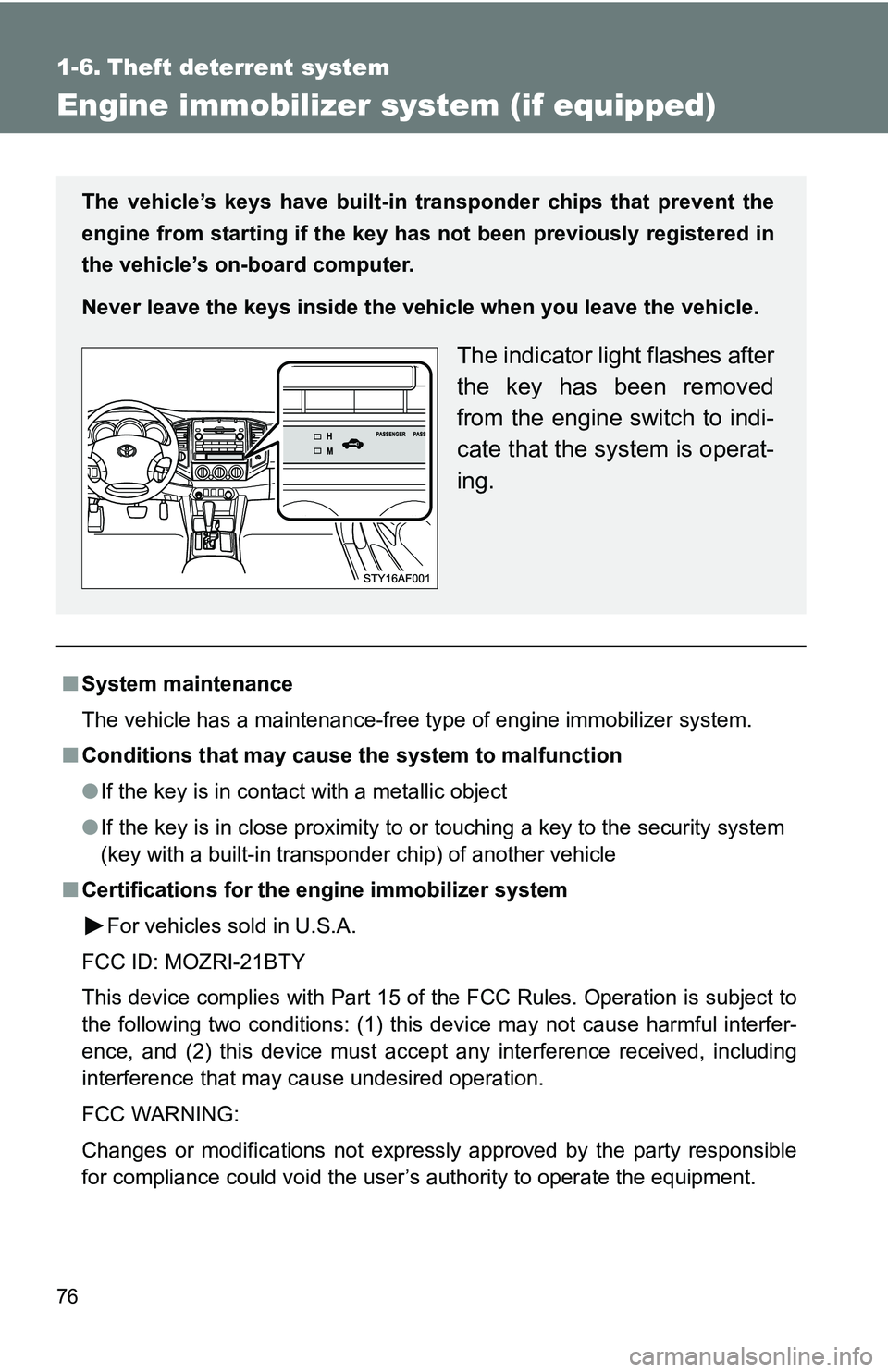
The vehicle’s keys have built-in tr ansponder chips that prevent the
engine from starting if the key has not been previously registered in
the vehicle’s on-board computer.
Never leave the keys inside the vehicle when you leave the vehicle.
The indicator light flashes after
the key has been removed
from the engine switch to indi-
cate that the system is operat-
ing.
Page 194 of 520
194 2-5. Driving information
NOTICE
■To prevent the water damage
●Take all necessary safety measures to ensure that water damage to the
engine or other components does not occur.
● Water entering the engine air intake will cause severe engine damage.
● Water entering the automatic transmission will cause deterioration in shift
quality, locking up of your transmission accompanied by vibration, and ulti-
mately damage.
● Water can wash the grease from wheel bearings, causing rusting and pre-
mature failure, and may also enter the differentials, transmission and
transfer case, reducing the gear oil’s lubricating qualities.
■ When you drive through water
If driving through water, such as when crossing shallow streams, first check
the depth of the water and the bottom of the river bed for firmness. Drive
slowly and avoid deep water.
■ Inspection after off-road driving
●Sand and mud that has accumulate d in brake drums and around brake
discs may affect braking efficiency and may damage brake system compo-
nents.
● Always perform a maintenance inspection after each day of off-road driv-
ing that has taken you through rough terrain, sand, mud, or water. For
scheduled maintenance information, refer to the “Scheduled Maintenance
Guide” or “Owner’s Manual Supplement”.
Page 212 of 520
212 2-5. Driving information
■Maintenance
●If you tow a trailer, your vehicle will require more frequent maintenance
due to the additional load. (See “Scheduled Maintenance Guide” or
“Owner’s Manual Supplement”.)
● Retighten the fixing bolts of the towing ball and bracket after approxi-
mately 600 miles (1000 km).
CAUTION
■To avoid accident or injury
●The gross trailer weight (trailer weight plus the weight of cargo) mus\
t not
exceed the following.
Without towing package 3500 lb. (1587 kg)
With towing package 6500 lb. (2948 kg)
● The gross trailer weight (trailer weight plus cargo weight) when towing with
the bumper must not exceed 3500 lb. (1587 kg).
● If the trailer and cargo weight is over 2000 lb. (907 kg), use a sway control
device with sufficient capacity.
● The combination of the gross trailer weight added to the total weight of the
vehicle, occupants and vehicle cargo must not exceed a total of the follow-
ing.
2WD models except PreRunner 7500 lb. (3402 kg)
4WD models and PreRunner 2.7 L 4-cylinder (2TR-FE) engine: 8000 lb. (3628 kg)
4.0 L V6 (1GR-FE) engine:
• Without towing package 8100 lb. (3674 kg)
• With towing package 11100 lb. (5034 kg)
Page 337 of 520
Maintenance and care4
337
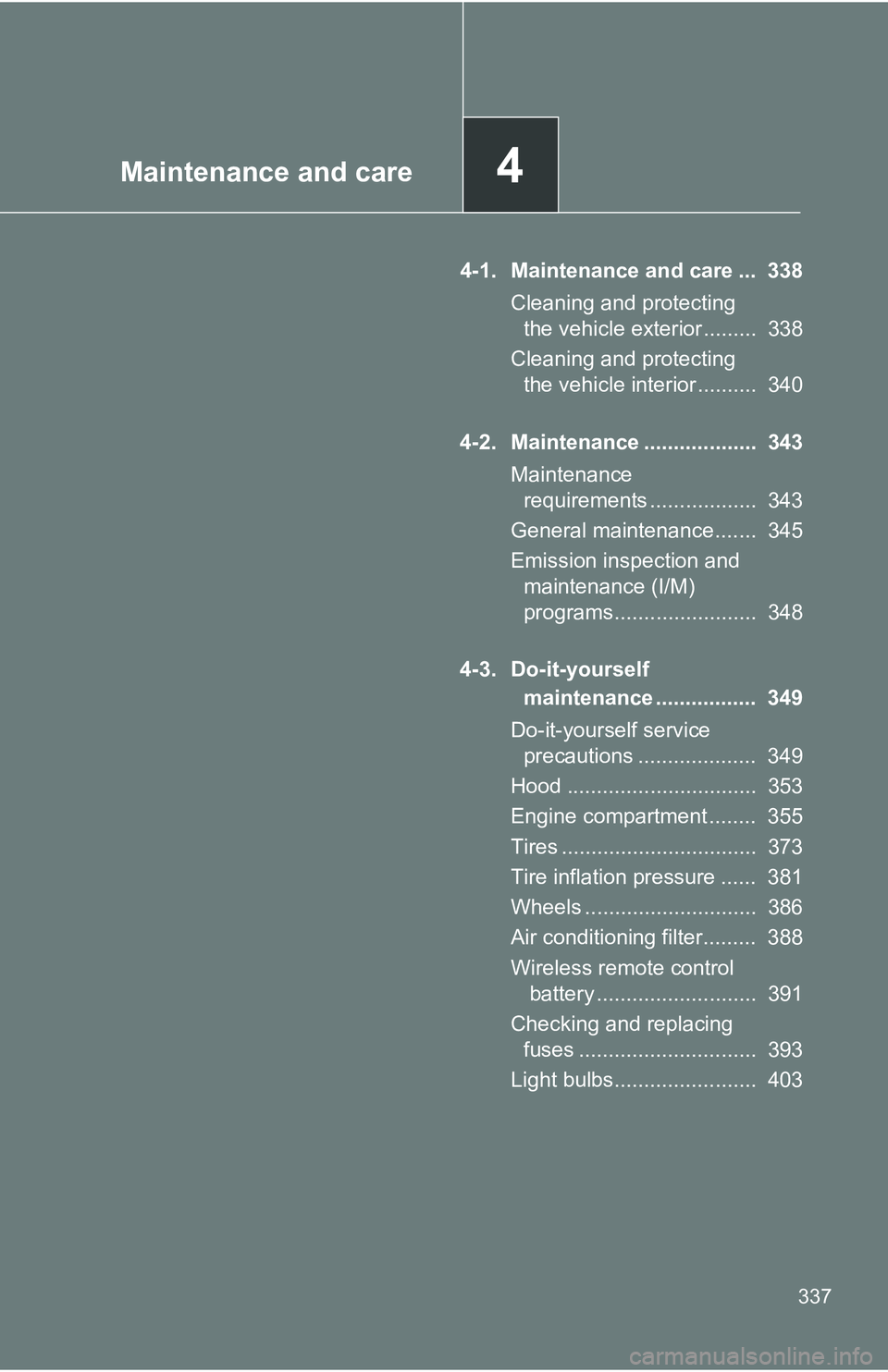
4-1. Maintenance and care ... 338Cleaning and protecting the vehicle exterior ......... 338
Cleaning and protecting the vehicle interior .......... 340
4-2. Maintenance ................... 343 Maintenance requirements .................. 343
General maintenance....... 345
Emission inspection and maintenance (I/M)
programs........................ 348
4-3. Do-it-yourself maintenance ................. 349
Do-it-yourself service precautions .................... 349
Hood ................................ 353
Engine compartment ........ 355
Tires ................................. 373
Tire inflation pressure ...... 381
Wheels ............................. 386
Air conditioning filter......... 388
Wireless remote control battery ........................... 391
Checking and replacing fuses .............................. 393
Light bulbs........................ 403
Page 338 of 520
338
4-1. Maintenance and care
Cleaning and protecting the vehicle exterior
■Automatic car washes
●Before washing the vehicle, do the following.
• Fold the mirrors back.
• Remove the antenna.
● Brushes used in automatic car washes may scratch the vehicle surface
and harm your vehicle’s paint.
■ High pressure car washes
Do not allow the nozzles of the car wash to come within close proximity \
of
the windows. Before entering an automatic car wash, check that the fuel filler
door on your vehicle is closed properly.
■ Aluminum wheels (if equipped)
Remove any dirt immediately by using a neutral detergent. Do not use har\
d
brushes or abrasive cleaners. Do not use strong or harsh chemical cleaners.
Use the same mild detergent and wax as used on the paint.
■ Bumpers and side moldings
Do not scrub with abrasive cleaners.
Perform the following to protect the vehicle and maintain it in prime
condition.
● Working from top to bottom, liber ally apply water to the vehicle
body, wheel wells and underside of the vehicle to remove any
dirt and dust.
Wash the vehicle body using a sponge or soft cloth, such as a
chamois.
● For hard-to-remove marks, use car wash soap and rinse thor-
oughly with water.
● Wipe away any water.
● Wax the vehicle when the waterproof coating deteriorates.
If water does not bead on a clean surface, apply wax when the vehicle
body is cool.
Page 339 of 520
339
4-1. Maintenance and care
4
Maintenance and care
■
To prevent deteriorati on and body corrosion
● Wash the vehicle immediately in the following cases:
• After driving near the sea coast
• After driving on salted roads
• If you see coal tar or tree sap on the paint surface
• If you see dead insects or insect droppings on the paint
• After driving in an area contaminated with soot, oily smoke, mine dust,
iron powder or chemical substances
• If the vehicle becomes heavily soiled in dust or mud
• If liquids such as benzene and gasoline are spilled on the paint surface
● If the paint is chipped or scratched, have it repaired immediately.
CAUTION
■Caution about the exhaust pipe
Exhaust gasses cause the exhaust pipe to become quite hot.
When washing the vehicle, be careful not to touch the pipe until it has cooled
sufficiently, as touching a hot exhaust pipe can cause burns.
NOTICE
■To protect your vehicle’s painted surfaces
Do not use organic cleaners such as benzene or gasoline.
■ Cleaning the exterior lights
●Wash carefully. Do not use organic substances or scrub with a hard brush.
This may damage the surfaces of the lights.
● Do not apply wax on the surfaces of the lights.
Wax may cause damage to the lenses.
Page 340 of 520
340
4-1. Maintenance and care
Cleaning and protecting the vehicle interior
■Caring for leather areas
Toyota recommends cleaning the interior of the vehicle at least twice a year
to maintain the quality of the vehicle’s interior.
The following procedures will help pr otect your vehicle’s interior and
keep it in top condition:
■ Protecting the vehicle interior
Remove dirt and dust using a vacuum cleaner. Wipe dirty sur-
faces with a cloth dampened with lukewarm water.
■ Cleaning the leather areas
●Remove dirt and dust using a vacuum cleaner.
● Wipe any excess dirt and dust with a soft cloth dampened with
diluted detergent.
Use a diluted water solution of approximately 5% neutral wool deter-
gent.
●Wring out any excess water from the cloth and thoroughly
wipe off all remaining traces of detergent.
● Wipe the surface with a dry, soft cloth to remove any remain-
ing moisture. Allow the leather to dry in a shaded and venti-
lated area.
■ Synthetic leather areas
●Remove loose dirt using a vacuum cleaner.
● Apply a mild soap solution to the synthetic leather using a
sponge or soft cloth.
● Allow the solution to soak in for a few minutes. Remove the
dirt and wipe off the solution with a clean, damp cloth.