fuel pressure TOYOTA TACOMA 2009 Owners Manual (in English)
[x] Cancel search | Manufacturer: TOYOTA, Model Year: 2009, Model line: TACOMA, Model: TOYOTA TACOMA 2009Pages: 520, PDF Size: 10.75 MB
Page 4 of 520
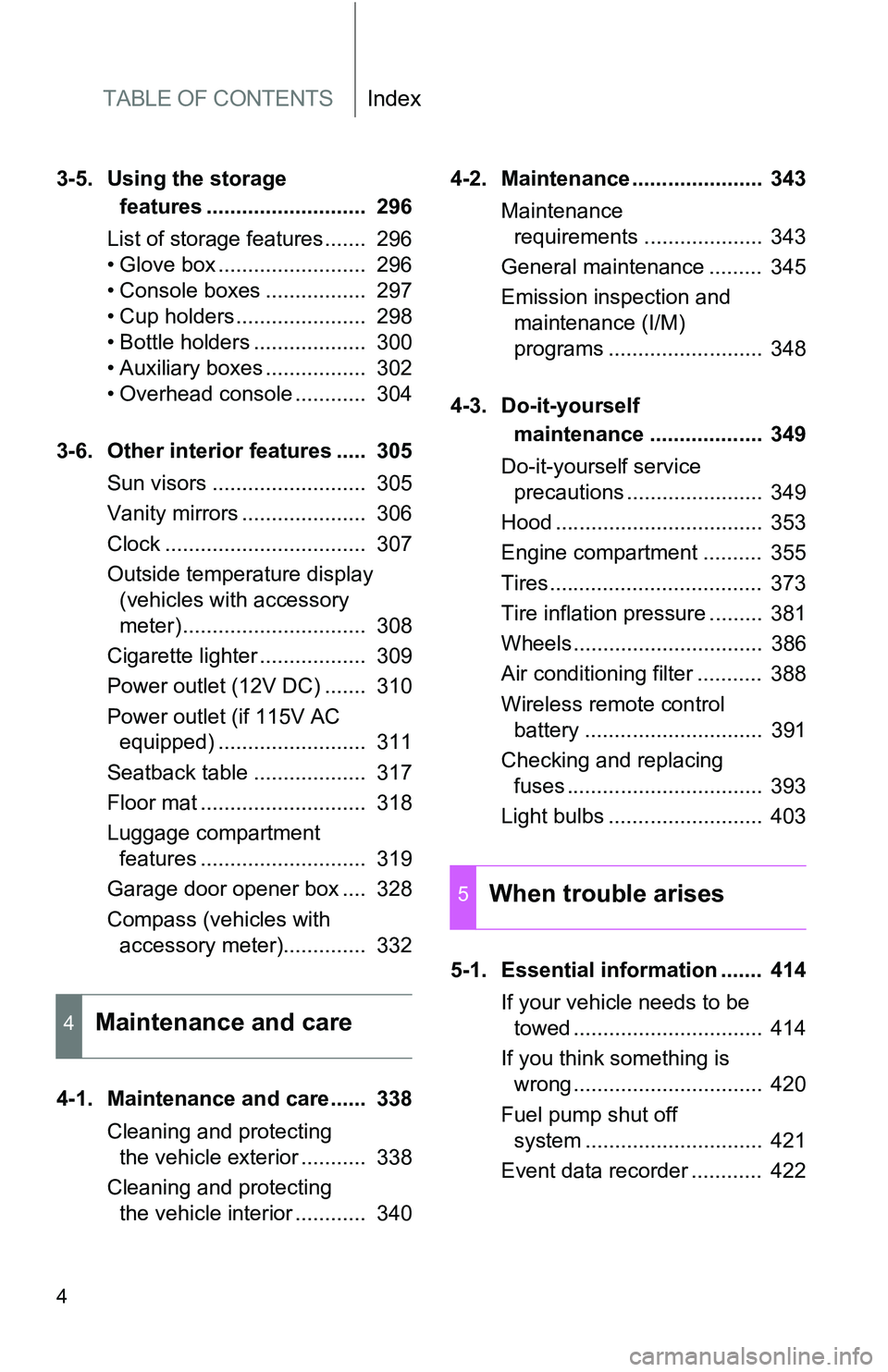
TABLE OF CONTENTSIndex
4
3-5. Using the storage features ........................... 296
List of storage features....... 296
• Glove box ......................... 296
• Console boxes ................. 297
• Cup holders ...................... 298
• Bottle holders ................... 300
• Auxiliary boxes ................. 302
• Overhead console ............ 304
3-6. Other interior features ..... 305 Sun visors .......................... 305
Vanity mirrors ..................... 306
Clock .................................. 307
Outside temperature display (vehicles with accessory
meter) ............................... 308
Cigarette lighter .................. 309
Power outlet (12V DC) ....... 310
Power outlet (if 115V AC equipped) ......................... 311
Seatback table ................... 317
Floor mat ............................ 318
Luggage compartment features ............................ 319
Garage door opener box .... 328
Compass (vehicles with accessory meter).............. 332
4-1. Maintenance and care...... 338 Cleaning and protecting the vehicle exterior ........... 338
Cleaning and protecting the vehicle interior ............ 340 4-2. Maintenance ...................... 343
Maintenance requirements .................... 343
General maintenance ......... 345
Emission inspection and maintenance (I/M)
programs .......................... 348
4-3. Do-it-yourself maintenance ................... 349
Do-it-yourself service precautions ....................... 349
Hood ................................... 353
Engine compartment .......... 355
Tires.................................... 373
Tire inflation pressure ......... 381
Wheels................................ 386
Air conditioning filter ........... 388
Wireless remote control battery .............................. 391
Checking and replacing fuses ................................. 393
Light bulbs .......................... 403
5-1. Essential information ....... 414 If your vehicle needs to be towed ................................ 414
If you think something is wrong ................................ 420
Fuel pump shut off system .............................. 421
Event data recorder ............ 422
4Maintenance and care
5When trouble arises
Page 7 of 520
7
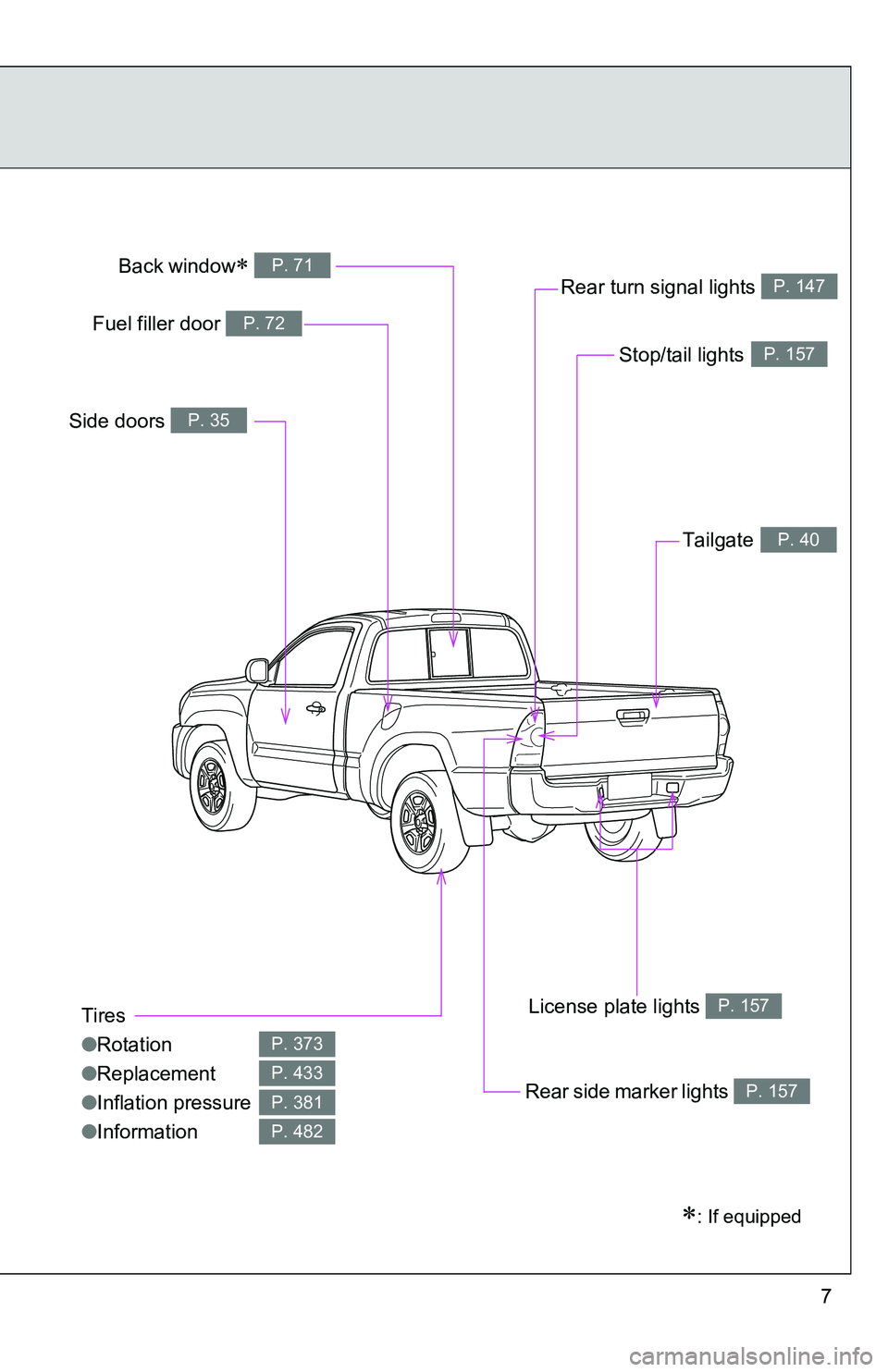
Tires
●Rotation
● Replacement
● Inflation pressure
● Information
P. 373
P. 433
P. 381
P. 482
Fuel filler door P. 72
Rear turn signal lights P. 147
Rear side marker lightsP. 157
Side doors P. 35
Stop/tail lightsP. 157
TailgateP. 40
License plate lights P. 157
Back window P. 71
: If equipped
Page 9 of 520
9
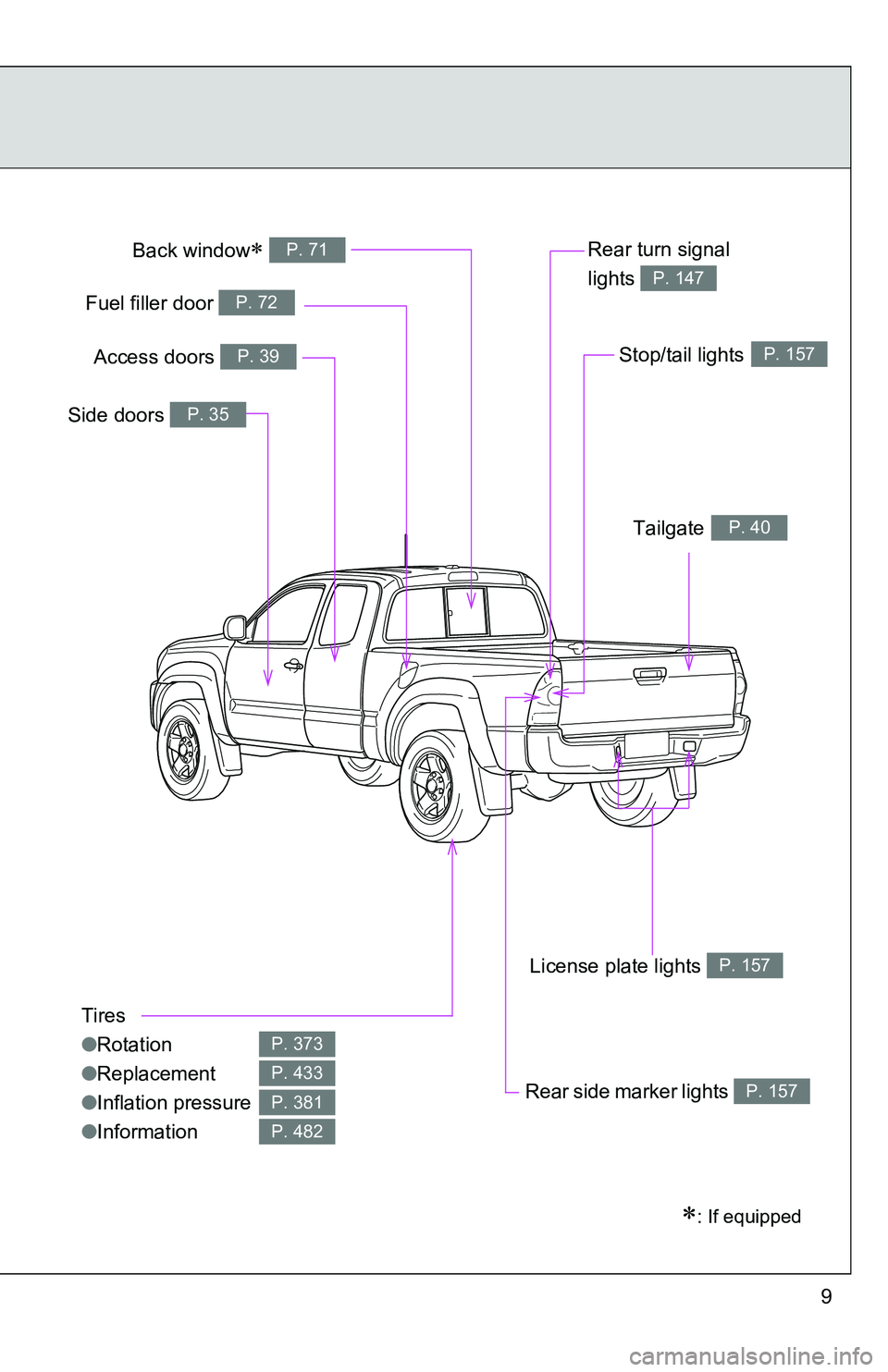
Tires
●Rotation
● Replacement
● Inflation pressure
● Information
P. 373
P. 433
P. 381
P. 482
Fuel filler door P. 72
Rear turn signal
lights
P. 147
Rear side marker lightsP. 157
Side doors P. 35
: If equipped
Stop/tail lightsP. 157
TailgateP. 40
License plate lights P. 157
Access doors P. 39
Back window P. 71
Page 11 of 520

11
Tires
●Rotation
● Replacement
● Inflation pressure
● Information
P. 373
P. 433
P. 381
P. 482
Fuel filler door P. 72Rear turn signal
lights
P. 147
Rear side marker lightsP. 157
Side doors P. 35
: If equipped
Stop/tail lightsP. 157
TailgateP. 40
License plate lights P. 157
Back window P. 71
Page 338 of 520
338
4-1. Maintenance and care
Cleaning and protecting the vehicle exterior
■Automatic car washes
●Before washing the vehicle, do the following.
• Fold the mirrors back.
• Remove the antenna.
● Brushes used in automatic car washes may scratch the vehicle surface
and harm your vehicle’s paint.
■ High pressure car washes
Do not allow the nozzles of the car wash to come within close proximity \
of
the windows. Before entering an automatic car wash, check that the fuel filler
door on your vehicle is closed properly.
■ Aluminum wheels (if equipped)
Remove any dirt immediately by using a neutral detergent. Do not use har\
d
brushes or abrasive cleaners. Do not use strong or harsh chemical cleaners.
Use the same mild detergent and wax as used on the paint.
■ Bumpers and side moldings
Do not scrub with abrasive cleaners.
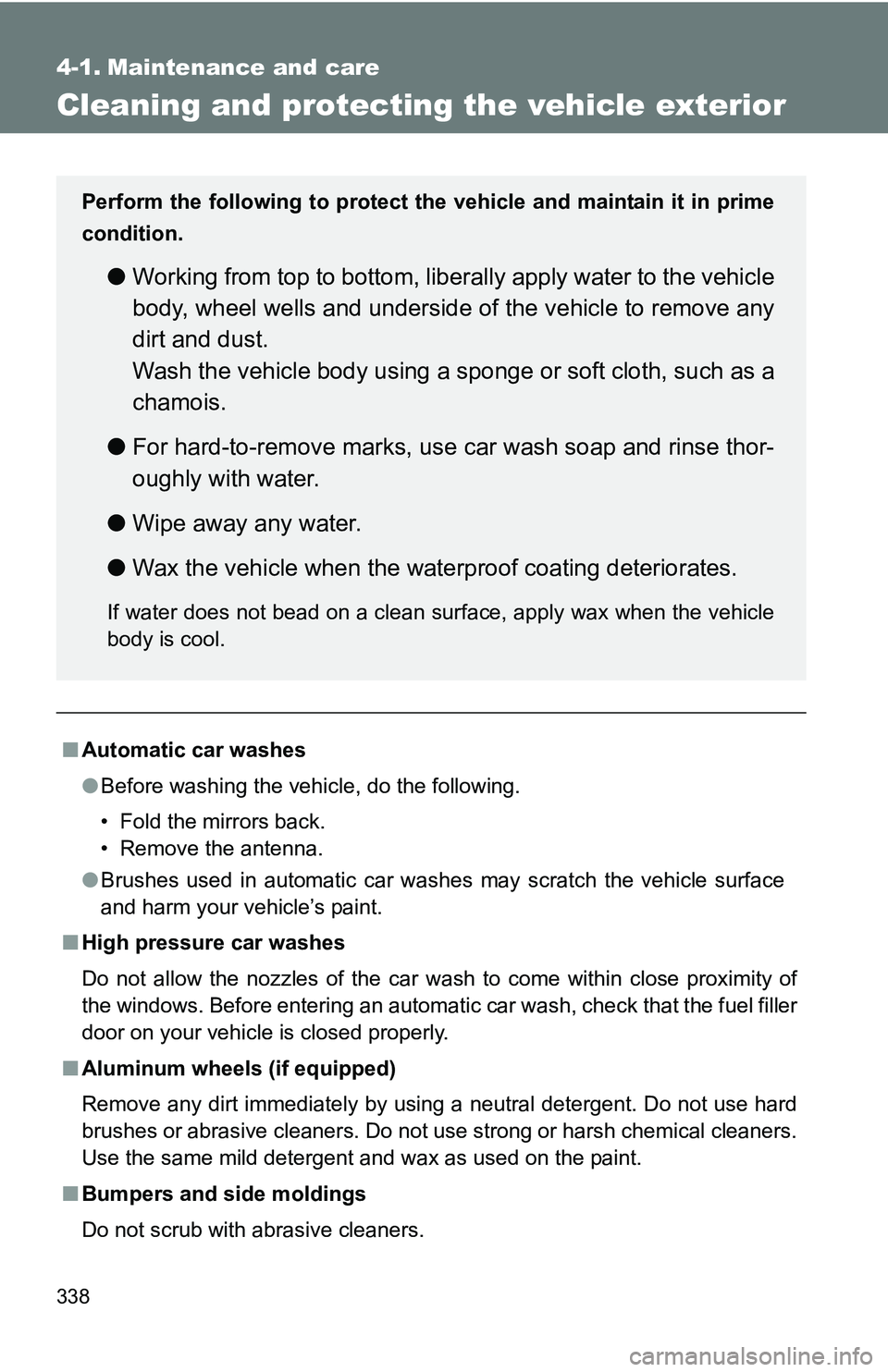
Perform the following to protect the vehicle and maintain it in prime
condition.
● Working from top to bottom, liber ally apply water to the vehicle
body, wheel wells and underside of the vehicle to remove any
dirt and dust.
Wash the vehicle body using a sponge or soft cloth, such as a
chamois.
● For hard-to-remove marks, use car wash soap and rinse thor-
oughly with water.
● Wipe away any water.
● Wax the vehicle when the waterproof coating deteriorates.
If water does not bead on a clean surface, apply wax when the vehicle
body is cool.
Page 384 of 520
384 4-3. Do-it-yourself maintenance
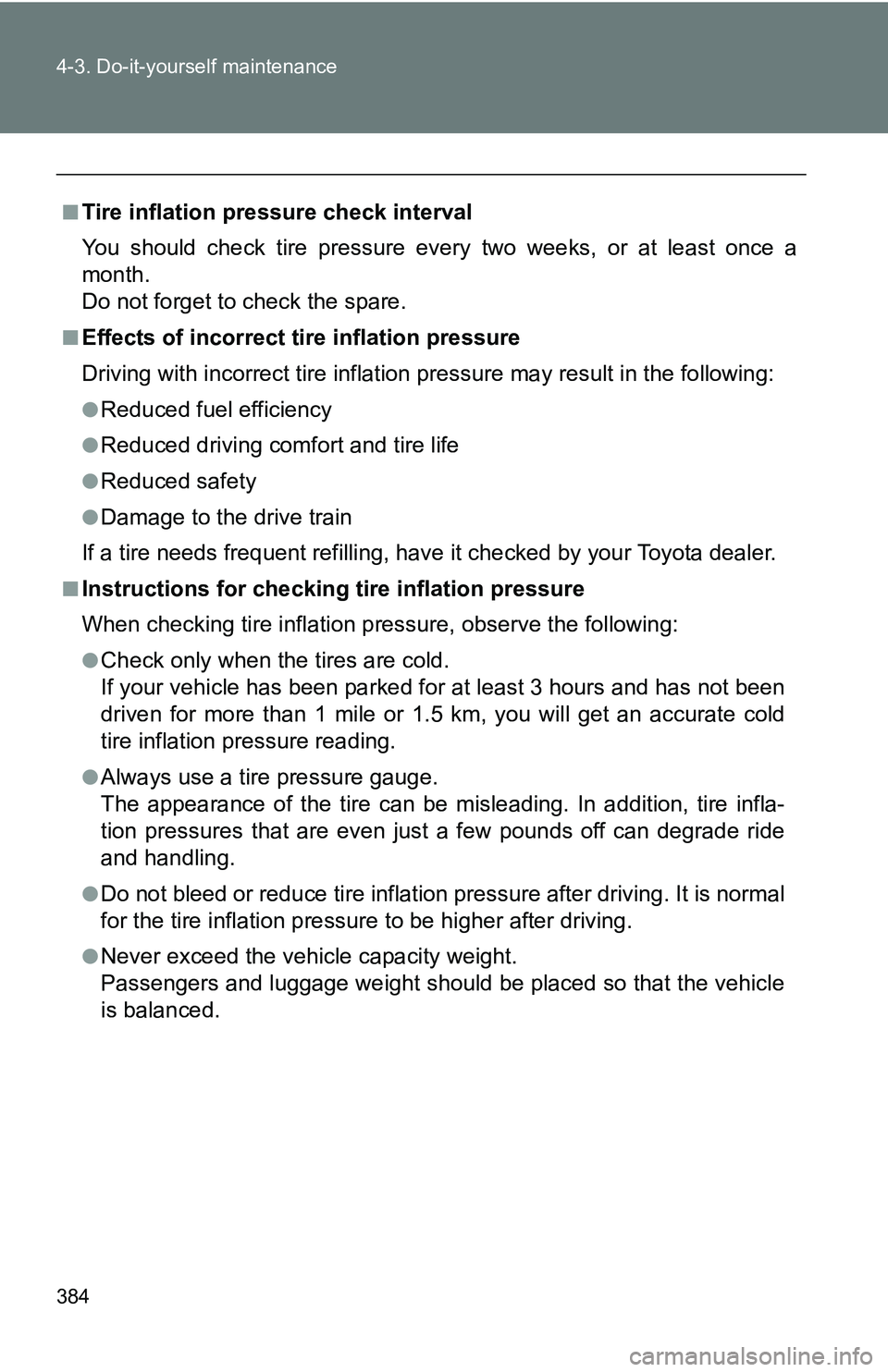
■Tire inflation pressure check interval
You should check tire pressure every two weeks, or at least once a
month.
Do not forget to check the spare.
■Effects of incorrect tire inflation pressure
Driving with incorrect tire inflation pressure ma y result in the following:
●Reduced fuel efficiency
●Reduced driving comfort and tire life
●Reduced safety
●Damage to the drive train
If a tire needs frequent re filling, have it checked by your Toyota dealer.
■Instructions for checking tire inflation pressure
When checking tire inflation pressure, observe the following:
●Check only when the tires are cold.
If your vehicle has been parked for at least 3 hours and has not been
driven for more than 1 mile or 1.5 km, you will get an accurate cold
tire inflation pressure reading.
●Always use a tire pressure gauge.
The appearance of the tire can be mi sleading. In addition, tire infla-
tion pressures that are even just a few pounds off can degrade ride
and handling.
●Do not bleed or reduce tire inflation pressure after driving. It is normal
for the tire inflation pressure to be higher after driving.
●Never exceed the vehicle capacity weight.
Passengers and luggage weight should be placed so that the vehicle
is balanced.
Page 401 of 520
401
4-3. Do-it-yourself maintenance
4
Maintenance and care
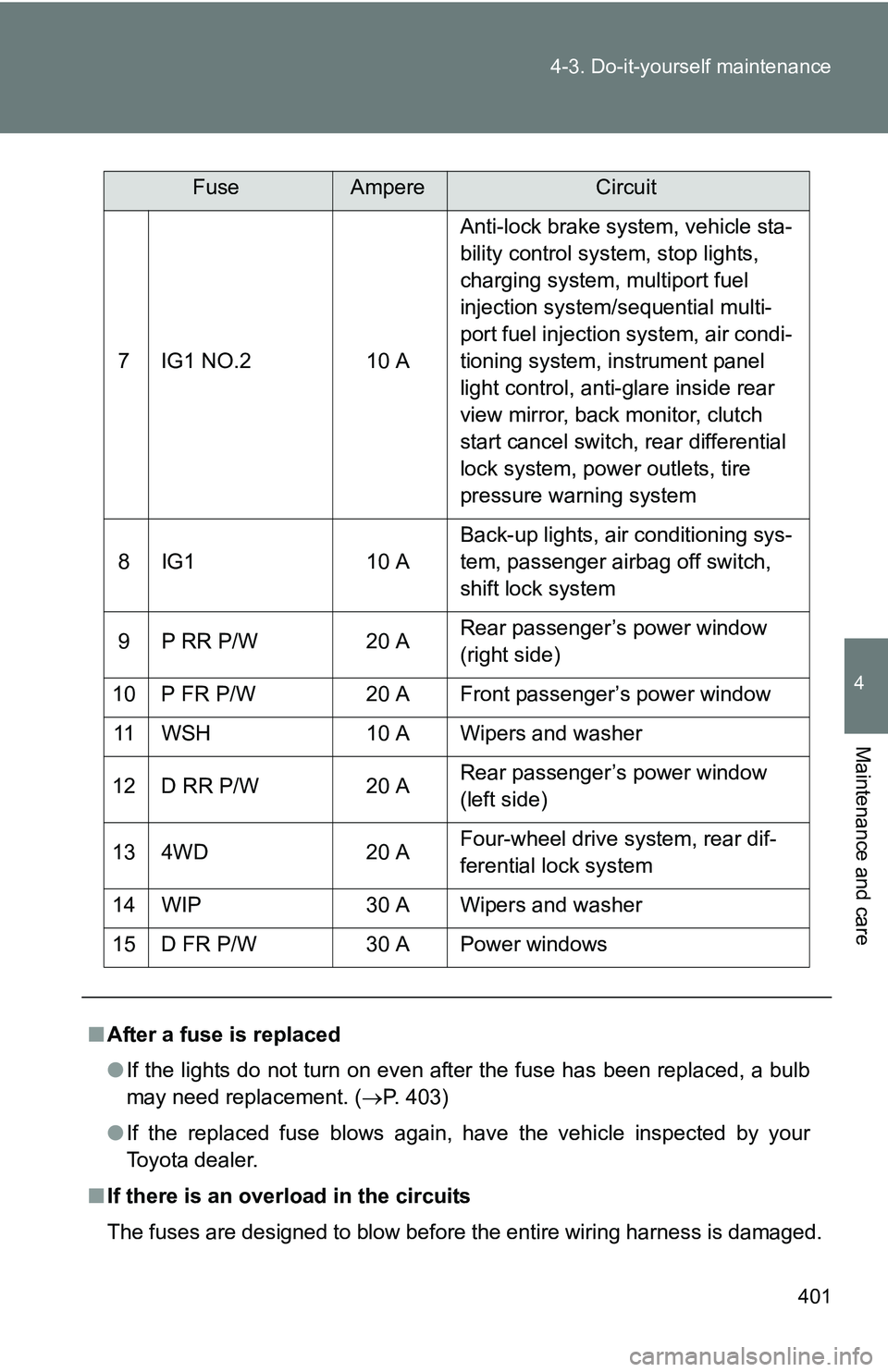
7 IG1 NO.2
10 AAnti-lock brake system, vehicle sta-
bility control system, stop lights,
charging system, multiport fuel
injection system/sequential multi-
port fuel injection system, air condi-
tioning system, instrument panel
light control, anti-glare inside rear
view mirror, back monitor, clutch
start cancel switch, rear differential
lock system, power outlets, tire
pressure warning system
8 IG1 10 ABack-up lights, air conditioning sys-
tem, passenger airbag off switch,
shift lock system
9 P RR P/W 20 ARear passenger’s power window
(right side)
10 P FR P/W 20 A Front passenger’s power window
11 WSH 10 A Wipers and washer
12 D RR P/W 20 ARear passenger’s power window
(left side)
13 4WD 20 AFour-wheel drive system, rear dif-
ferential lock system
14 WIP 30 A Wipers and washer
15 D FR P/W 30 A Power windows
■ After a fuse is replaced
●If the lights do not turn on even after the fuse has been replaced, a bulb
may need replacement. ( P. 403)
● If the replaced fuse blows again, have the vehicle inspected by your
Toyota dealer.
■ If there is an overload in the circuits
The fuses are designed to blow before the entire wiring harness is damaged.
FuseAmpereCircuit
Page 427 of 520
5
When trouble arises
427
5-2. Steps to take in an emergency
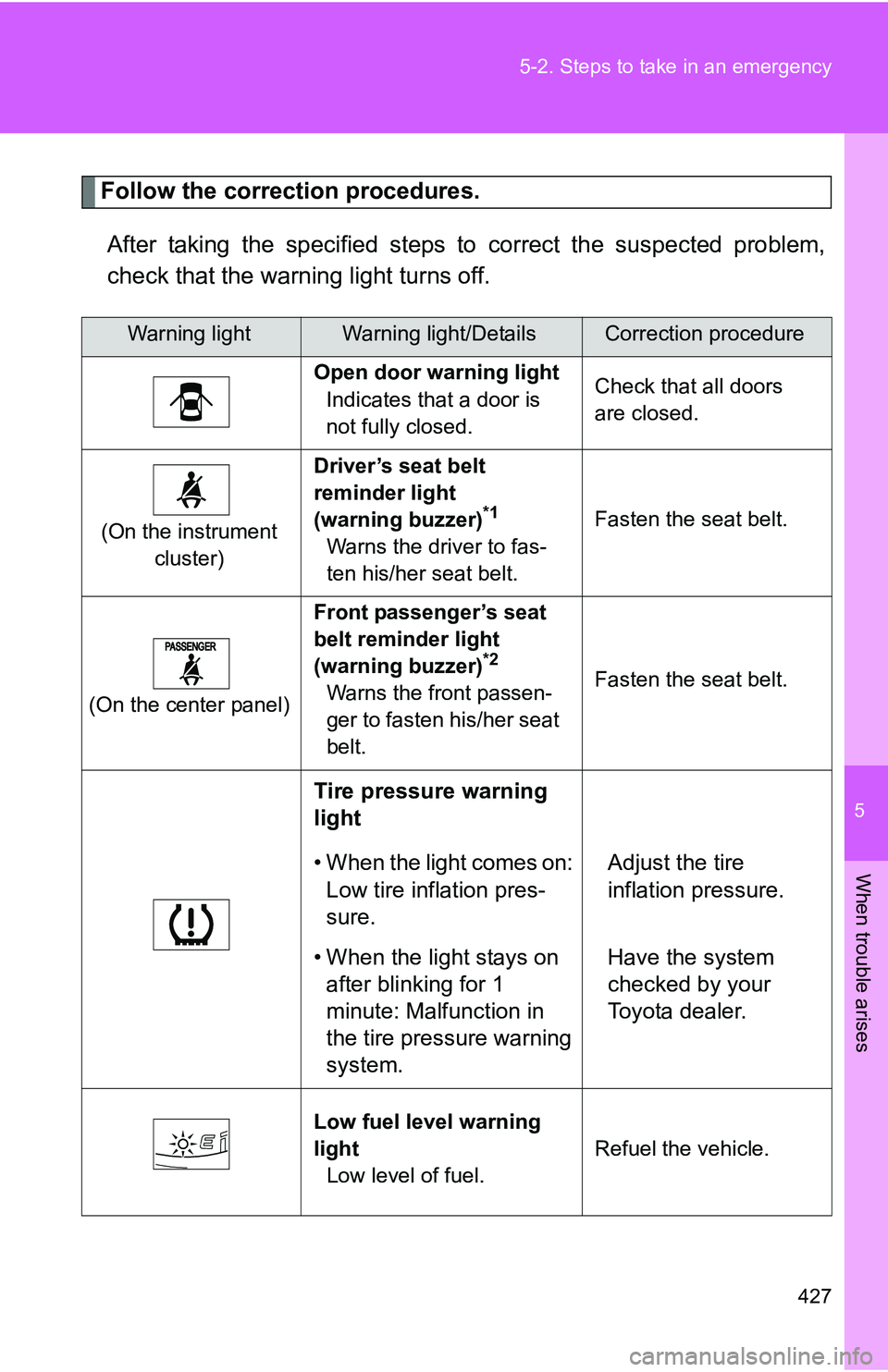
Follow the correction procedures.
After taking the specified steps to correct the suspected problem,
check that the warning light turns off.
Warning lightWarning light/DetailsCorrection procedure
Open door warning light Indicates that a door is
not fully closed. Check that all doors
are closed.
(On the instrument cluster) Driver’s seat belt
reminder light
(warning buzzer)
*1
Warns the driver to fas-
ten his/her seat belt.
Fasten the seat belt.
(On the center panel) Front passenger’s seat
belt reminder light
(warning buzzer)
*2
Warns the front passen-
ger to fasten his/her seat
belt.
Fasten the seat belt.
Tire pressure warning
light
• When the light comes on:
Low tire inflation pres-
sure. Adjust the tire
inflation pressure.
• When the light stays on after blinking for 1
minute: Malfunction in
the tire pressure warning
system. Have the system
checked by your
Toyota dealer.
Low fuel level warning
light
Low level of fuel. Refuel the vehicle.
Page 429 of 520
5
When trouble arises
429
5-2. Steps to take in an emergency
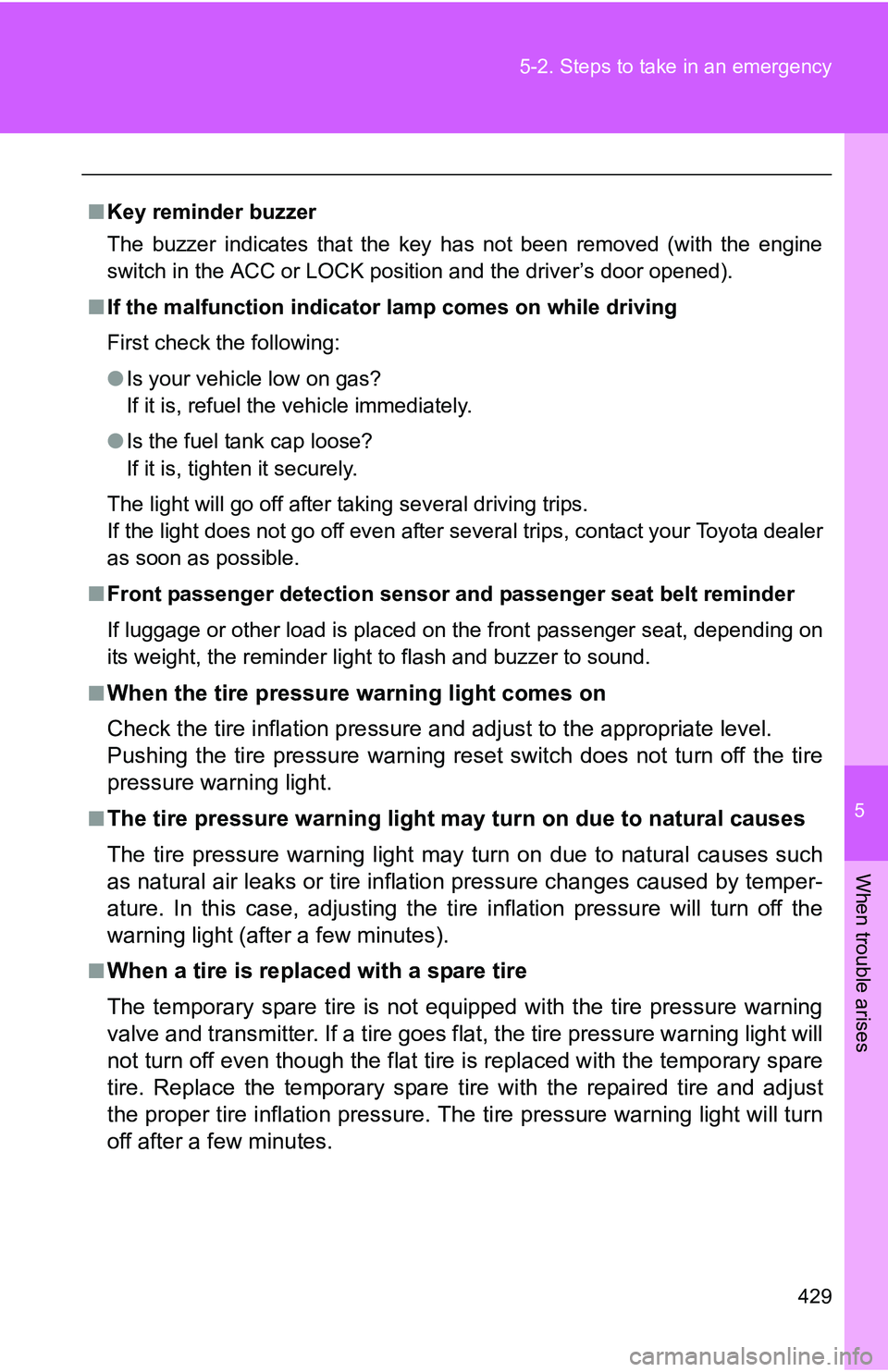
■
Key reminder buzzer
The buzzer indicates that the key has not been removed (with the engine
switch in the ACC or LOCK position and the driver’s door opened).
■ If the malfunction indicator lamp comes on while driving
First check the following:
● Is your vehicle low on gas?
If it is, refuel the vehicle immediately.
● Is the fuel tank cap loose?
If it is, tighten it securely.
The light will go off after taking several driving trips.
If the light does not go off even after several trips, contact your Toyota dealer
as soon as possible.
■ Front passenger detection sensor and passenger seat belt reminder
If luggage or other load is placed on the front passenger seat, depending on
its weight, the reminder light to flash and buzzer to sound.
■
When the tire pressure warning light comes on
Check the tire inflation pressure and adjust to the appropriate level.
Pushing the tire pressure warning reset switch does not turn off the tire
pressure warning light.
■The tire pressure warning light may turn on due to natural causes
The tire pressure warning light may turn on due to natural causes such
as natural air leaks or tire inflation pressure changes caused by temper-
ature. In this case, adjusting the ti re inflation pressure will turn off the
warning light (after a few minutes).
■When a tire is replaced with a spare tire
The temporary spare tire is not equipped with the tire pressure warning
valve and transmitter. If a tire goes flat, the tire pressure warning light will
not turn off even though the flat tire is replaced with the temporary spare
tire. Replace the temporary spare tire with the repaired tire and adjust
the proper tire inflatio n pressure. The tire pres sure warning light will turn
off after a few minutes.
Page 431 of 520
5
When trouble arises
431
5-2. Steps to take in an emergency
CAUTION
■If the tire pressure warning light comes on
Be sure to observe the following precautions. Failure to do so could
cause loss of vehicle control and result in death or serious injury.
●Stop your vehicle in a safe place as
soon as possible. Adjust the tire
inflation pressure immediately.
●If the tire pressure warning light comes on even after tire inflation pres-
sure adjustment, it is pr obable that you have a flat tire. Check the tires.
If the tire is flat, change to the spare tire and have the flat tire repaired
by the nearest Toyota dealer.
●Avoid abrupt maneuvering and braking. If the vehicle tires deteriorate,
you could lose control of the steering wheel or the brakes.
■If a blowout or sudden air leakage should occur
The tire pressure warning syste m may not activate immediately.
■Maintenance of the tire
Each tire, including the spare (if provided), should be checked monthly
when cold and inflated to the inflation pressure recommended by the
vehicle manufacturer on the vehicle placard or tire inflation pressure
label (tire and load information label). (If your vehicle has tires of a differ-
ent size than the size indicated on the vehicle placard or tire inflation
pressure label [tire and load information label], you should determine the
proper tire inflation pr essure for those tires.)
As an added safety feature, your vehicle has been equipped with a tire
pressure monitoring system (TPMS-ti re pressure warning system) that
illuminates a low tire pressure telltal e (tire pressure warning light) when
one or more of your tires is significantly under-inflated. Accordingly,
when the low tire pressure telltale (tire pre ssure warning light) illumi-
nates, you should stop and check your tires as soon as possible, and
inflate them to the proper pressure. Driving on a significantly under-
inflated tire causes the tire to overheat and can lead to tire failure.
Under-inflation also reduces fuel effi ciency and tire tread life, and may
affect the vehicle’s handling and stopping ability.