warning light TOYOTA TACOMA 2012 Owners Manual (in English)
[x] Cancel search | Manufacturer: TOYOTA, Model Year: 2012, Model line: TACOMA, Model: TOYOTA TACOMA 2012Pages: 628, PDF Size: 12.11 MB
Page 2 of 628

TABLE OF CONTENTSIndex
2
1-1. Key informationKeys ..................................... 34
1-2. Opening, closing and locking
the doors
Wireless remote control ....... 36
Side doors ............................ 39
Access doors (Access Cab models only) ....................... 43
Tailgate ................................ 44
1-3. Adjustable components
(seats, mirrors, steering
wheel)
Front seats ........................... 49
Rear seats (Access Cab and Double Cab models) .......... 54
Head restraints ..................... 58
Seat belts ............................. 63
Steering wheel ..................... 69
Anti-glare inside rear view mirror .................................. 70
Outside rear view mirrors ..... 75
1-4. Opening and clos ing
the windows
Pow er windows .................... 78
Back window (vehicles with sliding type) ........................ 80
1-5. Refueling Opening the fuel tank cap .... 81 1-6. Theft deterrent system
Engine immobilizer system ... 84
1-7. Safety information Correct driving posture ......... 87
SRS airbags ......................... 89
Front passenger occupant classification system ......... 103
Child restraint systems ....... 108
Installing child restraints ..... 112
2-1. Driving procedures Driving the vehicle .............. 132
Engine (ignition) switch....... 143
Automatic transmission ...... 146
Manual transmission........... 150
Turn signal lever ................. 153
Parking brake ..................... 154
Horn .................................... 156
2-2. Gauges and meters Gauges and meters ............ 157
Indicators and warning lights ................................. 160
2-3. Operating the li ghts and
wipers
Headlight switch ................. 164
Fog light switch ................... 167
Windshield wipers and washer .............................. 168
1Before driving
2When driving
Page 5 of 628

1
2
3
4
5
6
7
5
4-3. Do-it-yourself maintenanceDo-it-yourself service precautions ....................... 430
Hood ................................... 434
Engine compartment ........... 436
Tires .................................... 452
Tire inflation pressure ......... 461
Wheels ................................ 466
Air conditioning filter............ 469
Wireless remote control battery ............................... 472
Checking and replacing fuses ................................. 474
Light bulbs........................... 484
5-1. Essential information Emergency flashers ............ 496
If your vehicle needs to be towed ........................... 497
If you think something is wrong ................................ 503
Fuel pump shut off system .............................. 504 5-2. Steps to take in an emergency
If a warning light turns on or a warning buzzer
sounds... .......................... 505
If you have a flat tire ........... 515
If the engine will not start.... 532
If the shift lever cannot be shifted from P (vehicles
with an automatic
transmission) .................... 533
If you lose your keys........... 534
If the vehicle battery is discharged........................ 535
If your vehicle overheats .... 539
If the vehicle becomes stuck ................................. 542
If your vehicle has to be stopped in
an emergency .................. 544
6-1. Specifications Maintenance data (fuel, oil level, etc.) ........... 548
Fuel information.................. 569
Tire information .................. 572
6-2. Customization Customizable features........ 583
Items to initialize ................. 587
5When trouble arises
6Vehicle specifications
Page 67 of 628

67
1-3. Adjustable components (s
eats, mirrors, steering wheel)
1
Before driving
CAUTION
■When children are in the vehicle
Do not allow children to play with the seat belt. If the seat belt becomes
twisted around a child’s neck, it may lead to chocking or other serious inju-
ries that could result in death. If this occurs and the buckle cannot be unfas-
tened, scissors should be used to cut the belt.
■ Adjustable shoulder anchor
Always make sure the shoulder belt is positioned across the center of your
shoulder. The belt should be kept away from your neck, but not falling off
your shoulder. Failure to do so could reduce the amount of protection in an
accident and cause death or serious injuries in the event of a sudden stop,
sudden swerve or accident. ( P. 64)
■ Seat belt pretensioners
●Do not place anything, such as a cushion, on the front passenger’s seat.
Doing so will disperse the passenger’s weight, which prevents the sensor
from detecting the passenger’s weight properly. As a result, the seat belt
pretensioner for the front passenger’s seat may not activate in the event of
a collision.
● If the pretensioner has activated, the SRS warning light will come on. In
that case, the seat belt cannot be used again and must be replaced at
your Toyota dealer.
■ Seat belt damage and wear
●Do not damage the seat belts by allowing the belt, plate, or buckle to be
jammed in the door.
● Inspect the seat belt system periodically. Check for cuts, fraying, and loose
parts. Do not use a damaged seat belt until it is replaced. Damaged seat
belts cannot protect an occupant from death or serious injury.
● Ensure that the belt and tab are locked and the belt is not twisted.
If the seat belt does not function correctly, immediately contact your Toyota
dealer.
● Replace the seat assembly, including the belts, if your vehicle has been
involved in a serious accident, even if there is no obvious damage.
Page 91 of 628
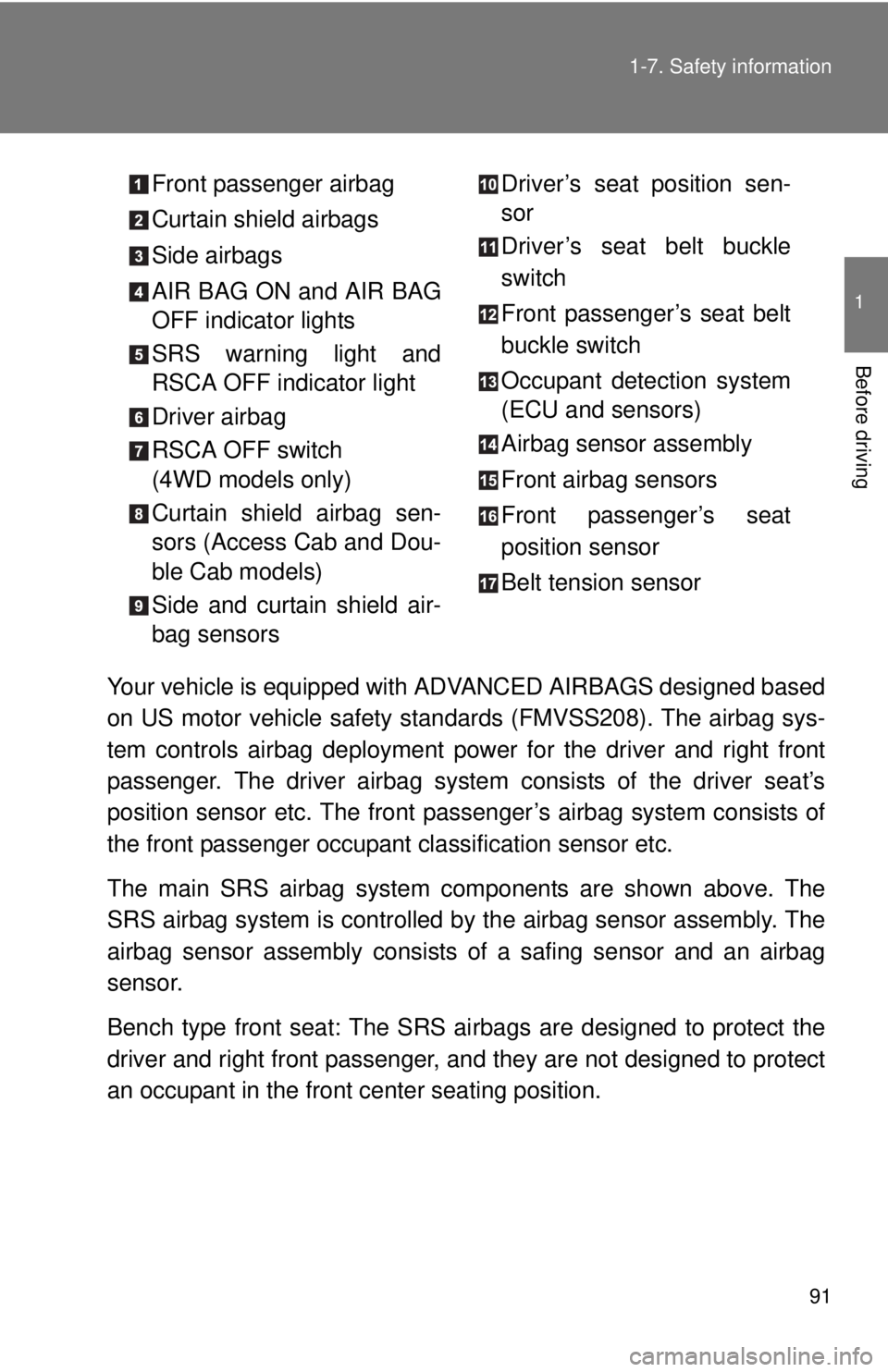
91
1-7. Safety information
1
Before driving
Your vehicle is equipped with
ADVANCED AIRBAGS designed based
on US motor vehicle safety standards (FMVSS208). The airbag sys-
tem controls airbag deployment power for the driver and right front
passenger. The driver airbag system consists of the driver seat’s
position sensor etc. The front pass enger’s airbag system consists of
the front passenger occupant classification sensor etc.
The main SRS airbag system components are shown above. The
SRS airbag system is controlled by the airbag sensor assembly. The
airbag sensor assembly consists of a safing sensor and an airbag
sensor.
Bench type front seat: The SRS ai rbags are designed to protect the
driver and right front passenger, and they are not designed to protect
an occupant in the front center seating position. Front passenger airbag
Curtain shield airbags
Side airbags
AIR BAG ON and AIR BAG
OFF indicator lights
SRS warning light and
RSCA OFF indicator light
Driver airbag
RSCA OFF switch
(4WD models only)
Curtain shield airbag sen-
sors (Access Cab and Dou-
ble Cab models)
Side and curtain shield air-
bag sensors
Driver’s seat position sen-
sor
Driver’s seat belt buckle
switch
Front passenger’s seat belt
buckle switch
Occupant detection system
(ECU and sensors)
Airbag sensor assembly
Front airbag sensors
Front passenger’s seat
position sensor
Belt tension sensor
Page 92 of 628

92 1-7. Safety information
In certain types of severe frontal or side impacts, the SRS airbag sys-
tem triggers the airbag inflators. A chemical reaction in the inflators
quickly fills the airbags with non-toxic gas to help restrain the motion
of the occupants.
■ SRS warning light
This warning light system monitors the airbag sensor assembly, front airbag
sensors, side and curtain shield airbag sensor assemblies, curtain shield air-
bag sensor assemblies (Access Cab and Double cab models), driver’s seat
position sensor, driver’s seat belt buckle switch, front passenger occupant
classification system, AIR BAG ON and AIR BAG OFF indicator lights, front
passenger’s seat position sensor (Bench type seat), front passenger’s seat
belt buckle switch, front seat belt pretensioner assemblies, belt tension sen-
sor (Bench type seat), RSCA OFF indicator light, inflators, interconnecting
wiring and power sources. ( P. 506)
■ If the SRS airbags deploy (inflate)
●Bruising and slight abrasions may result from contact with a deploying
(inflating) SRS airbag.
● A loud noise and white powder will be emitted.
● Parts of the airbag module (steering wheel hub, airbag cover and inflator)
as well as the front seats, and parts of the front and rear pillars and roof
side rail, may be hot for several minutes. The airbag itself may also be
hot.
● The front windshield may crack.
■ Operating conditions (front airbags)
● The SRS front airbag will deploy in the event of an impact that exceeds
the set threshold level (the level of force corresponding to an approxi-
mately 12-18 mph [20-30 km/h] frontal collision with a fixed wall that does
not move or deform).
However, this threshold velocity will be considerably higher if the vehicle
strikes an object, such as a parked vehicle or sign pole, which can move or
deform on impact, or if the vehicle is involved in an underride collision (e.g.
a collision in which the front of the vehicle “underrides”, or goes under, the
bed of a truck, etc.).
Page 103 of 628
103
1
1-7. Safety information
Before driving
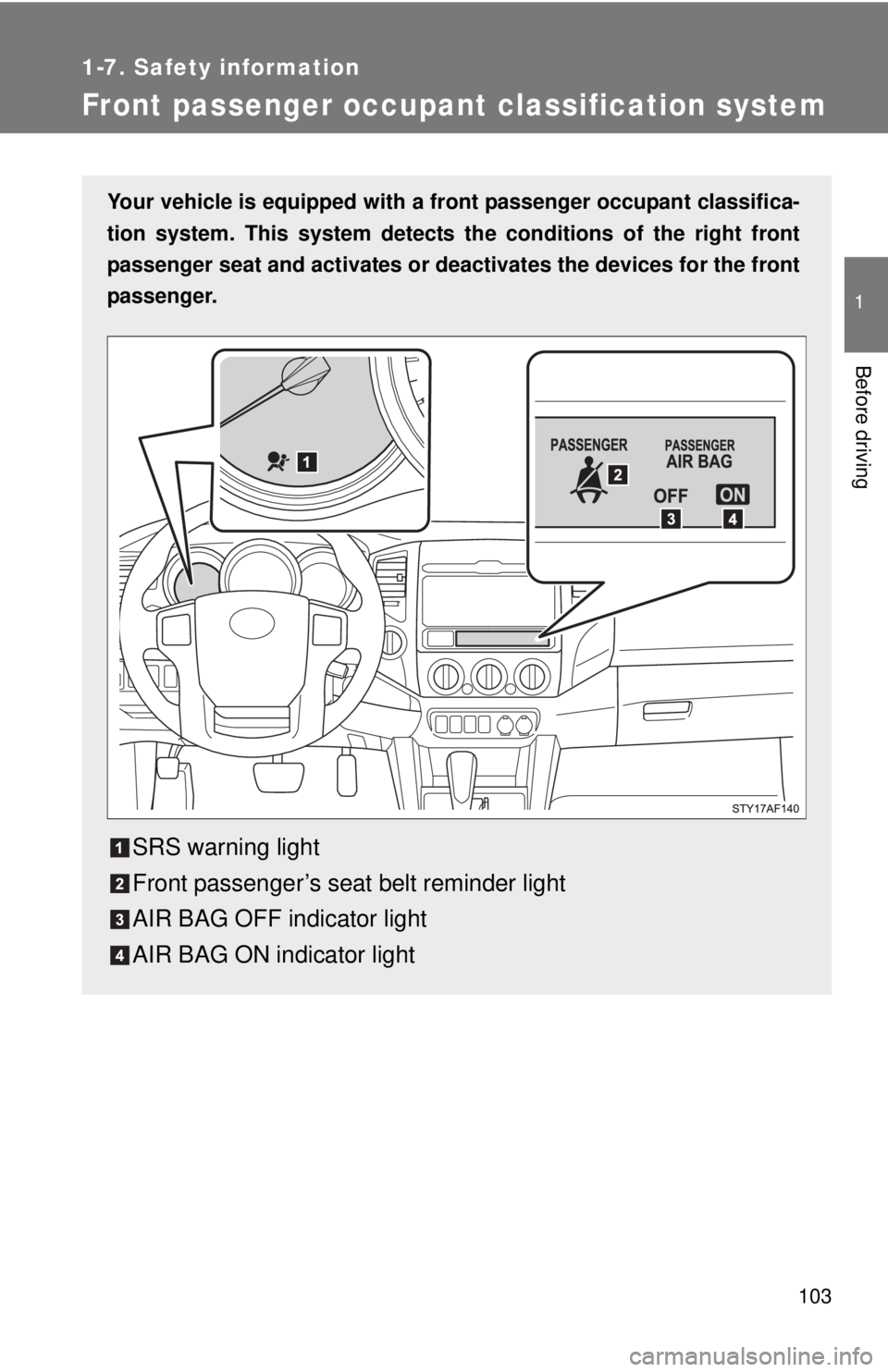
Front passenger occupant classification system
Your vehicle is equipped with a front passenger occupant classifica-
tion system. This system detects the conditions of the right front
passenger seat and activates or deactivates the devices for the front
passenger.
SRS warning light
Front passenger’s seat belt reminder light
AIR BAG OFF indicator light
AIR BAG ON indicator light
Page 104 of 628

104 1-7. Safety information
Conditions and operation of the front passenger occupant
classification system
■ Adult*
1
■Child*3 or child restraint system*4
Indicator/
warning light AIR BAG ON and AIR BAG OFF indica-
tor lights AIR BAG ON
SRS warning light Off
Front passenger’s seat belt reminder light
Flashing*2
Devices Front passenger airbag
Activated
Side airbag on the front passenger seat
Curtain shield airbag in the front passen- ger side
Front passenger’s seat belt pretensioner
Indicator/
warning light AIR BAG ON and AIR BAG OFF indica-
tor lights AIR BAG
OFF*
5
SRS warning light Off
Front passenger’s seat belt reminder light Flashing*
2
DevicesFront passenger airbag Deactivated
Side airbag on the front passenger seat
Activated
Curtain shield airbag in the front passen-
ger side
Front passenger’s seat belt pretensioner
Page 105 of 628

105
1-7. Safety information
1
Before driving
■
Unoccupied
■ There is a malfunction in the system
*
1: The system judges a person of adult size as an adult. When a smaller adult sits in the front passenger seat, the system may rec-
ognize him/her as a child depending on his/her physique and pos-
ture.
*
2: In the event the front passenger does not wear a seat belt.
*
3: When a larger child who has outgrown a child restraint system sits in the front passenger seat, the system may recognize him/
her as an adult depending on his/her physique or posture.
Indicator/
warning light AIR BAG ON and AIR BAG OFF indica-
tor lights Not illumi-
nated
SRS warning light Off
Front passenger’s seat belt reminder
light
Devices Front passenger airbag Deactivated
Side airbag on the front passenger seat Activated
Curtain shield airbag in the front passen-
ger side
Front passenger’s seat belt pretensioner Deactivated
Indicator/
warning light AIR BAG ON and AIR BAG OFF indica-
tor lights AIR BAG
OFF
SRS warning light On
Front passenger’s seat belt reminder light Off
Devices Front passenger airbag Deactivated
Side airbag on the front passenger seat
Activated
Curtain shield airbag in the front passen-
ger side
Front passenger’s seat belt pretensioner
Page 107 of 628

107
1-7. Safety information
1
Before driving
CAUTION
■
Front passenger occupant cl assification system precautions
● Do not recline the front passenger seatback so far that it touches a rear
seat or a back wall. This may cause the AIR BAG OFF indicator light to be
illuminated, which indicates that the passenger’s airbags will not deploy in
the event of a severe accident. If the seatback touches the rear seat or
back wall, return the seatback to a position where it does not touch the
rear seat or back wall. Keep the front passenger seatback as upright as
possible when the vehicle is moving. Reclining the seatback excessively
may lessen the effectiveness of the seat belt system.
● If an adult sits in the front passenger seat, the AIR BAG ON indicator light
is illuminated. If the AIR BAG OFF indicator is illuminated, ask the passen-
ger to sit up straight, well back in the seat, feet on the floor, and with the
seat belt worn correctly. If the AIR BAG OFF indicator still remains illumi-
nated, either ask the passenger to move to the rear seat, or if that is not
possible, move the front passenger seat fully rearward.
● When it is unavoidable to install the forward-facing child restraint system
on the front passenger seat, install the child restraint system on the front
passenger seat in the proper order. ( P. 112)
● Do not modify or remove the front seats.
● Do not kick the front passenger seat or subject it to severe impact. Other-
wise, the SRS warning light may come on to indicate a malfunction of the
detection system. In this case, contact your Toyota dealer immediately.
● Child restraint systems installed on the rear seat should not contact the
front seatbacks.
● Do not use a seat accessory, such as a cushion or seat cover, that covers
the seat cushion surface.
● Access Cab and Double Cab models: Do not attach a commercial seat-
back table or other heavy item to the back of the front passenger seat.
● Do not modify or replace the upholstery of the front seat.
Page 131 of 628
When driving2
131
2-1. Driving proceduresDriving the vehicle............ 132
Engine (ignition) switch .... 143
Automatic transmission .... 146
Manual transmission ........ 150
Turn signal lever .............. 153
Parking brake ................... 154
Horn ................................. 156
2-2. Gauges and meters Gauges and meters ......... 157
Indicators and warning lights .............................. 160
2-3. Operating the lights and wipers
Headlight switch ............... 164
Fog light switch ................ 167
Windshield wipers and washer ........................... 168 2-4. Using other driving systems
Cruise control ................... 174
Rear view monitor system (vehicles with auto
anti-glare inside rear
view mirror) .................... 178
Four-wheel drive system ........................... 186
Active traction control system ........................... 190
AUTO LSD system........... 192
Rear differential lock system ........................... 194
Downhill Assist Control system ........................... 197
Clutch start cancel switch ............................. 199
Driving assist systems ..... 200
2-5. Driving information Off-road precautions (4WD models and
PreRunner) .................... 207
Cargo and luggage .......... 212
Vehicle load limits ............ 217
Winter driving tips ............ 219
Trailer towing ................... 223
Dinghy towing .................. 244