coolant temperature TOYOTA TACOMA 2019 Owners Manual (in English)
[x] Cancel search | Manufacturer: TOYOTA, Model Year: 2019, Model line: TACOMA, Model: TOYOTA TACOMA 2019Pages: 700, PDF Size: 12.83 MB
Page 86 of 700
862. Instrument cluster
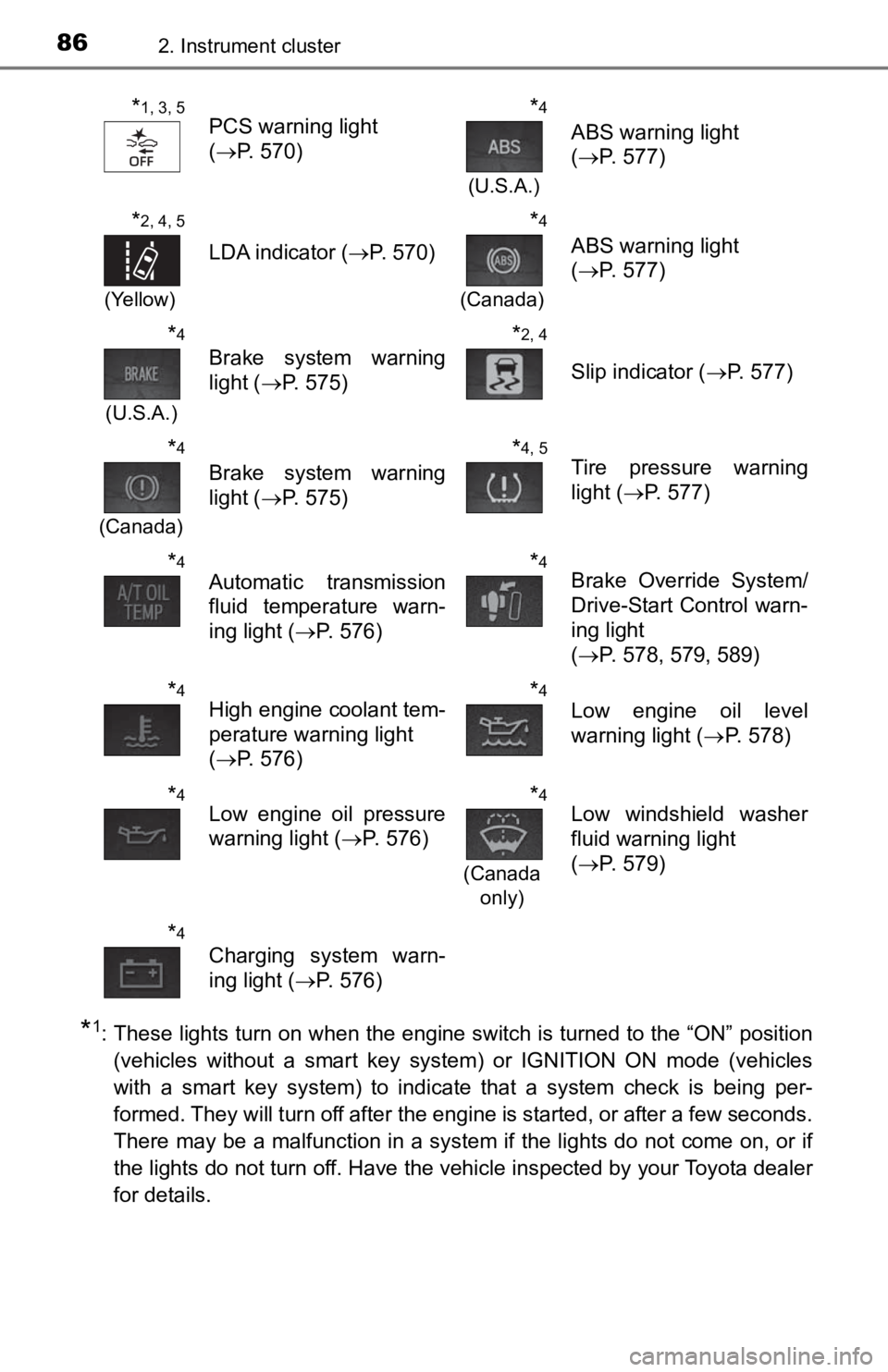
*1: These lights turn on when the engine switch is turned to the “ON” position(vehicles without a smart key system) or IGNITION ON mode (vehi cles
with a smart key system) to indicate that a system check is being per-
formed. They will turn off after the engine is started, or after a few seconds.
There may be a malfunction in a system if the lights do not com e on, or if
the lights do not turn off. Have the vehicle inspected by your Toyota dealer
for details.
*1, 3, 5PCS warning light
( P. 570)*4
(U.S.A.)
ABS warning light
(P. 577)
*2, 4, 5
(Yellow)
LDA indicator ( P. 570)
*4
(Canada)
ABS warning light
(P. 577)
*4
(U.S.A.)
Brake system warning
light ( P. 575)
*2, 4
Slip indicator ( P. 577)
*4
(Canada)
Brake system warning
light (P. 575)
*4, 5Tire pressure warning
light (P. 577)
*4Automatic transmission
fluid temperature warn-
ing light ( P. 576)*4Brake Override System/
Drive-Start Control warn-
ing light
(P. 578, 579, 589)
*4High engine coolant tem-
perature warning light
(P. 576)*4Low engine oil level
warning light ( P. 578)
*4Low engine oil pressure
warning light ( P. 576)*4
(Canada
only)
Low windshield washer
fluid warning light
(P. 579)
*4
Charging system warn-
ing light ( P. 576)
Page 90 of 700
902. Instrument cluster
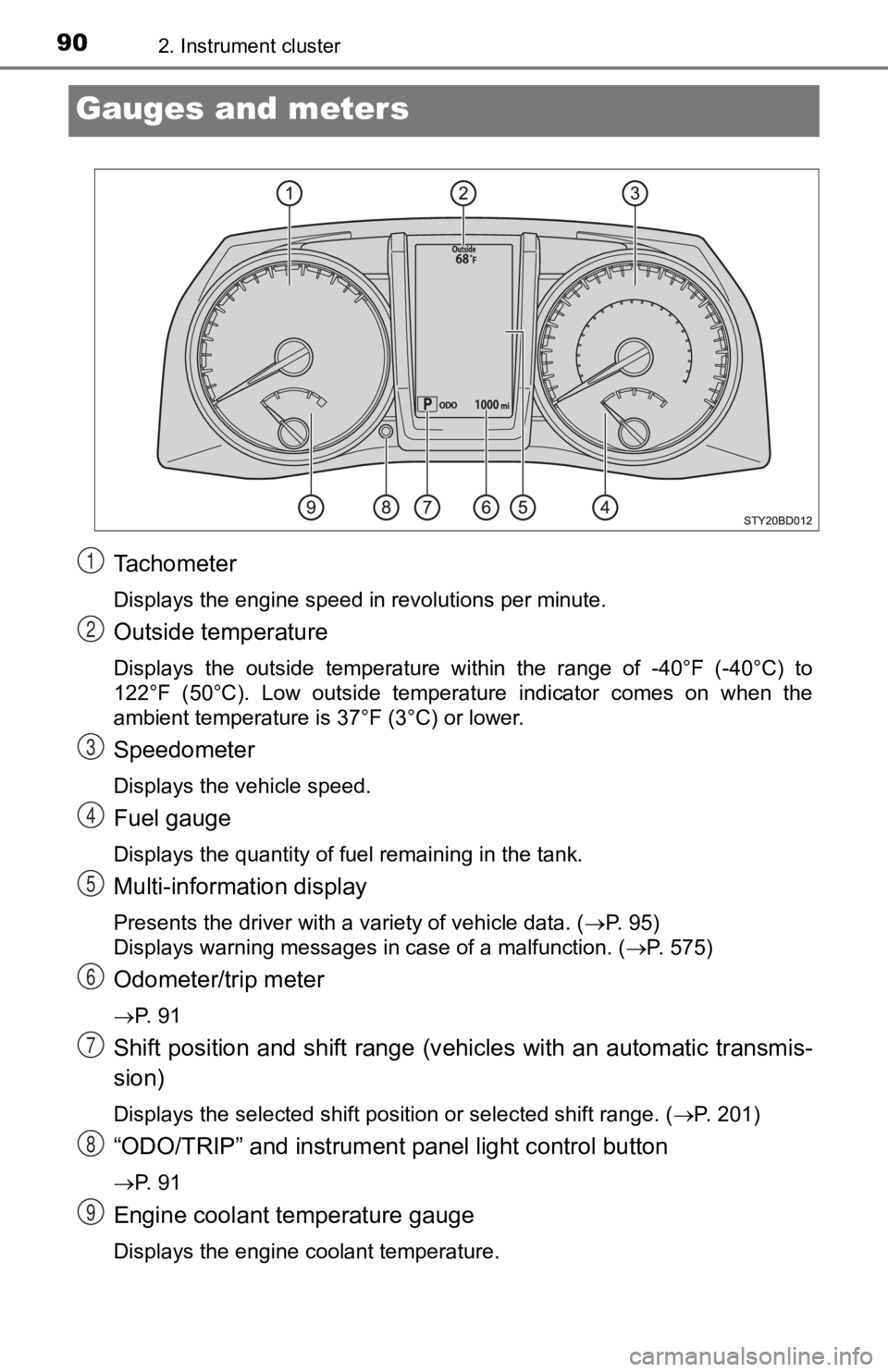
Gauges and meters
Tachometer
Displays the engine speed in revolutions per minute.
Outside temperature
Displays the outside temperature within the range of -40°F (-40°C) to
122°F (50°C). Low outside temperat ure indicator comes on when the
ambient temperature is 37°F (3°C) or lower.
Speedometer
Displays the vehicle speed.
Fuel gauge
Displays the quantity of fuel remaining in the tank.
Multi-information display
Presents the driver with a variety of vehicle data. ( P. 95)
Displays warning messages in case of a malfunction. ( P. 575)
Odometer/trip meter
P. 91
Shift position and shift range (vehicles with an automatic transmis-
sion)
Displays the selected shift position or selected shift range. ( P. 201)
“ODO/TRIP” and instrument panel light control button
P. 91
Engine coolant temperature gauge
Displays the engine coolant temperature.
1
2
3
4
5
6
7
8
9
Page 93 of 700
932. Instrument cluster
2
Instrument cluster
WARNING
■The information display at low temperatures
Allow the interior of the vehicle to warm up before using the liquid crystal
information display. At extremely low temperatures, the information display
monitor may respond slowly, and display changes may be delayed.
For example, there is a lag between the driver’s shifting and the new gear
number appearing on the display. This lag could cause the drive r to down-
shift again, causing rapid and excessive engine braking and pos sibly an
accident resulting in personal death or injury.
NOTICE
■ To prevent damage to the engine and its components
● Do not let the indicator needle of the tachometer enter the red zone, which
indicates the maximum engine speed.
● The engine may be overheating if the engine coolant temperature gauge is
in the red zone (H). In this case, immediately stop the vehicle in a safe
place, and check the engine after it has cooled completely. ( P. 620)
Page 186 of 700

1864-1. Before driving
●Slow down before making a turn, in crosswinds, on wet or slippe ry
surfaces, etc.
Increasing vehicle speed can destabilize the trailer.
● Take care when passing other vehicles. Passing requires consider-
able distance. After passing a vehicle, do not forget the lengt h of
your trailer, and be sure you have plenty of room before changi ng
lanes.
● Vehicles with an automatic transmission: To maintain engine bra k-
ing efficiency and charging system performance when using engin e
braking, do not use the transmission in D. If in the S mode, th e
transmission shift range posit ion must be in 5 or lower.
● Vehicles with a manual transmiss ion: To maintain engine braking
efficiency and charging system performance when using engine
braking, do not use the sixth gear.
● Instability happens more frequently when descending steep or lo ng
downhill grades. Before descending, slow down and downshift. Do
not make sudden downshifts while descending steep or long down-
hill grades.
● Avoid holding the brake pedal down too long or applying the bra kes
too frequently. This could cause the brakes to overheat and result in
reduced braking efficiency.
● Due to the added load of the trailer, your vehicle’s engine may over-
heat on hot days (at temperatures over 85°F [30°C]) when drivin g
up a long or steep grade. If the engine coolant temperature gau ge
indicates overheating, immediately turn off the air conditionin g (if in
use), pull your vehicle off the road and stop in a safe spot.
( P. 620)
Page 514 of 700
5147-3. Do-it-yourself maintenance
■Coolant selection
Only use “Toyota Super Long Life Coolant” or a similar high quality ethylene
glycol based non-silicate, non-amine, non-nitrite, and non-bora te coolant with
long-life hybrid organic acid technology.
U.S.A.:
“Toyota Super Long Life Coolant” is a mixture of 50% coolant and 50% deion-
ized water. (Minimum temperature: -31 F [-35 C])
Canada:
“Toyota Super Long Life Coolant” is a mixture of 55% coolant and 45% deion-
ized water. (Minimum temperature: -44 F [-42 C])
For more details about coolant, contact your Toyota dealer.
■ If the coolant level drops within a short time of replenishing
Visually check the radiator, hoses, engine coolant reservoir ca p, drain cock
and water pump.
If you cannot find a leak, have your Toyota dealer test the cap and check for
leaks in the cooling system.
WARNING
■ When the engine is hot
Do not remove the radiator cap and engine coolant reservoir cap . (P. 620)
The cooling system may be under pressure and may spray hot coolant if the
cap is removed, causing serious injuries, such as burns.
NOTICE
■ When adding coolant
Coolant is neither plain water nor straight antifreeze. The cor rect mixture of
water and antifreeze must be used to provide proper lubrication, corrosion
protection and cooling. Be sure to read the antifreeze or coolant label.
■ If you spill coolant
Be sure to wash it off with water to prevent it from damaging p arts or paint.
Page 566 of 700
5668-2. Steps to take in an emergency
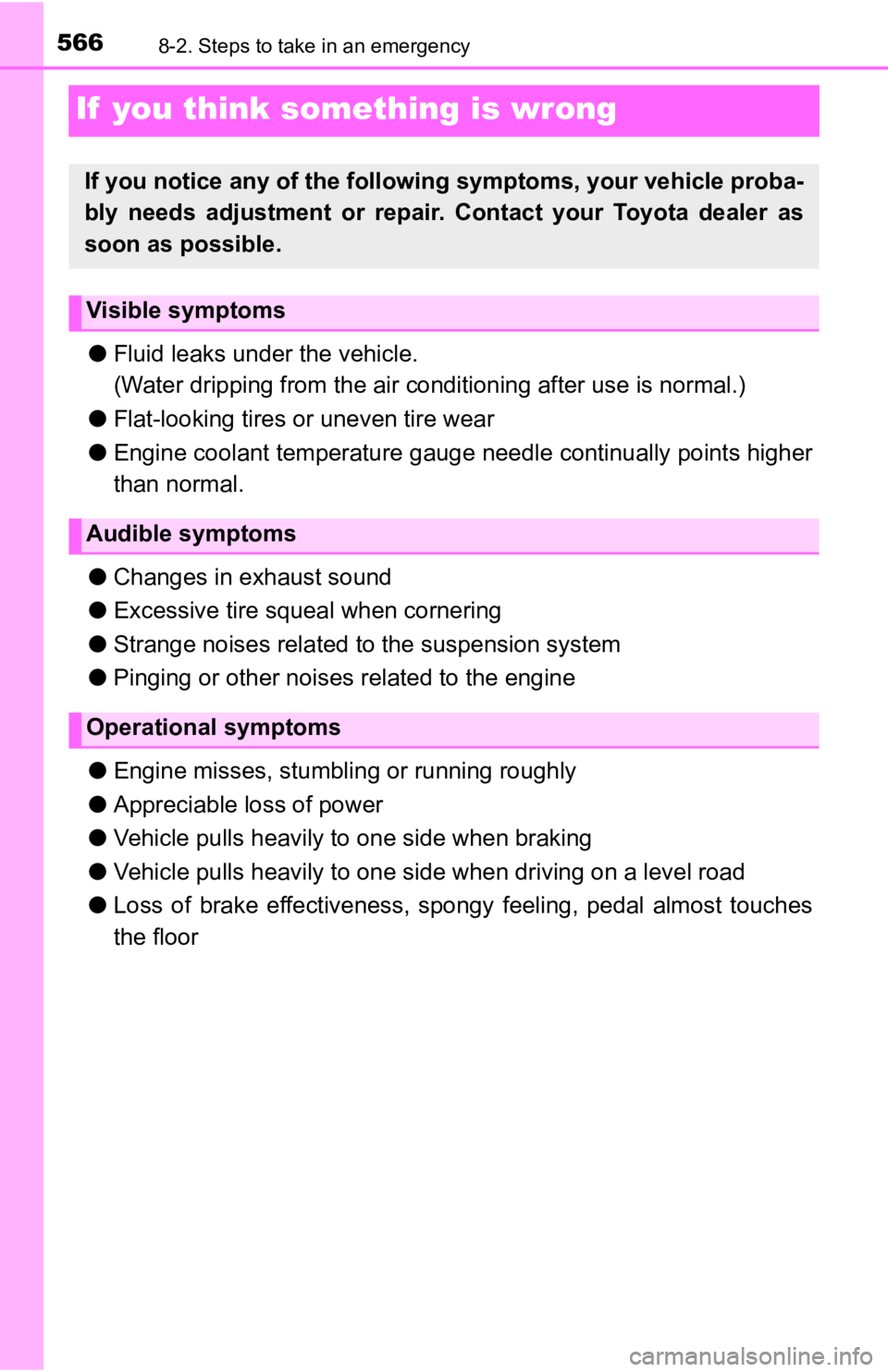
If you think something is wrong
●Fluid leaks un der the vehicle.
(Water dripping from the air conditioning a fter use is normal.)
● Flat-looking tires or uneven tire wear
● Engine coolant temperature gauge needle continually points high er
than normal.
● Changes in exhaust sound
● Excessive tire squeal when cornering
● Strange noises related to the suspension system
● Pinging or other noises related to the engine
● Engine misses, stumbli ng or running roughly
● Appreciable loss of power
● Vehicle pulls heavily to one side when braking
● Vehicle pulls heavily to one s ide when driving on a level road
● Loss of brake effectiveness, spongy feeling, pedal almost touch es
the floor
If you notice any of the followi ng symptoms, your vehicle proba -
bly needs adjustment or repair. Contact your Toyota dealer as
soon as possible.
Visible symptoms
Audible symptoms
Operational symptoms
Page 576 of 700
5768-2. Steps to take in an emergency
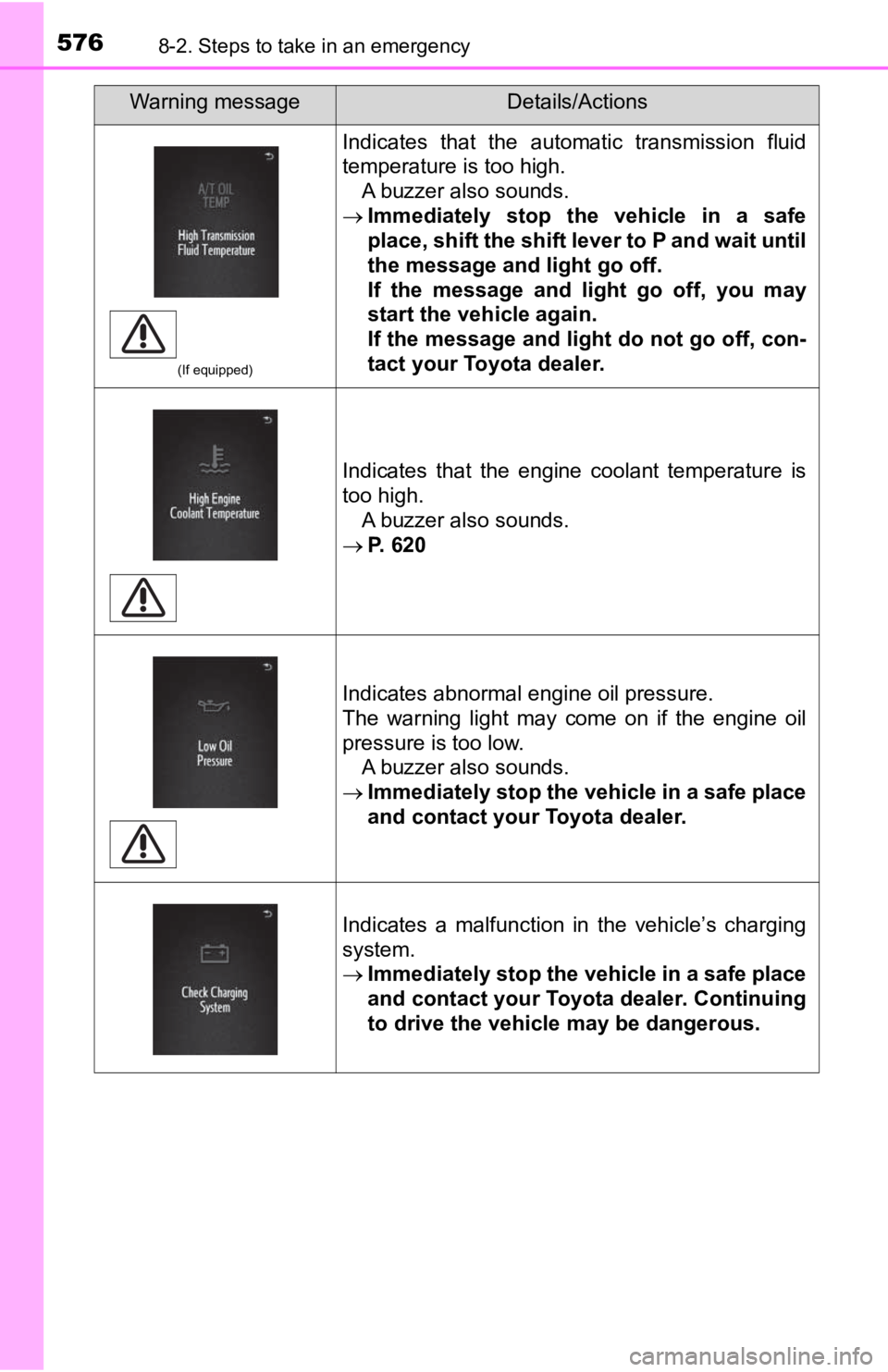
(If equipped)
Indicates that the automatic transmission fluid
temperature is too high.A buzzer also sounds.
Immediately stop the vehicle in a safe
place, shift the shift lever to P and wait until
the message and light go off.
If the message and light go off, you may
start the vehicle again.
If the message and light do not go off, con-
tact your Toyota dealer.
Indicates that the engine coolant temperature is
too high. A buzzer also sounds.
P. 620
Indicates abnormal engine oil pressure.
The warning light may come on if the engine oil
pressure is too low. A buzzer also sounds.
Immediately stop the vehicle in a safe place
and contact your Toyota dealer.
Indicates a malfunction in the vehicle’s charging
system.
Immediately stop the vehicle in a safe place
and contact your Toyota dealer. Continuing
to drive the vehicle may be dangerous.
Warning messageDetails/Actions
Page 620 of 700
6208-2. Steps to take in an emergency
If your vehicle overheats
●The needle of the engine coolant temperature gauge ( P. 9 0 )
enters the red zone or a loss of engine power is experienced. ( For
example, the vehicle speed does not increase.)
● “High Engine Coolant Temperature” is shown on the multi-informa-
tion display. (if equipped)
● Steam comes out f rom under the hood.
Stop the vehicle in a safe place and turn off the air condition ing sys-
tem, and then stop the engine.
If you see steam:
Carefully lift the hood after the steam subsides.
If you do not see steam:
Carefully lift the hood.
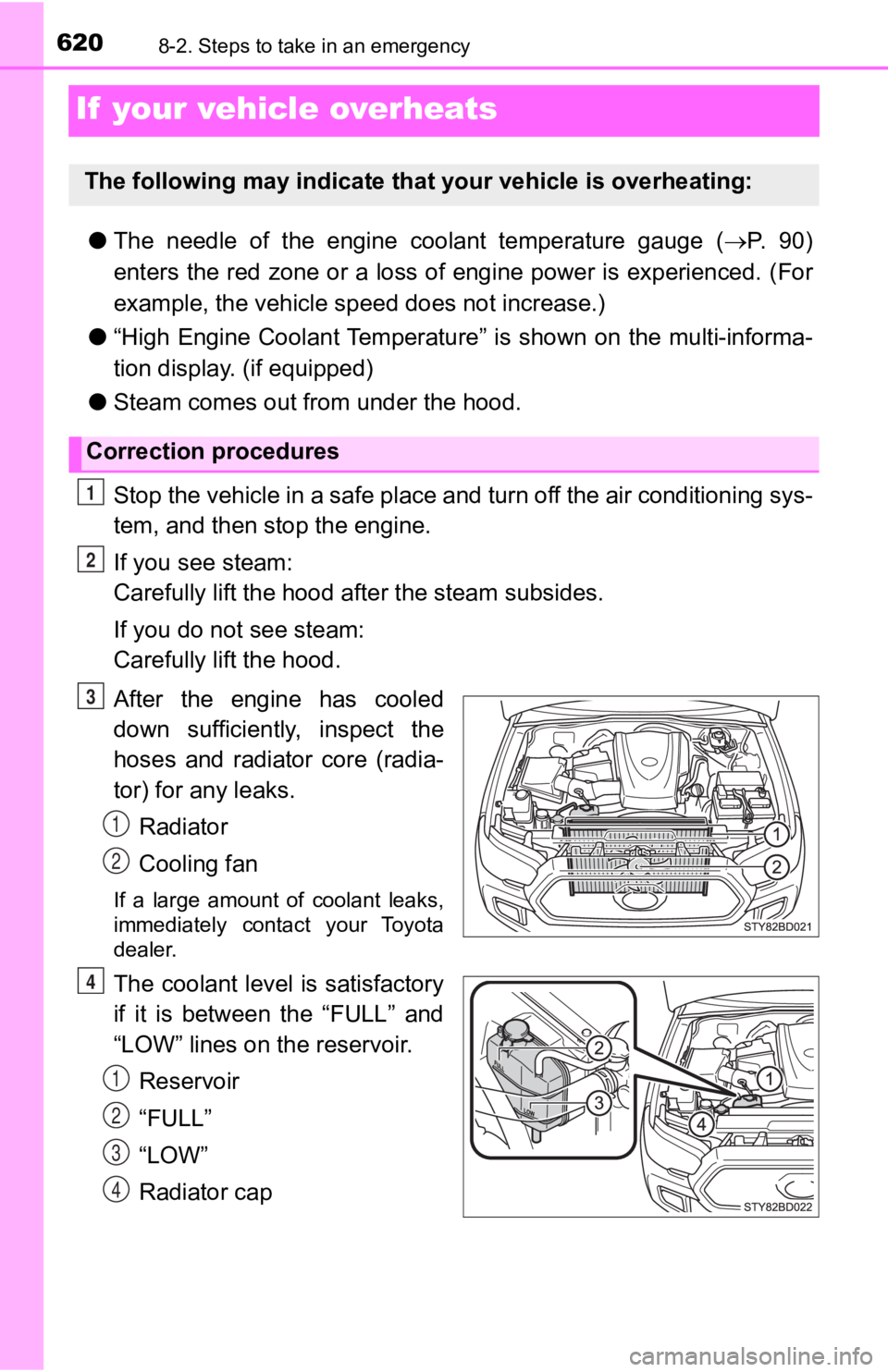
After the engine has cooled
down sufficiently, inspect the
hoses and radiator core (radia-
tor) for any leaks. Radiator
Cooling fan
If a large amount of coolant leaks,
immediately contact your Toyota
dealer.
The coolant level is satisfactory
if it is between the “FULL” and
“LOW” lines on the reservoir.Reservoir
“FULL”
“LOW”
Radiator cap
The following may indicate that your vehicle is overheating:
Correction procedures
1
2
3
1
2
4
1
2
3
4
Page 621 of 700
6218-2. Steps to take in an emergency
8
When trouble arises
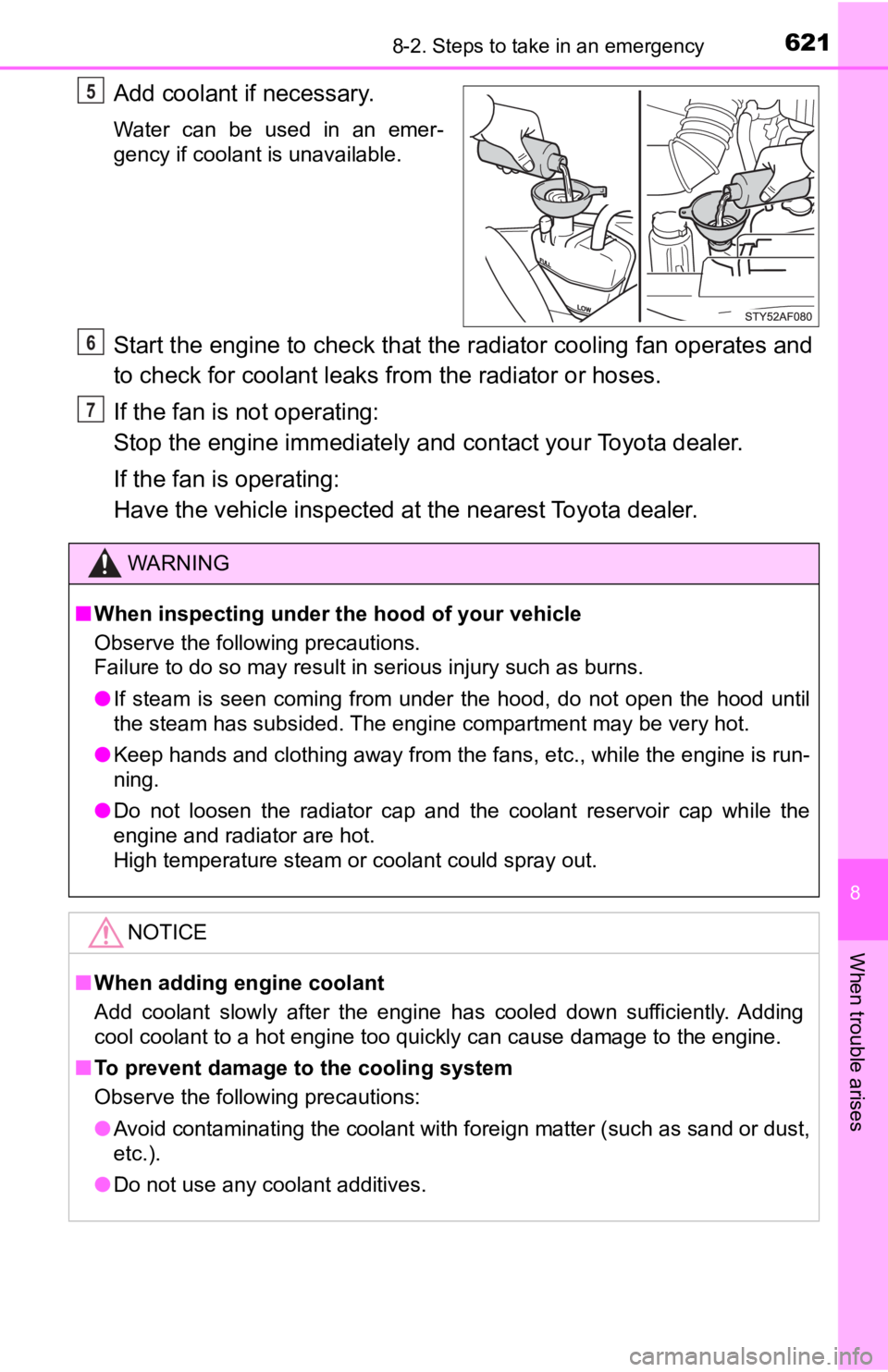
Add coolant if necessary.
Water can be used in an emer-
gency if coolant is unavailable.
Start the engine to check that the radiator cooling fan operates and
to check for coolant leaks from the radiator or hoses.
If the fan is not operating:
Stop the engine immediately and contact your Toyota dealer.
If the fan is operating:
Have the vehicle inspected at the neare st Toyota dealer.
5
WARNING
■When inspecting under the hood of your vehicle
Observe the following precautions.
Failure to do so may result in serious injury such as burns.
● If steam is seen coming from under the hood, do not open the ho od until
the steam has subsided. The engine compartment may be very hot.
● Keep hands and clothing away from the fans, etc., while the engine is run-
ning.
● Do not loosen the radiator cap and the coolant reservoir cap while the
engine and radiator are hot.
High temperature steam or coolant could spray out.
NOTICE
■When adding engine coolant
Add coolant slowly after the engine has cooled down sufficiently. Adding
cool coolant to a hot engine too quickly can cause damage to the engine.
■ To prevent damage to the cooling system
Observe the following precautions:
● Avoid contaminating the coolant with foreign matter (such as sa nd or dust,
etc.).
● Do not use any coolant additives.
6
7
Page 689 of 700
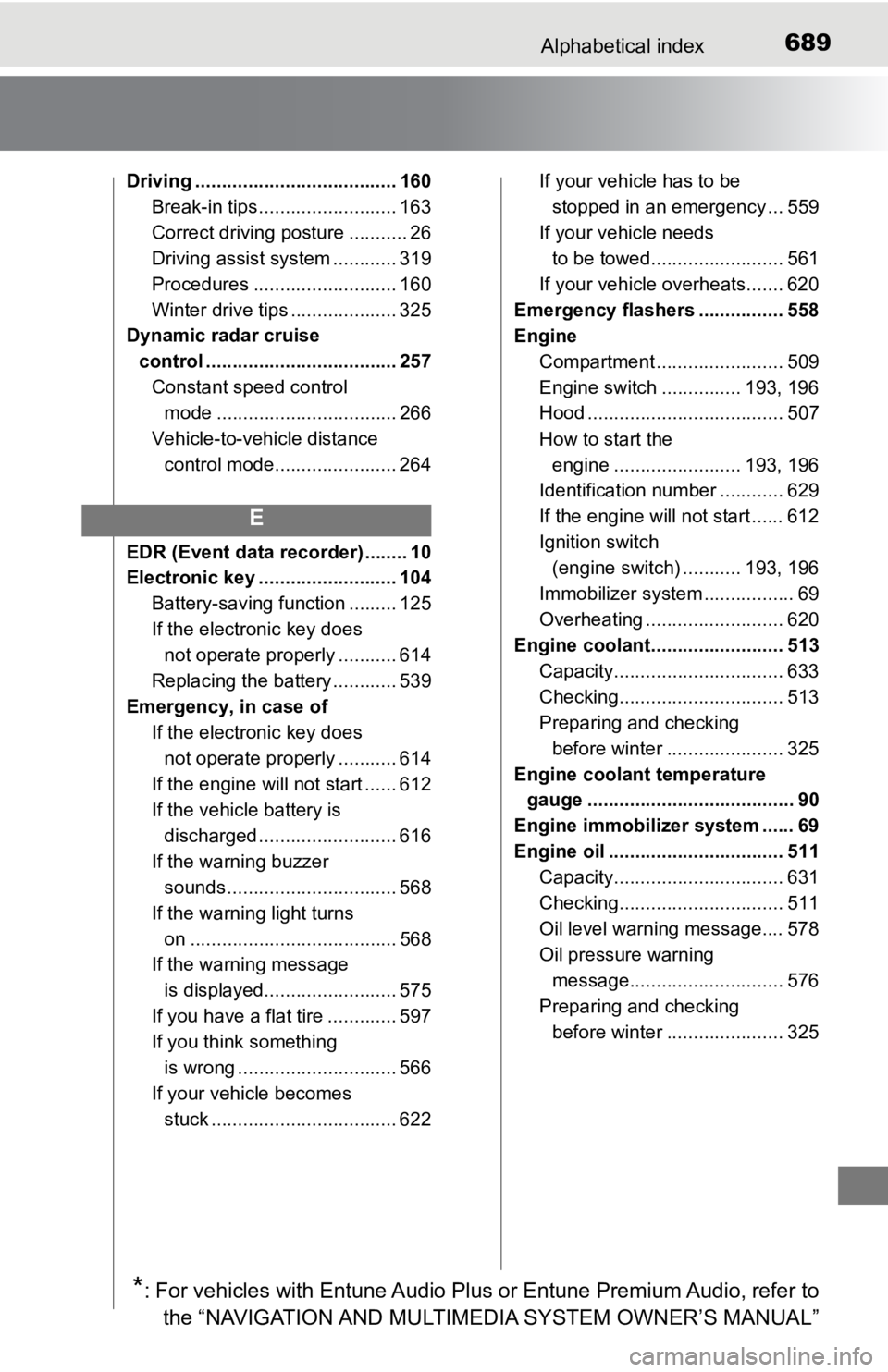
689Alphabetical index
Driving ...................................... 160Break-in tips .......................... 163
Correct driving posture ........... 26
Driving assist system ............ 319
Procedures ........................... 160
Winter drive tips .................... 325
Dynamic radar cruise
control .................................... 257 Constant speed control mode .................................. 266
Vehicle-to-vehicle distance control mode....................... 264
EDR (Event data recorder) ........ 10
Electronic key .......................... 104 Battery-saving function ......... 125
If the electronic key does not operate properly ........... 614
Replacing the battery ............ 539
Emergency, in case of If the electronic key does
not operate properly ........... 614
If the engine will not start ...... 612
If the vehicle battery is discharged .......................... 616
If the warning buzzer sounds ................................ 568
If the warning light turns on ....................................... 568
If the warning message
is displayed......................... 575
If you have a flat tire ............. 597
If you think something is wrong .............................. 566
If your vehicle becomes stuck ................................... 622 If your vehicle has to be
stopped in an emergency ... 559
If your vehicle needs
to be towed......................... 561
If your vehicle overheats....... 620
Emergency flashers ................ 558
Engine Compartment ........................ 509
Engine switch ............... 193, 196
Hood ..................................... 507
How to start the engine ........................ 193, 196
Identification number ............ 629
If the engine will not start ...... 612
Ignition switch (engine switch) ........... 193, 196
Immobilizer system .. ............... 69
Overheating .......................... 620
Engine coolant......................... 513
Capacity................................ 633
Checking............................... 513
Preparing and checking before winter ...................... 325
Engine coolant temperature gauge ....................................... 90
Engine immobilizer system ...... 69
Engine oil ................................. 511 Capacity................................ 631
Checking............................... 511
Oil level warning message.... 578
Oil pressure warning
message............................. 576
Preparing and checking before winter ...................... 325
E
*: For vehicles with Entune Audio Plus or Entune Premium Audio, refer to
the “NAVIGATION AND MULTIMEDIA SYSTEM OWNER’S MANUAL”