engine overheat TOYOTA tC 2013 Owners Manual (in English)
[x] Cancel search | Manufacturer: TOYOTA, Model Year: 2013, Model line: tC, Model: TOYOTA tC 2013Pages: 484, PDF Size: 9.1 MB
Page 4 of 484

TABLE OF CONTENTSIndex
4
tC_OM_OM21042U_(U)
4-1. Maintenance and careCleaning and protecting the
vehicle exterior ................. 272
Cleaning and protecting the
vehicle interior .................. 276
4-2. Maintenance Maintenance
requirements .................... 279
General maintenance ......... 282
Emission inspection and
maintenance (I/M)
programs .......................... 286
4-3. Do-it-yourself maintenance Do-it-yourself service
precautions ...................... 287
Hood................................... 292
Positioning a floor jack ....... 294
Engine compartment .......... 296
Tires ................................... 312
Tire inflation pressure......... 323
Wheels ............................... 327
Wireless remote control/
electronic key battery ....... 330
Checking and replacing
fuses ................................ 334
Light bulbs .......................... 345 5-1. Essential information
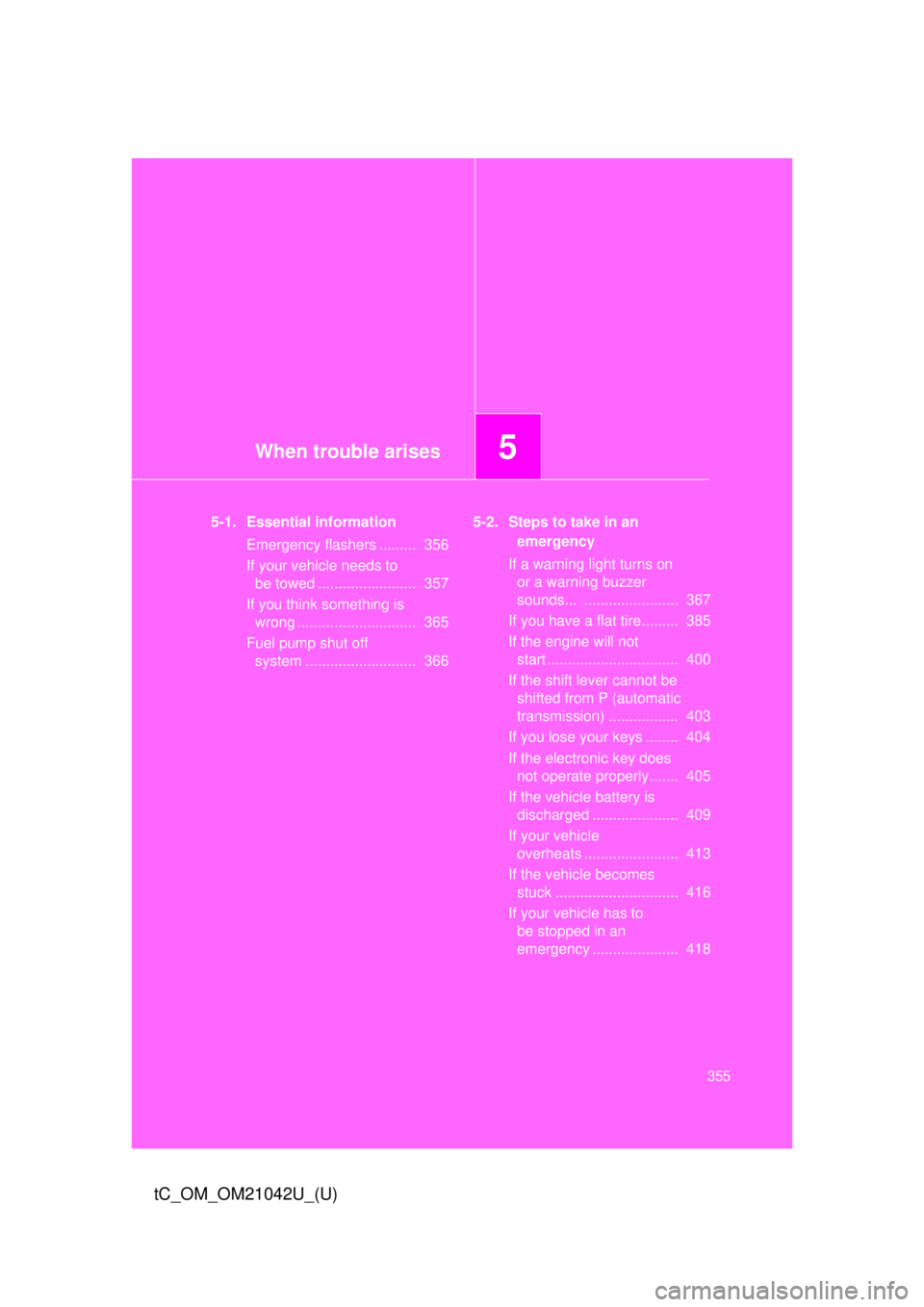
Emergency flashers ............ 356
If your vehicle needs to be
towed ................................ 357
If you think something is wrong ................................ 365
Fuel pump shut off
system .............................. 366
5-2. Steps to take in an emergency If a warning light turns on
or a warning buzzer
sounds... .......................... 367
If you have a flat tire ........... 385
If the engine will not start .... 400
If the shift lever cannot be
shifted from P (automatic
transmission) .................... 403
If you lose your keys ........... 404
If the electronic key does
not operate properly ......... 405
If the vehicle battery is discharged ........................ 409
If your vehicle overheats..... 413
If the vehicle becomes stuck ................................. 416
If your vehicle has to
be stopped in an
emergency ........................ 418
4Maintenance and care5When trouble arises
Page 154 of 484

154 2-1. Driving procedures
tC_OM_OM21042U_(U)
CAUTION
●If the smell of exhaust is noticed inside the vehicle, open the windows and
check that the back door is closed. Large amounts of exhaust in the vehi-
cle can cause driver drowsiness and an accident, resulting in death or a
serious health hazard. Have the vehicle inspected by your Scion dealer
immediately.
● On vehicles with an automatic transmission, do not shift the shift lever to P
while the vehicle is moving.
Doing so can damage the transmission and may result in a loss of vehicle\
control.
● Do not shift the shift lever to R while the vehicle is moving forward.
Doing so can damage the transmission and may result in a loss of vehicle\
control.
● Do not shift the shift lever to D (vehicles with an automatic transmission) or
1 (vehicles with a manual transmission) while the vehicle is moving back-
ward.
Doing so can damage the transmission and may result in a loss of vehicle\
control.
● Moving the shift lever to N while the vehicle is moving will disengage the
engine from the transmission. Engine braking is not available when N is
selected.
● During normal driving, do not turn off the engine. Turning the engine off
while driving will not cause loss of steering or braking control, but the
power assist to these systems will be lost. This will make it more difficult to
steer and brake, so you should pull over and stop the vehicle as soon as it
is safe to do so.
However, in the event of an emergency, such as if it becomes impossible
to stop the vehicle in the normal way: P. 418
● Use engine braking (downshift) to maintain a safe speed when driving
down a steep hill.
Using the brakes continuously may cause the brakes to overheat and lose
effectiveness. ( P. 177)
Page 156 of 484
156 2-1. Driving procedures
tC_OM_OM21042U_(U)
CAUTION
■If you hear a squealing or scraping noise (brake pad wear limit indica-
tors)
Have the brake pads checked and replaced by your Scion dealer as soon as
possible.
Rotor damage may result if the pads are not replaced when needed.
It is dangerous to drive the vehicle when the wear limits of the brake pads
and/or those of the brake discs are exceeded.
■ When the vehicle is stopped
● Do not race the engine.
If the vehicle is in any gear other than P (vehicles with an automatic trans-
mission only) or N, the vehicle may accelerate suddenly and unexpectedly,
causing an accident.
● Do not leave the vehicle with the engine running for a long time.
If such a situation cannot be avoided, park the vehicle in an open space
and check that exhaust fumes do not enter the vehicle interior.
● On vehicles with an automatic transmission, in order to prevent accidents
due to the vehicle rolling away, always keep depressing the brake pedal
while the engine is running, and apply the parking brake as necessary.
● If the vehicle is stopped on an incline, in order to prevent accidents caused
by the vehicle rolling forward or backward, always depress the brake pedal
and securely apply the parking brake as needed.
● Avoid revving or racing the engine. Running the engine at high speed
while the vehicle is stopped may cause the exhaust system to overheat,
which could result in a fire if combustible material is nearby.
Page 159 of 484
159
2-1. Driving procedures
2
When driving
tC_OM_OM21042U_(U)
CAUTION
■
When taking a nap in the vehicle
Always turn the engine off. Otherwise, you may accidentally move the shift
lever or depress the accelerator pedal, this could cause an accident or fire
due to engine overheating. Additionally, if the vehicle is parked in a poorly
ventilated area, exhaust gases may collect and enter the vehicle, leadin\
g to
death or a serious health hazard.
■ When braking
● When the brakes are wet, drive more cautiously.
Braking distance increases when the brakes are wet, and may cause one
side of the vehicle to brake differently than the other side. Also the parking
brake may not securely hold the vehicle.
● If the power brake assist function does not operate, do not follow other
vehicles closely and avoid hills or sharp turns that require braking.
In this case, braking is still possible, but the brake pedal should be
depressed more firmly than usual. Also, the braking distance will increase.
● Do not pump the brake pedal if the engine stalls.
Each push on the brake pedal uses up the reserve for the power-assisted
brakes.
● The brake system consists of 2 individual hydraulic systems; if one of the
systems fails, the other will still operate. In this case, the brake pedal
should be depressed more firmly than usual and the braking distance will
increase.
If this happens, do not continue to drive the vehicle. Have your brakes
fixed immediately.
Page 166 of 484

166 2-1. Driving procedures
tC_OM_OM21042U_(U)
CAUTION
■When starting the engine
Always start the engine while sitting in the driver’s seat. Do not depress the
accelerator pedal while starting the engine under any circumstances.
Doing so may cause an accident resulting in death or serious injury.
■ Caution when driving
Do not turn the engine switch to the “LOCK” position while driving. If, in an
emergency, you must turn the engine off while the vehicle is moving, turn the
engine switch only to the “ACC” position to stop the engine. An accident may
result if the engine is stopped while driving.
NOTICE
■To prevent battery discharge
Do not leave the engine switch in the “A CC” or “ON” position for long periods
of time without the engine running.
■ When starting the engine
● Do not crank the engine for more than 30 seconds at a time. This may
overheat the starter and wiring system.
● Do not race a cold engine.
● If the engine becomes difficult to start or stalls frequently, have the engine
checked immediately.
Page 173 of 484
173
2-1. Driving procedures
2
When driving
tC_OM_OM21042U_(U)
■
If the engine does not start
The engine immobilizer system may not have been deactivated. ( P. 100)
■ Steering lock
After turning the “ENGINE START STOP” switch off and opening and closing
the doors, the steering wheel will be locked due to the steering lock function.
Operating the “ENGINE START STOP” switch again automatically cancels
the steering lock.
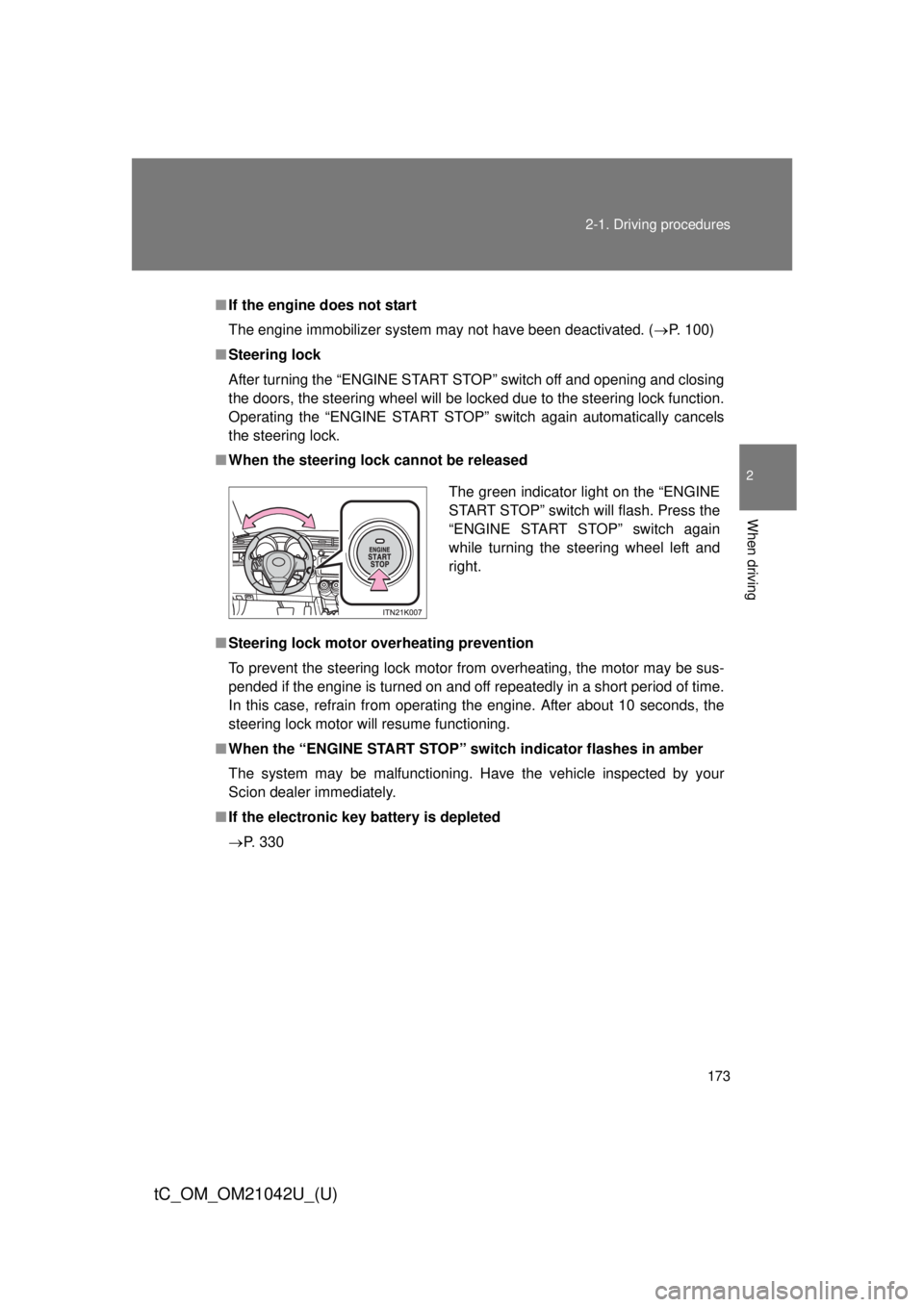
■ When the steering lock cannot be released
■ Steering lock motor overheating prevention
To prevent the steering lock motor from overheating, the motor may be sus-
pended if the engine is turned on and off repeatedly in a short period of time.
In this case, refrain from operating the engine. After about 10 seconds, the
steering lock motor will resume functioning.
■ When the “ENGINE START STOP” switch indicator flashes in amber
The system may be malfunctioning. Have the vehicle inspected by your
Scion dealer immediately.
■ If the electronic key battery is depleted
P. 330
The green indicator light on the “ENGINE
START STOP” switch will flash. Press the
“ENGINE START STOP” switch again
while turning the steering wheel left and
right.
Page 214 of 484

214 2-4. Using other driving systems
tC_OM_OM21042U_(U)
■Sounds and vibrations caused by the ABS, brake assist, VSC and
TRAC
● A sound may be heard from the engine compartment when the engine is
started or just after the vehicle begins to move. This sound does not indi-
cate that a malfunction has occurred in any of these systems.
● Any of the following conditions may occur when the above systems are
operating. None of these indicates that a malfunction has occurred.
• Vibrations may be felt through the vehicle body and steering.
• A motor sound may be heard after the vehicle comes to a stop.
• The brake pedal may pulsate slightly after the ABS is activated.
• The brake pedal may move down slightly after the ABS is activated.
■ EPS operation sound
When the steering wheel is operated, a motor sound (whirring sound) may
be heard. This does not indicate a malfunction.
■ Reactivation of the TRAC/VSC systems after turning off the engine
Turning off the engine after turning off the TRAC/VSC systems will automati-
cally reactivate them.
■ Reactivation of the TRAC system linked to vehicle speed
When only the TRAC system is turned off, the TRAC system will turn on
when vehicle speed increases. However, when both TRAC and VSC sys-
tems are turned off, the systems will not turn on even when vehicle speed
increases.
■ Reduced effectiveness of the EPS system
The effectiveness of the EPS system is reduced to prevent the system from
overheating when there is frequent steering input over an extended period of
time. The steering wheel may feel heavy as a result. Should this occur,
refrain from excessive steering input or stop the vehicle and turn the engine
off. The EPS system should return to normal within 10 minutes.
Page 261 of 484
261
3-5. Other interior features
3
Interior features
tC_OM_OM21042U_(U)
CAUTION
■
Burns
● Use caution when seating the following persons in a seat with the seat
heater on to avoid the possibility of burns:
• Babies, small children, the elderly, the sick and the physically chal-
lenged
• Persons with sensitive skin
• Persons who are fatigued
• Persons who have taken alcohol or drugs that induce sleep (sleeping drugs, cold remedies, etc.)
● Do not cover the seat with anything when using the seat heater.
Using the seat heater with a blanket or cushion increases the temperature
of the seat and may lead to overheating.
● Do not use the seat heater more than necessary. Doing so may cause
minor burns or overheating.
NOTICE
■To prevent seat heater damage
Do not put heavy objects that have an uneven surface on the seat and do
not stick sharp objects (needles, nails, etc.) into the seat.
■ To prevent battery discharge
Turn the seat heaters off when the engine is not running.
Page 355 of 484
When trouble arises5
355
tC_OM_OM21042U_(U)
5-1. Essential informationEmergency flashers ......... 356
If your vehicle needs to
be towed ........................ 357
If you think something is wrong ............................. 365
Fuel pump shut off
system ........................... 366 5-2. Steps to take in an
emergency
If a warning light turns on or a warning buzzer
sounds... ....................... 367
If you have a flat tire......... 385
If the engine will not start ................................ 400
If the shift lever cannot be
shifted from P (automatic
transmission) ................. 403
If you lose your keys ........ 404
If the electronic key does
not operate properly....... 405
If the vehicle battery is
discharged ..................... 409
If your vehicle
overheats ....................... 413
If the vehicle becomes
stuck .............................. 416
If your vehicle has to
be stopped in an
emergency ..................... 418
Page 371 of 484
5
When trouble arises
371
5-2. Steps to take in an emergency
tC_OM_OM21042U_(U)
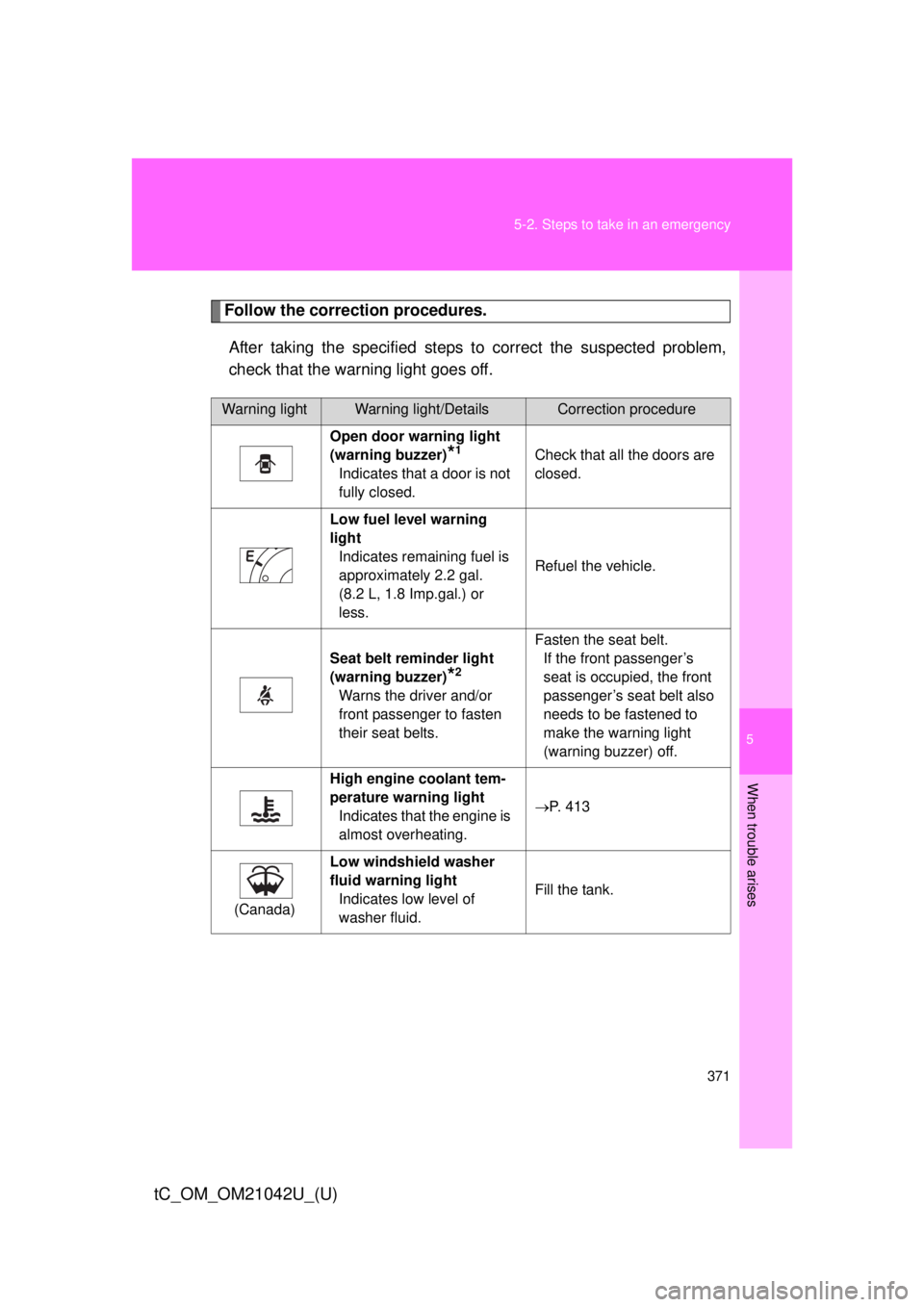
Follow the correction procedures.
After taking the specified steps to correct the suspected problem,
check that the warning light goes off.
Warning lightWarning light/DetailsCorrection procedure
Open door warning light
(warning buzzer)
*1
Indicates that a door is not
fully closed. Check that all the doors are
closed.
Low fuel level warning
light Indicates remaining fuel is
approximately 2.2 gal.
(8.2 L, 1.8 Imp.gal.) or
less. Refuel the vehicle.
Seat belt reminder light
(warning buzzer)
*2
Warns the driver and/or
front passenger to fasten
their seat belts. Fasten the seat belt.
If the front passenger’s
seat is occupied, the front
passenger’s seat belt also
needs to be fastened to
make the warning light
(warning buzzer) off.
High engine coolant tem-
perature warning light Indicates that the engine is
almost overheating. P. 413
(Canada) Low windshield washer
fluid warning light
Indicates low level of
washer fluid. Fill the tank.