torque TOYOTA TERCEL 1985 Service Manual
[x] Cancel search | Manufacturer: TOYOTA, Model Year: 1985, Model line: TERCEL, Model: TOYOTA TERCEL 1985Pages: 885, PDF Size: 64.52 MB
Page 548 of 885
RA-/[()REAR AXLE AND SUSPENSION - Differential (4WD)
RAOO3
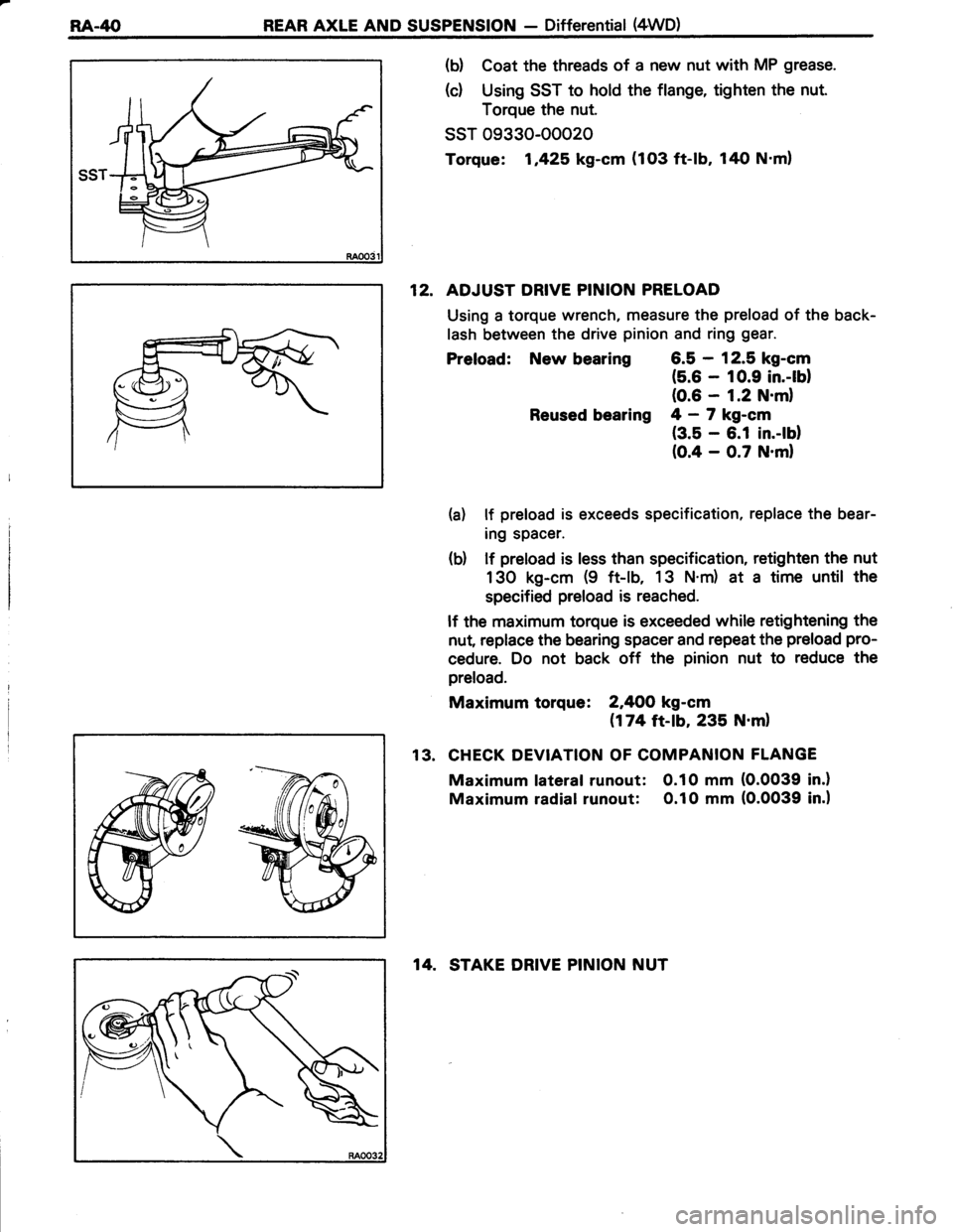
(b) Coat the threads of a new nut with MP grease.
(c) Using SST to hold the flange, tighten the nut.
Torque the nut.
ssr 09330-ooo20
Torque: 1,425 kg-cm (103 ft-lb, 140 N'ml
12. ADJUST DRIVE PINION PRELOAD
Using a torque wrench, measure the preload of the back-
lash between the drive pinion and ring gear.
Preload: New bearing 6.5 - 12.5 kg-cm
(5.6 - 10.9 in.-lbl
(0.6 - 1.2 N'ml
Reused bearing 4 - 7 kg-cm
(3.5 - 6.1 in.-lbl
(0.4 - 0.7 N'ml
lf preload is exceeds specification, replace the bear-
ing spacer.
lf preload is less than specification, retighten the nut
130 kg-cm (9 ft-lb, 13 N.m) at a time until the
specified preload is reached.
lf the maximum torque is exceeded while retightening the
nut, replace the bearing spacer and repeat the preload pro-
cedure. Do not back off the pinion nut to reduce the
preload.
Maximum torque: 2,4OO kg-cm
(174 ft-lb, 235 N'm)
CHECK DEVIATION OF COMPANION FLANGE
Maximum tateral runout: 0.10 mm (0.0039 in.l
Maximum radial runout: 0.10 mm (0.0039 in.l
14. STAKE DRIVE PINION NUT
(a)
(b)
13.
Page 549 of 885
REAR AXLE AND SUSPENSION - Differential (4WD)RA.41
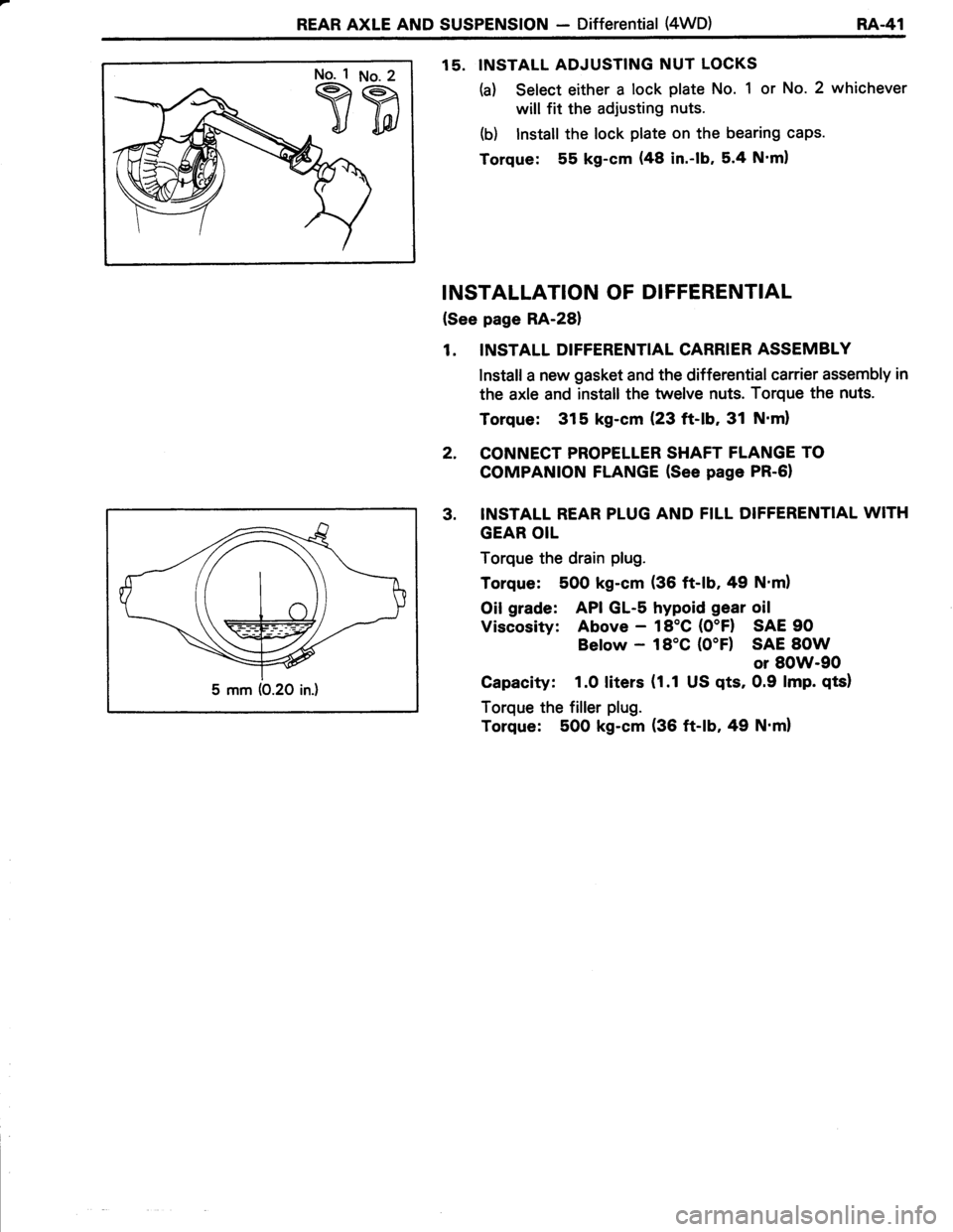
15. INSTALL ADJUSTING NUT LOCKS
(a) Select either a lock plate No. 1 or No. 2 whichever
will fit the adjusting nuts.
(b) lnstall the lock plate on the bearing caps.
Torque: 55 kg-cm (48 in.-lb, 5.4 N'ml
INSTALLATION OF DIFFERENTIAL
(See page RA-281
1. INSTALL DIFFERENTIAL CARRIER ASSEMBLY
Install a new gasket and the differentialcarrier assembly in
the axle and install the twelve nuts. Torque the nuts.
Torque: 315 kg-cm (23 ft-lb, 31 N'm)
2. CONNECT PROPELLER SHAFT FLANGE TO
COMPANION FLANGE (See page PR-61
3. INSTALL REAR PLUG AND FILL DIFFERENTIAL WITH
GEAR OIL
Torque the drain plug.
Torque: 500 kg-cm (36 ft-|b,49 N'm)
Oil grade: API GL-s hypoid gear oil
Viscosity: Above - 18"C (O'Fl SAE 90
Below - 18'C (0"F) SAE 8OW
or 80W-90
Capacity: 1.0 liters (1.1 US qts, 0.9 lmp. qts)
Torque the filler plug.
Torque: 500 kg-cm (36 ft-|b,49 N'ml
5 mm (0.2O in.)
Page 550 of 885
RA-42 REAR AXLE AND SUSPENSION - Four Link Type Rear Suspension (4WD)
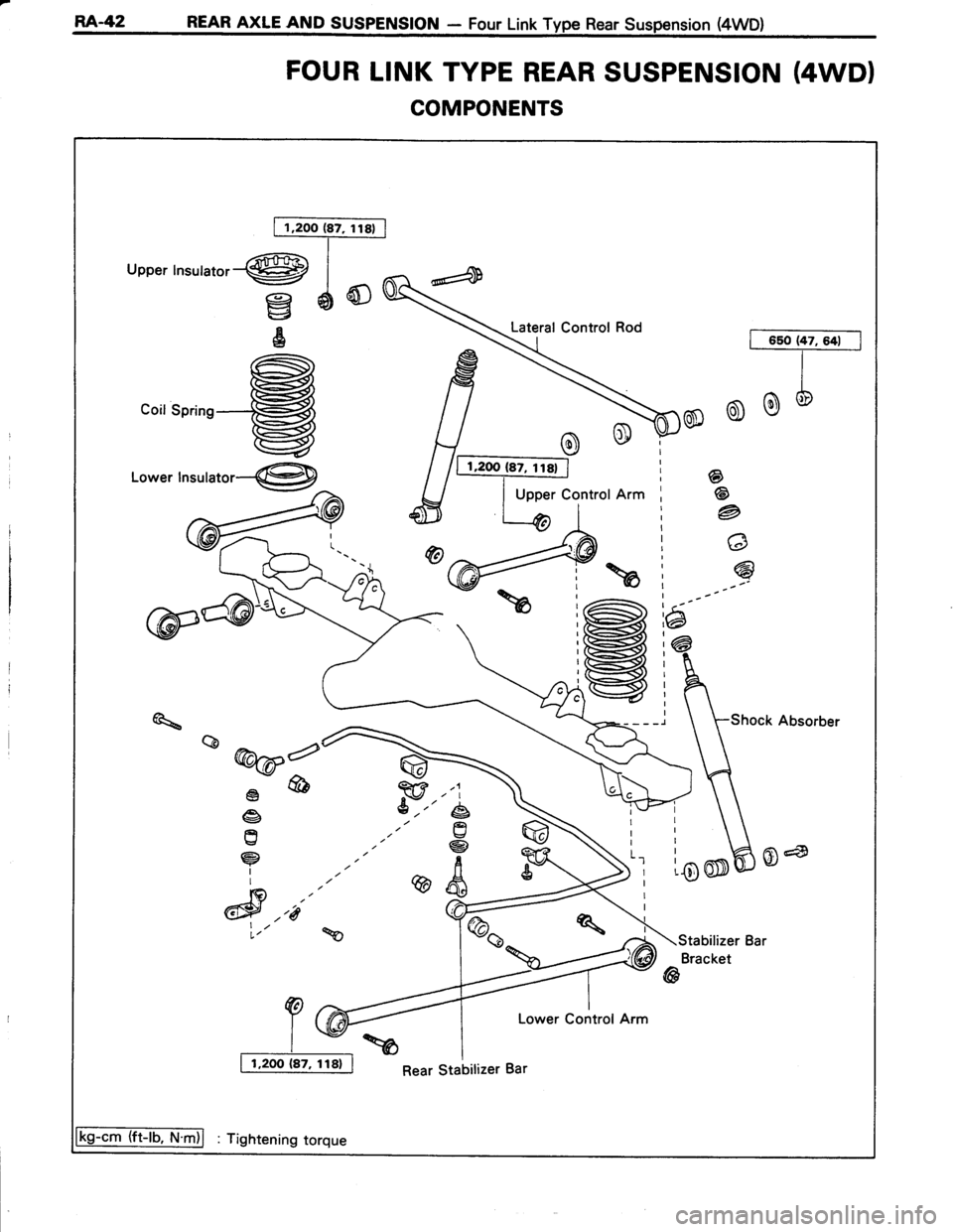
FOUR LINK TYPE REAR SUSPENSION (4WDI
COMPONENTS
fl,rooEz lrol
.ffi |Upper lnsutator-{sH9 I
€d@(
g\- Lateral Control Rod
\l l- 650 t+?,54l_l
€ ^T-
ll
ooo@
A/----_-9
a, r
f f I r,zoo raz, nat]. I a
g I uooe, Control Arm ', @
otr 11 " @
a",, ,0.,"n@
Lower tnrut.tor-@
D aia I i @v@
i o'wr=:i
b | .g
e€t,6
E i*u
,Wte
qShock Absorber
anv
%=
e@
e
Fv
? u.,r€
@.,a
i ,' a^@a
Lower Control Arm
-lb, N'm)l : Tightening torque
Rear Stabilizer Bar
Page 553 of 885
REAR AXLE AND SUSPENSION - Four Link Type Rear Suspension (4WD) Rl-+S
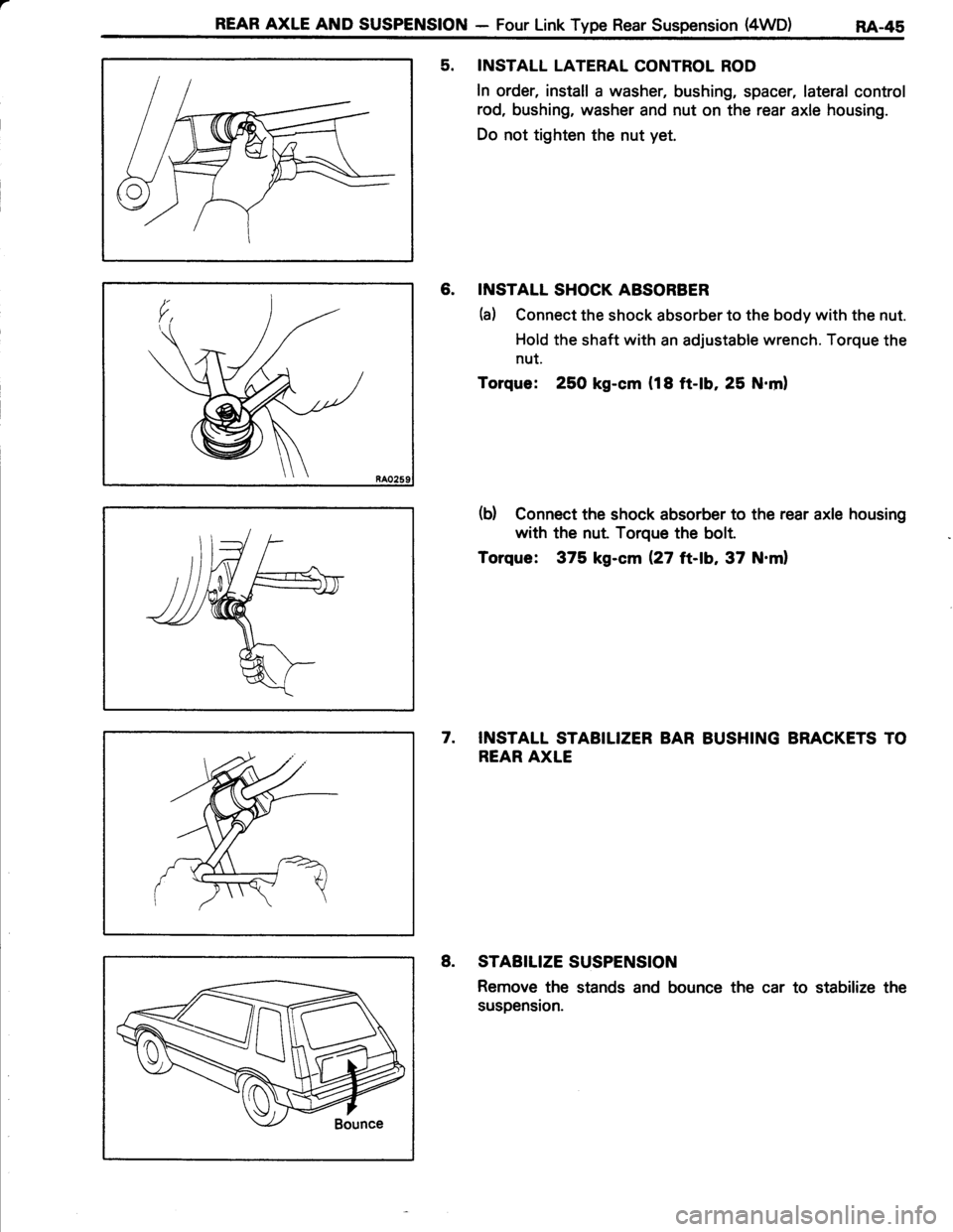
5. INSTALL LATERAL CONTROL ROD
In order, install a washer, bushing, spacer, lateral control
rod, bushing, washer and nut on the rear axle housing.
Do not tighten the nut yet.
6. INSTALL SHOCK ABSORBER
b) Connect the shock absorber to the body with the nut.
Hold the shaft with an adjustable wrench. Torque the
nut.
Torque: 250 kg-cm (18 ft-lb, 25 N.m)
(b) Connect the shock absorber to the rear axle housing
with the nut Torque the bolt.
Torque: 375 kg-cm (27 ft-\b,37 N.ml
7. INSTALL STABILIZER BAR BUSHING BRACKETS TO
REAR AXLE
8. STABILIZESUSPENSION
Remove the stands and bounce the car to stabilize the
suspension.
Page 554 of 885
RA-/t6 REAR AXLE AND SUSPENSION - Four Link Type Rear Suspension (4WD)
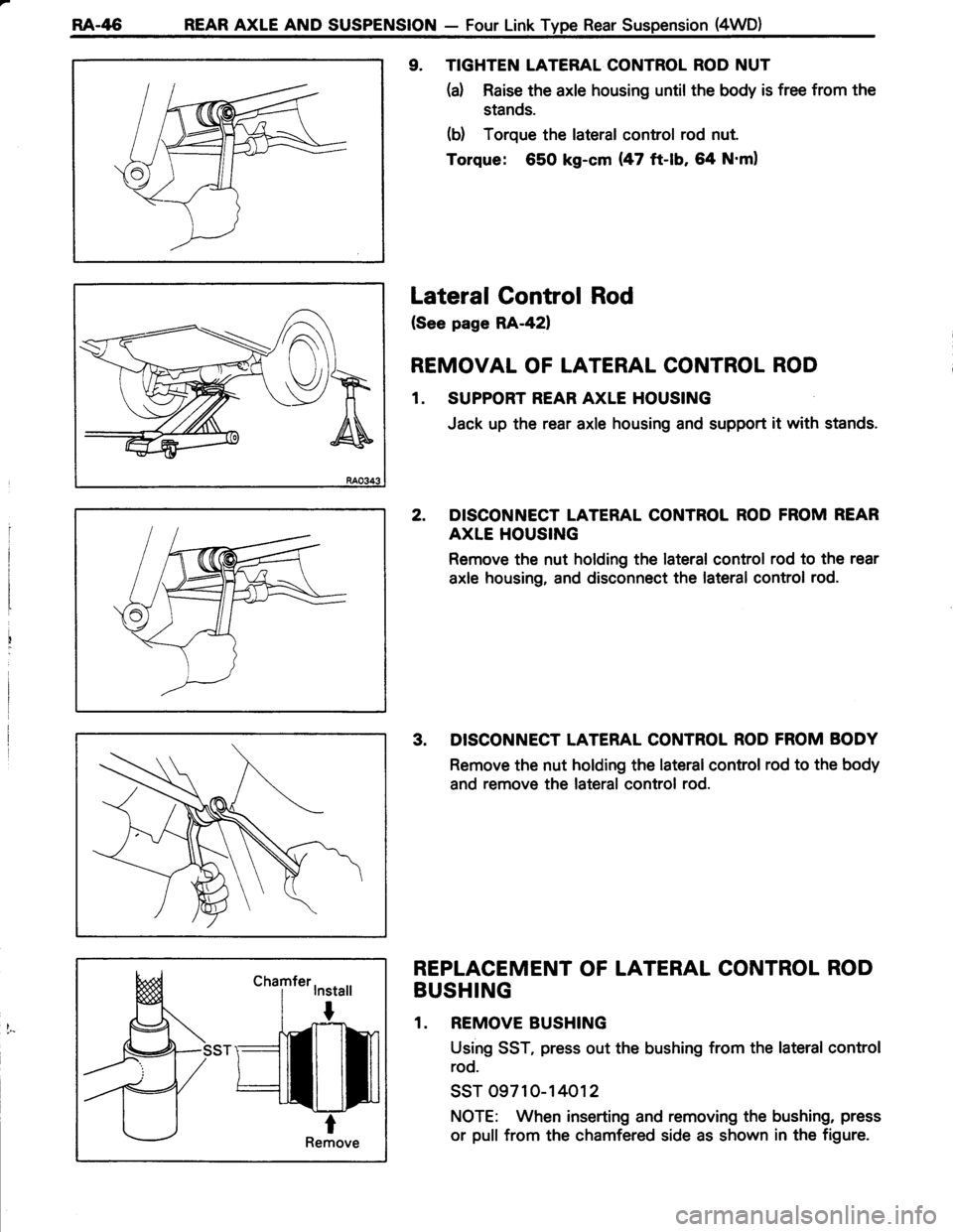
9. TIGHTEN LATERAL CONTROL ROD NUT
h) Raise the axle housing until the body is free from the
stands.
(b) Torque the lateral control rod nut.
Torque: 650 kg-cm (47 ft-lb, 64 N'm)
Lateral Control Rod
(See page RA-421
REMOVAL OF LATERAL CONTROL ROD
1. SUPPORT REAR AXLE HOUSING
Jack up the rear axle housing and support it with stands.
2. DISCONNECT LATERAL CONTROL ROD FROM REAR
AXLE HOUSING
Remove the nut holding the lateral control rod to the rear
axle housing, and disconnect the lateral control rod.
3. DISCONNECT LATERAL CONTROL ROD FROM BODY
Remove the nut holding the lateral control rod to the body
and remove the lateral control rod.
REPLACEMENT OF LATERAL CONTROL ROD
BUSHING
1. REMOVE BUSHING
Using SST, press out the bushing from the lateral control
rod.
ssT 0971 0-14012
NOTE: When inserting and removing the bushing, press
or pull from the chamfered side as shown in the figure.tRemove
Page 556 of 885
RA-48 REAR AXLE AND SUSPENSION - Four Link Type Rear Suspension (4WD)
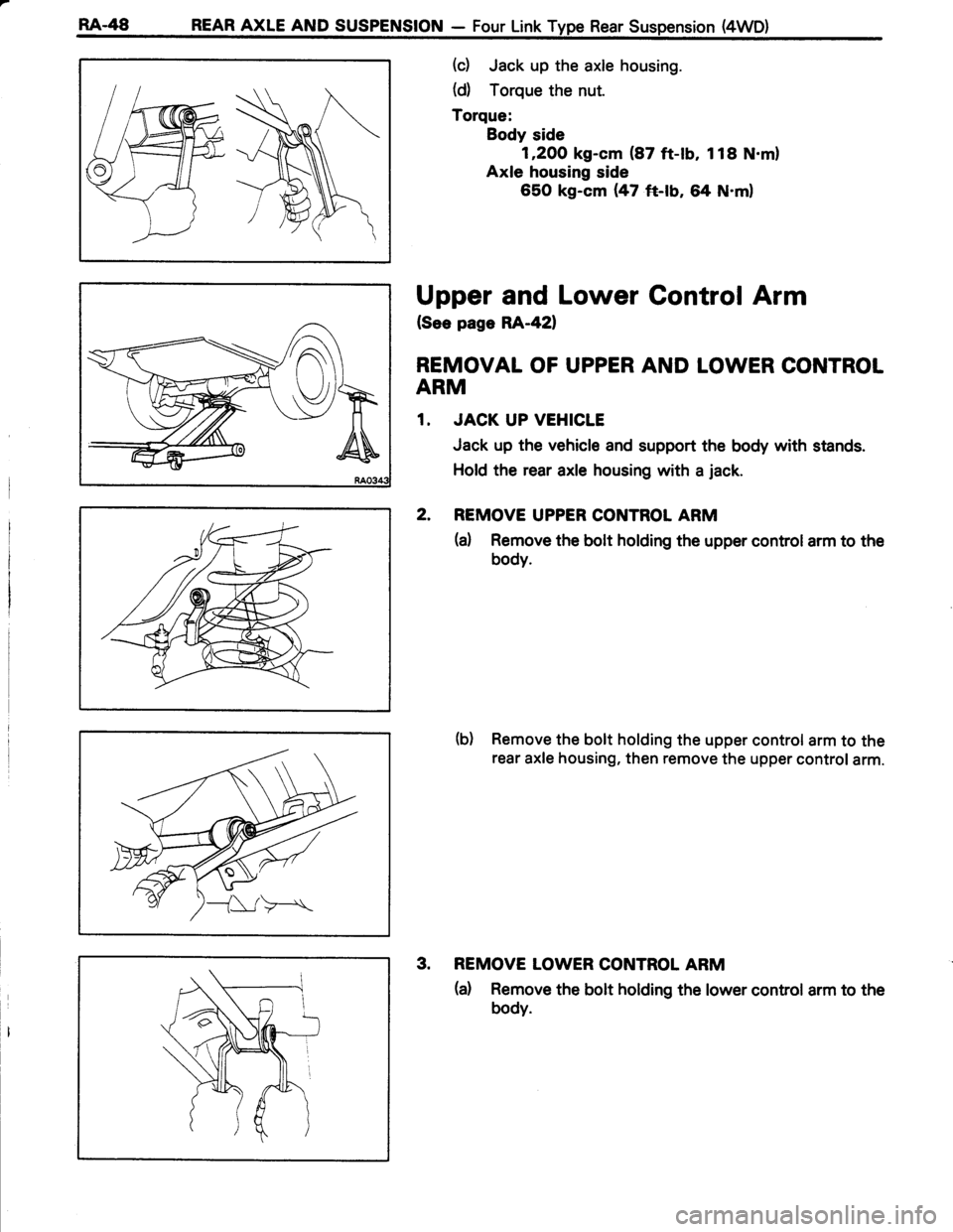
(d Jack up the axle housing.
(d) Torque the nut.
Torque:
Body side
1,2OO kg-cm (87 ft-lb, 1 18 N.m)
Axle housing side
650 kg-cm {47 ft-lb, 64 N.ml
Upper and Lower Gontrol Arm
(See page RA-421
REMOVAL OF UPPER AND LOWER CONTROL
ARM
1. JACK UP VEHICLE
Jack up the vehicle and support the body with stands.
Hold the rear axle housing with a jack.
2. REMOVE UPPER CONTROL ARM
(a) Remove the bolt holding the upper controlarm to the
body.
(b) Remove the bolt holding the upper control arm to the
rear axle housing, then remove the upper control arm.
3. REMOVE LOWER CONTROL ARM
(a) Remove the bolt holding the lower control arm to the
body.
Page 558 of 885
RA-50 REAR AXLE AND SUSPENSION - Four Link Type Rear Suspension (4WD)
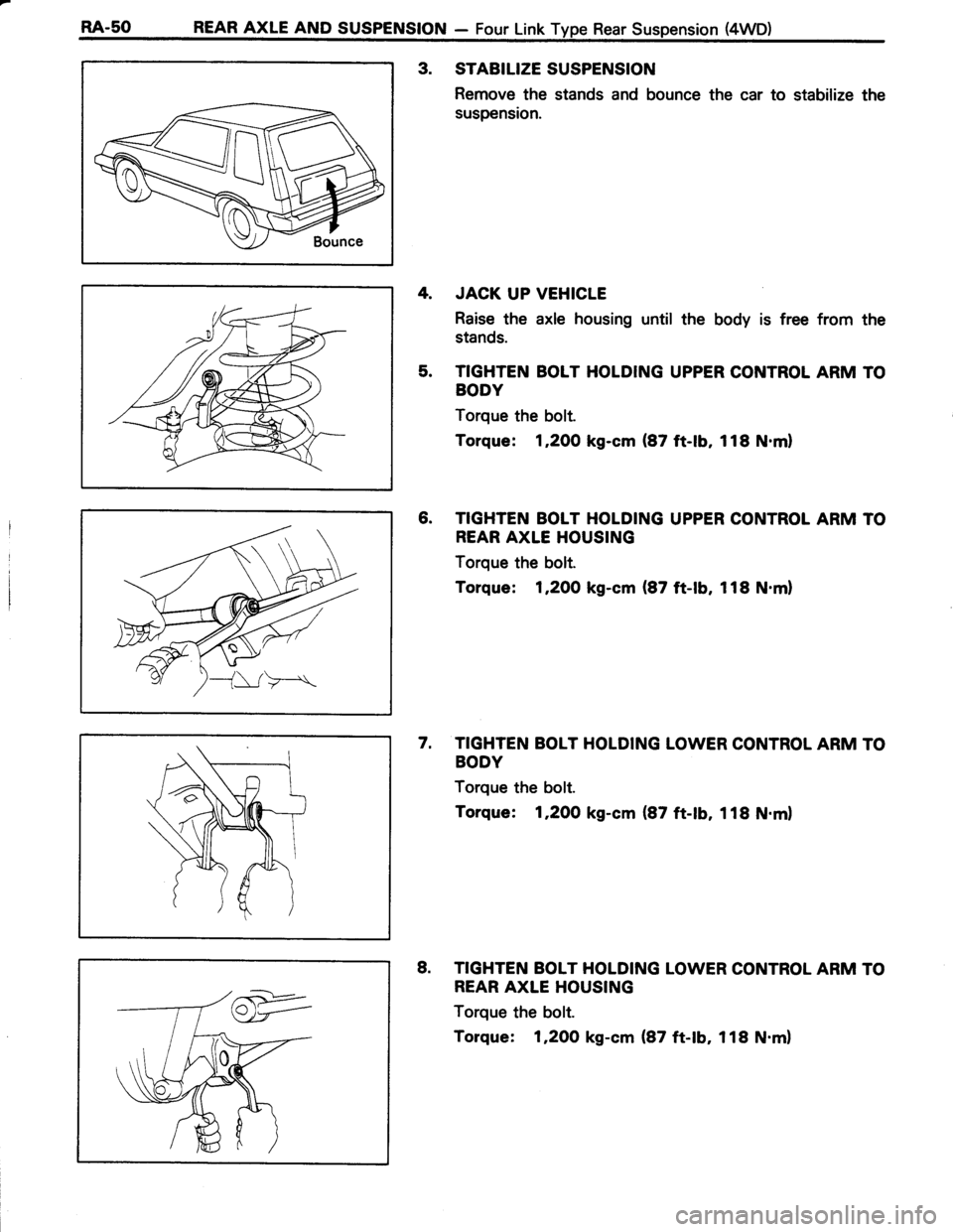
3. STABILIZESUSPENSION
Remove the stands and bounce the car to stabilize the
suspension.
4. JACK UP VEHICLE
Raise the axle housing until the body is free from the
stands.
5. TIGHTEN BOIT HOLDING UPPER CONTROL ARM TO
BODY
Torque the bolt.
Torque: 1,2OO kg-cm (87 ft-lb, 118 N.ml
6. TIGHTEN BOLT HOLDING UPPER CONTROT ARM TO
REAR AXLE HOUSING
Torque the bolt.
Torque: 1,2OO kg-cm (87 ft-lb, 1 18 N.ml
7, TIGHTEN BOLT HOLDING LOWER CONTROL ARM TO
BODY
Torque the bolt.
Torque: 1,2OO kg-cm (87 ft-lb, 118 N.ml
8. TIGHTEN BOLT HOLDING LOWER CONTROL ARM TO
REAR AXIE HOUSING
Torque the bolt.
Torque: 1,2OO kg-cm (87 ft-lb, 1 18 N.ml
Page 559 of 885
REAR AXLE AND SUSPENSION - Four Link Type Rear Suspension (4WD) ne-St
Rear Stabilizer Bar
(See page RA-421
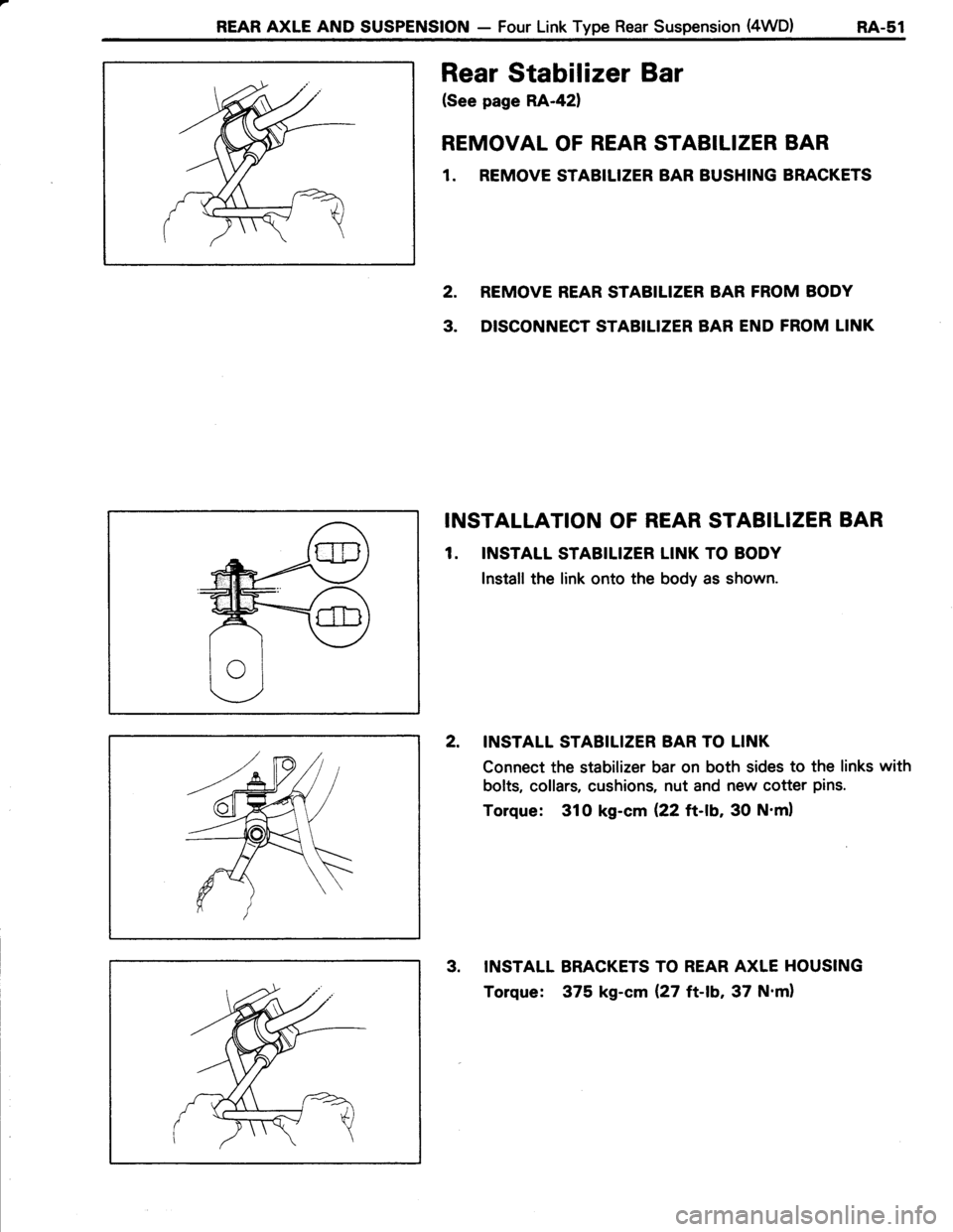
REMOVAL OF REAR STABILIZER BAR
1. REMOVE STABILIZER BAR BUSHING BRACKETS
2. REMOVE REAR STABILIZER BAR FROM BODY
3. DISCONNECT STABILIZER BAR END FROM LINK
INSTALLATION OF REAR STABILIZER BAR
1. INSTATL STABILIZER LINK TO BODY
Install the link onto the body as shown.
2. INSTALL STABILIZER BAR TO LINK
Connect the stabilizer bar on both sides to the links with
bolts, collars, cushions, nut and new cotter pins.
Torque: 310 kg-cm (22 ft-\b,30 N'ml
3. INSTALL BRACKETS TO REAR AXLE HOUSING
Torque: 375 kg-cm 127 ft-1b,37 N'm)
Page 564 of 885
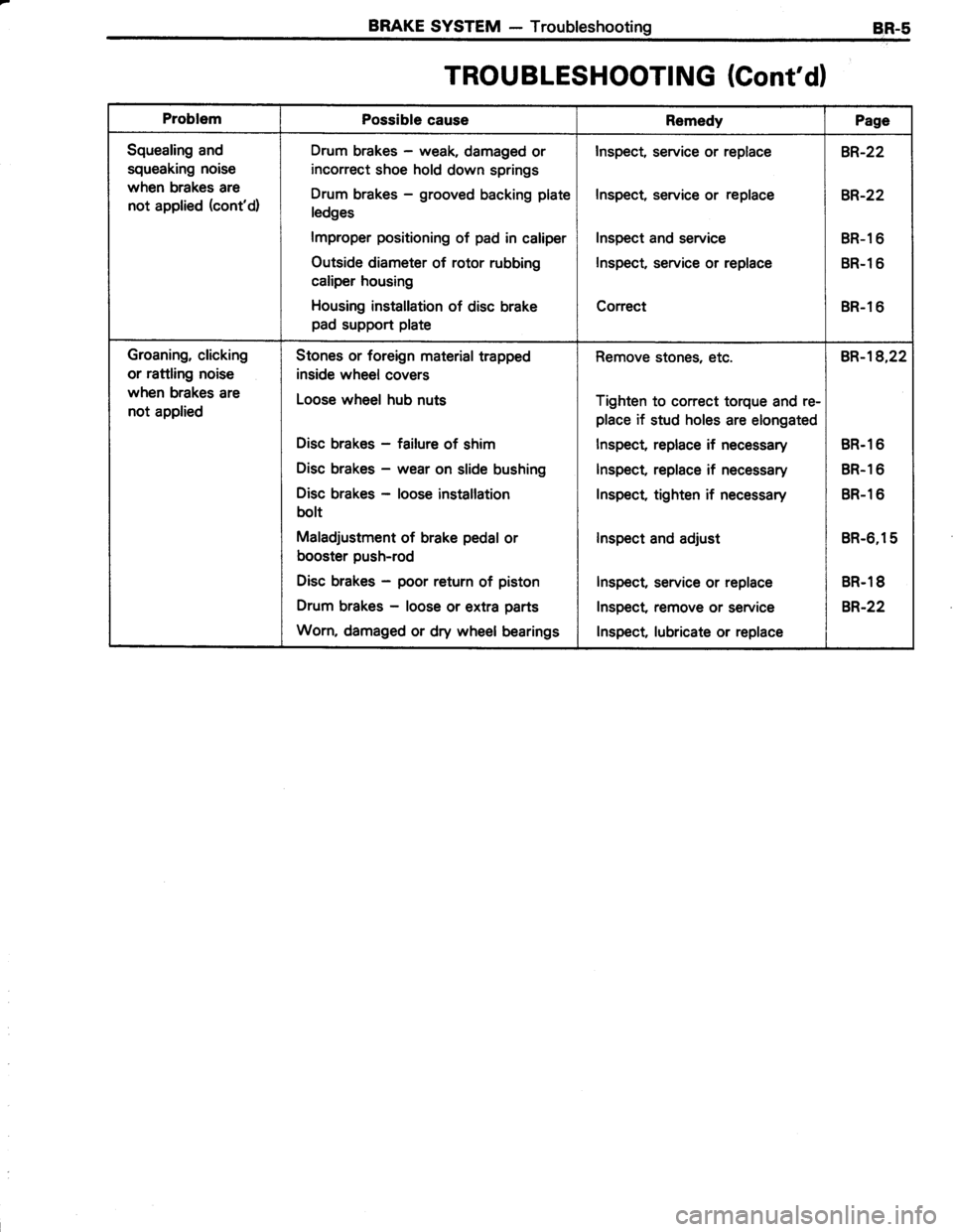
BRAKE SYSTEM - TroubleshootingBR-5
TROUBLESHOOTING (Cont'dl
ProblemPossible causeRemedyPage
Squealing and
squeaking noise
when brakes are
not applied (cont'd)
Drum brakes - weak, damaged or
incorrect shoe hold down springs
Drum brakes - grooved backing plate
ledges
lmproper positioning of pad in caliper
Outside diameter of rotor rubbing
caliper housing
Housing installation of disc brake
pad support plate
Inspect, service or replace
Inspect, service or replace
Inspect and service
Inspect, service or replace
Correct
BR-22
BR-22
BR-l 6
BR-l 6
BR-1 6
Groaning, clicking
or rattling noise
when brakes are
not applied
Stones or foreign material trapped
inside wheel covers
Loose wheel hub nuts
Disc brakes - failure of shim
Disc brakes - wear on slide bushing
Disc brakes - loose installation
bolt
Maladjustment of brake pedal or
booster push-rod
Disc brakes - poor return of piston
Drum brakes - loose or extra parts
Worn, damaged or dry wheel bearings
Remove stones, etc.
Tighten to correct torque and re-
place if stud holes are elongated
lnspect, replace if necessary
Inspect, replace if necessary
Inspect, tighten if necessary
lnspect and adjust
Inspect, service or replace
Inspect remove or service
lnspect lubricate or replace
BR-18,22
BR.1 6
BR.1 6
BR-1 6
BR-6,15
BR.1 8
B,R.22
Page 566 of 885
BRAKE SYSTEM - Checks and AdjustmentsBR-7
@@
VV
1 st 2nd
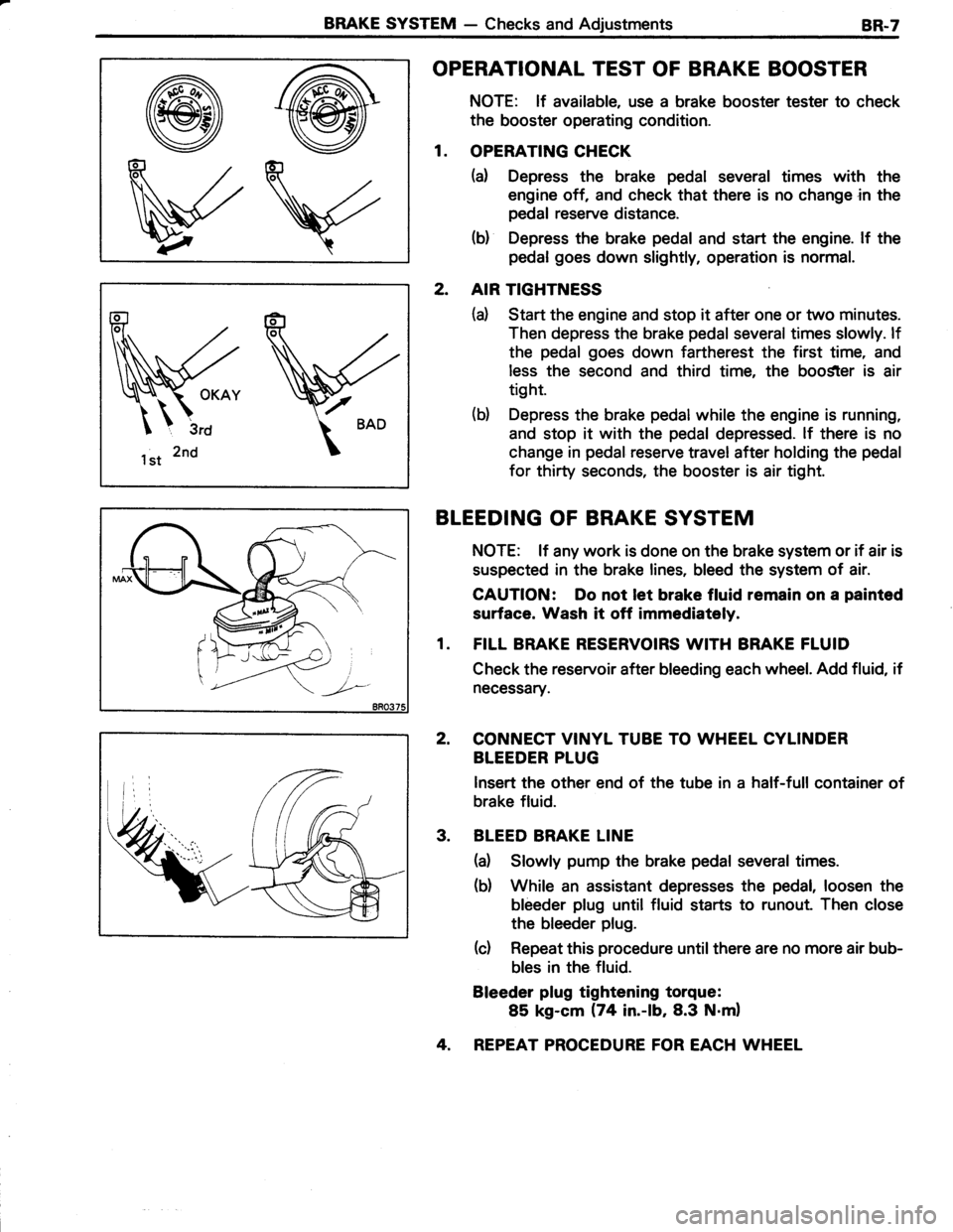
OPERATIONAL TEST OF BRAKE BOOSTER
NOTE: lf available, use a brake booster tester to check
the booster operating condition.
1. OPERATING CHECK
(a) Depress the brake pedal several times with the
engine off, and check that there is no change in the
pedal reserve distance.
(b) Depress the brake pedal and start the engine. lf the
pedal goes down slightly, operation is normal.
2. AIR TIGHTNESS
(d Start the engine and stop it after one or two minutes.
Then depress the brake pedal several times slowly. lf
the pedal goes down fartherest the first time, and
less the second and third time, the boo$ter is air
tight.
(b) Depress the brake pedal while the engine is running,
and stop it with the pedal depressed. lf there is no
change in pedal reserve travel after holding the pedal
for thirty seconds, the booster is air tight.
BLEEDING OF BRAKE SYSTEM
NOTE: lf any work is done on the brake system or if air is
suspected in the brake lines, bleed the system of air.
CAUTION: Do not let brake fluid remain on a painted
surface. Wash it off immediataly.
1. FILL BRAKE RESERVOIRS WITH BRAKE FLUID
Check the reservoir after bleeding each wheel. Add fluid, if
necessary.
2, CONNECT VINYL TUBE TO WHEEL CYLINDER
BLEEDER PLUG
lnsert the other end of the tube in a half-full container of
brake fluid.
3. BLEED BRAKE LINE
(a) Slowly pump the brake pedal several times.
(b) While an assistant depresses the pedal, loosen the
bleeder plug until fluid starts to runout. Then close
the bleeder plug.
(c) Repeat this procedure until there are no more air bub-
bles in the fluid.
Bleeder plug tightening torque:
85 kg-cm (74 in.-lb,8.3 N.m)
4. REPEAT PROCEDURE FOR EACH WHEEL