coolant level TOYOTA TUNDRA 2009 2.G Owners Manual
[x] Cancel search | Manufacturer: TOYOTA, Model Year: 2009, Model line: TUNDRA, Model: TOYOTA TUNDRA 2009 2.GPages: 672, PDF Size: 14.85 MB
Page 246 of 672
246
2-5. Driving information
Winter driving tips
Carry out the necessary preparations and inspections before driving
the vehicle in winter. Always drive the vehicle in a manner appropri-
ate to the prevailing weather conditions.
■ Pre-winter preparations
●Use fluids that are appropriate to the prevailing outside tem-
peratures.
• Engine oil
• Engine coolant
• Washer fluid
● Have a service technician inspect the level and specific grav-
ity of battery electrolyte.
● Have the vehicle fitted with four snow tires or purchase a set
of tire chains for the rear tires.
Ensure that all tires are the same size and brand, and that chains
match the size of the tires.
■Before driving the vehicle
Perform the following according to the driving conditions.
●Do not try to forcibly open a window, scrape an outside rear
view mirror surface or move a wiper or outside rear view mir-
ror that is frozen. Pour warm water over the frozen area to
melt the ice. Wipe away the water immediately to prevent it
from freezing.
● To ensure proper operation of th e climate control system fan,
remove any snow that has accumulated on the air inlet vents
in front of the windshield.
● Remove any ice that has accumu lated on the vehicle chassis.
● Periodically check for and remove any excess ice or snow
that may have accumulated in the wheel well or on the
brakes.
Page 467 of 672
467
4-2. Maintenance
4
Maintenance and care
General maintenance
Engine compartment
ItemsCheck points
Battery Maintenance-free. ( P. 489)
Brake fluid At the correct level? ( P. 486)
Engine coolant At the correct level? ( P. 484)
Engine oil At the correct level? ( P. 479)
Exhaust system No fumes or strange sounds?
Power steering fluid At the correct level? ( P. 488)
Radiator/condenser/hoses Not blocked with foreign matter?
(
P. 486)
Washer fluid At the correct level? ( P. 492)
Listed below are the general maintenance items that should be per-
formed at the intervals specified in the “Scheduled Maintenance
Guide” or “Owner’s Manual Supp lement”. It is recommended that
any problem you notice should be brought to the attention of your
Toyota dealer or qualified service shop for advice.
Page 471 of 672
471
4
Maintenance and care
4-3. Do-it-yourself maintenance
Do-it-yourself ser vice precautions
If you perform maintenance yourself, be sure to follow the correct
procedures as given in these sections.
ItemsParts and tools
Battery condition ( P. 489)•Warm water
• Baking soda
• Grease
• Conventional wrench
(for terminal clamp bolts)
Brake fluid level ( P. 486)• FMVSS No.116 DOT 3 or SAE
J1703 brake fluid
• Rag or paper towel
Engine coolant level ( P. 484)• “Toyota Super Long Life Coolant”
or similar high quality ethylene
glycol based non-silicate, non-
amine, non-nitrite and non-borate
coolant with long-life hybrid
organic acid technology.
U.S.A.:
“Toyota Super Long Life Coolant”
is pre-mixed with 50% coolant
and 50% deionized water.
Canada:
“Toyota Super Long Life Coolant”
is pre-mixed with 55% coolant
and 45% deionized water.
Engine oil level P. 479) • Toyota Genuine Motor Oil or
equivalent
• Rag or paper towel
• Funnel (used only for adding oil)
Fuses ( P. 512)• Fuse with same amperage rating
as original
Page 476 of 672
476
4-3. Do-it-yourself maintenance
Engine compar tment
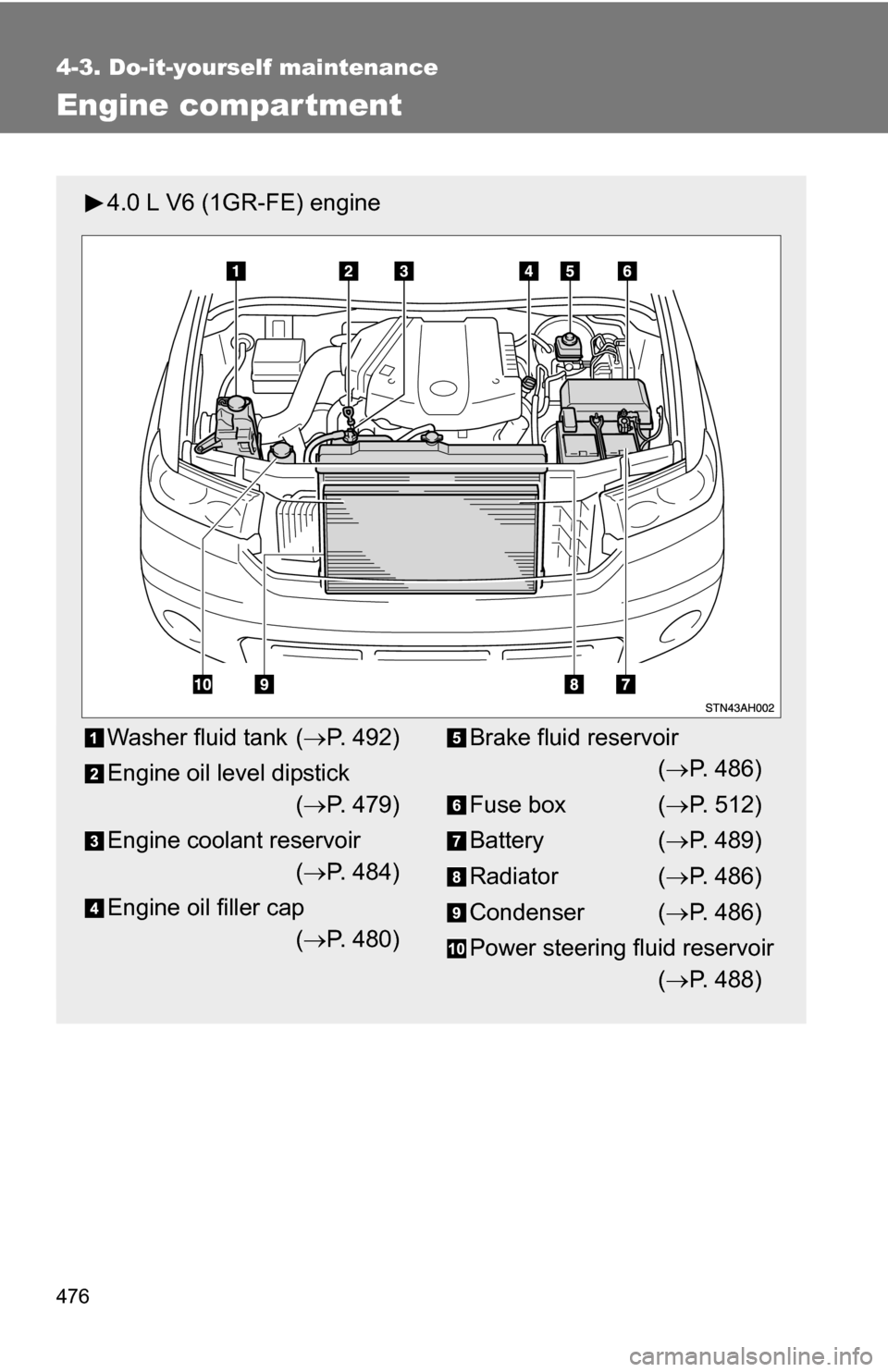
4.0 L V6 (1GR-FE) engine
Washer fluid tank (P. 492)
Engine oil level dipstick ( P. 479)
Engine coolant reservoir ( P. 484)
Engine oil filler cap ( P. 480)Brake fluid reservoir
( P. 486)
Fuse box ( P. 512)
Battery ( P. 489)
Radiator ( P. 486)
Condenser ( P. 486)
Power steering fluid reservoir ( P. 488)
Page 477 of 672
477
4-3. Do-it-yourself maintenance
4
Maintenance and care
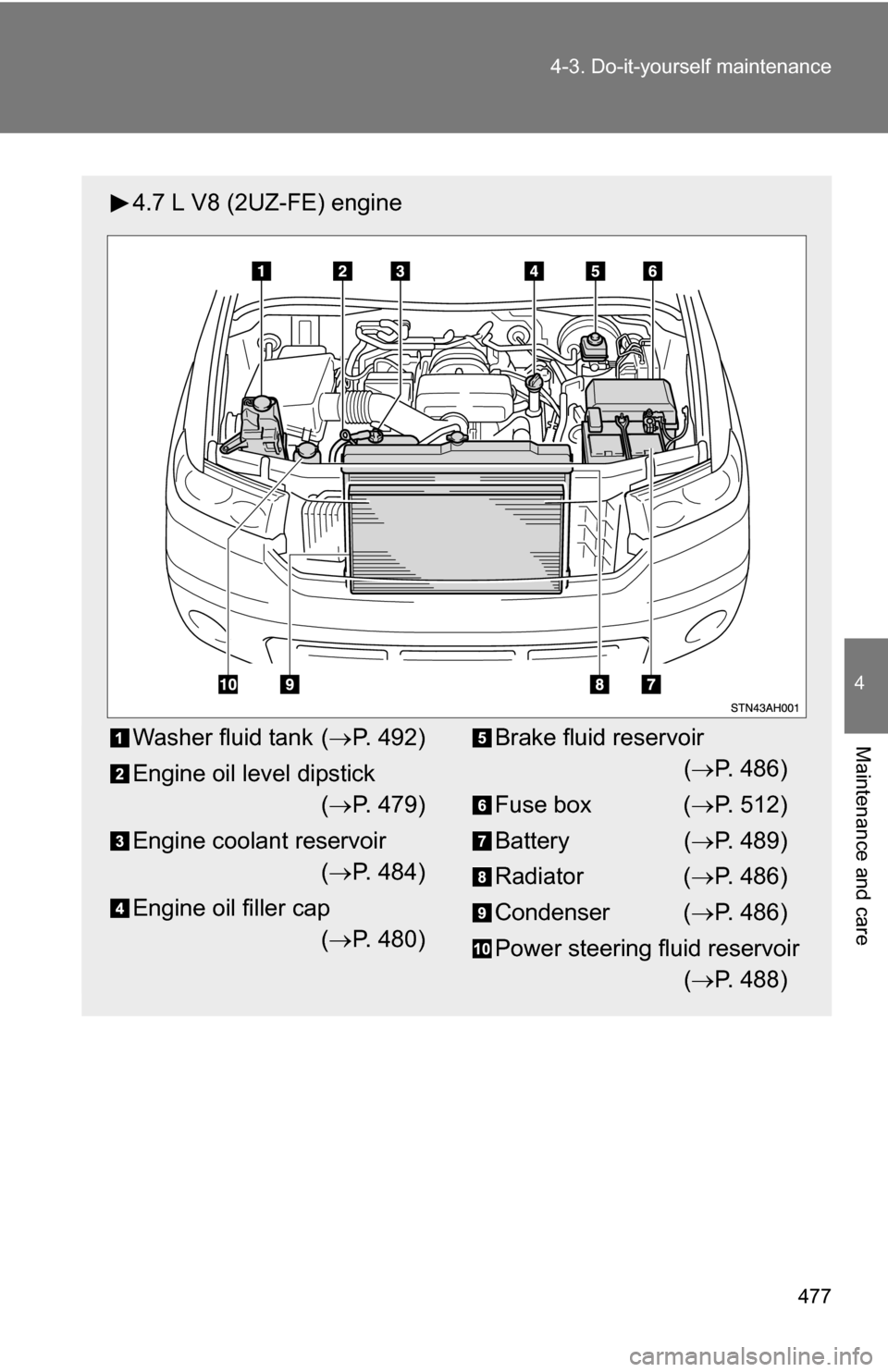
4.7 L V8 (2UZ-FE) engine
Washer fluid tank (
P. 492)
Engine oil level dipstick ( P. 479)
Engine coolant reservoir ( P. 484)
Engine oil filler cap ( P. 480)Brake fluid reservoir
( P. 486)
Fuse box ( P. 512)
Battery ( P. 489)
Radiator ( P. 486)
Condenser ( P. 486)
Power steering fluid reservoir ( P. 488)
Page 478 of 672
478 4-3. Do-it-yourself maintenance
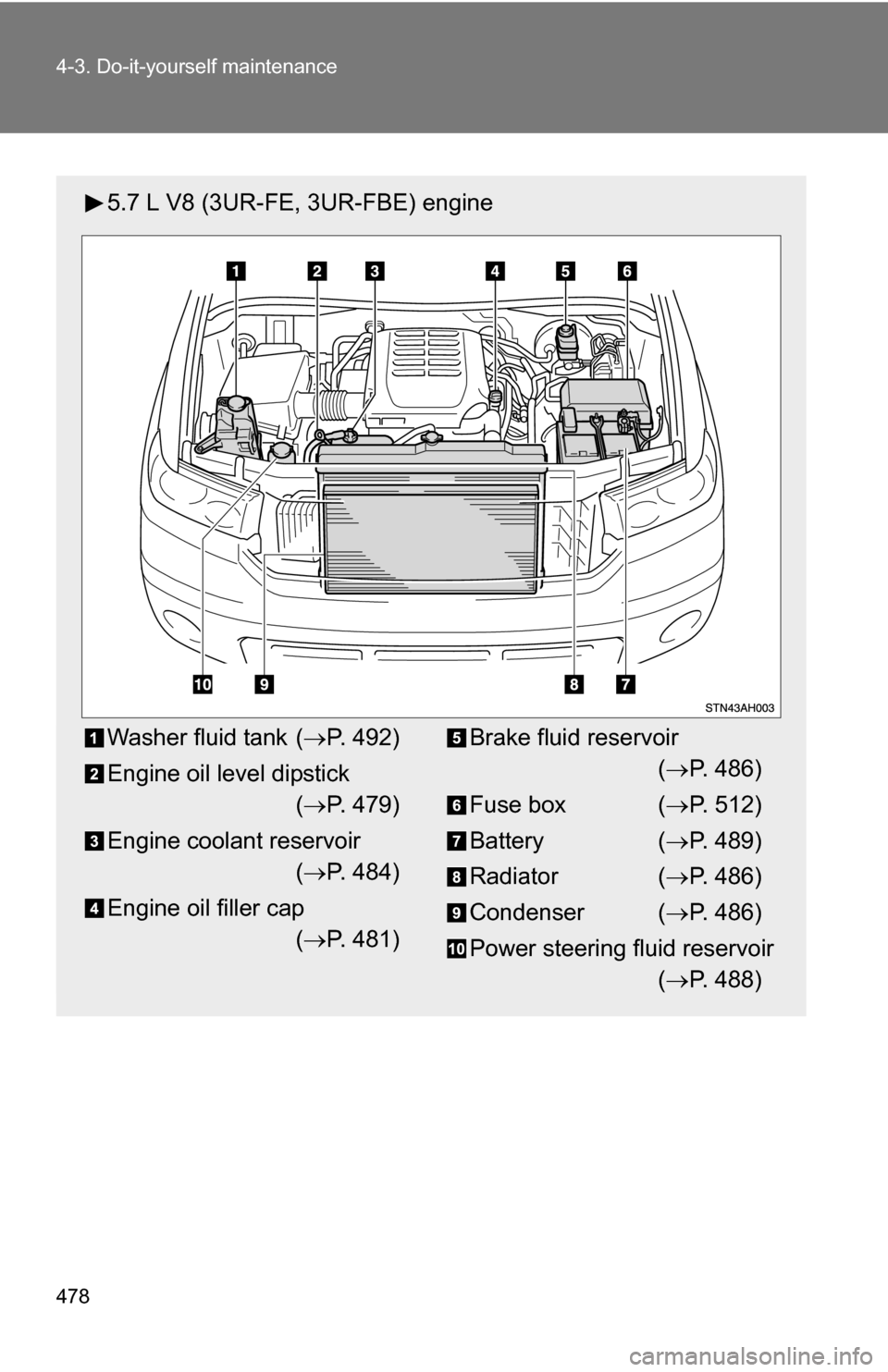
5.7 L V8 (3UR-FE, 3UR-FBE) engine
Washer fluid tank (P. 492)
Engine oil level dipstick ( P. 479)
Engine coolant reservoir ( P. 484)
Engine oil filler cap ( P. 481)Brake fluid reservoir
( P. 486)
Fuse box ( P. 512)
Battery ( P. 489)
Radiator ( P. 486)
Condenser ( P. 486)
Power steering fluid reservoir ( P. 488)
Page 484 of 672
484 4-3. Do-it-yourself maintenance
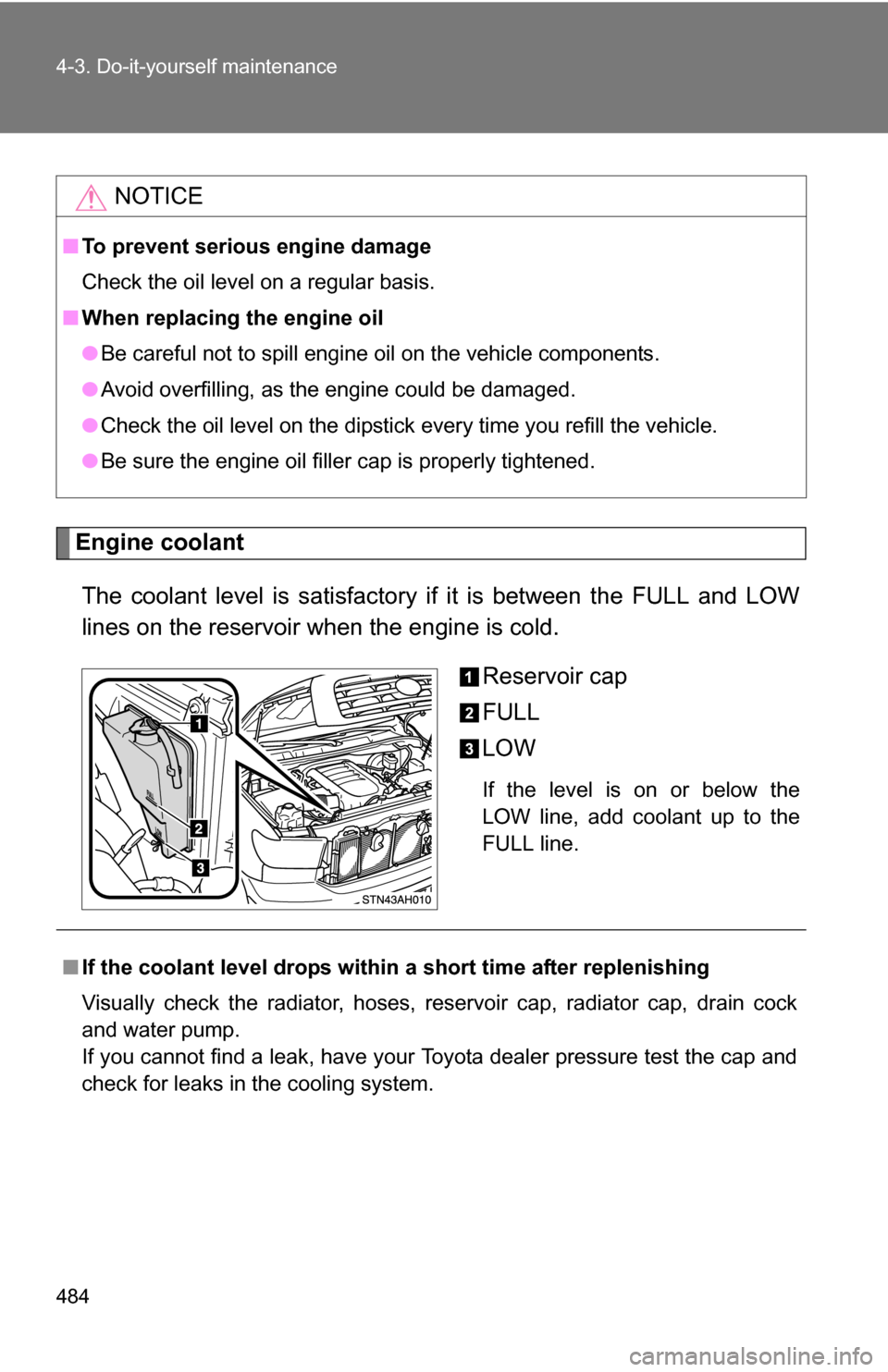
Engine coolantThe coolant level is satisfactory if it is between the FULL and LOW
lines on the reservoir when the engine is cold. Reservoir cap
FULL
LOW
If the level is on or below the
LOW line, add coolant up to the
FULL line.
NOTICE
■To prevent serious engine damage
Check the oil level on a regular basis.
■ When replacing the engine oil
●Be careful not to spill engine oil on the vehicle components.
● Avoid overfilling, as the engine could be damaged.
● Check the oil level on the dipstick every time you refill the vehicle.
● Be sure the engine oil filler cap is properly tightened.
■If the coolant level drops within a short time after replenishing
Visually check the radiator, hoses, reservoir cap, radiator cap, drain cock
and water pump.
If you cannot find a leak, have your Toyota dealer pressure test the cap and
check for leaks in the cooling system.
Page 541 of 672
5
When trouble arises
541
5-1. Essential information
If you think something is wrong
If you notice any of the following symptoms, your vehicle probably
needs adjustment or repair. Contact your Toyota dealer as soon as
possible.
■ Visible symptoms
●Fluid leaks under the vehicle
(Water dripping from the air cond itioning after use is normal.)
● Flat-looking tires or uneven tire wear
● Engine coolant temperature g auge needle continually points
higher than normal
● Voltmeter continually points higher or lower than normal
(if equipped)
● Engine oil pressure gauge continually points lower than nor-
mal (if equipped)
● Automatic transmission fluid temperature gauge needle con-
tinually points higher than normal (if equipped)
■ Audible symptoms
●Changes in exhaust sound
● Excessive tire squeal when cornering
● Strange noises related to the suspension system
● Pinging or other noises related to the engine
■ Operational symptoms
●Engine missing, stumbling or running rough
● Appreciable loss of power
● Vehicle pulls heavily to one side when braking
● Vehicle pulls heavily to one side when driving on a level road
● Loss of brake effectiveness, s pongy feeling, pedal almost
touches the floor
Page 586 of 672
586 5-2. Steps to take in an emergency
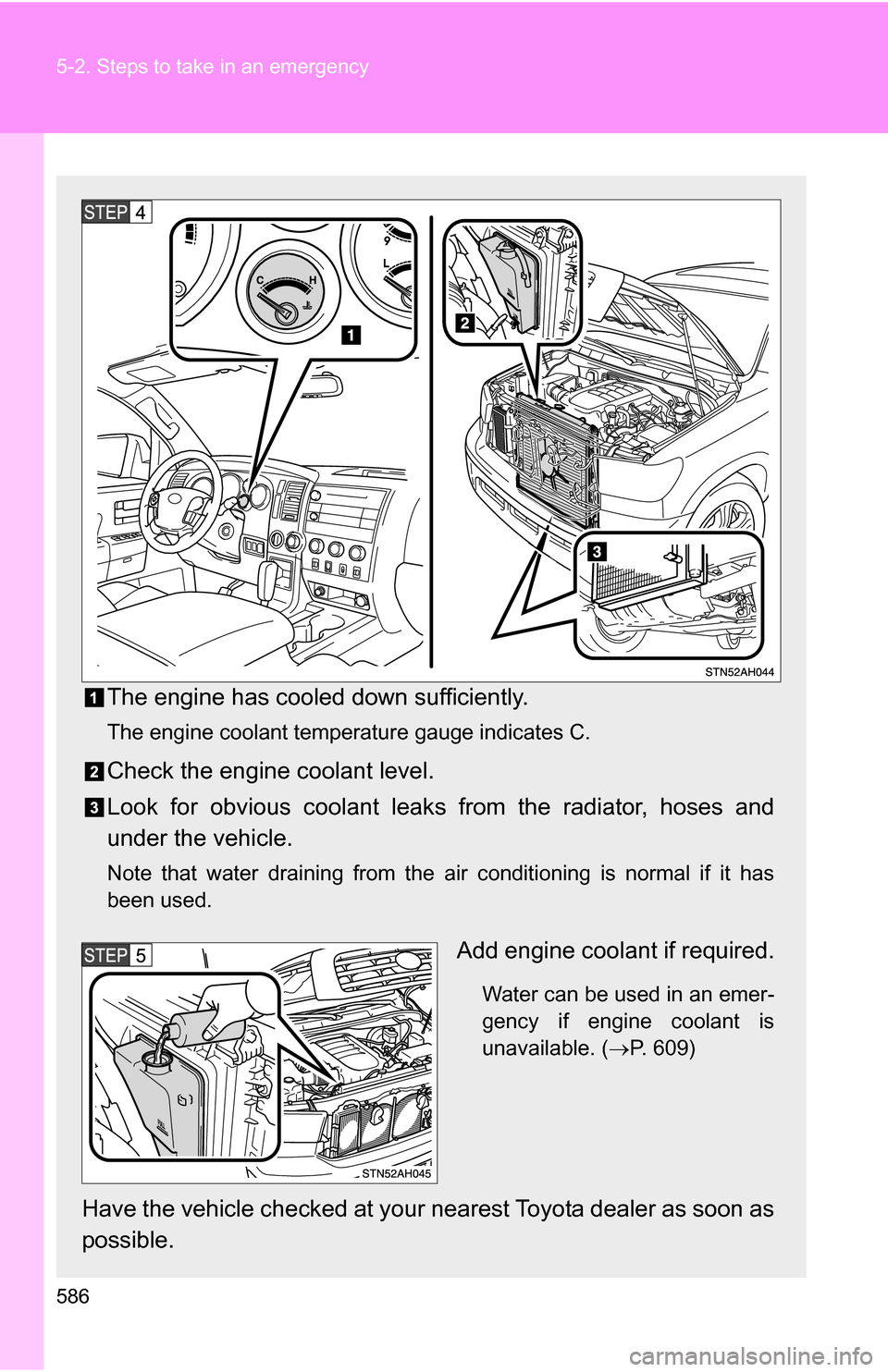
The engine has cooled down sufficiently.
The engine coolant temperature gauge indicates C.
Check the engine coolant level.
Look for obvious coolant leaks from the radiator, hoses and
under the vehicle.
Note that water draining from the air conditioning is normal if it has
been used.
Add engine coolant if required.
Water can be used in an emer-
gency if engine coolant is
unavailable. ( P. 609)
Have the vehicle checked at your nearest Toyota dealer as soon as
possible.