air condition TOYOTA TUNDRA 2010 2.G User Guide
[x] Cancel search | Manufacturer: TOYOTA, Model Year: 2010, Model line: TUNDRA, Model: TOYOTA TUNDRA 2010 2.GPages: 724, PDF Size: 13.74 MB
Page 133 of 724

133
1-7. Safety information
1
Before driving
■
Passenger risk group
For more detailed information conc erning about the passenger risk
group, please contact NHTSA at 1-888-327-4236 or Transport
Canada at 1-800-333-0371.
TABLE 1: A PASSENGER RISK GROUP
Infant. An infant (less than 1 year old) who must ride in the front seat
because:
• Vehicle has no rear seat;
• Vehicle has a rear seat too small to accommodate a rear-facing infant seat; or
• The infant has a medical condition which, according to the infant’s phy- sician, makes it necessary for the infant to ride in the front seat so that
the driver can constantly monitor the child’s condition.
Child age 1 to 12. A child age 1 to 12 must ride in the front seat because:
• Vehicle has no rear seat:
• Although children ages 1 to 12 ride in the rear seat(s) whenever possi- ble, children ages 1 to 12 sometimes must ride in the front because no
space is available in the rear seat(s) of vehicle; or
• The child has a medical condition which, according to the child’s physi- cian, makes it necessary for the child to ride in the front seat so that\
the
driver can constantly monitor the child’s condition.
Medical condition. A passenger has a medical condition which accord-
ing to his or her physician:
• Causes the passenger airbag to pose a special risk for the passenger: and
• Makes the potential harm from the passenger airbag in a crash greater than the potential harm from turning off the airbag and allowing the pas-
senger, even if belted, to hit the dashboard, or windshield in a crash.
Page 134 of 724
134 1-7. Safety information
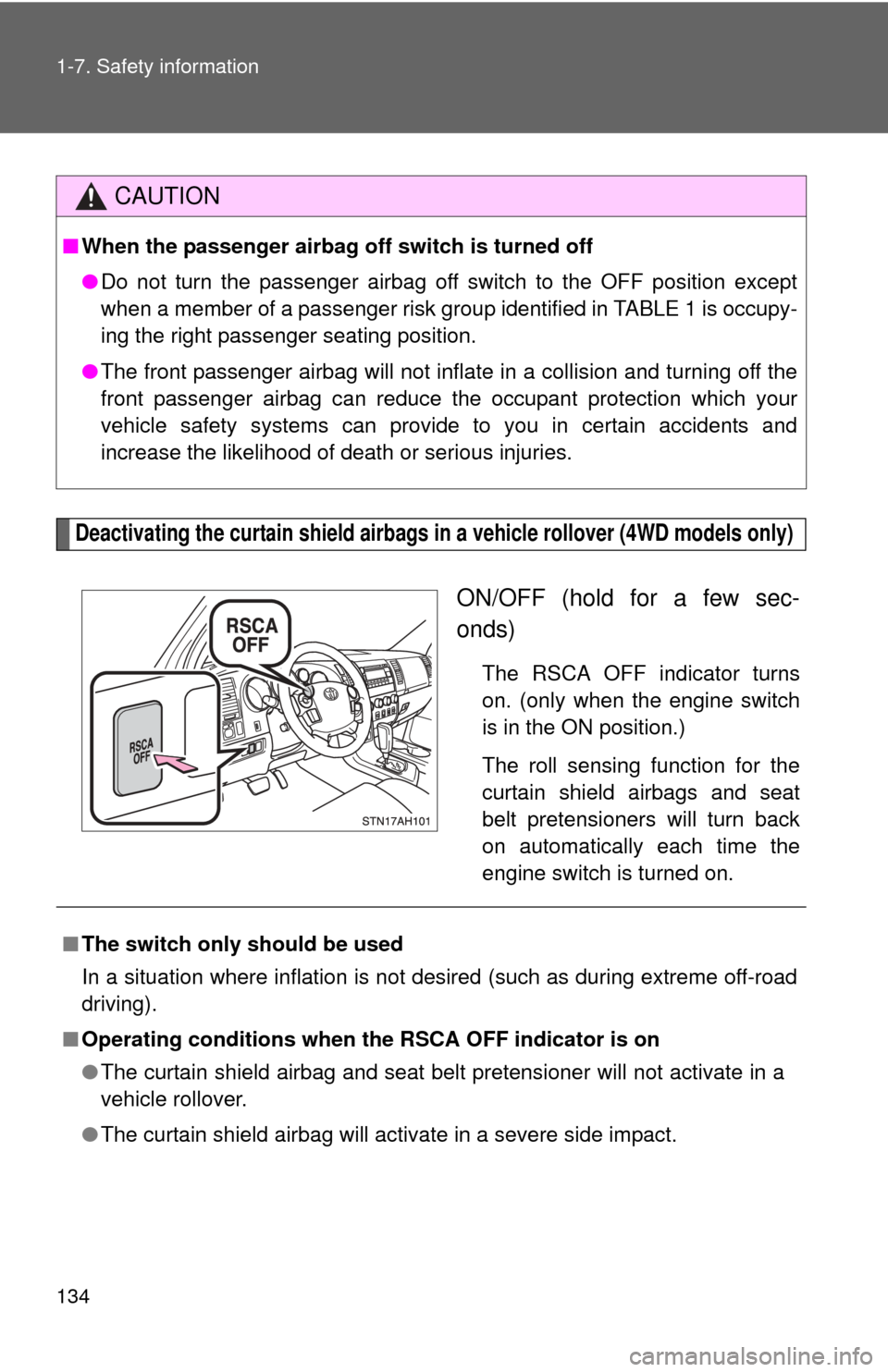
Deactivating the curtain shield airbags in a vehicle rollover (4WD models only)
ON/OFF (hold for a few sec-
onds)
The RSCA OFF indicator turns
on. (only when the engine switch
is in the ON position.)
The roll sensing function for the
curtain shield airbags and seat
belt pretensioners will turn back
on automatically each time the
engine switch is turned on.
CAUTION
■When the passenger airbag of f switch is turned off
● Do not turn the passenger airbag off switch to the OFF position except
when a member of a passenger risk group identified in TABLE 1 is occupy-
ing the right passenger seating position.
● The front passenger airbag will not inflate in a collision and turning off the
front passenger airbag can reduce the occupant protection which your
vehicle safety systems can provide to you in certain accidents and
increase the likelihood of death or serious injuries.
■The switch only should be used
In a situation where inflation is not desired (such as during extreme off-road
driving).
■ Operating conditions when th e RSCA OFF indicator is on
● The curtain shield airbag and seat belt pretensioner will not activate in a
vehicle rollover.
● The curtain shield airbag will activate in a severe side impact.
Page 136 of 724
136
1-7. Safety information
Front passenger occupant classification system
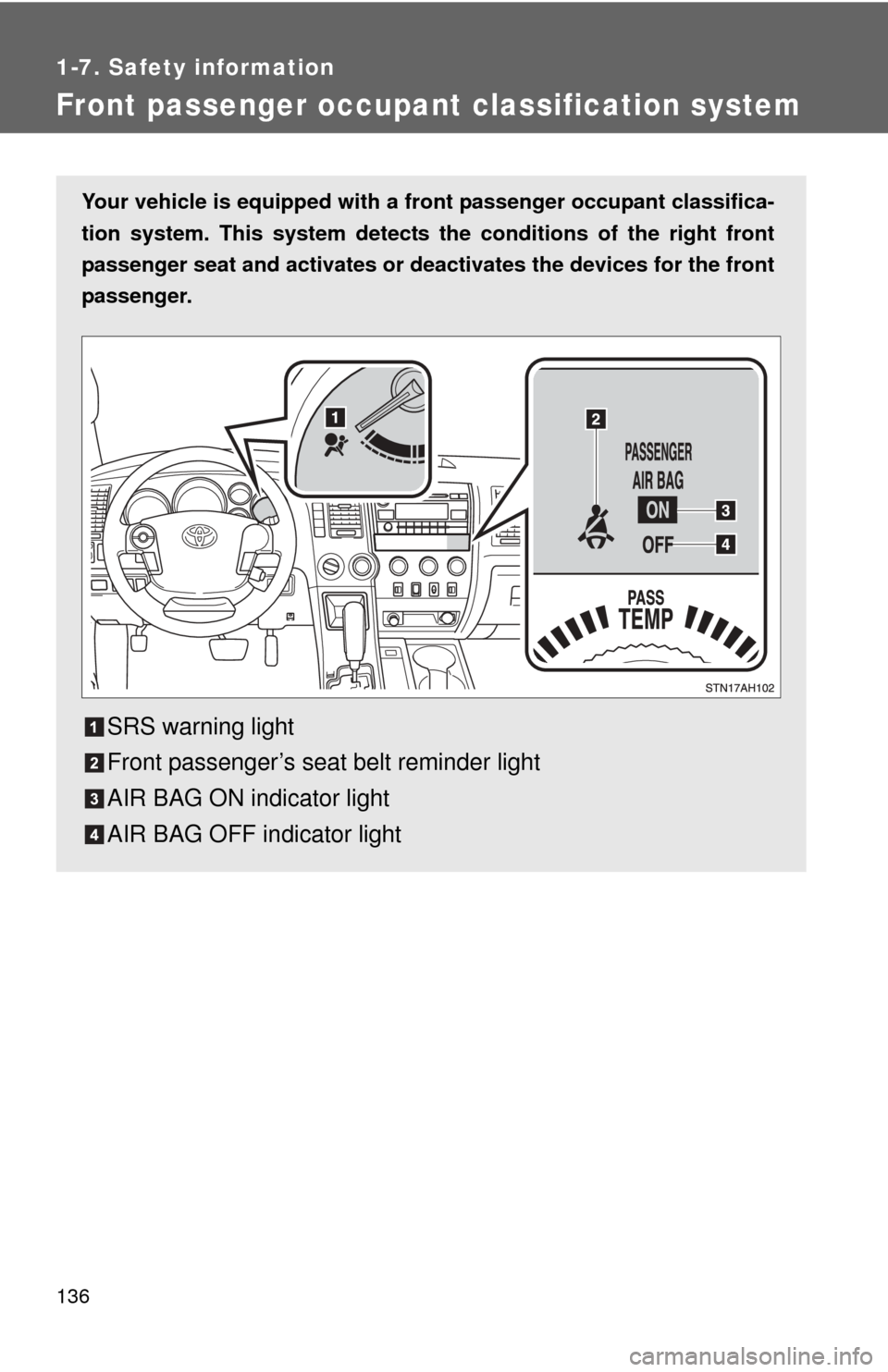
Your vehicle is equipped with a front passenger occupant classifica-
tion system. This system detects the conditions of the right front
passenger seat and activates or deactivates the devices for the front
passenger.
SRS warning light
Front passenger’s seat belt reminder light
AIR BAG ON indicator light
AIR BAG OFF indicator light
Page 137 of 724
137
1-7. Safety information
1
Before driving
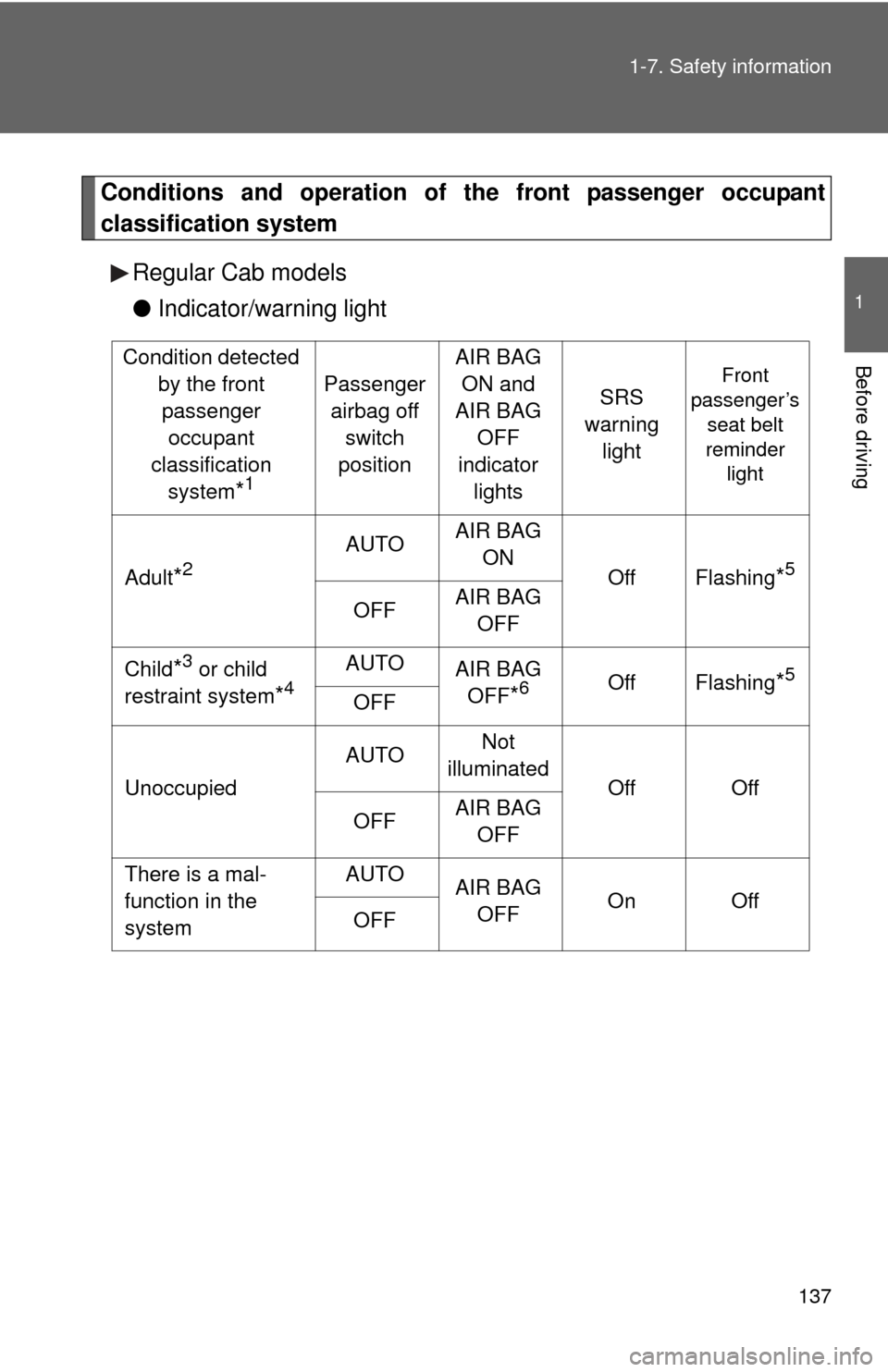
Conditions and operation of
the front passenger occupant
classification system
Regular Cab models
●Indicator/warning light
Condition detected
by the front passenger occupant
classification system
*1
Passenger airbag off switch
position
AIR BAG ON and
AIR BAG OFF
indicator lights
SRS
warning light
Front
passenger’s
seat belt
reminder light
Adult*2
AUTOAIR BAG
ON
OffFlashing*5
OFFAIR BAG OFF
Child*3 or child
restraint system
*4
AUTOAIR BAG OFF
*6OffFlashing*5
OFF
Unoccupied
AUTONot
illuminated
OffOff
OFFAIR BAG OFF
There is a mal-
function in the
systemAUTOAIR BAG OFFOnOffOFF
Page 138 of 724
138 1-7. Safety information
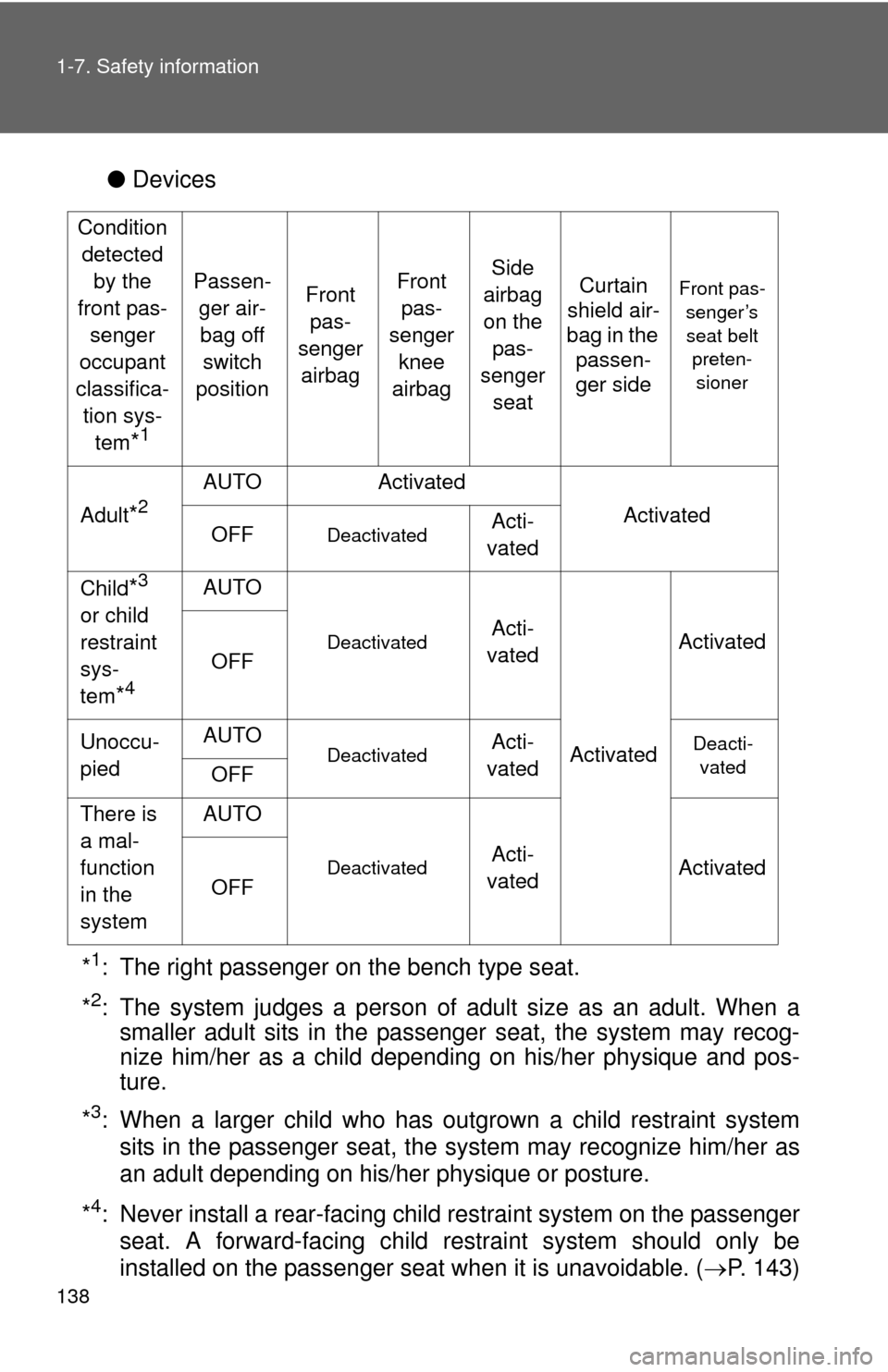
●Devices
*
1: The right passenger on the bench type seat.
*
2: The system judges a person of adult size as an adult. When a smaller adult sits in the passenger seat, the system may recog-
nize him/her as a child depending on his/her physique and pos-
ture.
*
3: When a larger child who has outgrown a child restraint system sits in the passenger seat, the system may recognize him/her as
an adult depending on his/her physique or posture.
*
4: Never install a rear-facing child restraint system on the passenger
seat. A forward-facing child rest raint system should only be
installed on the passenger seat when it is unavoidable. ( P. 143)
Condition
detected by the
front pas- senger
occupant
classifica- tion sys- tem
*1
Passen-ger air-bag off switch
positionFront pas-
senger airbagFront pas-
senger knee
airbagSide
airbag
on the pas-
senger seatCurtain
shield air-
bag in the passen-
ger sideFront pas-
senger’s seat belt preten-sioner
Adult*2
AUTOActivated
ActivatedOFFDeactivatedActi-
vated
Child*3
or child
restraint
sys-
tem
*4
AUTO
DeactivatedActi-
vated
Activated
ActivatedOFF
Unoccu-
piedAUTODeactivatedActi-
vatedDeacti- vated
OFF
There is
a mal-
function
in the
systemAUTO
DeactivatedActi-
vatedActivatedOFF
Page 139 of 724
139
1-7. Safety information
1
Before driving
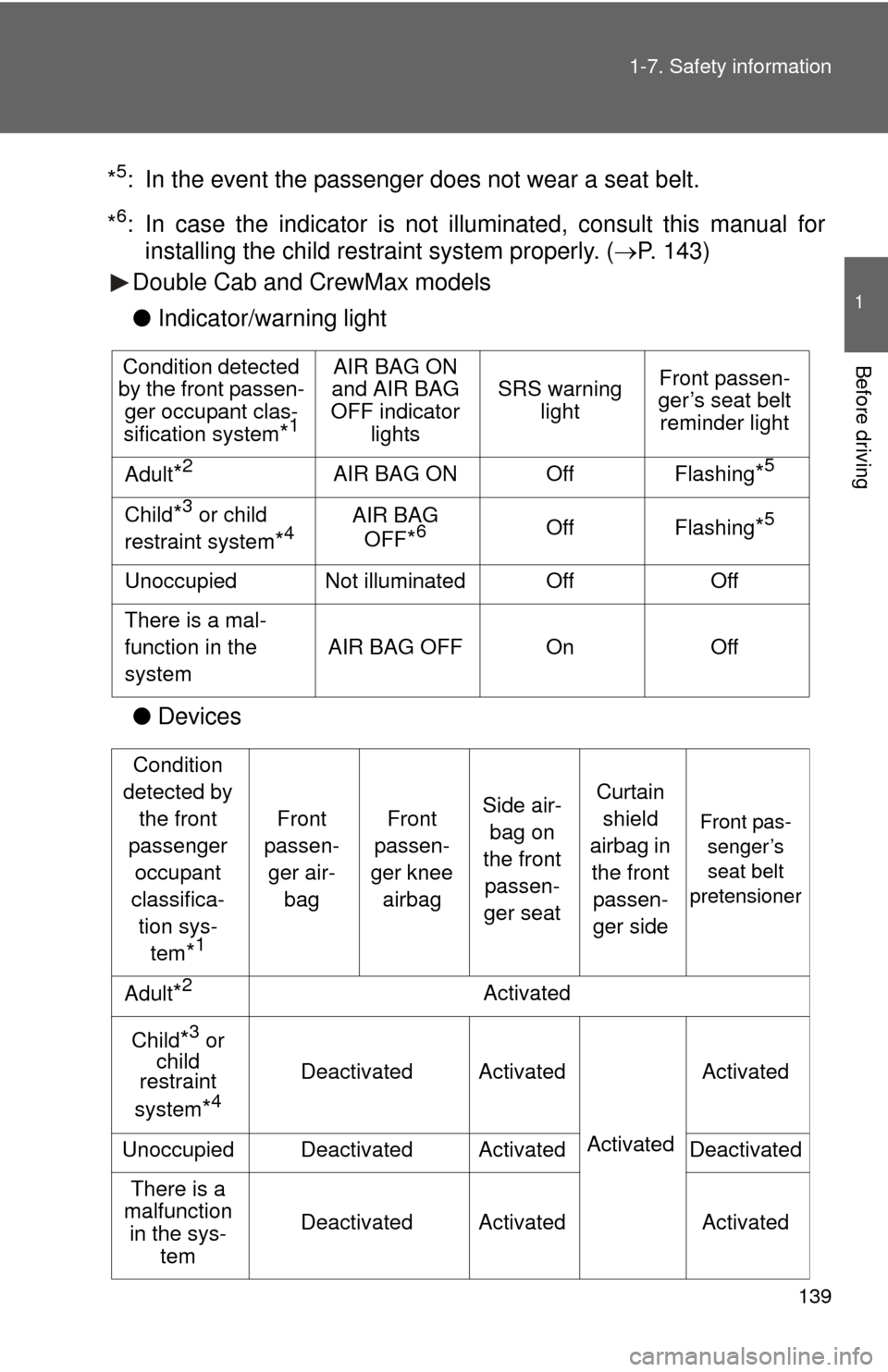
*5: In the event the passenger d
oes not wear a seat belt.
*
6: In case the indicator is not illu minated, consult this manual for
installing the child restra int system properly. (P. 143)
Double Cab and CrewMax models
● Indicator/warning light
● Devices
Condition detected
by the front passen-
ger occupant clas-
sification system
*1
AIR BAG ON
and AIR BAG
OFF indicator lightsSRS warning lightFront passen-
ger’s seat belt reminder light
Adult*2AIR BAG ONOffFlashing*5
Child*3 or child
restraint system
*4AIR BAG OFF
*6OffFlashing*5
UnoccupiedNot illuminatedOffOff
There is a mal-
function in the
system
AIR BAG OFFOnOff
Condition
detected by the front
passenger occupant
classifica- tion sys- tem
*1
Front
passen- ger air- bagFront
passen-
ger knee airbagSide air-bag on
the front passen-
ger seatCurtain shield
airbag in the front passen-
ger side
Front pas- senger’s seat belt
pretensioner
Adult*2Activated
Child*3 or
child
restraint
system
*4
DeactivatedActivated
Activated
Activated
UnoccupiedDeactivatedActivatedDeactivated
There is a
malfunction
in the sys- tem
DeactivatedActivatedActivated
Page 228 of 724

228 2-4. Using other driving systems
■The Intuitive parking assist system can be operated when
●Front corner sensors:
• The engine switch is in the ON position.
• The shift lever is in R.
• The shift lever is not in P or R and vehicle speed is approximate 6 mph
(10 km/h) or less.
● Back and rear corner sensors:
• The engine switch is in the ON position.
• The shift lever is in R
■ Sensor detection information
●Certain vehicle conditions and the surrounding environment may affect
the ability of a sensor to correctly detect an obstacle. Particular instances
where this may occur are listed below.
• There is dirt, snow or ice on a sensor.
• A sensor is frozen.
• A sensor is covered in any way.
• The vehicle is leaning considerably to one side.
• On an extremely bumpy road, on an incline, on gravel, or on grass.
• The vicinity of the vehicle is noisy due to vehicle horns, motorcycle
engines, air brakes of large vehicles, or other loud noises producing
ultrasonic waves.
• There is another vehicle equipped with intuitive parking assist sensors in the vicinity.
• A sensor is coated with a sheet of spray or heavy rain.
• The vehicle is equipped with a fender pole or radio antenna.
• A bumper or sensor receives a strong impact.
• The vehicle is approaching a tall or right-angled curb.
• In harsh sunlight or intense cold weather.
• The area directly under the bumpers is not detected. Objects lower than the sensors or thin stakes etc. may be detected ini-
tially, but as they draw closer, they may cease to be detected.
• A towing hitch is mounted to the vehicle.
• A non-genuine Toyota suspension (lowered suspension etc.) is installed.
• When attaching a two-way radio antenna.
• When the bumper is damaged.
Page 260 of 724
260
2-5. Driving information
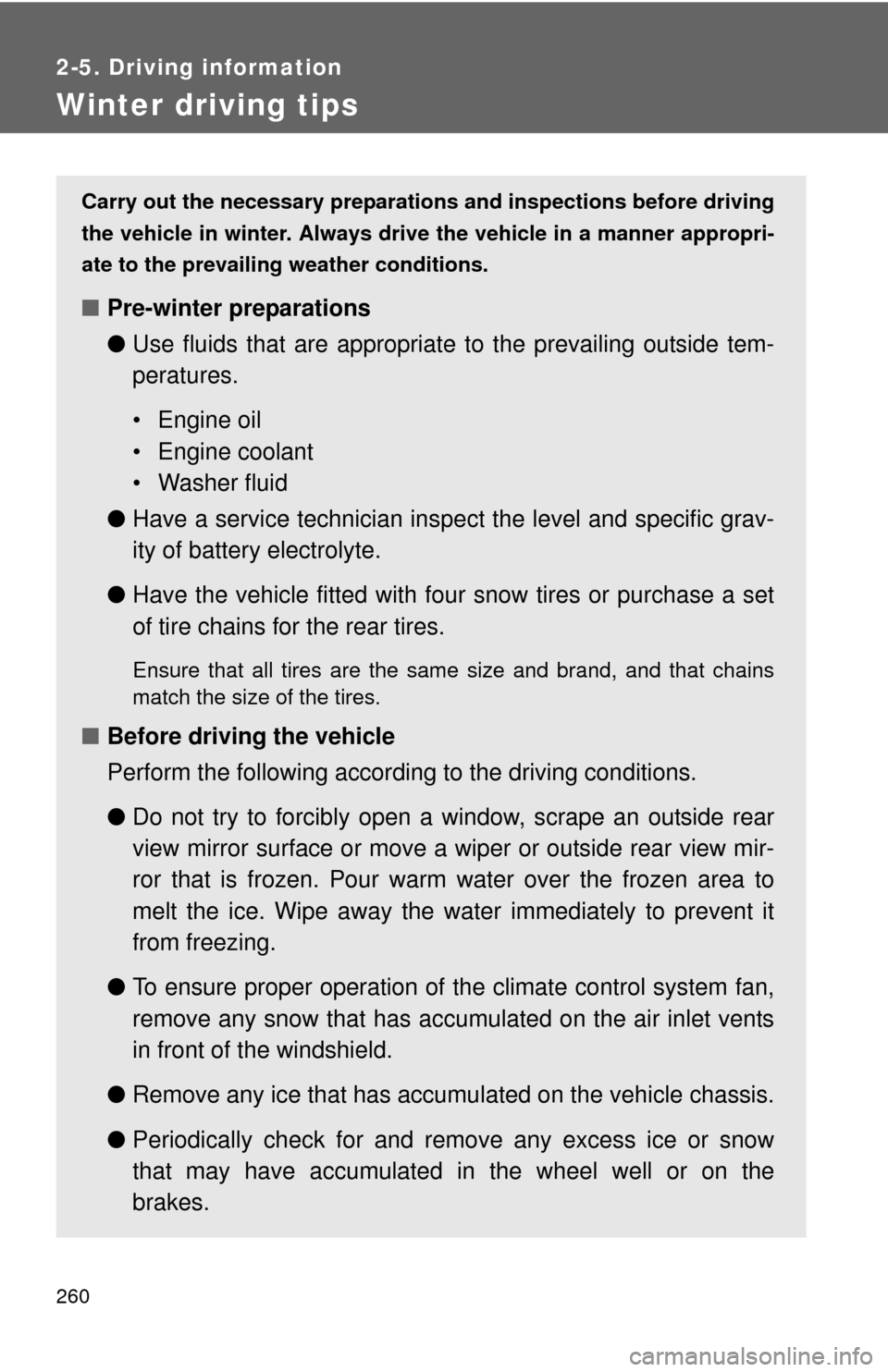
Winter driving tips
Carry out the necessary preparations and inspections before driving
the vehicle in winter. Always drive the vehicle in a manner appropri-
ate to the prevailing weather conditions.
■ Pre-winter preparations
●Use fluids that are appropriate to the prevailing outside tem-
peratures.
• Engine oil
• Engine coolant
• Washer fluid
● Have a service technician inspect the level and specific grav-
ity of battery electrolyte.
● Have the vehicle fitted with four snow tires or purchase a set
of tire chains for the rear tires.
Ensure that all tires are the same size and brand, and that chains
match the size of the tires.
■Before driving the vehicle
Perform the following according to the driving conditions.
●Do not try to forcibly open a window, scrape an outside rear
view mirror surface or move a wiper or outside rear view mir-
ror that is frozen. Pour warm water over the frozen area to
melt the ice. Wipe away the water immediately to prevent it
from freezing.
● To ensure proper operation of th e climate control system fan,
remove any snow that has accumulated on the air inlet vents
in front of the windshield.
● Remove any ice that has accumu lated on the vehicle chassis.
● Periodically check for and remove any excess ice or snow
that may have accumulated in the wheel well or on the
brakes.
Page 279 of 724

279
2-5. Driving information
2
When driving
●
Crosswinds and rough roads will adversely affect handling of your
vehicle and trailer, causing sway . Periodically check the rear to
prepare for being passed by large trucks or buses, which may
cause your vehicle and trailer to sway. If swaying occurs, firmly grip
the steering wheel, reduce speed immediately but gradually, and
steer straight ahead. Never increase speed. If you make no
extreme correction with the stee ring or brakes, your vehicle and
trailer will stabilize.
● Take care when passing other vehicles. Passing requires consider-
able distance. After passing a vehicle, do not forget the length of
your trailer, and be sure you hav e plenty of room before changing
lanes.
● In order to maintain engine braking efficiency when driving on a
long steep downgrade, do not use the transmission in D.
Transmission shift range position must be in 5 in the S mode (6-
speed models) or in 4 in the S mode (5-speed models).
● Due to the added load of the trailer, your vehicle’s engine may
overheat on hot days (at temperatures over 85°F [30°C]) when
driving up a long or steep grade. If the engine coolant temperature
gauge indicates overheating, immedi ately turn off the air condition-
ing (if in use), pull your vehicle off the road and stop in a safe spot.
( P. 634)
● Always place wheel blocks under both the vehicle and the trailer
wheels when parking. Apply the parking brake firmly, and put the
transmission in P. Avoid parking on a slope, but if unavoidable, do
so only after performing the following:
Apply the brakes and keep them applied.
Have someone place wheel blocks under both the vehicle and
trailer wheels.
When the wheel blocks are in pl ace, release the brakes slowly
until the blocks absorb the load.
Apply the parking brake firmly.
Page 286 of 724
286
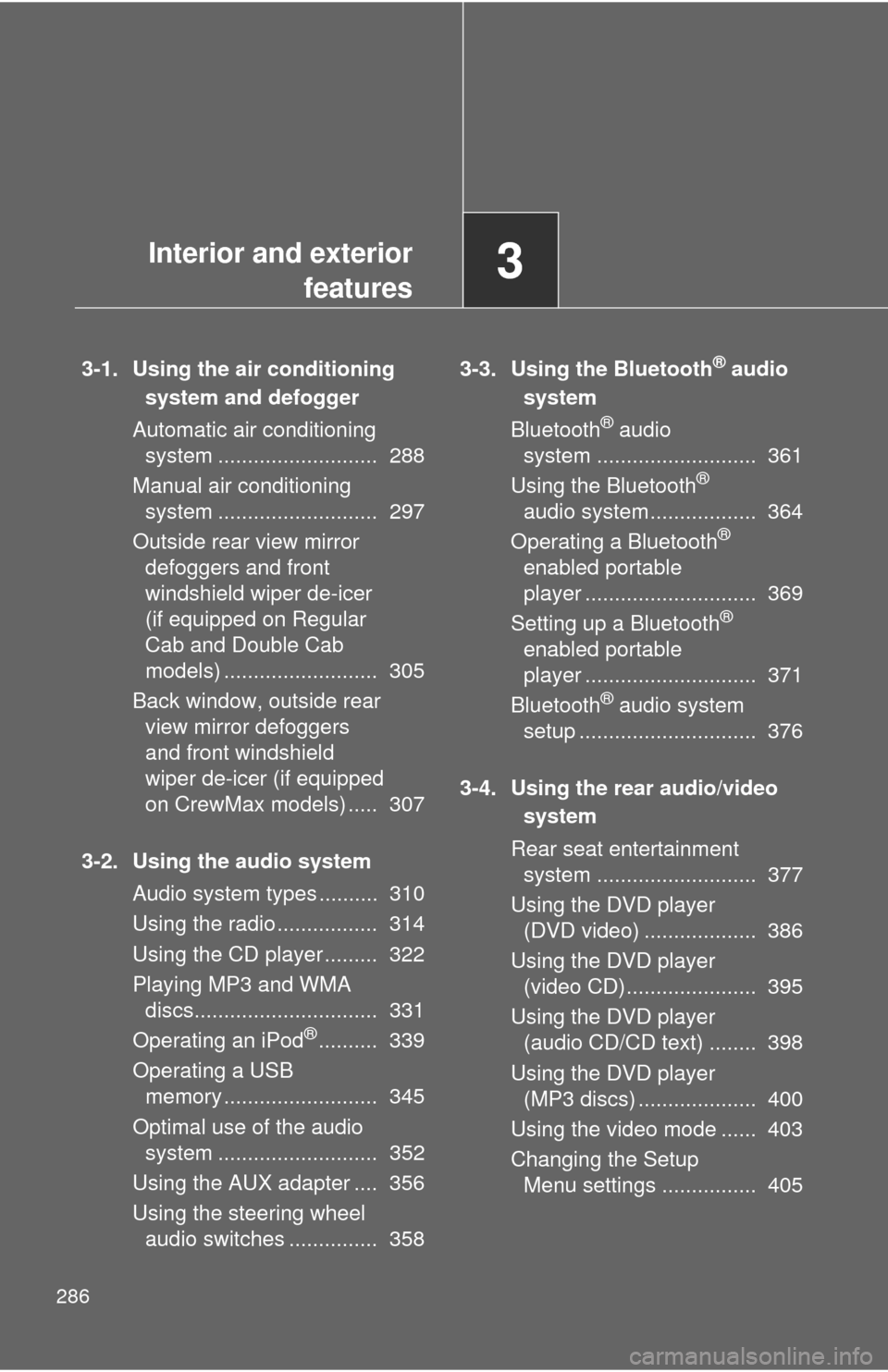
3-1. Using the air conditioning system and defogger
Automatic air conditioning system ........................... 288
Manual air conditioning system ........................... 297
Outside rear view mirror defoggers and front
windshield wiper de-icer
(if equipped on Regular
Cab and Double Cab
models) .......................... 305
Back window, outside rear view mirror defoggers
and front windshield
wiper de-icer (if equipped
on CrewMax models) ..... 307
3-2. Using the audio system Audio system types .......... 310
Using the radio ................. 314
Using the CD player ......... 322
Playing MP3 and WMA discs............................... 331
Operating an iPod
®.......... 339
Operating a USB memory .......................... 345
Optimal use of the audio system ........................... 352
Using the AUX adapter .... 356
Using the steering wheel audio switches ............... 358 3-3. Using the Bluetooth
® audio
system
Bluetooth
® audio
system ........................... 361
Using the Bluetooth
®
audio system.................. 364
Operating a Bluetooth
®
enabled portable
player ............................. 369
Setting up a Bluetooth
®
enabled portable
player ............................. 371
Bluetooth
® audio system
setup .............................. 376
3-4. Using the rear audio/video system
Rear seat entertainment system ........................... 377
Using the DVD player (DVD video) ................... 386
Using the DVD player (video CD)...................... 395
Using the DVD player (audio CD/CD text) ........ 398
Using the DVD player (MP3 discs) .................... 400
Using the video mode ...... 403
Changing the Setup Menu settings ................ 405
Interior and exterior
features3