tire type TOYOTA TUNDRA 2020 Owners Manual (in English)
[x] Cancel search | Manufacturer: TOYOTA, Model Year: 2020, Model line: TUNDRA, Model: TOYOTA TUNDRA 2020Pages: 608, PDF Size: 13.19 MB
Page 17 of 608
17Pictorial index
Fuel filler door . . . . . . . . . . . . . . . . . . . . . . . . . . . . . . . . . . . . P. 248
Refueling method . . . . . . . . . . . . . . . . . . . . . . . . . . . . . . . . . . . P. 248
Fuel type/fuel tank capacity . . . . . . . . . . . . . . . . . . . . . . . . . . . P. 540
Tires . . . . . . . . . . . . . . . . . . . . . . . . . . . . . . . . . . . . . . . . . . . . P. 426
Tire size/inflation pressure . . . . . . . . . . . . . . . . . . . . . . . . . . . . P. 546
Winter tires/tire chain . . . . . . . . . . . . . . . . . . . . . . . . . . . . . . . . P. 331
Checking/rotation/tire pressure warning system . . . . . . . . . . . P. 426
Coping with flat tires . . . . . . . . . . . . . . . . . . . . . . . . . . . . . . . . P. 504
Hood . . . . . . . . . . . . . . . . . . . . . . . . . . . . . . . . . . . . . . . . . . . . P. 414
Opening . . . . . . . . . . . . . . . . . . . . . . . . . . . . . . . . . . . . . . . . . . P. 414
Engine oil . . . . . . . . . . . . . . . . . . . . . . . . . . . . . . . . . . . . . . . . . P. 541
Coping with overheat . . . . . . . . . . . . . . . . . . . . . . . . . . . . . . . . P. 527
Camera
*4
Headlights . . . . . . . . . . . . . . . . . . . . . . . . . . . . . . . . . . . . . . . P. 234
Fog lights
*3 . . . . . . . . . . . . . . . . . . . . . . . . . . . . . . . . . . . . . . P. 244
Front turn signal lights . . . . . . . . . . . . . . . . . . . . . . . . . . . . . P. 232
Parking lights/daytime running lights . . . . . . . . . . . . . . . . . P. 234
Rear turn signal lights . . . . . . . . . . . . . . . . . . . . . . . . . . . . . . P. 232
Tail lights . . . . . . . . . . . . . . . . . . . . . . . . . . . . . . . . . . . . . . . . P. 234
License plate lights . . . . . . . . . . . . . . . . . . . . . . . . . . . . . . . . P. 234
Back-up lights
Shifting the shift lever to R . . . . . . . . . . . . . . . . . . . . . . . . . . . . P. 225
Side marker lights . . . . . . . . . . . . . . . . . . . . . . . . . . . . . . . . . P. 234
6
7
8
9
Light bulbs of the exter ior lights for driving
(Replacing method: P. 455, Watts: P. 548)
*1: Vehicles with a smart key system
*2: If equipped on CrewMax models
*3: If equipped
*4: Refer to the “NAVIGATION AND MULTIMEDIA
SYSTEM OWNER’S MANUAL”.
10
11
12
13
14
15
16
17
18
Page 195 of 608
1954-1. Before driving
4
Driving
Vehicle load limits
◆Total load capacity (vehicle capacity weight): P. 536
Total load capacity means the co mbined weight of occupants, cargo
and luggage.
◆Seating capacity
Vehicles with front se parated type seats —
5 occupants (Front 2, Rear 3)
Vehicles with front bench type seat —
6 occupants (Front 3, Rear 3)
Seating capacity means the max imum number of occupants whose
estimated average weight is 150 lb. (68 kg) per person.
Even if the number of occupants are within the seating capacity , do
not exceed the tota l load capacity.
◆TWR (Trailer Weight Rating): P. 201
TWR means the maximum gross trai ler weight (trailer weight plus
its cargo weight) that your vehicle is able to tow.
◆Cargo capacity
Cargo capacity may increase or decrease depending on the weight
and the number o f occupants.
■Total load capacity and seating capacity
These details are also described on the tire and loading inform ation label.
( P. 440)
Vehicle load limits include total load capacity, seating capaci ty,
TWR (Trailer Weight Rati ng) and cargo capacity.
Page 333 of 608
3334-6. Driving tips
4
Driving
Regulations regarding the use of tire chains vary depending on loca-
tion and type of road. Always chec k local regulations before installing
chains.
■ Tire chain installation
Observe the following precautions when installing and removing chains:
● Install and remove tire chains in a safe location.
● Install tire chains on the rear tires. Do not install tire chains on the front tires.
● Install tire chains on rear tires as tightly as possible. Retig hten chains after
driving 1/4 1/2 mile (0.5 1.0 km).
● Install tire chains following the instructions provided with th e tire chains.
Regulations on the use of tire chains
WARNING
■Driving with snow tires
Observe the following precautions to reduce the risk of acciden ts.
Failure to do so may result in a loss of vehicle control and ca use death or
serious injury.
● Use tires of the specified size.
● Maintain the recommended level of air pressure.
● Do not drive in excess of 75 mph (120 km/h), regardless of the type of
snow tires being used.
● Use snow tires on all, not just some wheels.
● 4WD models: Do not mix tires of different makes, models, tread patterns
or treadwear.
■ Driving with tire chains
Observe the following precautions to reduce the risk of acciden ts.
Failure to do so may result in the vehicle being unable to be d riven safely,
and may cause death or serious injury.
● Do not drive in excess of the speed limit specified for the tir e chains being
used, or 30 mph (50 km/h), whichever is lower.
● Avoid driving on bumpy road surfaces or over potholes.
● Avoid sudden acceleration, abrupt steering, sudden braking and shifting
operations that cause sudden engine braking.
● Slow down sufficiently before entering a curve to ensure that v ehicle con-
trol is maintained.
Page 431 of 608

4316-3. Do-it-yourself maintenance
6
Maintenance and care
■Tire types
●Summer tires
Summer tires are high-speed performance tires best suited to highway
driving under dry conditions. Si nce summer tires do not have th e same
traction performance as snow tires, summer tires are inadequate for
driving on snow-covered or icy ro ads. For driving on snow-covered
roads or icy roads, the use of snow tires is recommended. When install-
ing snow tires, be sure to replace all four tires.
●All season tires
All season tires are designed to provide better traction in sno w and to
be adequate for driving in most winter conditions as well as fo r use
year-round. All season tires, however, do not have adequate tra ction
performance compared with snow tires in heavy or loose snow. Al so, all
season tires fall short in acceleration and handling performanc e com-
pared with summer tires in highway driving.
●Snow tires
For driving on snow-covered roads or icy roads, we recommend us ing
snow tires. If you need snow tires, select tires of the same si ze, con-
struction and load capacity as t he originally installed tires. Since your
vehicle has radial tires as original equipment, make sure your snow
tires also have radial construct ion. Do not install studded tires without
first checking local regulations for possible restrictions. Sno w tires
should be install ed on all wheels. ( P. 331)
■Initializing the tire pressure warning system
Initialize the system with the tire inflation pressure adjusted to the speci-
fied level.
■If the tread on snow tires wea rs down below 0.16 in. (4 mm)
The effectiveness of the tires as snow tires is lost.
Page 443 of 608
4436-3. Do-it-yourself maintenance
6
Maintenance and care
Wheels
When replacing wheels, care should be taken to ensure that they are
equivalent to those removed in load capacity, diameter, rim wid th and
inset
*.
Replacement wheels are available at your Toyota dealer.
*: Conventionally referred to as “offset”.
Toyota does not recommend using the following:
● Wheels of different sizes or types
● Used wheels
● Bent wheels that hav e been straightened
● Use only Toyota wheel nuts and wrenches designed for use with
your aluminum wheels.
● When rotating, repairing or changi ng your tires, check that the
wheel nuts are still tight afte r driving 1000 miles (1600 km).
● Be careful not to damage the aluminum wheels when using tire
chains.
● Use only Toyota genuine balance we ights or equivalent and a plas-
tic or rubber hammer when balancing your wheels.
If a wheel is bent, cracked or heavily corroded, it should be
replaced. Otherwise, the tire may separate from the wheel or
cause a loss of handling control.
Wheel selection
Aluminum wheel pre cautions (if equipped)
Page 499 of 608
4997-2. Steps to take in an emergency
7
When trouble arises
*: Refer to the separate “Scheduled Maintenance Guide” or “Owner’s Manual
Supplement” for the maintenance interval applicable to your veh icle.
■Warning message in radar cruise mode (if equipped)
In the following cases, the warning message may not be displaye d even if
vehicle-to-vehicle distance decreases:
● When your vehicle and the vehicle ahead are traveling at the sa me speed or
the vehicle ahead is traveling more quickly than your vehicle
● When the vehicle ahead is traveling at a very low speed
● Immediately after cruise control speed is set
● At the instant the accelerator pedal is depressed
■
Conditions that the tire pressure warning system may not functi on
properly
P. 4 3 2
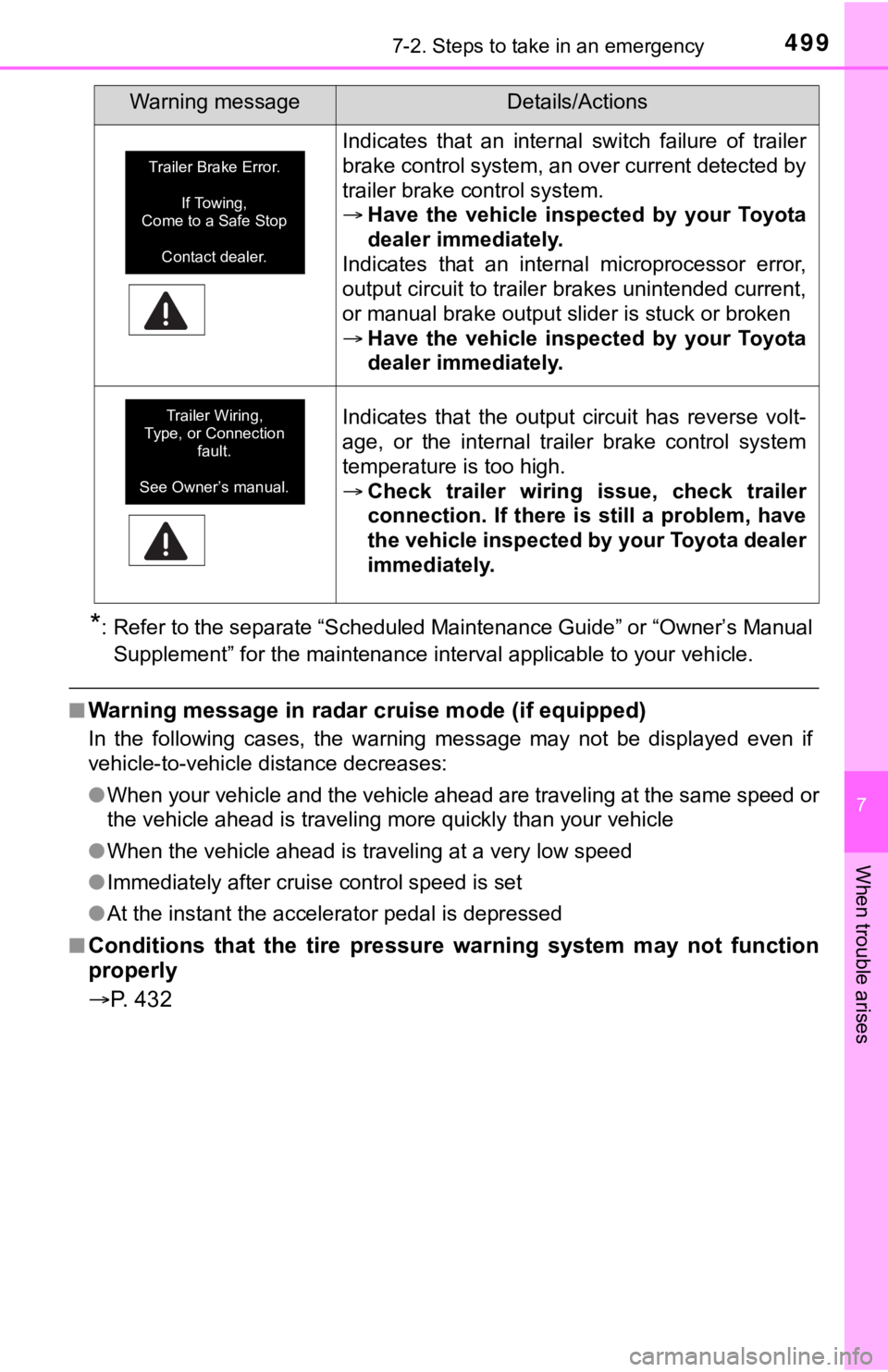
Indicates that an internal switch failure of trailer
brake control system, an over current detected by
trailer brake control system.
Have the vehicle inspected by your Toyota
dealer immediately.
Indicates that an internal microprocessor error,
output circuit to trailer brakes unintended current,
or manual brake output slider is stuck or broken
Have the vehicle inspected by your Toyota
dealer immediately.
Indicates that the output circuit has reverse volt-
age, or the internal trailer brake control system
temperature is too high.
Check trailer wiring issue, check trailer
connection. If there is still a problem, have
the vehicle inspected by your Toyota dealer
immediately.
Warning messageDetails/Actions
Trailer Brake Error.
If Towing,
Come to a Safe Stop
Contact dealer.
Trailer Wiring,
Type, or Connection
fault.
See Owner’s manual.
Page 534 of 608
5348-1. Specifications
Maintenance data (fuel, oil level, etc.)
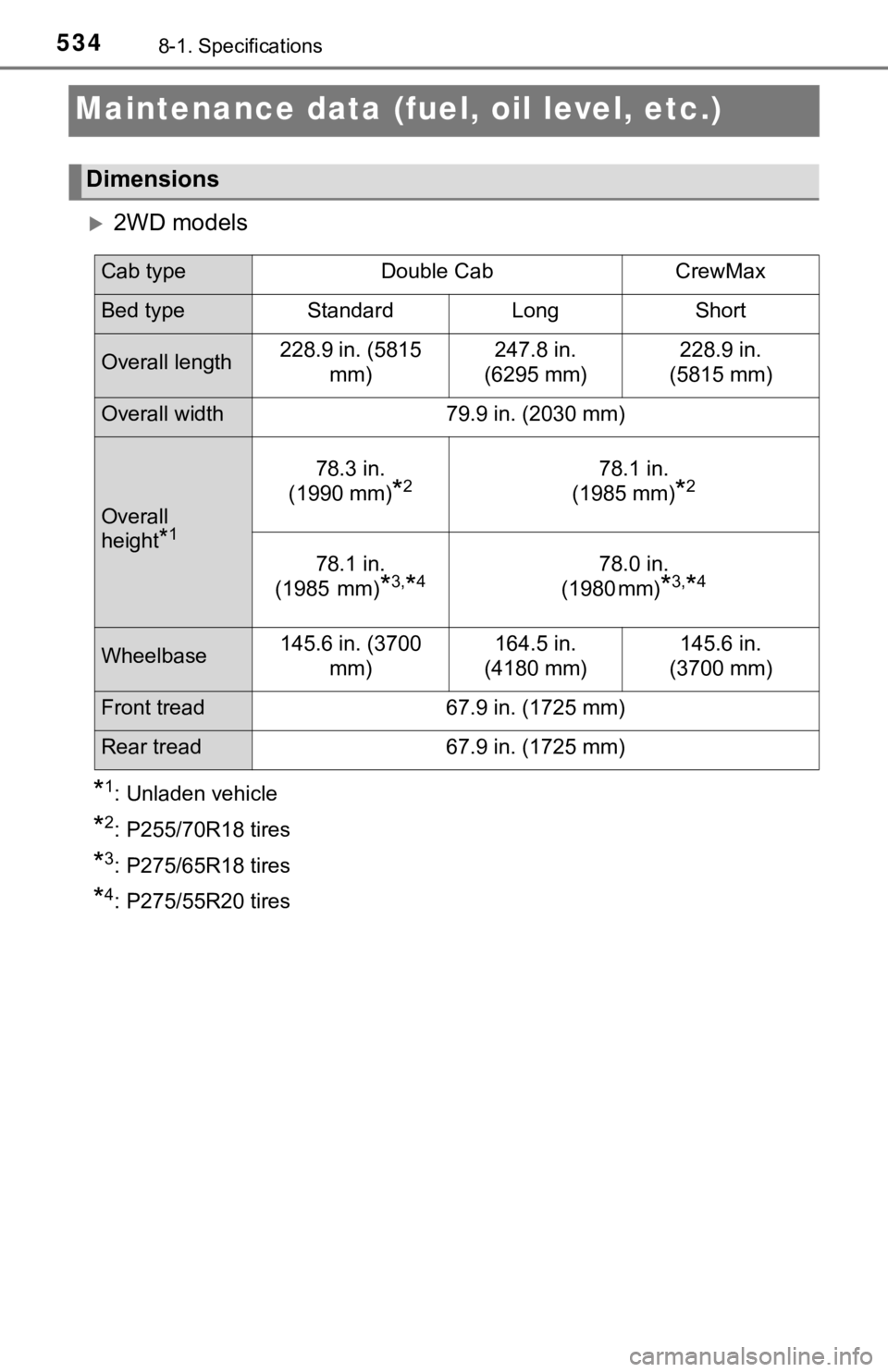
2WD models
*1: Unladen vehicle
*2: P255/70R18 tires
*3: P275/65R18 tires
*4: P275/55R20 tires
Dimensions
Cab typeDouble Cab CrewMax
Bed typeStandardLongShort
Overall length228.9 in. (5815
mm) 247.8 in.
(6295 mm) 228.9 in.
(5815 mm)
Overall width 79.9 in. (2030 mm)
Overall
height
*1
78.3 in.
(1990 mm)
*278.1 in.
(1985 mm)
*2
78.1 in.
(1985 mm)
*3,*478.0 in.
(1980 mm)
*3,*4
Wheelbase 145.6 in. (3700
mm) 164.5 in.
(4180 mm) 145.6 in.
(3700 mm)
Front tread 67.9 in. (1725 mm)
Rear tread67.9 in. (1725 mm)
Page 535 of 608
5358-1. Specifications
8
Vehicle specifications
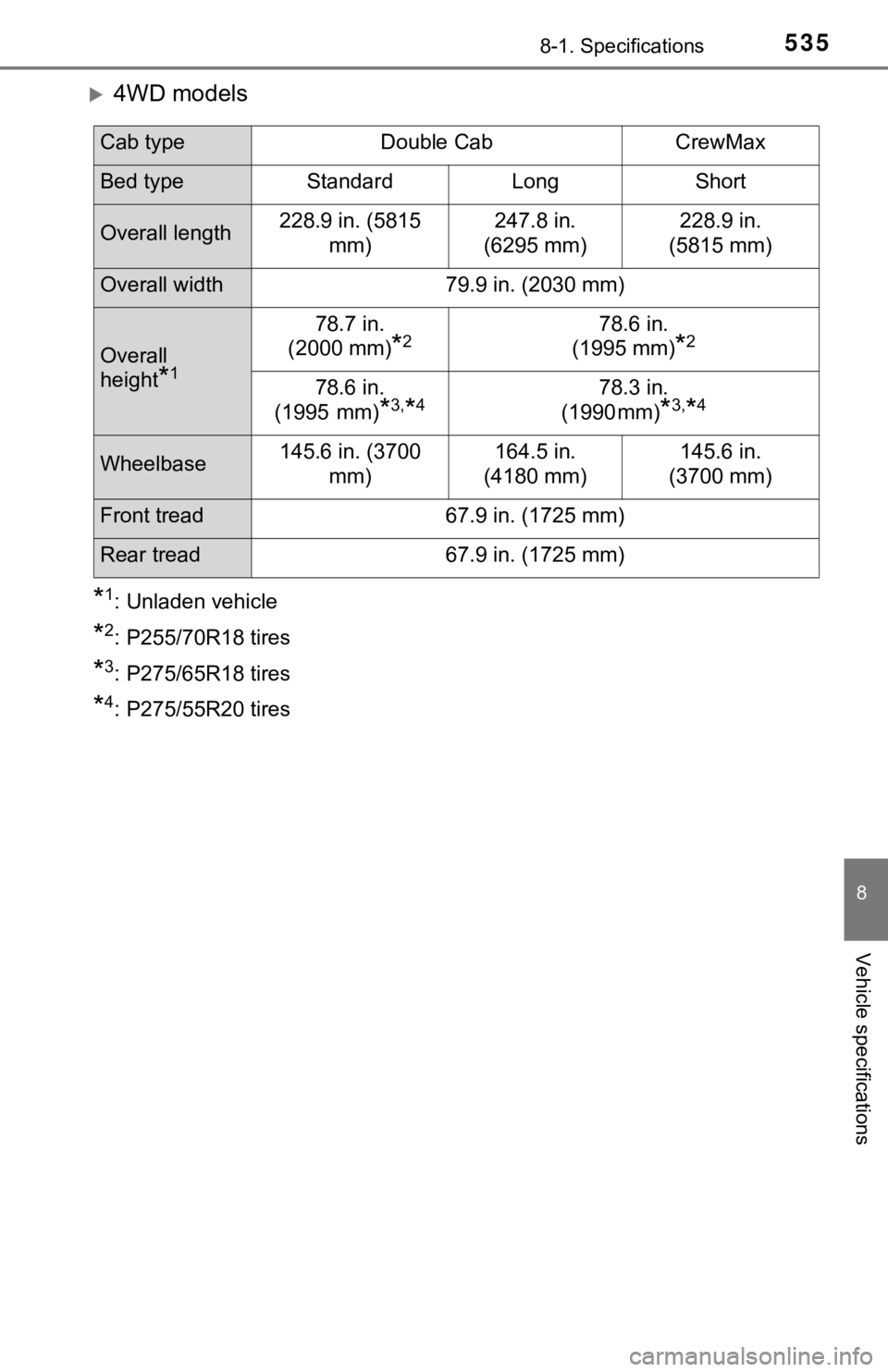
4WD models
*1: Unladen vehicle
*2: P255/70R18 tires
*3: P275/65R18 tires
*4: P275/55R20 tires
Cab typeDouble Cab CrewMax
Bed typeStandardLongShort
Overall length228.9 in. (5815
mm) 247.8 in.
(6295 mm) 228.9 in.
(5815 mm)
Overall width 79.9 in. (2030 mm)
Overall
height
*1
78.7 in.
(2000 mm)
*278.6 in.
(1995 mm)
*2
78.6 in.
(1995 mm)
*3,*478.3 in.
(1990 mm)
*3,*4
Wheelbase 145.6 in. (3700
mm) 164.5 in.
(4180 mm) 145.6 in.
(3700 mm)
Front tread 67.9 in. (1725 mm)
Rear tread67.9 in. (1725 mm)
Page 552 of 608
5528-1. Specifications
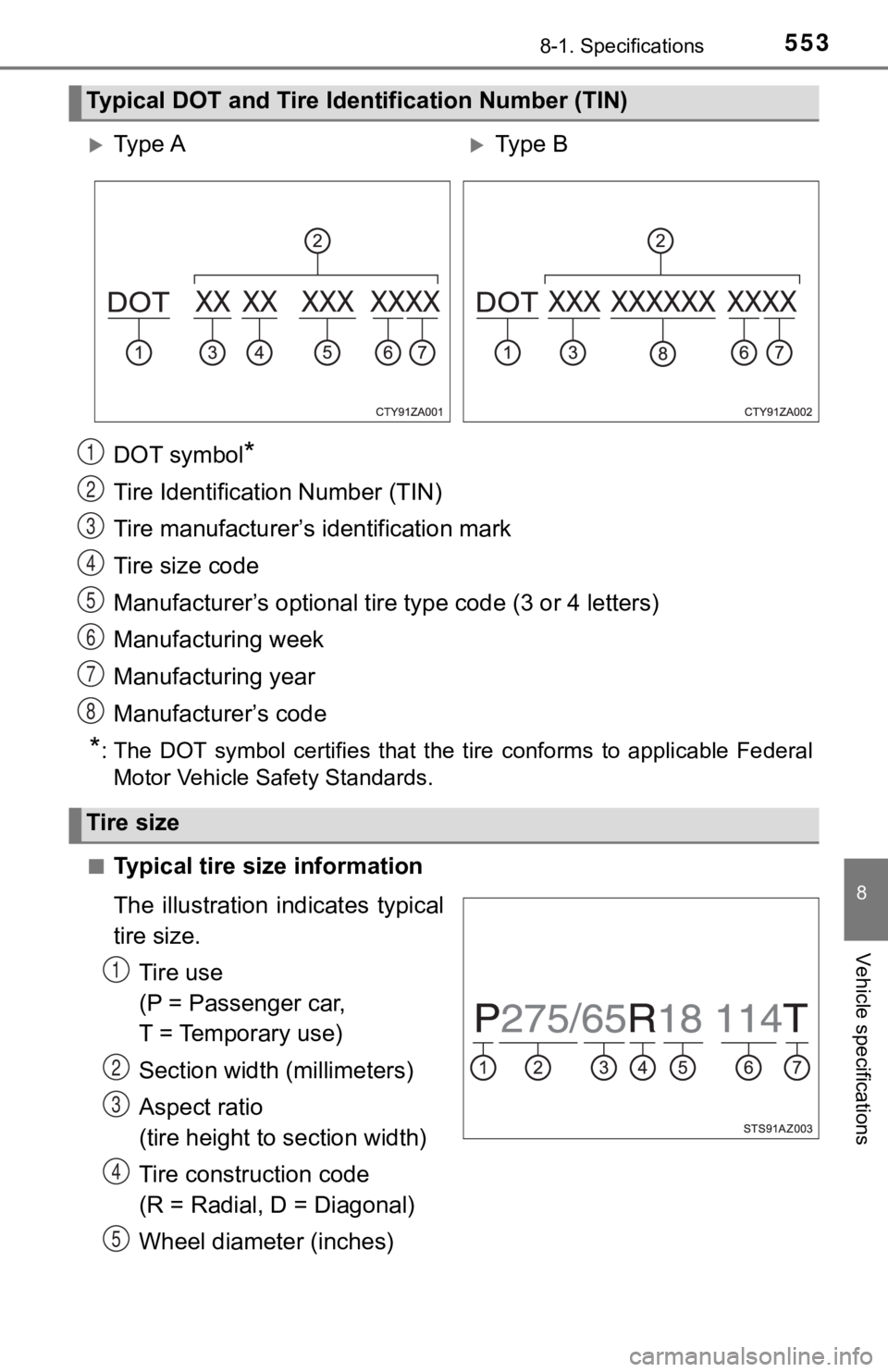
Tire information
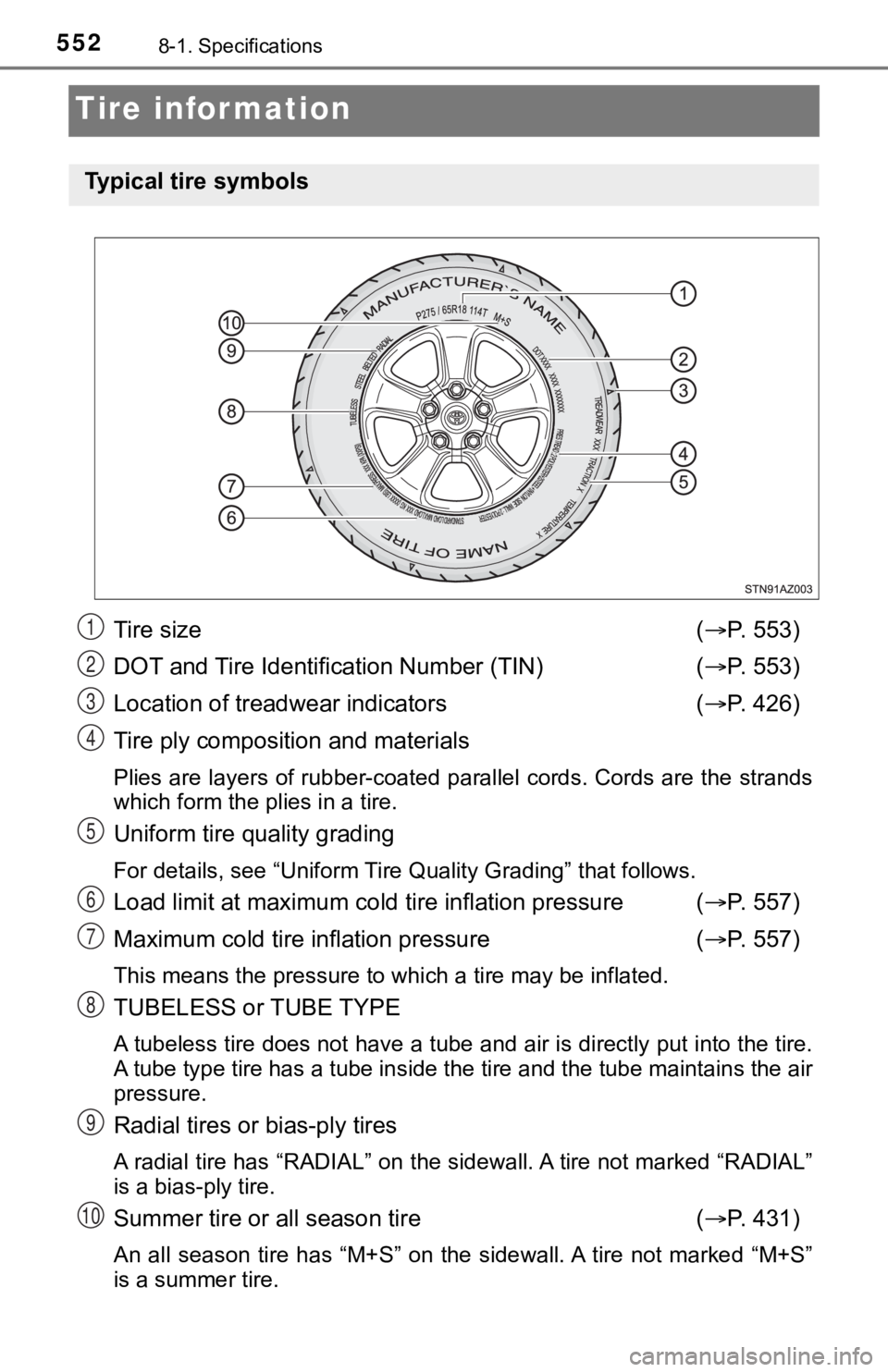
Tire size ( P. 553)
DOT and Tire Identification Number (TIN) ( P. 553)
Location of treadwear indicators ( P. 426)
Tire ply composition and materials
Plies are layers of rubber-coated parallel cords. Cords are the strands
which form the p lies in a tire.
Uniform tire quality grading
For details, see “Uniform Tire Q uality Grading” that follows.
Load limit at maximum cold tire inflation pressure ( P. 557)
Maximum cold tire inflation pressure ( P. 557)
This means the press ure to which a tire may be inflated.
TUBELESS or TUBE TYPE
A tubeless tire does not have a tube and air is directly put into the tire.
A tube type tire has a tube insi de the tire and the tube mainta ins the air
pressure.
Radial tires or bias-ply tires
A radial tire has “RADIAL” on the sidewall. A tire not marked “ RADIAL”
is a bias-ply tire.
Summer tire or all season tire ( P. 431)
An all season tire has “M+S” on the sidewall. A tire not marked “M+S”
is a summer tire.
Typical tire symbols
1
2
3
4
5
6
7
8
9
10
Page 553 of 608
5538-1. Specifications
8
Vehicle specifications
DOT symbol*
Tire Identification Number (TIN)
Tire manufacturer’s identification mark
Tire size code
Manufacturer’s optional tire type code (3 or 4 letters)
Manufacturing week
Manufacturing year
Manufacturer’s code
*: The DOT symbol certifies that the tire conforms to applicable Federal
Motor Vehicle Safety Standards.
■Typical tire size information
The illustration i ndicates typical
tire size.
Tire use
(P = Passenger car,
T = Temporary use)
Section widt h (millimeters)
Aspect ratio
(tire height to section width)
Tire construction code
(R = Radial, D = Diagonal)
Wheel diameter (inches)
Typical DOT and Tire Iden tification Number (TIN)
Ty p e AType B
Tire size
1
2
3
4
5
6
7
8
1
2
3
4
5