Pressure TOYOTA VERSO 2014 User Guide
[x] Cancel search | Manufacturer: TOYOTA, Model Year: 2014, Model line: VERSO, Model: TOYOTA VERSO 2014Pages: 650, PDF Size: 36.61 MB
Page 306 of 650
306 2-5. Driving information
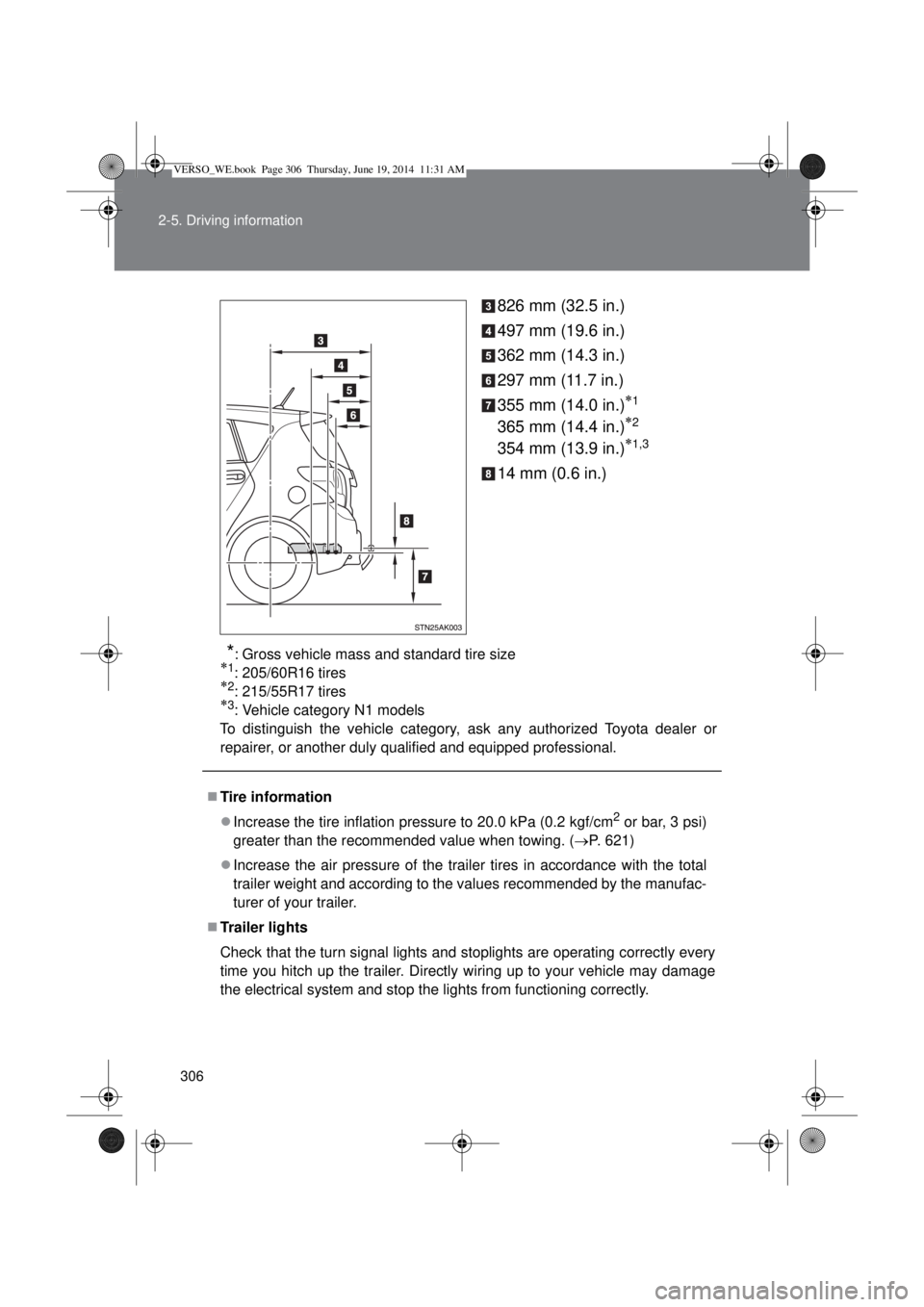
826 mm (32.5 in.)
497 mm (19.6 in.)
362 mm (14.3 in.)
297 mm (11.7 in.)
355 mm (14.0 in.)
1
365 mm (14.4 in.)2
354 mm (13.9 in.)1,3
14 mm (0.6 in.)
*: Gross vehicle mass and standard tire size1: 205/60R16 tires2: 215/55R17 tires3: Vehicle category N1 models
To distinguish the vehicle category, ask any authorized Toyota dealer or
repairer, or another duly qualified and equipped professional.
Tire information
Increase the tire inflation pressure to 20.0 kPa (0.2 kgf/cm
2 or bar, 3 psi)
greater than the recommended value when towing. (P. 621)
Increase the air pressure of the trailer tires in accordance with the total
trailer weight and according to the values recommended by the manufac-
turer of your trailer.
Trailer lights
Check that the turn signal lights and stoplights are operating correctly every
time you hitch up the trailer. Directly wiring up to your vehicle may damage
the electrical system and stop the lights from functioning correctly.
VERSO_WE.book Page 306 Thursday, June 19, 2014 11:31 AM
Page 351 of 650
351 3-2. Using the audio system
3
Interior features
Depending on differences between models or software version etc., some
models listed above might be incompatible with this system.
iPod 4th generation and earlier models are not compatible with this system.
iPod mini, iPod shuffle and iPod photo are not compatible with this system.
Items related to standards and limitations are as follows:
Maximum number of lists in device: 9999
Maximum number of songs in device: 65535
Maximum number of songs per list: 65535
CAUTION
Caution while driving
Do not connect iPod or operate the controls. Doing so may cause an acci-
dent, resulting in death or serious injury.
NOTICE
To prevent damage to iPod or its terminal
Do not leave iPod in the vehicle. The temperature inside the vehicle may
become high, resulting in damage to the iPod.
Do not push down on or apply unnecessary pressure to the iPod while it is
connected as this may damage the iPod or its terminal.
Do not insert foreign objects into the port as this may damage the iPod or
its terminal.
VERSO_WE.book Page 351 Thursday, June 19, 2014 11:31 AM
Page 358 of 650

358 3-2. Using the audio system
NOTICE
To prevent damage to USB memory or its terminal
Do not leave USB memory in the vehicle. The temperature inside the vehi-
cle may become high, resulting in damage to the USB memory.
Do not push down on or apply unnecessary pressure to the USB memory
while it is connected as this may damage the USB memory or its terminal.
Do not insert foreign objects into the port as this may damage the USB
memory or its terminal.
Depending on the size and shape of the USB memory that is connected to
the system, the passenger’s seat may hit the USB memory when moving
the seat forward. In this case, do not forcibly move the seat forward as this
may damage the USB memory or the terminal, etc.
VERSO_WE.book Page 358 Thursday, June 19, 2014 11:31 AM
Page 401 of 650
4Maintenance and care
401
4-1. Maintenance and care
Cleaning and protecting
the vehicle exterior ......... 402
Cleaning and protecting
the vehicle interior .......... 406
4-2. Maintenance
Maintenance
requirements................... 409
4-3. Do-it-yourself maintenance
Do-it-yourself service
precautions ..................... 412
Hood ................................. 416
Positioning a floor jack ...... 418
Engine compartment......... 420
Tires .................................. 443
Tire inflation pressure ....... 457
Wheels .............................. 459
Air conditioning filter ......... 462
Key battery........................ 465
Checking and replacing
fuses ............................... 469
Light bulbs ........................ 484
VERSO_WE.book Page 401 Thursday, June 19, 2014 11:31 AM
Page 402 of 650
402
4-1. Maintenance and care
Cleaning and protecting the vehicle exterior
Automatic car washes
Fold the mirrors and remove the antenna before washing the vehicle.
Start washing from the front of the vehicle. Make sure to re-install the
antenna and extend the mirrors before driving.
Brushes used in automatic car washes may scratch the vehicle surface
and harm your vehicle’s paint.
Vehicles with rain-sensing windshield wipers: Turn the wipers off before
washing the vehicle. (P. 403)
High pressure car washes
Do not allow the nozzles of the car wash to come within close proximity
of the windows.
Before using car wash, check that the fuel filler door on your vehicle is
closed properly. Perform the following to protect the vehicle and maintain it in prime
condition.
Working from top to bottom, liberally apply water to the vehicle
body, wheel wells and underside of the vehicle to remove any
dirt and dust.
Wash the vehicle body using a sponge or soft cloth, such as a
chamois.
For hard-to-remove marks, use car wash soap and rinse thor-
oughly with water.
Wipe away any water.
Wax the vehicle when the waterproof coating deteriorates.
If water does not bead on a clean surface, apply wax when the vehicle
body is cool.
VERSO_WE.book Page 402 Thursday, June 19, 2014 11:31 AM
Page 413 of 650
413 4-3. Do-it-yourself maintenance
4
Maintenance and care
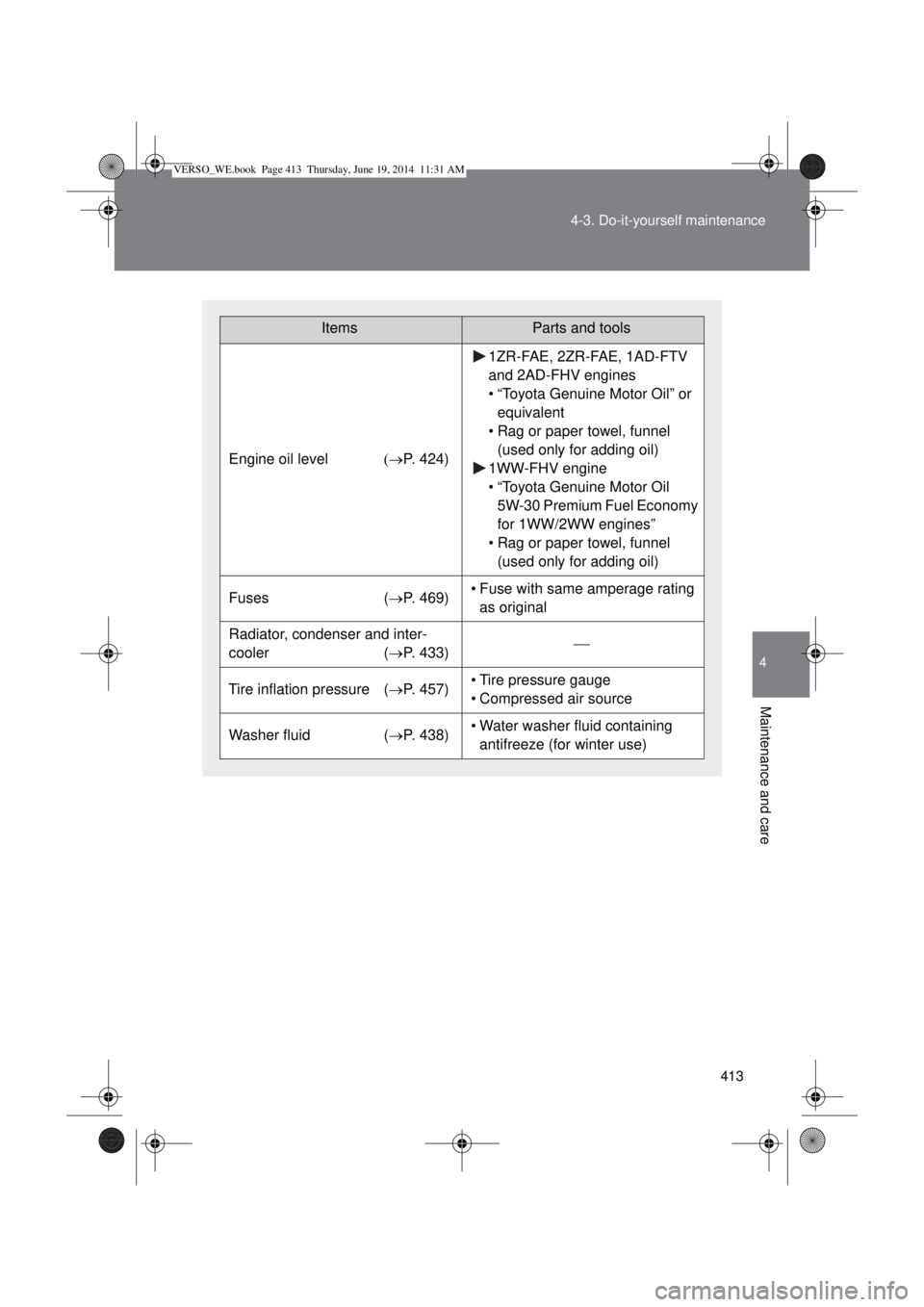
ItemsParts and tools
Engine oil levelP. 424)
1ZR-FAE, 2ZR-FAE, 1AD-FTV
and 2AD-FHV engines
• “Toyota Genuine Motor Oil” or
equivalent
• Rag or paper towel, funnel
(used only for adding oil)
1WW-FHV engine
• “Toyota Genuine Motor Oil
5W-30 Premium Fuel Economy
for 1WW/2WW engines”
• Rag or paper towel, funnel
(used only for adding oil)
Fuses (P. 469)• Fuse with same amperage rating
as original
Radiator, condenser and inter-
cooler (P. 433)
Tire inflation pressure (P. 457)• Tire pressure gauge
• Compressed air source
Washer fluid (P. 438)• Water washer fluid containing
antifreeze (for winter use)
VERSO_WE.book Page 413 Thursday, June 19, 2014 11:31 AM
Page 432 of 650

432 4-3. Do-it-yourself maintenance
If the coolant level drops within a short time after replenishing
Visually check the radiator, hoses, reservoir cap, radiator cap, drain cock
and water pump.
If you cannot find a leak, have any authorized Toyota dealer or repairer, or
another duly qualified and equipped professional, test the cap and check for
leaks in the cooling system.
Coolant selection
1ZR-FAE, 2ZR-FAE, 1AD-FTV and 2AD-FHV engines
Only use “Toyota Super Long Life Coolant” or similar high quality eth-
ylene glycol based non-silicate, non-amine, non-nitrite, and non-borate
coolant with long-life hybrid organic acid technology.
“Toyota Super Long Life Coolant” is a mixture of 50% coolant and 50%
deionized water. (Enabled: -35C [-31F])
1WW-FHV engine
Only use “Toyota Premium Long Life Coolant for 1WW/2WW engines” or
any of the approved engine coolants listed. (P. 616)
“Toyota Premium Long Life Coolant for 1WW/2WW engines” is a mixture
of 50% coolant and 50% deionized water. (Enabled: -35C [-31F])
For more details about engine coolant, contact any authorized Toyota dealer
or repairer, or another duly qualified and equipped professional.
CAUTION
When the engine is hot
Do not remove the coolant reservoir cap.
The cooling system may be under pressure and may spray hot coolant if the
cap is removed, causing serious injuries, such as burns.
VERSO_WE.book Page 432 Thursday, June 19, 2014 11:31 AM
Page 443 of 650
443
4-3. Do-it-yourself maintenance
4
Maintenance and care
Tires
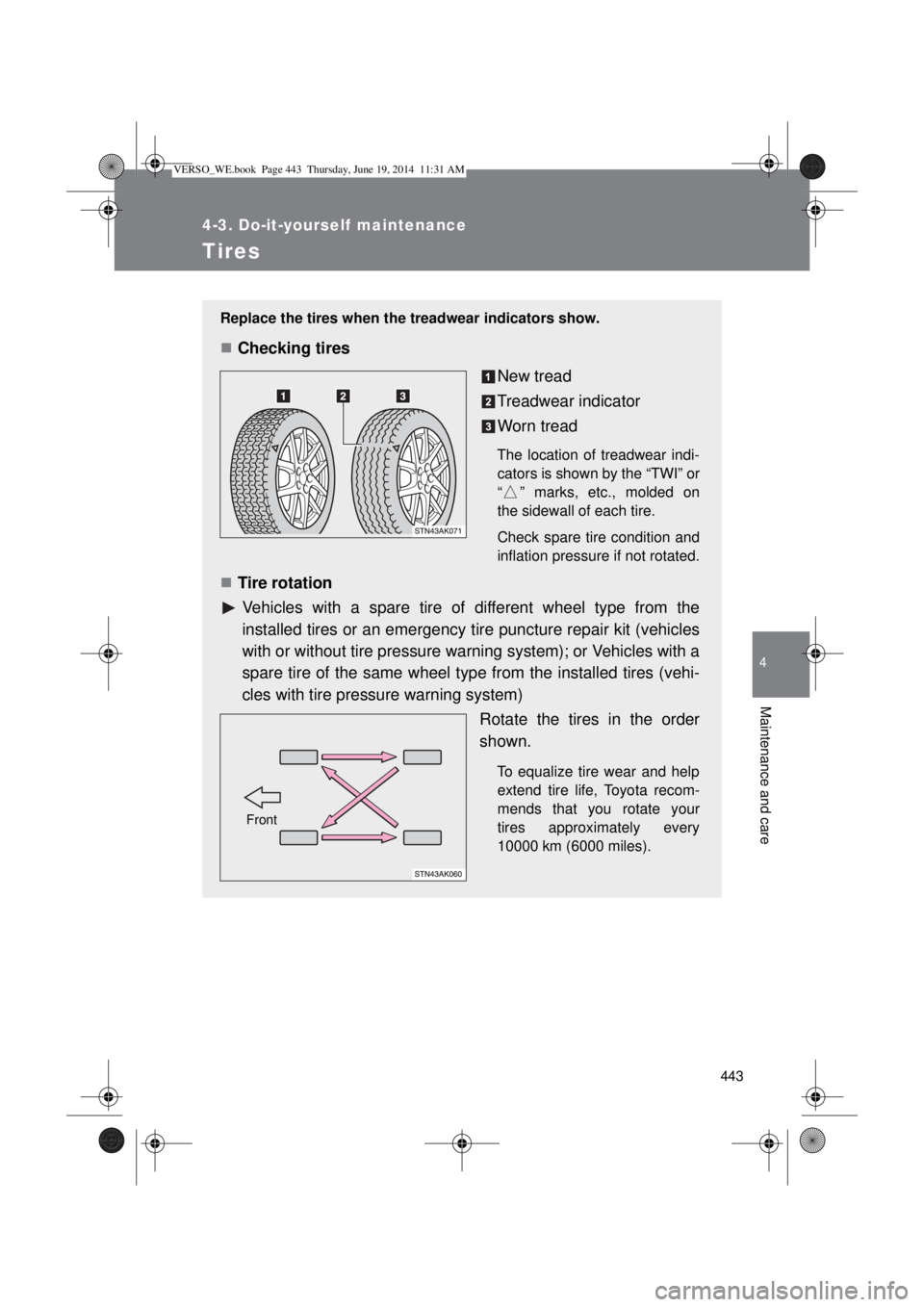
Replace the tires when the treadwear indicators show.
Checking tires
New tread
Treadwear indicator
Worn tread
The location of treadwear indi-
cators is shown by the “TWI” or
“ ” marks, etc., molded on
the sidewall of each tire.
Check spare tire condition and
inflation pressure if not rotated.
Tire rotation
Vehicles with a spare tire of different wheel type from the
installed tires or an emergency tire puncture repair kit (vehicles
with or without tire pressure warning system); or Vehicles with a
spare tire of the same wheel type from the installed tires (vehi-
cles with tire pressure warning system)
Rotate the tires in the order
shown.
To equalize tire wear and help
extend tire life, Toyota recom-
mends that you rotate your
tires approximately every
10000 km (6000 miles).
Front
VERSO_WE.book Page 443 Thursday, June 19, 2014 11:31 AM
Page 444 of 650
444 4-3. Do-it-yourself maintenance
Installing tire pressure warning valves and transmitters (if equipped)
When replacing tires or wheels, tire pressure warning valves and
transmitters must also be installed.
When new tire pressure warning valves and transmitters are
installed, new ID codes must be registered in the tire pressure warn-
ing computer and the tire pressure warning system must be initial-
ized. Have tire pressure warning valve and transmitter ID codes
registered by any authorized Toyota dealer or repairer, or another
duly qualified and equipped professional. (P. 447)
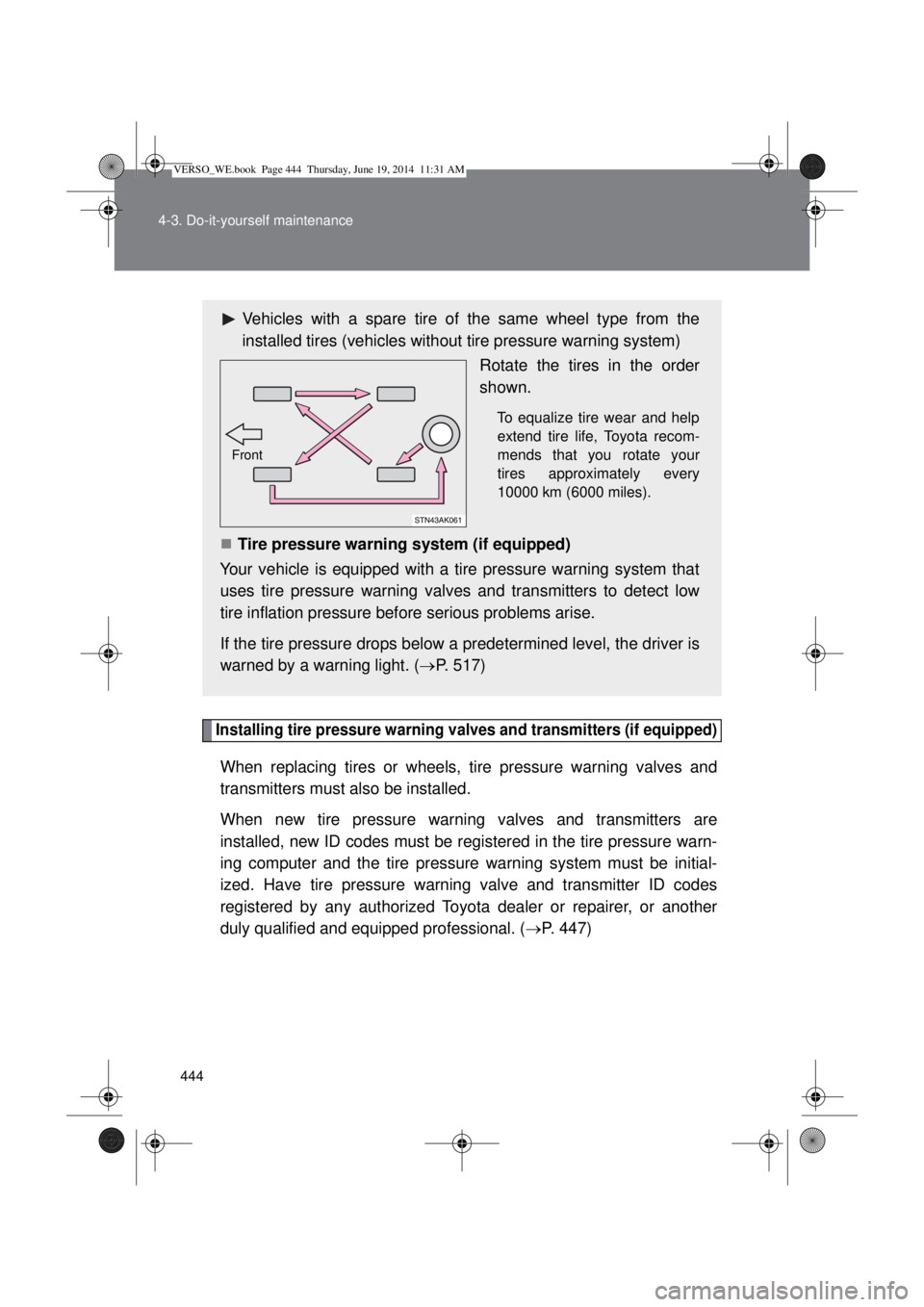
Vehicles with a spare tire of the same wheel type from the
installed tires (vehicles without tire pressure warning system)
Rotate the tires in the order
shown.
To equalize tire wear and help
extend tire life, Toyota recom-
mends that you rotate your
tires approximately every
10000 km (6000 miles).
Tire pressure warning system (if equipped)
Your vehicle is equipped with a tire pressure warning system that
uses tire pressure warning valves and transmitters to detect low
tire inflation pressure before serious problems arise.
If the tire pressure drops below a predetermined level, the driver is
warned by a warning light. (P. 517)
Front
VERSO_WE.book Page 444 Thursday, June 19, 2014 11:31 AM
Page 445 of 650

445 4-3. Do-it-yourself maintenance
4
Maintenance and care
Initializing the tire pressure warning system (if equipped)
The tire pressure warning system must be initialized in the fol-
lowing circumstances:
When rotating front and rear tires which have different tire infla-
tion pressures
When the tire inflation pressure is changed such as when
changing traveling speed
When changing the tire size
When the tire pressure warning system is initialized, the current
tire inflation pressure is set as the benchmark pressure.
How to initialize the tire pressure warning system (if
equipped)
Park the vehicle in a safe place and turn the engine switch to
the “LOCK” position (vehicles without smart entry & start sys-
tem) or the “ENGINE START STOP” switch off (vehicles with
smart entry & start system).
Initialization cannot be performed while the vehicle is moving.
Adjust the tire inflation pressure to the specified cold tire infla-
tion pressure level. (P. 621)
Make sure to adjust the tire pressure to the specified cold tire infla-
tion pressure level. The tire pressure warning system will operate
based on this pressure level.
Turn the engine switch to the “ON” position (vehicles without
smart entry & start system) or the “ENGINE START STOP”
switch to IGNITION ON mode (vehicles with smart entry &
start system).
VERSO_WE.book Page 445 Thursday, June 19, 2014 11:31 AM