warning TOYOTA VERSO 2014 Owner's Manual
[x] Cancel search | Manufacturer: TOYOTA, Model Year: 2014, Model line: VERSO, Model: TOYOTA VERSO 2014Pages: 650, PDF Size: 36.61 MB
Page 301 of 650

301 2-5. Driving information
2
When driving
NOTICE
Repairing or replacing snow tires (vehicles with the tire pressure warn-
ing system)
Request repairs or replacement of snow tires from Toyota dealers or legiti-
mate tire retailers.
This is because the removal and attachment of snow tires affects the opera-
tion of the tire pressure warning valves and transmitters.
Fitting tire chains (vehicles with the tire pressure warning system)
The tire pressure warning valves and transmitters may not function correctly
when tire chains are fitted.
VERSO_WE.book Page 301 Thursday, June 19, 2014 11:31 AM
Page 309 of 650

309 2-5. Driving information
2
When driving
Important points regarding turning
The wheels of the trailer will travel closer to the inside of the curve
than the wheels of the vehicle. To make allowance for this, take the
turns wider than you would normally.
Important points regarding stability
Vehicle movement resulting from uneven road surfaces and strong
crosswinds will affect handling. The vehicle may also be rocked by
passing buses or large trucks. Frequently check behind when mov-
ing alongside such vehicles. As soon as such vehicle movement
occurs, immediately start to decelerate smoothly by slowly apply-
ing the brakes. Always steer the vehicle straight ahead while brak-
ing.
Passing other vehicles
Consider the total combined length of your vehicle and trailer, and
ensure that the vehicle-to-vehicle distance is sufficient before exe-
cuting lane changes.
Transmission information
Multidrive or automatic transmission
To maintain engine braking efficiency, when using engine brak-
ing, do not use the transmission in “D”. Transmission shift gear
position must be in “4” in the 7-speed sport sequential shiftmatic
mode (Multidrive) (P. 206) or the “M” mode (automatic trans-
mission) (P. 212).
Manual transmission
To maintain engine braking efficiency, when using engine brak-
ing, do not use the transmission in “5” and “6” gear. (P. 220)
When towing a trailer, check the engine coolant temperature
warning light (Red)
Towing a loaded trailer up a long steep incline in temperatures
exceeding 30C (85F) may result in the engine overheating.
If the engine coolant temperature warning light (Red) flashes or
comes on, turn the air conditioning off immediately and stop the
vehicle in a safe place. (P. 589)
VERSO_WE.book Page 309 Thursday, June 19, 2014 11:31 AM
Page 411 of 650
411 4-2. Maintenance
4
Maintenance and care
Engine coolant temperature continually higher than normal
If you notice any of these clues, take your vehicle to any authorized Toyota
dealer or repairer, or another duly qualified and equipped professional, as
soon as possible. Your vehicle may need adjustment or repair.
CAUTION
If your vehicle is not properly maintained
It could result in serious damage to the vehicle and possible serious injury or
death.
Warning in handling of the battery
Battery posts, terminals and related accessories contain lead and lead com-
pounds which are known to cause brain damage. Wash your hands after
handling. (P. 434)
VERSO_WE.book Page 411 Thursday, June 19, 2014 11:31 AM
Page 439 of 650
439 4-3. Do-it-yourself maintenance
4
Maintenance and care
Fuel filter (diesel engine only)
The water in the fuel filter needs to be drained in either of the follow-
ing situations:
• The “DRAIN WATER FROM FUEL FILTER” warning message is
shown on the multi-information display and a buzzer sounds.
(P. 525)
• 1WW-FHV engine only: Every 20000 km (12000 miles) or 12
months.
1AD-FTV and 2AD-FHV engines
You may drain the fuel filter yourself. However, as the operation is dif-
ficult, we recommend having it drained by any authorized Toyota
dealer or repairer, or another duly qualified and equipped profes-
sional. Even if you decide to drain it yourself, contact any authorized
Toyota dealer or repairer, or another duly qualified and equipped pro-
fessional.
Vehicles without smart entry & start system:
Turn the engine switch to the “LOCK” position.
Vehicles with smart entry & start system:
Turn the “ENGINE START STOP” switch off.
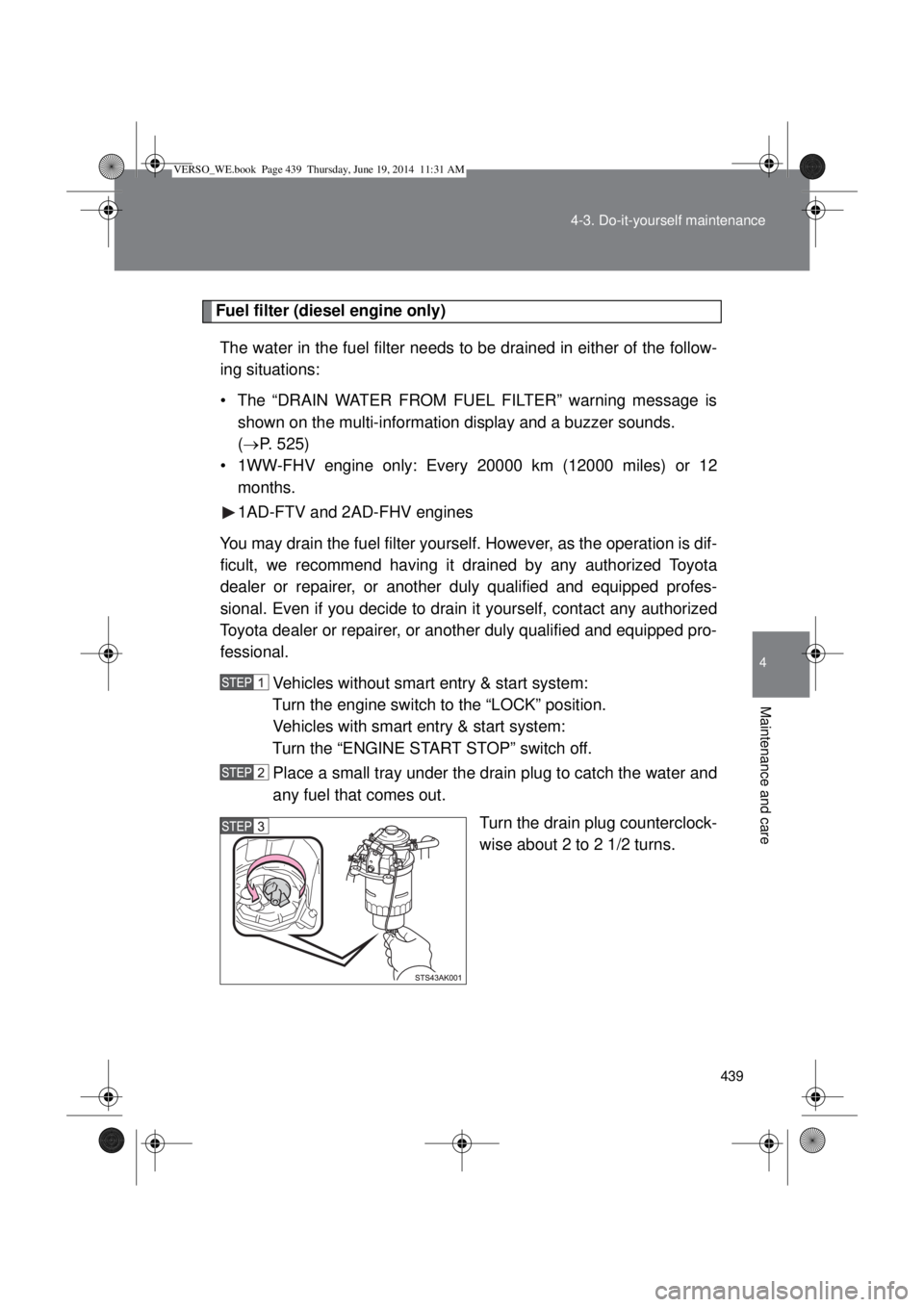
Place a small tray under the drain plug to catch the water and
any fuel that comes out.
Turn the drain plug counterclock-
wise about 2 to 2 1/2 turns.
VERSO_WE.book Page 439 Thursday, June 19, 2014 11:31 AM
Page 443 of 650
443
4-3. Do-it-yourself maintenance
4
Maintenance and care
Tires
Replace the tires when the treadwear indicators show.
Checking tires
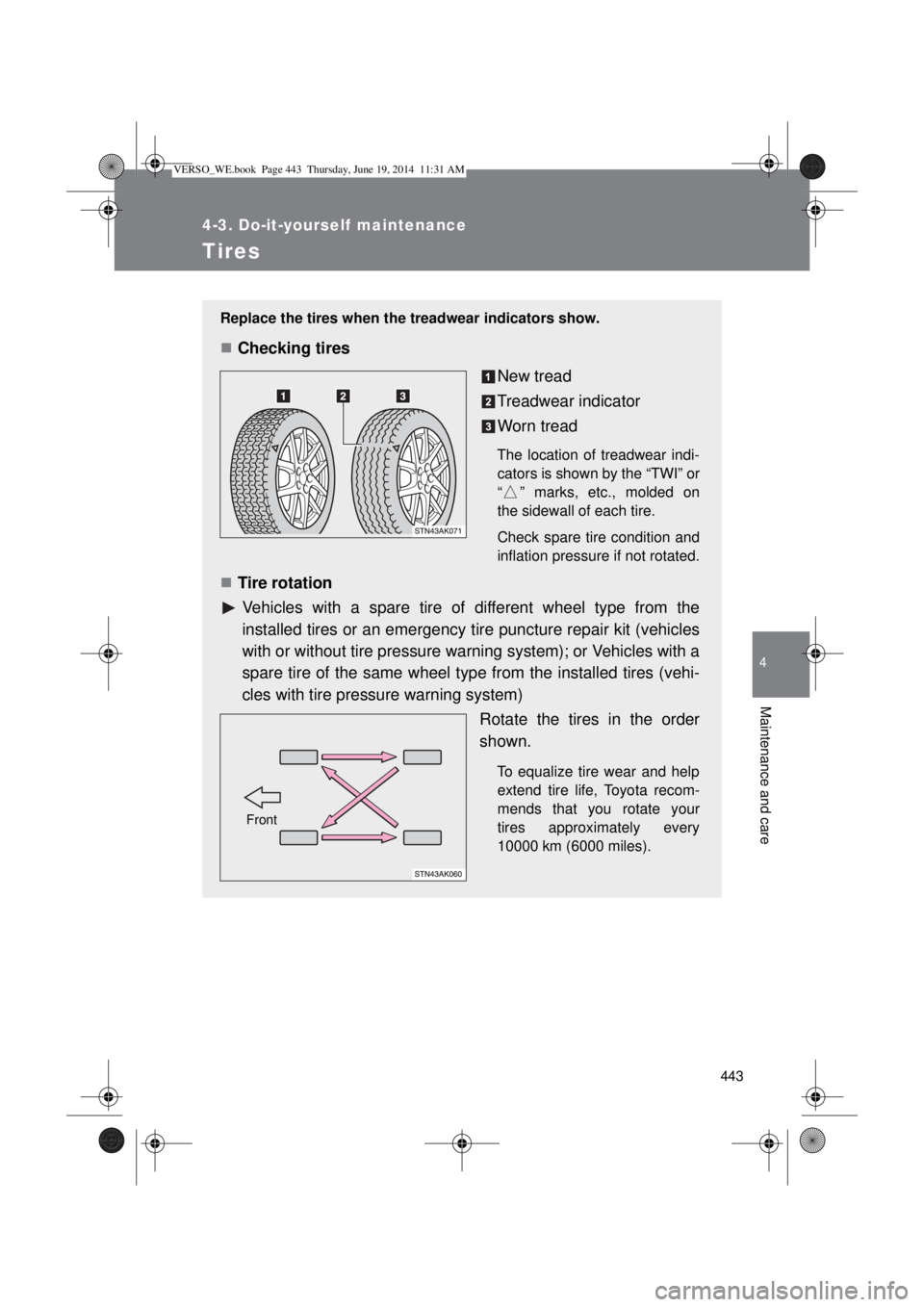
New tread
Treadwear indicator
Worn tread
The location of treadwear indi-
cators is shown by the “TWI” or
“ ” marks, etc., molded on
the sidewall of each tire.
Check spare tire condition and
inflation pressure if not rotated.
Tire rotation
Vehicles with a spare tire of different wheel type from the
installed tires or an emergency tire puncture repair kit (vehicles
with or without tire pressure warning system); or Vehicles with a
spare tire of the same wheel type from the installed tires (vehi-
cles with tire pressure warning system)
Rotate the tires in the order
shown.
To equalize tire wear and help
extend tire life, Toyota recom-
mends that you rotate your
tires approximately every
10000 km (6000 miles).
Front
VERSO_WE.book Page 443 Thursday, June 19, 2014 11:31 AM
Page 444 of 650
444 4-3. Do-it-yourself maintenance
Installing tire pressure warning valves and transmitters (if equipped)
When replacing tires or wheels, tire pressure warning valves and
transmitters must also be installed.
When new tire pressure warning valves and transmitters are
installed, new ID codes must be registered in the tire pressure warn-
ing computer and the tire pressure warning system must be initial-
ized. Have tire pressure warning valve and transmitter ID codes
registered by any authorized Toyota dealer or repairer, or another
duly qualified and equipped professional. (P. 447)
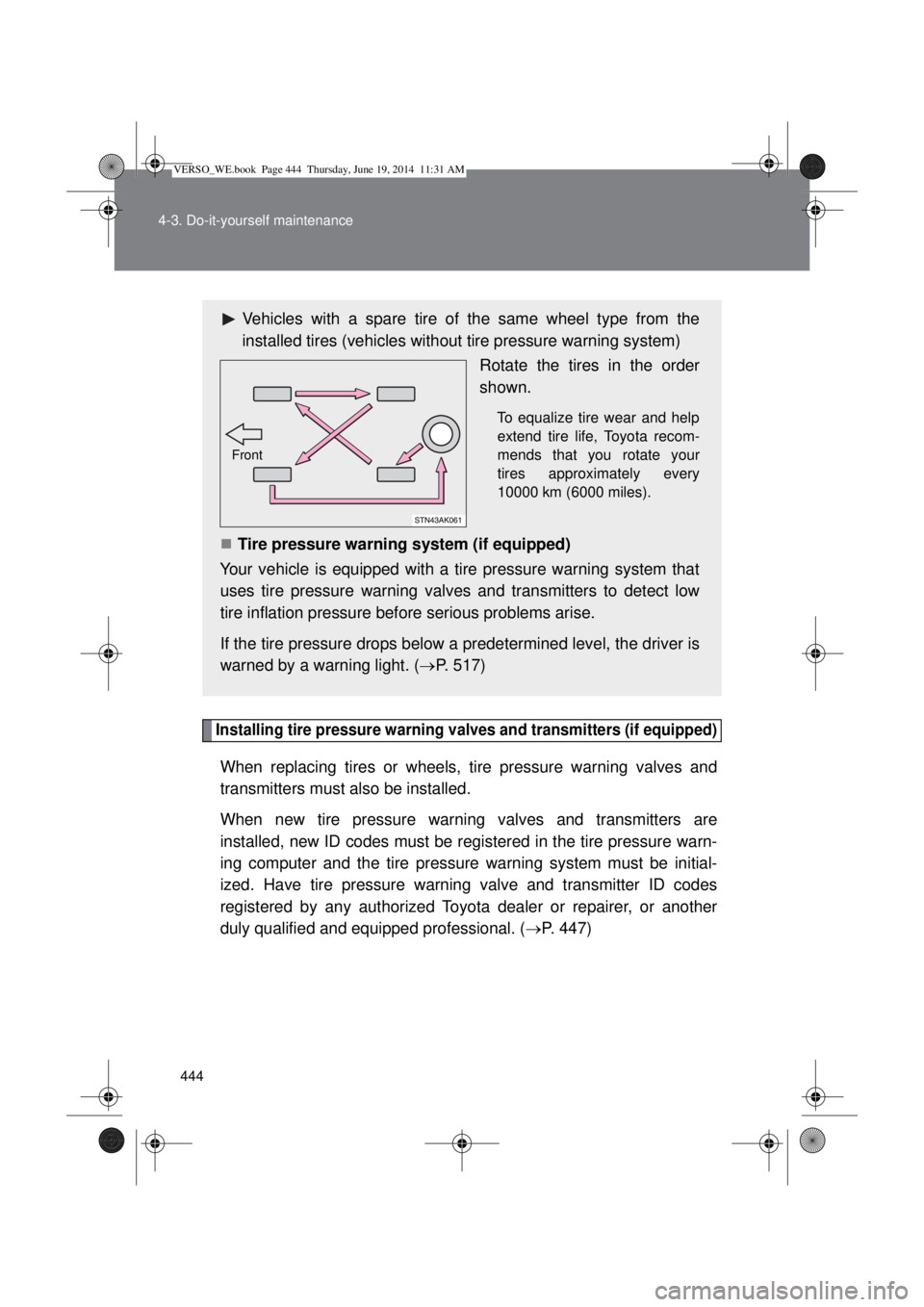
Vehicles with a spare tire of the same wheel type from the
installed tires (vehicles without tire pressure warning system)
Rotate the tires in the order
shown.
To equalize tire wear and help
extend tire life, Toyota recom-
mends that you rotate your
tires approximately every
10000 km (6000 miles).
Tire pressure warning system (if equipped)
Your vehicle is equipped with a tire pressure warning system that
uses tire pressure warning valves and transmitters to detect low
tire inflation pressure before serious problems arise.
If the tire pressure drops below a predetermined level, the driver is
warned by a warning light. (P. 517)
Front
VERSO_WE.book Page 444 Thursday, June 19, 2014 11:31 AM
Page 445 of 650
445 4-3. Do-it-yourself maintenance
4
Maintenance and care
Initializing the tire pressure warning system (if equipped)
The tire pressure warning system must be initialized in the fol-
lowing circumstances:
When rotating front and rear tires which have different tire infla-
tion pressures
When the tire inflation pressure is changed such as when
changing traveling speed
When changing the tire size
When the tire pressure warning system is initialized, the current
tire inflation pressure is set as the benchmark pressure.
How to initialize the tire pressure warning system (if
equipped)
Park the vehicle in a safe place and turn the engine switch to
the “LOCK” position (vehicles without smart entry & start sys-
tem) or the “ENGINE START STOP” switch off (vehicles with
smart entry & start system).
Initialization cannot be performed while the vehicle is moving.
Adjust the tire inflation pressure to the specified cold tire infla-
tion pressure level. (P. 621)
Make sure to adjust the tire pressure to the specified cold tire infla-
tion pressure level. The tire pressure warning system will operate
based on this pressure level.
Turn the engine switch to the “ON” position (vehicles without
smart entry & start system) or the “ENGINE START STOP”
switch to IGNITION ON mode (vehicles with smart entry &
start system).
VERSO_WE.book Page 445 Thursday, June 19, 2014 11:31 AM
Page 446 of 650
446 4-3. Do-it-yourself maintenance
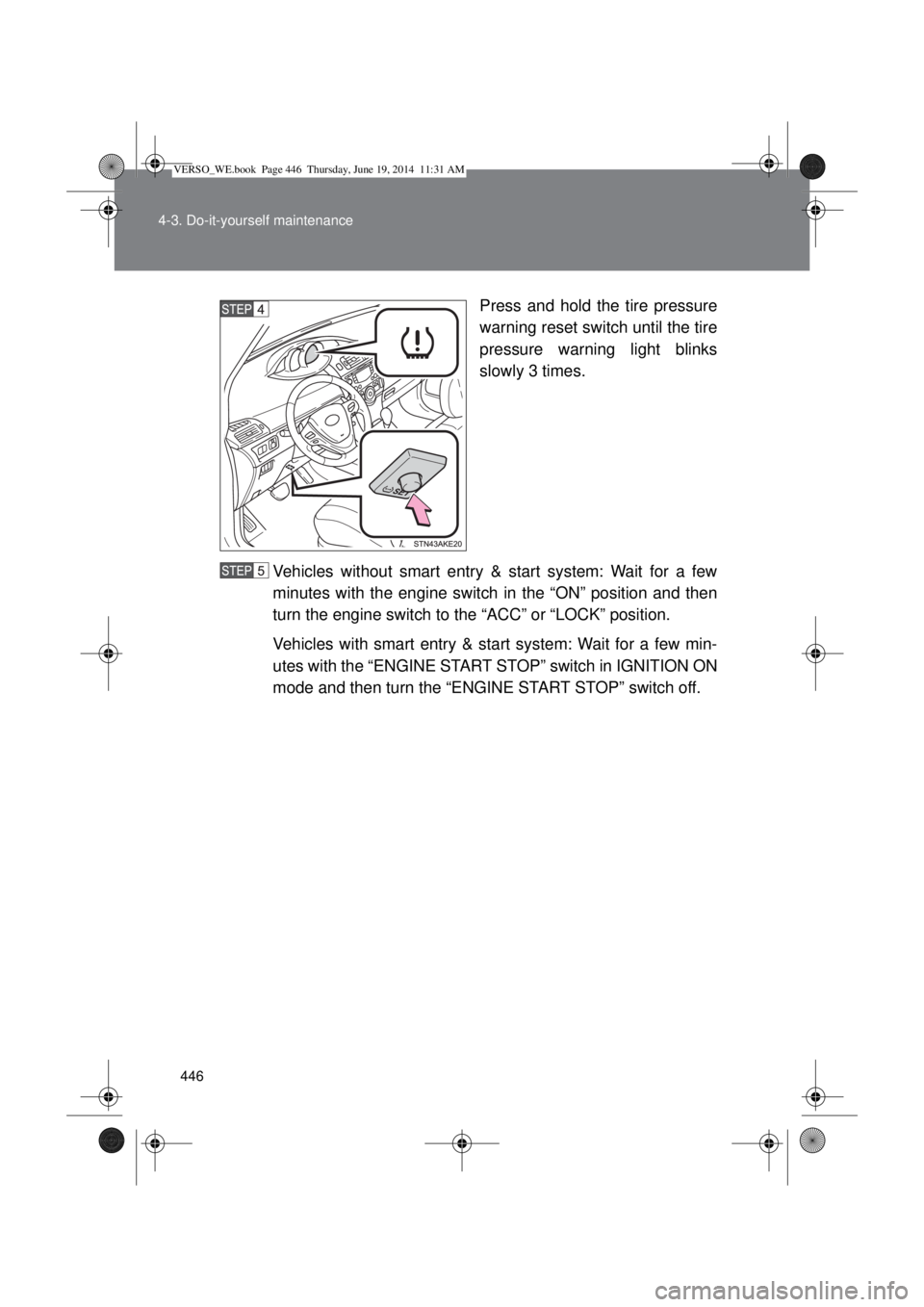
Press and hold the tire pressure
warning reset switch until the tire
pressure warning light blinks
slowly 3 times.
Vehicles without smart entry & start system: Wait for a few
minutes with the engine switch in the “ON” position and then
turn the engine switch to the “ACC” or “LOCK” position.
Vehicles with smart entry & start system: Wait for a few min-
utes with the “ENGINE START STOP” switch in IGNITION ON
mode and then turn the “ENGINE START STOP” switch off.
VERSO_WE.book Page 446 Thursday, June 19, 2014 11:31 AM
Page 447 of 650

447 4-3. Do-it-yourself maintenance
4
Maintenance and care
Registering ID codes (vehicles with the tire pressure warning system)
The tire pressure warning valve and transmitter is equipped with a
unique ID code. When replacing a tire pressure warning valve and
transmitter, it is necessary to register the ID code. Have the ID code
registered by any authorized Toyota dealer or repairer, or another
duly qualified and equipped professional.
When to replace your vehicle’s tires
Tires should be replaced if:
You have tire damage such as cuts, splits, cracks deep enough to
expose the fabric or bulges indicating internal damage
A tire goes flat repeatedly or cannot be properly repaired due to the size
or location of a cut or other damage
If you are not sure, consult with any authorized Toyota dealer or repairer, or
another duly qualified and equipped professional.
Replacing tire and wheels (vehicles with the tire pressure warning sys-
tem)
If the ID code of the tire pressure warning valve and transmitter is not regis-
tered, the tire pressure warning system will not work properly. After driving
for about 10 minutes, the tire pressure warning light blinks for 1 minute and
stays on to indicate a system malfunction.
Tire life
Any tires over 6 years old must be checked by a qualified technician even if
they have seldom or never been used or damage is not obvious.
VERSO_WE.book Page 447 Thursday, June 19, 2014 11:31 AM
Page 448 of 650

448 4-3. Do-it-yourself maintenance
Routine tire inflation pressure checks (vehicles with the tire pressure
warning system)
The tire pressure warning system does not replace routine tire inflation pres-
sure checks. Make sure to check tire inflation pressure as part of your rou-
tine of daily vehicle checks.
Initializing the tire pressure warning system (if equipped)
Initialize the system with the tire inflation pressure adjusted to the specified
level.
If the tread depth wears down to 4 mm (0.16 in.) or more on snow tires
The effectiveness of snow tires is lost.
When initialization of the tire pressure warning system has failed (if
equipped)
Initialization can be completed in a few minutes. However, in the following
cases, the settings have not been recorded and the system will not operate
properly. If repeated attempts to record tire inflation pressure settings are
unsuccessful, have the vehicle inspected by any authorized Toyota dealer or
repairer, or another duly qualified and equipped professional.
When operating the tire pressure warning reset switch, the tire pressure
warning light does not blink 3 times.
After driving for a certain period of time since the initialization has been
completed, the warning light comes on after blinking for 1 minute.
VERSO_WE.book Page 448 Thursday, June 19, 2014 11:31 AM