warning TOYOTA VERSO 2016 Repair Manual
[x] Cancel search | Manufacturer: TOYOTA, Model Year: 2016, Model line: VERSO, Model: TOYOTA VERSO 2016Pages: 664, PDF Size: 62.24 MB
Page 263 of 664
263
2-4. Toyota Safety Sense
2
When driving
VERSO_EE_OM64590E
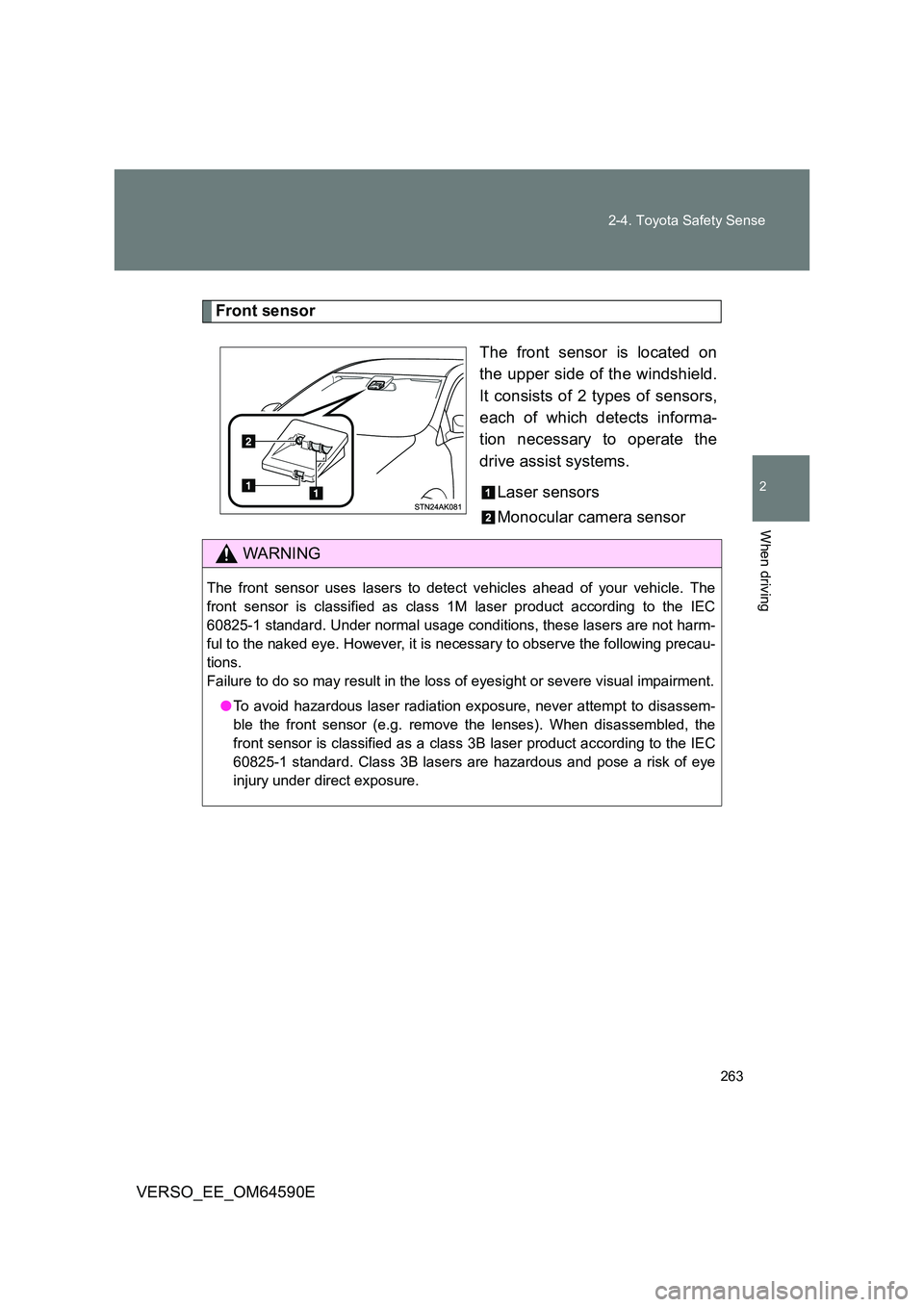
Front sensor
The front sensor is located on
the upper side of the windshield.
It consists of 2 types of sensors,
each of which detects informa-
tion necessary to operate the
drive assist systems.
Laser sensors
Monocular camera sensor
2
WARNING
The front sensor uses lasers to detect vehicles ahead of your vehicle. The
front sensor is classified as class 1M laser product according to the IEC
60825-1 standard. Under normal usage condi tions, these lasers are not harm-
ful to the naked eye. However, it is necessary to observe the following precau-
tions.
Failure to do so may result in the loss of eyesight or severe visual impairment.
● To avoid hazardous laser radiation exposure, never attempt to disassem-
ble the front sensor (e.g. remove the lenses). When disassembled, the
front sensor is classified as a class 3B laser product according to the IEC
60825-1 standard. Class 3B lasers are hazardous and pose a risk of eye
injury under direct exposure.
Page 264 of 664
264
2-4. Toyota Safety Sense
VERSO_EE_OM64590E
WARNING
● Do not attempt to look into the front sensor with a magnifying glass, micro-
scope or other optical instrument within a distance of less than 100 mm
(3.9 in.).
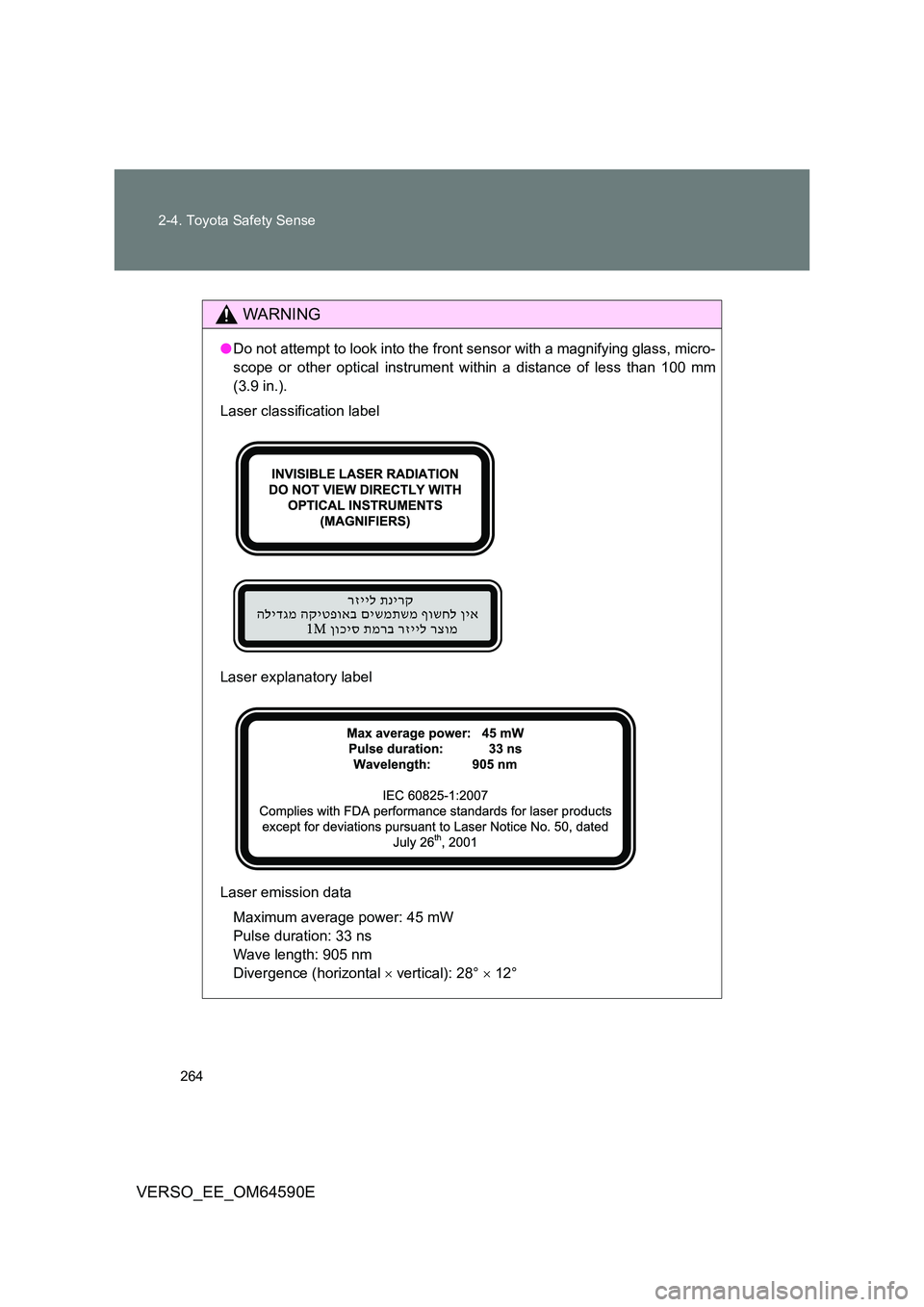
Laser classification label
Laser explanatory label
Laser emission data
Maximum average power: 45 mW
Pulse duration: 33 ns
Wave length: 905 nm
Divergence (horizontal vertical): 28° 12°
Page 265 of 664
265
2-4. Toyota Safety Sense
2
When driving
VERSO_EE_OM64590E
NOTICE
■ Front sensor
Observe the following to ensure that the sensor operates correctly:
● Do not attach window tinting to the windshield.
● On cold days when there is a large temperature difference between the
vehicle interior and outside air temperatures, the windshield fogs up easily.
If the part of the windshield in front of the front sensor becomes fogged up
or covered with condensation or ice, the system temporarily stops working
and the PCS warning light flashes or illuminates. In that case, use the front
defroster to remove the fog, condensation, or ice. ( P. 334, 344)
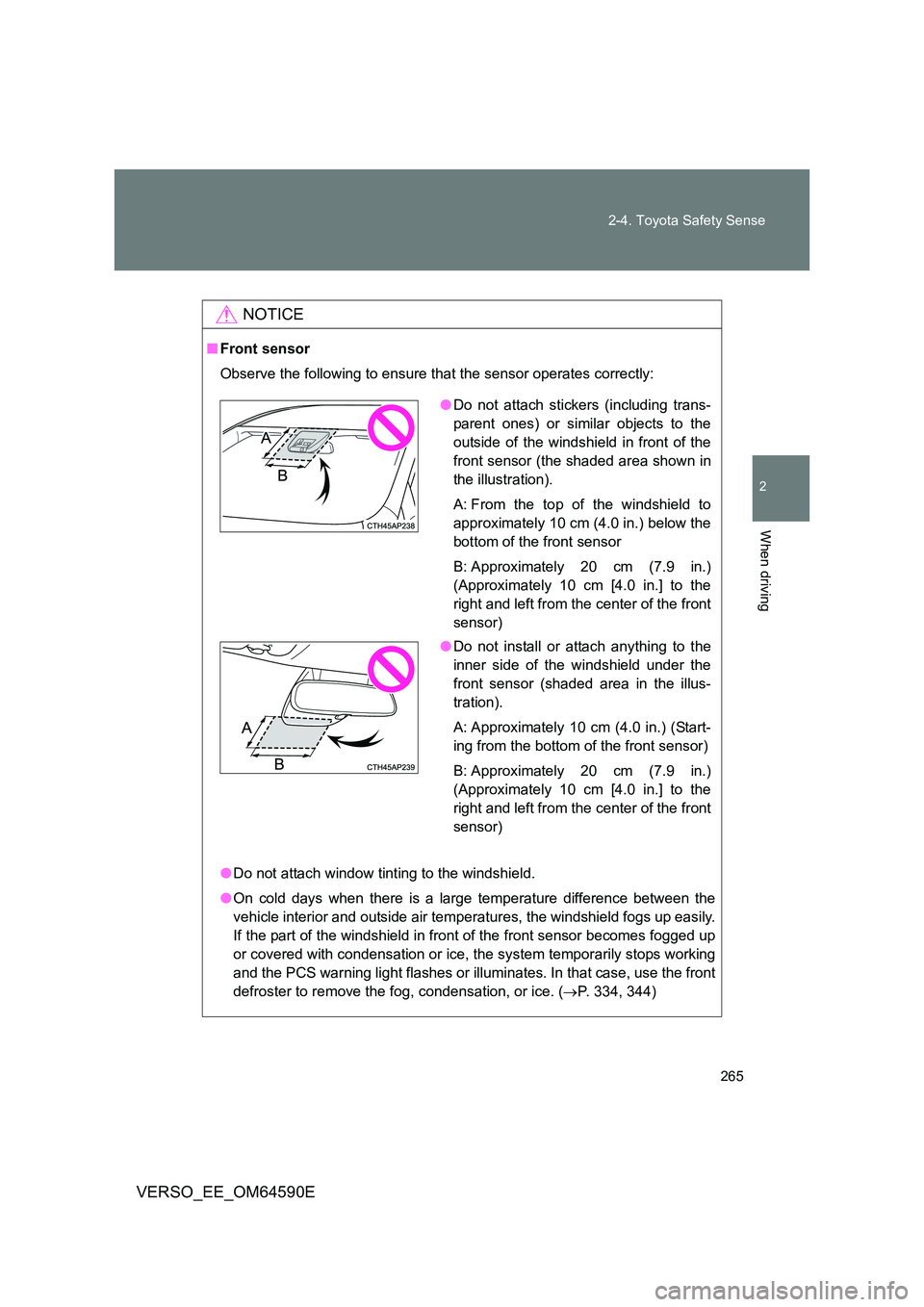
●Do not attach stickers (including trans-
parent ones) or similar objects to the
outside of the windshield in front of the
front sensor (the shaded area shown in
the illustration).
A: From the top of the windshield to
approximately 10 cm (4.0 in.) below the
bottom of the front sensor
B: Approximately 20 cm (7.9 in.)
(Approximately 10 cm [4.0 in.] to the
right and left from the center of the front
sensor)
● Do not install or attach anything to the
inner side of the windshield under the
front sensor (shaded area in the illus-
tration).
A: Approximately 10 cm (4.0 in.) (Start-
ing from the bottom of the front sensor)
B: Approximately 20 cm (7.9 in.)
(Approximately 10 cm [4.0 in.] to the
right and left from the center of the front
sensor)
Page 267 of 664
267
2-4. Toyota Safety Sense
2
When driving
VERSO_EE_OM64590E
PCS (Pre-Collision System)
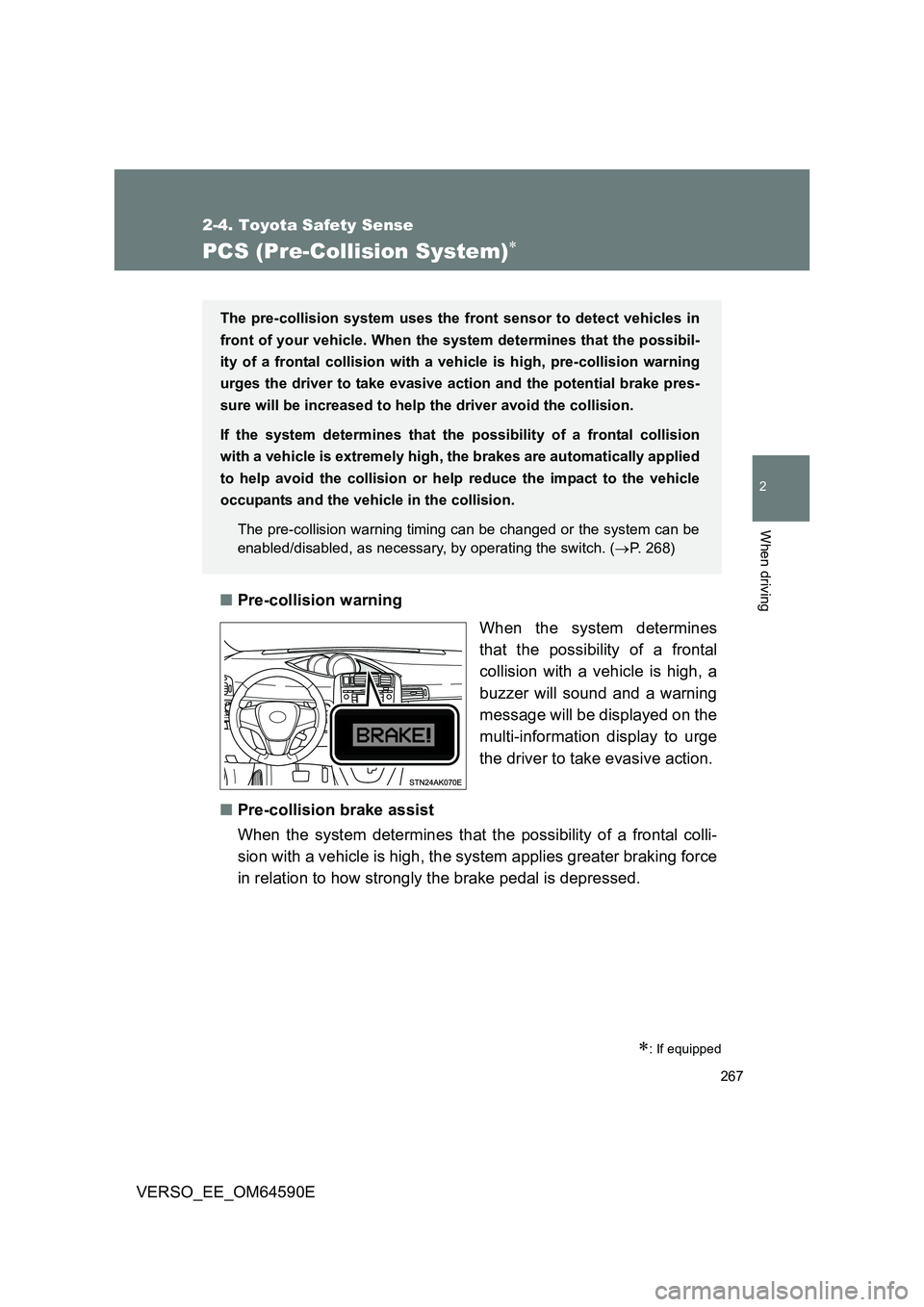
■Pre-collision warning
When the system determines
that the possibility of a frontal
collision with a vehicle is high, a
buzzer will sound and a warning
message will be displayed on the
multi-information display to urge
the driver to take evasive action.
■ Pre-collision brake assist
When the system determines that the possibility of a frontal colli-
sion with a vehicle is high, the system applies greater braking force
in relation to how strongly the brake pedal is depressed.
: If equipped
The pre-collision system uses the front sensor to detect vehicles in
front of your vehicle. When the system determines that the possibil-
ity of a frontal collision with a vehicle is high, pre-collision warning
urges the driver to take evasive action and the potential brake pres-
sure will be increased to help the driver avoid the collision.
If the system determines that the possibility of a frontal collision
with a vehicle is extremely high, the brakes are automatically applied
to help avoid the collision or he lp reduce the impact to the vehicle
occupants and the vehicle in the collision.
The pre-collision warning timing can be changed or the system can be
enabled/disabled, as necessary, by operating the switch. ( P. 268)
Page 268 of 664
268
2-4. Toyota Safety Sense
VERSO_EE_OM64590E
■ Pre-collision braking
When the system determines that the possibility of a frontal colli-
sion with a vehicle is high, the system warns the driver. If the sys-
tem determines that the possibility of a collision is extremely high,
the brakes are automatically applied to help avoid the collision or
reduce the collision speed.
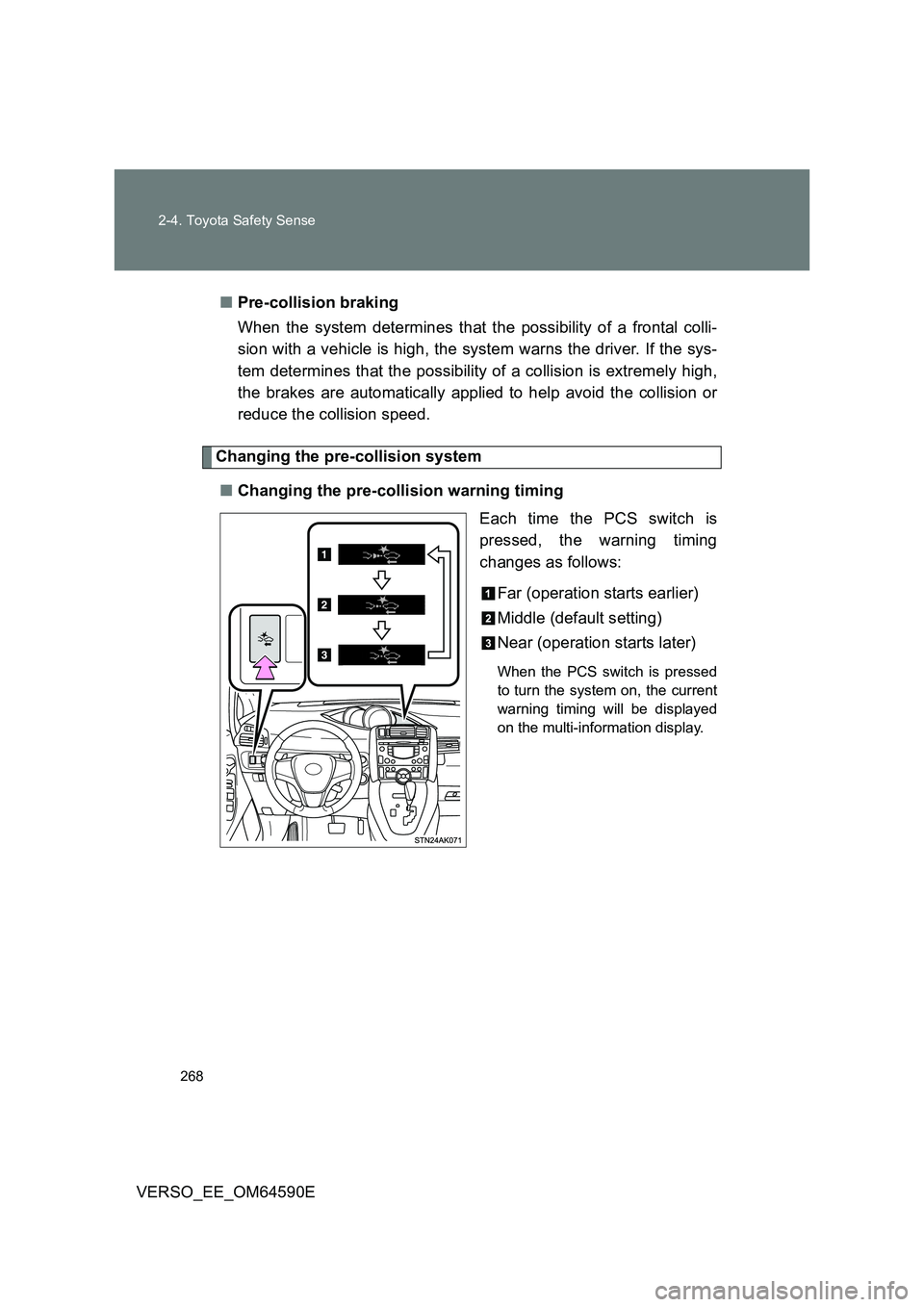
Changing the pre-collision system
■ Changing the pre-collision warning timing
Each time the PCS switch is
pressed, the warning timing
changes as follows:
Far (operation starts earlier)
Middle (default setting)
Near (operation starts later)
When the PCS switch is pressed
to turn the system on, the current
warning timing will be displayed
on the multi-information display.
Page 269 of 664
269
2-4. Toyota Safety Sense
2
When driving
VERSO_EE_OM64590E
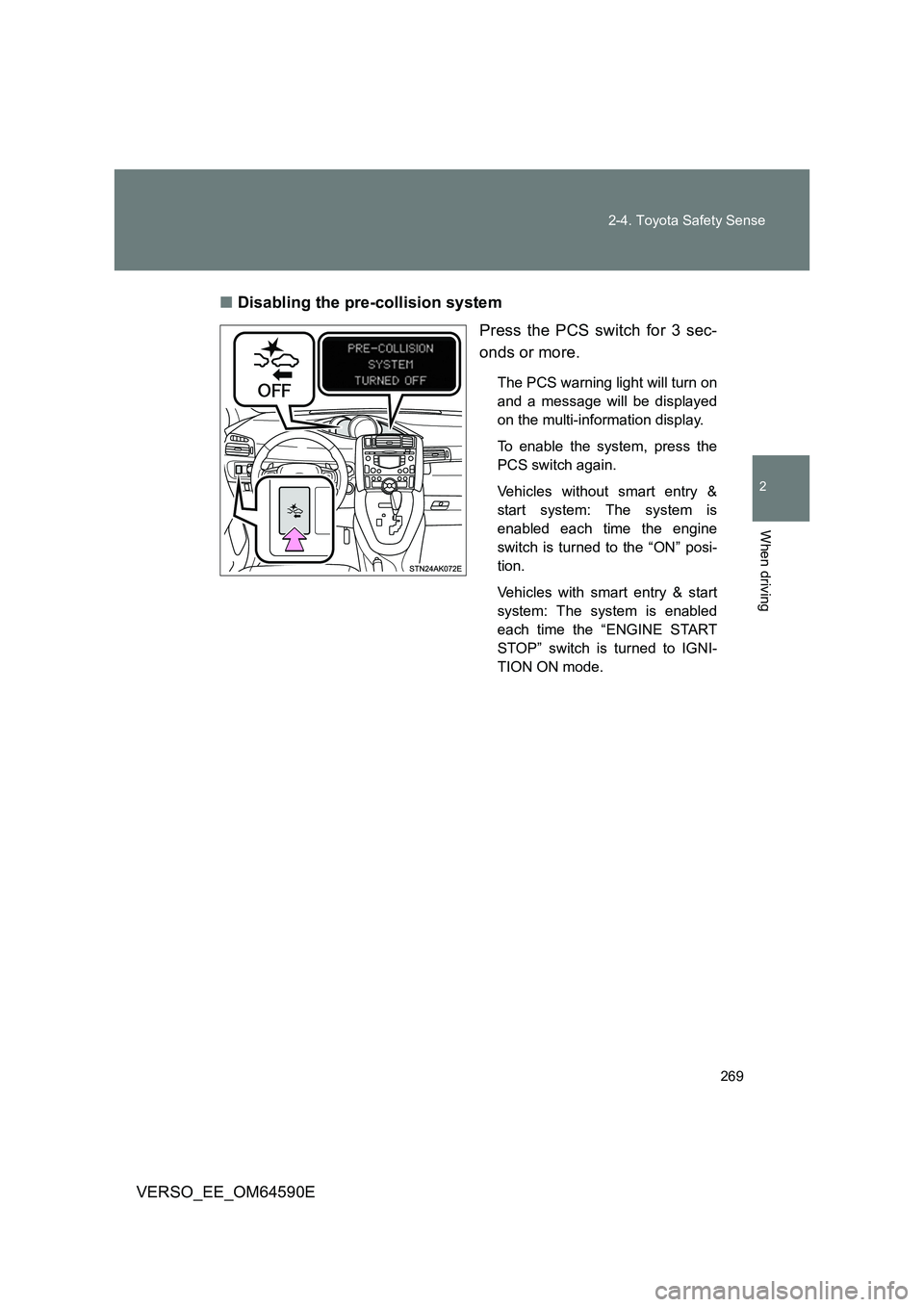
■ Disabling the pre-collision system
Press the PCS switch for 3 sec-
onds or more.
The PCS warning light will turn on
and a message will be displayed
on the multi-information display.
To enable the system, press the
PCS switch again.
Vehicles without smart entry &
start system: The system is
enabled each time the engine
switch is turned to the “ON” posi-
tion.
Vehicles with smart entry & start
system: The system is enabled
each time the “ENGINE START
STOP” switch is turned to IGNI-
TION ON mode.
Page 270 of 664
270
2-4. Toyota Safety Sense
VERSO_EE_OM64590E
■ Operational conditions
The pre-collision system is enabled and determines that the possibility of a
frontal collision with a vehicle (except motorcycles and bicycles) is high.
● Pre-collision warning:
• Vehicle speed is approximately 15 to 140 km/h (10 to 86 mph).
• The relative speed between your vehicle and the vehicle ahead is
greater than approximately 15 km/h (10 mph).
● Pre-collision brake assist:
• Vehicle speed is approximately 30 to 80 km/h (19 to 49 mph).
• The relative speed between your vehicle and the vehicle ahead is
greater than approximately 30 km/h (19 mph).
● Pre-collision braking:
• Vehicle speed is approximately 10 to 80 km/h (7 to 49 mph).
• The relative speed between your vehicle and the vehicle ahead is
greater than approximately 10 km/h (7 mph).
When the brake pedal is stepped on, the system judges if evasion actions
are being done by the driver and the start timing for pre-collision braking
may be delayed.
During the following, the driver oper ations takes precedence and the system
may not operate:
● The accelerator pedal is depressed strongly.
● The steering wheel is turned sharply or abruptly.
In case of the following, the system will not operate:
● If a battery terminal has been disconnected and reconnected and then
the vehicle has not been driven for a certain amount of time
● If VSC is disabled (only the pre-collision warning function will be opera-
tional)
● If the PCS warning light is flashing or illuminated
● When the shift position is in “R”
Page 274 of 664
274
2-4. Toyota Safety Sense
VERSO_EE_OM64590E
■ If the PCS warning light flashes or illuminates, and a warning message
is displayed on the multi-information display
The pre-collision system may be tempor arily unavailable or there may be a
malfunction in the system.
● In the following situations, the indicator and message will be cleared and
the system will become operational when normal operating conditions
return:
• When the area around the front sensor is hot, such as after the vehicle
has been parked in the sun
• When the windshield is fogged up or covered with condensation or ice
( P. 334, 344)
• If the area in front of the front sensor is obstructed, such as when the
hood is open
● If the PCS warning light continues to flash or illuminate, or the warning
message is not cleared, the system may be malfunctioning. Have the
vehicle inspected by any authorized Toyota dealer or repairer, or another
duly qualified and equipped professional immediately.
■ If the TRC and VSC+ are disabled
● If the TRC and VSC+ are disabled (P. 313), pre-collision brake assist
and pre-collision braking are also di sabled. However, the pre-collision
warning function will still operate.
● The PCS warning light will turn on and a warning message will be dis-
played on the multi-information display. ( P. 551)
Page 275 of 664
275
2-4. Toyota Safety Sense
2
When driving
VERSO_EE_OM64590E
WARNING
■ Limitations of the pre-collision system
● The driver is solely responsible for safe driving. Always drive safely, taking
care to observe your surroundings.
Do not use the pre-collision system instead of normal braking operations
under any circumstances. This system will not prevent collisions or lessen
damage or injuries in every situation. Do not overly rely on this system.
Failure to do so may lead to an accident, resulting in death or serious
injury.
Although this system is designed to help avoid and reduce the impact of a
collision, its effectiveness may change according to various conditions
( P. 270). As a result, the system may not always provide the same level
of performance.
● The pre-collision braking function may not operate if certain operations are
performed by the driver. If the accelerator pedal is being depressed
strongly or the steering wheel is bei ng turned, the system may determine
that the driver is taking evasive action and possibly prevent the pre-colli-
sion braking function from operating.
● In some situations, while the pre-collision braking function is operating,
operation of the function may be canceled if the accelerator pedal is
depressed strongly or the steering w heel is turned and the system deter-
mines that the driver is taking evasive action.
● While driving, the system may recognize front obstacles, such as the
crossing gate of a railway crossing, as a collision objects and operate the
pre-collision brake.
In the event that the vehicle gets caught within the railroad crossing, move
the vehicle with the following actions and depending on the situation main-
tain safety.
• Depress the accelerator pedal after the vehicle has stopped
• Strongly depress the accelerator pedal when decelerating ( P. 271)
• Turn the pre-collision system OFF ( P. 269)
● A large amount of braking force is applied while the pre-collision braking
function is operating. Additionally, as the vehicle may creep after the pre-
collision braking function has operated, the driver should depress the
brake pedal as necessary.
Page 276 of 664
276
2-4. Toyota Safety Sense
VERSO_EE_OM64590E
WARNING
■ Cautions regarding the assist functions of the system
By means of warnings and brake control, the pre-collision system is
intended to assist the driver in avoi ding collisions through the process of
LOOK-JUDGE-ACT. There are limits to the degree of assistance the system
can provide, so keep in mind the following important points.
● Assisting the driver in watching the road
The pre-collision system is only able to detect vehicles directly in front of
your vehicle, and only within a limited range. It does not allow for careless
or inattentive driving, and is not a system that can assist the driver in low-
visibility conditions. It is still necessary for the driver to pay close attention
to the vehicle’s surroundings.
● Assisting the driver in making correct judgement
When attempting to estimate the possibility of a collision, the only data
available to the pre-collision system is that from vehicles it has detected
directly in front of the vehicle. Therefore, it is absolutely necessary for the
driver to remain vigilant and to determine whether or not there is a possi-
bility of collision in any given situation.
● Assisting the driver in taking action
The pre-collision brake assist and pre-collision braking functions are
designed to help avoid a collision or reduce the severity of a collision, as
such they only operate when the system has determined that the possibil-
ity of a collision is high. This system is not capable of automatically avoid-
ing a collision or bringing the vehicle to a stop safely, without appropriate
operations being performed by the driver. For this reason, when encoun-
tering a dangerous situation the driver must take direct and immediate
action in order to ensure the safety of all involved.