fuel TOYOTA VERSO 2017 Owner's Manual
[x] Cancel search | Manufacturer: TOYOTA, Model Year: 2017, Model line: VERSO, Model: TOYOTA VERSO 2017Pages: 668, PDF Size: 49.7 MB
Page 234 of 668
234
2-2. Instrument cluster
VERSO_EE_OM64517E
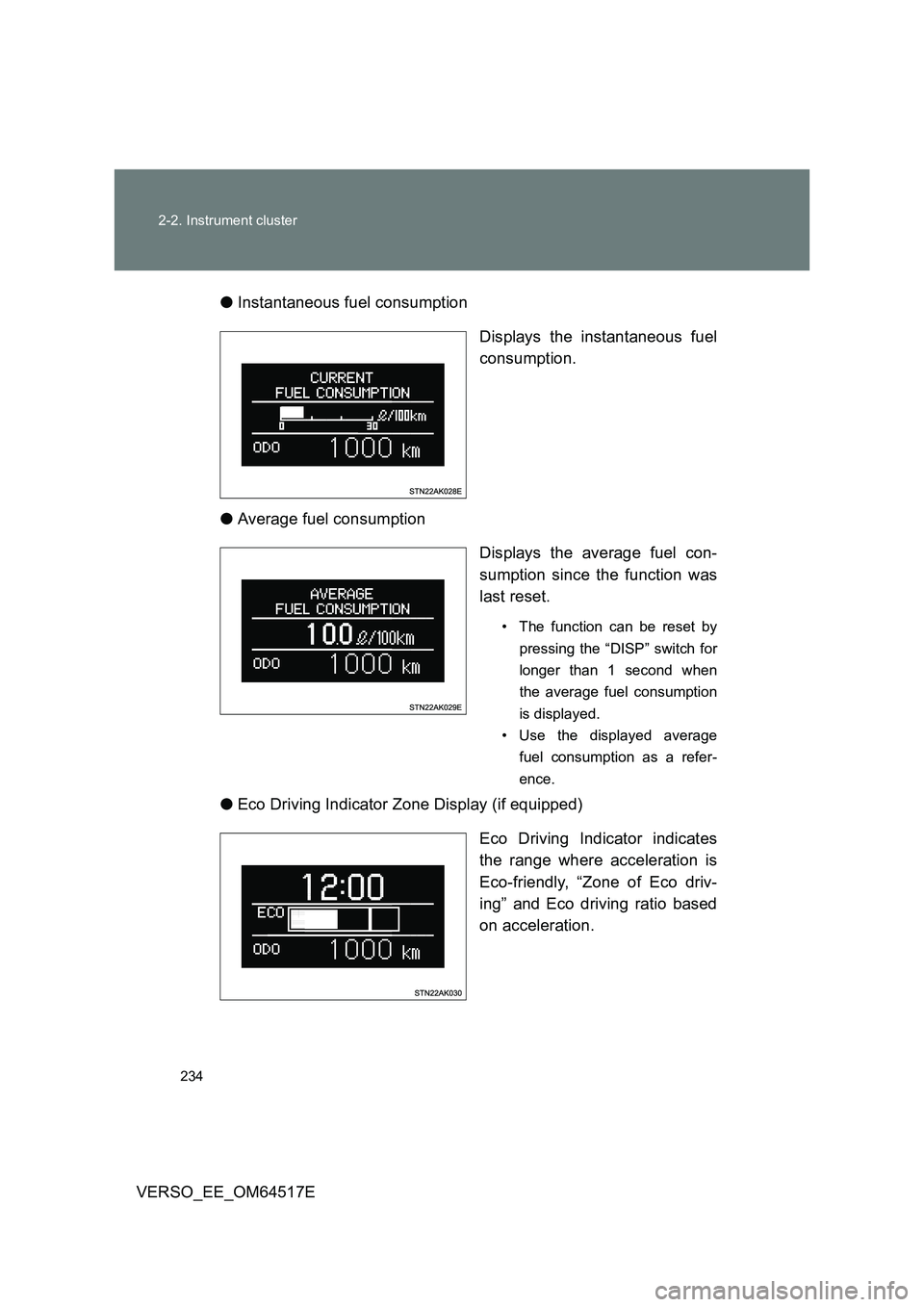
● Instantaneous fuel consumption
Displays the instantaneous fuel
consumption.
● Average fuel consumption
Displays the average fuel con-
sumption since the function was
last reset.
• The function can be reset by
pressing the “DISP” switch for
longer than 1 second when
the average fuel consumption
is displayed.
• Use the displayed average
fuel consumption as a refer-
ence.
● Eco Driving Indicator Zone Display (if equipped)
Eco Driving Indicator indicates
the range where acceleration is
Eco-friendly, “Zone of Eco driv-
ing” and Eco driving ratio based
on acceleration.
Page 235 of 668
235
2-2. Instrument cluster
2
When driving
VERSO_EE_OM64517E
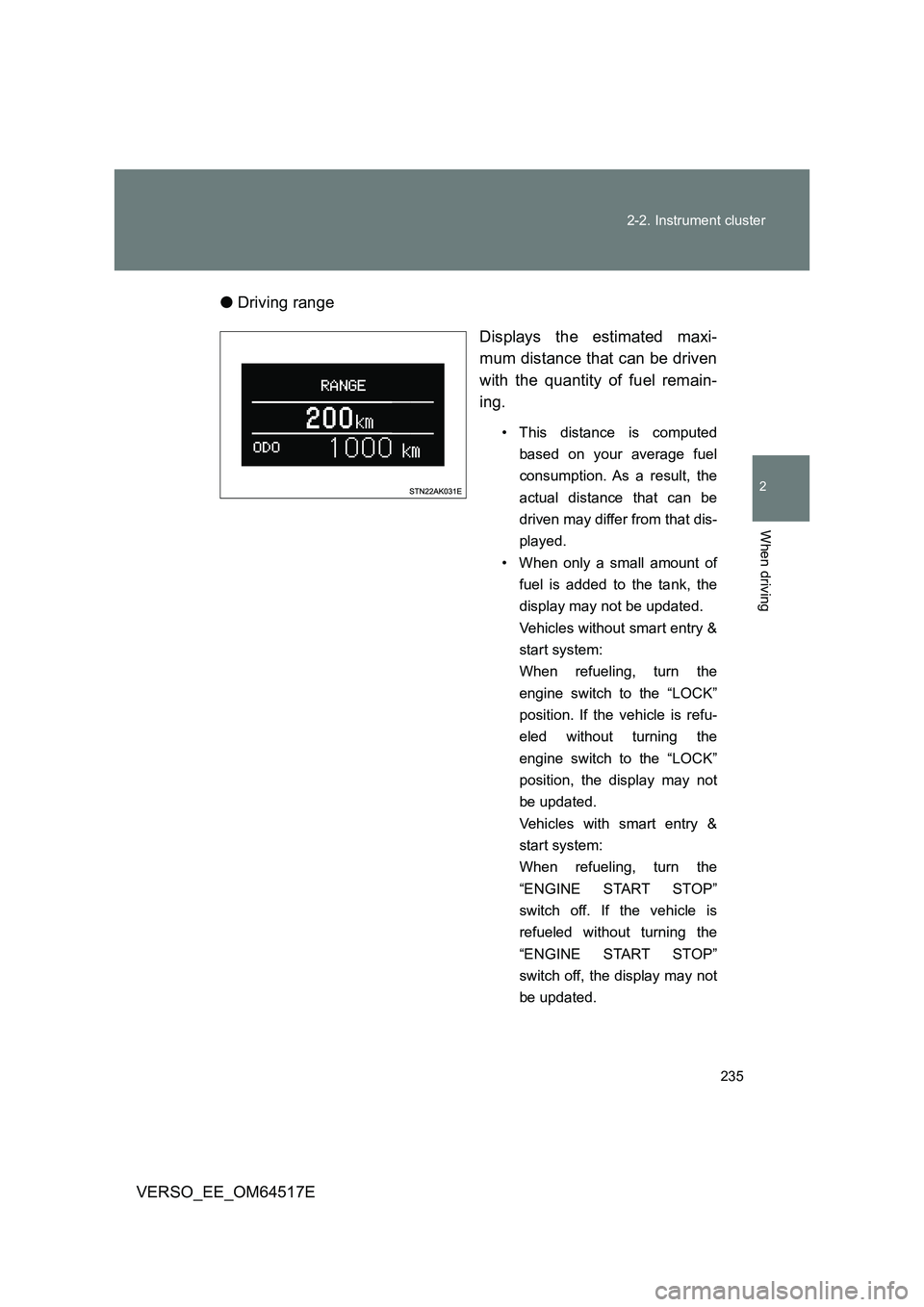
● Driving range
Displays the estimated maxi-
mum distance that can be driven
with the quantity of fuel remain-
ing.
• This distance is computed
based on your average fuel
consumption. As a result, the
actual distance that can be
driven may differ from that dis-
played.
• When only a small amount of
fuel is added to the tank, the
display may not be updated.
Vehicles without smart entry &
start system:
When refueling, turn the
engine switch to the “LOCK”
position. If the vehicle is refu-
eled without turning the
engine switch to the “LOCK”
position, the display may not
be updated.
Vehicles with smart entry &
start system:
When refueling, turn the
“ENGINE START STOP”
switch off. If the vehicle is
refueled without turning the
“ENGINE START STOP”
switch off, the display may not
be updated.
Page 244 of 668
244
2-2. Instrument cluster
VERSO_EE_OM64517E
Fuel consumption information
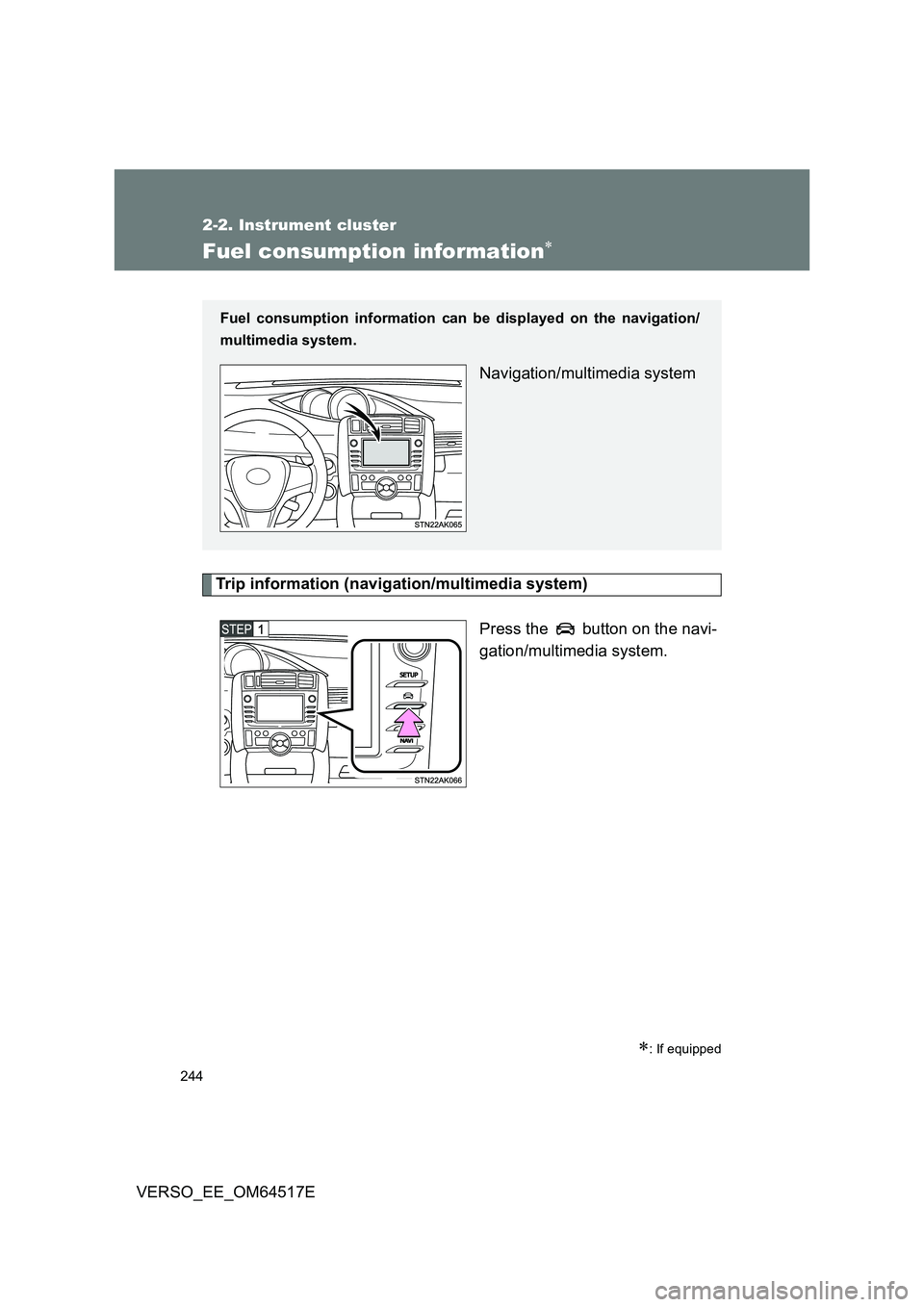
Trip information (navigation/multimedia system)
Press the button on the navi-
gation/multimedia system.
: If equipped
Fuel consumption information can be displayed on the navigation/
multimedia system.
Navigation/multimedia system
Page 245 of 668
245
2-2. Instrument cluster
2
When driving
VERSO_EE_OM64517E
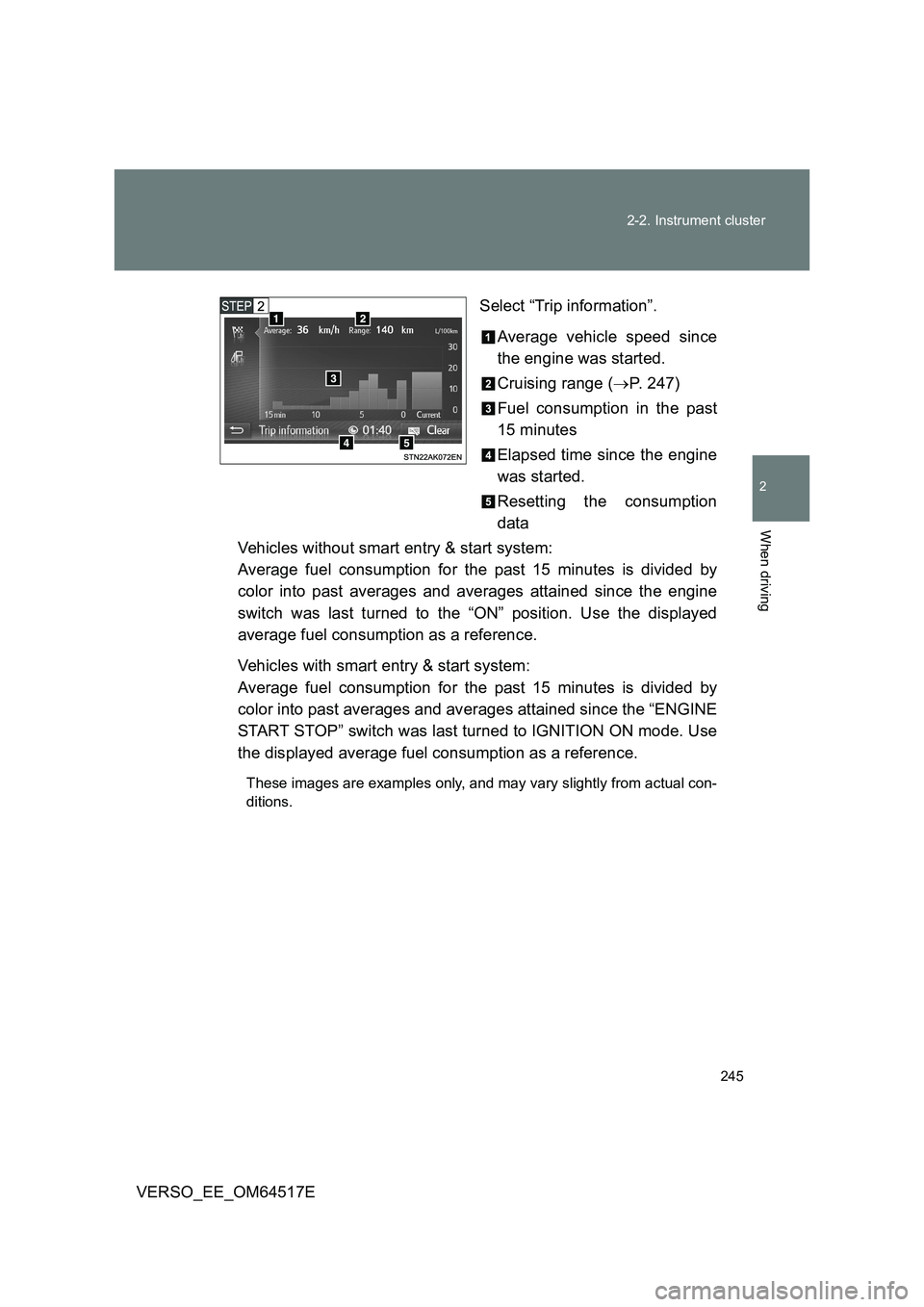
Select “Trip information”.
Average vehicle speed since
the engine was started.
Cruising range ( P. 247)
Fuel consumption in the past
15 minutes
Elapsed time since the engine
was started.
Resetting the consumption
data
Vehicles without smart entry & start system:
Average fuel consumption for the past 15 minutes is divided by
color into past averages and averages attained since the engine
switch was last turned to the “ON” position. Use the displayed
average fuel consumption as a reference.
Vehicles with smart entry & start system:
Average fuel consumption for the past 15 minutes is divided by
color into past averages and averages attained since the “ENGINE
START STOP” switch was last turned to IGNITION ON mode. Use
the displayed average fuel consumption as a reference.
These images are examples only, and may vary slightly from actual con-
ditions.
Page 246 of 668
246
2-2. Instrument cluster
VERSO_EE_OM64517E
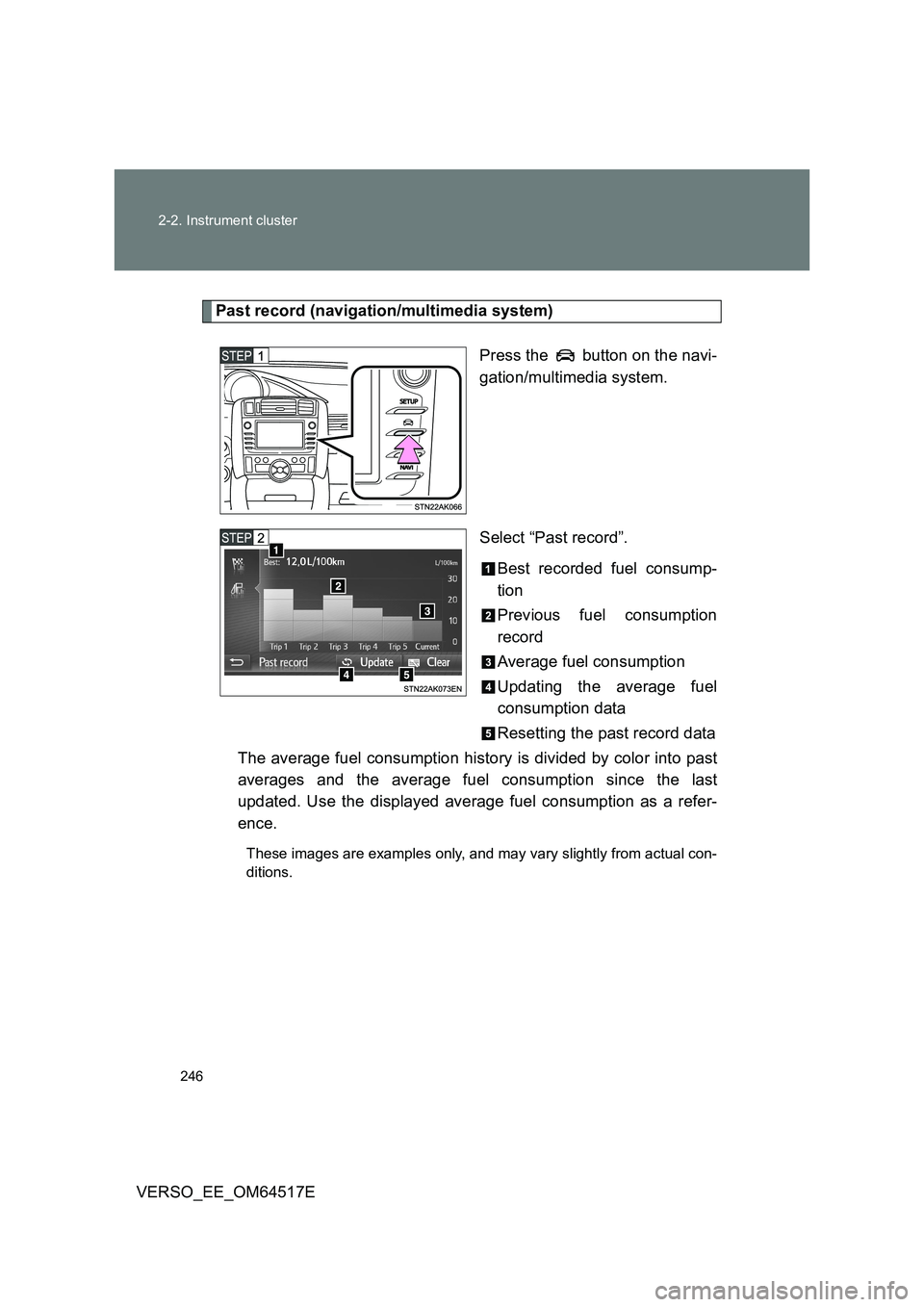
Past record (navigation/multimedia system)
Press the button on the navi-
gation/multimedia system.
Select “Past record”.
Best recorded fuel consump-
tion
Previous fuel consumption
record
Average fuel consumption
Updating the average fuel
consumption data
Resetting the past record data
The average fuel consumption history is divided by color into past
averages and the average fuel consumption since the last
updated. Use the displayed average fuel consumption as a refer-
ence.
These images are examples only, and may vary slightly from actual con-
ditions.
Page 247 of 668
247
2-2. Instrument cluster
2
When driving
VERSO_EE_OM64517E
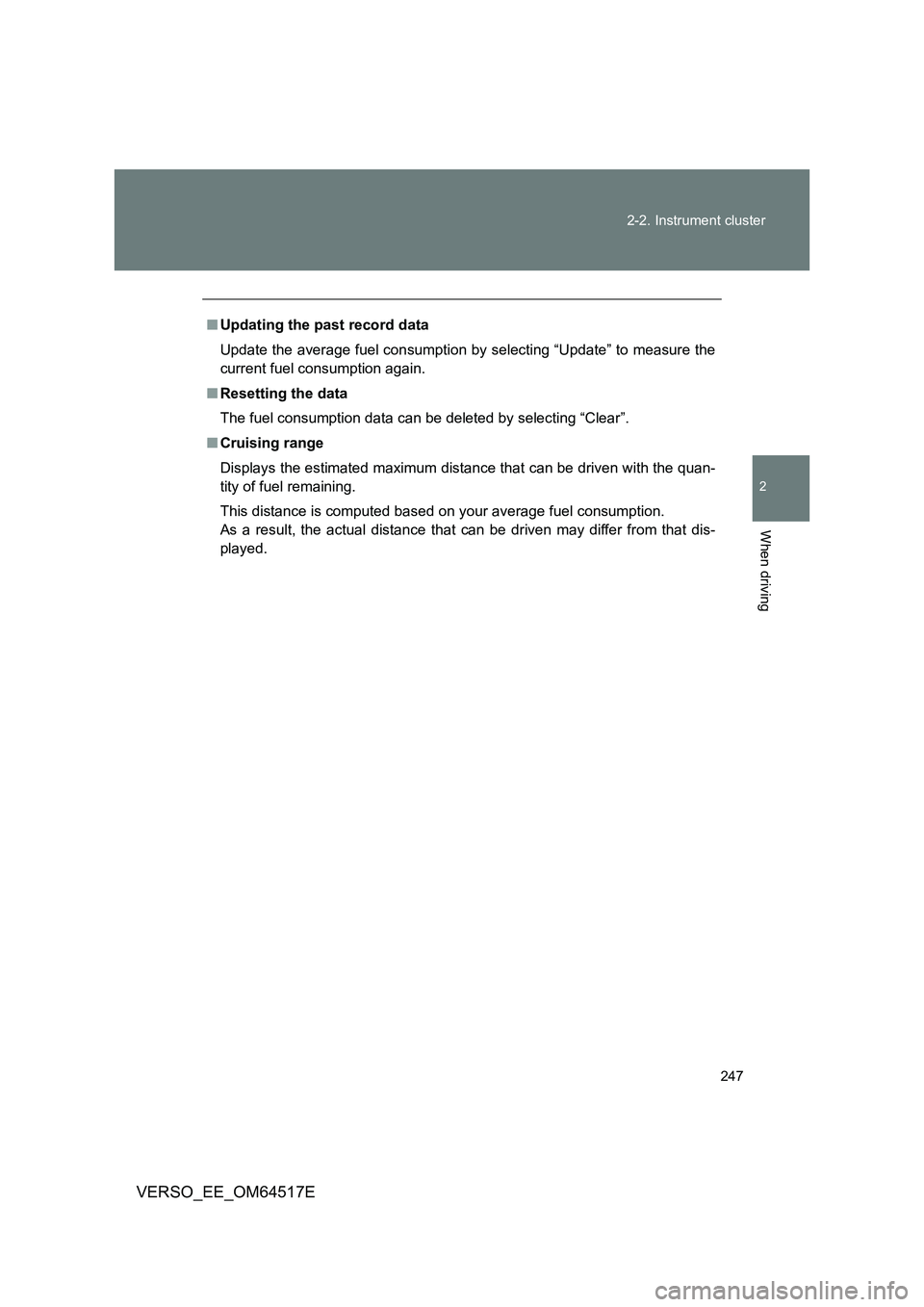
■ Updating the past record data
Update the average fuel consumption by selecting “Update” to measure the
current fuel consumption again.
■ Resetting the data
The fuel consumption data can be deleted by selecting “Clear”.
■ Cruising range
Displays the estimated maximum distance that can be driven with the quan-
tity of fuel remaining.
This distance is computed based on your average fuel consumption.
As a result, the actual distance that can be driven may differ from that dis-
played.
Page 322 of 668
322
VERSO_EE_OM64517E
2-6. Driving information
Cargo and luggage
WARNING
■Things that must not be carried in the luggage compartment
The following things may cause a fi re if loaded in the luggage compartment.
● Receptacles containing gasoline
● Aerosol cans
Take notice of the following information about storage precautions,
cargo capacity and load.
● Stow cargo and luggage in the luggage compartment whenever
possible.
● Be sure all items are secured in place.
● Be careful to keep the vehicle level. Placing the weight as far for-
ward as possible helps maintain vehicle balance.
● For better fuel economy, do not carry unnecessary weight.
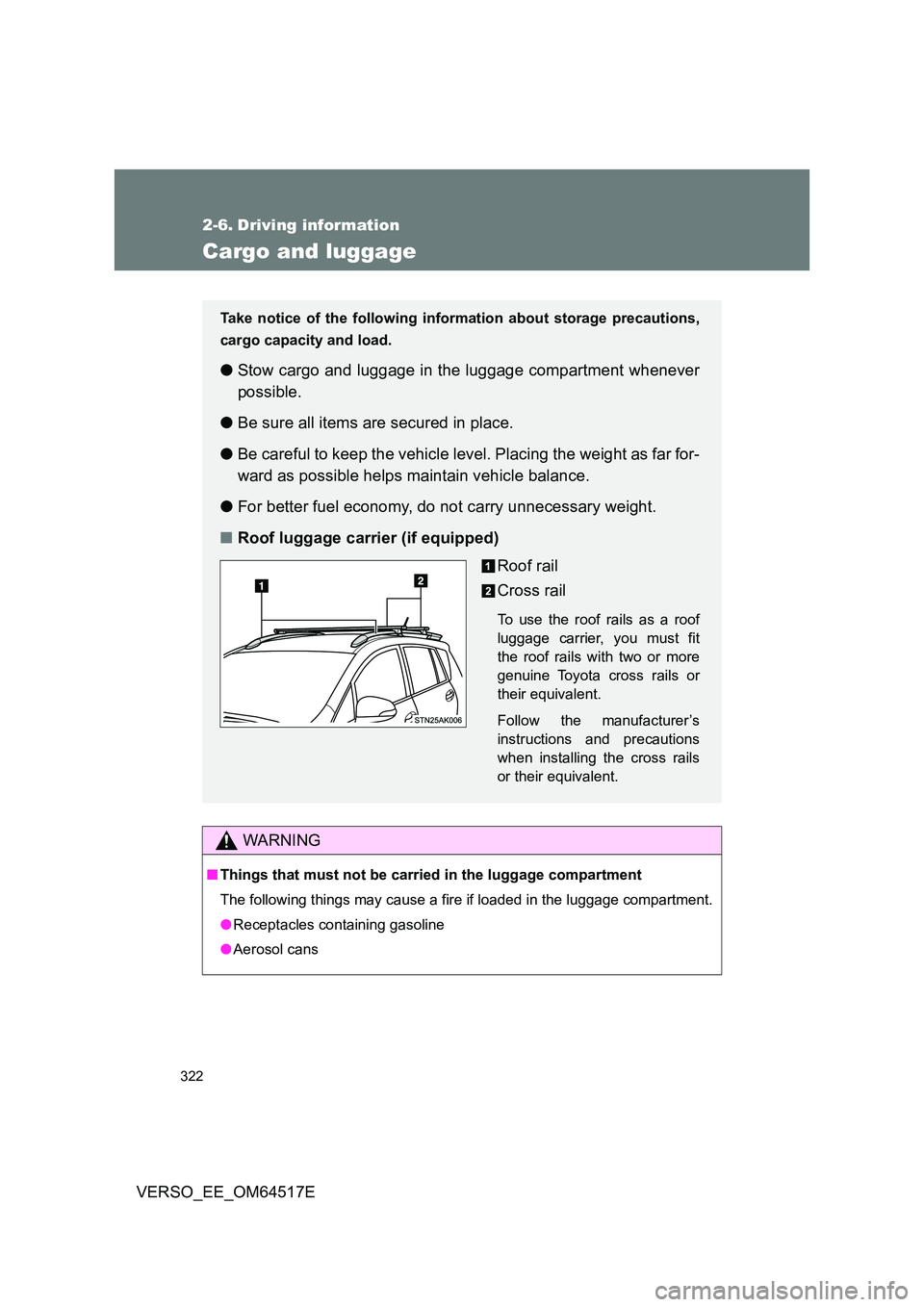
■ Roof luggage carrier (if equipped)
Roof rail
Cross rail
To use the roof rails as a roof
luggage carrier, you must fit
the roof rails with two or more
genuine Toyota cross rails or
their equivalent.
Follow the manufacturer’s
instructions and precautions
when installing the cross rails
or their equivalent.
Page 329 of 668
329
2-6. Driving information
2
When driving
VERSO_EE_OM64517E
Trailer towing
Your vehicle is designed primarily as a passenger carrying vehicle.
Towing a trailer will have an adverse effect on handling, perfor-
mance, braking, durability, and fuel consumption. Your safety and
satisfaction depend on the proper use of correct equipment and cau-
tious driving habits. For your safety and the safety of others, do not
overload the vehicle or trailer.
To tow a trailer safely, use extreme care and drive the vehicle in
accordance with the trailer’s characteristics and operating condi-
tions.
Toyota warranties do not apply to damage or malfunction caused by
towing a trailer for commercial purposes.
Ask your local authorized Toyota dealer or repairer, or another duly
qualified and equipped professional , for further details before tow-
ing, as there are additional legal requirements in some countries.
■ Weight limits
Check the allowable towing capacity, GVM (Gross Vehicle
Mass), MPAC (Maximum Permissible Axle Capacity), and per-
missible drawbar load before towing. ( P. 622)
■ Towing hitch/bracket
Toyota recommends the use of the Toyota hitch/bracket for your
vehicle. Other products of a suitable nature and comparable
quality may also be used.
Page 353 of 668
353
3-1. Using the air conditioning system and defogger
3
Interior features
VERSO_EE_OM64517E
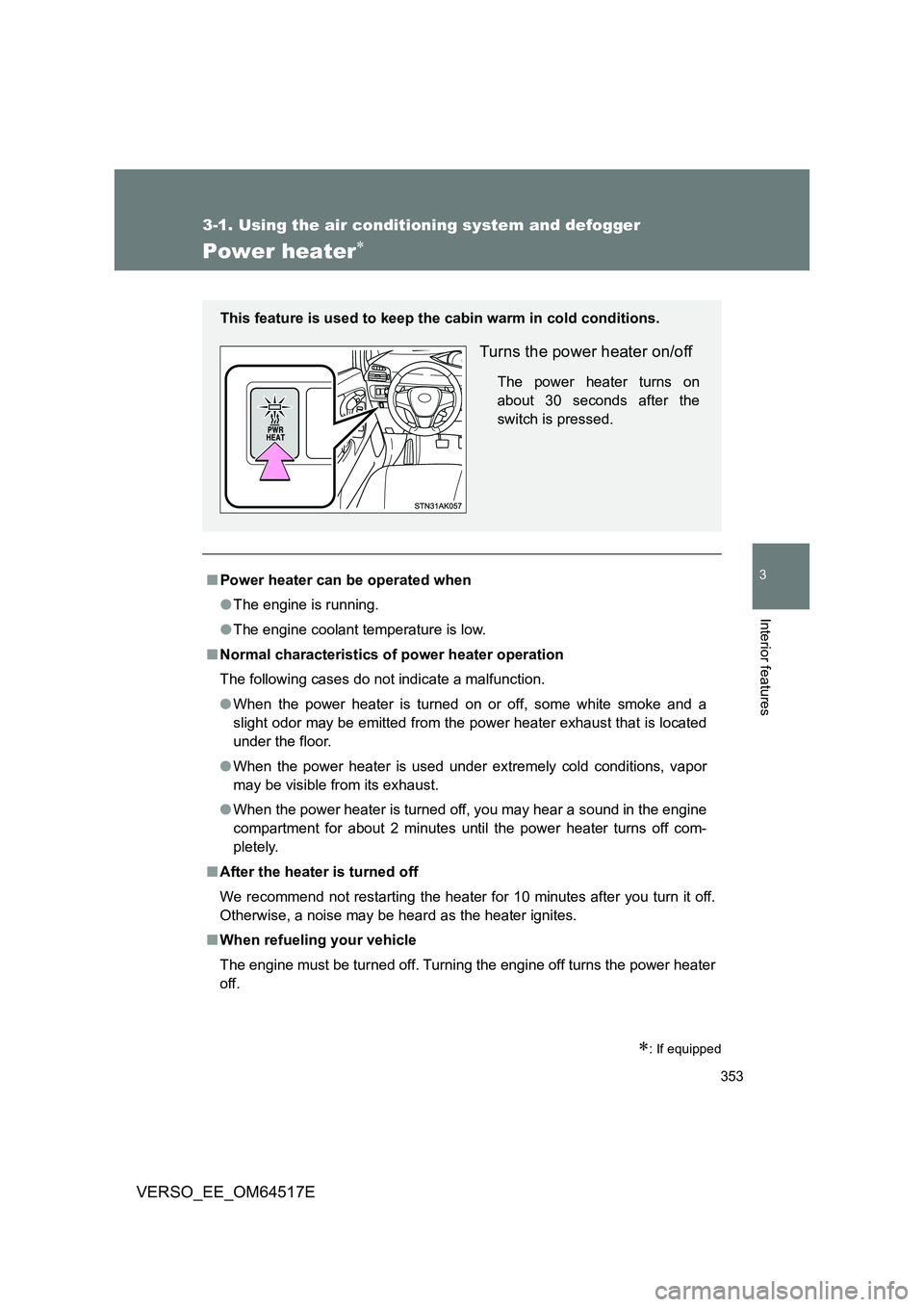
Power heater
: If equipped
■Power heater can be operated when
● The engine is running.
● The engine coolant temperature is low.
■ Normal characteristics of power heater operation
The following cases do not indicate a malfunction.
● When the power heater is turned on or off, some white smoke and a
slight odor may be emitted from the power heater exhaust that is located
under the floor.
● When the power heater is used under extremely cold conditions, vapor
may be visible from its exhaust.
● When the power heater is turned off, you may hear a sound in the engine
compartment for about 2 minutes until the power heater turns off com-
pletely.
■ After the heater is turned off
We recommend not restarting the heater for 10 minutes after you turn it off.
Otherwise, a noise may be heard as the heater ignites.
■ When refueling your vehicle
The engine must be turned off. Turning the engine off turns the power heater
off.
This feature is used to keep the cabin warm in cold conditions.
Turns the power heater on/off
The power heater turns on
about 30 seconds after the
switch is pressed.
Page 354 of 668
354
3-1. Using the air conditioning system and defogger
VERSO_EE_OM64517E
WARNING
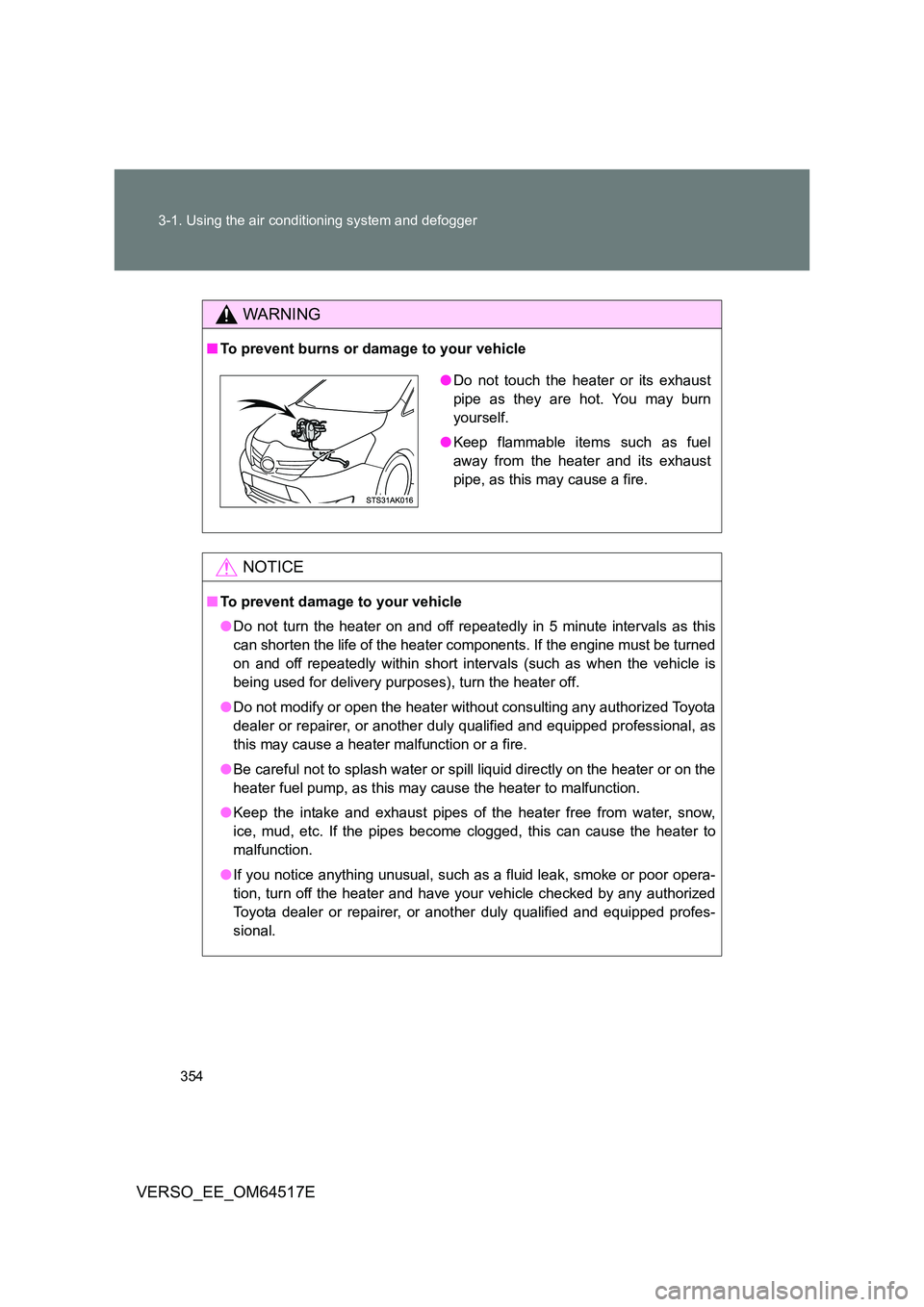
■ To prevent burns or damage to your vehicle
NOTICE
■To prevent damage to your vehicle
● Do not turn the heater on and off repeatedly in 5 minute intervals as this
can shorten the life of the heater components. If the engine must be turned
on and off repeatedly within short intervals (such as when the vehicle is
being used for delivery purposes), turn the heater off.
● Do not modify or open the heater without consulting any authorized Toyota
dealer or repairer, or another duly qualified and equipped professional, as
this may cause a heater malfunction or a fire.
● Be careful not to splash water or spill liquid directly on the heater or on the
heater fuel pump, as this may cause the heater to malfunction.
● Keep the intake and exhaust pipes of the heater free from water, snow,
ice, mud, etc. If the pipes become clogged, this can cause the heater to
malfunction.
● If you notice anything unusual, such as a fluid leak, smoke or poor opera-
tion, turn off the heater and have your vehicle checked by any authorized
Toyota dealer or repairer, or another duly qualified and equipped profes-
sional.
● Do not touch the heater or its exhaust
pipe as they are hot. You may burn
yourself.
● Keep flammable items such as fuel
away from the heater and its exhaust
pipe, as this may cause a fire.