warning TOYOTA VERSO S 2011 Owners Manual
[x] Cancel search | Manufacturer: TOYOTA, Model Year: 2011, Model line: VERSO S, Model: TOYOTA VERSO S 2011Pages: 664, PDF Size: 160.56 MB
Page 219 of 664
219
4
4-2. Opening, closing and locking the doors
Before driving
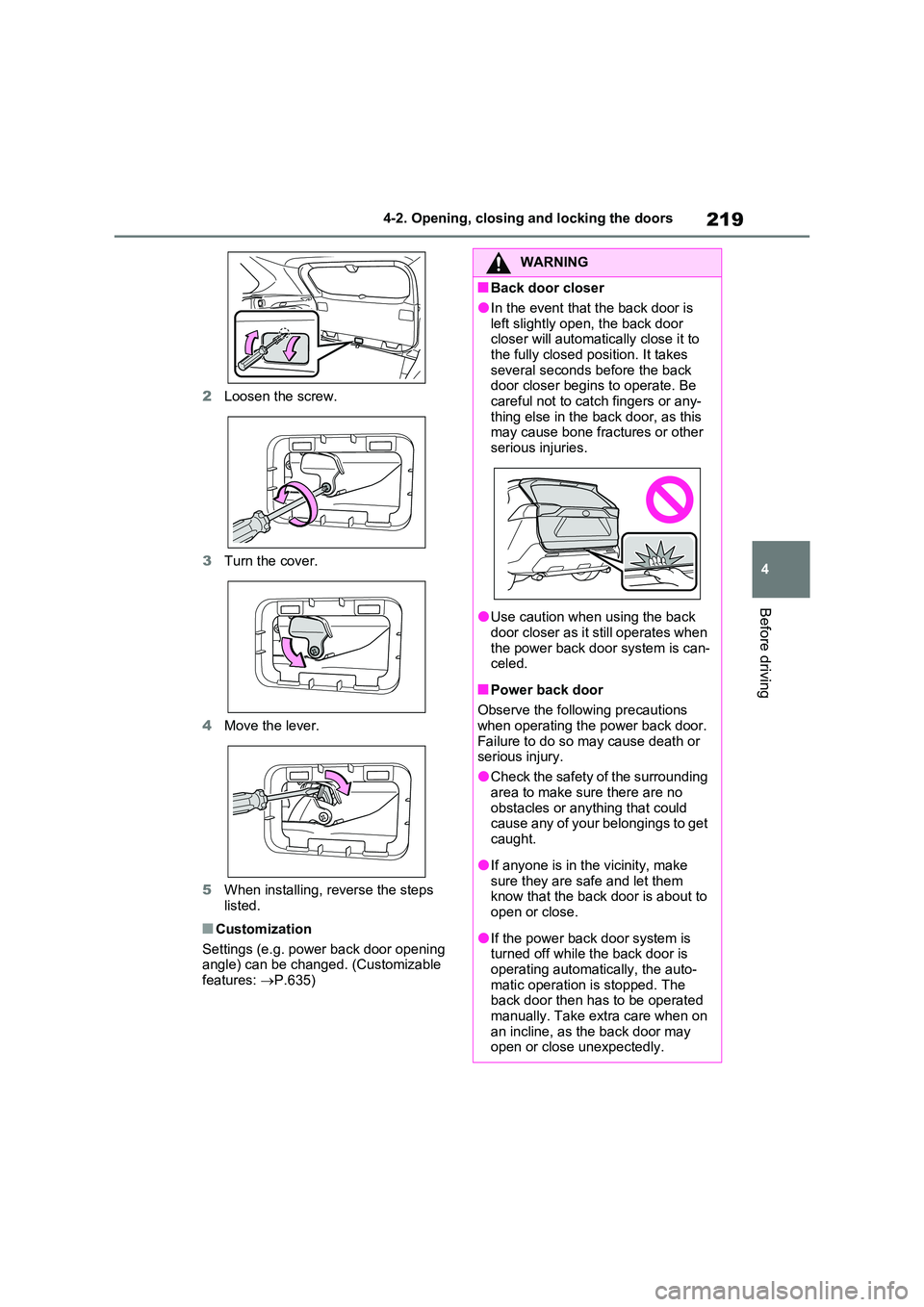
2 Loosen the screw.
3 Turn the cover.
4 Move the lever.
5 When installing, reverse the steps
listed.
■Customization
Settings (e.g. power back door opening angle) can be changed. (Customizable
features: P.635)
WARNING
■Back door closer
●In the event that the back door is
left slightly open, the back door closer will automatically close it to the fully closed position. It takes
several seconds before the back door closer begins to operate. Be careful not to catch fingers or any-
thing else in the back door, as this may cause bone fractures or other serious injuries.
●Use caution when using the back door closer as it still operates when
the power back door system is can- celed.
■Power back door
Observe the following precautions when operating the power back door.
Failure to do so may cause death or serious injury.
●Check the safety of the surrounding
area to make sure there are no obstacles or anything that could cause any of your belongings to get
caught.
●If anyone is in the vicinity, make
sure they are safe and let them know that the back door is about to open or close.
●If the power back door system is turned off while the back door is
operating automatically, the auto- matic operation is stopped. The back door then has to be operated
manually. Take extra care when on an incline, as the back door may open or close unexpectedly.
Page 220 of 664
2204-2. Opening, closing and locking the doors
WARNING
●If the operating conditions of the power back door are no longer met,
a buzzer may sound and the back door may stop opening or closing. The back door then has to be oper-
ated manually. Take extra care when on an incline, as the back door may open or close abruptly.
●On an incline, the back door may suddenly shut after it opens. Make
sure the back door is fully open and secure.
●In the following situations, the power back door may detect an abnormality and automatic opera-
tion may be stopped. In this case, the back door has to be operated manually. Take extra care when on
an incline, as the back door may open or close abruptly.
• When the back door contacts an
obstacle
• When the 12-volt battery voltage suddenly drops, such as when the
power switch is turned to ON or the hybrid system is started during automatic operation
●If a bicycle carrier or similar heavy object is attached to the back door,
the power back door may not oper- ate, causing itself to malfunction, or the back door may suddenly shut
again after being opened, causing someone’s hands, head or neck to be caught and injured. When
installing an accessory part to the back door, using a genuine Toyota part is recommended.
■Jam protection function
Observe the following precautions.
Failure to do so may cause death or serious injury.
●Never use any part of your body to
intentionally activate the jam pro- tection function.
●The jam protection function may not work if something gets caught just before the back door fully closes.
Be careful not to catch fingers or anything else.
●The jam protection function may not work depending on the shape of the object that is caught. Be careful not
to catch fingers or anything else.
■Hands Free Power Back Door (if
equipped)
Observe the following precautions when operating the Hands Free
Power Back Door. Failure to do so may cause death or serious injury.
●Check the safety of the surrounding area to make sure there are no obstacles or anything that could
cause any of your belongings to get caught.
●When putting your foot near the lower center part of the rear bumper and moving it from the rear bumper,
be careful not to touch the exhaust pipes until they have cooled down sufficiently, as touching hot exhaust
pipes can cause burns.
●Do not leave the electronic key
within the effective range (detection area) of the luggage compartment.
Page 224 of 664
2244-2. Opening, closing and locking the doors
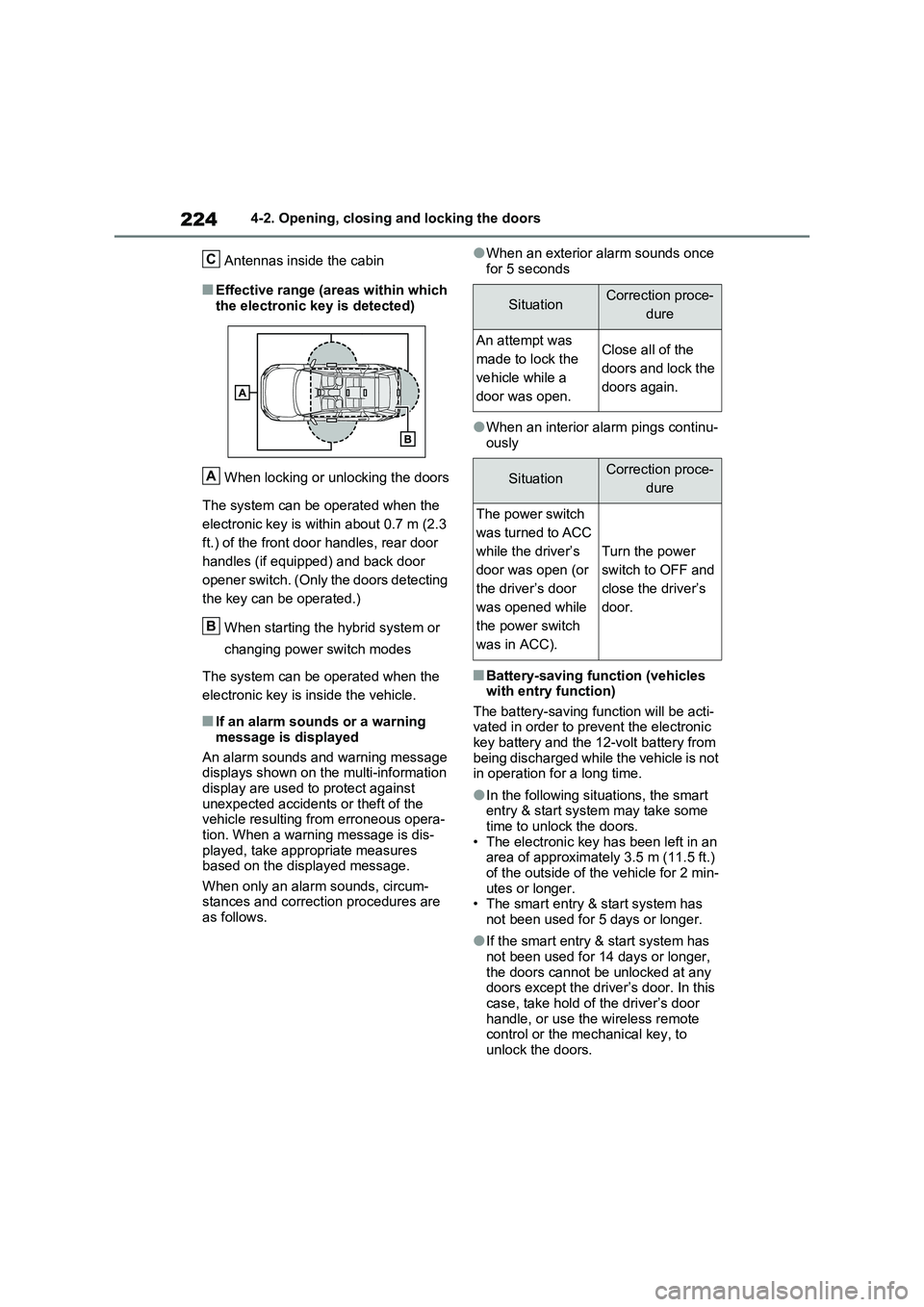
Antennas inside the cabin
■Effective range (areas within which
the electronic key is detected)
When locking or unlocking the doors
The system can be operated when the
electronic key is within about 0.7 m (2.3
ft.) of the front door handles, rear door
handles (if equipped) and back door
opener switch. (Only the doors detecting
the key can be operated.)
When starting the hybrid system or
changing power switch modes
The system can be operated when the
electronic key is inside the vehicle.
■If an alarm sounds or a warning
message is displayed
An alarm sounds and warning message displays shown on the multi-information
display are used to protect against unexpected accidents or theft of the vehicle resulting from erroneous opera-
tion. When a warning message is dis- played, take appropriate measures based on the displayed message.
When only an alarm sounds, circum- stances and correction procedures are as follows.
●When an exterior alarm sounds once
for 5 seconds
●When an interior alarm pings continu- ously
■Battery-saving function (vehicles with entry function)
The battery-saving function will be acti- vated in order to prevent the electronic key battery and the 12-volt battery from
being discharged while the vehicle is not in operation for a long time.
●In the following situations, the smart entry & start system may take some time to unlock the doors.
• The electronic key has been left in an area of approximately 3.5 m (11.5 ft.) of the outside of the vehicle for 2 min-
utes or longer. • The smart entry & start system has not been used for 5 days or longer.
●If the smart entry & start system has not been used for 14 days or longer,
the doors cannot be unlocked at any doors except the driver’s door. In this case, take hold of the driver’s door
handle, or use the wireless remote control or the mechanical key, to unlock the doors.
C
A
B
SituationCorrection proce-
dure
An attempt was
made to lock the
vehicle while a
door was open.
Close all of the
doors and lock the
doors again.
SituationCorrection proce-
dure
The power switch
was turned to ACC
while the driver’s
door was open (or
the driver’s door
was opened while
the power switch
was in ACC).
Turn the power
switch to OFF and
close the driver’s
door.
Page 269 of 664
269
4
4-2. Opening, closing and locking the doors
Before driving
WARNING
■Caution regarding interference with electronic devices
●People with implantable cardiac pacemakers, cardiac resynchroni-zation therapy-pacemakers or
implantable cardioverter defi- brillators should maintain a reason-able distance between themselves
and the smart entry & start system antennas. ( P.223) The radio waves may affect the
operation of such devices. If neces- sary, the entry function can be dis-abled. Ask any authorized Toyota
retailer or Toyota authorized repairer, or any reliable repairer for details, such as the frequency of
radio waves and timing of the emit- ted radio waves. Then, consult your doctor to see if you should disable
the entry function.
●User of any electrical medical
device other than implantable car- diac pacemakers, cardiac resyn-chronization therapy-pacemakers
or implantable cardioverter defi- brillators should consult the manu-facturer of the device for
information about its operation under the influence of radio waves.Radio waves could have unex-
pected effects on the operation of such medical devices.
Ask any authorized Toyota retailer or Toyota authorized repairer, or any reliable repairer for details for dis-
abling the entry function.
Page 270 of 664
2704-3. Adjusting the seats
4-3.Adjusting the sea ts
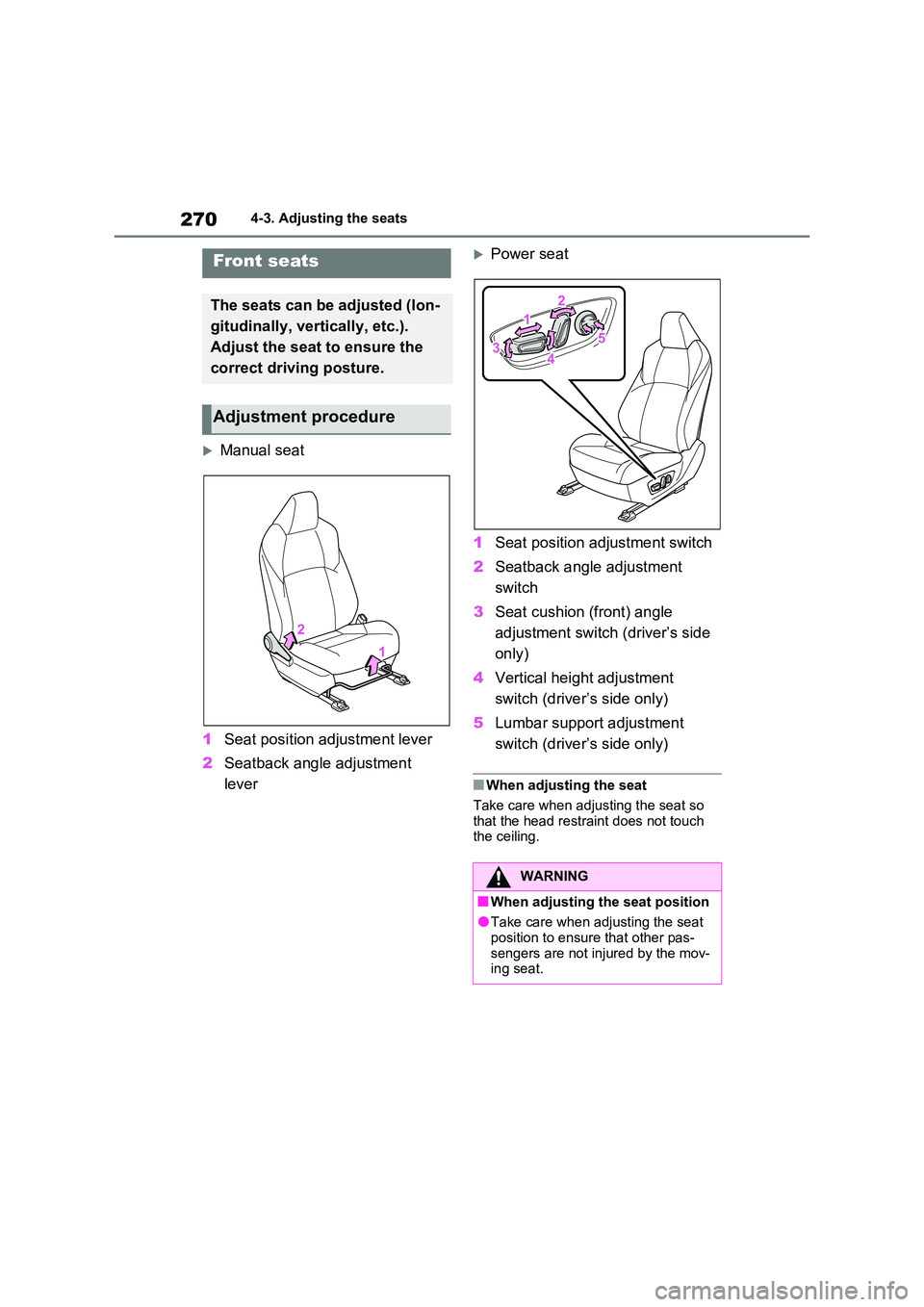
Manual seat
1 Seat position adjustment lever
2 Seatback angle adjustment
lever
Power seat
1 Seat position adjustment switch
2 Seatback angle adjustment
switch
3 Seat cushion (front) angle
adjustment switch (driver’s side
only)
4 Vertical height adjustment
switch (driver’s side only)
5 Lumbar support adjustment
switch (driver’s side only)
■When adjusting the seat
Take care when adjusting the seat so
that the head restraint does not touch the ceiling.
Front seats
The seats can be adjusted (lon-
gitudinally, vertically, etc.).
Adjust the seat to ensure the
correct driving posture.
Adjustment procedure
WARNING
■When adjusting the seat position
●Take care when adjusting the seat position to ensure that other pas-
sengers are not injured by the mov- ing seat.
Page 271 of 664
271
4
4-3. Adjusting the seats
Before driving
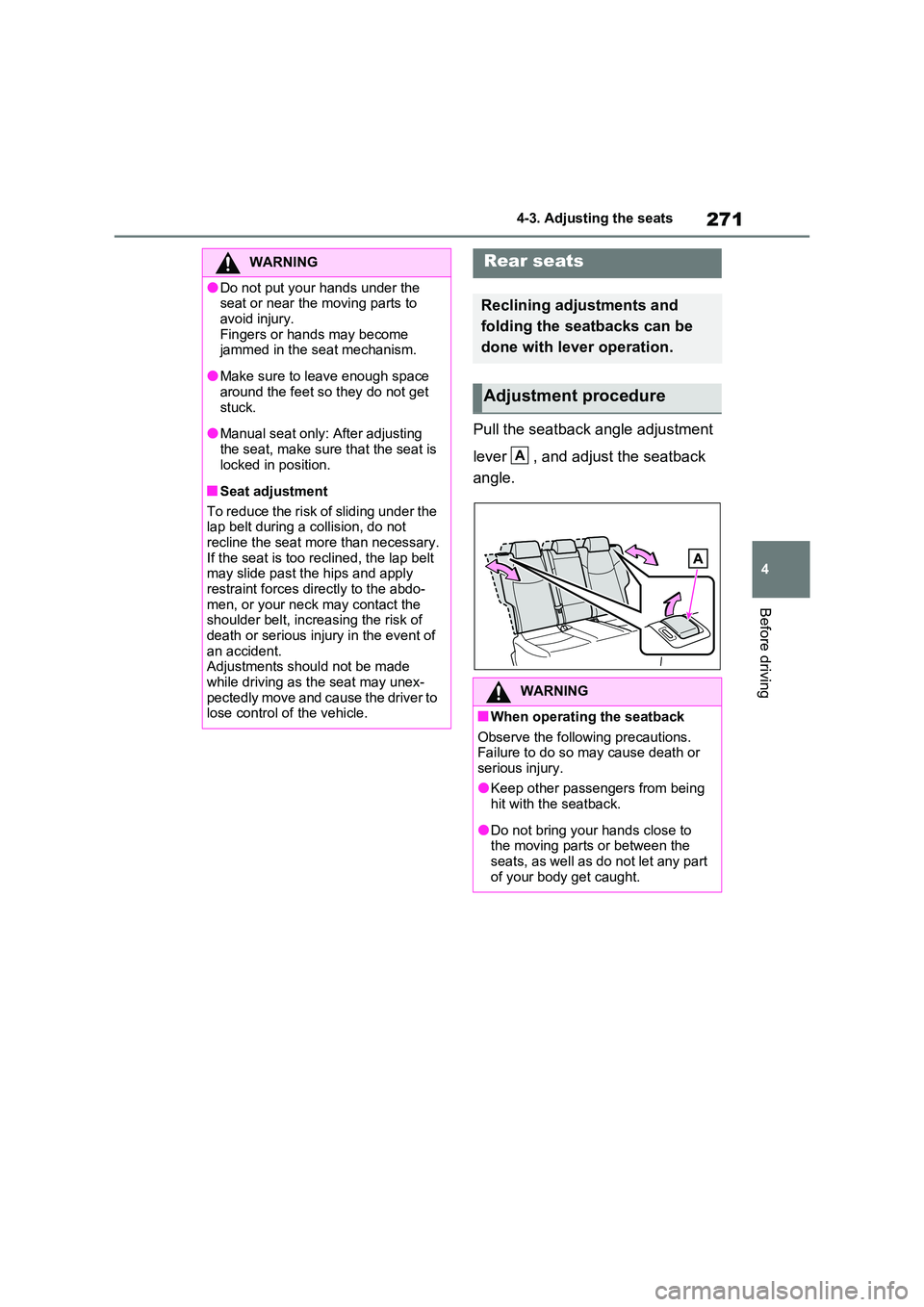
Pull the seatback angle adjustment
lever , and adjust the seatback
angle.
WARNING
●Do not put your hands under the seat or near the moving parts to
avoid injury. Fingers or hands may become jammed in the seat mechanism.
●Make sure to leave enough space around the feet so they do not get
stuck.
●Manual seat only: After adjusting
the seat, make sure that the seat is locked in position.
■Seat adjustment
To reduce the risk of sliding under the lap belt during a collision, do not
recline the seat more than necessary. If the seat is too reclined, the lap belt may slide past the hips and apply
restraint forces directly to the abdo- men, or your neck may contact the shoulder belt, increasing the risk of
death or serious injury in the event of an accident.Adjustments should not be made
while driving as the seat may unex- pectedly move and cause the driver to lose control of the vehicle.
Rear seats
Reclining adjustments and
folding the seatbacks can be
done with lever operation.
Adjustment procedure
WARNING
■When operating the seatback
Observe the following precautions. Failure to do so may cause death or serious injury.
●Keep other passengers from being hit with the seatback.
●Do not bring your hands close to the moving parts or between the seats, as well as do not let any part
of your body get caught.
A
Page 272 of 664
2724-3. Adjusting the seats
■Before folding down the seat-
backs
1 Park the vehicle in a safe place.
Apply the parking brake (P.326) and shift the shift lever to P. ( P.322)
2Adjust the position of the front
seat and the angle of the seat-
back. ( P.270)
Depending on the position of the front
seat, if the seatback is folded back- ward, it may interfere with the operation of the rear seat.
3 Lower the head restraint of the
rear seat. ( P.276)
4 Stow the armrest of the rear
seat if it is pulled out. ( P.484)
This step is not necessary when oper-
ating the left side seat only.
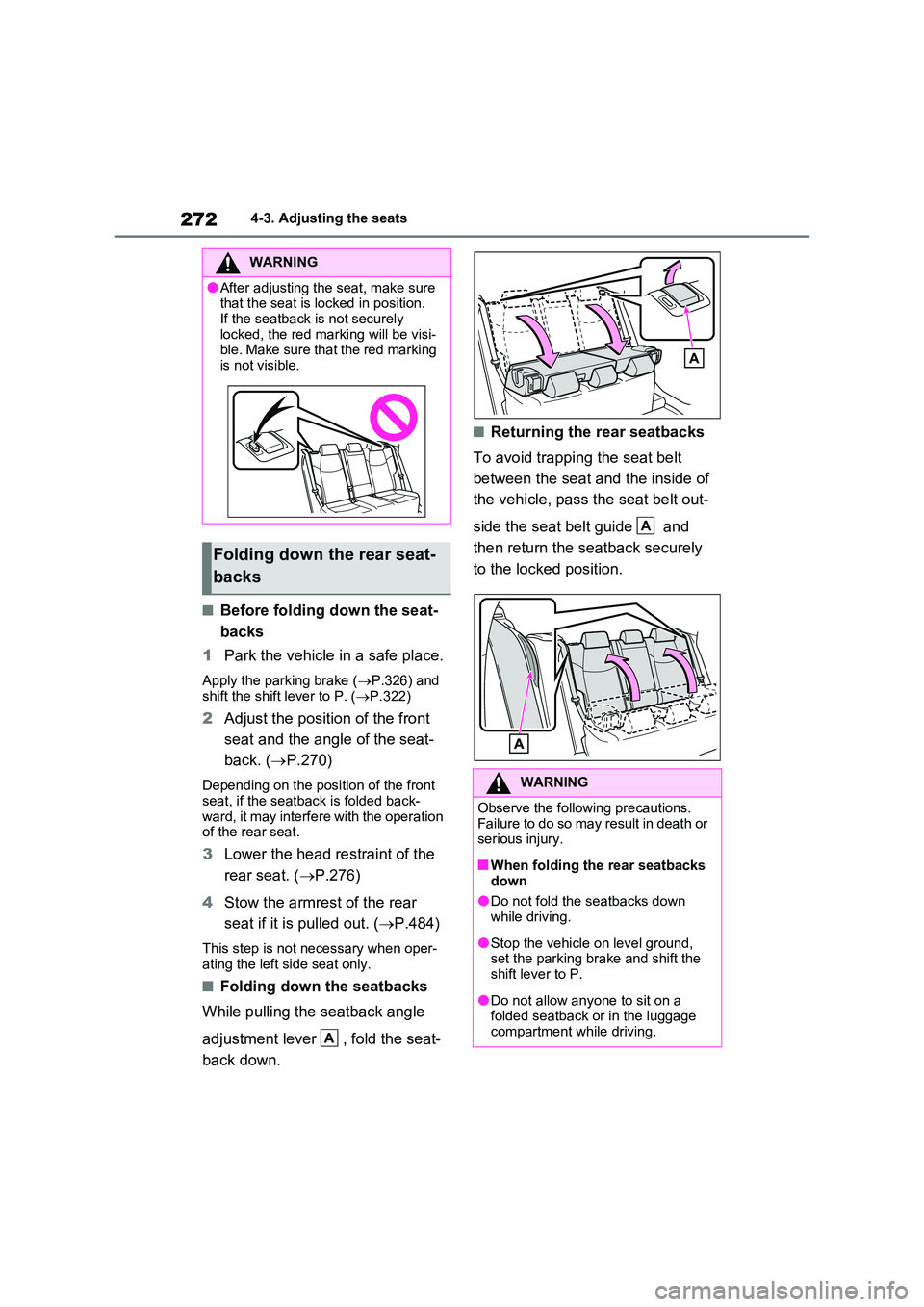
■Folding down the seatbacks
While pulling the seatback angle
adjustment lever , fold the seat-
back down.
■Returning the rear seatbacks
To avoid trapping the seat belt
between the seat and the inside of
the vehicle, pass the seat belt out-
side the seat belt guide and
then return the seatback securely
to the locked position.
WARNING
●After adjusting the seat, make sure that the seat is locked in position.
If the seatback is not securely locked, the red marking will be visi-ble. Make sure that the red marking
is not visible.
Folding down the rear seat-
backs
A
WARNING
Observe the following precautions. Failure to do so may result in death or serious injury.
■When folding the rear seatbacks down
●Do not fold the seatbacks down while driving.
●Stop the vehicle on level ground, set the parking brake and shift the shift lever to P.
●Do not allow anyone to sit on a folded seatback or in the luggage
compartment while driving.
A
Page 273 of 664
273
4
4-3. Adjusting the seats
Before driving
*: If equipped
■Recording procedure
1 Check that the shift lever is in P.
2 Turn the power switch to ON.
3 Adjust the driver’s seat to the
desired positions.
4 While pressing the “SET” but-
ton, or within 3 seconds after the
“SET” button is pressed, press
button “1” or “2” until the buzzer
sounds.
If the selected button has already been preset, the previously recorded position
WARNING
●Do not allow children to enter the luggage compartment.
●Do not operate the rear seat if it is occupied.
●Be careful not to get feet or hands caught in the moving parts or joints
of the seats during operation.
●Do not allow children to operate the
seat.
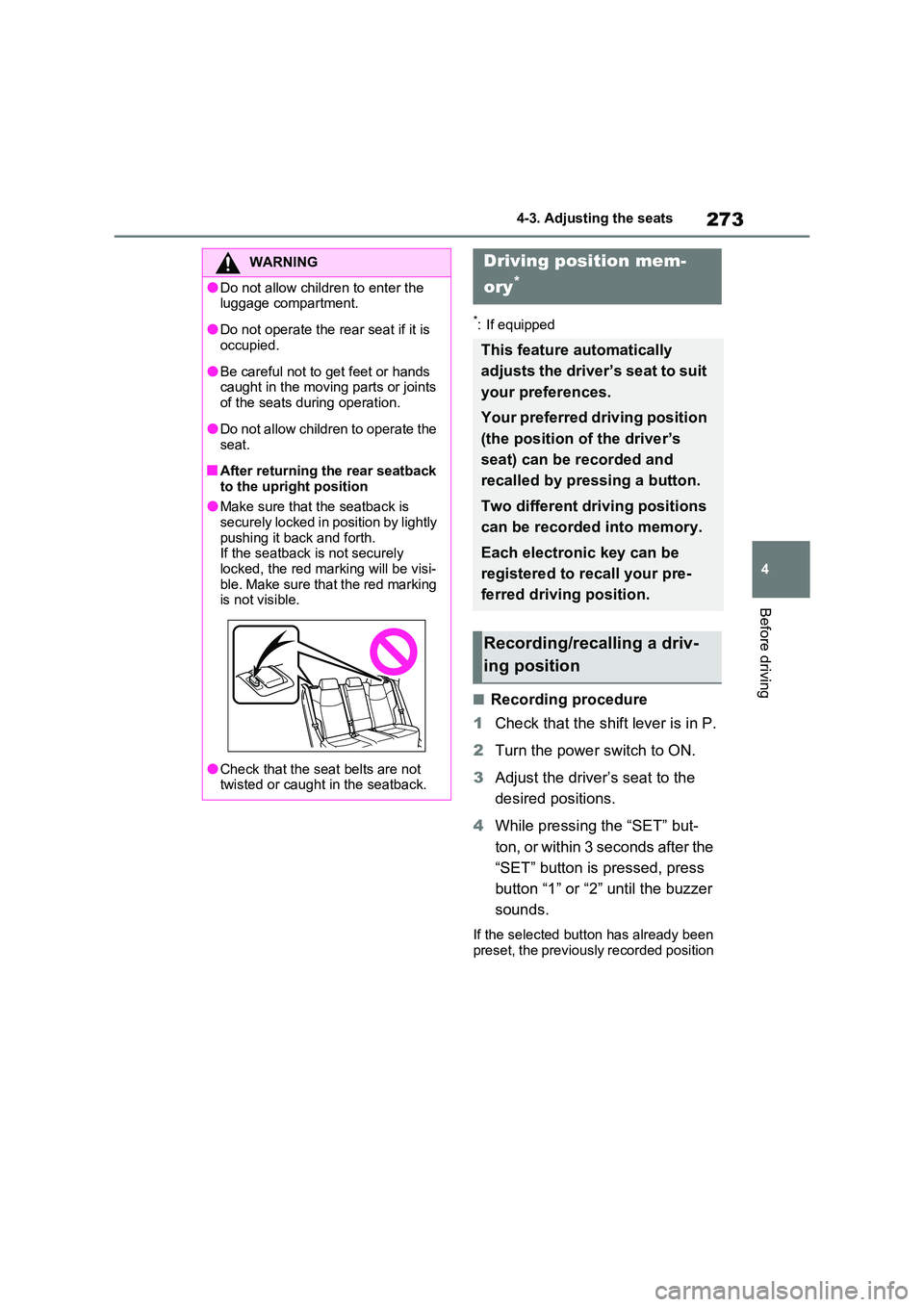
■After returning the rear seatback
to the upright position
●Make sure that the seatback is securely locked in position by lightly
pushing it back and forth. If the seatback is not securely locked, the red marking will be visi-
ble. Make sure that the red marking is not visible.
●Check that the seat belts are not twisted or caught in the seatback.
Driving position mem-
ory*
This feature automatically
adjusts the driver’s seat to suit
your preferences.
Your preferred driving position
(the position of the driver’s
seat) can be recorded and
recalled by pressing a button.
Two different driving positions
can be recorded into memory.
Each electronic key can be
registered to recall your pre-
ferred driving position.
Recording/recalling a driv-
ing position
Page 274 of 664
2744-3. Adjusting the seats
will be overwritten.
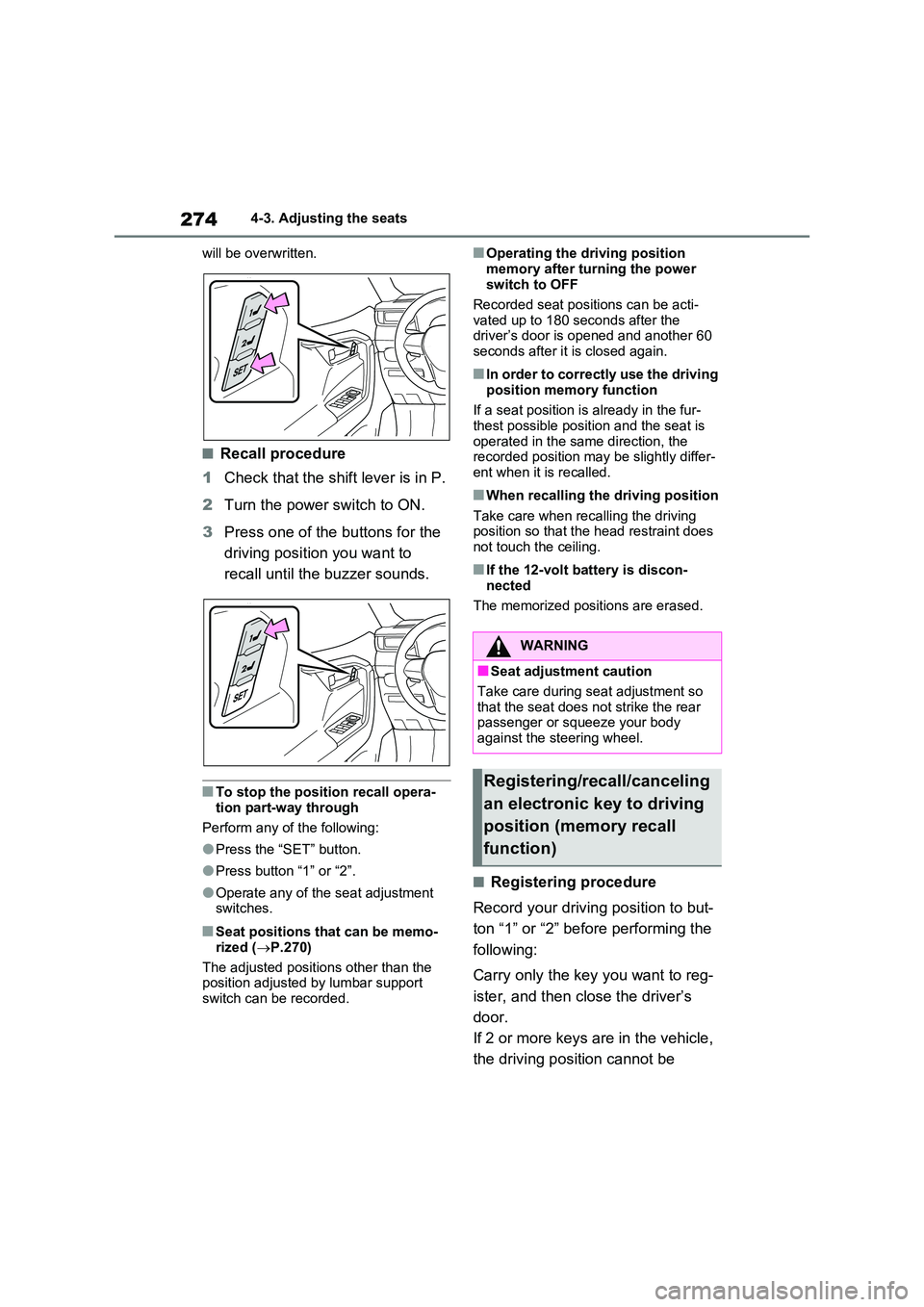
■Recall procedure
1 Check that the shift lever is in P.
2 Turn the power switch to ON.
3 Press one of the buttons for the
driving position you want to
recall until the buzzer sounds.
■To stop the position recall opera-
tion part-way through
Perform any of the following:
●Press the “SET” button.
●Press button “1” or “2”.
●Operate any of the seat adjustment switches.
■Seat positions that can be memo-
rized ( P.270)
The adjusted positions other than the position adjusted by lumbar support
switch can be recorded.
■Operating the driving position
memory after turning the power switch to OFF
Recorded seat positions can be acti-
vated up to 180 seconds after the driver’s door is opened and another 60 seconds after it is closed again.
■In order to correctly use the driving
position memory function
If a seat position is already in the fur- thest possible position and the seat is
operated in the same direction, the recorded position may be slightly differ-ent when it is recalled.
■When recalling the driving position
Take care when recalling the driving position so that the head restraint does not touch the ceiling.
■If the 12-volt battery is discon-
nected
The memorized positions are erased.
■Registering procedure
Record your driving position to but-
ton “1” or “2” before performing the
following:
Carry only the key you want to reg-
ister, and then close the driver’s
door.
If 2 or more keys are in the vehicle,
the driving position cannot be
WARNING
■Seat adjustment caution
Take care during seat adjustment so that the seat does not strike the rear passenger or squeeze your body
against the steering wheel.
Registering/recall/canceling
an electronic key to driving
position (memory recall
function)
Page 276 of 664
2764-3. Adjusting the seats
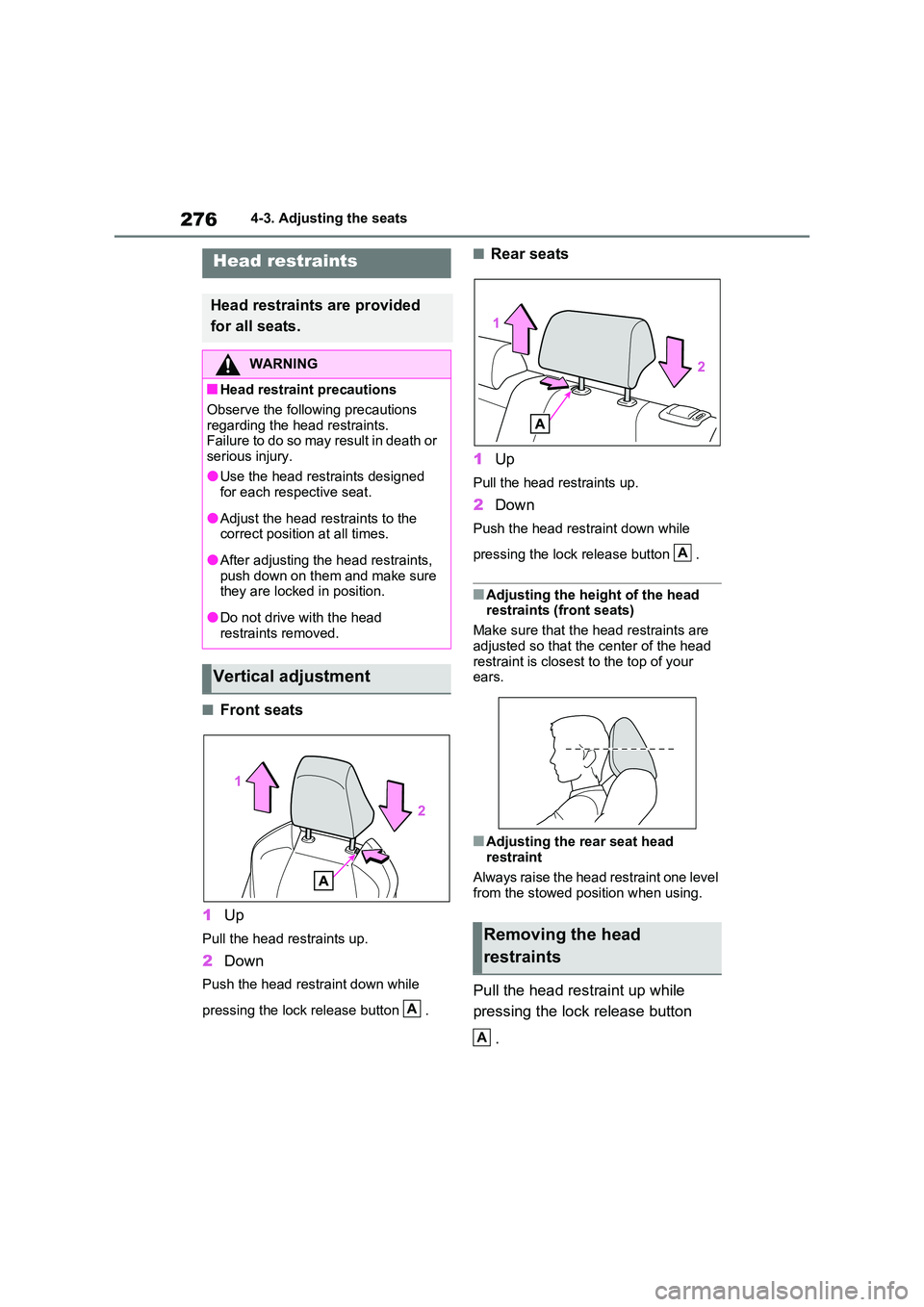
■Front seats
1 Up
Pull the head restraints up.
2Down
Push the head restraint down while
pressing the lock release button .
■Rear seats
1 Up
Pull the head restraints up.
2Down
Push the head restraint down while
pressing the lock release button .
■Adjusting the height of the head restraints (front seats)
Make sure that the head restraints are
adjusted so that the center of the head restraint is closest to the top of your ears.
■Adjusting the rear seat head restraint
Always raise the head restraint one level from the stowed position when using.
Pull the head restraint up while
pressing the lock release button
.
Head restraints
Head restraints are provided
for all seats.
WARNING
■Head restraint precautions
Observe the following precautions
regarding the head restraints. Failure to do so may result in death or serious injury.
●Use the head restraints designed for each respective seat.
●Adjust the head restraints to the correct position at all times.
●After adjusting the head restraints, push down on them and make sure they are locked in position.
●Do not drive with the head restraints removed.
Vertical adjustment
A
Removing the head
restraints
A
A