light TOYOTA VERSO S 2011 User Guide
[x] Cancel search | Manufacturer: TOYOTA, Model Year: 2011, Model line: VERSO S, Model: TOYOTA VERSO S 2011Pages: 664, PDF Size: 160.56 MB
Page 24 of 664
24Pictorial index
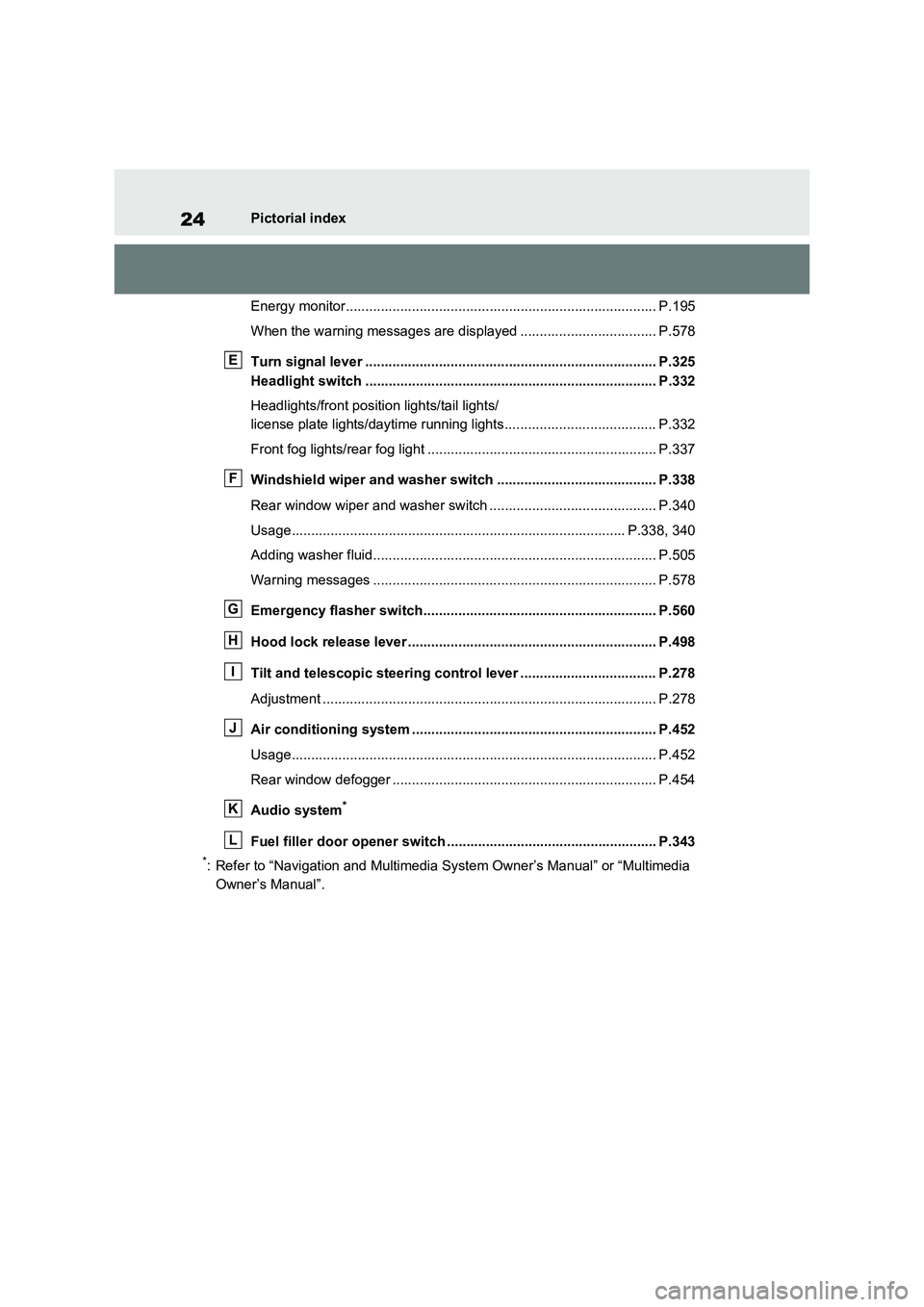
Energy monitor................................................................................ P.195
When the warning messages are displayed ................................... P.578
Turn signal lever ........................................................................... P.325
Headlight switch ........................................................................... P.332
Headlights/front position lights/tail lights/
license plate lights/daytime running lights....................................... P.332
Front fog lights/rear fog light ........................................................... P.337
Windshield wiper and washer switch ......................................... P.338
Rear window wiper and washer switch ........................................... P.340
Usage...................................................................................... P.338, 340
Adding washer fluid......................................................................... P.505
Warning messages ......................................................................... P.578
Emergency flasher switch............................................................ P.560
Hood lock release lever ................................................................ P.498
Tilt and telescopic steering control lever ................................... P.278
Adjustment ...................................................................................... P.278
Air conditioning system ............................................................... P.452
Usage.............................................................................................. P.452
Rear window defogger .................................................................... P.454
Audio system
*
Fuel filler door opener switch ...................................................... P.343
*: Refer to “Navigation and Multimedia System Owner’s Manual” or “Multimedia
Owner’s Manual”.
E
F
G
H
I
J
K
L
Page 29 of 664
29Pictorial index
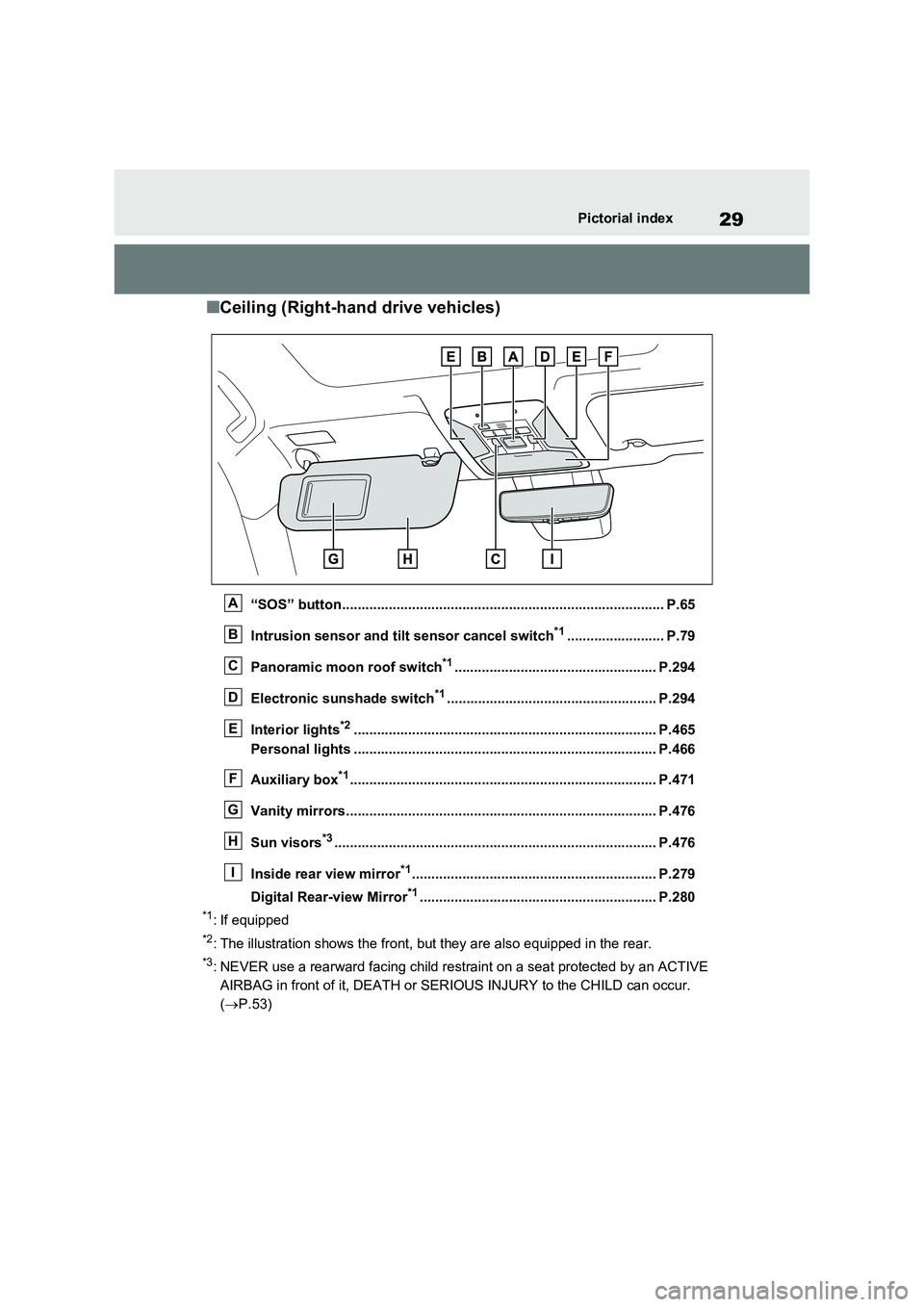
■Ceiling (Right-hand drive vehicles)
“SOS” button................................................................................... P.65
Intrusion sensor and tilt sensor cancel switch*1......................... P.79
Panoramic moon roof switch*1.................................................... P.294
Electronic sunshade switch*1...................................................... P.294
Interior lights*2.............................................................................. P.465
Personal lights .............................................................................. P.466
Auxiliary box*1............................................................................... P.471
Vanity mirrors................................................................................ P.476
Sun visors*3................................................................................... P.476
Inside rear view mirror*1............................................................... P.279
Digital Rear-view Mirror*1............................................................. P.280
*1: If equipped
*2: The illustration shows the front, but they are also equipped in the rear.
*3: NEVER use a rearward facing child restraint on a seat protected by an ACTIVE
AIRBAG in front of it, DEATH or SERIOUS INJURY to the CHILD can occur.
( P.53)
A
B
C
D
E
F
G
H
I
Page 33 of 664
33
1
1-1. For safe use
For safety and security
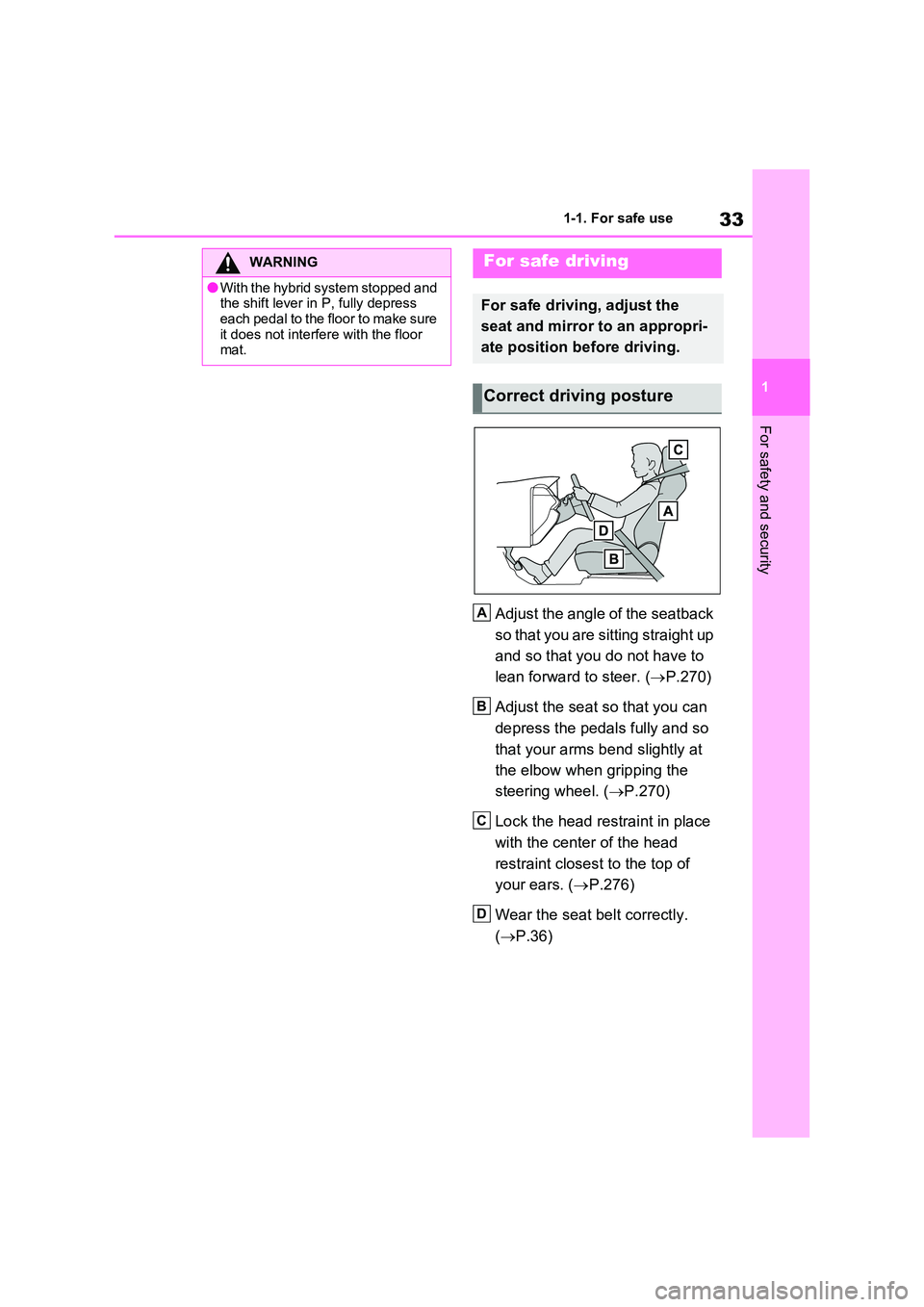
Adjust the angle of the seatback
so that you are sitting straight up
and so that you do not have to
lean forward to steer. ( P.270)
Adjust the seat so that you can
depress the pedals fully and so
that your arms bend slightly at
the elbow when gripping the
steering wheel. ( P.270)
Lock the head restraint in place
with the center of the head
restraint closest to the top of
your ears. ( P.276)
Wear the seat belt correctly.
( P.36)
WARNING
●With the hybrid system stopped and the shift lever in P, fully depress
each pedal to the floor to make sure it does not interfere with the floor mat.
For safe driving
For safe driving, adjust the
seat and mirror to an appropri-
ate position before driving.
Correct driving posture
A
B
C
D
Page 38 of 664
381-1. For safe use
■PCS-linked seat belt pretensioner
control
If the PCS (Pre-Collision System) deter- mines that the possibility of a collision
with a vehicle is high, the seat belt pre- tensioners will be prepared to operate.
WARNING
■Seat belt pretensioners
If the pretensioner has activated, the SRS warning light will come on. In that case, the seat belt cannot be
used again and must be replaced at any authorized Toyota retailer or Toyota authorized repairer, or any
reliable repairer. Failure to do so may cause death or serious injury.
Page 40 of 664
401-1. For safe use
Can help protect primarily the head of occupants in the outer seats
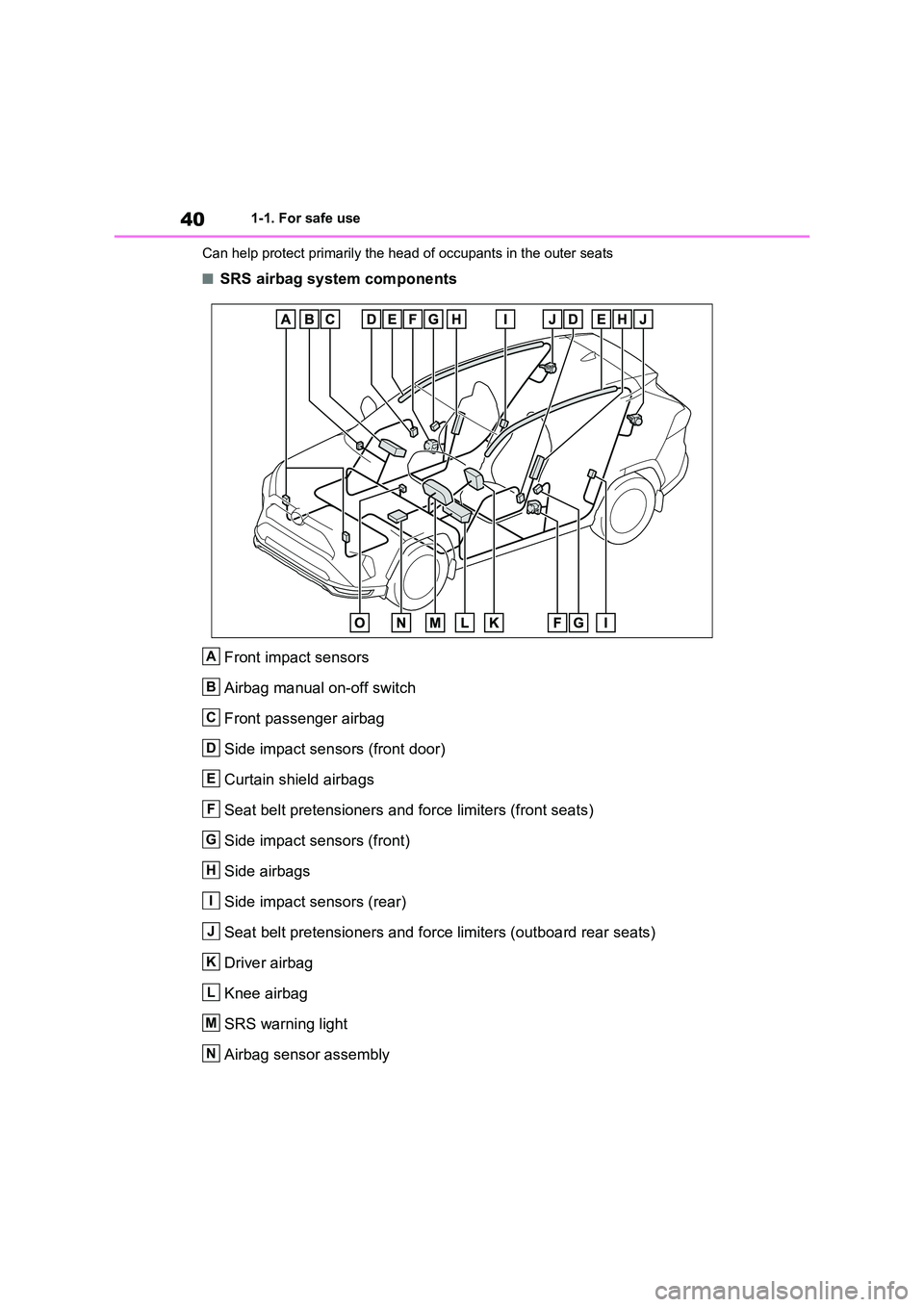
■SRS airbag system components
Front impact sensors
Airbag manual on-off switch
Front passenger airbag
Side impact sensors (front door)
Curtain shield airbags
Seat belt pretensioners and force limiters (front seats)
Side impact sensors (front)
Side airbags
Side impact sensors (rear)
Seat belt pretensioners and force limiters (outboard rear seats)
Driver airbag
Knee airbag
SRS warning light
Airbag sensor assembly
A
B
C
D
E
F
G
H
I
J
K
L
M
N
Page 41 of 664
41
1
1-1. For safe use
For safety and security
“PASSENGER AIR BAG” indicator
The main SRS airbag system components are shown above. The SRS air-
bag system is controlled by the airbag sensor assembly. As the airbags
deploy, a chemical reaction in the inflators quickly fills the airbags with non-
toxic gas to help restrain the motion of the occupants.
■If the SRS airbags deploy (inflate)
●Slight abrasions, burns, bruising etc., may be sustained from SRS airbags, due to the extremely high speed
deployment (inflation) by hot gases.
●A loud noise and white powder will be
emitted.
●Parts of the airbag module (steering
wheel hub, airbag cover and inflator) as well as the front seats, parts of the front and rear pillars, and roof side
rails, may be hot for several minutes. The airbag itself may also be hot.
●The windshield may crack.
●The hybrid system will be stopped and
fuel supply to the engine will be stopped. ( P.98)
●All of the doors will be unlocked. ( P.206)
●Vehicles with Secondary Collision Brake: The brakes and stop lights will be controlled automatically. ( P.439)
●The interior lights will turn on automat- ically. ( P.466)
●The emergency flashers will turn on automatically. ( P.560)
■SRS airbag deployment conditions
(SRS front airbags)
●The SRS front airbags will deploy in
the event of an impact that exceeds the set threshold level (the level of force corresponding to an approxi-
mately 20-30 km/h [12-18 mph] frontal collision with a fixed wall that does not move or deform).
However, this threshold velocity will be
considerably higher in the following situ-
ations:
• If the vehicle strikes an object, such as a parked vehicle or sign pole,
which can move or deform on impact • If the vehicle is involved in an under-
ride collision, such as a collision in which the front of the vehicle under-rides, or goes under, the bed of a
truck
●Depending on the type of collision, it is
possible that only the seat belt preten- sioners will activate.
■SRS airbag deployment conditions (SRS side and curtain shield air-
bags)
●The SRS side and curtain shield air-
bags will deploy in the event of an impact that exceeds the set threshold level (the level of force corresponding
to the impact force produced by an approximately 1500 kg [3300 lb.] vehi-cle colliding with the vehicle cabin
from a direction perpendicular to the vehicle orientation at an approximate speed of 20 -30 km/h [12 -18 mph]).
●Both SRS curtain shield airbags may also deploy in the event of a severe
frontal collision.
■Conditions under which the SRS airbags may deploy (inflate), other than a collision
The SRS front airbags and SRS curtain shield airbags may also deploy if a seri-ous impact occurs to the underside of
your vehicle. Some examples are shown in the illustration.
●Hitting a curb, edge of pavement or hard surface
●Falling into or jumping over a deep hole
●Landing hard or falling
O
Page 44 of 664
441-1. For safe use
WARNING
●The SRS driver airbag deploys with considerable force, and can cause
death or serious injury especially if the driver is very close to the air-bag.
Since the risk zone for the driver’s air-
bag is the first 50 - 75 mm (2 - 3 in.) of
inflation, placing yourself 250 mm (10
in.) from your driver airbag provides
you with a clear margin of safety. This
distance is measured from the center
of the steering wheel to your breast-
bone. If you sit less than 250 mm (10
in.) away now, you can change your
driving position in several ways:
• Move your seat to the rear as far as
you can while still reaching the ped- als comfortably.
• Slightly recline the back of the seat. Although vehicle designs vary, many drivers can achieve the 250
mm (10 in.) distance, even with the driver seat all the way forward, sim-ply by reclining the back of the seat
somewhat. If reclining the back of your seat makes it hard to see the road, raise yourself by using a firm,
non-slippery cushion, or raise the seat if your vehicle has that feature.
• If your steering wheel is adjustable, tilt it downward. This points the air-bag toward your chest instead of
your head and neck.
The seat should be adjusted as rec- ommended above, while still main-
taining control of the foot pedals, steering wheel, and your view of the instrument panel controls.
●The SRS front passenger airbag also deploys with considerable force, and can cause death or seri-
ous injury especially if the front pas- senger is very close to the airbag. The front passenger seat should be
as far from the airbag as possible with the seatback adjusted, so the front passenger sits upright.
●Improperly seated and/or restrained infants and children can be killed or
seriously injured by a deploying air- bag. An infant or child who is too small to use a seat belt should be
properly secured using a child restraint system. Toyota strongly recommends that all infants and
children be placed in the rear seats of the vehicle and properly restrained. The rear seats are safer
for infants and children than the front passenger seat. ( P.50)
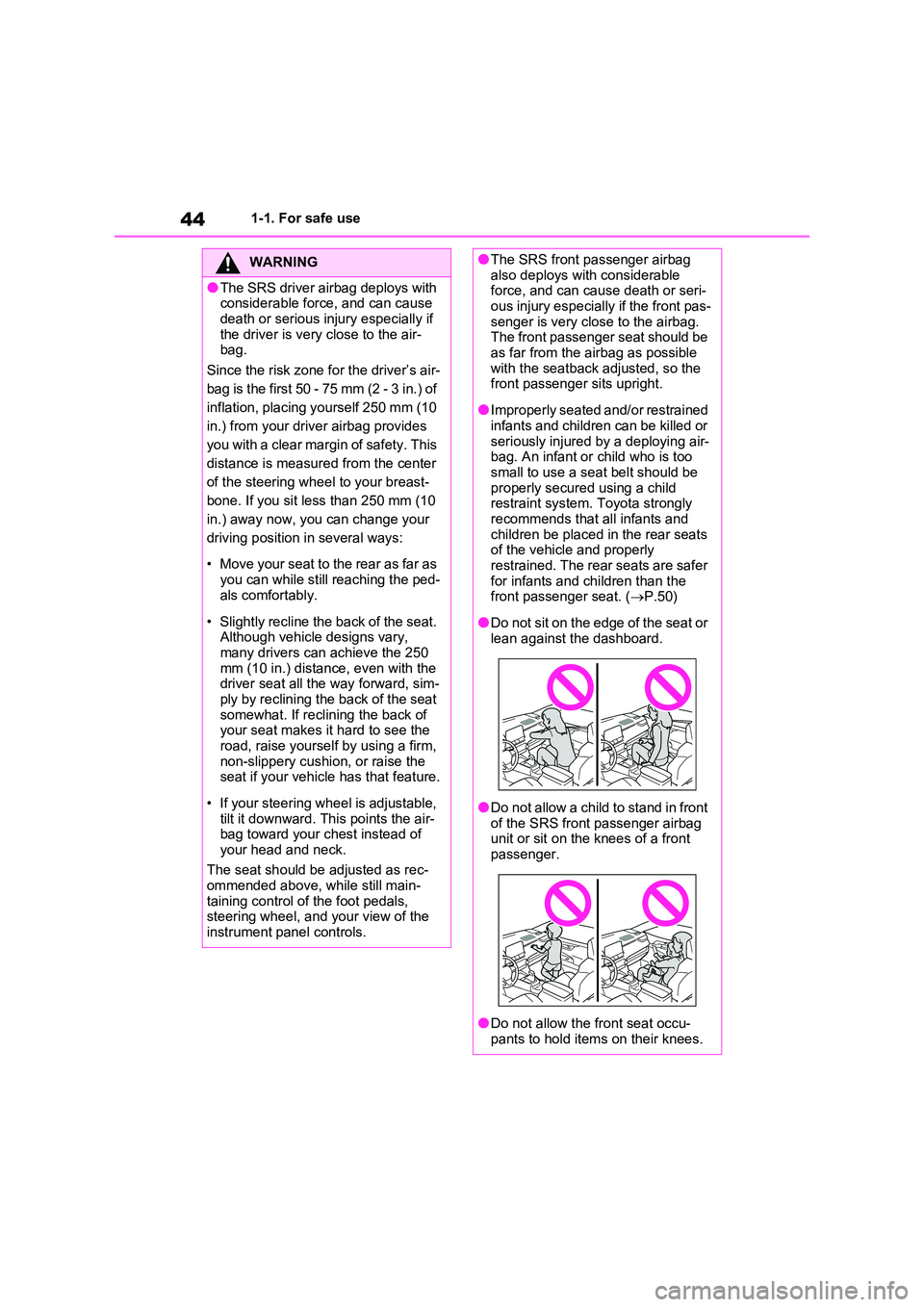
●Do not sit on the edge of the seat or lean against the dashboard.
●Do not allow a child to stand in front of the SRS front passenger airbag unit or sit on the knees of a front
passenger.
●Do not allow the front seat occu-
pants to hold items on their knees.
Page 47 of 664
47
1
1-1. For safe use
For safety and security
Exhaust gas precautions
Harmful substance to the
human body is included in
exhaust gases if inhaled.
WARNING
Exhaust gases contain harmful car-
bon monoxide (CO), which is color- less and odorless. Observe the following precautions.
Failure to do so may cause exhaust gases to enter the vehicle and may lead to an accident caused by light-
headedness, or may lead to death or a serious health hazard.
■Important points while driving
●Keep the back door closed.
●If you smell exhaust gases in the
vehicle even when the back door is closed, open the side windows and have the vehicle inspected at any
authorized Toyota retailer or Toyota authorized repairer, or any reliable repairer as soon as possible.
■When parking
●If the vehicle is in a poorly venti-
lated area or a closed area, such as a garage, stop the hybrid system.
●Do not leave the vehicle with the hybrid system operating for a long time.
If such a situation cannot be avoided, park the vehicle in an open space and ensure that
exhaust fumes do not enter the vehicle interior.
●Do not leave the hybrid system operating in an area with snow build-up, or where it is snowing. If
snowbanks build up around the vehicle while the hybrid system is operating, exhaust gases may col-
lect and enter the vehicle.
■Exhaust pipe
The exhaust system needs to be checked periodically. If there is a hole
or crack caused by corrosion, dam- age to a joint or abnormal exhaust noise, be sure to have the vehicle
inspected and repaired by any autho- rized Toyota retailer or Toyota autho-rized repairer, or any reliable repairer.
Page 48 of 664
481-2. Child safety
1-2.Child sa fety
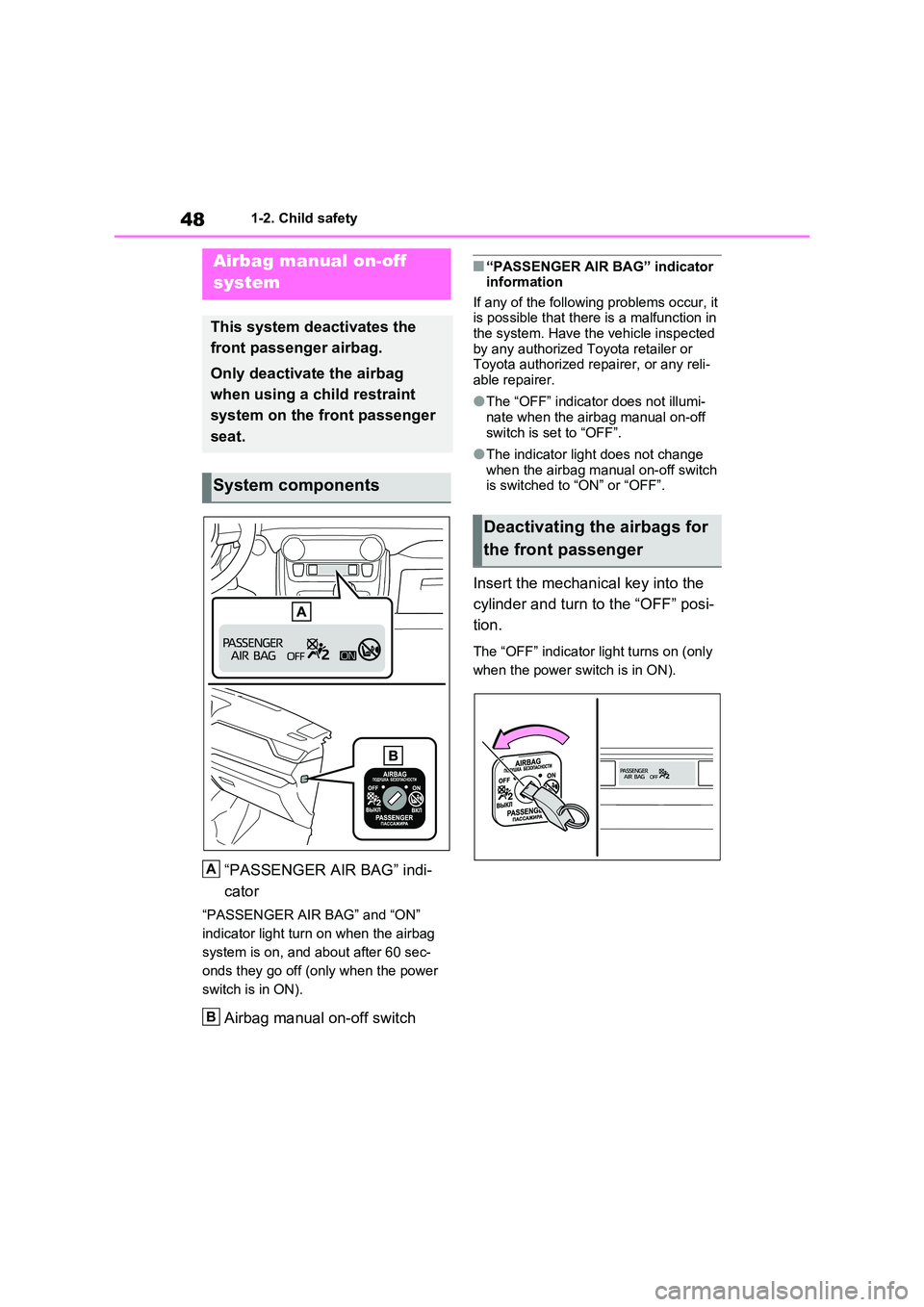
“PASSENGER AIR BAG” indi-
cator
“PASSENGER AIR BAG” and “ON”
indicator light turn on when the airbag
system is on, and about after 60 sec-
onds they go off (only when the power
switch is in ON).
Airbag manual on-off switch
■“PASSENGER AIR BAG” indicator information
If any of the following problems occur, it is possible that there is a malfunction in the system. Have the vehicle inspected
by any authorized Toyota retailer or Toyota authorized repairer, or any reli-able repairer.
●The “OFF” indicator does not illumi-nate when the airbag manual on-off
switch is set to “OFF”.
●The indicator light does not change
when the airbag manual on-off switch is switched to “ON” or “OFF”.
Insert the mechanical key into the
cylinder and turn to the “OFF” posi-
tion.
The “OFF” indicator light turns on (only
when the power switch is in ON).
Airbag manual on-off
system
This system deactivates the
front passenger airbag.
Only deactivate the airbag
when using a child restraint
system on the front passenger
seat.
System components
A
B
Deactivating the airbags for
the front passenger
Page 65 of 664
65
1
1-3. Emergency assistance
For safety and security
1-3.Emerg ency as sista nce
*: Operates within the eCall coverage.
The system name differs depending
on the country.
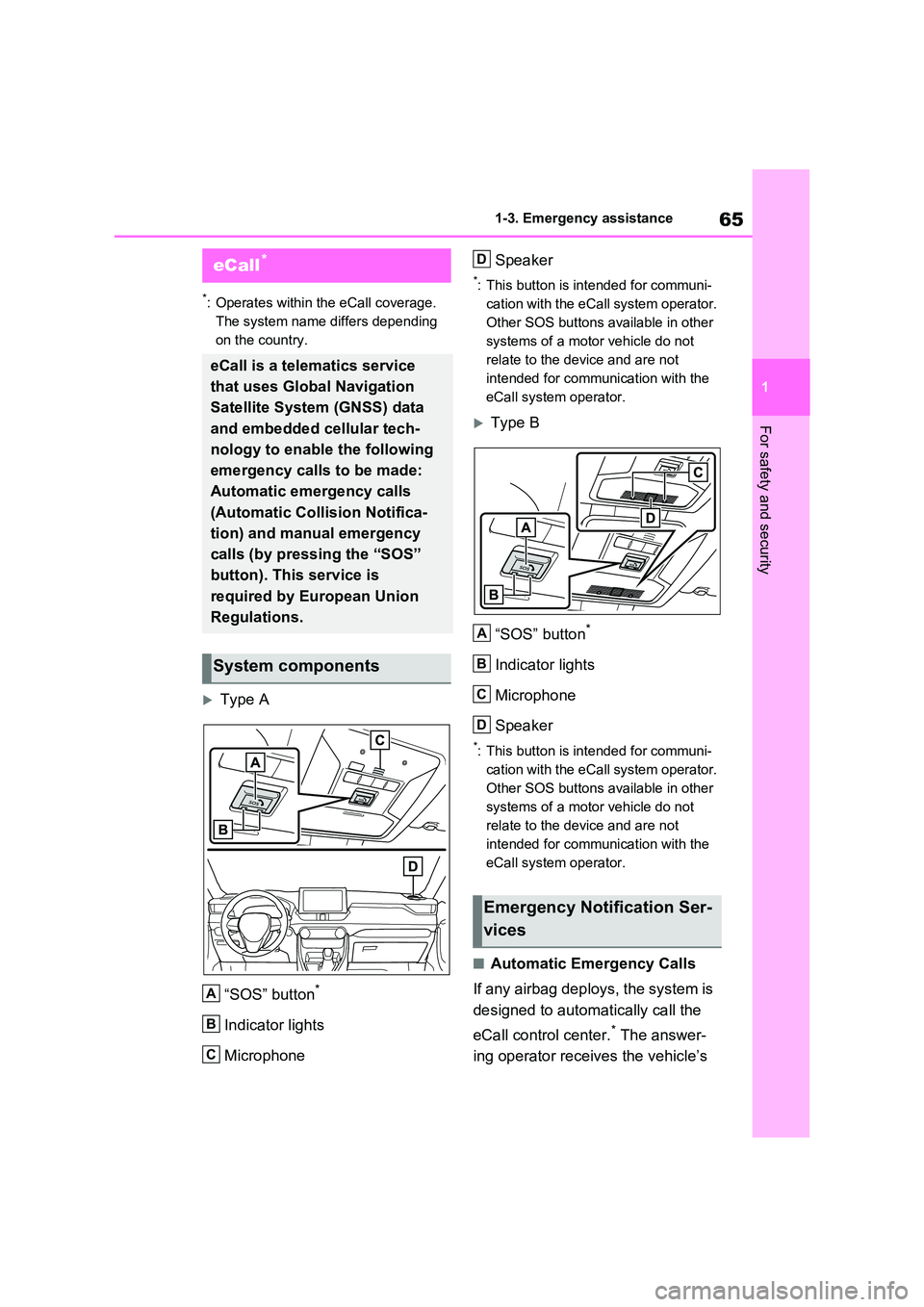
Type A
“SOS” button*
Indicator lights
Microphone
Speaker
*: This button is intended for communi-
cation with the eCall system operator.
Other SOS buttons available in other
systems of a motor vehicle do not
relate to the device and are not
intended for communication with the
eCall system operator.
Type B
“SOS” button*
Indicator lights
Microphone
Speaker
*: This button is intended for communi-
cation with the eCall system operator.
Other SOS buttons available in other
systems of a motor vehicle do not
relate to the device and are not
intended for communication with the
eCall system operator.
■Automatic Emergency Calls
If any airbag deploys, the system is
designed to automatically call the
eCall control center.* The answer-
ing operator receives the vehicle’s
eCall*
eCall is a telematics service
that uses Global Navigation
Satellite System (GNSS) data
and embedded cellular tech-
nology to enable the following
emergency calls to be made:
Automatic emergency calls
(Automatic Collision Notifica-
tion) and manual emergency
calls (by pressing the “SOS”
button). This service is
required by European Union
Regulations.
System components
A
B
C
Emergency Notification Ser-
vices
D
A
B
C
D