belt TOYOTA VERSO S 2011 Owner's Manual
[x] Cancel search | Manufacturer: TOYOTA, Model Year: 2011, Model line: VERSO S, Model: TOYOTA VERSO S 2011Pages: 664, PDF Size: 160.56 MB
Page 54 of 664
541-2. Child safety
■Child restraint system compat-
ibility for each seating posi-
tion
Compatibility of each seating posi-
tion with child restraint systems
( P.56) displays the type of child
restraint systems that can be used
and possible seating positions for
installation using symbols. Also, the
recommended child restraint sys-
tem that is suitable for your child
can be selected.
Otherwise, check [Recommended
child restraint systems and Com-
patibility table] for recommended
WARNING
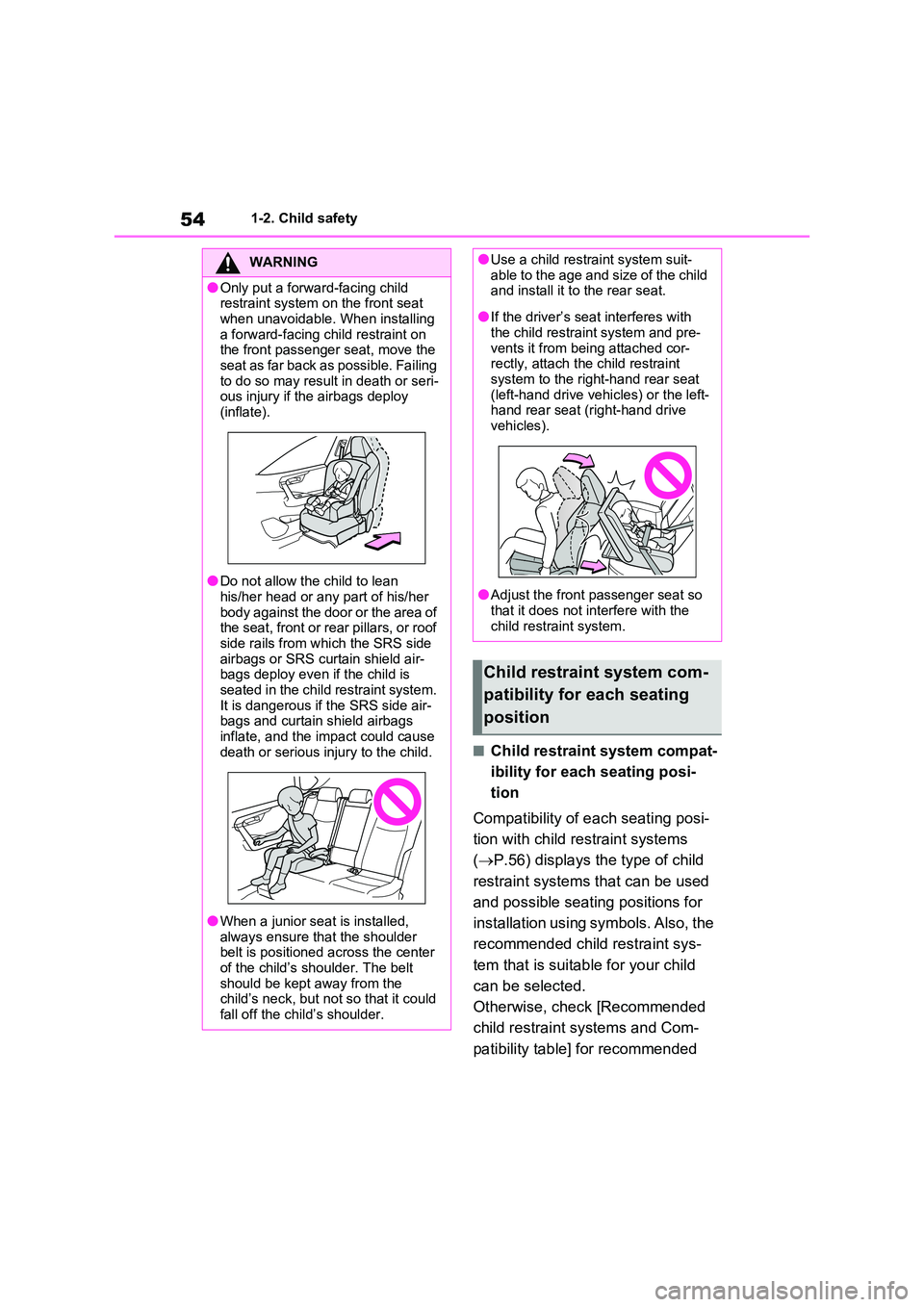
●Only put a forward-facing child restraint system on the front seat
when unavoidable. When installing a forward-facing child restraint on the front passenger seat, move the
seat as far back as possible. Failing to do so may result in death or seri-ous injury if the airbags deploy
(inflate).
●Do not allow the child to lean
his/her head or any part of his/her body against the door or the area of the seat, front or rear pillars, or roof
side rails from which the SRS side airbags or SRS curtain shield air-bags deploy even if the child is
seated in the child restraint system. It is dangerous if the SRS side air-bags and curtain shield airbags
inflate, and the impact could cause death or serious injury to the child.
●When a junior seat is installed, always ensure that the shoulder belt is positioned across the center
of the child’s shoulder. The belt should be kept away from the child’s neck, but not so that it could
fall off the child’s shoulder.
●Use a child restraint system suit- able to the age and size of the child and install it to the rear seat.
●If the driver’s seat interferes with the child restraint system and pre-
vents it from being attached cor- rectly, attach the child restraint system to the right-hand rear seat
(left-hand drive vehicles) or the left- hand rear seat (right-hand drive vehicles).
●Adjust the front passenger seat so that it does not interfere with the
child restraint system.
Child restraint system com-
patibility for each seating
position
Page 56 of 664
561-2. Child safety
depending on the product.
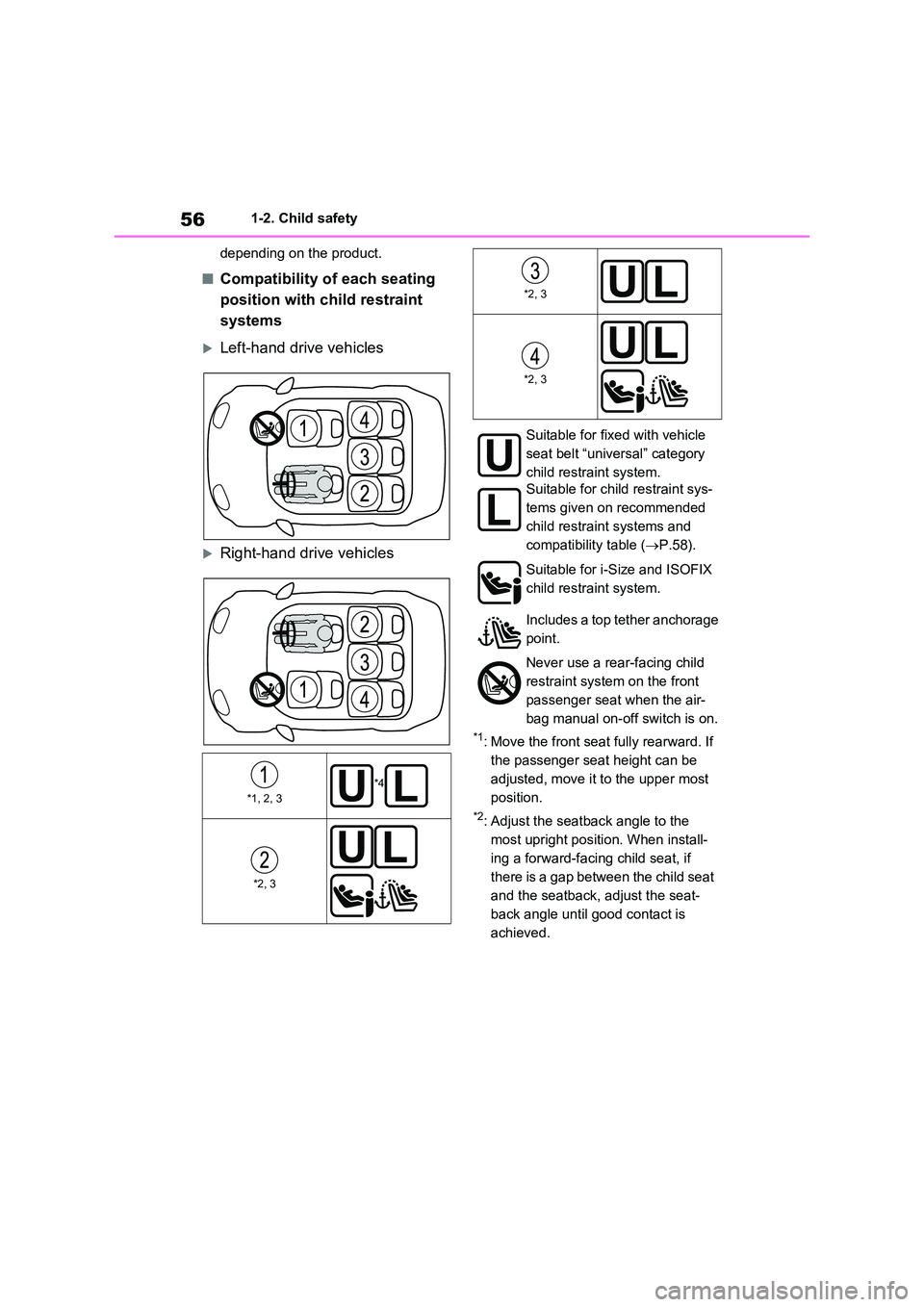
■Compatibility of each seating
position with child restraint
systems
Left-hand drive vehicles
Right-hand drive vehicles
*1: Move the front seat fully rearward. If
the passenger seat height can be
adjusted, move it to the upper most
position.
*2: Adjust the seatback angle to the
most upright position. When install-
ing a forward-facing child seat, if
there is a gap between the child seat
and the seatback, adjust the seat-
back angle until good contact is
achieved.
*1, 2, 3*4
*2, 3
*2, 3
*2, 3
Suitable for fixed with vehicle
seat belt “universal” category
child restraint system.
Suitable for child restraint sys-
tems given on recommended
child restraint systems and
compatibility table ( P.58).
Suitable for i-Size and ISOFIX
child restraint system.
Includes a top tether anchorage
point.
Never use a rear-facing child
restraint system on the front
passenger seat when the air-
bag manual on-off switch is on.
Page 57 of 664
57
1
1-2. Child safety
For safety and security
*3: If the head restraint interferes with
your child restraint system, and the
head restraint can be removed,
remove the head restraint.
Otherwise, put the head restraint in
the upper most position.
*4: Use only a front-facing child restraint
system when the airbag manual on-
off switch is on.
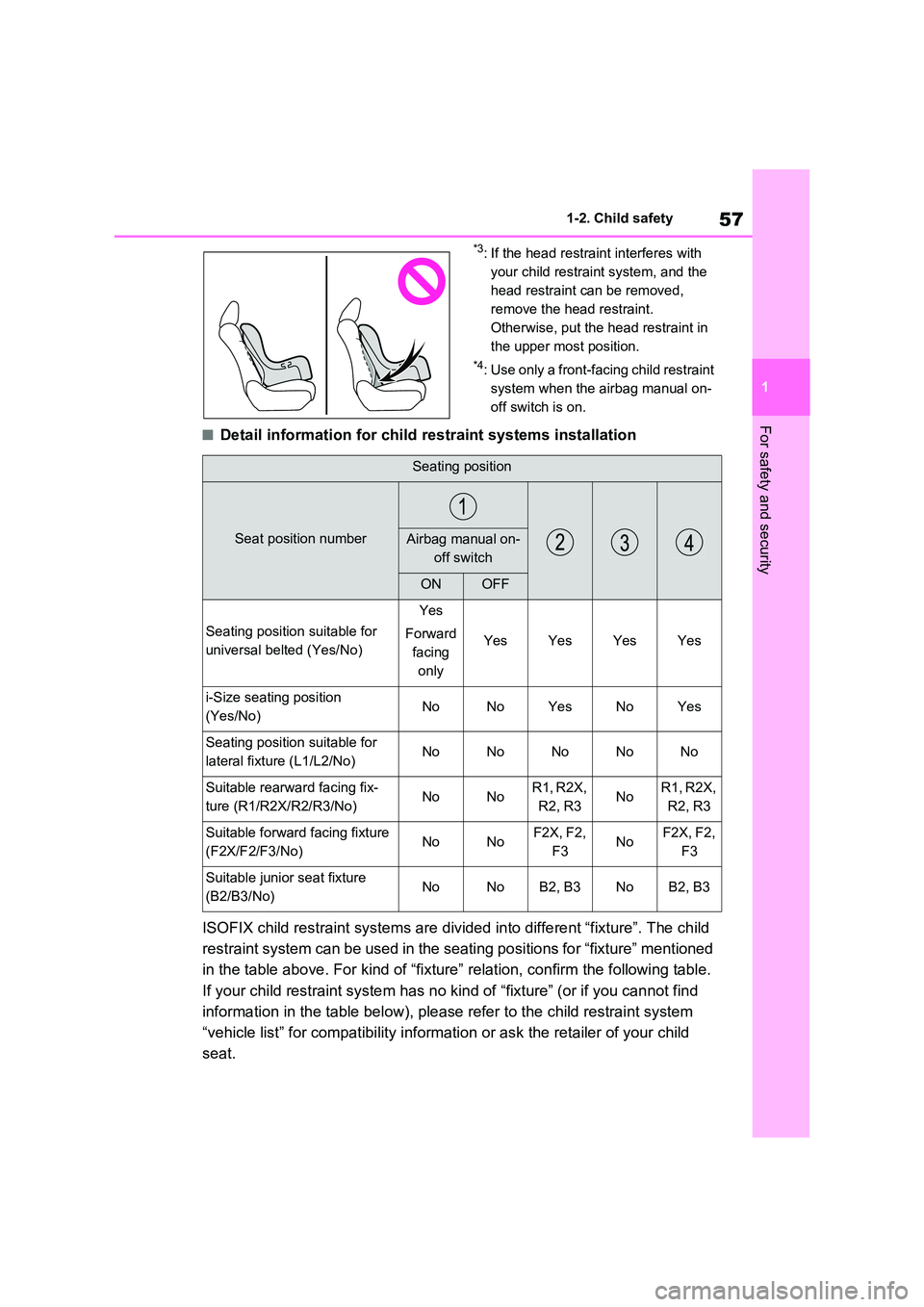
■Detail information for child restraint systems installation
ISOFIX child restraint systems are divided into different “fixture”. The child
restraint system can be used in the seating positions for “fixture” mentioned
in the table above. For kind of “fixture” relation, confirm the following table.
If your child restraint system has no kind of “fixture” (or if you cannot find
information in the table below), please refer to the child restraint system
“vehicle list” for compatibility information or ask the retailer of your child
seat.
Seating position
Seat position numberAirbag manual on-
off switch
ONOFF
Seating position suitable for
universal belted (Yes/No)
Yes
Forward
facing
only
YesYesYesYes
i-Size seating position
(Yes/No)NoNoYesNoYes
Seating position suitable for
lateral fixture (L1/L2/No)NoNoNoNoNo
Suitable rearward facing fix-
ture (R1/R2X/R2/R3/No)NoNoR1, R2X,
R2, R3NoR1, R2X,
R2, R3
Suitable forward facing fixture
(F2X/F2/F3/No)NoNoF2X, F2,
F3NoF2X, F2,
F3
Suitable junior seat fixture
(B2/B3/No)NoNoB2, B3NoB2, B3
Page 58 of 664
581-2. Child safety
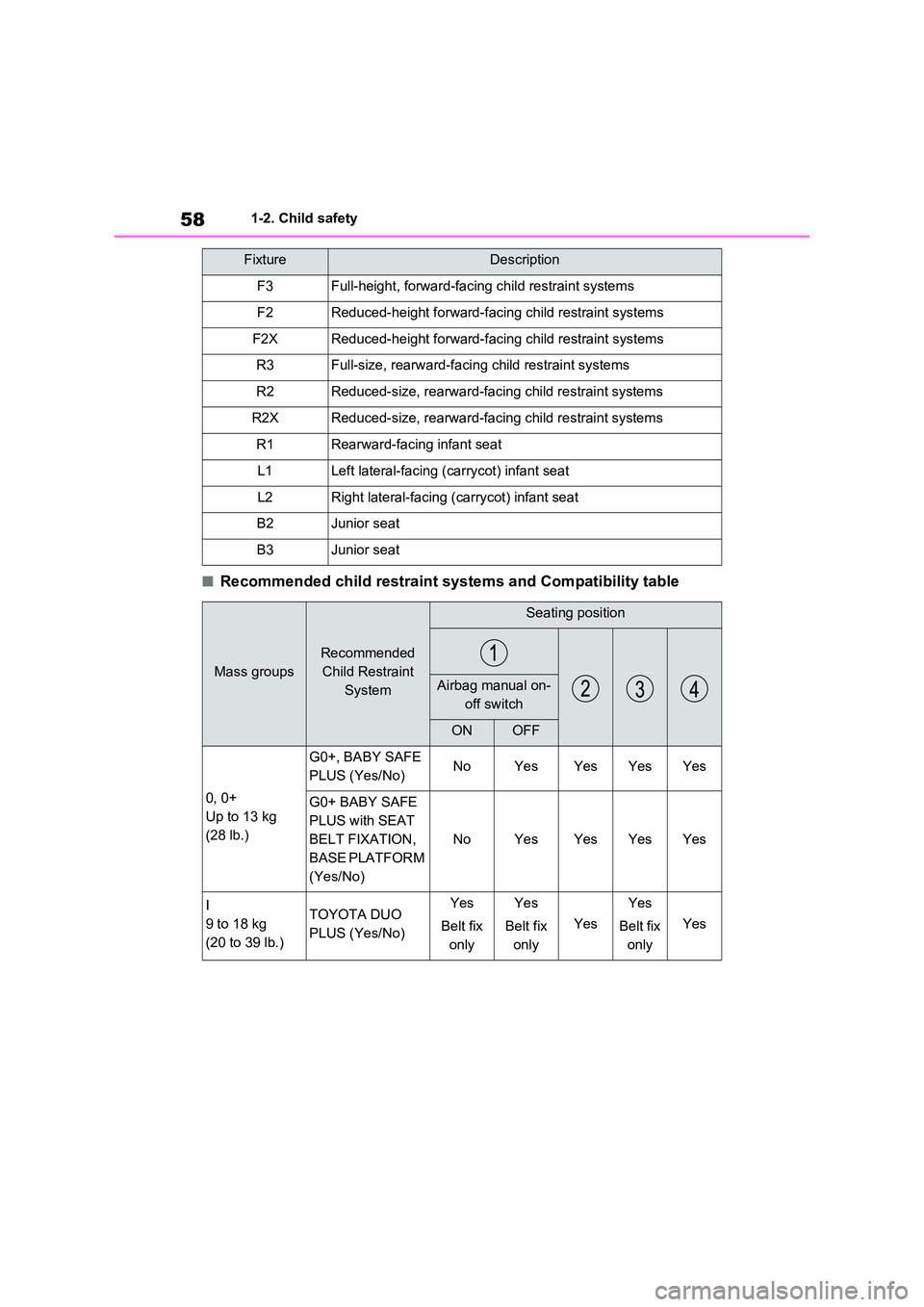
■Recommended child restraint systems and Compatibility table
FixtureDescription
F3Full-height, forward-facing child restraint systems
F2Reduced-height forward-facing child restraint systems
F2XReduced-height forward-facing child restraint systems
R3Full-size, rearward-facing child restraint systems
R2Reduced-size, rearward-facing child restraint systems
R2XReduced-size, rearward-facing child restraint systems
R1Rearward-facing infant seat
L1Left lateral-facing (carrycot) infant seat
L2Right lateral-facing (carrycot) infant seat
B2Junior seat
B3Junior seat
Mass groups
Recommended
Child Restraint
System
Seating position
Airbag manual on-
off switch
ONOFF
0, 0+
Up to 13 kg
(28 lb.)
G0+, BABY SAFE
PLUS (Yes/No)NoYesYesYesYes
G0+ BABY SAFE
PLUS with SEAT
BELT FIXATION,
BASE PLATFORM
(Yes/No)
NoYesYesYesYes
I
9 to 18 kg
(20 to 39 lb.)
TOYOTA DUO
PLUS (Yes/No)
Yes
Belt fix
only
Yes
Belt fix
only
Yes
Yes
Belt fix
only
Yes
Page 59 of 664
59
1
1-2. Child safety
For safety and security
The child restraint systems mentioned in the table may not be available out-
side the EU area.
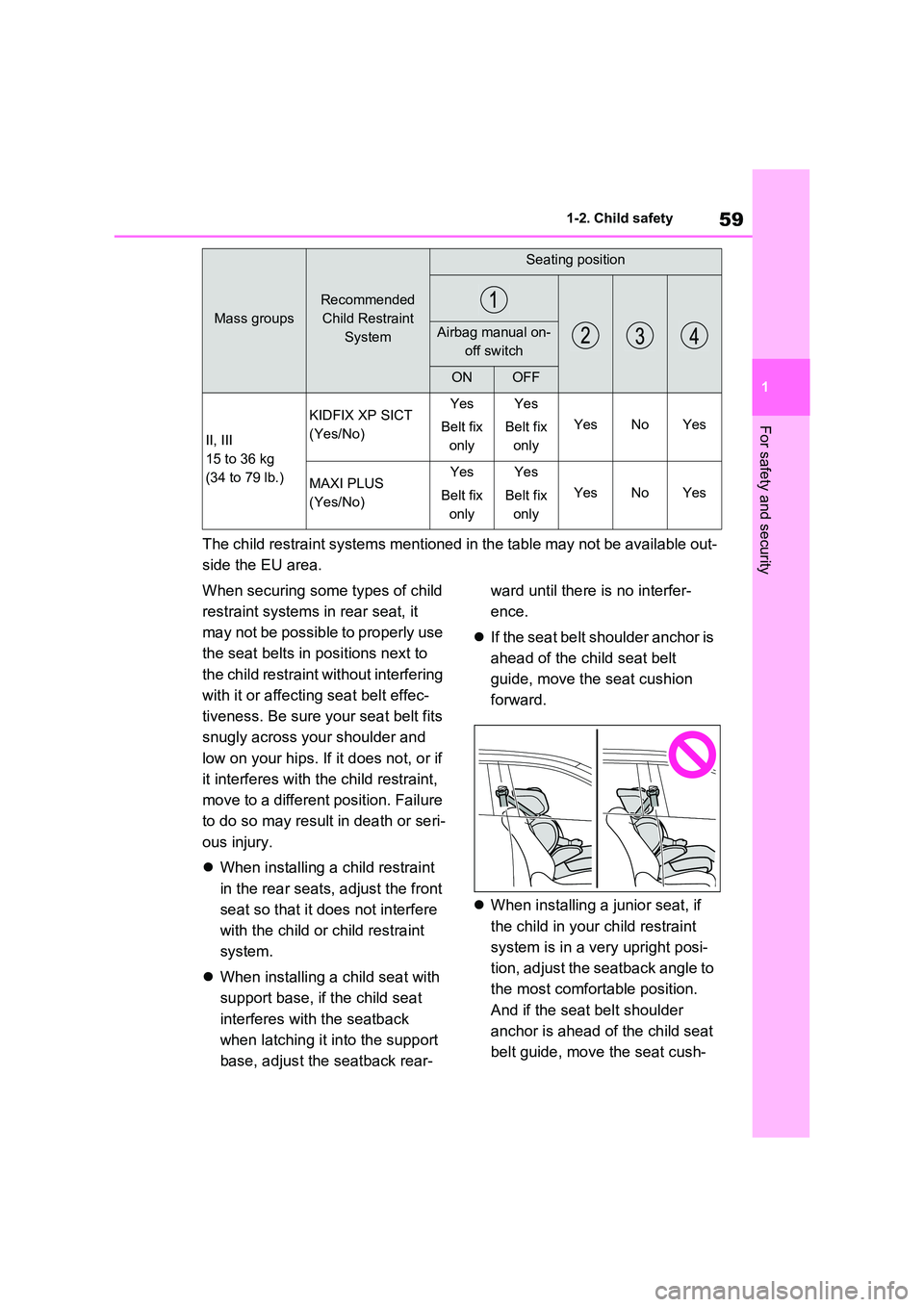
When securing some types of child
restraint systems in rear seat, it
may not be possible to properly use
the seat belts in positions next to
the child restraint without interfering
with it or affecting seat belt effec-
tiveness. Be sure your seat belt fits
snugly across your shoulder and
low on your hips. If it does not, or if
it interferes with the child restraint,
move to a different position. Failure
to do so may result in death or seri-
ous injury.
When installing a child restraint
in the rear seats, adjust the front
seat so that it does not interfere
with the child or child restraint
system.
When installing a child seat with
support base, if the child seat
interferes with the seatback
when latching it into the support
base, adjust the seatback rear-
ward until there is no interfer-
ence.
If the seat belt shoulder anchor is
ahead of the child seat belt
guide, move the seat cushion
forward.
When installing a junior seat, if
the child in your child restraint
system is in a very upright posi-
tion, adjust the seatback angle to
the most comfortable position.
And if the seat belt shoulder
anchor is ahead of the child seat
belt guide, move the seat cush-
II, III
15 to 36 kg
(34 to 79 lb.)
KIDFIX XP SICT
(Yes/No)
Yes
Belt fix
only
Yes
Belt fix
only
YesNoYes
MAXI PLUS
(Yes/No)
Yes
Belt fix
only
Yes
Belt fix
only
YesNoYes
Mass groups
Recommended
Child Restraint
System
Seating position
Airbag manual on-
off switch
ONOFF
Page 60 of 664
601-2. Child safety
ion forward.
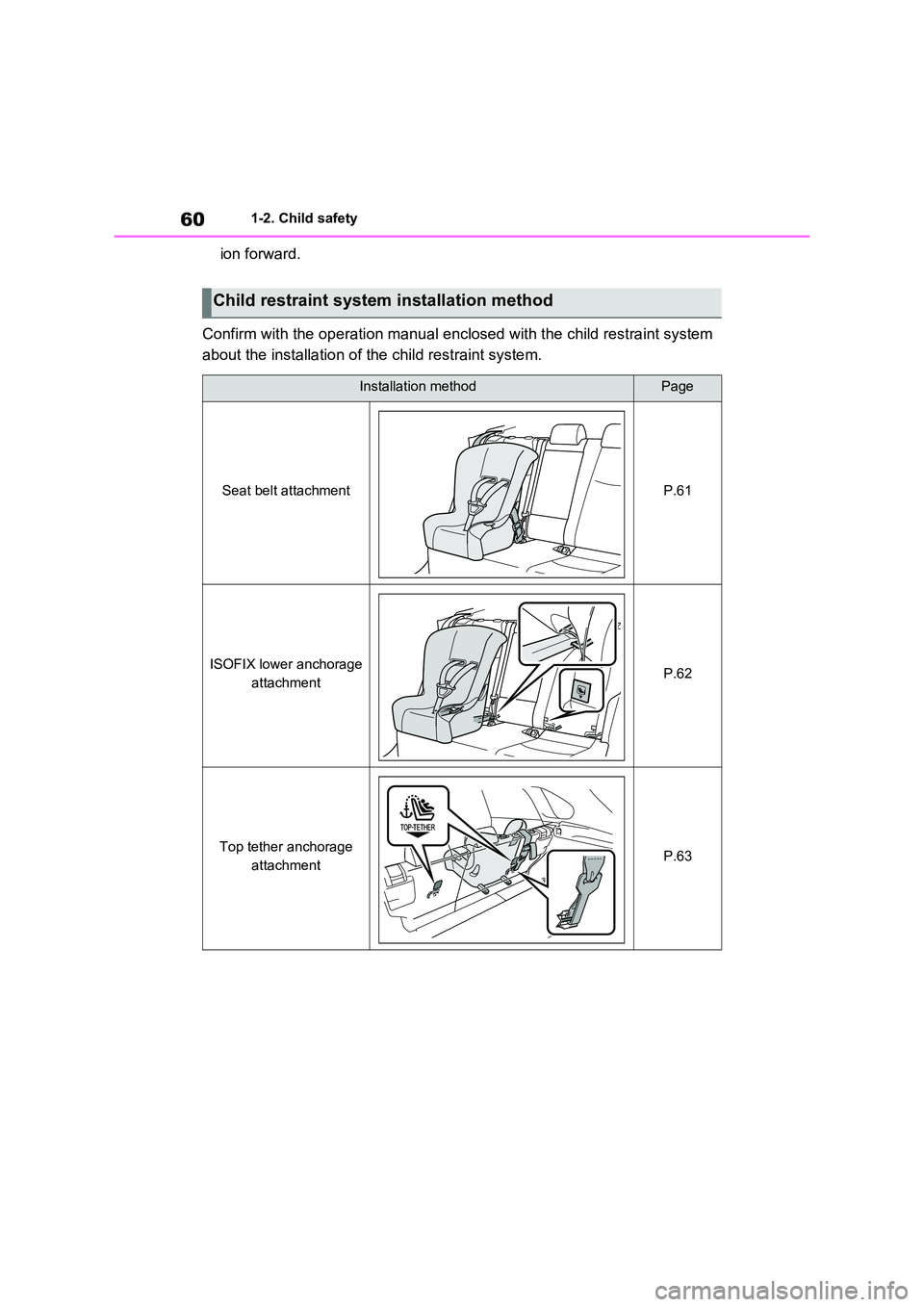
Confirm with the operation manual enclosed with the child restraint system
about the installation of the child restraint system.
Child restraint system installation method
Installation methodPage
Seat belt attachmentP.61
ISOFIX lower anchorage
attachmentP.62
Top tether anchorage
attachmentP.63
Page 61 of 664
61
1
1-2. Child safety
For safety and security
■Installing child restraint sys-
tem using a seat belt
Install the child restraint system in
accordance to the operation man-
ual enclosed with the child restraint
system.
If the child restraint system on hand
is not within the “universal” cate-
gory (or the necessary information
is not in the table), refer to the
“Vehicle List” provided by the child
restraint system maker for various
possible installation positions, or
check the compatibility after asking
the retailer of the child seat.
( P.55, 56)
1 If installing the child restraint
system to the front passenger
seat is unavoidable, refer to
P.52 for the front passenger
seat adjustment.
2 Adjust the seatback angle to the
most upright position. When
installing a forward-facing child
seat, if there is a gap between
the child seat and the seatback,
adjust the seatback angle until
good contact is achieved.
3 If the head restraint interferes
with the child restraint system
installation and the head
restraint can be removed,
remove the head restraint. Oth-
erwise, put the head restraint in
the upper most position.
( P.276)
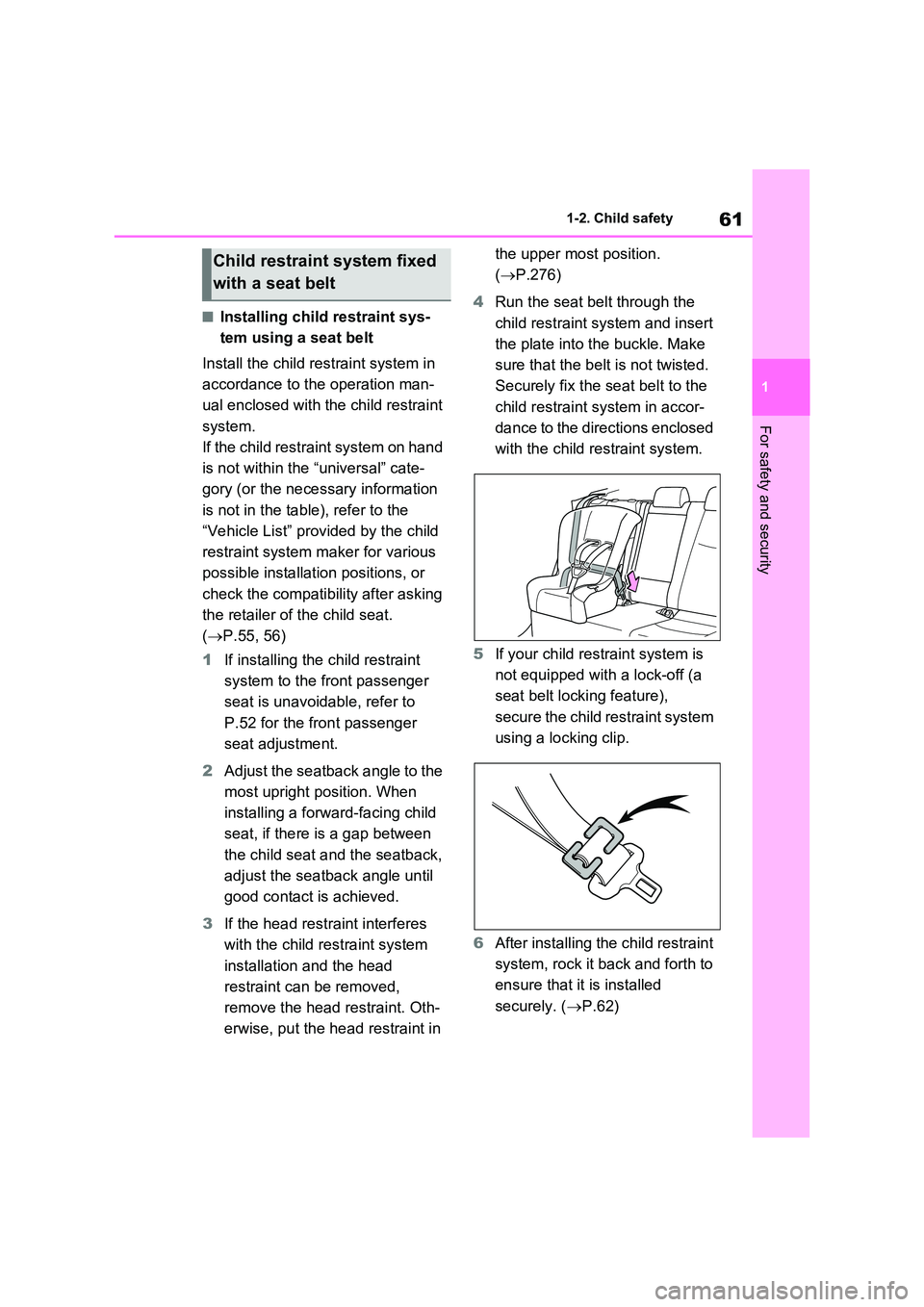
4 Run the seat belt through the
child restraint system and insert
the plate into the buckle. Make
sure that the belt is not twisted.
Securely fix the seat belt to the
child restraint system in accor-
dance to the directions enclosed
with the child restraint system.
5 If your child restraint system is
not equipped with a lock-off (a
seat belt locking feature),
secure the child restraint system
using a locking clip.
6 After installing the child restraint
system, rock it back and forth to
ensure that it is installed
securely. ( P.62)
Child restraint system fixed
with a seat belt
Page 62 of 664
621-2. Child safety
■Removing a child restraint
system installed with a seat
belt
Press the buckle release button
and fully retract the seat belt.
When releasing the buckle, the child
restraint system may spring up due to
the rebound of the seat cushion.
Release the buckle while holding down
the child restraint system.
Since the seat belt automatically reels
itself, slowly return it to the stowing
position.
■When installing a child restraint system
You may need a locking clip to install the child restraint system. Follow the instructions provided by the manufac-
turer of the system. If your child restraint system does not provide a locking clip, you can purchase the following item
from any authorized Toyota retailer or Toyota authorized repairer, or any reli-able repairer: Locking clip for child
restraint system (Part No. 73119-22010)
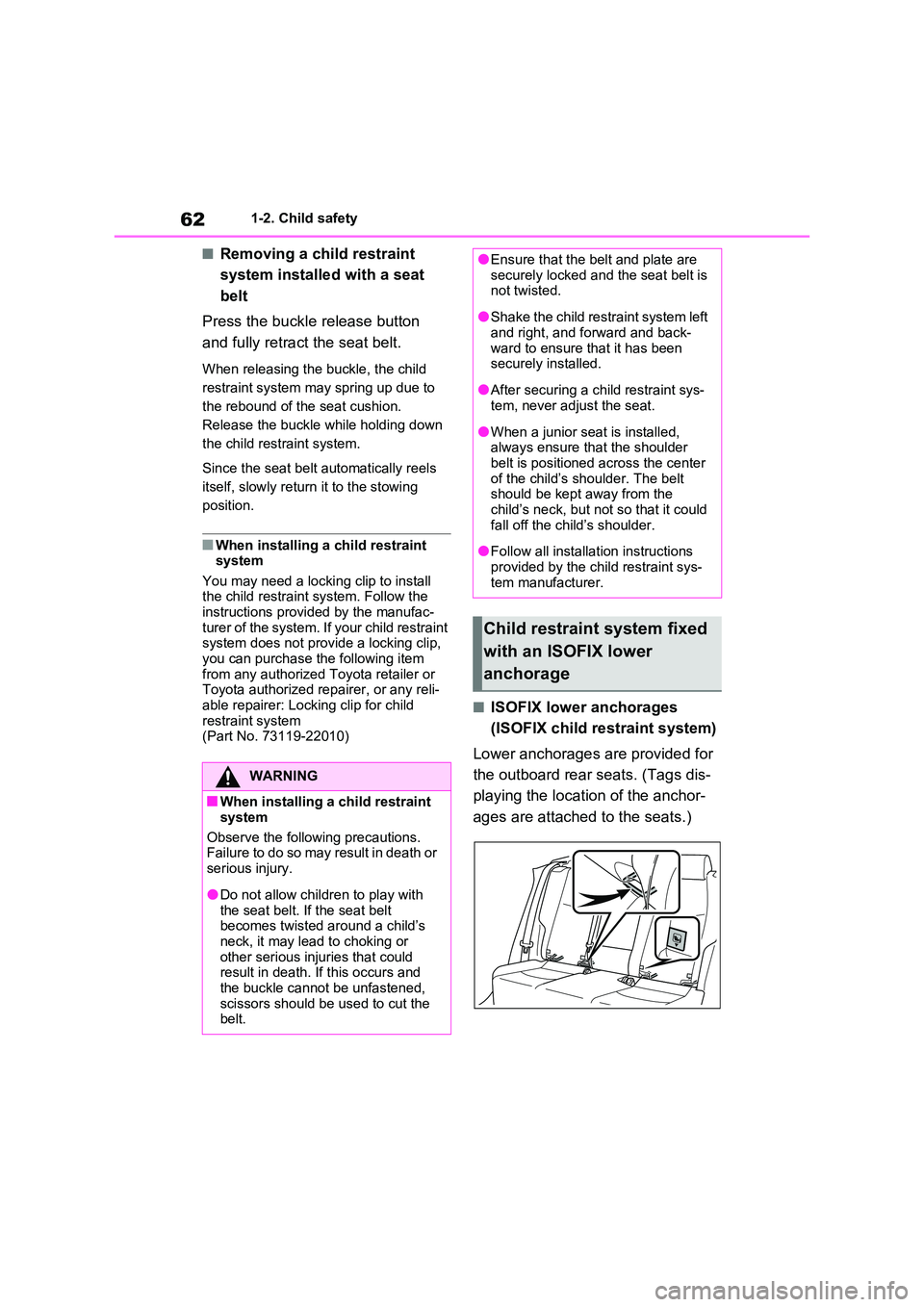
■ISOFIX lower anchorages
(ISOFIX child restraint system)
Lower anchorages are provided for
the outboard rear seats. (Tags dis-
playing the location of the anchor-
ages are attached to the seats.)
WARNING
■When installing a child restraint
system
Observe the following precautions. Failure to do so may result in death or
serious injury.
●Do not allow children to play with
the seat belt. If the seat belt becomes twisted around a child’s neck, it may lead to choking or
other serious injuries that could result in death. If this occurs and the buckle cannot be unfastened,
scissors should be used to cut the belt.
●Ensure that the belt and plate are securely locked and the seat belt is not twisted.
●Shake the child restraint system left and right, and forward and back-
ward to ensure that it has been securely installed.
●After securing a child restraint sys-tem, never adjust the seat.
●When a junior seat is installed, always ensure that the shoulder belt is positioned across the center
of the child’s shoulder. The belt should be kept away from the child’s neck, but not so that it could
fall off the child’s shoulder.
●Follow all installation instructions
provided by the child restraint sys- tem manufacturer.
Child restraint system fixed
with an ISOFIX lower
anchorage
Page 63 of 664
63
1
1-2. Child safety
For safety and security
■Installation with ISOFIX lower
anchorage (ISOFIX child
restraint system)
Install the child restraint system in
accordance to the operation man-
ual enclosed with the child restraint
system.
If the child restraint system on hand
is not within the “universal” cate-
gory (or the necessary information
is not in the table), refer to the
“Vehicle List” provided by the child
restraint system maker for various
possible installation positions, or
check the compatibility after asking
the retailer of the child seat.
( P.55, 56)
1 Adjust the seatback angle to the
most upright position. When
installing a forward-facing child
seat, if there is a gap between
the child seat and the seatback,
adjust the seatback angle until
good contact is achieved.
2 If the head restraint interferes
with the child restraint system
installation and the head
restraint can be removed,
remove the head restraint. Oth-
erwise, put the head restraint in
the upper most position.
( P.276)
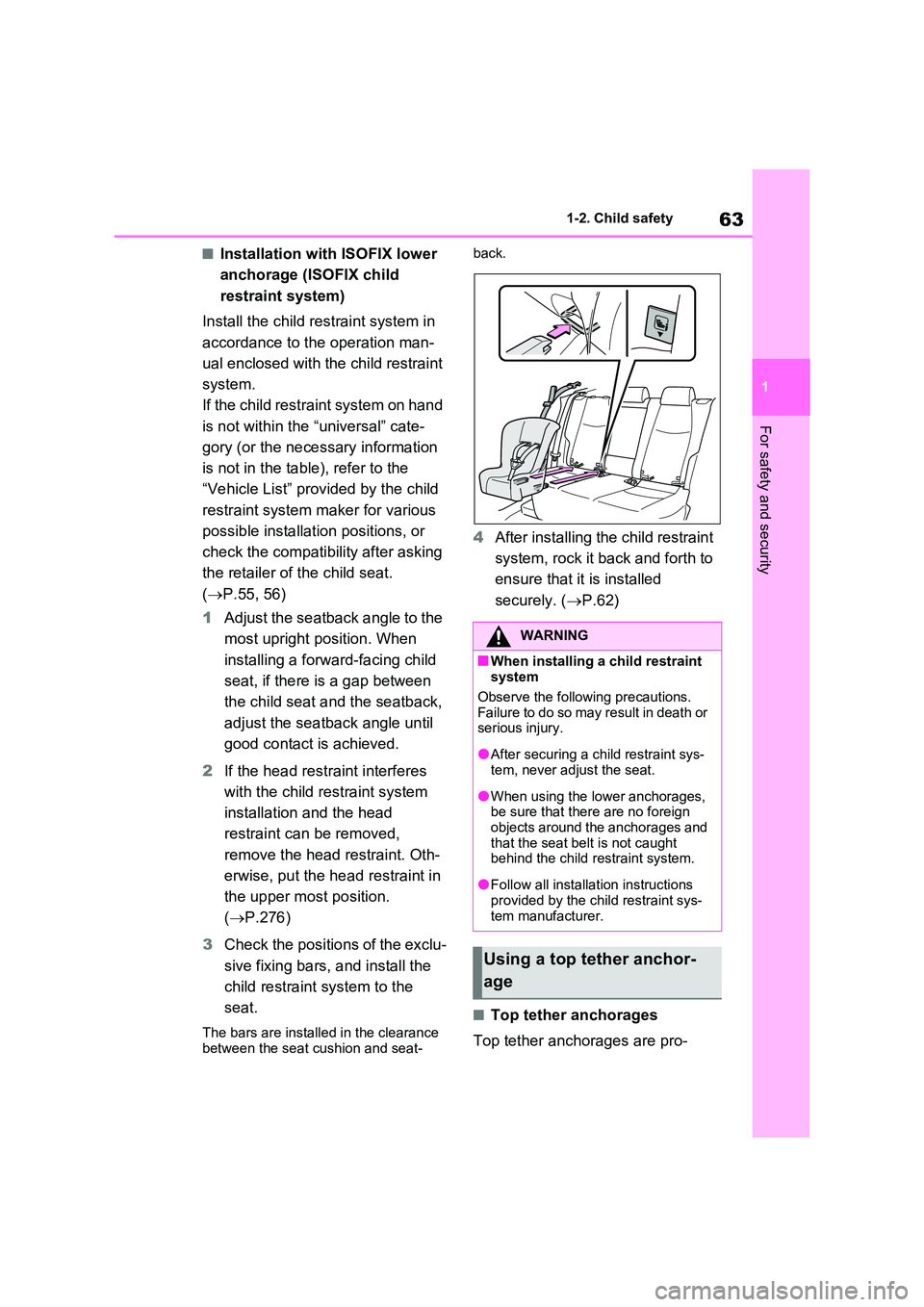
3 Check the positions of the exclu-
sive fixing bars, and install the
child restraint system to the
seat.
The bars are installed in the clearance between the seat cushion and seat-
back.
4 After installing the child restraint
system, rock it back and forth to
ensure that it is installed
securely. ( P.62)
■Top tether anchorages
Top tether anchorages are pro-
WARNING
■When installing a child restraint system
Observe the following precautions. Failure to do so may result in death or serious injury.
●After securing a child restraint sys-tem, never adjust the seat.
●When using the lower anchorages, be sure that there are no foreign
objects around the anchorages and that the seat belt is not caught behind the child restraint system.
●Follow all installation instructions provided by the child restraint sys-
tem manufacturer.
Using a top tether anchor-
age
Page 64 of 664
641-2. Child safety
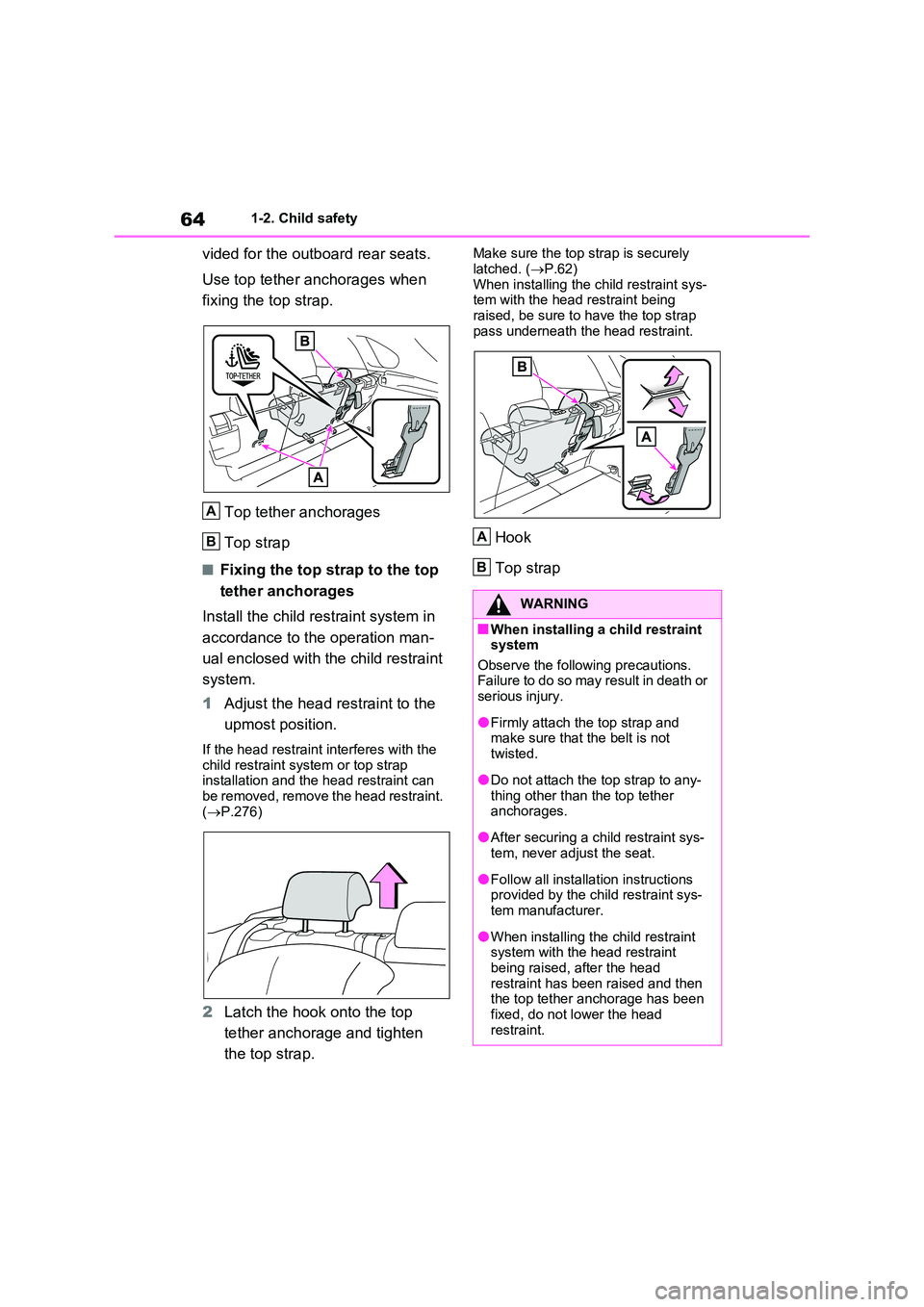
vided for the outboard rear seats.
Use top tether anchorages when
fixing the top strap.
Top tether anchorages
Top strap
■Fixing the top strap to the top
tether anchorages
Install the child restraint system in
accordance to the operation man-
ual enclosed with the child restraint
system.
1 Adjust the head restraint to the
upmost position.
If the head restraint interferes with the
child restraint system or top strap installation and the head restraint can be removed, remove the head restraint.
( P.276)
2Latch the hook onto the top
tether anchorage and tighten
the top strap.
Make sure the top strap is securely
latched. ( P.62) When installing the child restraint sys-tem with the head restraint being
raised, be sure to have the top strap pass underneath the head restraint.
Hook
Top strap
A
B
WARNING
■When installing a child restraint system
Observe the following precautions. Failure to do so may result in death or serious injury.
●Firmly attach the top strap and make sure that the belt is not
twisted.
●Do not attach the top strap to any-
thing other than the top tether anchorages.
●After securing a child restraint sys-tem, never adjust the seat.
●Follow all installation instructions provided by the child restraint sys-tem manufacturer.
●When installing the child restraint system with the head restraint
being raised, after the head restraint has been raised and then the top tether anchorage has been
fixed, do not lower the head restraint.
A
B