belt TOYOTA VERSO S 2011 Service Manual
[x] Cancel search | Manufacturer: TOYOTA, Model Year: 2011, Model line: VERSO S, Model: TOYOTA VERSO S 2011Pages: 664, PDF Size: 160.56 MB
Page 448 of 664
4485-6. Driving tips
Specific design characteristics
give it a higher center of gravity
than ordinary passenger cars.
This vehicle design feature
causes this type of vehicle to be
more likely to rollover. And, utility
vehicles have a significantly
higher rollover rate than other
types of vehicles.
An advantage of the higher
ground clearance is a better view
of the road allowing you to antici-
pate problems.
It is not designed for cornering at
the same speeds as ordinary
passenger cars any more than
low-slung sports cars are
designed to perform satisfactorily
under off-road conditions. There-
fore, sharp turns at excessive
speeds may cause the vehicle to
rollover.
When driving your vehicle off-road,
please observe the following pre-
Utility vehicle precau-
tions
This vehicle belongs to the
utility vehicle class, which has
higher ground clearance and
narrower tread in relation to
the height of its center of grav-
ity to make it capable of per-
forming in a wide variety of off-
road applications.
Utility vehicle feature
WARNING
■Utility vehicle precautions
Always observe the following precau-
tions to minimize the risk of death, serious injury or damage to your vehi-cle:
●In a rollover crash, an unbelted per-son is significantly more likely to die than a person wearing a seat belt.
Therefore, the driver and all pas- sengers should always fasten their seat belts.
●Avoid sharp turns or abrupt maneu-vers, if at all possible.
Failure to operate this vehicle cor- rectly may result in loss of control or vehicle rollover causing death or
serious injury.
●Loading cargo on the roof luggage
carrier (if equipped) will make the center of the vehicle gravity higher. Avoid high speeds, sudden starts,
sharp turns, sudden braking or abrupt maneuvers, otherwise it may result in loss of control or vehicle
rollover due to failure to operate this vehicle correctly.
●Always slow down in gusty cross-winds. Because of its profile and higher center of gravity, your vehi-
cle is more sensitive to side winds than an ordinary passenger car. Slowing down will allow you to have
better control.
●Do not drive horizontally across
steep slopes. Driving straight up or straight down is preferred. Your vehicle (or any similar off-road vehi-
cle) can tip over sideways much more easily than forward or back-ward.
Off-road driving
Page 491 of 664
491
7
7-1. Maintenance and care
Maintenance and care
Remove dirt and dust using a
vacuum cleaner. Wipe dirty sur-
faces with a cloth dampened with
lukewarm water.
If dirt cannot be removed, wipe it
off with a soft cloth dampened
with neutral detergent diluted to
approximately 1%.
Wring out any excess water from
the cloth and thoroughly wipe off
remaining traces of detergent
and water.
■Shampooing the carpets
There are several commercial foaming-
type cleaners available. Use a sponge or brush to apply the foam. Rub in over-lapping circles. Do not use water. Wipe
dirty surfaces and let them dry. Excel- lent results are obtained by keeping the carpet as dry as possible.
■Handling the seat belts
Clean with mild soap and lukewarm water using a cloth or sponge. Also check the belts periodically for exces-
sive wear, fraying or cuts.
NOTICE
●Do not spray the lower part of the windshield continuously. If water
enters the air conditioning system intake located near the lower part of the windshield, the air conditioning
system may not operate correctly.
●Do not wash the underside of the
vehicle using a high pressure car washer.
●Do not use the washer on the area around the charging port lid. Water could get into the AC charging inlet
and could damage the vehicle.
Cleaning and protecting
the vehicle interior
Perform cleaning in a manner
appropriate to each compo-
nent and its material.
Protecting the vehicle inte-
rior
Page 510 of 664
5107-3. Do-it-yourself maintenance
molded into the sidewall of each tire.
Replace the tires if the treadwear indi-
cators are showing on a tire.
■When to replace your vehicle’s tires
Tires should be replaced if:
●The treadwear indicators are showing on a tire.
●You have tire damage such as cuts, splits, cracks deep enough to expose
the fabric, and bulges indicating inter- nal damage.
●A tire goes flat repeatedly or cannot be properly repaired due to the size or location of a cut or other damage.
If you are not sure, consult with any authorized Toyota retailer or Toyota authorized repairer, or any reliable
repairer.
■Tire life
Any tire over 6 years old must be checked by a qualified technician even if
it has seldom or never been used or damage is not obvious.
■If the tread on snow tires wears down below 4 mm (0.16 in.)
The effectiveness of the tires as snow tires is lost.
Rotate the tires in the order shown.
To equalize tire wear and help extend
tire life, Toyota recommends that tire
rotation is carried out approximately
WARNING
■When inspecting or replacing tires
Observe the following precautions to
prevent accidents. Failure to do so may cause damage to parts of the drive train as well as
dangerous handling characteristics, which may lead to an accident result-ing in death or serious injury.
●Do not mix tires of different makes, models or tread patterns.Also, do not mix tires of remarkably
different treadwear.
●Do not use tire sizes other than those recommended by Toyota.
●Do not mix differently constructed tires (radial, bias-belted or bias-ply tires).
●Do not mix summer, all season and snow tires.
●Do not use tires that have been used on another vehicle.
Do not use tires if you do not know how they were used previously.
●Vehicles with compact spare tire: Do not tow if your vehicle has a compact spare tire installed.
●Vehicles with emergency tire punc-ture repair kit: Do not tow anything
if a tire that has been repaired using the emergency tire puncture repair kit is installed. The load on the tire
may cause unexpected damage to the tire.
NOTICE
■Driving on rough roads
Take particular care when driving on roads with loose surfaces or potholes.These conditions may cause losses in
tire inflation pressure, reducing the cushioning ability of the tires. In addi-tion, driving on rough roads may
cause damage to the tires them- selves, as well as the vehicle’s wheels and body.
■If tire inflation pressure of each tire becomes low while driving
Do not continue driving, or your tires and/or wheels may be ruined.
Tire rotation
Page 561 of 664
561
8
8-1. Essential information
When trouble arises
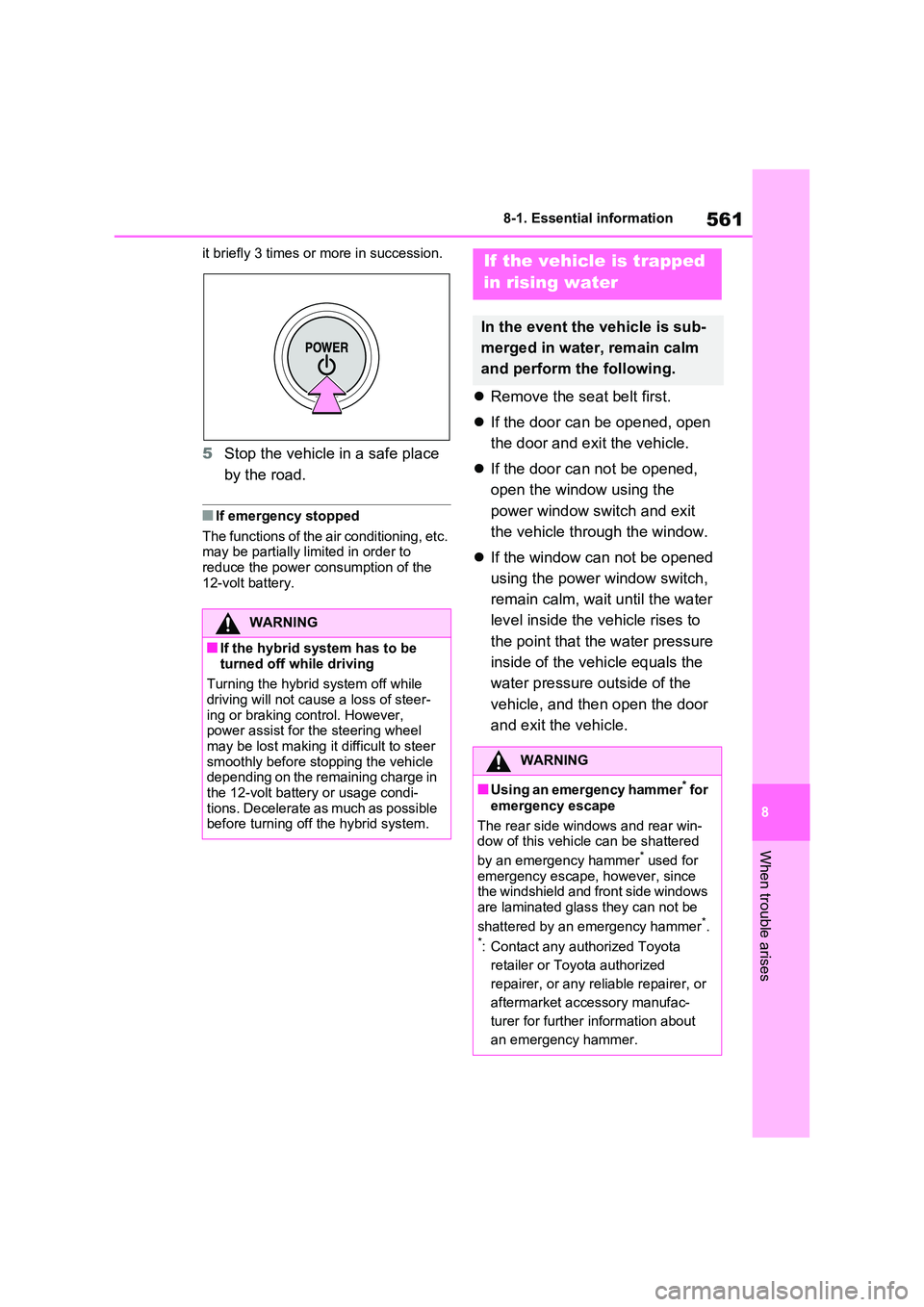
it briefly 3 times or more in succession.
5 Stop the vehicle in a safe place
by the road.
■If emergency stopped
The functions of the air conditioning, etc. may be partially limited in order to reduce the power consumption of the
12-volt battery.
Remove the seat belt first.
If the door can be opened, open
the door and exit the vehicle.
If the door can not be opened,
open the window using the
power window switch and exit
the vehicle through the window.
If the window can not be opened
using the power window switch,
remain calm, wait until the water
level inside the vehicle rises to
the point that the water pressure
inside of the vehicle equals the
water pressure outside of the
vehicle, and then open the door
and exit the vehicle.
WARNING
■If the hybrid system has to be
turned off while driving
Turning the hybrid system off while driving will not cause a loss of steer-
ing or braking control. However, power assist for the steering wheel may be lost making it difficult to steer
smoothly before stopping the vehicle depending on the remaining charge in the 12-volt battery or usage condi-
tions. Decelerate as much as possible before turning off the hybrid system.
If the vehicle is trapped
in rising water
In the event the vehicle is sub-
merged in water, remain calm
and perform the following.
WARNING
■Using an emergency hammer* for
emergency escape
The rear side windows and rear win- dow of this vehicle can be shattered
by an emergency hammer* used for emergency escape, however, since the windshield and front side windows
are laminated glass they can not be
shattered by an emergency hammer*.*: Contact any authorized Toyota
retailer or Toyota authorized
repairer, or any reliable repairer, or
aftermarket accessory manufac-
turer for further information about
an emergency hammer.
Page 565 of 664
565
8
8-2. Steps to take in an emergency
When trouble arises
When using a flat-bed truck to
transport the vehicle, use tire strap-
ping belts. Refer to the owner’s
manual of the flat-bed truck for the
tire strapping method.
In order to suppress vehicle move-
ment during transportation, set the
parking brake and turn the power
switch off.
If a tow truck is not available in an
emergency, your vehicle may be
temporarily towed using cables or
chains secured to the emergency
towing eyelets. This should only be
attempted on hard surfaced roads
for short distances at under 30
km/h (18 mph).
A driver must be in the vehicle to
steer and operate the brakes. The
vehicle’s wheels, drive train, axles,
steering and brakes must be in
good condition.
To have your vehicle towed by
another vehicle, the towing eyelet
must be installed to your vehicle.
Install the towing eyelet using the
following procedure.
1 Take out the wheel nut wrench
and towing eyelet. ( P.583,
594)
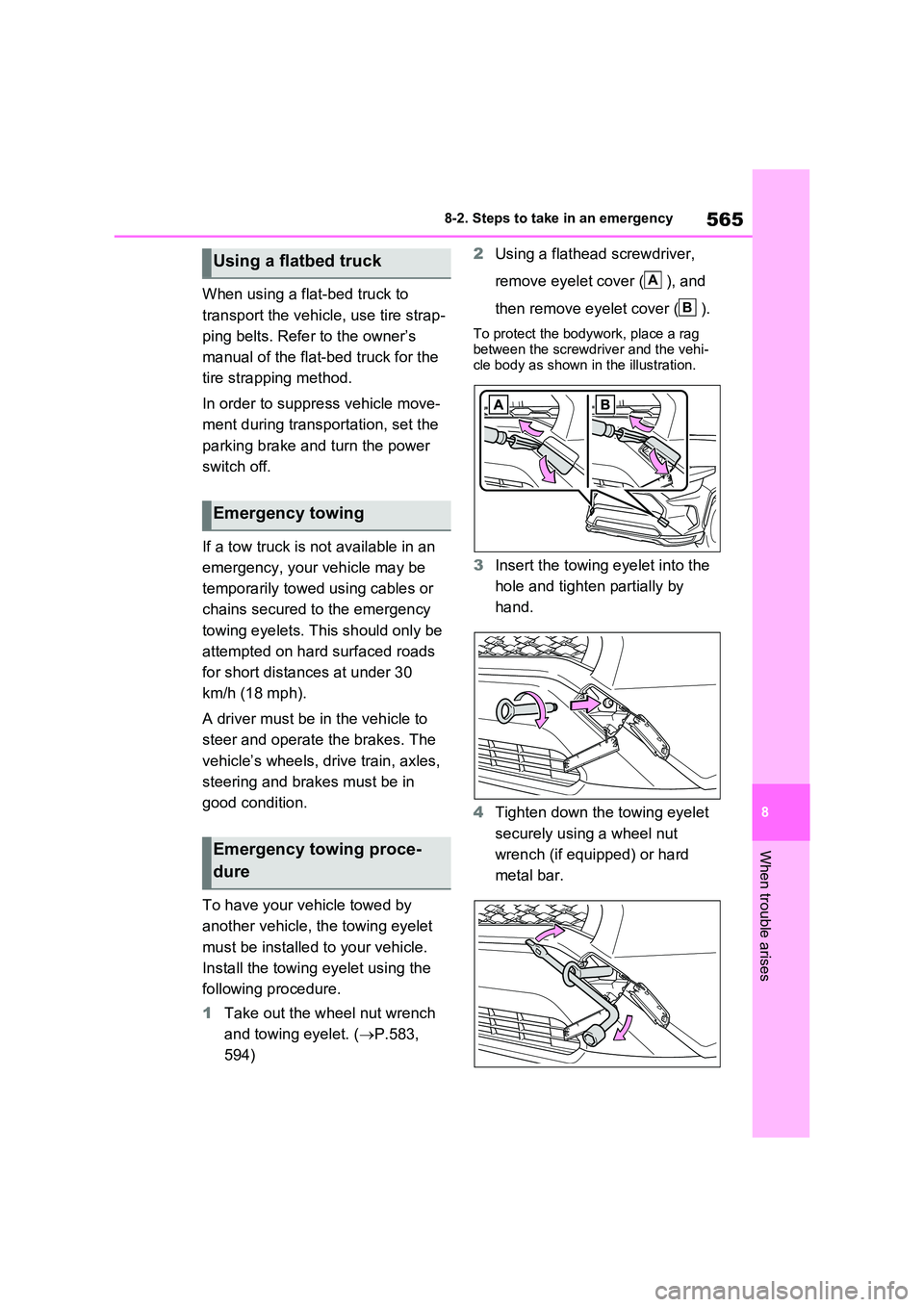
2 Using a flathead screwdriver,
remove eyelet cover ( ), and
then remove eyelet cover ( ).
To protect the bodywork, place a rag
between the screwdriver and the vehi- cle body as shown in the illustration.
3 Insert the towing eyelet into the
hole and tighten partially by
hand.
4 Tighten down the towing eyelet
securely using a wheel nut
wrench (if equipped) or hard
metal bar.
Using a flatbed truck
Emergency towing
Emergency towing proce-
dure
A
B
Page 570 of 664
5708-2. Steps to take in an emergency
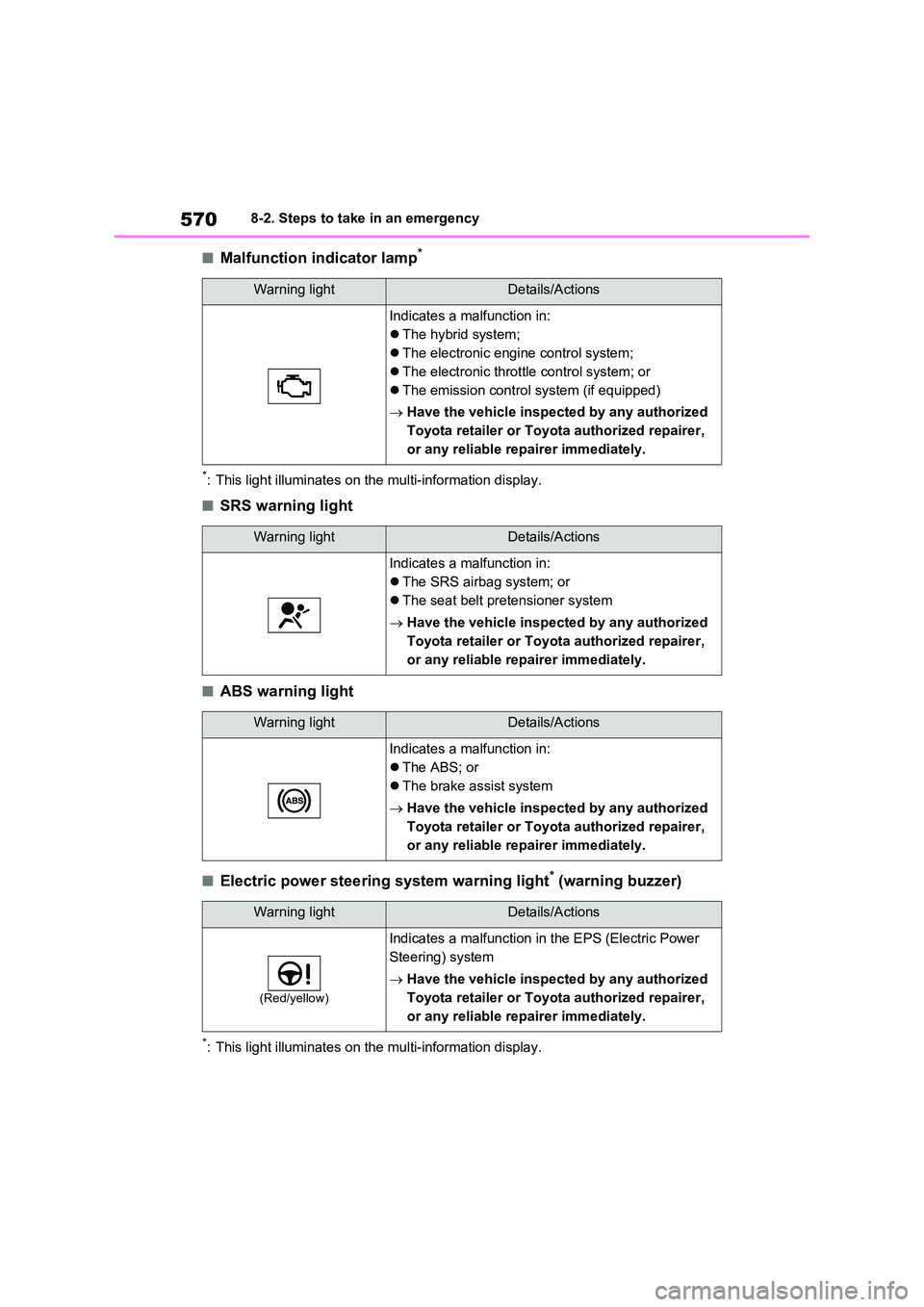
■Malfunction indicator lamp*
*: This light illuminates on the multi-information display.
■SRS warning light
■ABS warning light
■Electric power steering system warning light* (warning buzzer)
*: This light illuminates on the multi-information display.
Warning lightDetails/Actions
Indicates a malfunction in:
The hybrid system;
The electronic engine control system;
The electronic throttle control system; or
The emission control system (if equipped)
Have the vehicle inspected by any authorized
Toyota retailer or Toyota authorized repairer,
or any reliable repairer immediately.
Warning lightDetails/Actions
Indicates a malfunction in:
The SRS airbag system; or
The seat belt pretensioner system
Have the vehicle inspected by any authorized
Toyota retailer or Toyota authorized repairer,
or any reliable repairer immediately.
Warning lightDetails/Actions
Indicates a malfunction in:
The ABS; or
The brake assist system
Have the vehicle inspected by any authorized
Toyota retailer or Toyota authorized repairer,
or any reliable repairer immediately.
Warning lightDetails/Actions
(Red/yellow)
Indicates a malfunction in the EPS (Electric Power
Steering) system
Have the vehicle inspected by any authorized
Toyota retailer or Toyota authorized repairer,
or any reliable repairer immediately.
Page 575 of 664
575
8
8-2. Steps to take in an emergency
When trouble arises
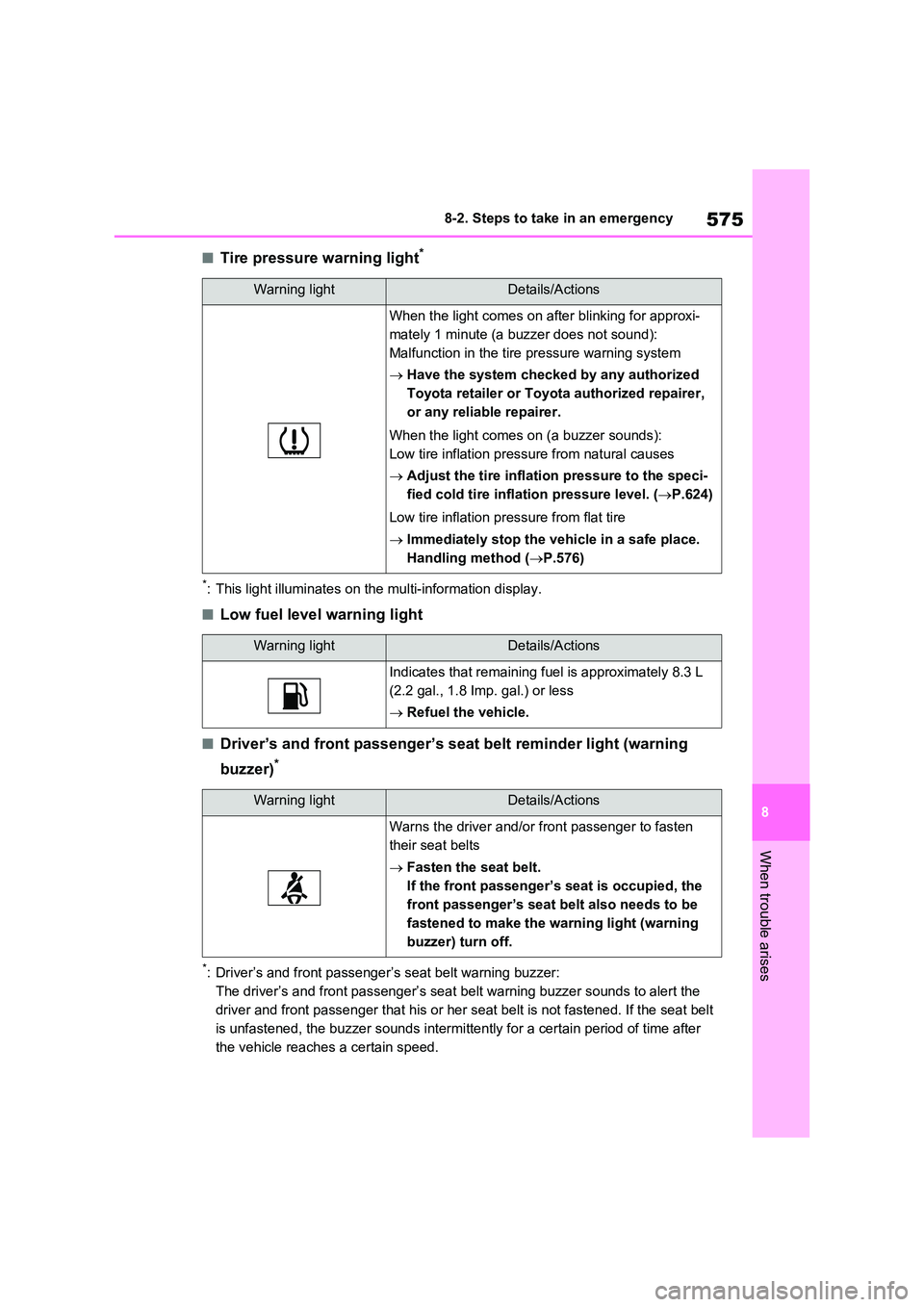
■Tire pressure warning light*
*: This light illuminates on the multi-information display.
■Low fuel level warning light
■Driver’s and front passenger’s seat belt reminder light (warning
buzzer)*
*: Driver’s and front passenger’s seat belt warning buzzer:
The driver’s and front passenger’s seat belt warning buzzer sounds to alert the
driver and front passenger that his or her seat belt is not fastened. If the seat belt
is unfastened, the buzzer sounds intermittently for a certain period of time after
the vehicle reaches a certain speed.
Warning lightDetails/Actions
When the light comes on after blinking for approxi-
mately 1 minute (a buzzer does not sound):
Malfunction in the tire pressure warning system
Have the system checked by any authorized
Toyota retailer or Toyota authorized repairer,
or any reliable repairer.
When the light comes on (a buzzer sounds):
Low tire inflation pressure from natural causes
Adjust the tire inflation pressure to the speci-
fied cold tire inflation pressure level. ( P.624)
Low tire inflation pressure from flat tire
Immediately stop the vehicle in a safe place.
Handling method ( P.576)
Warning lightDetails/Actions
Indicates that remaining fuel is approximately 8.3 L
(2.2 gal., 1.8 Imp. gal.) or less
Refuel the vehicle.
Warning lightDetails/Actions
Warns the driver and/or front passenger to fasten
their seat belts
Fasten the seat belt.
If the front passenger’s seat is occupied, the
front passenger’s seat belt also needs to be
fastened to make the warning light (warning
buzzer) turn off.
Page 576 of 664
5768-2. Steps to take in an emergency
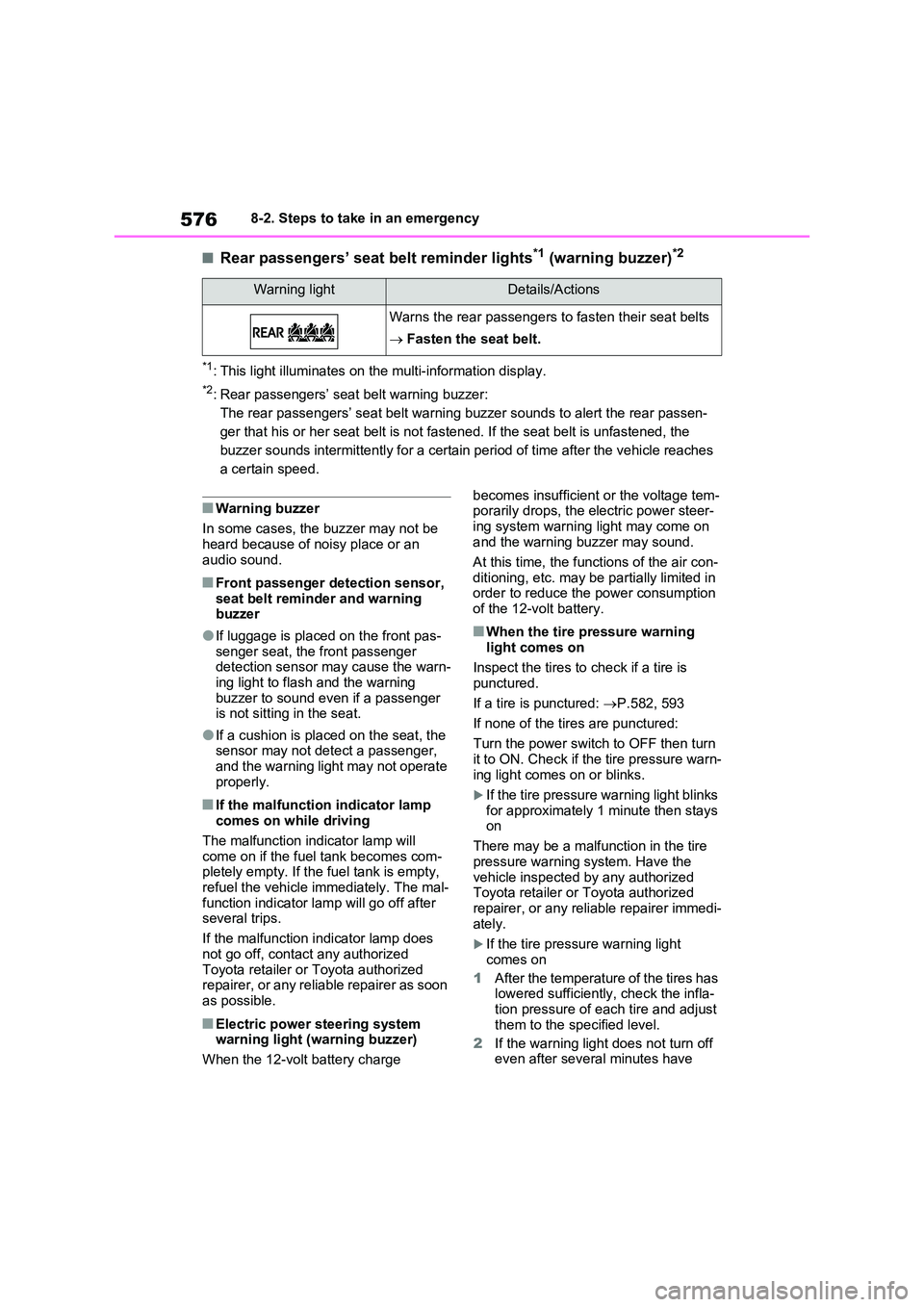
■Rear passengers’ seat belt reminder lights*1 (warning buzzer)*2
*1: This light illuminates on the multi-information display.
*2: Rear passengers’ seat belt warning buzzer:
The rear passengers’ seat belt warning buzzer sounds to alert the rear passen-
ger that his or her seat belt is not fastened. If the seat belt is unfastened, the
buzzer sounds intermittently for a certain period of time after the vehicle reaches
a certain speed.
■Warning buzzer
In some cases, the buzzer may not be heard because of noisy place or an
audio sound.
■Front passenger detection sensor, seat belt reminder and warning buzzer
●If luggage is placed on the front pas-
senger seat, the front passenger detection sensor may cause the warn-ing light to flash and the warning
buzzer to sound even if a passenger is not sitting in the seat.
●If a cushion is placed on the seat, the sensor may not detect a passenger, and the warning light may not operate
properly.
■If the malfunction indicator lamp comes on while driving
The malfunction indicator lamp will
come on if the fuel tank becomes com- pletely empty. If the fuel tank is empty, refuel the vehicle immediately. The mal-
function indicator lamp will go off after several trips.
If the malfunction indicator lamp does
not go off, contact any authorized Toyota retailer or Toyota authorized repairer, or any reliable repairer as soon
as possible.
■Electric power steering system warning light (warning buzzer)
When the 12-volt battery charge
becomes insufficient or the voltage tem- porarily drops, the electric power steer-
ing system warning light may come on and the warning buzzer may sound.
At this time, the functions of the air con-
ditioning, etc. may be partially limited in order to reduce the power consumption of the 12-volt battery.
■When the tire pressure warning
light comes on
Inspect the tires to check if a tire is punctured.
If a tire is punctured: P.582, 593
If none of the tires are punctured:
Turn the power switch to OFF then turn
it to ON. Check if the tire pressure warn- ing light comes on or blinks.
If the tire pressure warning light blinks
for approximately 1 minute then stays on
There may be a malfunction in the tire
pressure warning system. Have the vehicle inspected by any authorized Toyota retailer or Toyota authorized
repairer, or any reliable repairer immedi- ately.
If the tire pressure warning light
comes on
1 After the temperature of the tires has lowered sufficiently, check the infla-tion pressure of each tire and adjust
them to the specified level.
2 If the warning light does not turn off even after several minutes have
Warning lightDetails/Actions
Warns the rear passengers to fasten their seat belts
Fasten the seat belt.
Page 647 of 664
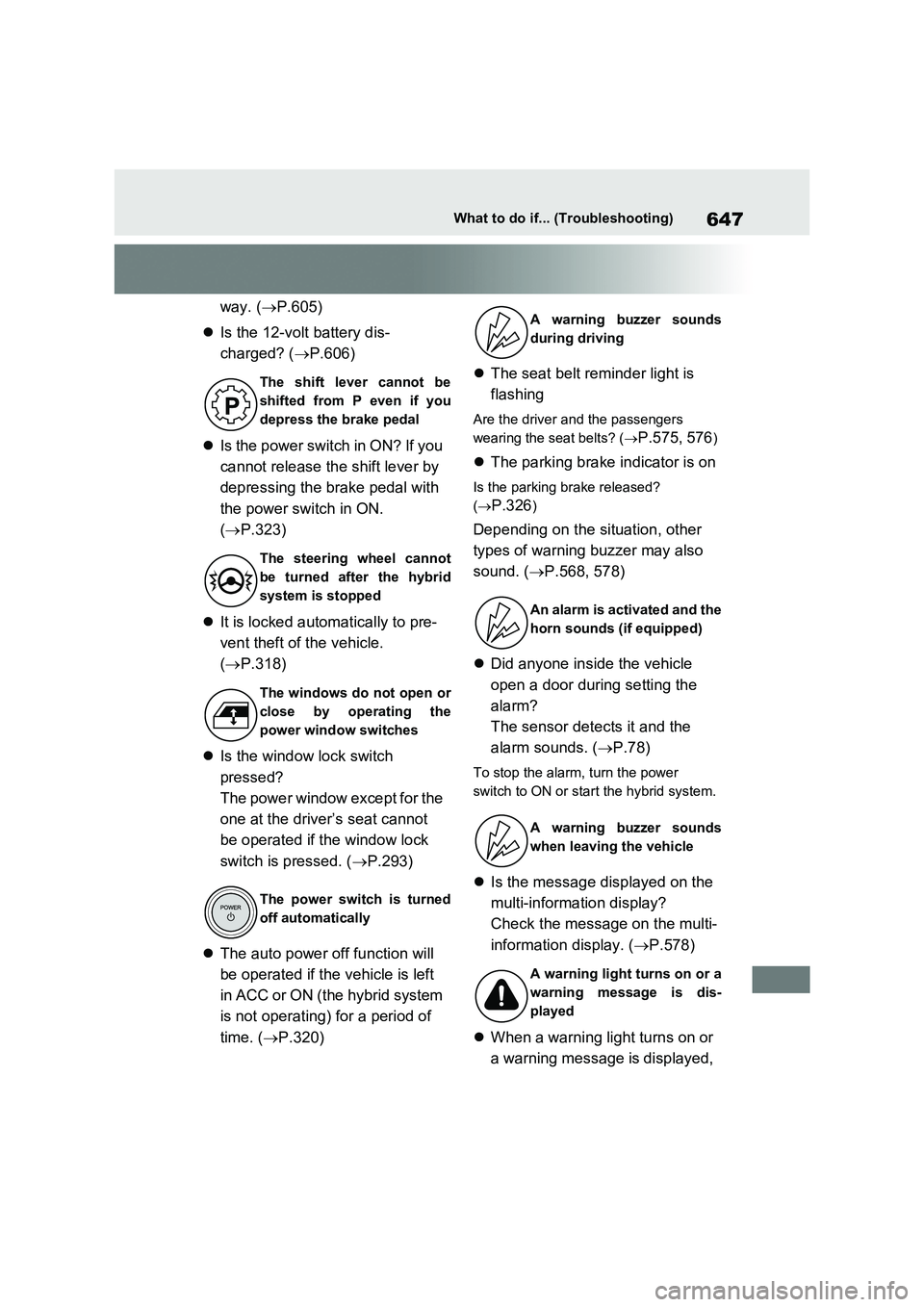
647What to do if... (Troubleshooting)
way. (P.605)
Is the 12-volt battery dis-
charged? ( P.606)
Is the power switch in ON? If you
cannot release the shift lever by
depressing the brake pedal with
the power switch in ON.
( P.323)
It is locked automatically to pre-
vent theft of the vehicle.
( P.318)
Is the window lock switch
pressed?
The power window except for the
one at the driver’s seat cannot
be operated if the window lock
switch is pressed. ( P.293)
The auto power off function will
be operated if the vehicle is left
in ACC or ON (the hybrid system
is not operating) for a period of
time. ( P.320)
The seat belt reminder light is
flashing
Are the driver and the passengers
wearing the seat belts? ( P.575, 576)
The parking brake indicator is on
Is the parking brake released?
( P.326)
Depending on the situation, other
types of warning buzzer may also
sound. ( P.568, 578)
Did anyone inside the vehicle
open a door during setting the
alarm?
The sensor detects it and the
alarm sounds. ( P.78)
To stop the alarm, turn the power
switch to ON or start the hybrid system.
Is the message displayed on the
multi-information display?
Check the message on the multi-
information display. ( P.578)
When a warning light turns on or
a warning message is displayed,
The shift lever cannot be
shifted from P even if you
depress the brake pedal
The steering wheel cannot
be turned after the hybrid
system is stopped
The windows do not open or
close by operating the
power window switches
The power switch is turned
off automatically
A warning buzzer sounds
during driving
An alarm is activated and the
horn sounds (if equipped)
A warning buzzer sounds
when leaving the vehicle
A warning light turns on or a
warning message is dis-
played
Page 650 of 664
650Alphabetical Index
Blower customization ................. 454
Front seat concentrated airflow
mode (S-FLOW) ...................... 457
Humidity sensor ......................... 459
Remote Air Conditioning System460
Automatic headlight leveling system
..................................................... 333
Automatic High Beam (AHB) ....... 334
Automatic light control system ... 332
Auxiliary box ................................. 471
Average fuel consumption .......... 198
Average fuel economy ................. 181
Average vehicle speed ......... 185, 198
B
Back door ...................................... 210
Hands Free Power Back Door ... 215
Power back door ........................ 213
Wireless remote control ............. 213
Back-up lights
Replacing light bulbs .................. 548
Wattage...................................... 625
Battery (12-volt battery) ............... 506
If the 12-volt battery is discharged
................................................. 606
Preparing and checking before win-
ter ............................................ 445
Replacing ................................... 609
Warning light .............................. 569
Battery (traction battery)................ 94
Charging .................................... 135
Location ....................................... 94
Specification............................... 621
Blind Spot Monitor (BSM) ............ 393
Blind Spot Monitor function ........ 408
Rear Crossing Traffic Alert function
................................................. 411
Bottle holders ............................... 470
Brake
Brake Hold ................................. 329
Parking brake ............................. 326Regenerative braking ................... 90
Warning light .............................. 568
Brake assist...................................438
Brake Hold ..................................... 329
Brake Override System ................ 301
Break-in tips .................................. 301
BSM (Blind Spot Monitor) ............393
Blind Spot Monitor function ........ 408
Rear Crossing Traffic Alert function
................................................. 411
C
Card holder.................................... 471
Care
Aluminum wheels .......................488
Exterior ....................................... 488
Front camera .............................. 345
Interior ........................................491
Radar sensor.............................. 345
Seat belts ...................................491
Water-repellent coating .............. 489
Cargo hooks .................................. 472
Chains ............................................ 447
Charging
“My Room Mode” .......................153
AC charging cable ...................... 108
Charging equipment ................... 105
Charging indicator ...................... 106
Charging messages ................... 160
Charging procedure ................... 135
Charging schedule function........ 144
Charging time may increase ...... 128
High voltage components............. 94
How to charge ............................ 135
Information related to charging dis-
play .......................................... 131
Opening and closing the charging
port lid ...................................... 106
Power sources precautions ........ 125
Power sources that can be used 124
Safety functions.......................... 132